Whitley's Guide - Valkyrie
Spectrum Dispatch Undefined News UpdateContent
This article originally appeared in Jump Point 7.5.
Anvil Valkyrie
DEVELOPMENT HISTORY
In early spring 2807, a delegation of engineers, theoreticians, and computer scientists working for Anvil Aerospace booked three weeks of supercomputer array time at the Levindosk Institute on Terra. By this point, Anvil had long-secured its position as the go-to aerospace corporation for both military-contracted weaponry and private combat spacecraft. Equipped with a large war chest owed to the success of the F7A Hornet launch, Anvil was ready and willing to invest in speculative products rather than adapting government contracts for domestic use. But before that could happen, the company’s long-term planners were eager to answer a difficult question: what next? The team dispatched to Levindosk had an intriguing proposal for how to answer this question. They would conduct a large-scale wargaming simulation that would hopefully allow them to predict the United Empire of Earth’s future vehicular needs rather than wait for future contracts to be offered.
Computer wargaming is by no means a radical invention; humans have been using advanced computers to attempt to predict future trends for the entire millennia and such devices have existed with varying degrees of success across generations. Indeed, the UEE military conducts electronic wargaming continually using even more powerful technology than those available to civilian researchers. However, it is exceedingly rare that such analyses are ever declassified and, when they are, they tend to concern past events of very little value to the civilian aerospace sector. Additionally, the rarely available UEE wargaming results are largely concerned with worst case scenarios and are offered to the public as propaganda. Anvil’s executives were interested in a different approach, developing only those scenarios in which day-to-day business continues.
The Anvil team that arrived at Levindosk had been preparing for the moment for seven years, more time than it would ultimately take the engineering team to develop the resulting ship. The process involved massive data gathering and organization on a scale not previously attempted in the private sector. Decades of data that could help the supercomputers imagine the current state of the UEE had been collected and organized, ranging from simple census statistics to observed fleet movements and spectrum usage metrics. The engineering team worked tirelessly to create a statistical portrait of the UEE in 2802 to allow the supercomputers to process viable outcomes. The immediate result, which would take some thirty-eight months to properly examine, was thousands of different possible scenarios that might impact the need for armed spacecraft in five, ten, twenty, and thirty years. Next, the results were moved to an undisclosed location aboard a fleet of data runners protected by corporate-owned Hornet escort fighters. The data in hand, a second team of expert analysts settled in for the long-haul of connecting these possibilities to future market trends.
As Anvil’s analysts processed the results, they were quick to move past the obvious findings that the Vanduul conflict and future wars would require faster, more maneuverable, and more powerful frontline spacecraft. Instead, they focused on roles for support craft; what might be the next Crucible? Although most of the group’s findings remain proprietary, interviews have since made it a matter of public record that their first realization was that every future scenario involving a Vanduul defeat would require a significant advancement in landing craft. For example, should the Empire move to retake systems like Orion and Virgil, an Anvil-designed troopship solution could easily lead the way. So, both the technology behind the ships and the ability to mass produce them for future large-scale amphibious operation were certainly worth investigating.
EARLY DEVELOPMENT
Prior to the introduction of the Valkyrie, Human amphibious assault craft were divided into two types: smaller, more expensive dropships intended to deploy individual squads for specialized operations and larger, more expendable spacecraft designed to deploy entire companies or mechanized artillery units. The Valkyrie’s design team aimed to split the difference down the middle by creating a mass-produced spacecraft capable of transporting both a platoon of soldiers and an armored support vehicle. Anvil’s supercomputer predictions suggested that future war planners would need to rethink the traditional amphibious assault process for future attacks on Vanduul-held worlds. While smaller strike units backed with the threat of orbital bombardment have typically been effective in recent centuries of warfare fought against Humans, mass attacks with additional firepower would be needed for the theoretical taking of a Vanduul planet. To address this challenge, the team attempted to make up the difference between ships used to insert special operations teams and the larger freighters/landing craft used for logistical support.
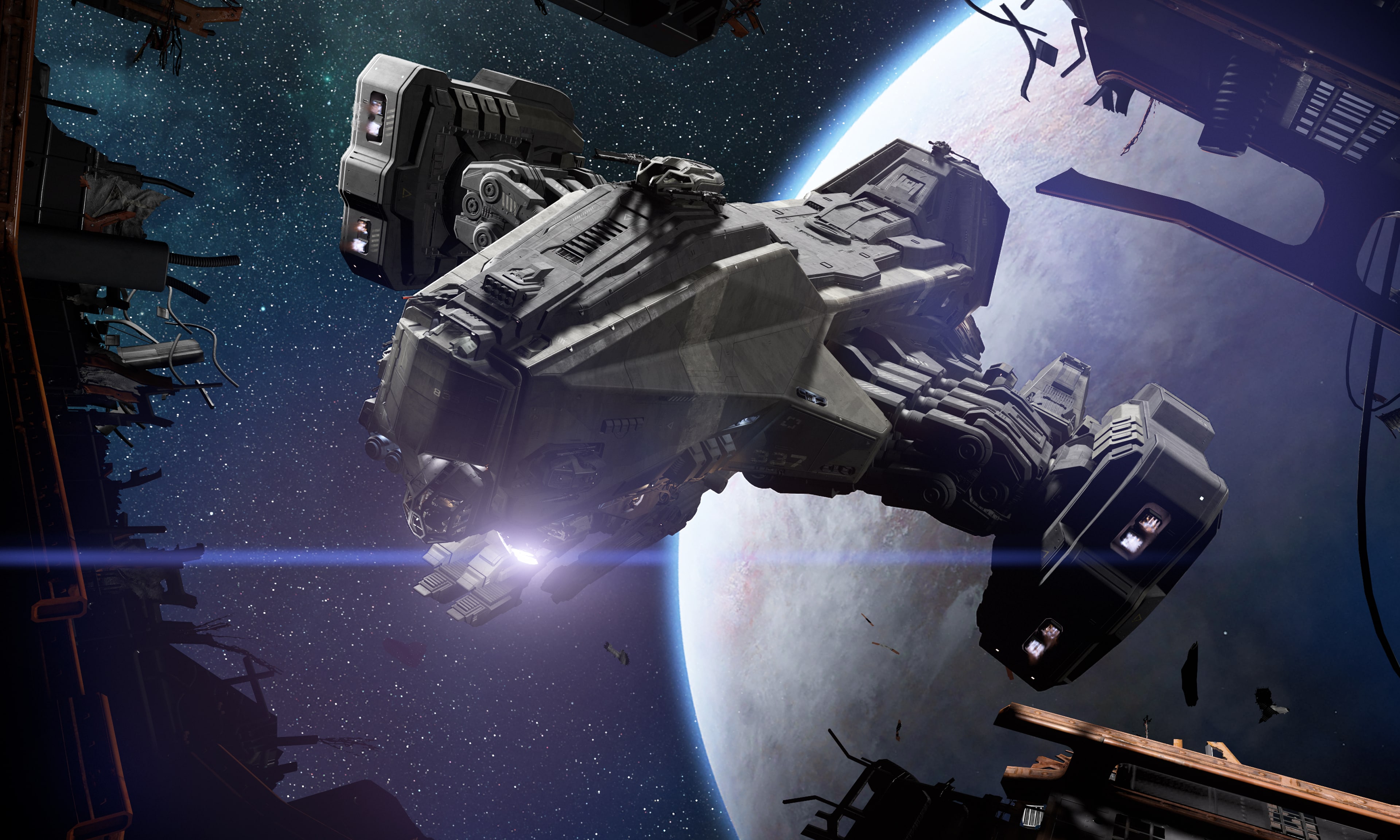
The new armored landing craft, officially designated a heavy dropship, would carry both the sophisticated defenses of a dropship while still maintaining some of the size and deployment capabilities of a starlifter. An array of twenty sophisticated g-couches would keep individual soldiers harnessed during the ride to the surface (landing injuries being another problem with more disposable landing craft) and VTOL thrusters would allow the ship to land and quickly deploy troops and equipment on rough terrain no larger than the ship’s own base (plus area to deploy a vehicle if needed). The spacecraft’s name, Valkyrie, was chosen early on as a tribute to a UEEN pilot who flew under the same callsign who had recently been killed on a reconnaissance mission that identified a Vanduul destroyer (though Anvil’s marketing team would eventually promote it as referring to the ship’s ability to carry soldiers screaming into battle like the Valkyries of myth).
The design process quickly resulted in a prototype and then a production prototype, all before the idea was ever presented to the military. Anvil opted to keep the test program completely secret, leading to a series of leaked photographs that aerospace watchers incorrectly theorized might be proof that the company was developing another deep space fighter in the style of the Vanguard. It is impossible to know whether similar UEE analyses generated an identical future prediction or if Anvil happened upon an incredibly lucky coincidence, but in 2810 a joint request of the UEE Army and Navy requested a heavy dropship capable of deploying larger combat teams quickly. Anvil was able to present the Valkyrie with its testing complete, already flying, and ready for production. A modified no-bid contract quickly followed and Anvil’s factories began turning out the first military model for active service in 2812.
CIVILIAN DEVELOPMENT
Although the Valkyrie has not yet been used for a mass invasion, the design has already repeatedly proven itself in combat in frontier regions. After-action reports specifically praise the ability to immediately deploy an armored vehicle, itself a great improvement over smaller gunships. The ship has become a favorite of UEEN ground pilots and is considered the “best way to travel” by soldiers deploying into hostile situations. Military orders from the design have increased each quarter and, if the long-term computer analysis is any indication, Anvil expects to almost double production of the Valkyrie each year for the foreseeable future. To this end, the company has made investments on no fewer than five worlds to add additional factory capacity for producing Valkyries in greater numbers. If a future massed planetary assault occurs, it will be even more of a windfall for Anvil stockholders.
In 2948, Anvil expanded the Valkyrie line with the not-unexpected addition of a civilian variant. Since the Valkyrie was not developed using government funds, the company was free to adapt it for the civilian market more quickly than previous designs like the Hornet. The civilian conversion team found the design process especially quick, with only limited fittings intended for specific UEEA equipment needing to be removed due to classification. The civilian Valkyrie is otherwise indistinguishable from the military equivalent and is even produced on the same factory floor.
Civilian Valkyries are now operated by local militia and police units on frontier worlds where deploying heavier weapons across great distances is especially important. The design has also found unexpected favor with prospectors and other explorers who have found great use of the ship’s ability to maintain and deploy a ground vehicle on rough terrain with a small footprint. Individual explorers can set down a Valkyrie at one claim site, dispatch a buggy or a small crew of workers and then jump ahead to another location. The process has greatly sped up mining surveys on some worlds by allowing a single work team to cover three to five sites at once. Anvil’s forecasters are keen to see if further uses develop in the asteroid mining or the science-support disciplines.
Dieser Artikel erschien ursprünglich in Jump Point 7.5.
Anvil Valkyrie
ENTWICKLUNGSGESCHICHTE
Im Frühjahr 2802 buchte eine Delegation von Ingenieuren, Theoretikern und Informatikern, die für Anvil Aerospace arbeiteten, drei Wochen Supercomputerzeit im Levindosk-Institut auf Terra. Zu diesem Zeitpunkt hatte Anvil seine Position als führendes Raumfahrtunternehmen sowohl für Waffen im Auftrag des Militärs als auch für private Kampfraumschiffe längst gefestigt. Ausgestattet mit einer großen Kriegskasse, die dem Erfolg der zivilen F7C Hornet zu verdanken war, war Anvil bereit und willens, in spekulativere Produkte zu investieren, anstatt weitere Regierungsaufträge für den heimischen Gebrauch anzupassen. Doch bevor das geschehen konnte, wollten die langfristigen Planer des Unternehmens eine schwierige Frage beantworten: Wie geht es weiter? Das Team, das nach Levindosk geschickt wurde, hatte einen faszinierenden Vorschlag, wie diese Frage zu beantworten sei. Sie würden eine groß angelegte Wargaming-Simulation durchführen, die es ihnen hoffentlich ermöglichen würde, den zukünftigen Fahrzeugbedarf des Vereinigten Imperiums der Erde vorherzusagen, anstatt auf zukünftige Vertragsangebote zu warten.
Computer-Wargaming ist keineswegs eine radikale Erfindung; seit Jahrtausenden versuchen die Menschen mit Hilfe fortschrittlicher Computer, künftige Trends vorherzusagen, und solche Geräte gibt es seit Generationen mit unterschiedlichem Erfolg. Das UEE-Militär betreibt sogar ständig elektronisches Wargaming und setzt dabei noch leistungsfähigere Technologien ein als die, die zivilen Forschern zur Verfügung stehen. Es ist jedoch äußerst selten, dass solche Analysen jemals freigegeben werden, und wenn, dann beziehen sie sich in der Regel auf vergangene Ereignisse, die für den zivilen Luft- und Raumfahrtsektor nur von geringem Wert sind. Außerdem beziehen sich die selten verfügbaren UEE-Wargaming-Ergebnisse meist auf Worst-Case-Szenarien und werden der Öffentlichkeit als Propaganda angeboten. Die Führungskräfte von Anvil waren an einem anderen Ansatz interessiert und entwickelten nur solche Szenarien, in denen das Tagesgeschäft weiterläuft.
Das Anvil-Team, das in Levindosk eintraf, hatte sich sieben Jahre lang auf diesen Moment vorbereitet - mehr Zeit, als das Ingenieursteam letztendlich für die Entwicklung des Schiffes brauchte. Der Prozess beinhaltete eine massive Datensammlung und -organisation in einem Ausmaß, wie es in der Privatwirtschaft noch nie versucht wurde. Jahrzehntelang wurden Daten gesammelt und organisiert, die den Supercomputern helfen sollten, sich ein Bild vom aktuellen Zustand der UEE zu machen - von einfachen Volkszählungsstatistiken bis hin zu beobachteten Flottenbewegungen und Metriken zur Frequenznutzung. Das Ingenieurteam arbeitete unermüdlich daran, ein statistisches Porträt der UEE im Jahr 2802 zu erstellen, damit die Supercomputer brauchbare Ergebnisse verarbeiten konnten. Das unmittelbare Ergebnis, dessen genaue Untersuchung etwa achtunddreißig Monate in Anspruch nehmen würde, waren Tausende verschiedener möglicher Szenarien, die den Bedarf an bewaffneten Raumfahrzeugen in fünf, zehn, zwanzig und dreißig Jahren beeinflussen könnten. Anschließend wurden die Ergebnisse an einen geheimen Ort an Bord einer Flotte von Datenläufern gebracht, die von firmeneigenen Hornet-Begleitjägern geschützt wurden. Mit den Daten in der Hand machte sich ein zweites Team von Experten daran, diese Möglichkeiten mit zukünftigen Markttrends zu verbinden.
Als die Analysten von Anvil die Ergebnisse auswerteten, kamen sie schnell zu dem Schluss, dass der Vanduul-Konflikt und künftige Kriege schnellere, wendigere und leistungsfähigere Raumschiffe an vorderster Front erfordern würden. Stattdessen konzentrierten sie sich auf die Aufgaben von Unterstützungsschiffen: Was könnte die nächste Schmelztiegel sein? Obwohl die meisten Ergebnisse der Gruppe geheim bleiben, wurde in Interviews bekannt gegeben, dass ihre erste Erkenntnis war, dass jedes zukünftige Szenario, das eine Niederlage der Vanduul zur Folge hätte, eine deutliche Verbesserung der Landungsschiffe erfordern würde. Sollte das Imperium beispielsweise versuchen, Systeme wie Orion und Virgil zurückzuerobern, könnte ein von Anvil entwickeltes Truppenschiff leicht den Weg weisen. Sowohl die Technologie hinter den Schiffen als auch die Möglichkeit, sie für künftige amphibische Operationen in großem Maßstab zu produzieren, waren es also wert, untersucht zu werden.
FRÜHE ENTWICKLUNG
Vor der Einführung der Valkyrie gab es zwei Arten von amphibischen Angriffsschiffen: kleinere, teurere Absetzschiffe, die für den Einsatz einzelner Trupps bei speziellen Operationen gedacht waren, und größere, entbehrlichere Raumschiffe, die für den Einsatz ganzer Kompanien oder mechanisierter Artillerieeinheiten konzipiert waren. Das Konstruktionsteam der Valkyrie wollte den Unterschied in der Mitte aufteilen, indem es ein serienmäßig hergestelltes Raumschiff entwickelte, das sowohl einen Trupp Soldaten als auch ein gepanzertes Unterstützungsfahrzeug transportieren kann. Die Supercomputer-Vorhersagen von Anvil legten nahe, dass die Kriegsplaner für künftige Angriffe auf von Vanduul gehaltene Welten den traditionellen amphibischen Angriffsprozess überdenken müssten. Während in den letzten Jahrhunderten der Kriegsführung gegen die Menschen in der Regel kleinere Angriffseinheiten mit der Drohung von Orbitalbombardements erfolgreich waren, wären für die theoretische Einnahme eines Vanduul-Planeten Massenangriffe mit zusätzlicher Feuerkraft erforderlich. Um diese Herausforderung zu meistern, versuchte das Team, den Unterschied zwischen dem Aegis Dynamics Redeemer, der für den Einsatz von Sondereinsatzteams verwendet wird, und den größeren Frachtern/Landungsschiffen, die für die logistische Unterstützung eingesetzt werden, auszugleichen.
Das neue gepanzerte Landungsschiff, das offiziell als "Heavy Dropship" bezeichnet wird, verfügt über die ausgefeilten Verteidigungssysteme eines Redeemer und hat gleichzeitig die Größe und Einsatzmöglichkeiten eines Starlifters. Eine Reihe von zwanzig hochentwickelten G-Couches würde die einzelnen Soldaten während der Fahrt zur Oberfläche festhalten (Landungsverletzungen sind ein weiteres Problem bei Einweg-Landebooten), und VTOL-Triebwerke würden es dem Schiff ermöglichen, zu landen und Truppen und Ausrüstung auf unwegsamem Gelände, das nicht größer als die eigene Basis ist, schnell zu verlegen (plus Platz, um bei Bedarf ein Fahrzeug zu verlegen). Der Name des Raumschiffs, Valkyrie, wurde schon früh als Hommage an einen UEEN-Piloten gewählt, der unter demselben Rufzeichen flog und kürzlich bei einer Aufklärungsmission getötet wurde, bei der ein Vanduul-Zerstörer identifiziert wurde (obwohl das Marketingteam von Anvil den Namen später als Hinweis auf die Fähigkeit des Schiffes, Soldaten schreiend in die Schlacht zu tragen, wie die Walküren aus der Sage, bewarb).
Der Entwurfsprozess führte schnell zu einem Prototyp und dann zu einem Produktionsprototyp, bevor die Idee überhaupt dem Militär vorgestellt wurde. Anvil entschied sich, das Testprogramm völlig geheim zu halten, was zu einer Reihe von durchgesickerten Fotos führte, die Beobachter der Luft- und Raumfahrt fälschlicherweise als Beweis dafür ansahen, dass das Unternehmen einen weiteren Weltraumjäger im Stil der Vanguard entwickelte. Es ist unmöglich zu wissen, ob ähnliche UEE-Analysen zu einer identischen Zukunftsprognose führten oder ob Anvil auf einen unglaublich glücklichen Zufall stieß, aber im Jahr 2810 wurde in einer gemeinsamen Anfrage der UEE-Armee und -Marine ein schweres Abwurfschiff gefordert, das in der Lage war, größere Kampftruppen schnell zu verlegen. Anvil konnte die Walküre präsentieren, deren Tests abgeschlossen waren, die bereits flog und bereit für die Produktion war. Es folgte ein modifizierter No-Bid-Vertrag und Anvils Fabriken begannen im Jahr 2812 mit der Produktion des ersten Militärmodells für den aktiven Dienst.
ZIVILE ENTWICKLUNG
Obwohl die Valkyrie noch nicht für eine Masseninvasion eingesetzt wurde, hat sich die Konstruktion bereits mehrfach im Kampf in Grenzregionen bewährt. In Berichten nach dem Einsatz wird besonders die Fähigkeit gelobt, sofort ein gepanzertes Fahrzeug einzusetzen, was eine große Verbesserung gegenüber kleineren Kampfschiffen darstellt. Das Schiff ist zu einem Favoriten der UEEN-Bodenpiloten geworden und wird von Soldaten, die in feindlichen Situationen eingesetzt werden, als die "beste Art zu reisen" angesehen. Die militärischen Aufträge für die Konstruktion haben von Quartal zu Quartal zugenommen, und wenn die langfristige Computeranalyse stimmt, rechnet Anvil damit, die Produktion der Valkyrie in absehbarer Zeit jedes Jahr fast zu verdoppeln. Zu diesem Zweck hat das Unternehmen auf nicht weniger als fünf Welten Investitionen getätigt, um zusätzliche Fabrikkapazitäten für die Produktion von Walküren in größerer Zahl zu schaffen. Sollte es in Zukunft zu einem Massenangriff auf einen Planeten kommen, wird das für die Anvil-Aktionäre ein noch größerer Gewinn sein.
Im Jahr 2948 erweiterte Anvil die Walküre-Reihe um eine zivile Variante, die nicht unerwartet kam. Da die Valkyrie nicht mit Regierungsgeldern entwickelt wurde, konnte das Unternehmen sie schneller für den zivilen Markt umbauen als frühere Modelle wie die Hornet. Das zivile Umrüstungsteam fand den Entwurfsprozess besonders schnell, da nur wenige Ausrüstungsgegenstände, die für spezielle UEEA-Ausrüstung vorgesehen waren, aufgrund der Klassifizierung entfernt werden mussten. Die zivile Walküre ist ansonsten nicht von ihrem militärischen Pendant zu unterscheiden und wird sogar in der gleichen Fabrikhalle hergestellt.
Zivile Walküren werden heute von lokalen Miliz- und Polizeieinheiten auf Grenzwelten eingesetzt, wo der Einsatz schwerer Waffen über große Entfernungen besonders wichtig ist. Das Design hat auch unerwarteten Anklang bei Goldsuchern und anderen Entdeckern gefunden, die die Fähigkeit des Schiffes, ein Bodenfahrzeug auf unwegsamem Gelände mit geringem Platzbedarf zu warten und einzusetzen, sehr zu schätzen wissen. Einzelne Schürfer können eine Walküre an einem Claim absetzen, einen Buggy oder eine kleine Mannschaft von Arbeitern losschicken und dann zu einem anderen Ort weiterfahren. Dieses Verfahren hat die Erkundung von Bergbaugebieten auf einigen Welten erheblich beschleunigt, da ein einziges Arbeitsteam drei bis fünf Standorte auf einmal abdecken kann. Die Prognostiker von Anvil sind gespannt, ob sich weitere Einsatzmöglichkeiten im Asteroidenabbau oder in der wissenschaftlichen Unterstützung ergeben.
This article originally appeared in Jump Point 7.5.
Anvil Valkyrie
DEVELOPMENT HISTORY
In early spring 2807, a delegation of engineers, theoreticians, and computer scientists working for Anvil Aerospace booked three weeks of supercomputer array time at the Levindosk Institute on Terra. By this point, Anvil had long-secured its position as the go-to aerospace corporation for both military-contracted weaponry and private combat spacecraft. Equipped with a large war chest owed to the success of the F7A Hornet launch, Anvil was ready and willing to invest in speculative products rather than adapting government contracts for domestic use. But before that could happen, the company’s long-term planners were eager to answer a difficult question: what next? The team dispatched to Levindosk had an intriguing proposal for how to answer this question. They would conduct a large-scale wargaming simulation that would hopefully allow them to predict the United Empire of Earth’s future vehicular needs rather than wait for future contracts to be offered.
Computer wargaming is by no means a radical invention; humans have been using advanced computers to attempt to predict future trends for the entire millennia and such devices have existed with varying degrees of success across generations. Indeed, the UEE military conducts electronic wargaming continually using even more powerful technology than those available to civilian researchers. However, it is exceedingly rare that such analyses are ever declassified and, when they are, they tend to concern past events of very little value to the civilian aerospace sector. Additionally, the rarely available UEE wargaming results are largely concerned with worst case scenarios and are offered to the public as propaganda. Anvil’s executives were interested in a different approach, developing only those scenarios in which day-to-day business continues.
The Anvil team that arrived at Levindosk had been preparing for the moment for seven years, more time than it would ultimately take the engineering team to develop the resulting ship. The process involved massive data gathering and organization on a scale not previously attempted in the private sector. Decades of data that could help the supercomputers imagine the current state of the UEE had been collected and organized, ranging from simple census statistics to observed fleet movements and spectrum usage metrics. The engineering team worked tirelessly to create a statistical portrait of the UEE in 2802 to allow the supercomputers to process viable outcomes. The immediate result, which would take some thirty-eight months to properly examine, was thousands of different possible scenarios that might impact the need for armed spacecraft in five, ten, twenty, and thirty years. Next, the results were moved to an undisclosed location aboard a fleet of data runners protected by corporate-owned Hornet escort fighters. The data in hand, a second team of expert analysts settled in for the long-haul of connecting these possibilities to future market trends.
As Anvil’s analysts processed the results, they were quick to move past the obvious findings that the Vanduul conflict and future wars would require faster, more maneuverable, and more powerful frontline spacecraft. Instead, they focused on roles for support craft; what might be the next Crucible? Although most of the group’s findings remain proprietary, interviews have since made it a matter of public record that their first realization was that every future scenario involving a Vanduul defeat would require a significant advancement in landing craft. For example, should the Empire move to retake systems like Orion and Virgil, an Anvil-designed troopship solution could easily lead the way. So, both the technology behind the ships and the ability to mass produce them for future large-scale amphibious operation were certainly worth investigating.
EARLY DEVELOPMENT
Prior to the introduction of the Valkyrie, Human amphibious assault craft were divided into two types: smaller, more expensive dropships intended to deploy individual squads for specialized operations and larger, more expendable spacecraft designed to deploy entire companies or mechanized artillery units. The Valkyrie’s design team aimed to split the difference down the middle by creating a mass-produced spacecraft capable of transporting both a platoon of soldiers and an armored support vehicle. Anvil’s supercomputer predictions suggested that future war planners would need to rethink the traditional amphibious assault process for future attacks on Vanduul-held worlds. While smaller strike units backed with the threat of orbital bombardment have typically been effective in recent centuries of warfare fought against Humans, mass attacks with additional firepower would be needed for the theoretical taking of a Vanduul planet. To address this challenge, the team attempted to make up the difference between ships used to insert special operations teams and the larger freighters/landing craft used for logistical support.
The new armored landing craft, officially designated a heavy dropship, would carry both the sophisticated defenses of a dropship while still maintaining some of the size and deployment capabilities of a starlifter. An array of twenty sophisticated g-couches would keep individual soldiers harnessed during the ride to the surface (landing injuries being another problem with more disposable landing craft) and VTOL thrusters would allow the ship to land and quickly deploy troops and equipment on rough terrain no larger than the ship’s own base (plus area to deploy a vehicle if needed). The spacecraft’s name, Valkyrie, was chosen early on as a tribute to a UEEN pilot who flew under the same callsign who had recently been killed on a reconnaissance mission that identified a Vanduul destroyer (though Anvil’s marketing team would eventually promote it as referring to the ship’s ability to carry soldiers screaming into battle like the Valkyries of myth).
The design process quickly resulted in a prototype and then a production prototype, all before the idea was ever presented to the military. Anvil opted to keep the test program completely secret, leading to a series of leaked photographs that aerospace watchers incorrectly theorized might be proof that the company was developing another deep space fighter in the style of the Vanguard. It is impossible to know whether similar UEE analyses generated an identical future prediction or if Anvil happened upon an incredibly lucky coincidence, but in 2810 a joint request of the UEE Army and Navy requested a heavy dropship capable of deploying larger combat teams quickly. Anvil was able to present the Valkyrie with its testing complete, already flying, and ready for production. A modified no-bid contract quickly followed and Anvil’s factories began turning out the first military model for active service in 2812.
CIVILIAN DEVELOPMENT
Although the Valkyrie has not yet been used for a mass invasion, the design has already repeatedly proven itself in combat in frontier regions. After-action reports specifically praise the ability to immediately deploy an armored vehicle, itself a great improvement over smaller gunships. The ship has become a favorite of UEEN ground pilots and is considered the “best way to travel” by soldiers deploying into hostile situations. Military orders from the design have increased each quarter and, if the long-term computer analysis is any indication, Anvil expects to almost double production of the Valkyrie each year for the foreseeable future. To this end, the company has made investments on no fewer than five worlds to add additional factory capacity for producing Valkyries in greater numbers. If a future massed planetary assault occurs, it will be even more of a windfall for Anvil stockholders.
In 2948, Anvil expanded the Valkyrie line with the not-unexpected addition of a civilian variant. Since the Valkyrie was not developed using government funds, the company was free to adapt it for the civilian market more quickly than previous designs like the Hornet. The civilian conversion team found the design process especially quick, with only limited fittings intended for specific UEEA equipment needing to be removed due to classification. The civilian Valkyrie is otherwise indistinguishable from the military equivalent and is even produced on the same factory floor.
Civilian Valkyries are now operated by local militia and police units on frontier worlds where deploying heavier weapons across great distances is especially important. The design has also found unexpected favor with prospectors and other explorers who have found great use of the ship’s ability to maintain and deploy a ground vehicle on rough terrain with a small footprint. Individual explorers can set down a Valkyrie at one claim site, dispatch a buggy or a small crew of workers and then jump ahead to another location. The process has greatly sped up mining surveys on some worlds by allowing a single work team to cover three to five sites at once. Anvil’s forecasters are keen to see if further uses develop in the asteroid mining or the science-support disciplines.
This article originally appeared in Jump Point 7.5.
Anvil Valkyrie
DEVELOPMENT HISTORY
In early spring 2807, a delegation of engineers, theoreticians, and computer scientists working for Anvil Aerospace booked three weeks of supercomputer array time at the Levindosk Institute on Terra. By this point, Anvil had long-secured its position as the go-to aerospace corporation for both military-contracted weaponry and private combat spacecraft. Equipped with a large war chest owed to the success of the F7A Hornet launch, Anvil was ready and willing to invest in speculative products rather than adapting government contracts for domestic use. But before that could happen, the company’s long-term planners were eager to answer a difficult question: what next? The team dispatched to Levindosk had an intriguing proposal for how to answer this question. They would conduct a large-scale wargaming simulation that would hopefully allow them to predict the United Empire of Earth’s future vehicular needs rather than wait for future contracts to be offered.
Computer wargaming is by no means a radical invention; humans have been using advanced computers to attempt to predict future trends for the entire millennia and such devices have existed with varying degrees of success across generations. Indeed, the UEE military conducts electronic wargaming continually using even more powerful technology than those available to civilian researchers. However, it is exceedingly rare that such analyses are ever declassified and, when they are, they tend to concern past events of very little value to the civilian aerospace sector. Additionally, the rarely available UEE wargaming results are largely concerned with worst case scenarios and are offered to the public as propaganda. Anvil’s executives were interested in a different approach, developing only those scenarios in which day-to-day business continues.
The Anvil team that arrived at Levindosk had been preparing for the moment for seven years, more time than it would ultimately take the engineering team to develop the resulting ship. The process involved massive data gathering and organization on a scale not previously attempted in the private sector. Decades of data that could help the supercomputers imagine the current state of the UEE had been collected and organized, ranging from simple census statistics to observed fleet movements and spectrum usage metrics. The engineering team worked tirelessly to create a statistical portrait of the UEE in 2802 to allow the supercomputers to process viable outcomes. The immediate result, which would take some thirty-eight months to properly examine, was thousands of different possible scenarios that might impact the need for armed spacecraft in five, ten, twenty, and thirty years. Next, the results were moved to an undisclosed location aboard a fleet of data runners protected by corporate-owned Hornet escort fighters. The data in hand, a second team of expert analysts settled in for the long-haul of connecting these possibilities to future market trends.
As Anvil’s analysts processed the results, they were quick to move past the obvious findings that the Vanduul conflict and future wars would require faster, more maneuverable, and more powerful frontline spacecraft. Instead, they focused on roles for support craft; what might be the next Crucible? Although most of the group’s findings remain proprietary, interviews have since made it a matter of public record that their first realization was that every future scenario involving a Vanduul defeat would require a significant advancement in landing craft. For example, should the Empire move to retake systems like Orion and Virgil, an Anvil-designed troopship solution could easily lead the way. So, both the technology behind the ships and the ability to mass produce them for future large-scale amphibious operation were certainly worth investigating.
EARLY DEVELOPMENT
Prior to the introduction of the Valkyrie, Human amphibious assault craft were divided into two types: smaller, more expensive dropships intended to deploy individual squads for specialized operations and larger, more expendable spacecraft designed to deploy entire companies or mechanized artillery units. The Valkyrie’s design team aimed to split the difference down the middle by creating a mass-produced spacecraft capable of transporting both a platoon of soldiers and an armored support vehicle. Anvil’s supercomputer predictions suggested that future war planners would need to rethink the traditional amphibious assault process for future attacks on Vanduul-held worlds. While smaller strike units backed with the threat of orbital bombardment have typically been effective in recent centuries of warfare fought against Humans, mass attacks with additional firepower would be needed for the theoretical taking of a Vanduul planet. To address this challenge, the team attempted to make up the difference between ships used to insert special operations teams and the larger freighters/landing craft used for logistical support.
The new armored landing craft, officially designated a heavy dropship, would carry both the sophisticated defenses of a dropship while still maintaining some of the size and deployment capabilities of a starlifter. An array of twenty sophisticated g-couches would keep individual soldiers harnessed during the ride to the surface (landing injuries being another problem with more disposable landing craft) and VTOL thrusters would allow the ship to land and quickly deploy troops and equipment on rough terrain no larger than the ship’s own base (plus area to deploy a vehicle if needed). The spacecraft’s name, Valkyrie, was chosen early on as a tribute to a UEEN pilot who flew under the same callsign who had recently been killed on a reconnaissance mission that identified a Vanduul destroyer (though Anvil’s marketing team would eventually promote it as referring to the ship’s ability to carry soldiers screaming into battle like the Valkyries of myth).
The design process quickly resulted in a prototype and then a production prototype, all before the idea was ever presented to the military. Anvil opted to keep the test program completely secret, leading to a series of leaked photographs that aerospace watchers incorrectly theorized might be proof that the company was developing another deep space fighter in the style of the Vanguard. It is impossible to know whether similar UEE analyses generated an identical future prediction or if Anvil happened upon an incredibly lucky coincidence, but in 2810 a joint request of the UEE Army and Navy requested a heavy dropship capable of deploying larger combat teams quickly. Anvil was able to present the Valkyrie with its testing complete, already flying, and ready for production. A modified no-bid contract quickly followed and Anvil’s factories began turning out the first military model for active service in 2812.
CIVILIAN DEVELOPMENT
Although the Valkyrie has not yet been used for a mass invasion, the design has already repeatedly proven itself in combat in frontier regions. After-action reports specifically praise the ability to immediately deploy an armored vehicle, itself a great improvement over smaller gunships. The ship has become a favorite of UEEN ground pilots and is considered the “best way to travel” by soldiers deploying into hostile situations. Military orders from the design have increased each quarter and, if the long-term computer analysis is any indication, Anvil expects to almost double production of the Valkyrie each year for the foreseeable future. To this end, the company has made investments on no fewer than five worlds to add additional factory capacity for producing Valkyries in greater numbers. If a future massed planetary assault occurs, it will be even more of a windfall for Anvil stockholders.
In 2948, Anvil expanded the Valkyrie line with the not-unexpected addition of a civilian variant. Since the Valkyrie was not developed using government funds, the company was free to adapt it for the civilian market more quickly than previous designs like the Hornet. The civilian conversion team found the design process especially quick, with only limited fittings intended for specific UEEA equipment needing to be removed due to classification. The civilian Valkyrie is otherwise indistinguishable from the military equivalent and is even produced on the same factory floor.
Civilian Valkyries are now operated by local militia and police units on frontier worlds where deploying heavier weapons across great distances is especially important. The design has also found unexpected favor with prospectors and other explorers who have found great use of the ship’s ability to maintain and deploy a ground vehicle on rough terrain with a small footprint. Individual explorers can set down a Valkyrie at one claim site, dispatch a buggy or a small crew of workers and then jump ahead to another location. The process has greatly sped up mining surveys on some worlds by allowing a single work team to cover three to five sites at once. Anvil’s forecasters are keen to see if further uses develop in the asteroid mining or the science-support disciplines.
Links
No links available.


Metadata
- CIG ID
- 19787
- Channel
- Spectrum Dispatch
- Category
- Undefined
- Series
- News Update
- Comments
- 33
- Published
- 2 years ago (2024-02-13T00:00:00+00:00)