News Update: AI Pilots
Spectrum Dispatch Undefined News UpdateContent
SHOWDOWN!
Auto-Transcript for S&P and NFSC Submission
EP: 54:16 : “Guiding Light”
ERIA QUINT: Hello and welcome to another dynamic episode of ShowDown! I’m your host, Eria Quint. On April 12th of this year, the mining and shipping consortium ArcCorp announced that they are going to field-test their first AI-piloted cargo vessel on the infamous Earth-Pinecone run. Public reaction to the news has been mixed at best. Some applaud this as a natural, next step in flight mechanics, while others decry the company for depriving thousands of their jobs in the midst of tough economic times.
We have two very special guests joining us to hash out this debate. The first is the host of the very popular shipping broadcast, Clean Shot, Mr. Craig Burton.
CRAIG BURTON: Hi there.
ERIA QUINT: The second is Dr. Yusef Phan, Chief Programming Executive at BabbageCorp and one of the architects of the avionic system that was ultimately used as part of ArcCorp’s proprietary AI-flight system. Welcome, doctor.
DR. YUSEF PHAN: Glad to be here. Thank you for having me.
ERIA QUINT: So Craig, ever since ArcCorp’s announcement, you’ve been quite critical of the entire concept.
CRAIG BURTON: Guess that’s a polite way to put it.
ERIA QUINT: How would you put it?
CRAIG BURTON: I think it’s a travesty to the good men and women who risk their lives transporting goods.
DR. YUSEF PHAN: I would think this system would address precisely that. Save them from risking their lives. It’s dangerous out there.
CRAIG BURTON: Damn right it is. Point is, no damn system’s ever gonna be as good as an experienced pilot.
DR. YUSEF PHAN: Initially maybe but these are adaptive programs, capable of learning and growing as they continue to fly missions.
CRAIG BURTON: Tell me something, you think it’ll ever be able to tell when it’s about to be ambushed?
DR. YUSEF PHAN: I’m sure scanning a vessel to see weapons and shields activate is a pretty good indication of malicious intent.
CRAIG BURTON: Yeah, how will it know that the malicious intent is directed at it or some other threat?
DR. YUSEF PHAN: I don’t know. You’re presenting a hypothetical situation that you alone know the parameters of.
CRAIG BURTON: My daddy used to tell me, “Son, it’s easy to be smart, ain’t easy to be wise.” The point is, you’re asking a computer to make a judgment call. Now I don’t care how smart it gets, it’s still gonna be making decisions on logic, and I think we all know, people ain’t that logical.
DR. YUSEF PHAN: Here’s what I do know. ArcCorp reported over three hundred million Credits in losses last cycle due to human error and compensation payouts to the families of pilots lost during pirate and Vanduul attacks.
CRAIG BURTON: Jeez, you sure you ain’t really a member of ArcCorp’s marketing team?
DR. YUSEF PHAN: Leaving the money aside for the moment, I would think that saving the lives of your fellow shippers might be worth the inconvenience of looking for work.
CRAIG BURTON: Don’t try and twist it. My heart breaks every time I hear about some hauler getting blasted while on a run, but we all signed up for the job. Ain’t nobody ever spared us the risks. We took them in stride like we do everything else. Point is, your program is taking away the opportunity for us to provide for our families.
ERIA QUINT: I don’t think anyone’s disagreeing with the possibility of saving pilots’ lives on transport routes through dangerous space but let’s talk for a moment about the financial implications of this.
CRAIG BURTON: Corporate lifeblood, you mean.
ERIA QUINT: To offer his perspective on this matter, we’re joined by Economic Analyst Ryu Tarkovsky.
RYU TARKOVSKY: Hello.
ERIA QUINT: So let’s talk cost. You’ve offered a pretty comprehensive analysis of the possible cost risks and benefits of adopting a fleet of AI-controlled haulers.
CRAIG BURTON: There’s a horrible image.
RYU TARKOVSKY: Yes, Eria, that’s correct.
ERIA QUINT: What did you discover?
RYU TARKOVSKY: Humanity’s always had an aversion to the notion of AI. Particularly after the disastrous Artemis expedition —
DR. YUSEF PHAN: Technically, we don’t know if Janus was indeed responsible for that.
RYU TARKOVSKY: Regardless, the public seems to like it in theory, but actual application seems to be a different matter. Anthropologists theorize that there’s an innate part of our being that needs to control. Hence why flight computers are designed to assist the pilot, handling the complex mathematics necessarily to fly, as opposed to deferring control to the system.
CRAIG BURTON: It’s also boring as hell. I mean, why wouldn’t you want to fly it yourself if you had the choice?
DR. YUSEF PHAN: Oh I don’t know, maximizing fuel efficiency, operating with reflexes that are significantly higher than your own …
ERIA QUINT: Gentlemen, please. Continue, Mr. Tarkovsky.
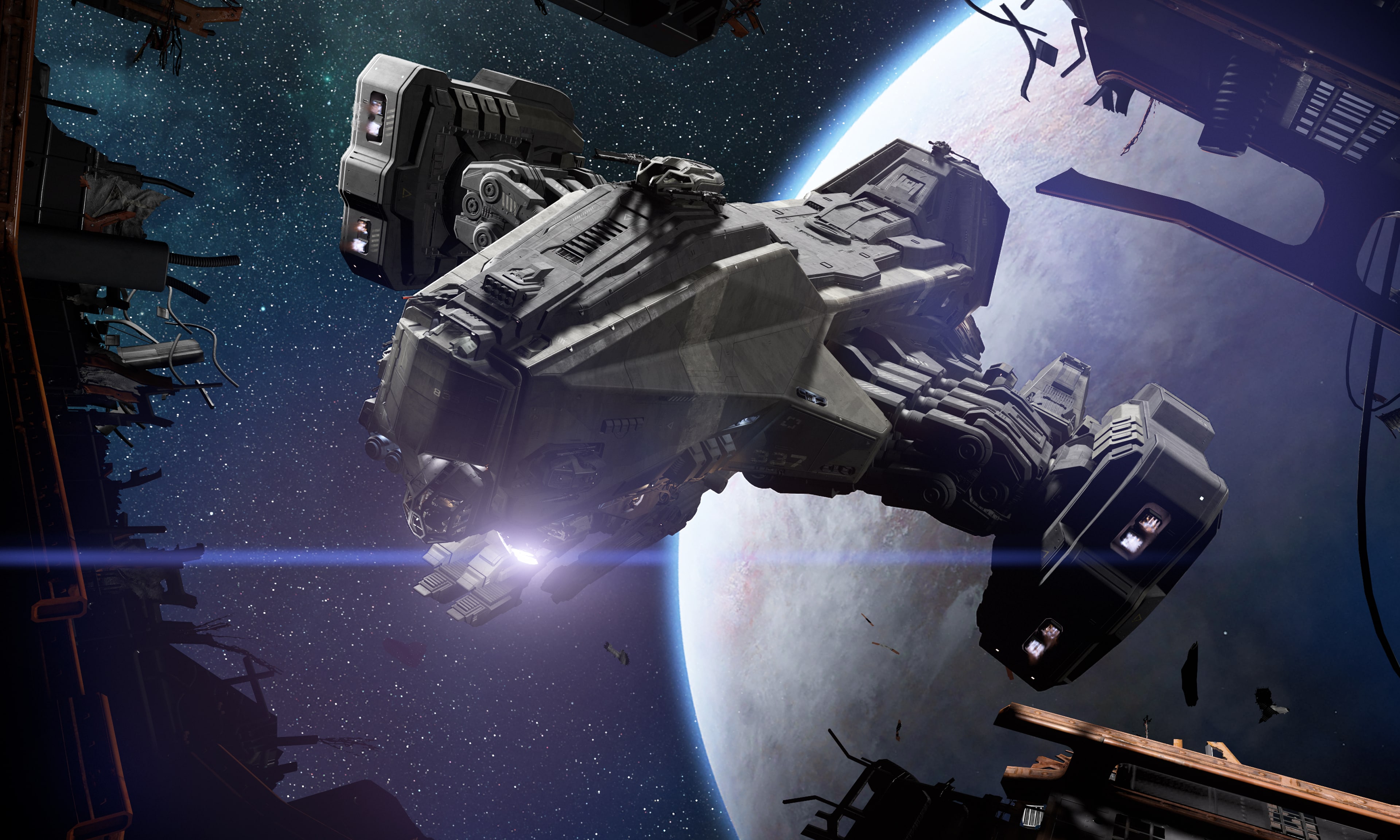
RYU TARKOVSKY: So the first hurdle would be their customers embracing the concept of AI in common use. Financially speaking, it could be a worthy investment in the long run. The first vessel is apparently a modified Caterpillar but ultimately, if they chose to spend the Credits, they could design a brand new type of ship that wouldn’t need to be designed with life support functions in mind, thus eliminating many systems and increasing the cargo capacity, thereby increasing the money generated per run.
Unfortunately, this initial phase will be their costliest. As Dr. Phan said, these are learning systems. Every systems engineer I’ve spoken to anticipates a small percentage of ships will cause some very costly accidents, accidents that could have been easily avoided by having a human pilot who could ‘read the circumstances’ if you will.
The situation will effectively become a financial game of Dead Man’s Bluff: can ArcCorp weather the financial drain of accidents and lost cargo long enough for the AI to learn enough to stop making those mistakes?
DR. YUSEF PHAN: If I may interject, Mr. Tarkovsky, you’re assuming that the AIs aren’t going to be able to learn from each other. The programs will be constantly sending feeds of their activities to relay stations, which will be funneled into a central hub then beamed back out to the drone pilots. So all will learn from each other’s mistakes and successes.
CRAIG BURTON: Right, well, Comm traffic ain’t exactly reliable on a good day …
DR. YUSEF PHAN: ArcCorp has already announced that they plan to include human pilots to act as ‘monitors’ while the AI system is vetted and learning. So I think your concerns are a little unfounded, Mr. Burton.
CRAIG BURTON: Right, well, the first time a 200,000 Kg tanker ship crashes headlong into an Orbital because it didn’t get the correct update that the docking arm was under construction, I’m sure you’ll be singin’ a different tune.
DR. YUSEF PHAN: If you’re so distrusting of computer-controlled craft, Mr. Burton, why do you let your own computer take control when navigating a jump point?
CRAIG BURTON: That’s different. That’s no more advanced than playing back a recording through the ship’s controls, and we’ve been doing for more than 1000 years. So it ain’t an AI thing at all, really.
DR. YUSEF PHAN: It’s hypocritical is what it is.
ERIA QUINT: We’re going to take a quick break. When we get back, we’ll examine the legal ramifications of AI-piloted craft; in the past, pilots are partially liable for damage; now would it be solely the Corp or would the AI programming also be held accountable? You won’t want to miss it. So reload your guns and get ready for another ShowDown!
TRANSCRIPT BREAK
SHOWDOWN!
Automatische Übertragung für S&P- und NFSC-Einreichungen
EP: 54:16 : " Leitendes Licht ".
ERIA QUINT: Hallo und willkommen zu einer weiteren dynamischen Episode von ShowDown! Ich bin dein Gastgeber, Eria Quint. Am 12. April dieses Jahres gab das Bergbau- und Schifffahrtskonsortium ArcCorp bekannt, dass sie ihren ersten KI-pilotierten Frachter auf der berüchtigten Earth-Pinecone Strecke im Feldtest testen werden. Die öffentliche Reaktion auf die Nachrichten war bestenfalls gemischt. Einige begrüßen dies als natürlichen, nächsten Schritt in der Flugmechanik, während andere das Unternehmen dafür kritisieren, dass es in schwierigen wirtschaftlichen Zeiten Tausende von Arbeitsplätzen entzogen hat.
Wir haben zwei ganz besondere Gäste, die uns begleiten, um diese Debatte zu vertiefen. Der erste ist der Gastgeber der sehr beliebten Schifffahrtssendung Clean Shot, Mr. Craig Burton.
CRAIG BURTON: Hallo.
ERIA QUINT: Der zweite ist Dr. Yusef Phan, Chief Programming Executive bei BabbageCorp und einer der Architekten des Avioniksystems, das letztlich als Teil des ArcCorp-eigenen KI-Flugsystems eingesetzt wurde. Willkommen, Doktor.
DR. YUSEF PHAN: Schön, hier zu sein. Danke, dass Sie mich haben.
ERIA QUINT: Also Craig, seit der Ankündigung von ArcCorp waren Sie ziemlich kritisch gegenüber dem gesamten Konzept.
CRAIG BURTON: Ich schätze, das ist eine höfliche Art, es auszudrücken.
ERIA QUINT: Wie würdest du es ausdrücken?
CRAIG BURTON: Ich denke, es ist eine Travestie für die guten Männer und Frauen, die ihr Leben riskieren, um Waren zu transportieren.
DR. YUSEF PHAN: Ich würde denken, dass dieses System genau das anspricht. Rette sie davor, ihr Leben zu riskieren. Es ist gefährlich da draußen.
CRAIG BURTON: Verdammt richtig, das ist es. Der Punkt ist, kein verdammtes System wird jemals so gut sein wie ein erfahrener Pilot.
DR. YUSEF PHAN: Zuerst vielleicht, aber das sind adaptive Programme, die lernen und wachsen können, während sie weiterhin Missionen fliegen.
CRAIG BURTON: Sag mir etwas, denkst du, es wird jemals in der Lage sein zu sagen, wann es in einen Hinterhalt geraten wird?
DR. YUSEF PHAN: Ich bin sicher, dass das Scannen eines Schiffes, um Waffen und Schilde zu sehen, die aktiviert werden, ein ziemlich gutes Zeichen für böswillige Absichten ist.
CRAIG BURTON: Ja, woher weiß sie, dass die bösartige Absicht auf sie oder eine andere Bedrohung gerichtet ist?
DR. YUSEF PHAN: Ich weiß nicht. Sie präsentieren eine hypothetische Situation, von der Sie allein die Parameter kennen.
CRAIG BURTON: Mein Vater sagte immer zu mir: "Sohn, es ist einfach, schlau zu sein, es ist nicht einfach, weise zu sein." Der Punkt ist, dass Sie einen Computer bitten, eine Entscheidung zu treffen. Jetzt ist es mir egal, wie klug es wird, es wird immer noch Entscheidungen über die Logik treffen, und ich denke, wir alle wissen, dass die Leute nicht so logisch sind.
DR. YUSEF PHAN: Hier ist, was ich weiß. ArcCorp berichtete über mehr als dreihundert Millionen Credits in Verlusten im letzten Zyklus aufgrund menschlicher Fehler und Entschädigungszahlungen an die Familien von Piloten, die bei Piraten- und Vanduul-Angriffen verloren gingen.
CRAIG BURTON: Mensch, bist du sicher, dass du nicht wirklich ein Mitglied des Marketing-Teams von ArcCorp bist?
DR. YUSEF PHAN: Wenn Sie das Geld für den Moment beiseite lassen, würde ich denken, dass die Rettung des Lebens Ihrer Verladekollegen die Unannehmlichkeiten der Arbeitssuche wert sein könnte.
CRAIG BURTON: Versuch nicht, es zu verdrehen. Mein Herz bricht jedes Mal, wenn ich höre, dass ein Schlepper auf der Flucht gesprengt wird, aber wir haben uns alle für den Job angemeldet. Niemand hat uns jemals die Risiken erspart. Wir haben sie in Schwung gebracht, so wie wir alles andere machen. Der Punkt ist, dass Ihr Programm uns die Möglichkeit nimmt, für unsere Familien zu sorgen.
ERIA QUINT: Ich glaube nicht, dass jemand mit der Möglichkeit, Pilotenleben auf Transportrouten durch gefährliche Räume zu retten, nicht einverstanden ist, aber lassen Sie uns einen Moment über die finanziellen Auswirkungen sprechen.
CRAIG BURTON: Firmen-Lebensblut, meinen Sie.
ERIA QUINT: Um seine Sichtweise in dieser Angelegenheit darzulegen, schließt sich uns der Wirtschaftsanalytiker Ryu Tarkovsky an.
RYU TARKOVSKY: Hallo.
ERIA QUINT: Also lassen Sie uns über die Kosten sprechen. Sie haben eine ziemlich umfassende Analyse der möglichen Kostenrisiken und -vorteile durch den Einsatz einer Flotte von KI-gesteuerten Schleppern angeboten.
CRAIG BURTON: Es gibt ein schreckliches Bild.
RYU TARKOVSKY: Ja, Eria, das ist richtig.
ERIA QUINT: Was hast du entdeckt?
RYU TARKOVSKY: Die Menschheit hatte immer eine Abneigung gegen den Begriff der KI. Besonders nach der verheerenden Artemis-Expedition -
DR. YUSEF PHAN: Technisch gesehen wissen wir nicht, ob Janus dafür verantwortlich war.
RYU TARKOVSKY: Unabhängig davon scheint es der Öffentlichkeit in der Theorie zu gefallen, aber die tatsächliche Anwendung scheint eine andere Sache zu sein. Anthropologen theoretisieren, dass es einen angeborenen Teil unseres Wesens gibt, der kontrolliert werden muss. Daher sind Flugcomputer so konzipiert, dass sie den Piloten unterstützen und die komplexe Mathematik beherrschen, die für das Fliegen notwendig ist, anstatt die Steuerung auf das System zu verschieben.
CRAIG BURTON: Es ist auch langweilig wie die Hölle. Ich meine, warum solltest du es nicht selbst fliegen wollen, wenn du die Wahl hättest?
DR. YUSEF PHAN: Oh, ich weiß nicht, Maximierung der Kraftstoffeffizienz, Betrieb mit Reflexen, die deutlich höher sind als die eigenen.....
ERIA QUINT: Meine Herren, bitte. Weiter, Mr. Tarkovsky.
RYU TARKOVSKY: Die erste Hürde wäre also, dass ihre Kunden das Konzept der KI im allgemeinen Gebrauch annehmen. Finanziell gesehen könnte es sich auf lange Sicht um eine lohnende Investition handeln. Das erste Schiff ist anscheinend eine modifizierte Caterpillar, aber letztendlich, wenn sie sich dafür entscheiden, die Credits auszugeben, könnten sie einen brandneuen Schiffstyp entwerfen, der nicht mit Blick auf die Lebenserhaltungsfunktionen entworfen werden müsste, wodurch viele Systeme eliminiert und die Ladekapazität erhöht würde, wodurch das pro Fahrt generierte Geld erhöht würde.
Leider wird diese Anfangsphase am kostspieligsten sein. Wie Dr. Phan sagte, sind dies Lernsysteme. Jeder Systemingenieur, mit dem ich gesprochen habe, geht davon aus, dass ein kleiner Prozentsatz der Schiffe einige sehr kostspielige Unfälle verursachen wird, Unfälle, die leicht zu vermeiden gewesen wären, wenn man einen menschlichen Piloten hätte, der die Umstände lesen könnte, wenn man so will.
Die Situation wird effektiv zu einem Finanzspiel von Dead Man's Bluff: Kann ArcCorp den finanziellen Abfluss von Unfällen und verlorener Ladung lange genug überstehen, damit die KI genug lernen kann, um diese Fehler zu stoppen?
DR. YUSEF PHAN: Wenn ich unterbrechen darf, Mr. Tarkovsky, gehen Sie davon aus, dass die KIs nicht in der Lage sein werden, voneinander zu lernen. Die Programme werden ständig Feeds ihrer Aktivitäten an Relaisstationen senden, die in eine zentrale Drehscheibe geleitet und dann an die Drohnenpiloten zurückbeamt werden. So werden alle aus den Fehlern und Erfolgen des anderen lernen.
CRAIG BURTON: Richtig, nun, der Comm-Verkehr ist an einem guten Tag nicht gerade zuverlässig....
DR. YUSEF PHAN: ArcCorp hat bereits angekündigt, dass sie menschliche Piloten als "Beobachter" einbeziehen wollen, während das KI-System überprüft wird und lernt. Also denke ich, dass Ihre Bedenken ein wenig unbegründet sind, Mr. Burton.
CRAIG BURTON: Richtig, nun, das erste Mal, wenn ein 200.000 kg Tanklastschiff kopfüber in einen Orbital stürzt, weil es nicht das richtige Update bekommen hat, dass der Andockarm im Bau war, bin ich sicher, dass Sie ein anderes Lied singen werden.
DR. YUSEF PHAN: Wenn Sie dem computergesteuerten Boot so misstrauen, Mr. Burton, warum lassen Sie Ihren eigenen Computer die Kontrolle übernehmen, wenn Sie einen Sprungpunkt steuern?
CRAIG BURTON: Das ist etwas anderes. Das ist nicht fortschrittlicher, als eine Aufnahme über die Schiffssteuerung wiederzugeben, und das seit mehr als 1000 Jahren. Also ist es überhaupt keine KI-Sache, wirklich.
DR. YUSEF PHAN: Es ist scheinheilig, was es ist.
ERIA QUINT: Wir machen eine kurze Pause. Wenn wir zurückkommen, werden wir die rechtlichen Auswirkungen von KI-geführten Schiffen untersuchen; in der Vergangenheit waren die Piloten teilweise für Schäden haftbar; jetzt wäre es allein das Corp oder würde auch die KI-Programmierung zur Verantwortung gezogen werden? Du wirst es nicht verpassen wollen. Also lade deine Waffen nach und mach dich bereit für einen weiteren ShowDown!
TRANSKRIPTUMBRUCH
SHOWDOWN!
Auto-Transcript for S&P and NFSC Submission
EP: 54:16 : “Guiding Light”
ERIA QUINT: Hello and welcome to another dynamic episode of ShowDown! I’m your host, Eria Quint. On April 12th of this year, the mining and shipping consortium ArcCorp announced that they are going to field-test their first AI-piloted cargo vessel on the infamous Earth-Pinecone run. Public reaction to the news has been mixed at best. Some applaud this as a natural, next step in flight mechanics, while others decry the company for depriving thousands of their jobs in the midst of tough economic times.
We have two very special guests joining us to hash out this debate. The first is the host of the very popular shipping broadcast, Clean Shot, Mr. Craig Burton.
CRAIG BURTON: Hi there.
ERIA QUINT: The second is Dr. Yusef Phan, Chief Programming Executive at BabbageCorp and one of the architects of the avionic system that was ultimately used as part of ArcCorp’s proprietary AI-flight system. Welcome, doctor.
DR. YUSEF PHAN: Glad to be here. Thank you for having me.
ERIA QUINT: So Craig, ever since ArcCorp’s announcement, you’ve been quite critical of the entire concept.
CRAIG BURTON: Guess that’s a polite way to put it.
ERIA QUINT: How would you put it?
CRAIG BURTON: I think it’s a travesty to the good men and women who risk their lives transporting goods.
DR. YUSEF PHAN: I would think this system would address precisely that. Save them from risking their lives. It’s dangerous out there.
CRAIG BURTON: Damn right it is. Point is, no damn system’s ever gonna be as good as an experienced pilot.
DR. YUSEF PHAN: Initially maybe but these are adaptive programs, capable of learning and growing as they continue to fly missions.
CRAIG BURTON: Tell me something, you think it’ll ever be able to tell when it’s about to be ambushed?
DR. YUSEF PHAN: I’m sure scanning a vessel to see weapons and shields activate is a pretty good indication of malicious intent.
CRAIG BURTON: Yeah, how will it know that the malicious intent is directed at it or some other threat?
DR. YUSEF PHAN: I don’t know. You’re presenting a hypothetical situation that you alone know the parameters of.
CRAIG BURTON: My daddy used to tell me, “Son, it’s easy to be smart, ain’t easy to be wise.” The point is, you’re asking a computer to make a judgment call. Now I don’t care how smart it gets, it’s still gonna be making decisions on logic, and I think we all know, people ain’t that logical.
DR. YUSEF PHAN: Here’s what I do know. ArcCorp reported over three hundred million Credits in losses last cycle due to human error and compensation payouts to the families of pilots lost during pirate and Vanduul attacks.
CRAIG BURTON: Jeez, you sure you ain’t really a member of ArcCorp’s marketing team?
DR. YUSEF PHAN: Leaving the money aside for the moment, I would think that saving the lives of your fellow shippers might be worth the inconvenience of looking for work.
CRAIG BURTON: Don’t try and twist it. My heart breaks every time I hear about some hauler getting blasted while on a run, but we all signed up for the job. Ain’t nobody ever spared us the risks. We took them in stride like we do everything else. Point is, your program is taking away the opportunity for us to provide for our families.
ERIA QUINT: I don’t think anyone’s disagreeing with the possibility of saving pilots’ lives on transport routes through dangerous space but let’s talk for a moment about the financial implications of this.
CRAIG BURTON: Corporate lifeblood, you mean.
ERIA QUINT: To offer his perspective on this matter, we’re joined by Economic Analyst Ryu Tarkovsky.
RYU TARKOVSKY: Hello.
ERIA QUINT: So let’s talk cost. You’ve offered a pretty comprehensive analysis of the possible cost risks and benefits of adopting a fleet of AI-controlled haulers.
CRAIG BURTON: There’s a horrible image.
RYU TARKOVSKY: Yes, Eria, that’s correct.
ERIA QUINT: What did you discover?
RYU TARKOVSKY: Humanity’s always had an aversion to the notion of AI. Particularly after the disastrous Artemis expedition —
DR. YUSEF PHAN: Technically, we don’t know if Janus was indeed responsible for that.
RYU TARKOVSKY: Regardless, the public seems to like it in theory, but actual application seems to be a different matter. Anthropologists theorize that there’s an innate part of our being that needs to control. Hence why flight computers are designed to assist the pilot, handling the complex mathematics necessarily to fly, as opposed to deferring control to the system.
CRAIG BURTON: It’s also boring as hell. I mean, why wouldn’t you want to fly it yourself if you had the choice?
DR. YUSEF PHAN: Oh I don’t know, maximizing fuel efficiency, operating with reflexes that are significantly higher than your own …
ERIA QUINT: Gentlemen, please. Continue, Mr. Tarkovsky.
RYU TARKOVSKY: So the first hurdle would be their customers embracing the concept of AI in common use. Financially speaking, it could be a worthy investment in the long run. The first vessel is apparently a modified Caterpillar but ultimately, if they chose to spend the Credits, they could design a brand new type of ship that wouldn’t need to be designed with life support functions in mind, thus eliminating many systems and increasing the cargo capacity, thereby increasing the money generated per run.
Unfortunately, this initial phase will be their costliest. As Dr. Phan said, these are learning systems. Every systems engineer I’ve spoken to anticipates a small percentage of ships will cause some very costly accidents, accidents that could have been easily avoided by having a human pilot who could ‘read the circumstances’ if you will.
The situation will effectively become a financial game of Dead Man’s Bluff: can ArcCorp weather the financial drain of accidents and lost cargo long enough for the AI to learn enough to stop making those mistakes?
DR. YUSEF PHAN: If I may interject, Mr. Tarkovsky, you’re assuming that the AIs aren’t going to be able to learn from each other. The programs will be constantly sending feeds of their activities to relay stations, which will be funneled into a central hub then beamed back out to the drone pilots. So all will learn from each other’s mistakes and successes.
CRAIG BURTON: Right, well, Comm traffic ain’t exactly reliable on a good day …
DR. YUSEF PHAN: ArcCorp has already announced that they plan to include human pilots to act as ‘monitors’ while the AI system is vetted and learning. So I think your concerns are a little unfounded, Mr. Burton.
CRAIG BURTON: Right, well, the first time a 200,000 Kg tanker ship crashes headlong into an Orbital because it didn’t get the correct update that the docking arm was under construction, I’m sure you’ll be singin’ a different tune.
DR. YUSEF PHAN: If you’re so distrusting of computer-controlled craft, Mr. Burton, why do you let your own computer take control when navigating a jump point?
CRAIG BURTON: That’s different. That’s no more advanced than playing back a recording through the ship’s controls, and we’ve been doing for more than 1000 years. So it ain’t an AI thing at all, really.
DR. YUSEF PHAN: It’s hypocritical is what it is.
ERIA QUINT: We’re going to take a quick break. When we get back, we’ll examine the legal ramifications of AI-piloted craft; in the past, pilots are partially liable for damage; now would it be solely the Corp or would the AI programming also be held accountable? You won’t want to miss it. So reload your guns and get ready for another ShowDown!
TRANSCRIPT BREAK
SHOWDOWN!
Auto-Transcript for S&P and NFSC Submission
EP: 54:16 : “Guiding Light”
ERIA QUINT: Hello and welcome to another dynamic episode of ShowDown! I’m your host, Eria Quint. On April 12th of this year, the mining and shipping consortium ArcCorp announced that they are going to field-test their first AI-piloted cargo vessel on the infamous Earth-Pinecone run. Public reaction to the news has been mixed at best. Some applaud this as a natural, next step in flight mechanics, while others decry the company for depriving thousands of their jobs in the midst of tough economic times.
We have two very special guests joining us to hash out this debate. The first is the host of the very popular shipping broadcast, Clean Shot, Mr. Craig Burton.
CRAIG BURTON: Hi there.
ERIA QUINT: The second is Dr. Yusef Phan, Chief Programming Executive at BabbageCorp and one of the architects of the avionic system that was ultimately used as part of ArcCorp’s proprietary AI-flight system. Welcome, doctor.
DR. YUSEF PHAN: Glad to be here. Thank you for having me.
ERIA QUINT: So Craig, ever since ArcCorp’s announcement, you’ve been quite critical of the entire concept.
CRAIG BURTON: Guess that’s a polite way to put it.
ERIA QUINT: How would you put it?
CRAIG BURTON: I think it’s a travesty to the good men and women who risk their lives transporting goods.
DR. YUSEF PHAN: I would think this system would address precisely that. Save them from risking their lives. It’s dangerous out there.
CRAIG BURTON: Damn right it is. Point is, no damn system’s ever gonna be as good as an experienced pilot.
DR. YUSEF PHAN: Initially maybe but these are adaptive programs, capable of learning and growing as they continue to fly missions.
CRAIG BURTON: Tell me something, you think it’ll ever be able to tell when it’s about to be ambushed?
DR. YUSEF PHAN: I’m sure scanning a vessel to see weapons and shields activate is a pretty good indication of malicious intent.
CRAIG BURTON: Yeah, how will it know that the malicious intent is directed at it or some other threat?
DR. YUSEF PHAN: I don’t know. You’re presenting a hypothetical situation that you alone know the parameters of.
CRAIG BURTON: My daddy used to tell me, “Son, it’s easy to be smart, ain’t easy to be wise.” The point is, you’re asking a computer to make a judgment call. Now I don’t care how smart it gets, it’s still gonna be making decisions on logic, and I think we all know, people ain’t that logical.
DR. YUSEF PHAN: Here’s what I do know. ArcCorp reported over three hundred million Credits in losses last cycle due to human error and compensation payouts to the families of pilots lost during pirate and Vanduul attacks.
CRAIG BURTON: Jeez, you sure you ain’t really a member of ArcCorp’s marketing team?
DR. YUSEF PHAN: Leaving the money aside for the moment, I would think that saving the lives of your fellow shippers might be worth the inconvenience of looking for work.
CRAIG BURTON: Don’t try and twist it. My heart breaks every time I hear about some hauler getting blasted while on a run, but we all signed up for the job. Ain’t nobody ever spared us the risks. We took them in stride like we do everything else. Point is, your program is taking away the opportunity for us to provide for our families.
ERIA QUINT: I don’t think anyone’s disagreeing with the possibility of saving pilots’ lives on transport routes through dangerous space but let’s talk for a moment about the financial implications of this.
CRAIG BURTON: Corporate lifeblood, you mean.
ERIA QUINT: To offer his perspective on this matter, we’re joined by Economic Analyst Ryu Tarkovsky.
RYU TARKOVSKY: Hello.
ERIA QUINT: So let’s talk cost. You’ve offered a pretty comprehensive analysis of the possible cost risks and benefits of adopting a fleet of AI-controlled haulers.
CRAIG BURTON: There’s a horrible image.
RYU TARKOVSKY: Yes, Eria, that’s correct.
ERIA QUINT: What did you discover?
RYU TARKOVSKY: Humanity’s always had an aversion to the notion of AI. Particularly after the disastrous Artemis expedition —
DR. YUSEF PHAN: Technically, we don’t know if Janus was indeed responsible for that.
RYU TARKOVSKY: Regardless, the public seems to like it in theory, but actual application seems to be a different matter. Anthropologists theorize that there’s an innate part of our being that needs to control. Hence why flight computers are designed to assist the pilot, handling the complex mathematics necessarily to fly, as opposed to deferring control to the system.
CRAIG BURTON: It’s also boring as hell. I mean, why wouldn’t you want to fly it yourself if you had the choice?
DR. YUSEF PHAN: Oh I don’t know, maximizing fuel efficiency, operating with reflexes that are significantly higher than your own …
ERIA QUINT: Gentlemen, please. Continue, Mr. Tarkovsky.
RYU TARKOVSKY: So the first hurdle would be their customers embracing the concept of AI in common use. Financially speaking, it could be a worthy investment in the long run. The first vessel is apparently a modified Caterpillar but ultimately, if they chose to spend the Credits, they could design a brand new type of ship that wouldn’t need to be designed with life support functions in mind, thus eliminating many systems and increasing the cargo capacity, thereby increasing the money generated per run.
Unfortunately, this initial phase will be their costliest. As Dr. Phan said, these are learning systems. Every systems engineer I’ve spoken to anticipates a small percentage of ships will cause some very costly accidents, accidents that could have been easily avoided by having a human pilot who could ‘read the circumstances’ if you will.
The situation will effectively become a financial game of Dead Man’s Bluff: can ArcCorp weather the financial drain of accidents and lost cargo long enough for the AI to learn enough to stop making those mistakes?
DR. YUSEF PHAN: If I may interject, Mr. Tarkovsky, you’re assuming that the AIs aren’t going to be able to learn from each other. The programs will be constantly sending feeds of their activities to relay stations, which will be funneled into a central hub then beamed back out to the drone pilots. So all will learn from each other’s mistakes and successes.
CRAIG BURTON: Right, well, Comm traffic ain’t exactly reliable on a good day …
DR. YUSEF PHAN: ArcCorp has already announced that they plan to include human pilots to act as ‘monitors’ while the AI system is vetted and learning. So I think your concerns are a little unfounded, Mr. Burton.
CRAIG BURTON: Right, well, the first time a 200,000 Kg tanker ship crashes headlong into an Orbital because it didn’t get the correct update that the docking arm was under construction, I’m sure you’ll be singin’ a different tune.
DR. YUSEF PHAN: If you’re so distrusting of computer-controlled craft, Mr. Burton, why do you let your own computer take control when navigating a jump point?
CRAIG BURTON: That’s different. That’s no more advanced than playing back a recording through the ship’s controls, and we’ve been doing for more than 1000 years. So it ain’t an AI thing at all, really.
DR. YUSEF PHAN: It’s hypocritical is what it is.
ERIA QUINT: We’re going to take a quick break. When we get back, we’ll examine the legal ramifications of AI-piloted craft; in the past, pilots are partially liable for damage; now would it be solely the Corp or would the AI programming also be held accountable? You won’t want to miss it. So reload your guns and get ready for another ShowDown!
TRANSCRIPT BREAK
Links
No links available.


Metadata
- CIG ID
- 12969
- Channel
- Spectrum Dispatch
- Category
- Undefined
- Series
- News Update
- Comments
- 151
- Published
- 13 years ago (2013-04-23T00:00:00+00:00)