This Day in History: A Dangerous Flight
Spectrum Dispatch Undefined News UpdateContent
THIS DAY IN HISTORY
January 14, 2884 SET
A Dangerous Flight
There’s something equally admirable and insane about the scientific mind. It is that need to question and revisit that has undoubtedly led to some of Humanity’s greatest achievements, but also led to such spectacular disasters.
By all accounts, Russell Valem was a wunderkind. Passing his Equivalency at 12 years old, Valem attended a handful of universities in Rhetor and completed a triple doctorate by the age of 24. Shortly thereafter, he received the illustrious Kilian Quaesitor Grant for his dissertation entitled “Theoretical Applications of Antimatter Propulsion.”
The young Dr. Valem believed that Humanity had become complacent in their development ever since Nick Croshaw discovered the first jump point almost seven hundred years earlier.
“Simply because he had found a means for us to cross space, didn’t mean that we had conquered the vast and terrifying distances of the universe,” Dr. Valem said at the Science and Technology Summit in 2873. “Jump points are an illusion of control. There is so much more out there for us to discover. Maybe an entire civilization could be closer to Earth than Croshaw system, but we won’t know because everyone’s out there looking for jump points.”
Dr. Valem’s passion was engines, specifically building an engine capable of travelling at speeds equal to or faster than the speed of light. With that, the universe “would be truly open for exploration. Gone would be the chokepoints of jump points.”
Tirelessly collecting any and all data from scientists who had attempted similar endeavors over the centuries, Dr. Valem spent years sifting through the theories, formulas and schematics, convinced that somewhere in the vast troves of data lay the secret to unlocking “absolute freedom.” He even began to study controversial experiments in fringe technology performed during the height of the Messer Era.
In late 2882, Dr. Valem resurfaced to organize a scientific symposium for some of the most celebrated scientific minds of the age. The finale of the event was advertised as an “announcement that will change the direction of Human expansion,” an appropriate level of theatricality that had become synonymous with his presentations in the past. The scientist who emerged seemed different than the focused, passionate thinker who abandoned the spotlight almost a decade earlier. This new man was wild, argumentative and even more headstrong.
Dr. Valem revealed that through a list of private investors including several Xi’An entrepreneurs and Banu traders, he had developed a prototype engine named CHARIOT that was capable of reaching speeds near or exceeding the speed of light.
Paranoid to the extreme that other scientists would steal his tech, he had eschewed any field testing, opting for extensive simulation and laboratory tests instead, but claiming that his science was sound. He was going to give the universe the opportunity to see the engine at work live, in its first field testing shortly after the New Earth Year.
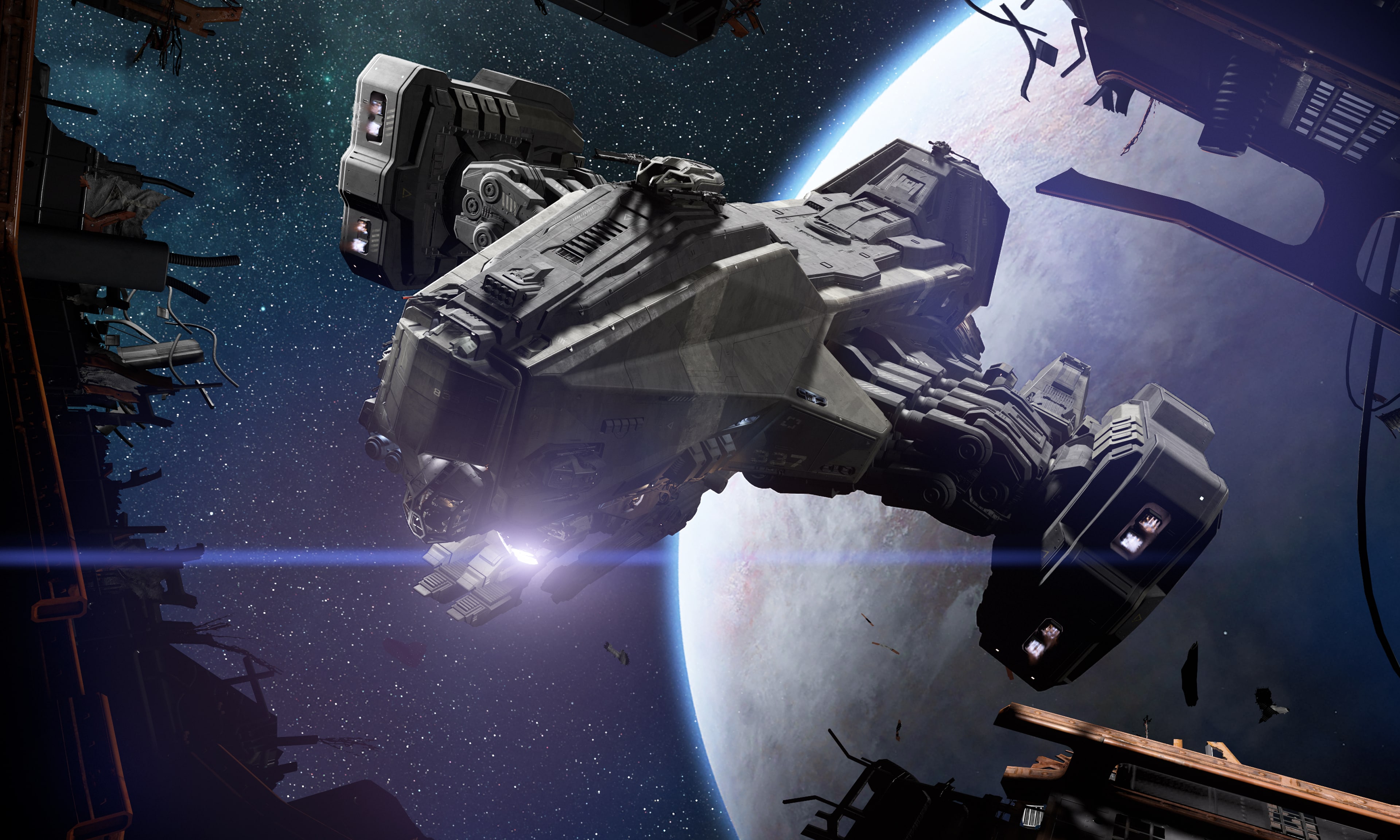
The scientific community and NewsOrgs turned out in force on the 14th of January in 2884 to see Dr. Russell Valem’s first display of the CHARIOT engine. He chose to stage his demonstration above Angeli in the Croshaw system as “a testament to the brilliance of Nick Croshaw as well as a condemnation of the shackles that his discovery bound onto Humanity.”
Using a spacecraft of his own design, Dr. Valem prepared to fire the CHARIOT. He gave a final message to the crowd of onlookers.
“I leap forward to unveil the universe.”
Dr. Valem then activated the CHARIOT.
The explosion nearly ruptured the observation station’s hull, causing dozens of injuries to the scientists and journalists aboard. By the time everyone came to, there were only fragments of Dr. Valem’s ship that hadn’t been completely incinerated.
Celebrated satirist Lasse Hatwell, who was just starting his career as a journalist for the Terra Gazette, summed up the display with what would become his signature style of humor:
“While the scientific community and Spectrum representatives had probably turned up expecting a failure, there was a small part in all of us that was hoping for something monumental,” he wrote of the day’s events. “On the bright side, Dr. Valem’s engine and ship exploded faster than any ship I had seen before.”
AN DIESEM TAG IN DER GESCHICHTE
14. Januar 2884 SET
Ein gefährlicher Flug
Der wissenschaftliche Verstand hat etwas gleichermaßen Bewundernswertes und Wahnsinniges. Es ist diese Notwendigkeit der Infragestellung und des Wiederbesuchs, die zweifellos zu einigen der größten Errungenschaften der Menschheit geführt hat, aber auch zu solchen spektakulären Katastrophen.
Nach allem, was man hört, war Russell Valem ein Wunderkind. Valem bestand seine Äquivalenz im Alter von 12 Jahren, besuchte eine Handvoll Universitäten in Rhetor und schloss im Alter von 24 Jahren eine dreifache Promotion ab. Kurz darauf erhielt er für seine Dissertation mit dem Titel "Theoretische Anwendungen des Antimaterieantriebs" das renommierte Kilian Quaesitor Grant.
Der junge Dr. Valem glaubte, dass die Menschheit in ihrer Entwicklung selbstgefällig geworden sei, seit Nick Croshaw fast siebenhundert Jahre zuvor den ersten Sprungpunkt entdeckt hatte.
"Einfach weil er ein Mittel gefunden hatte, um den Weltraum zu durchqueren, bedeutete das nicht, dass wir die enormen und schrecklichen Entfernungen des Universums überwunden hatten", sagte Dr. Valem 2873 auf dem Wissenschafts- und Technologiegipfel. "Sprungbretter sind eine Illusion von Kontrolle. Es gibt so viel mehr da draußen, das wir entdecken können. Vielleicht könnte eine ganze Zivilisation näher an der Erde sein als das Croshaw-System, aber wir werden es nicht wissen, weil alle da draußen auf der Suche nach Sprungpunkten sind."
Dr. Valems Leidenschaft waren Motoren, insbesondere der Bau eines Motors, der mit Geschwindigkeiten gleich oder schneller als die Lichtgeschwindigkeit fahren kann. Damit wäre das Universum "wirklich offen für die Erforschung. Vorbei wären die Würgepunkte der Sprungbretter."
Dr. Valem sammelte unermüdlich alle Daten von Wissenschaftlern, die im Laufe der Jahrhunderte ähnliche Versuche unternommen hatten, und verbrachte Jahre damit, die Theorien, Formeln und Schemata durchzugehen, in der Überzeugung, dass irgendwo in den riesigen Tiefen der Daten das Geheimnis lag, "absolute Freiheit" zu erschließen. Er begann sogar, kontroverse Experimente in der Randtechnologie zu studieren, die während des Höhepunkts der Messer-Ära durchgeführt wurden.
Ende 2882 tauchte Dr. Valem wieder auf, um ein wissenschaftliches Symposium für einige der berühmtesten wissenschaftlichen Köpfe der Gegenwart zu organisieren. Das Finale der Veranstaltung wurde als "Ankündigung angekündigt, die die Richtung der menschlichen Expansion ändern wird", eine angemessene Ebene der Theatralik, die in der Vergangenheit zum Synonym für seine Präsentationen geworden war. Der Wissenschaftler, der auftauchte, schien anders zu sein als der fokussierte, leidenschaftliche Denker, der fast ein Jahrzehnt zuvor das Rampenlicht verließ. Dieser neue Mann war wild, argumentativ und noch eigensinniger.
Dr. Valem enthüllte, dass er durch eine Liste von Privatinvestoren, darunter mehrere Xi'An-Unternehmer und Banu-Händler, einen Prototyp-Motor namens CHARIOT entwickelt hatte, der in der Lage war, Geschwindigkeiten nahe oder oberhalb der Lichtgeschwindigkeit zu erreichen.
Paranoid bis zum Äußersten, dass andere Wissenschaftler seine Technologie stehlen würden, hatte er jeden Feldtest vermieden und sich stattdessen für umfangreiche Simulations- und Labortests entschieden, behauptete aber, dass seine Wissenschaft solide sei. Er wollte dem Universum die Möglichkeit geben, den Motor bei der Arbeit live zu sehen, bei seinen ersten Feldtests kurz nach dem neuen Erdenjahr.
Die wissenschaftliche Gemeinschaft und NewsOrgs haben sich am 14. Januar 2884 in Kraft gesetzt, um Dr. Russell Valems erste Ausstellung des CHARIOT-Motors zu sehen. Er entschied sich dafür, seine Demonstration über Angeli im Croshaw-System als "Beweis für die Brillanz von Nick Croshaw sowie als Verurteilung der Fesseln, die seine Entdeckung an die Menschheit gebunden hat", zu veranstalten.
Dr. Valem bereitete sich mit einem selbst entworfenen Raumschiff darauf vor, den CHARIOT zu feuern. Er gab eine letzte Botschaft an die Menge der Zuschauer.
"Ich springe vorwärts, um das Universum zu enthüllen."
Dr. Valem aktivierte dann den CHARIOT.
Die Explosion brach fast den Rumpf der Beobachtungsstation und verursachte Dutzende von Verletzungen für die Wissenschaftler und Journalisten an Bord. Als alle zu sich kamen, gab es nur noch Bruchstücke von Dr. Valems Schiff, die nicht vollständig verbrannt waren.
Der gefeierte Satiriker Lasse Hatwell, der gerade seine Karriere als Journalist für die Terra Gazette begann, fasste die Ausstellung mit dem zusammen, was zu seinem typischen Humorstil werden sollte:
"Während die wissenschaftliche Gemeinschaft und die Vertreter von Spectrum wahrscheinlich mit einem Scheitern gerechnet hatten, gab es in uns allen einen kleinen Teil, der auf etwas Monumentales hoffte", schrieb er über die Ereignisse des Tages. "Auf der anderen Seite explodierten Dr. Valems Motor und Schiff schneller als jedes andere Schiff, das ich je gesehen hatte."
THIS DAY IN HISTORY
January 14, 2884 SET
A Dangerous Flight
There’s something equally admirable and insane about the scientific mind. It is that need to question and revisit that has undoubtedly led to some of Humanity’s greatest achievements, but also led to such spectacular disasters.
By all accounts, Russell Valem was a wunderkind. Passing his Equivalency at 12 years old, Valem attended a handful of universities in Rhetor and completed a triple doctorate by the age of 24. Shortly thereafter, he received the illustrious Kilian Quaesitor Grant for his dissertation entitled “Theoretical Applications of Antimatter Propulsion.”
The young Dr. Valem believed that Humanity had become complacent in their development ever since Nick Croshaw discovered the first jump point almost seven hundred years earlier.
“Simply because he had found a means for us to cross space, didn’t mean that we had conquered the vast and terrifying distances of the universe,” Dr. Valem said at the Science and Technology Summit in 2873. “Jump points are an illusion of control. There is so much more out there for us to discover. Maybe an entire civilization could be closer to Earth than Croshaw system, but we won’t know because everyone’s out there looking for jump points.”
Dr. Valem’s passion was engines, specifically building an engine capable of travelling at speeds equal to or faster than the speed of light. With that, the universe “would be truly open for exploration. Gone would be the chokepoints of jump points.”
Tirelessly collecting any and all data from scientists who had attempted similar endeavors over the centuries, Dr. Valem spent years sifting through the theories, formulas and schematics, convinced that somewhere in the vast troves of data lay the secret to unlocking “absolute freedom.” He even began to study controversial experiments in fringe technology performed during the height of the Messer Era.
In late 2882, Dr. Valem resurfaced to organize a scientific symposium for some of the most celebrated scientific minds of the age. The finale of the event was advertised as an “announcement that will change the direction of Human expansion,” an appropriate level of theatricality that had become synonymous with his presentations in the past. The scientist who emerged seemed different than the focused, passionate thinker who abandoned the spotlight almost a decade earlier. This new man was wild, argumentative and even more headstrong.
Dr. Valem revealed that through a list of private investors including several Xi’An entrepreneurs and Banu traders, he had developed a prototype engine named CHARIOT that was capable of reaching speeds near or exceeding the speed of light.
Paranoid to the extreme that other scientists would steal his tech, he had eschewed any field testing, opting for extensive simulation and laboratory tests instead, but claiming that his science was sound. He was going to give the universe the opportunity to see the engine at work live, in its first field testing shortly after the New Earth Year.
The scientific community and NewsOrgs turned out in force on the 14th of January in 2884 to see Dr. Russell Valem’s first display of the CHARIOT engine. He chose to stage his demonstration above Angeli in the Croshaw system as “a testament to the brilliance of Nick Croshaw as well as a condemnation of the shackles that his discovery bound onto Humanity.”
Using a spacecraft of his own design, Dr. Valem prepared to fire the CHARIOT. He gave a final message to the crowd of onlookers.
“I leap forward to unveil the universe.”
Dr. Valem then activated the CHARIOT.
The explosion nearly ruptured the observation station’s hull, causing dozens of injuries to the scientists and journalists aboard. By the time everyone came to, there were only fragments of Dr. Valem’s ship that hadn’t been completely incinerated.
Celebrated satirist Lasse Hatwell, who was just starting his career as a journalist for the Terra Gazette, summed up the display with what would become his signature style of humor:
“While the scientific community and Spectrum representatives had probably turned up expecting a failure, there was a small part in all of us that was hoping for something monumental,” he wrote of the day’s events. “On the bright side, Dr. Valem’s engine and ship exploded faster than any ship I had seen before.”
THIS DAY IN HISTORY
January 14, 2884 SET
A Dangerous Flight
There’s something equally admirable and insane about the scientific mind. It is that need to question and revisit that has undoubtedly led to some of Humanity’s greatest achievements, but also led to such spectacular disasters.
By all accounts, Russell Valem was a wunderkind. Passing his Equivalency at 12 years old, Valem attended a handful of universities in Rhetor and completed a triple doctorate by the age of 24. Shortly thereafter, he received the illustrious Kilian Quaesitor Grant for his dissertation entitled “Theoretical Applications of Antimatter Propulsion.”
The young Dr. Valem believed that Humanity had become complacent in their development ever since Nick Croshaw discovered the first jump point almost seven hundred years earlier.
“Simply because he had found a means for us to cross space, didn’t mean that we had conquered the vast and terrifying distances of the universe,” Dr. Valem said at the Science and Technology Summit in 2873. “Jump points are an illusion of control. There is so much more out there for us to discover. Maybe an entire civilization could be closer to Earth than Croshaw system, but we won’t know because everyone’s out there looking for jump points.”
Dr. Valem’s passion was engines, specifically building an engine capable of travelling at speeds equal to or faster than the speed of light. With that, the universe “would be truly open for exploration. Gone would be the chokepoints of jump points.”
Tirelessly collecting any and all data from scientists who had attempted similar endeavors over the centuries, Dr. Valem spent years sifting through the theories, formulas and schematics, convinced that somewhere in the vast troves of data lay the secret to unlocking “absolute freedom.” He even began to study controversial experiments in fringe technology performed during the height of the Messer Era.
In late 2882, Dr. Valem resurfaced to organize a scientific symposium for some of the most celebrated scientific minds of the age. The finale of the event was advertised as an “announcement that will change the direction of Human expansion,” an appropriate level of theatricality that had become synonymous with his presentations in the past. The scientist who emerged seemed different than the focused, passionate thinker who abandoned the spotlight almost a decade earlier. This new man was wild, argumentative and even more headstrong.
Dr. Valem revealed that through a list of private investors including several Xi’An entrepreneurs and Banu traders, he had developed a prototype engine named CHARIOT that was capable of reaching speeds near or exceeding the speed of light.
Paranoid to the extreme that other scientists would steal his tech, he had eschewed any field testing, opting for extensive simulation and laboratory tests instead, but claiming that his science was sound. He was going to give the universe the opportunity to see the engine at work live, in its first field testing shortly after the New Earth Year.
The scientific community and NewsOrgs turned out in force on the 14th of January in 2884 to see Dr. Russell Valem’s first display of the CHARIOT engine. He chose to stage his demonstration above Angeli in the Croshaw system as “a testament to the brilliance of Nick Croshaw as well as a condemnation of the shackles that his discovery bound onto Humanity.”
Using a spacecraft of his own design, Dr. Valem prepared to fire the CHARIOT. He gave a final message to the crowd of onlookers.
“I leap forward to unveil the universe.”
Dr. Valem then activated the CHARIOT.
The explosion nearly ruptured the observation station’s hull, causing dozens of injuries to the scientists and journalists aboard. By the time everyone came to, there were only fragments of Dr. Valem’s ship that hadn’t been completely incinerated.
Celebrated satirist Lasse Hatwell, who was just starting his career as a journalist for the Terra Gazette, summed up the display with what would become his signature style of humor:
“While the scientific community and Spectrum representatives had probably turned up expecting a failure, there was a small part in all of us that was hoping for something monumental,” he wrote of the day’s events. “On the bright side, Dr. Valem’s engine and ship exploded faster than any ship I had seen before.”
Links
No links available.


Metadata
- CIG ID
- 13474
- Channel
- Spectrum Dispatch
- Category
- Undefined
- Series
- News Update
- Comments
- 88
- Published
- 12 years ago (2014-01-15T00:00:00+00:00)