Galactic Guide: Baker System
Spectrum Dispatch Undefined Galactic GuideContent
Baker is a binary system consisting of two K-type main sequence stars surrounded by a relatively desolate collection of planets that range from completely uninhabitable to barely habitable. The binary stars have drawn the attention of astrophysicists eager to study such a phenomenon. A Covalex shipping hub and a largely automated mining outpost are the primary bastions of civilization in the region. As usual, that’s only half of the story — the Baker system is also home to the “Able Baker Challenge,” arguably underground racing’s most dangerous event.
The first successful transit to Baker occurred in 2522 when the jump point to Baker was discovered by accident in the Kiel System. Baker remained relatively forgotten due to the fact that binary stars traditionally offer little of value to Humans. Even when a planet within a binary star’s green zone can be terraformed, the gravitic stress associated with passing close to (or between) two stars renders attempts at civilization a moot point. However, Baker was subsequently explored by a purely scientific expedition.
Inner Planets: Baker I, II & III
From a settlement-or-resources standpoint, Baker’s first three worlds were written off immediately after the system was charted. None can be terraformed in a fashion that will sustain life permanently, and none have resources that make traveling close to the system’s stars worthwhile for major corporations. Baker I is a small planet with a dense iron core that is in a dangerously close orbit around Baker’s two suns. This proximity leads to an unstable orbital trajectory, and scientists posit that its orbit will steadily decay until it is subsumed by the larger star within the next one hundred and fifty million years.
Baker II is a typical smog planet, a sickly yellow-green worldlet with a dense and highly poisonous atmosphere. While not significantly crushed by the stars’ gravity during its rotation, Baker II’s atmosphere is so unsupportive of Human life that terraforming has never been a serious option here. In fact, the toxic mix is also incredibly corrosive to standard spacecraft hulls; the planet made headlines recently when a Freelancer piloted by suspected gunrunners attempted to hide out at Baker II only to find their ship literally dissolving out from under their feet. Baker III is an ice giant, a churning mass of white with deep blue veins. The planet’s circumference has increased noticeably since its discovery, something astrophysicists are keeping a watchful eye on.
Xenia
Xenia is a Covalex shipping hub constructed to support the burgeoning trade lanes between Baker and the Xi’An Empire. Xenia has expanded by leaps and bounds with the realization that operating through the station allows merchants to avoid the increasingly high tariffs associated with moving goods through more populated systems.
The station itself has grown into a series of pre-fab habitation facilities joining together cargo bays to form a ring. These bays range from pressurized hangars for smaller ships to massive vacuum ‘wet docks’ capable of servicing the largest freighter designs. Larger ships flying under Covalex registry and carrying bulk goods typically disperse their cargo at Xenia, where private enterprise crews can pick up contracts for delivery to the surrounding systems.
Xenia is a great place for newly formed hauler crews to learn the tricks of the trade. There’s not a great deal of profit in helping Covalex avoid import taxes, but it is ideal for inexperienced crews looking to find their space legs. The station’s active job board is also a good place to pick up longer duration missions with higher payouts.
Baker IV
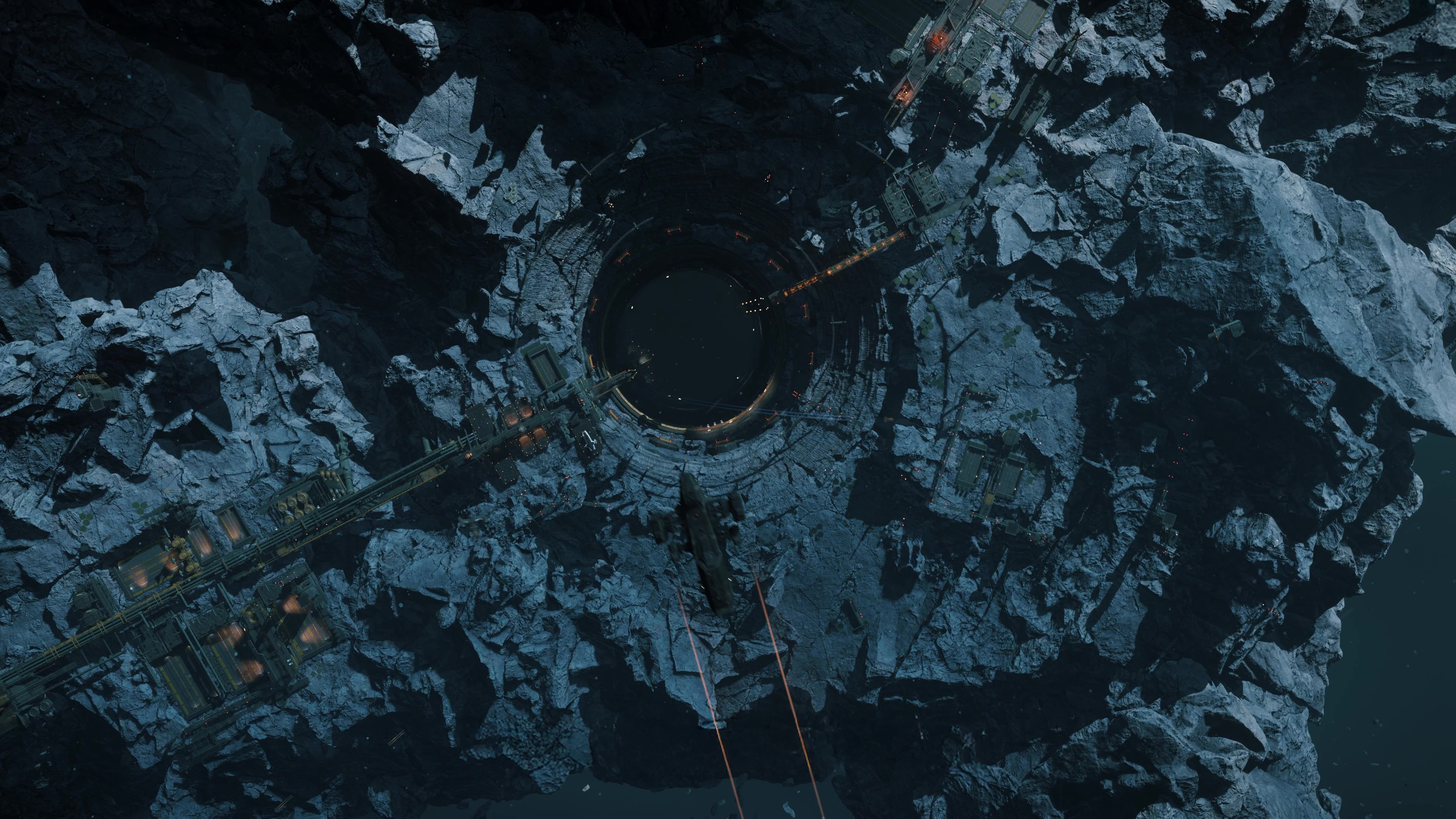
The final planet in the Baker system has no atmosphere or magnetic field, but it is home to very dense mineral deposits. Shubin Interstellar has been granted claim rights to the planet and a mining outpost named GIO is now the planet’s most noteable feature. Spacecraft can come and go from GIO, although the Shubin-constructed facilities on the planet are spartan at best.
The Race
While Baker’s three inner planets may be useless in any formal sense, they have taken on new life as one of the galaxy’s most dangerous unofficial racetracks where the Able Baker Challenge pits pilots against each other and the environmental dangers.
Brave pilots who flew in past races had to face severe and often deadly challenges. One year saw the participants having to navigate the space that surrounds Baker III, which is filled with dangerous ice crystals that can impair instrumentation and severely hamper visibility. Another race featured a stage called ‘breathing the vapors.’ that involved ring targets placed very close to Baker II’s toxic atmosphere. Pilots had to traverse the course carefully to avoid hull damage. There have often been races that included final legs that are weapons-free. Unlike more “civilized” events, this means racers are not immediately disqualified for the destruction of an opponent’s ship (although kills are still frowned upon).
This makes for one of the most dangerous competitions in the galaxy. Navigating the course is considered a badge of honor among underground racers, although official racing teams avoid the Able Baker Challenge for the most part. As it is an unofficial race organized by unknown concerns, the challenge has no rules concerning weapons or other safety procedures, and especially competitive racers have been known to gun down opponents even in early race phases in order to gain an edge.
Visitors should also be aware that the underground nature of the challenge has led to a significant number of casualties among amateurs.
Travel Warning
As Baker has no recognized worlds, it is patrolled irregularly by the UEEN. You may find yourself in danger when traveling in the system.
Baker ist ein binäres System, das aus zwei Hauptreihensternen vom Typ K besteht, die von einer relativ trostlosen Ansammlung von Planeten umgeben sind, die von völlig unbewohnbar bis kaum bewohnbar reichen. Die binären Sterne haben die Aufmerksamkeit der Astrophysiker auf sich gezogen, die ein solches Phänomen untersuchen wollen. Ein Schifffahrtszentrum von Covalex und ein weitgehend automatisierter Minenaußenposten sind die wichtigsten Bastionen der Zivilisation in der Region. Wie üblich ist das nur die halbe Miete - im Baker-System befindet sich auch die "Able Baker Challenge", das wohl gefährlichste Ereignis im Untergrund.
Der erste erfolgreiche Transit nach Baker erfolgte 2522, als der Sprungpunkt nach Baker zufällig im Kieler System entdeckt wurde. Baker blieb relativ vergessen, da Binärsterne den Menschen traditionell wenig Wert bieten. Selbst wenn ein Planet innerhalb der grünen Zone eines Doppelsterns terraformiert werden kann, macht der gravitäre Stress, der mit dem Passieren nahe (oder zwischen) zwei Sternen verbunden ist, die Versuche zur Zivilisation zu einem strittigen Punkt. Baker wurde jedoch später von einer rein wissenschaftlichen Expedition erforscht.
Innere Planeten: Bäcker I, II & III
Aus Sicht der Siedlung oder der Ressourcen wurden Bakers erste drei Welten unmittelbar nach der Erstellung des Systems abgeschrieben. Keine kann auf eine Weise terraformiert werden, die das Leben dauerhaft erhält, und keine verfügt über Ressourcen, die es für Großunternehmen lohnenswert machen, in der Nähe der Sterne des Systems zu reisen. Baker I ist ein kleiner Planet mit einem dichten Eisenkern, der sich in einer gefährlich engen Umlaufbahn um die beiden Sonnen von Baker befindet. Diese Nähe führt zu einer instabilen Orbitaltrajektorie, und Wissenschaftler gehen davon aus, dass ihre Bahn stetig zerfallen wird, bis sie innerhalb der nächsten hundertfünfzig Millionen Jahre vom größeren Stern unterdrückt wird.
Baker II ist ein typischer Smogplanet, ein kränklich gelb-grünes Weltkind mit einer dichten und hochgiftigen Atmosphäre. Obwohl die Atmosphäre von Baker II während der Rotation nicht signifikant von der Schwerkraft der Sterne zerquetscht wird, ist sie für das menschliche Leben so ungünstig, dass Terraforming hier nie eine ernsthafte Option war. Tatsächlich ist die giftige Mischung auch unglaublich ätzend für Standard-Raumschiffe; der Planet machte kürzlich Schlagzeilen, als ein Freelancer, der von verdächtigen Waffenschmugglern gesteuert wird, versuchte, sich bei Baker II zu verstecken, nur um festzustellen, dass sich ihr Schiff buchstäblich unter ihren Füßen auflöst. Baker III ist ein Eisriese, eine wirbelnde Masse aus Weiß mit tiefblauen Adern. Der Umfang des Planeten hat sich seit seiner Entdeckung deutlich vergrößert, was von Astrophysikern beobachtet wird.
Xenia
Xenia ist ein Schifffahrtszentrum von Covalex, das zur Unterstützung der wachsenden Handelsrouten zwischen Baker und dem Reich Xi'An gebaut wurde. Xenia hat sich mit der Erkenntnis, dass der Betrieb über den Bahnhof es den Händlern ermöglicht, die immer höheren Zölle zu vermeiden, die mit dem Transport von Waren durch bevölkerungsreichere Systeme verbunden sind, sprunghaft erweitert.
Die Station selbst ist zu einer Reihe von Wohnanlagen für Fertighäuser herangewachsen, die Laderäume zu einem Ring verbinden. Diese Buchten reichen von druckbeaufschlagten Hangars für kleinere Schiffe bis hin zu massiven Vakuum-"Wet Docks", die in der Lage sind, die größten Frachterkonstruktionen zu bedienen. Größere Schiffe, die unter der Registry von Covalex fliegen und Massengüter befördern, verteilen ihre Ladung typischerweise in Xenia, wo Privatunternehmer Verträge zur Lieferung an die umliegenden Systeme abholen können.
Xenia ist ein großartiger Ort für neu gebildete Speditionsteams, um die Tricks des Handels zu erlernen. Es gibt nicht viel Gewinn, wenn man Covalex hilft, Einfuhrsteuern zu vermeiden, aber es ist ideal für unerfahrene Besatzungen, die ihre Raumbeine finden wollen. Die aktive Jobbörse der Station ist auch ein guter Ort, um längerfristige Missionen mit höheren Auszahlungen durchzuführen.
Bäcker IV
Der letzte Planet im Baker-System hat keine Atmosphäre oder kein Magnetfeld, aber er beherbergt sehr dichte Mineralvorkommen. Shubin Interstellar hat Anspruch auf den Planeten erhalten, und ein Minenvorposten namens GIO ist heute das bemerkenswerteste Merkmal des Planeten. Raumschiffe können von GIO aus kommen und gehen, obwohl die von Shubin konstruierten Einrichtungen auf dem Planeten bestenfalls spartanisch sind.
Das Rennen
Während die drei inneren Planeten von Baker in jeder Hinsicht nutzlos sind, haben sie als eine der gefährlichsten inoffiziellen Rennstrecken der Galaxie, auf der die Able Baker Challenge Piloten gegeneinander und die Umweltgefahren antreten, neues Leben erlangt.
Mutige Piloten, die in vergangenen Rennen geflogen sind, mussten sich schweren und oft tödlichen Herausforderungen stellen. Ein Jahr lang mussten die Teilnehmer den Raum um Baker III herum navigieren, der mit gefährlichen Eiskristallen gefüllt ist, die die Instrumentierung beeinträchtigen und die Sicht stark beeinträchtigen können. Ein weiteres Rennen beinhaltete eine Etappe namens "Atmung der Dämpfe", bei der Ringziele in unmittelbarer Nähe der giftigen Atmosphäre von Baker II platziert wurden. Die Piloten mussten die Strecke vorsichtig durchqueren, um Hüllenschäden zu vermeiden. Es gab oft Rennen, bei denen die letzten Etappen waffenfrei waren. Im Gegensatz zu mehr "zivilisierten" Ereignissen bedeutet dies, dass Rennfahrer nicht sofort für die Zerstörung des gegnerischen Schiffes disqualifiziert werden (obwohl Kills immer noch verpönt sind).
Dies ist einer der gefährlichsten Wettkämpfe in der Galaxie. Die Navigation auf der Strecke gilt als Ehrenzeichen unter den Underground-Fahrern, obwohl offizielle Rennteams die Able Baker Challenge größtenteils vermeiden. Da es sich um ein inoffizielles Rennen handelt, das von unbekannten Interessen organisiert wird, hat die Herausforderung keine Regeln für Waffen oder andere Sicherheitsverfahren, und vor allem Rennfahrer sind bekannt dafür, ihre Gegner auch in frühen Rennphasen abzuschießen, um sich einen Vorteil zu verschaffen.
Die Besucher sollten sich auch darüber im Klaren sein, dass der unterirdische Charakter der Herausforderung zu einer erheblichen Anzahl von Verlusten unter Amateuren geführt hat.
Reisewarnung
Da Baker keine erkannten Welten hat, wird er von der UEEN unregelmäßig überwacht. Sie können sich bei Fahrten im System in Gefahr befinden.
Baker is a binary system consisting of two K-type main sequence stars surrounded by a relatively desolate collection of planets that range from completely uninhabitable to barely habitable. The binary stars have drawn the attention of astrophysicists eager to study such a phenomenon. A Covalex shipping hub and a largely automated mining outpost are the primary bastions of civilization in the region. As usual, that’s only half of the story — the Baker system is also home to the “Able Baker Challenge,” arguably underground racing’s most dangerous event.
The first successful transit to Baker occurred in 2522 when the jump point to Baker was discovered by accident in the Kiel System. Baker remained relatively forgotten due to the fact that binary stars traditionally offer little of value to Humans. Even when a planet within a binary star’s green zone can be terraformed, the gravitic stress associated with passing close to (or between) two stars renders attempts at civilization a moot point. However, Baker was subsequently explored by a purely scientific expedition.
Inner Planets: Baker I, II & III
From a settlement-or-resources standpoint, Baker’s first three worlds were written off immediately after the system was charted. None can be terraformed in a fashion that will sustain life permanently, and none have resources that make traveling close to the system’s stars worthwhile for major corporations. Baker I is a small planet with a dense iron core that is in a dangerously close orbit around Baker’s two suns. This proximity leads to an unstable orbital trajectory, and scientists posit that its orbit will steadily decay until it is subsumed by the larger star within the next one hundred and fifty million years.
Baker II is a typical smog planet, a sickly yellow-green worldlet with a dense and highly poisonous atmosphere. While not significantly crushed by the stars’ gravity during its rotation, Baker II’s atmosphere is so unsupportive of Human life that terraforming has never been a serious option here. In fact, the toxic mix is also incredibly corrosive to standard spacecraft hulls; the planet made headlines recently when a Freelancer piloted by suspected gunrunners attempted to hide out at Baker II only to find their ship literally dissolving out from under their feet. Baker III is an ice giant, a churning mass of white with deep blue veins. The planet’s circumference has increased noticeably since its discovery, something astrophysicists are keeping a watchful eye on.
Xenia
Xenia is a Covalex shipping hub constructed to support the burgeoning trade lanes between Baker and the Xi’An Empire. Xenia has expanded by leaps and bounds with the realization that operating through the station allows merchants to avoid the increasingly high tariffs associated with moving goods through more populated systems.
The station itself has grown into a series of pre-fab habitation facilities joining together cargo bays to form a ring. These bays range from pressurized hangars for smaller ships to massive vacuum ‘wet docks’ capable of servicing the largest freighter designs. Larger ships flying under Covalex registry and carrying bulk goods typically disperse their cargo at Xenia, where private enterprise crews can pick up contracts for delivery to the surrounding systems.
Xenia is a great place for newly formed hauler crews to learn the tricks of the trade. There’s not a great deal of profit in helping Covalex avoid import taxes, but it is ideal for inexperienced crews looking to find their space legs. The station’s active job board is also a good place to pick up longer duration missions with higher payouts.
Baker IV
The final planet in the Baker system has no atmosphere or magnetic field, but it is home to very dense mineral deposits. Shubin Interstellar has been granted claim rights to the planet and a mining outpost named GIO is now the planet’s most noteable feature. Spacecraft can come and go from GIO, although the Shubin-constructed facilities on the planet are spartan at best.
The Race
While Baker’s three inner planets may be useless in any formal sense, they have taken on new life as one of the galaxy’s most dangerous unofficial racetracks where the Able Baker Challenge pits pilots against each other and the environmental dangers.
Brave pilots who flew in past races had to face severe and often deadly challenges. One year saw the participants having to navigate the space that surrounds Baker III, which is filled with dangerous ice crystals that can impair instrumentation and severely hamper visibility. Another race featured a stage called ‘breathing the vapors.’ that involved ring targets placed very close to Baker II’s toxic atmosphere. Pilots had to traverse the course carefully to avoid hull damage. There have often been races that included final legs that are weapons-free. Unlike more “civilized” events, this means racers are not immediately disqualified for the destruction of an opponent’s ship (although kills are still frowned upon).
This makes for one of the most dangerous competitions in the galaxy. Navigating the course is considered a badge of honor among underground racers, although official racing teams avoid the Able Baker Challenge for the most part. As it is an unofficial race organized by unknown concerns, the challenge has no rules concerning weapons or other safety procedures, and especially competitive racers have been known to gun down opponents even in early race phases in order to gain an edge.
Visitors should also be aware that the underground nature of the challenge has led to a significant number of casualties among amateurs.
Travel Warning
As Baker has no recognized worlds, it is patrolled irregularly by the UEEN. You may find yourself in danger when traveling in the system.
Baker is a binary system consisting of two K-type main sequence stars surrounded by a relatively desolate collection of planets that range from completely uninhabitable to barely habitable. The binary stars have drawn the attention of astrophysicists eager to study such a phenomenon. A Covalex shipping hub and a largely automated mining outpost are the primary bastions of civilization in the region. As usual, that’s only half of the story — the Baker system is also home to the “Able Baker Challenge,” arguably underground racing’s most dangerous event.
The first successful transit to Baker occurred in 2522 when the jump point to Baker was discovered by accident in the Kiel System. Baker remained relatively forgotten due to the fact that binary stars traditionally offer little of value to Humans. Even when a planet within a binary star’s green zone can be terraformed, the gravitic stress associated with passing close to (or between) two stars renders attempts at civilization a moot point. However, Baker was subsequently explored by a purely scientific expedition.
Inner Planets: Baker I, II & III
From a settlement-or-resources standpoint, Baker’s first three worlds were written off immediately after the system was charted. None can be terraformed in a fashion that will sustain life permanently, and none have resources that make traveling close to the system’s stars worthwhile for major corporations. Baker I is a small planet with a dense iron core that is in a dangerously close orbit around Baker’s two suns. This proximity leads to an unstable orbital trajectory, and scientists posit that its orbit will steadily decay until it is subsumed by the larger star within the next one hundred and fifty million years.
Baker II is a typical smog planet, a sickly yellow-green worldlet with a dense and highly poisonous atmosphere. While not significantly crushed by the stars’ gravity during its rotation, Baker II’s atmosphere is so unsupportive of Human life that terraforming has never been a serious option here. In fact, the toxic mix is also incredibly corrosive to standard spacecraft hulls; the planet made headlines recently when a Freelancer piloted by suspected gunrunners attempted to hide out at Baker II only to find their ship literally dissolving out from under their feet. Baker III is an ice giant, a churning mass of white with deep blue veins. The planet’s circumference has increased noticeably since its discovery, something astrophysicists are keeping a watchful eye on.
Xenia
Xenia is a Covalex shipping hub constructed to support the burgeoning trade lanes between Baker and the Xi’An Empire. Xenia has expanded by leaps and bounds with the realization that operating through the station allows merchants to avoid the increasingly high tariffs associated with moving goods through more populated systems.
The station itself has grown into a series of pre-fab habitation facilities joining together cargo bays to form a ring. These bays range from pressurized hangars for smaller ships to massive vacuum ‘wet docks’ capable of servicing the largest freighter designs. Larger ships flying under Covalex registry and carrying bulk goods typically disperse their cargo at Xenia, where private enterprise crews can pick up contracts for delivery to the surrounding systems.
Xenia is a great place for newly formed hauler crews to learn the tricks of the trade. There’s not a great deal of profit in helping Covalex avoid import taxes, but it is ideal for inexperienced crews looking to find their space legs. The station’s active job board is also a good place to pick up longer duration missions with higher payouts.
Baker IV
The final planet in the Baker system has no atmosphere or magnetic field, but it is home to very dense mineral deposits. Shubin Interstellar has been granted claim rights to the planet and a mining outpost named GIO is now the planet’s most noteable feature. Spacecraft can come and go from GIO, although the Shubin-constructed facilities on the planet are spartan at best.
The Race
While Baker’s three inner planets may be useless in any formal sense, they have taken on new life as one of the galaxy’s most dangerous unofficial racetracks where the Able Baker Challenge pits pilots against each other and the environmental dangers.
Brave pilots who flew in past races had to face severe and often deadly challenges. One year saw the participants having to navigate the space that surrounds Baker III, which is filled with dangerous ice crystals that can impair instrumentation and severely hamper visibility. Another race featured a stage called ‘breathing the vapors.’ that involved ring targets placed very close to Baker II’s toxic atmosphere. Pilots had to traverse the course carefully to avoid hull damage. There have often been races that included final legs that are weapons-free. Unlike more “civilized” events, this means racers are not immediately disqualified for the destruction of an opponent’s ship (although kills are still frowned upon).
This makes for one of the most dangerous competitions in the galaxy. Navigating the course is considered a badge of honor among underground racers, although official racing teams avoid the Able Baker Challenge for the most part. As it is an unofficial race organized by unknown concerns, the challenge has no rules concerning weapons or other safety procedures, and especially competitive racers have been known to gun down opponents even in early race phases in order to gain an edge.
Visitors should also be aware that the underground nature of the challenge has led to a significant number of casualties among amateurs.
Travel Warning
As Baker has no recognized worlds, it is patrolled irregularly by the UEEN. You may find yourself in danger when traveling in the system.
Links
No links available.


Metadata
- CIG ID
- 14230
- Channel
- Spectrum Dispatch
- Category
- Undefined
- Series
- Galactic Guide
- Comments
- 130
- Published
- 12 years ago (2014-10-15T00:00:00+00:00)