(Updated) Arena Commander 1.0 Released!
Transmission Undefined NoneContent
Greetings Citizens,
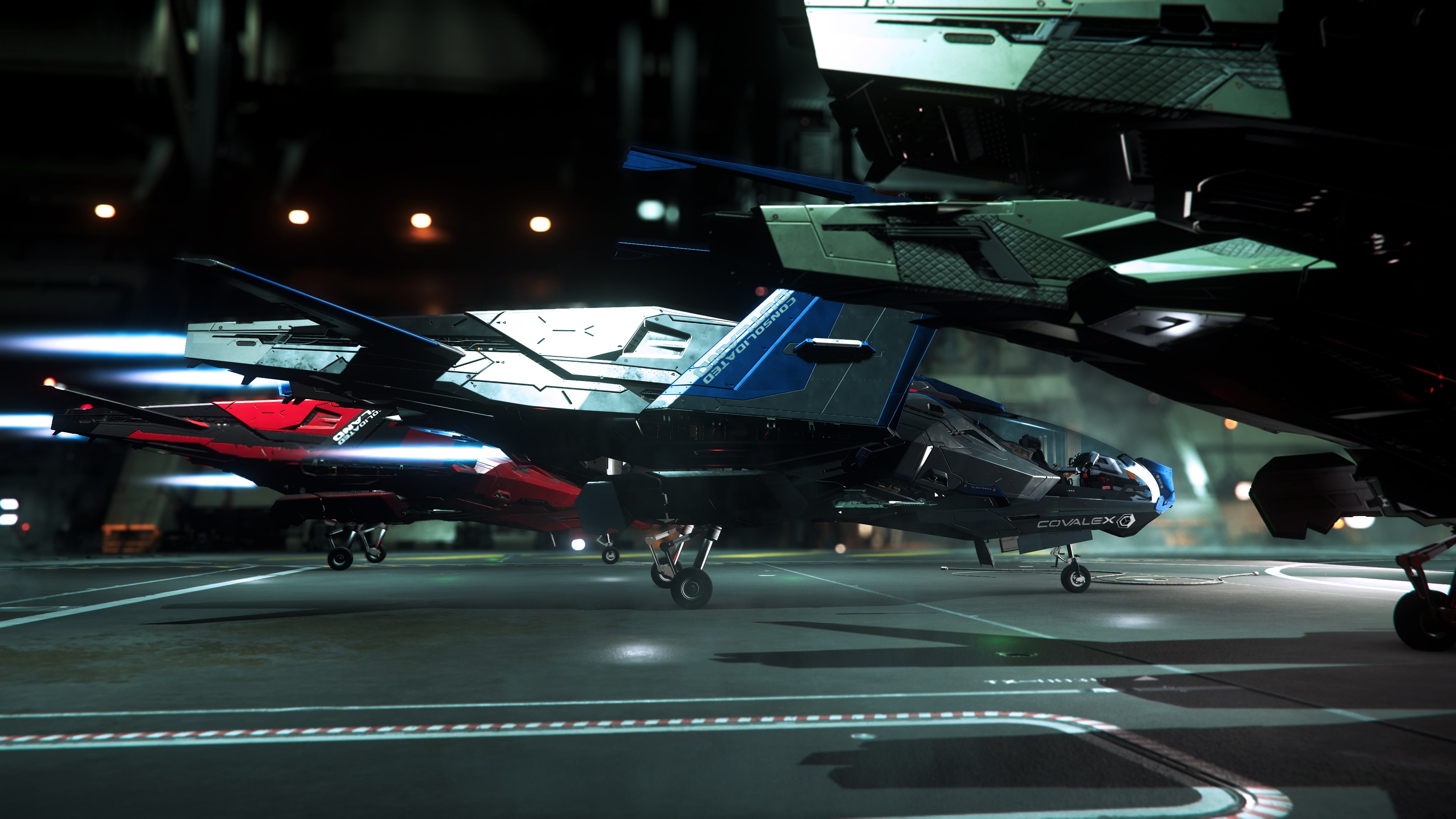
Arena Commander 1.0 is here! Today’s release marks the most significant update to Arena Commander yet, adding both the long-awaited lobby system and more than tripling the number of flyable ships. Every variant of the Aurora, Mustang, 300 and Hornet are now flyable, as are the base models of the Cutlass and the Avenger. If you’ve been waiting to fly one of Star Citizen’s single-seaters, there’s a good chance your ship has come in today!
Arena Commander 1.0 adds a host of new ship upgrades as well as significant enhancements to many of the game’s systems. Included for the first time are a ship signature system, a thruster power system, and a lateral g-force system. It contains the first iteration of the game’s lobby and we have launched a friends system in the game and on the RSI site to help you connect. Audio and visual effects have been updated throughout the game, with new animations, new textures, new cameras and more. You can find the complete list of changes, which range from the major updates below to dozens of game balancing changes and technical fixes, in the patch notes.
As you know, the team has been working very hard to release Arena Commander today and we’re especially excited to publish this patch before our Holiday break. We would have ideally liked another 4-5 days of internal stress testing and polish but with everyone looking forward to some well-earned time off I didn’t want to eat into people’s break. That said, being cognizant of the fact that the upcoming holidays are a time when everyone (myself included) looks forward to playing their favorite games we wanted to make sure that we released Arena Commander 1.0 for all our backers to enjoy over the holidays. With that in mind, I’ve opted to push today’s build of Arena Commander 1.0 to all of our backers today. So please, enjoy this significant update, give us your feedback, and we’ll come back in the New Year ready to continue polishing Arena Commander and developing the BDSSE!
I would like to stress that today’s release of Arena Commander 1.0 is a beginning, not an ending. This milestone does not denote the completion of Arena Commander, it kicks off an even more significant phase of its development. With this update, we’ve added a significant number of ships, items, missiles, and systems which means more interconnected systems, more servers to stress and more bugs to squash. These future changes won’t be limited to fixing technical glitches and balance issues.
Some elements, like the initial Avenger and Cutlass, will be converted to the new modular ship component system, but we wanted long-waiting owners to get an early look at their ships. So I encourage you to experience everything we’ve added to Arena Commander 1.0, but also to know that much, much more is in the works!
And that is where you come in! With this update, there’s a lot more for the community to help us test. So get on the forums and share your feedback and let us know your thoughts, criticisms, and ideas on everything that we’ve added. Every experience you report today, positive or negative, will help us make a better game tomorrow and come January 2nd, we will go back to work making Arena Commander even better.
Thank you for your continued support, and I sincerely hope you enjoy Arena Commander 1.0. I think that it’s a great indication of where we’re going with the Star Citizen experience. I’d like to close by saying Happy Holidays to backers everywhere. I wish you all the joy in the world and look forward to continuing our journey in the coming year.
— Chris Roberts
New Manual
The Cloud Imperium publications team has produced an updated version of the Arena Commander manual in honor of 1.0! Check out the latest ships, learn about the new upgrades and how to use the game’s new systems.
Grab your PDF copy here:
https://robertsspaceindustries.com/media/hwb5x45eghhelr/source/AC-Manual-1-0-V6.pdf
New Ships
Arena Commander 1.0 introduces fourteen ships to the dogfighting experience! From the jack-of-all-trades Aurora ES to the fearsome Avenger, Star Citizen’s combat balance is going through a major revision. In addition to ships sold as concepts, we’ve put a number of newly-available ships (including the Mustang lineup) for sale in the pledge store.
Update : If you wish to explore the entire Starter Ship line ups, but want to keep you alpha access, LTI or other precious package items, you can use the following Ship and Cross-Chassis Upgrades :
New Components
In addition to new ships, Arena Commander 1.0 adds an assortment of additional ship components to the game. Now backers will be able to further customize their ship’s loadout with a level of complexity unseen before. We are offering some of this additional equipment for UEC via the Voyager Direct store.
New guns
New missile racks
Missile ammo!
Visit your Voyager Direct dealer!
Public Test Universe
Arena Commander 1.0 isn’t the only big launch for the team today! As you may have noticed on your accounts, we are also kicking off something we’re calling the Public Test Universe. The Public Test Universe, or PTU, is a new server environment which will allow us to selectively push more experimental builds of Star Citizen to players who wish to assist with more hardcore testing of our game, balance and systems. With the PTU, we will be able to do more testing and get more feedback between patches, all while sharing more of Star Citizen’s development with backers! PTU releases will be launched in “phases,” with varying amounts of players given access as are needed for tests. If your account is eligible, you can start the process under account settings in the My RSI > Settings > Public Test Universe panel.
HUD
Debug Mode: SNR Detection Graph We’re proud to introduce in Arena Commander 1.0 our initial implementation of the in-cockpit user-interface. We have designated the Aurora to be the “prototype” ship to host much of the HUD information and interaction you’ve been seeing in the visor on the cockpit’s display panels. This represents our first step towards diversifying the HUD / UI so that each ship can have a unique and immersive piloting experience. The technology that allows us to achieve this diegetic projection of interface elements is called Scaleform 3Di. 3Di allows us the ability to project any number of UI components anywhere we want within the game world with minimal effort in terms of setup. This technology, in conjunction with our robust UI framework provides us with a highly flexible system to create truly unique interfaces with their own visual languages and interaction rules. It also allows us to iterate very efficiently with regards to the positioning, scale, and rotation of these elements within the game-world.
But the Aurora isn’t the only ship to receive an upgrade to the UI. We have also made some updates to the Combat Visor Interface (CVI) to have a more immersive feel when you’re wearing your helmet. Now, when looking at your character in 3rd person, the HUD can be seen actually projected inside the helmet and conforming to the helmet’s geometry.
To help address some of the complaints about visibility of certain UI elements on brighter backgrounds, we have introduced an additive blending mode for the HUD which essentially “brightens” UI elements when displayed against bright backgrounds such as the planet on Broken Moon. This means that elements such as the reticle and hit predictors will be much more visible because they will always appear brighter than the backgrounds that they are projected against. This also has the benefit of making the HUD look much better visually and less “flat”, because its brightness and color is more reactive to the environment. Going forward, we will continue to improve on this blending to provide pilots with the best readability for a given environment while still retaining the nice visual look we want for the HUD.
Missiles
Debug Mode: Enemy SNR We’ve had missiles in the game before, but for 1.0 we went back to the basics of what missile gameplay could mean and created a unique mechanic that creates a variety of other potential uses outside of simply blowing a target up, such as the ability to lock multiple missiles onto a target (or multiple targets, if your ship can handle it).
Adding these sorts of changes into missiles meant touching a whole host of other systems. The radar needed revamping to read all the signatures properly, the HUD had to be revisited to communicate any number of missiles, the controller/keybound input had to be modified to accommodate missile management while also keeping the system available and useful in the heat of battle, and the targeting computer needed to be linked to each missile individually (rather than just the rack that fires them) to accommodate the wide range of missile types and behaviors that became available.
Then we built the Rattler missile, the first example of many of our new missile behaviors to come, which carries its own salvo of Venom rockets to hunt down your enemies. It’s a very satisfying weapon to use, try not to get so distracted watching it that you forget to stay in the fight! There’s also the new rocket pods strapped to the Mustang Delta, presenting the first opportunity to use dumbfire ordnance. I look forward to seeing the videos of skillshots that come out of those things.
The final piece of the puzzle was a new look at countermeasures. In most games, the use of countermeasures would be effectively the same as using an accuracy debuff – thing enters the field, thing has trouble hitting the target, simple as that. Here, we actually have the countermeasures affecting the signal system directly, which means that you aren’t playing against arbitrary data – you can just as easily escape an enemy radar as a missile as they are all part of a single data-driven system.
Signature System
One major update to Arena Commander 1.0 is the launch of the Signature System, which we kick off with three measured signatures in today’s build. The Signature System is an important new combat mechanic, which introduces a huge variable to how Arena Commander’s ships face off.
Most objects generate a detectable signature of some sort. These signals take on any number of forms: radio signals, electromagnetic signals, audio signals. Even visual reflectivity is a form of signal. It’s through these signals that we detect objects, and an ability to track them is key in all forms of weapons targeting. Whether it’s a heat-seeking missile homing in on the hottest jet exhaust or an image recognition warhead knocking something out of the sky based on its shape, signals are key to modern warfare.
Under this approach, it stands to reason that most objects in the Star Citizen environment must also generate detectable signals. Our challenge becomes: what signals do we simulate, how do we simulate them and, for the purposes of a variety of gameplay elements, how do we simulate their detection? (That is: how does a missile know that it sees you and how does that differ from how an NPC does the same?)
Signal-to-Noise Ratio
Debug Mode: Signal Emissions Graph The answer to this final question is that we create a signal-to-noise ratio (SNR) value for every objection. In science and engineering, signal-to-noise ratio is a value that compares the level of a given signal to the amount of background noise. More specifically, it is the ratio of a signal’s power to the background noise’s power. A ratio higher than 1:1 means that there is more signal than noise and that for our purposes an object is more readily detected. In simplest terms, SNR is a value that distinguishes an object from the background.
How do we calculate SNR for an individual situation, defined as targeting between two objects? The magic formula is SNR = 10 * log10( (S * (1-N/100) * (A^Z) * O) / R ). In this equation, S is the target’s signal emission, N is the overall level noise given as a percentage, A is your ship’s radar amplitude, Z is your ship’s radar amplitude power, R is your distance from the target and O is the occlusion influence percent (0 to 1.)
Noise
What, then, is noise in Star Citizen? It’s not an arbitrary value and most importantly it is not a constant! At present, every Star Citizen map contains a default level of noise intended to mimic background cosmic radiation. That’s the general noise present throughout the universe, the general static of the universe that is generated by countless of stars, black holes, quasars and the like. But in addition to a default level of cosmic radiation, Star Citizen is capable of altering the noise on a case by case basis. Imagine flying through an electromagnetic storm, or a gaseous nebula, or into a gravity well. The background noise will increase, often significantly. The SNR ratio will be impacted and the game will make it easier (or, occasionally, harder) for players to keep their ships undetected.
The noise value is determined by measuring the maximum amount of noise between two targets. If there’s a disturbance somewhere between you and your opponent, that increases the measured noise as the two attempt to target one another. This gives rise to one more opportunity for gameplay: the ability to deploy chaff, which generates a temporary artificial field of noise. Upend the ratio yourself to avoid detection or missile locks! (This is essentially the basis upon which actual chaff functions. Instead of telling the computer ‘if chaff is fired, decrease missile’s chance’ we’ve created an overall logical system that autonomously creates the same functionality.)
Debug Mode: Own Emissions Levels Signal
Now that we have noise, including ways to both increase and decrease it, what constitutes a signal? At present, combat in Star Citizen measures three distinct types of signals: infrared, electromagnetic and cross section. Each of these signals, which factor into the overall ’S’ value of your situation’s SNR number, has a distinct set of rules and characteristics intended to emulate how they would function in actual combat.
Infrared – With a ship’s infrared signal, individual items have a heat pool which builds up based on certain actions. An item such as a weapon will generate heat in the pool briefly while firing, whereas an engine might output a steady stream of heat that constantly impacts your infrared signal. Items such as coolers will pull heat away from a given item’s pool, reducing the infrared signature. The cooler impacts the infrared signature based on the amount of heat a ship was cooled (think of it like water cooling your PC!) Thrusters generate heat based on the amount of thrust generated at any given point, dumping this into the heat pool. Thus, thrusters will take time to cool off after use and the resulting infrared signature will take time to dissipate (like a hot car engine on a cold day.) Occlusion lowers the overall detected infrared signature.
Electromagnetic – Electromagnetic energy is generated by a number of items on a standard ship, especially the shield systems and power plants. Shields require power to stay active and additional power during any regeneration. This power requirement generates the electromagnetic signature, meaning that a ship holding with shields active will generate a significant holding signature but that this signature will increase should the shields be damaged and begin recharging. A ship’s power plant generates its electromagnetic signature based on the overall amount of power needed by the ship at a given time. Occlusion also lowers the detected electromagnetic signature.
Cross Section – The cross section signature is based on the actual volume of a given ship using offline calculations which determine the measurements based on each axis. It is our first ship signature to be in 3D. It is based on the view direction of a ship’s cross-section, so the value will change constantly based on the angle from which you can view a target. A Scythe viewed directly head-on will have a significantly lower cross section signature than one viewed from above or below. Unlike electromagnetic and infrared signatures, a ship’s cross section signature value cannot be detected through geometry (other objects that physically block a target.)
With the signature system, we hope to kick off a more complex sort of balance for Arena Commander. Hopefully you can see that, in addition to being the basis for how all objects lock on to one another, Star Citizen’s stealth mechanics will spring directly from the development of this system. Pilots who wish to fly stealthy ships will arrange their upgrades and enhancements in such a way as to reduce power consumption, signal output and even visual size if they wish to score a low SNR. Some ships, such as the Hornet Tracker, will include enhanced functionality to detect and alter signals.
We’re dedicated to making Arena Commander more than just shooting, and we’re excited to expand and balance signals going forward!
Grüße Bürger,
Arena Commander 1.0 ist da! Die heutige Veröffentlichung markiert das bisher bedeutendste Update für Arena Commander, das sowohl das lang erwartete Lobby-System als auch die Anzahl der fliegbaren Schiffe mehr als verdreifacht. Jede Variante der Aurora, Mustang, 300 und Hornet ist nun flugfähig, ebenso wie die Basismodelle des Cutlass und des Avenger. Wenn Sie darauf gewartet haben, einen der Einsitzer von Star Citizen zu fliegen, besteht eine gute Chance, dass Ihr Schiff heute eingetroffen ist!
Arena Commander 1.0 bietet eine Vielzahl neuer Schiffsupgrades sowie bedeutende Verbesserungen für viele der Systeme des Spiels. Erstmals enthalten sind ein Schiffssignatursystem, ein Triebwerksantriebssystem und ein laterales g-Kraft-System. Es enthält die erste Iteration der Lobby des Spiels und wir haben ein Freundessystem im Spiel und auf der RSI-Seite gestartet, um dir zu helfen, dich zu verbinden. Audio- und visuelle Effekte wurden im Laufe des Spiels aktualisiert, mit neuen Animationen, neuen Texturen, neuen Kameras und mehr. Die vollständige Liste der Änderungen, die von den wichtigsten Updates unten bis hin zu Dutzenden von Änderungen der Spielbalance und technischen Korrekturen reicht, findest du in den Patch-Notizen.
Wie Sie wissen, hat das Team sehr hart daran gearbeitet, Arena Commander heute zu veröffentlichen, und wir freuen uns besonders, diesen Patch noch vor unserer Ferienpause zu veröffentlichen. Wir hätten uns ideal weitere 4-5 Tage interne Stresstests und Polieren gewünscht, aber da sich jeder auf eine wohlverdiente Auszeit freut, wollte ich nicht in die Pause der Leute gehen. In dem Bewusstsein, dass die bevorstehenden Feiertage eine Zeit sind, in der sich alle (auch ich) darauf freuen, ihre Lieblingsspiele zu spielen, wollten wir sicherstellen, dass wir Arena Commander 1.0 veröffentlicht haben, das alle unsere Geldgeber über die Feiertage genießen können. Vor diesem Hintergrund habe ich mich entschieden, den heutigen Build von Arena Commander 1.0 an alle unsere Geldgeber weiterzugeben. Also bitte, genießen Sie dieses wichtige Update, geben Sie uns Ihr Feedback, und wir werden im neuen Jahr wiederkommen, um den Arena Commander weiter zu polieren und den BDSSE zu entwickeln!
Ich möchte betonen, dass die heutige Veröffentlichung von Arena Commander 1.0 ein Anfang und kein Ende ist. Dieser Meilenstein bedeutet nicht den Abschluss des Arena Commander, er leitet eine noch bedeutendere Phase seiner Entwicklung ein. Mit diesem Update haben wir eine beträchtliche Anzahl von Schiffen, Gegenständen, Raketen und Systemen hinzugefügt, was bedeutet, dass mehr miteinander verbundene Systeme, mehr Server zum Stress und mehr Fehler zum Squashen vorhanden sind. Diese zukünftigen Änderungen werden sich nicht darauf beschränken, technische Störungen und Balance-Probleme zu beheben.
Einige Elemente, wie der anfängliche Avenger und Cutlass, werden auf das neue modulare Schiffskomponentensystem umgestellt, aber wir wollten, dass lang erwartete Besitzer einen frühen Einblick in ihre Schiffe erhalten. Deshalb ermutige ich Sie, alles zu erleben, was wir Arena Commander 1.0 hinzugefügt haben, aber auch zu wissen, dass noch viel, viel mehr in Arbeit ist!
Und da kommt ihr ins Spiel! Mit diesem Update gibt es noch viel mehr für die Community, die uns beim Testen helfen kann. Also geht in die Foren und teilt euer Feedback und lasst uns eure Gedanken, Kritiken und Ideen zu allem, was wir hinzugefügt haben, wissen. Jede Erfahrung, von der du heute berichtest, ob positiv oder negativ, wird uns helfen, morgen ein besseres Spiel zu machen, und am 2. Januar werden wir wieder an die Arbeit gehen und Arena Commander noch besser machen.
Vielen Dank für Ihre anhaltende Unterstützung und ich wünsche Ihnen viel Spaß mit Arena Commander 1.0. Ich denke, dass es ein großartiger Hinweis darauf ist, wohin wir mit dem Star Citizen Erlebnis gehen. Abschließend möchte ich den Geldgebern überall frohe Feiertage wünschen. Ich wünsche Ihnen alle Freude an der Welt und freue mich darauf, unsere Reise im kommenden Jahr fortzusetzen.
- Chris Roberts
Neues Handbuch
Das Cloud Imperium Publikationsteam hat eine aktualisierte Version des Arena Commander Handbuchs zu Ehren von 1.0 erstellt! Informieren Sie sich über die neuesten Schiffe, erfahren Sie mehr über die neuen Upgrades und die Verwendung der neuen Systeme des Spiels.
Holen Sie sich hier Ihre PDF-Kopie:
https://robertsspaceindustries.com/media/hwb5×45eghhelr/source/AC-Manual-1-0-V6.pdf
Neue Schiffe
Arena Commander 1.0 bringt vierzehn Schiffe in den Luftkampf! Vom Allrounder Aurora ES bis zum furchterregenden Avenger durchläuft die Kampfbilanz von Star Citizen eine umfassende Revision. Zusätzlich zu den Schiffen, die als Konzepte verkauft werden, haben wir eine Reihe von neu erhältlichen Schiffen (einschließlich der Mustang-Linie) im Pfandhaus zum Verkauf angeboten.
Update: Wenn Sie die gesamte Starter Ship-Linie erkunden möchten, aber dennoch Alpha Access, LTI oder andere wertvolle Paketartikel behalten möchten, können Sie die folgenden Schiffs- und Cross-Chassis-Upgrades verwenden:
Neue Komponenten
Zusätzlich zu den neuen Schiffen erweitert Arena Commander 1.0 das Spiel um eine Reihe weiterer Schiffskomponenten. Jetzt können die Geldgeber die Auslastung ihres Schiffes mit einer bisher unerreichten Komplexität weiter anpassen. Wir bieten einige dieser zusätzlichen Geräte für UEC über den Voyager Direct Store an.
Neue Geschütze Neue Raketenständer Raketenmunition! Besuchen Sie Ihren Voyager Direct Händler!
Öffentliches Testuniversum
Arena Commander 1.0 ist nicht der einzige große Start für das Team heute! Wie Sie vielleicht auf Ihren Konten bemerkt haben, starten wir auch etwas, das wir das Public Test Universe nennen. Das Public Test Universe, kurz PTU, ist eine neue Serverumgebung, die es uns ermöglichen wird, selektiv experimentellere Builds von Star Citizen an Spieler weiterzugeben, die bei Hardcore-Tests unseres Spiels, unserer Balance und unserer Systeme helfen möchten. Mit der PTU können wir mehr Tests durchführen und mehr Feedback zwischen den Patches erhalten, während wir gleichzeitig mehr von der Entwicklung von Star Citizen mit den Geldgebern teilen! PTU-Releases werden in "Phasen" mit unterschiedlichen Zugriffsmöglichkeiten für die Spieler, wie sie für Tests erforderlich sind, eingeführt. Wenn Ihr Konto berechtigt ist, können Sie den Prozess unter den Kontoeinstellungen im Bereich Mein RSI > Einstellungen > Öffentliches Testuniversum starten.
HUD
Wir sind stolz darauf, in Arena Commander 1.0 unsere erste Implementierung der In-Cockpit-Benutzeroberfläche vorzustellen. Wir haben die Aurora als das "Prototyp"-Schiff bezeichnet, das einen Großteil der HUD-Informationen und -Interaktionen aufnimmt, die Sie im Visier auf den Anzeigetafeln des Cockpits gesehen haben. Dies ist unser erster Schritt zur Diversifizierung des HUD / UI, so dass jedes Schiff ein einzigartiges und immersives Pilotenerlebnis haben kann. Die Technologie, die es uns ermöglicht, diese diegetische Projektion von Oberflächenelementen zu erreichen, heißt Scaleform 3Di. 3Di ermöglicht es uns, beliebig viele UI-Komponenten überall in der Spielwelt mit minimalem Aufwand bei der Einrichtung zu projizieren. Diese Technologie, in Verbindung mit unserem robusten UI-Framework, bietet uns ein hochflexibles System, um wirklich einzigartige Schnittstellen mit ihren eigenen visuellen Sprachen und Interaktionsregeln zu erstellen. Es ermöglicht uns auch, sehr effizient in Bezug auf die Positionierung, Skalierung und Rotation dieser Elemente innerhalb der Spielwelt zu iterieren.
Aber die Aurora ist nicht das einzige Schiff, das ein Upgrade auf die Benutzeroberfläche erhält. Wir haben auch einige Aktualisierungen am Combat Visor Interface (CVI) vorgenommen, um ein immersiveres Gefühl beim Tragen des Helmes zu bekommen. Nun, wenn man sich seinen Charakter in der dritten Person ansieht, kann man das HUD tatsächlich im Helm projizieren und sich an die Geometrie des Helmes anpassen.
Um einige der Beschwerden über die Sichtbarkeit bestimmter Oberflächenelemente auf helleren Hintergründen zu beheben, haben wir einen additiven Mischmodus für das HUD eingeführt, der die Oberflächenelemente bei der Darstellung vor hellen Hintergründen wie dem Planeten auf Broken Moon wesentlich "aufhellt". Das bedeutet, dass Elemente wie das Absehen und die Trefferprädikatoren viel besser sichtbar sind, da sie immer heller erscheinen als die Hintergründe, auf die sie projiziert werden. Dies hat auch den Vorteil, dass das HUD optisch viel besser und weniger "flach" aussieht, da seine Helligkeit und Farbe stärker auf die Umgebung reagiert. In Zukunft werden wir diese Mischung weiter verbessern, um den Piloten die beste Lesbarkeit für eine bestimmte Umgebung zu bieten und gleichzeitig das schöne visuelle Aussehen des HUD zu erhalten.
Raketen
Wir hatten schon einmal Raketen im Spiel, aber für 1.0 gingen wir zurück zu den Grundlagen dessen, was Raketen-Gameplay bedeuten könnte, und schufen einen einzigartigen Mechanismus, der eine Vielzahl anderer möglicher Anwendungen außerhalb des einfachen Sprengens eines Ziels schafft, wie z.B. die Fähigkeit, mehrere Raketen auf ein Ziel zu fixieren (oder mehrere Ziele, wenn Ihr Schiff damit umgehen kann).
Das Hinzufügen solcher Änderungen zu Raketen bedeutete, eine ganze Reihe anderer Systeme zu berühren. Das Radar musste überarbeitet werden, um alle Unterschriften richtig zu lesen, das HUD musste erneut besucht werden, um eine beliebige Anzahl von Raketen zu kommunizieren, der Controller/Keybound-Eingang musste modifiziert werden, um das Raketenmanagement unterzubringen und gleichzeitig das System verfügbar und nützlich in der Hitze des Gefechts zu halten, und der Zielrechner musste mit jeder Rakete einzeln (und nicht nur mit dem Rack, das sie abfeuert) verbunden werden, um die große Bandbreite an Raketentypen und Verhaltensweisen, die verfügbar wurden, unterzubringen.
Dann bauten wir die Rattler-Rakete, das erste Beispiel für viele unserer neuen Raketenverhalten, die eine eigene Salve von Giftraketen trägt, um Ihre Feinde zu jagen. Es ist eine sehr befriedigende Waffe, die man benutzen kann, versuche nicht so abgelenkt zu werden, dass du vergisst, im Kampf zu bleiben! Es gibt auch die neuen Raketenschächte, die am Mustang-Delta befestigt sind und die erste Gelegenheit bieten, Dumbfire-Munition einzusetzen. Ich freue mich auf die Videos von Skillshots, die aus diesen Dingen entstehen.
Das letzte Stück des Puzzles war ein neuer Blick auf Gegenmaßnahmen. In den meisten Spielen wäre der Einsatz von Gegenmaßnahmen effektiv dasselbe wie die Verwendung eines Genauigkeitsschwächungszaubers - das Ding kommt ins Spiel, das Ding hat Schwierigkeiten, das Ziel zu treffen, einfach so. Hier haben wir die Gegenmaßnahmen, die das Signalsystem direkt betreffen, d.h. Sie spielen nicht gegen beliebige Daten - Sie können einem feindlichen Radar als Rakete genauso leicht entkommen, wie sie alle Teil eines einzigen datengesteuerten Systems sind.
Signatursystem
Ein wichtiges Update für Arena Commander 1.0 ist die Einführung des Signatursystems, das wir mit drei gemessenen Signaturen im heutigen Build starten. Das Signatursystem ist ein wichtiger neuer Kampfmechaniker, der eine große Variable in die Art und Weise einführt, wie sich die Schiffe des Arena-Commanders gegenüberstehen.
Die meisten Objekte erzeugen eine erkennbare Signatur einer Art. Diese Signale nehmen eine Vielzahl von Formen an: Funksignale, elektromagnetische Signale, Audiosignale. Auch die visuelle Reflektivität ist eine Form des Signals. Durch diese Signale erkennen wir Objekte, und die Fähigkeit, sie zu verfolgen, ist der Schlüssel zu allen Formen von Waffenzielen. Ob es sich nun um eine wärmesuchende Rakete handelt, die sich auf den heißesten Düsenausstoß einlässt, oder um einen Bilderkennungssprengkopf, der aufgrund seiner Form etwas vom Himmel wirft, Signale sind der Schlüssel zur modernen Kriegsführung.
Nach diesem Ansatz liegt es nahe, dass die meisten Objekte in der Star Citizen-Umgebung auch erkennbare Signale erzeugen müssen. Unsere Herausforderung wird: Welche Signale simulieren wir, wie simulieren wir sie und wie simulieren wir deren Erkennung für eine Vielzahl von Spielelementen? (Das heißt: Woher weiß eine Rakete, dass sie dich sieht und wie unterscheidet sich das von dem, was ein NSC tut?)
Signal-Rausch-Verhältnis
Die Antwort auf diese letzte Frage ist, dass wir für jeden Einwand einen Signal-Rausch-Verhältnis (SNR-Wert) erstellen. In Wissenschaft und Technik ist der Signal-Rausch-Abstand ein Wert, der den Pegel eines bestimmten Signals mit dem Betrag des Hintergrundgeräusches vergleicht. Genauer gesagt, ist es das Verhältnis der Leistung eines Signals zur Leistung des Hintergrundgeräusches. Ein Verhältnis größer als 1:1 bedeutet, dass es mehr Signale als Rauschen gibt und dass für unsere Zwecke ein Objekt leichter erkannt wird. Einfach ausgedrückt ist SNR ein Wert, der ein Objekt vom Hintergrund unterscheidet.
Wie berechnet man den SNR für eine individuelle Situation, definiert als Targeting zwischen zwei Objekten? Die Zauberformel lautet SNR = 10 * log10( (S * (1-N/100) * (A^Z) * O) / R). In dieser Gleichung ist S die Signalausstrahlung des Ziels, N das prozentuale Gesamtpegelgeräusch, A die Radaramplitude Ihres Schiffes, Z die Radaramplitudenleistung Ihres Schiffes, R die Entfernung vom Ziel und O der prozentuale Okklusionseinfluss (0 bis 1.).
Lärm
Was ist dann Lärm in Star Citizen? Es ist kein beliebiger Wert und vor allem keine Konstante! Derzeit enthält jede Sternenbürgerkarte einen voreingestellten Geräuschpegel, der die kosmische Hintergrundstrahlung nachahmen soll. Das ist das allgemeine Geräusch, das im ganzen Universum vorhanden ist, die allgemeine Statik des Universums, die durch unzählige Sterne, schwarze Löcher, Quasare und dergleichen erzeugt wird. Aber zusätzlich zu einem Standardpegel der kosmischen Strahlung ist Star Citizen in der Lage, den Lärm von Fall zu Fall zu verändern. Stellen Sie sich vor, Sie fliegen durch einen elektromagnetischen Sturm, einen gasförmigen Nebel oder in einen Gravitationsschacht. Das Hintergrundgeräusch nimmt zu, oft deutlich. Die SNR-Ratio wird beeinträchtigt und das Spiel wird es den Spielern leichter (oder gelegentlich auch härter) machen, ihre Schiffe unentdeckt zu halten.
Der Rauschwert wird durch Messen der maximalen Rauschmenge zwischen zwei Zielen bestimmt. Wenn es irgendwo eine Störung zwischen dir und deinem Gegner gibt, erhöht das das das gemessene Geräusch, wenn die beiden versuchen, sich gegenseitig anzugreifen. Daraus ergibt sich eine weitere Möglichkeit für das Gameplay: die Fähigkeit, Spreu zu entfalten, was ein temporäres künstliches Störfeld erzeugt. Heben Sie die Übersetzung selbst an, um Erkennungs- oder Raketenschlösser zu vermeiden! (Dies ist im Wesentlichen die Grundlage, auf der die tatsächliche Spreu funktioniert. Anstatt dem Computer zu sagen: "Wenn Spreu abgefeuert wird, verringern Sie die Chance der Rakete", haben wir ein logisches Gesamtsystem geschaffen, das autonom die gleiche Funktionalität erzeugt.
Signal
Jetzt, da wir Rauschen haben, einschließlich Möglichkeiten, es sowohl zu erhöhen als auch zu verringern, was ist ein Signal? Derzeit misst der Kampf in Star Citizen drei verschiedene Arten von Signalen: Infrarot, elektromagnetisch und Querschnitt. Jedes dieser Signale, die in den Gesamtwert des S-Wertes der SNR-Nummer Ihrer Situation einfließen, hat eine Reihe von Regeln und Merkmalen, die darauf abzielen, nachzuahmen, wie sie im tatsächlichen Kampf funktionieren würden.
Infrarot - Mit dem Infrarotsignal eines Schiffes verfügen die einzelnen Gegenstände über einen Wärmepool, der sich aufgrund bestimmter Aktionen aufbaut. Ein Gegenstand wie eine Waffe erzeugt beim Schießen kurzzeitig Wärme im Pool, während ein Motor einen stetigen Wärmestrom abgeben kann, der ständig auf Ihr Infrarotsignal wirkt. Gegenstände wie Kühler entziehen dem Pool eines bestimmten Gegenstandes Wärme und reduzieren die Infrarotsignatur. Der Kühler trifft die Infrarotsignatur basierend auf der Wärmemenge, die ein Schiff gekühlt wurde (denken Sie an die Wasserkühlung Ihres PCs!) Die Strahler erzeugen Wärme basierend auf der Menge des an einem bestimmten Punkt erzeugten Schubs und leiten diese in den Wärmepool ein. So brauchen Triebwerke Zeit, um sich nach dem Gebrauch abzukühlen, und die daraus resultierende Infrarotsignatur braucht Zeit, um sich zu zerstreuen (wie ein heißer Automotor an einem kalten Tag.) Okklusion senkt die insgesamt erkannte Infrarotsignatur.
Elektromagnetische - Elektromagnetische Energie wird durch eine Reihe von Gegenständen auf einem Standardschiff erzeugt, insbesondere durch die Abschirmsysteme und Kraftwerke. Schilde benötigen Energie, um aktiv zu bleiben, und zusätzliche Energie während der Regeneration. Dieser Energiebedarf erzeugt die elektromagnetische Signatur, was bedeutet, dass eine Schiffshaltung mit aktiven Schilden eine signifikante Haltesignatur erzeugt, diese Signatur aber zunimmt, wenn die Schilde beschädigt werden und mit dem Aufladen beginnen. Das Kraftwerk eines Schiffes erzeugt seine elektromagnetische Signatur basierend auf der Gesamtmenge der vom Schiff zu einem bestimmten Zeitpunkt benötigten Leistung. Die Okklusion senkt auch die erkannte elektromagnetische Signatur.
Querschnitt - Die Querschnittsignatur basiert auf dem tatsächlichen Volumen eines bestimmten Schiffes unter Verwendung von Offline-Berechnungen, die die Messungen basierend auf jeder Achse bestimmen. Es ist unsere erste Schiffssignatur in 3D. Es basiert auf der Blickrichtung eines Schiffquerschnitts, so dass sich der Wert ständig ändert, je nachdem, aus welchem Winkel Sie ein Ziel betrachten können. Eine Scythe, die direkt von vorne betrachtet wird, hat eine deutlich niedrigere Querschnittsignatur als eine von oben oder unten gesehene. Im Gegensatz zu elektromagnetischen und infraroten Signaturen kann der Signaturwert eines Schiffes nicht durch Geometrie erkannt werden (andere Objekte, die ein Ziel physisch blockieren.).
Mit dem Signatursystem hoffen wir, eine komplexere Art von Gleichgewicht für Arena Commander zu schaffen. Hoffentlich können Sie sehen, dass die Tarnmechanik von Star Citizen nicht nur die Grundlage dafür ist, wie sich alle Objekte miteinander verbinden, sondern auch direkt aus der Entwicklung dieses Systems hervorgeht. Piloten, die heimliche Schiffe fliegen wollen, werden ihre Upgrades und Verbesserungen so gestalten, dass der Stromverbrauch, die Signalausgabe und sogar die visuelle Größe reduziert werden, wenn sie einen niedrigen SNR erreichen wollen. Einige Schiffe, wie z.B. der Hornet Tracker, werden über erweiterte Funktionen zur Erkennung und Änderung von Signalen verfügen.
Wir haben es uns zur Aufgabe gemacht, den Arena Commander mehr als nur zu schießen, und wir freuen uns, die Signale in Zukunft zu erweitern und auszugleichen!
Greetings Citizens,
Arena Commander 1.0 is here! Today’s release marks the most significant update to Arena Commander yet, adding both the long-awaited lobby system and more than tripling the number of flyable ships. Every variant of the Aurora, Mustang, 300 and Hornet are now flyable, as are the base models of the Cutlass and the Avenger. If you’ve been waiting to fly one of Star Citizen’s single-seaters, there’s a good chance your ship has come in today!
Arena Commander 1.0 adds a host of new ship upgrades as well as significant enhancements to many of the game’s systems. Included for the first time are a ship signature system, a thruster power system, and a lateral g-force system. It contains the first iteration of the game’s lobby and we have launched a friends system in the game and on the RSI site to help you connect. Audio and visual effects have been updated throughout the game, with new animations, new textures, new cameras and more. You can find the complete list of changes, which range from the major updates below to dozens of game balancing changes and technical fixes, in the patch notes.
As you know, the team has been working very hard to release Arena Commander today and we’re especially excited to publish this patch before our Holiday break. We would have ideally liked another 4-5 days of internal stress testing and polish but with everyone looking forward to some well-earned time off I didn’t want to eat into people’s break. That said, being cognizant of the fact that the upcoming holidays are a time when everyone (myself included) looks forward to playing their favorite games we wanted to make sure that we released Arena Commander 1.0 for all our backers to enjoy over the holidays. With that in mind, I’ve opted to push today’s build of Arena Commander 1.0 to all of our backers today. So please, enjoy this significant update, give us your feedback, and we’ll come back in the New Year ready to continue polishing Arena Commander and developing the BDSSE!
I would like to stress that today’s release of Arena Commander 1.0 is a beginning, not an ending. This milestone does not denote the completion of Arena Commander, it kicks off an even more significant phase of its development. With this update, we’ve added a significant number of ships, items, missiles, and systems which means more interconnected systems, more servers to stress and more bugs to squash. These future changes won’t be limited to fixing technical glitches and balance issues.
Some elements, like the initial Avenger and Cutlass, will be converted to the new modular ship component system, but we wanted long-waiting owners to get an early look at their ships. So I encourage you to experience everything we’ve added to Arena Commander 1.0, but also to know that much, much more is in the works!
And that is where you come in! With this update, there’s a lot more for the community to help us test. So get on the forums and share your feedback and let us know your thoughts, criticisms, and ideas on everything that we’ve added. Every experience you report today, positive or negative, will help us make a better game tomorrow and come January 2nd, we will go back to work making Arena Commander even better.
Thank you for your continued support, and I sincerely hope you enjoy Arena Commander 1.0. I think that it’s a great indication of where we’re going with the Star Citizen experience. I’d like to close by saying Happy Holidays to backers everywhere. I wish you all the joy in the world and look forward to continuing our journey in the coming year.
— Chris Roberts
New Manual
The Cloud Imperium publications team has produced an updated version of the Arena Commander manual in honor of 1.0! Check out the latest ships, learn about the new upgrades and how to use the game’s new systems.
Grab your PDF copy here:
https://robertsspaceindustries.com/media/hwb5x45eghhelr/source/AC-Manual-1-0-V6.pdf
New Ships
Arena Commander 1.0 introduces fourteen ships to the dogfighting experience! From the jack-of-all-trades Aurora ES to the fearsome Avenger, Star Citizen’s combat balance is going through a major revision. In addition to ships sold as concepts, we’ve put a number of newly-available ships (including the Mustang lineup) for sale in the pledge store.
Update : If you wish to explore the entire Starter Ship line ups, but want to keep you alpha access, LTI or other precious package items, you can use the following Ship and Cross-Chassis Upgrades :
New Components
In addition to new ships, Arena Commander 1.0 adds an assortment of additional ship components to the game. Now backers will be able to further customize their ship’s loadout with a level of complexity unseen before. We are offering some of this additional equipment for UEC via the Voyager Direct store.
New guns
New missile racks
Missile ammo!
Visit your Voyager Direct dealer!
Public Test Universe
Arena Commander 1.0 isn’t the only big launch for the team today! As you may have noticed on your accounts, we are also kicking off something we’re calling the Public Test Universe. The Public Test Universe, or PTU, is a new server environment which will allow us to selectively push more experimental builds of Star Citizen to players who wish to assist with more hardcore testing of our game, balance and systems. With the PTU, we will be able to do more testing and get more feedback between patches, all while sharing more of Star Citizen’s development with backers! PTU releases will be launched in “phases,” with varying amounts of players given access as are needed for tests. If your account is eligible, you can start the process under account settings in the My RSI > Settings > Public Test Universe panel.
HUD
Debug Mode: SNR Detection Graph We’re proud to introduce in Arena Commander 1.0 our initial implementation of the in-cockpit user-interface. We have designated the Aurora to be the “prototype” ship to host much of the HUD information and interaction you’ve been seeing in the visor on the cockpit’s display panels. This represents our first step towards diversifying the HUD / UI so that each ship can have a unique and immersive piloting experience. The technology that allows us to achieve this diegetic projection of interface elements is called Scaleform 3Di. 3Di allows us the ability to project any number of UI components anywhere we want within the game world with minimal effort in terms of setup. This technology, in conjunction with our robust UI framework provides us with a highly flexible system to create truly unique interfaces with their own visual languages and interaction rules. It also allows us to iterate very efficiently with regards to the positioning, scale, and rotation of these elements within the game-world.
But the Aurora isn’t the only ship to receive an upgrade to the UI. We have also made some updates to the Combat Visor Interface (CVI) to have a more immersive feel when you’re wearing your helmet. Now, when looking at your character in 3rd person, the HUD can be seen actually projected inside the helmet and conforming to the helmet’s geometry.
To help address some of the complaints about visibility of certain UI elements on brighter backgrounds, we have introduced an additive blending mode for the HUD which essentially “brightens” UI elements when displayed against bright backgrounds such as the planet on Broken Moon. This means that elements such as the reticle and hit predictors will be much more visible because they will always appear brighter than the backgrounds that they are projected against. This also has the benefit of making the HUD look much better visually and less “flat”, because its brightness and color is more reactive to the environment. Going forward, we will continue to improve on this blending to provide pilots with the best readability for a given environment while still retaining the nice visual look we want for the HUD.
Missiles
Debug Mode: Enemy SNR We’ve had missiles in the game before, but for 1.0 we went back to the basics of what missile gameplay could mean and created a unique mechanic that creates a variety of other potential uses outside of simply blowing a target up, such as the ability to lock multiple missiles onto a target (or multiple targets, if your ship can handle it).
Adding these sorts of changes into missiles meant touching a whole host of other systems. The radar needed revamping to read all the signatures properly, the HUD had to be revisited to communicate any number of missiles, the controller/keybound input had to be modified to accommodate missile management while also keeping the system available and useful in the heat of battle, and the targeting computer needed to be linked to each missile individually (rather than just the rack that fires them) to accommodate the wide range of missile types and behaviors that became available.
Then we built the Rattler missile, the first example of many of our new missile behaviors to come, which carries its own salvo of Venom rockets to hunt down your enemies. It’s a very satisfying weapon to use, try not to get so distracted watching it that you forget to stay in the fight! There’s also the new rocket pods strapped to the Mustang Delta, presenting the first opportunity to use dumbfire ordnance. I look forward to seeing the videos of skillshots that come out of those things.
The final piece of the puzzle was a new look at countermeasures. In most games, the use of countermeasures would be effectively the same as using an accuracy debuff – thing enters the field, thing has trouble hitting the target, simple as that. Here, we actually have the countermeasures affecting the signal system directly, which means that you aren’t playing against arbitrary data – you can just as easily escape an enemy radar as a missile as they are all part of a single data-driven system.
Signature System
One major update to Arena Commander 1.0 is the launch of the Signature System, which we kick off with three measured signatures in today’s build. The Signature System is an important new combat mechanic, which introduces a huge variable to how Arena Commander’s ships face off.
Most objects generate a detectable signature of some sort. These signals take on any number of forms: radio signals, electromagnetic signals, audio signals. Even visual reflectivity is a form of signal. It’s through these signals that we detect objects, and an ability to track them is key in all forms of weapons targeting. Whether it’s a heat-seeking missile homing in on the hottest jet exhaust or an image recognition warhead knocking something out of the sky based on its shape, signals are key to modern warfare.
Under this approach, it stands to reason that most objects in the Star Citizen environment must also generate detectable signals. Our challenge becomes: what signals do we simulate, how do we simulate them and, for the purposes of a variety of gameplay elements, how do we simulate their detection? (That is: how does a missile know that it sees you and how does that differ from how an NPC does the same?)
Signal-to-Noise Ratio
Debug Mode: Signal Emissions Graph The answer to this final question is that we create a signal-to-noise ratio (SNR) value for every objection. In science and engineering, signal-to-noise ratio is a value that compares the level of a given signal to the amount of background noise. More specifically, it is the ratio of a signal’s power to the background noise’s power. A ratio higher than 1:1 means that there is more signal than noise and that for our purposes an object is more readily detected. In simplest terms, SNR is a value that distinguishes an object from the background.
How do we calculate SNR for an individual situation, defined as targeting between two objects? The magic formula is SNR = 10 * log10( (S * (1-N/100) * (A^Z) * O) / R ). In this equation, S is the target’s signal emission, N is the overall level noise given as a percentage, A is your ship’s radar amplitude, Z is your ship’s radar amplitude power, R is your distance from the target and O is the occlusion influence percent (0 to 1.)
Noise
What, then, is noise in Star Citizen? It’s not an arbitrary value and most importantly it is not a constant! At present, every Star Citizen map contains a default level of noise intended to mimic background cosmic radiation. That’s the general noise present throughout the universe, the general static of the universe that is generated by countless of stars, black holes, quasars and the like. But in addition to a default level of cosmic radiation, Star Citizen is capable of altering the noise on a case by case basis. Imagine flying through an electromagnetic storm, or a gaseous nebula, or into a gravity well. The background noise will increase, often significantly. The SNR ratio will be impacted and the game will make it easier (or, occasionally, harder) for players to keep their ships undetected.
The noise value is determined by measuring the maximum amount of noise between two targets. If there’s a disturbance somewhere between you and your opponent, that increases the measured noise as the two attempt to target one another. This gives rise to one more opportunity for gameplay: the ability to deploy chaff, which generates a temporary artificial field of noise. Upend the ratio yourself to avoid detection or missile locks! (This is essentially the basis upon which actual chaff functions. Instead of telling the computer ‘if chaff is fired, decrease missile’s chance’ we’ve created an overall logical system that autonomously creates the same functionality.)
Debug Mode: Own Emissions Levels Signal
Now that we have noise, including ways to both increase and decrease it, what constitutes a signal? At present, combat in Star Citizen measures three distinct types of signals: infrared, electromagnetic and cross section. Each of these signals, which factor into the overall ’S’ value of your situation’s SNR number, has a distinct set of rules and characteristics intended to emulate how they would function in actual combat.
Infrared – With a ship’s infrared signal, individual items have a heat pool which builds up based on certain actions. An item such as a weapon will generate heat in the pool briefly while firing, whereas an engine might output a steady stream of heat that constantly impacts your infrared signal. Items such as coolers will pull heat away from a given item’s pool, reducing the infrared signature. The cooler impacts the infrared signature based on the amount of heat a ship was cooled (think of it like water cooling your PC!) Thrusters generate heat based on the amount of thrust generated at any given point, dumping this into the heat pool. Thus, thrusters will take time to cool off after use and the resulting infrared signature will take time to dissipate (like a hot car engine on a cold day.) Occlusion lowers the overall detected infrared signature.
Electromagnetic – Electromagnetic energy is generated by a number of items on a standard ship, especially the shield systems and power plants. Shields require power to stay active and additional power during any regeneration. This power requirement generates the electromagnetic signature, meaning that a ship holding with shields active will generate a significant holding signature but that this signature will increase should the shields be damaged and begin recharging. A ship’s power plant generates its electromagnetic signature based on the overall amount of power needed by the ship at a given time. Occlusion also lowers the detected electromagnetic signature.
Cross Section – The cross section signature is based on the actual volume of a given ship using offline calculations which determine the measurements based on each axis. It is our first ship signature to be in 3D. It is based on the view direction of a ship’s cross-section, so the value will change constantly based on the angle from which you can view a target. A Scythe viewed directly head-on will have a significantly lower cross section signature than one viewed from above or below. Unlike electromagnetic and infrared signatures, a ship’s cross section signature value cannot be detected through geometry (other objects that physically block a target.)
With the signature system, we hope to kick off a more complex sort of balance for Arena Commander. Hopefully you can see that, in addition to being the basis for how all objects lock on to one another, Star Citizen’s stealth mechanics will spring directly from the development of this system. Pilots who wish to fly stealthy ships will arrange their upgrades and enhancements in such a way as to reduce power consumption, signal output and even visual size if they wish to score a low SNR. Some ships, such as the Hornet Tracker, will include enhanced functionality to detect and alter signals.
We’re dedicated to making Arena Commander more than just shooting, and we’re excited to expand and balance signals going forward!
Greetings Citizens,
Arena Commander 1.0 is here! Today’s release marks the most significant update to Arena Commander yet, adding both the long-awaited lobby system and more than tripling the number of flyable ships. Every variant of the Aurora, Mustang, 300 and Hornet are now flyable, as are the base models of the Cutlass and the Avenger. If you’ve been waiting to fly one of Star Citizen’s single-seaters, there’s a good chance your ship has come in today!
Arena Commander 1.0 adds a host of new ship upgrades as well as significant enhancements to many of the game’s systems. Included for the first time are a ship signature system, a thruster power system, and a lateral g-force system. It contains the first iteration of the game’s lobby and we have launched a friends system in the game and on the RSI site to help you connect. Audio and visual effects have been updated throughout the game, with new animations, new textures, new cameras and more. You can find the complete list of changes, which range from the major updates below to dozens of game balancing changes and technical fixes, in the patch notes.
As you know, the team has been working very hard to release Arena Commander today and we’re especially excited to publish this patch before our Holiday break. We would have ideally liked another 4-5 days of internal stress testing and polish but with everyone looking forward to some well-earned time off I didn’t want to eat into people’s break. That said, being cognizant of the fact that the upcoming holidays are a time when everyone (myself included) looks forward to playing their favorite games we wanted to make sure that we released Arena Commander 1.0 for all our backers to enjoy over the holidays. With that in mind, I’ve opted to push today’s build of Arena Commander 1.0 to all of our backers today. So please, enjoy this significant update, give us your feedback, and we’ll come back in the New Year ready to continue polishing Arena Commander and developing the BDSSE!
I would like to stress that today’s release of Arena Commander 1.0 is a beginning, not an ending. This milestone does not denote the completion of Arena Commander, it kicks off an even more significant phase of its development. With this update, we’ve added a significant number of ships, items, missiles, and systems which means more interconnected systems, more servers to stress and more bugs to squash. These future changes won’t be limited to fixing technical glitches and balance issues.
Some elements, like the initial Avenger and Cutlass, will be converted to the new modular ship component system, but we wanted long-waiting owners to get an early look at their ships. So I encourage you to experience everything we’ve added to Arena Commander 1.0, but also to know that much, much more is in the works!
And that is where you come in! With this update, there’s a lot more for the community to help us test. So get on the forums and share your feedback and let us know your thoughts, criticisms, and ideas on everything that we’ve added. Every experience you report today, positive or negative, will help us make a better game tomorrow and come January 2nd, we will go back to work making Arena Commander even better.
Thank you for your continued support, and I sincerely hope you enjoy Arena Commander 1.0. I think that it’s a great indication of where we’re going with the Star Citizen experience. I’d like to close by saying Happy Holidays to backers everywhere. I wish you all the joy in the world and look forward to continuing our journey in the coming year.
— Chris Roberts
New Manual
The Cloud Imperium publications team has produced an updated version of the Arena Commander manual in honor of 1.0! Check out the latest ships, learn about the new upgrades and how to use the game’s new systems.
Grab your PDF copy here:
https://robertsspaceindustries.com/media/hwb5x45eghhelr/source/AC-Manual-1-0-V6.pdf
New Ships
Arena Commander 1.0 introduces fourteen ships to the dogfighting experience! From the jack-of-all-trades Aurora ES to the fearsome Avenger, Star Citizen’s combat balance is going through a major revision. In addition to ships sold as concepts, we’ve put a number of newly-available ships (including the Mustang lineup) for sale in the pledge store.
Update : If you wish to explore the entire Starter Ship line ups, but want to keep you alpha access, LTI or other precious package items, you can use the following Ship and Cross-Chassis Upgrades :
New Components
In addition to new ships, Arena Commander 1.0 adds an assortment of additional ship components to the game. Now backers will be able to further customize their ship’s loadout with a level of complexity unseen before. We are offering some of this additional equipment for UEC via the Voyager Direct store.
New guns
New missile racks
Missile ammo!
Visit your Voyager Direct dealer!
Public Test Universe
Arena Commander 1.0 isn’t the only big launch for the team today! As you may have noticed on your accounts, we are also kicking off something we’re calling the Public Test Universe. The Public Test Universe, or PTU, is a new server environment which will allow us to selectively push more experimental builds of Star Citizen to players who wish to assist with more hardcore testing of our game, balance and systems. With the PTU, we will be able to do more testing and get more feedback between patches, all while sharing more of Star Citizen’s development with backers! PTU releases will be launched in “phases,” with varying amounts of players given access as are needed for tests. If your account is eligible, you can start the process under account settings in the My RSI > Settings > Public Test Universe panel.
HUD
Debug Mode: SNR Detection Graph We’re proud to introduce in Arena Commander 1.0 our initial implementation of the in-cockpit user-interface. We have designated the Aurora to be the “prototype” ship to host much of the HUD information and interaction you’ve been seeing in the visor on the cockpit’s display panels. This represents our first step towards diversifying the HUD / UI so that each ship can have a unique and immersive piloting experience. The technology that allows us to achieve this diegetic projection of interface elements is called Scaleform 3Di. 3Di allows us the ability to project any number of UI components anywhere we want within the game world with minimal effort in terms of setup. This technology, in conjunction with our robust UI framework provides us with a highly flexible system to create truly unique interfaces with their own visual languages and interaction rules. It also allows us to iterate very efficiently with regards to the positioning, scale, and rotation of these elements within the game-world.
But the Aurora isn’t the only ship to receive an upgrade to the UI. We have also made some updates to the Combat Visor Interface (CVI) to have a more immersive feel when you’re wearing your helmet. Now, when looking at your character in 3rd person, the HUD can be seen actually projected inside the helmet and conforming to the helmet’s geometry.
To help address some of the complaints about visibility of certain UI elements on brighter backgrounds, we have introduced an additive blending mode for the HUD which essentially “brightens” UI elements when displayed against bright backgrounds such as the planet on Broken Moon. This means that elements such as the reticle and hit predictors will be much more visible because they will always appear brighter than the backgrounds that they are projected against. This also has the benefit of making the HUD look much better visually and less “flat”, because its brightness and color is more reactive to the environment. Going forward, we will continue to improve on this blending to provide pilots with the best readability for a given environment while still retaining the nice visual look we want for the HUD.
Missiles
Debug Mode: Enemy SNR We’ve had missiles in the game before, but for 1.0 we went back to the basics of what missile gameplay could mean and created a unique mechanic that creates a variety of other potential uses outside of simply blowing a target up, such as the ability to lock multiple missiles onto a target (or multiple targets, if your ship can handle it).
Adding these sorts of changes into missiles meant touching a whole host of other systems. The radar needed revamping to read all the signatures properly, the HUD had to be revisited to communicate any number of missiles, the controller/keybound input had to be modified to accommodate missile management while also keeping the system available and useful in the heat of battle, and the targeting computer needed to be linked to each missile individually (rather than just the rack that fires them) to accommodate the wide range of missile types and behaviors that became available.
Then we built the Rattler missile, the first example of many of our new missile behaviors to come, which carries its own salvo of Venom rockets to hunt down your enemies. It’s a very satisfying weapon to use, try not to get so distracted watching it that you forget to stay in the fight! There’s also the new rocket pods strapped to the Mustang Delta, presenting the first opportunity to use dumbfire ordnance. I look forward to seeing the videos of skillshots that come out of those things.
The final piece of the puzzle was a new look at countermeasures. In most games, the use of countermeasures would be effectively the same as using an accuracy debuff – thing enters the field, thing has trouble hitting the target, simple as that. Here, we actually have the countermeasures affecting the signal system directly, which means that you aren’t playing against arbitrary data – you can just as easily escape an enemy radar as a missile as they are all part of a single data-driven system.
Signature System
One major update to Arena Commander 1.0 is the launch of the Signature System, which we kick off with three measured signatures in today’s build. The Signature System is an important new combat mechanic, which introduces a huge variable to how Arena Commander’s ships face off.
Most objects generate a detectable signature of some sort. These signals take on any number of forms: radio signals, electromagnetic signals, audio signals. Even visual reflectivity is a form of signal. It’s through these signals that we detect objects, and an ability to track them is key in all forms of weapons targeting. Whether it’s a heat-seeking missile homing in on the hottest jet exhaust or an image recognition warhead knocking something out of the sky based on its shape, signals are key to modern warfare.
Under this approach, it stands to reason that most objects in the Star Citizen environment must also generate detectable signals. Our challenge becomes: what signals do we simulate, how do we simulate them and, for the purposes of a variety of gameplay elements, how do we simulate their detection? (That is: how does a missile know that it sees you and how does that differ from how an NPC does the same?)
Signal-to-Noise Ratio
Debug Mode: Signal Emissions Graph The answer to this final question is that we create a signal-to-noise ratio (SNR) value for every objection. In science and engineering, signal-to-noise ratio is a value that compares the level of a given signal to the amount of background noise. More specifically, it is the ratio of a signal’s power to the background noise’s power. A ratio higher than 1:1 means that there is more signal than noise and that for our purposes an object is more readily detected. In simplest terms, SNR is a value that distinguishes an object from the background.
How do we calculate SNR for an individual situation, defined as targeting between two objects? The magic formula is SNR = 10 * log10( (S * (1-N/100) * (A^Z) * O) / R ). In this equation, S is the target’s signal emission, N is the overall level noise given as a percentage, A is your ship’s radar amplitude, Z is your ship’s radar amplitude power, R is your distance from the target and O is the occlusion influence percent (0 to 1.)
Noise
What, then, is noise in Star Citizen? It’s not an arbitrary value and most importantly it is not a constant! At present, every Star Citizen map contains a default level of noise intended to mimic background cosmic radiation. That’s the general noise present throughout the universe, the general static of the universe that is generated by countless of stars, black holes, quasars and the like. But in addition to a default level of cosmic radiation, Star Citizen is capable of altering the noise on a case by case basis. Imagine flying through an electromagnetic storm, or a gaseous nebula, or into a gravity well. The background noise will increase, often significantly. The SNR ratio will be impacted and the game will make it easier (or, occasionally, harder) for players to keep their ships undetected.
The noise value is determined by measuring the maximum amount of noise between two targets. If there’s a disturbance somewhere between you and your opponent, that increases the measured noise as the two attempt to target one another. This gives rise to one more opportunity for gameplay: the ability to deploy chaff, which generates a temporary artificial field of noise. Upend the ratio yourself to avoid detection or missile locks! (This is essentially the basis upon which actual chaff functions. Instead of telling the computer ‘if chaff is fired, decrease missile’s chance’ we’ve created an overall logical system that autonomously creates the same functionality.)
Debug Mode: Own Emissions Levels Signal
Now that we have noise, including ways to both increase and decrease it, what constitutes a signal? At present, combat in Star Citizen measures three distinct types of signals: infrared, electromagnetic and cross section. Each of these signals, which factor into the overall ’S’ value of your situation’s SNR number, has a distinct set of rules and characteristics intended to emulate how they would function in actual combat.
Infrared – With a ship’s infrared signal, individual items have a heat pool which builds up based on certain actions. An item such as a weapon will generate heat in the pool briefly while firing, whereas an engine might output a steady stream of heat that constantly impacts your infrared signal. Items such as coolers will pull heat away from a given item’s pool, reducing the infrared signature. The cooler impacts the infrared signature based on the amount of heat a ship was cooled (think of it like water cooling your PC!) Thrusters generate heat based on the amount of thrust generated at any given point, dumping this into the heat pool. Thus, thrusters will take time to cool off after use and the resulting infrared signature will take time to dissipate (like a hot car engine on a cold day.) Occlusion lowers the overall detected infrared signature.
Electromagnetic – Electromagnetic energy is generated by a number of items on a standard ship, especially the shield systems and power plants. Shields require power to stay active and additional power during any regeneration. This power requirement generates the electromagnetic signature, meaning that a ship holding with shields active will generate a significant holding signature but that this signature will increase should the shields be damaged and begin recharging. A ship’s power plant generates its electromagnetic signature based on the overall amount of power needed by the ship at a given time. Occlusion also lowers the detected electromagnetic signature.
Cross Section – The cross section signature is based on the actual volume of a given ship using offline calculations which determine the measurements based on each axis. It is our first ship signature to be in 3D. It is based on the view direction of a ship’s cross-section, so the value will change constantly based on the angle from which you can view a target. A Scythe viewed directly head-on will have a significantly lower cross section signature than one viewed from above or below. Unlike electromagnetic and infrared signatures, a ship’s cross section signature value cannot be detected through geometry (other objects that physically block a target.)
With the signature system, we hope to kick off a more complex sort of balance for Arena Commander. Hopefully you can see that, in addition to being the basis for how all objects lock on to one another, Star Citizen’s stealth mechanics will spring directly from the development of this system. Pilots who wish to fly stealthy ships will arrange their upgrades and enhancements in such a way as to reduce power consumption, signal output and even visual size if they wish to score a low SNR. Some ships, such as the Hornet Tracker, will include enhanced functionality to detect and alter signals.
We’re dedicated to making Arena Commander more than just shooting, and we’re excited to expand and balance signals going forward!
Links
| Text | URL |
|---|---|
| https://robertsspaceindustries.com/media/hwb5x45eghhelr/source/AC-Manual-1-0-V6.pdf | https://robertsspaceindustries.com/media/hwb5x45eghhelr/source/AC-Manual-1-0-V6.pdf |
Images
11


AC-Manual-1-0-V6.pdf
Metadata
- CIG ID
- 14390
- Channel
- Transmission
- Category
- Undefined
- Series
- None
- Comments
- 331
- Published
- 11 years ago (2014-12-20T00:00:00+00:00)