Galactic Guide: Banshee System
Spectrum Dispatch Undefined Galactic GuideContent
Galactic Guide: Banshee System
BANSHEE SYSTEM
Human history is a story of exploration and expansion, written by brave individuals willing to set sail across an uncharted sea or enter an unknown jump point, each driven by the curiosity of what exists just over the horizon. Not asking if they should go there, but only if they could. The Banshee System exemplifies Humanity’s ability to overcome nature’s obstacles. At its center sits a pulsar, spewing enough radiation to make the system’s green zone planetary surfaces inhospitable. Many commonplace activities, like EVAing outside of a ship to perform repairs, can be deadly. Yet Humanity has found a way to call the system home. Maybe not because it should, but because it could.
Banshee’s pulsar is a rapidly rotating blue-white neutron star. Though there are many pulsars in the universe, Banshee’s is the only one discovered so far with jump points connected to it. This fact has led some scientists to hypothesize that the jump points’ proximity to a pulsar could eventually lead to their collapse and cut off the system from the wider universe. This fear permeates popular culture, despite the fact that the 2943 discovery of the Banshee-Tamsa jump has made the system one of the most connected in the UEE.
Still, danger and the Banshee System have been synonymous since its discovery in 2317. At the time, the Fora System was crawling with contractors brought in to terraform Hyperion. Spearheaded by Adaliz Dayan, a number of adventurous individuals decided to spend their free time exploring the system. The group dubbed themselves the Immram Association and exploration became a popular way for workers to enjoy their free time between shifts. One day, Dayan’s scans picked up a mysterious pocket of radiation in the middle of space. She sent a comm to her fellow IA members to investigate the anomaly. By the time others arrived, Dayan was gone.
IA members assumed Dayan had found a new jump point, but were unable to locate it themselves; when she didn’t re-emerge, they soon grew concerned and contacted the government. Eventually, a military pathfinder unit was dispatched to her coordinates to begin a search. When they finally discovered the jump point, what would come to be known as the Banshee System and its radiation spewing pulsar waited on the other side.
Sadly, Adaliz Dayan and her ship were never found. It is assumed she perished due to a pulsar flare and that her ship still drifts through space. Conscious of her sacrifice, Dayan was credited with discovering the system, and the Immram Association allowed to name it. They settled on the nickname Dayan earned during her college Sataball days and the system formally became Banshee — a doubly fitting title as the association with the ancient creature of myth served well to warn people of the system’s inherent dangers.
Wary of the hazards the Banshee System and its pulsar posed to the public, the government didn’t herald its discovery. They even passed a bill making it illegal for unauthorized ships to enter the system. Tensions came to a head in the early 26th century as Earth’s overcrowding reached cataclysmic levels. A legal argument erupted over whether the government had the right to ban people from a system. Many worried a future government could abuse this power to hide valuable land and/or minerals.
This led to the landmark Minto vs UPE court case that nullified the government’s permanent ban. The decision opened the Banshee System to all, and is also the reason the UEE cannot legally keep people from venturing into Vanduul space.
Curious members of the public, and numerous private interests, entered the system and quickly saw they weren’t missing much. Though massive deposits of raw materials existed on Lorona (Banshee III) no one could figure out how to safely extract them. Until, as has been the case numerous times in Human history, war catapulted technology to a new frontier.
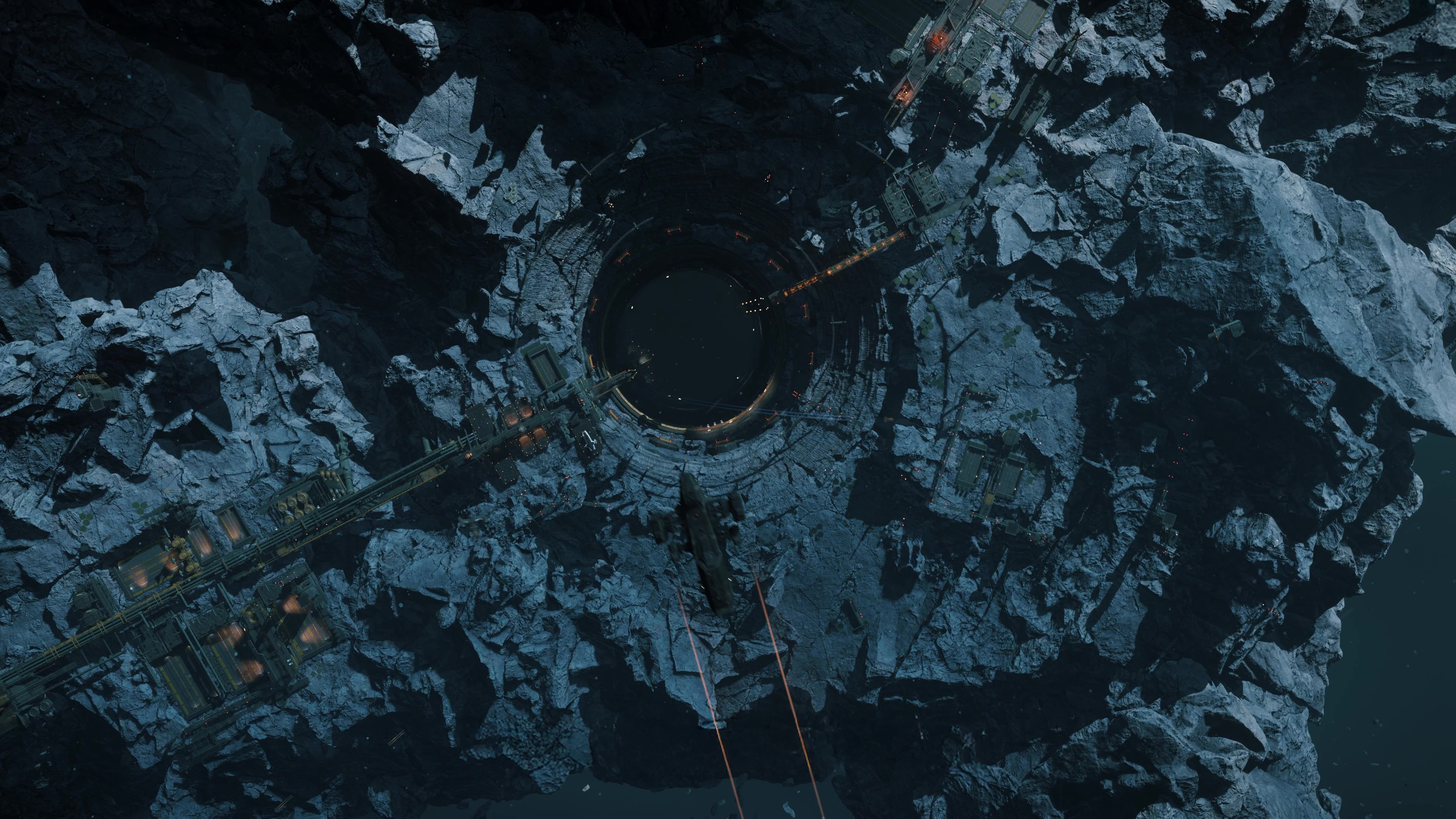
During the First Tevarin War, Persei-based UPARQ developed massive magnetic coils designed to weaponize solar electromagnetic radiation. Though the project failed, UPARQ realized the coils could be an ideal method to collect power in the Banshee System. It wasn’t long before autonomous drilling rigs, powered by panels of these connected coils, bored into Lorona’s surface and allowed Humanity a place to hide from the pulsar’s effects. Today Lorona’s landing zones are lined with these iconic coils that power the vast settlements and mining operations beneath the planet’s surface.
TRAVEL WARNING
Refuel and run a complete system diagnosis on your ship prior to entering the Banshee System. Due to the extremely harsh conditions and pulsar fluctuations, rescue and repair operations can be exceedingly risky.
BANSHEE I
This small dwarf planet contains small pockets of mineral resources. However, its proximity to the pulsar makes extracting them a deadly proposition.
BANSHEE II
A terrestrial planet with an iron core. Documents released during the Historical Truth Act of 2941 revealed that a secret Messer era operation removed a number of specific swaths of the planet’s heavily irradiated surface. The intention of the operation, or what was done with the extracted sections, was not found within the documentation and remains unknown to this day.
BANSHEE III (Lorona)
Were it not for the vast resources of Lorona, many say the UEE would never have claimed the Banshee System. Today, it’s an essential and irreplaceable part of the universal supply chain. Extensive mining operations extract everything from precious metals to short carbon for the diamond laminate in cockpit glass.
The planet’s riches and inhospitable surface have driven Humanity to create a vast system of underground settlements connected by tunnels, a network that continues to expand to this day. When mining operations begin drilling and excavating new areas, the previous dig sites frequently become home to settlements of workers and their families. Some of these encampments want to trade with outsiders, while others prefer to be left alone. To avoid any confusion, we recommend not venturing into the tunnel system without a local guide.
Once deep enough underground to not have to wear radiation suits, or “Below the Line” in local slang, visitors spend most of their time in Kesseli, the capital and one of the largest subterranean cities in the universe. Though still a mining settlement at its core, the amount a valuable resources moving through the city have brought a measure of wealth to the inhabitants.
Under a ubiquitous layer of dust, numerous Empire-wide franchises have a presence here to supply locals, traders and visitors alike. One can even find high-end restaurants servicing well-paid mining executives. Lorona’s local culinary treasure is undoubtedly the Beutrempe, a sweet or savory puff pastry that uses a yeast strain native to the world to give a uniquely tangy taste. These delicious delicacies are on the menus of most restaurants, but can more easily be found baked in stalls set up near the most trafficked tunnels.
BANSHEE IV
In the 27th century, the Cenote Concern undertook an ambitious business plan to turn this distantly orbiting ice giant into an industrial source of heavy water. The plan famously failed and subsequently drove the company out of business.
HEARD IN THE WIND
“Haulers take heed or the death for which this Banshee keens will be your own.”
– Old Folk Saying
“Take the worst, most awful place in the ’verse, and you can be damn sure there’s not only someone who wants to live there, but who will think you’re crazy for wanting to live anywhere else. These are my people.”
– Senator Junger Ries, Lorona, address to constituent dinner, 2943
Galaktischer Leitfaden: Banshee-System
BANSHEE-SYSTEM
Die Menschheitsgeschichte ist eine Geschichte der Erforschung und Erweiterung, geschrieben von mutigen Individuen, die bereit sind, Segel über ein unbekanntes Meer zu setzen oder einen unbekannten Sprungpunkt zu erreichen, angetrieben von der Neugierde auf das, was direkt am Horizont existiert. Nicht fragen, ob sie dorthin gehen sollen, sondern nur, wenn sie es können. Das Banshee-System veranschaulicht die Fähigkeit der Menschheit, die Hindernisse der Natur zu überwinden. In seinem Zentrum befindet sich ein Pulsar, der genügend Strahlung ausspuckt, um die Planetenoberflächen der grünen Zone des Systems unwirtlich zu machen. Viele alltägliche Aktivitäten, wie das EVAing außerhalb eines Schiffes, um Reparaturen durchzuführen, können tödlich sein. Dennoch hat die Menschheit einen Weg gefunden, das System als Zuhause zu bezeichnen. Vielleicht nicht, weil es das sollte, sondern weil es das könnte.
Banshees Pulsar ist ein schnell rotierender blau-weißer Neutronenstern. Obwohl es viele Pulsare im Universum gibt, ist Banshees der einzige, der bisher entdeckt wurde, mit Sprungbrettern, die mit ihm verbunden sind. Diese Tatsache hat einige Wissenschaftler zu der Annahme veranlasst, dass die Nähe der Sprungbretter zu einem Pulsar letztendlich zu ihrem Zusammenbruch führen und das System vom weiteren Universum abschneiden könnte. Diese Angst durchdringt die Populärkultur, obwohl die Entdeckung des Banshee-Tamsa-Sprungs durch 2943 das System zu einem der am stärksten vernetzten in der UEE gemacht hat; nur Terra und Hadrian sind derzeit mit mehr Systemen verbunden.
Dennoch sind Gefahr und das Banshee-System seit seiner Entdeckung im Jahr 2317 ein Synonym. Damals wimmelte das Fora-System von Auftragnehmern, die auf Terraform Hyperion einbrachten. Unter der Leitung von Adaliz Dayan beschlossen einige abenteuerlustige Personen, ihre Freizeit damit zu verbringen, das System zu erkunden. Die Gruppe nannte sich selbst die Immram Association und die Erkundung wurde zu einer beliebten Möglichkeit für die Arbeiter, ihre Freizeit zwischen den Schichten zu genießen. Eines Tages hoben Dayans Scans eine mysteriöse Tasche mit Strahlung in der Mitte des Weltraums auf. Sie schickte einen Befehl an ihre Kollegen von der IA, um die Anomalie zu untersuchen. Als die anderen ankamen, war Dayan weg.
IA-Mitglieder nahmen an, dass Dayan einen neuen Sprungpunkt gefunden hatte, konnten ihn aber nicht selbst finden; als sie nicht wieder auftauchte, wurden sie bald besorgt und kontaktierten die Regierung. Schließlich wurde eine militärische Pfadfindereinheit zu ihren Koordinaten geschickt, um eine Suche zu starten. Als sie schließlich den Sprungpunkt entdeckten, wartete auf der anderen Seite das so genannte Banshee-System mit seinem Strahlungsspeipulsar.
Leider wurden Adaliz Dayan und ihr Schiff nie gefunden. Es wird angenommen, dass sie durch eine Pulsarfahne umgekommen ist und dass ihr Schiff immer noch durch den Weltraum driftet. Im Bewusstsein ihres Opfers wurde Dayan die Entdeckung des Systems zugeschrieben, und die Immram Association erlaubte, es zu benennen. Sie einigten sich auf den Spitznamen Dayan, der während ihrer College-Sataballzeit verdient wurde, und das System wurde offiziell zu Banshee - ein doppelt passender Titel, da die Assoziation mit der alten Kreatur des Mythos gut dazu diente, die Menschen vor den Gefahren des Systems zu warnen.
Angesichts der Gefahren, die das Banshee-System und sein Pulsar für die Öffentlichkeit darstellten, kündigte die Regierung seine Entdeckung nicht an. Sie verabschiedeten sogar ein Gesetz, das es illegal machte, dass nicht autorisierte Schiffe in das System eindringen konnten. Die Spannungen spitzelten sich Anfang des 26. Jahrhunderts zu, als die Überbelegung der Erde ein katastrophales Niveau erreichte. Ein Rechtsstreit brach aus, ob die Regierung das Recht hatte, Menschen aus einem System zu verbannen. Viele befürchteten, dass eine zukünftige Regierung diese Macht missbrauchen könnte, um wertvolles Land und/oder Mineralien zu verstecken.
Dies führte zu dem richtungsweisenden Gerichtsverfahren Minto gegen UPE, das das permanente Verbot der Regierung aufhob. Die Entscheidung öffnete das Banshee-System für alle, und ist auch der Grund, warum die UEE die Menschen rechtlich nicht davon abhalten kann, sich in den Vanduuler Raum zu wagen.
Neugierige Mitglieder der Öffentlichkeit und zahlreiche private Interessen traten in das System ein und sahen schnell, dass sie nicht viel verpassten. Obwohl es auf Lorona (Banshee III) massive Rohstoffvorkommen gab, konnte niemand herausfinden, wie man sie sicher gewinnen kann. Bis, wie schon mehrfach in der Menschheitsgeschichte, der Krieg die Technologie an eine neue Grenze katapultierte.
Während des Ersten Tevarin-Krieges entwickelte die in Persei ansässige Firma UPARQ massive Magnetspulen zur Bewaffnung der elektromagnetischen Sonneneinstrahlung. Obwohl das Projekt fehlschlug, erkannte UPARQ, dass die Spulen eine ideale Methode sein könnten, um Strom im Banshee-System zu sammeln. Es dauerte nicht lange, bis autonome Bohrgeräte, die von Platten dieser verbundenen Spulen angetrieben wurden, in Loronas Oberfläche gebohrt wurden und der Menschheit einen Platz boten, um sich vor den Auswirkungen des Pulsars zu verstecken. Heute sind die Landezonen Loronas von diesen ikonischen Windungen gesäumt, die die riesigen Siedlungen und Minenbetriebe unter der Erdoberfläche antreiben.
REISEWARNUNG
Betanken und führen Sie eine komplette Systemdiagnose auf Ihrem Schiff durch, bevor Sie in das Banshee-System eintreten. Aufgrund der extrem rauen Bedingungen und Pulsarschwankungen können Rettungs- und Reparaturarbeiten äußerst riskant sein.
BANSHEE I
Dieser kleine Zwergplanet enthält kleine Taschen mit Bodenschätzen. Die Nähe zum Pulsar macht die Gewinnung jedoch zu einem tödlichen Unterfangen.
BANSHEE II
Ein irdischer Planet mit einem Eisenkern. Dokumente, die während des Historical Truth Act von 2941 veröffentlicht wurden, enthüllten, dass eine geheime Operation aus der Messerzeit eine Reihe spezifischer Schwaden der stark bestrahlten Oberfläche des Planeten entfernt hat. Die Absicht der Operation oder was mit den extrahierten Abschnitten gemacht wurde, wurde in der Dokumentation nicht gefunden und ist bis heute unbekannt.
BANSHEE III (Lorona)
Ohne die enormen Ressourcen von Lorona hätten viele sagen, dass die UEE nie das Banshee-System beansprucht hätte. Heute ist es ein wesentlicher und unersetzlicher Bestandteil der universellen Lieferkette. Umfangreiche Bergbauarbeiten gewinnen alles von Edelmetallen bis hin zu kurzem Kohlenstoff für das Diamantlaminat im Cockpitglas.
Der Reichtum und die unwirtliche Oberfläche des Planeten haben die Menschheit dazu veranlasst, ein riesiges System von unterirdischen Siedlungen zu schaffen, die durch Tunnel miteinander verbunden sind, ein Netzwerk, das bis heute weiter wächst. Wenn der Bergbau mit dem Bohren und Ausheben neuer Gebiete beginnt, werden die bisherigen Ausgrabungsstätten häufig zur Heimat von Siedlungen von Arbeitern und ihren Familien. Einige dieser Lager wollen mit Außenstehenden Handel treiben, während andere lieber allein gelassen werden. Um Verwirrung zu vermeiden, empfehlen wir, sich nicht ohne lokale Führung in das Tunnelsystem zu begeben.
Einmal tief genug unter der Erde, um keine Strahlenanzüge tragen zu müssen, oder "Below the Line" im lokalen Slang, verbringen die Besucher die meiste Zeit in Kesseli, der Hauptstadt und einer der größten unterirdischen Städte des Universums. Obwohl es sich im Kern immer noch um eine Bergbau-Siedlung handelt, hat der Betrag, den wertvolle Ressourcen durch die Stadt transportieren, den Bewohnern ein gewisses Maß an Reichtum gebracht.
Unter einer allgegenwärtigen Staubschicht sind hier zahlreiche empireweite Franchiseunternehmen präsent, um Einheimische, Händler und Besucher gleichermaßen zu versorgen. Man findet sogar High-End-Restaurants, die gut bezahlte Bergleute bedienen. Loronas kulinarischer Schatz ist zweifellos die Beutrempe, ein süßes oder pikantes Blätterteiggebäck, das eine weltweit heimische Hefesorte verwendet, um einen einzigartig würzigen Geschmack zu verleihen. Diese köstlichen Köstlichkeiten stehen auf der Speisekarte der meisten Restaurants, können aber leichter in Ständen in der Nähe der meistverkauften Tunnel gebacken gefunden werden.
BANSHEE IV
Im 27. Jahrhundert unternahm der Cenote-Konzern einen ehrgeizigen Geschäftsplan, um diesen weit entfernten Eisriesen zu einer industriellen Quelle für Schwerwasser zu machen. Der Plan scheiterte bekanntlich und führte dazu, dass das Unternehmen aus dem Geschäft ausstieg.
IM WIND GEHÖRT
"Schlepper achten auf den Tod, für den dieser Banshee scharf ist, und du wirst ihn bekommen."
- Alte Leute sagen
"Nimm den schlimmsten, schrecklichsten Ort in der Strophe, und du kannst verdammt sicher sein, dass es nicht nur jemanden gibt, der dort leben will, sondern der dich für verrückt hält, weil du woanders leben willst. Das sind meine Leute."
- Senatorin Junger Ries, Lorona, Ansprache vor dem konstituierenden Abendessen, 2943
Galactic Guide: Banshee System
BANSHEE SYSTEM
Human history is a story of exploration and expansion, written by brave individuals willing to set sail across an uncharted sea or enter an unknown jump point, each driven by the curiosity of what exists just over the horizon. Not asking if they should go there, but only if they could. The Banshee System exemplifies Humanity’s ability to overcome nature’s obstacles. At its center sits a pulsar, spewing enough radiation to make the system’s green zone planetary surfaces inhospitable. Many commonplace activities, like EVAing outside of a ship to perform repairs, can be deadly. Yet Humanity has found a way to call the system home. Maybe not because it should, but because it could.
Banshee’s pulsar is a rapidly rotating blue-white neutron star. Though there are many pulsars in the universe, Banshee’s is the only one discovered so far with jump points connected to it. This fact has led some scientists to hypothesize that the jump points’ proximity to a pulsar could eventually lead to their collapse and cut off the system from the wider universe. This fear permeates popular culture, despite the fact that the 2943 discovery of the Banshee-Tamsa jump has made the system one of the most connected in the UEE.
Still, danger and the Banshee System have been synonymous since its discovery in 2317. At the time, the Fora System was crawling with contractors brought in to terraform Hyperion. Spearheaded by Adaliz Dayan, a number of adventurous individuals decided to spend their free time exploring the system. The group dubbed themselves the Immram Association and exploration became a popular way for workers to enjoy their free time between shifts. One day, Dayan’s scans picked up a mysterious pocket of radiation in the middle of space. She sent a comm to her fellow IA members to investigate the anomaly. By the time others arrived, Dayan was gone.
IA members assumed Dayan had found a new jump point, but were unable to locate it themselves; when she didn’t re-emerge, they soon grew concerned and contacted the government. Eventually, a military pathfinder unit was dispatched to her coordinates to begin a search. When they finally discovered the jump point, what would come to be known as the Banshee System and its radiation spewing pulsar waited on the other side.
Sadly, Adaliz Dayan and her ship were never found. It is assumed she perished due to a pulsar flare and that her ship still drifts through space. Conscious of her sacrifice, Dayan was credited with discovering the system, and the Immram Association allowed to name it. They settled on the nickname Dayan earned during her college Sataball days and the system formally became Banshee — a doubly fitting title as the association with the ancient creature of myth served well to warn people of the system’s inherent dangers.
Wary of the hazards the Banshee System and its pulsar posed to the public, the government didn’t herald its discovery. They even passed a bill making it illegal for unauthorized ships to enter the system. Tensions came to a head in the early 26th century as Earth’s overcrowding reached cataclysmic levels. A legal argument erupted over whether the government had the right to ban people from a system. Many worried a future government could abuse this power to hide valuable land and/or minerals.
This led to the landmark Minto vs UPE court case that nullified the government’s permanent ban. The decision opened the Banshee System to all, and is also the reason the UEE cannot legally keep people from venturing into Vanduul space.
Curious members of the public, and numerous private interests, entered the system and quickly saw they weren’t missing much. Though massive deposits of raw materials existed on Lorona (Banshee III) no one could figure out how to safely extract them. Until, as has been the case numerous times in Human history, war catapulted technology to a new frontier.
During the First Tevarin War, Persei-based UPARQ developed massive magnetic coils designed to weaponize solar electromagnetic radiation. Though the project failed, UPARQ realized the coils could be an ideal method to collect power in the Banshee System. It wasn’t long before autonomous drilling rigs, powered by panels of these connected coils, bored into Lorona’s surface and allowed Humanity a place to hide from the pulsar’s effects. Today Lorona’s landing zones are lined with these iconic coils that power the vast settlements and mining operations beneath the planet’s surface.
TRAVEL WARNING
Refuel and run a complete system diagnosis on your ship prior to entering the Banshee System. Due to the extremely harsh conditions and pulsar fluctuations, rescue and repair operations can be exceedingly risky.
BANSHEE I
This small dwarf planet contains small pockets of mineral resources. However, its proximity to the pulsar makes extracting them a deadly proposition.
BANSHEE II
A terrestrial planet with an iron core. Documents released during the Historical Truth Act of 2941 revealed that a secret Messer era operation removed a number of specific swaths of the planet’s heavily irradiated surface. The intention of the operation, or what was done with the extracted sections, was not found within the documentation and remains unknown to this day.
BANSHEE III (Lorona)
Were it not for the vast resources of Lorona, many say the UEE would never have claimed the Banshee System. Today, it’s an essential and irreplaceable part of the universal supply chain. Extensive mining operations extract everything from precious metals to short carbon for the diamond laminate in cockpit glass.
The planet’s riches and inhospitable surface have driven Humanity to create a vast system of underground settlements connected by tunnels, a network that continues to expand to this day. When mining operations begin drilling and excavating new areas, the previous dig sites frequently become home to settlements of workers and their families. Some of these encampments want to trade with outsiders, while others prefer to be left alone. To avoid any confusion, we recommend not venturing into the tunnel system without a local guide.
Once deep enough underground to not have to wear radiation suits, or “Below the Line” in local slang, visitors spend most of their time in Kesseli, the capital and one of the largest subterranean cities in the universe. Though still a mining settlement at its core, the amount a valuable resources moving through the city have brought a measure of wealth to the inhabitants.
Under a ubiquitous layer of dust, numerous Empire-wide franchises have a presence here to supply locals, traders and visitors alike. One can even find high-end restaurants servicing well-paid mining executives. Lorona’s local culinary treasure is undoubtedly the Beutrempe, a sweet or savory puff pastry that uses a yeast strain native to the world to give a uniquely tangy taste. These delicious delicacies are on the menus of most restaurants, but can more easily be found baked in stalls set up near the most trafficked tunnels.
BANSHEE IV
In the 27th century, the Cenote Concern undertook an ambitious business plan to turn this distantly orbiting ice giant into an industrial source of heavy water. The plan famously failed and subsequently drove the company out of business.
HEARD IN THE WIND
“Haulers take heed or the death for which this Banshee keens will be your own.”
– Old Folk Saying
“Take the worst, most awful place in the ’verse, and you can be damn sure there’s not only someone who wants to live there, but who will think you’re crazy for wanting to live anywhere else. These are my people.”
– Senator Junger Ries, Lorona, address to constituent dinner, 2943
Galactic Guide: Banshee System
BANSHEE SYSTEM
Human history is a story of exploration and expansion, written by brave individuals willing to set sail across an uncharted sea or enter an unknown jump point, each driven by the curiosity of what exists just over the horizon. Not asking if they should go there, but only if they could. The Banshee System exemplifies Humanity’s ability to overcome nature’s obstacles. At its center sits a pulsar, spewing enough radiation to make the system’s green zone planetary surfaces inhospitable. Many commonplace activities, like EVAing outside of a ship to perform repairs, can be deadly. Yet Humanity has found a way to call the system home. Maybe not because it should, but because it could.
Banshee’s pulsar is a rapidly rotating blue-white neutron star. Though there are many pulsars in the universe, Banshee’s is the only one discovered so far with jump points connected to it. This fact has led some scientists to hypothesize that the jump points’ proximity to a pulsar could eventually lead to their collapse and cut off the system from the wider universe. This fear permeates popular culture, despite the fact that the 2943 discovery of the Banshee-Tamsa jump has made the system one of the most connected in the UEE.
Still, danger and the Banshee System have been synonymous since its discovery in 2317. At the time, the Fora System was crawling with contractors brought in to terraform Hyperion. Spearheaded by Adaliz Dayan, a number of adventurous individuals decided to spend their free time exploring the system. The group dubbed themselves the Immram Association and exploration became a popular way for workers to enjoy their free time between shifts. One day, Dayan’s scans picked up a mysterious pocket of radiation in the middle of space. She sent a comm to her fellow IA members to investigate the anomaly. By the time others arrived, Dayan was gone.
IA members assumed Dayan had found a new jump point, but were unable to locate it themselves; when she didn’t re-emerge, they soon grew concerned and contacted the government. Eventually, a military pathfinder unit was dispatched to her coordinates to begin a search. When they finally discovered the jump point, what would come to be known as the Banshee System and its radiation spewing pulsar waited on the other side.
Sadly, Adaliz Dayan and her ship were never found. It is assumed she perished due to a pulsar flare and that her ship still drifts through space. Conscious of her sacrifice, Dayan was credited with discovering the system, and the Immram Association allowed to name it. They settled on the nickname Dayan earned during her college Sataball days and the system formally became Banshee — a doubly fitting title as the association with the ancient creature of myth served well to warn people of the system’s inherent dangers.
Wary of the hazards the Banshee System and its pulsar posed to the public, the government didn’t herald its discovery. They even passed a bill making it illegal for unauthorized ships to enter the system. Tensions came to a head in the early 26th century as Earth’s overcrowding reached cataclysmic levels. A legal argument erupted over whether the government had the right to ban people from a system. Many worried a future government could abuse this power to hide valuable land and/or minerals.
This led to the landmark Minto vs UPE court case that nullified the government’s permanent ban. The decision opened the Banshee System to all, and is also the reason the UEE cannot legally keep people from venturing into Vanduul space.
Curious members of the public, and numerous private interests, entered the system and quickly saw they weren’t missing much. Though massive deposits of raw materials existed on Lorona (Banshee III) no one could figure out how to safely extract them. Until, as has been the case numerous times in Human history, war catapulted technology to a new frontier.
During the First Tevarin War, Persei-based UPARQ developed massive magnetic coils designed to weaponize solar electromagnetic radiation. Though the project failed, UPARQ realized the coils could be an ideal method to collect power in the Banshee System. It wasn’t long before autonomous drilling rigs, powered by panels of these connected coils, bored into Lorona’s surface and allowed Humanity a place to hide from the pulsar’s effects. Today Lorona’s landing zones are lined with these iconic coils that power the vast settlements and mining operations beneath the planet’s surface.
TRAVEL WARNING
Refuel and run a complete system diagnosis on your ship prior to entering the Banshee System. Due to the extremely harsh conditions and pulsar fluctuations, rescue and repair operations can be exceedingly risky.
BANSHEE I
This small dwarf planet contains small pockets of mineral resources. However, its proximity to the pulsar makes extracting them a deadly proposition.
BANSHEE II
A terrestrial planet with an iron core. Documents released during the Historical Truth Act of 2941 revealed that a secret Messer era operation removed a number of specific swaths of the planet’s heavily irradiated surface. The intention of the operation, or what was done with the extracted sections, was not found within the documentation and remains unknown to this day.
BANSHEE III (Lorona)
Were it not for the vast resources of Lorona, many say the UEE would never have claimed the Banshee System. Today, it’s an essential and irreplaceable part of the universal supply chain. Extensive mining operations extract everything from precious metals to short carbon for the diamond laminate in cockpit glass.
The planet’s riches and inhospitable surface have driven Humanity to create a vast system of underground settlements connected by tunnels, a network that continues to expand to this day. When mining operations begin drilling and excavating new areas, the previous dig sites frequently become home to settlements of workers and their families. Some of these encampments want to trade with outsiders, while others prefer to be left alone. To avoid any confusion, we recommend not venturing into the tunnel system without a local guide.
Once deep enough underground to not have to wear radiation suits, or “Below the Line” in local slang, visitors spend most of their time in Kesseli, the capital and one of the largest subterranean cities in the universe. Though still a mining settlement at its core, the amount a valuable resources moving through the city have brought a measure of wealth to the inhabitants.
Under a ubiquitous layer of dust, numerous Empire-wide franchises have a presence here to supply locals, traders and visitors alike. One can even find high-end restaurants servicing well-paid mining executives. Lorona’s local culinary treasure is undoubtedly the Beutrempe, a sweet or savory puff pastry that uses a yeast strain native to the world to give a uniquely tangy taste. These delicious delicacies are on the menus of most restaurants, but can more easily be found baked in stalls set up near the most trafficked tunnels.
BANSHEE IV
In the 27th century, the Cenote Concern undertook an ambitious business plan to turn this distantly orbiting ice giant into an industrial source of heavy water. The plan famously failed and subsequently drove the company out of business.
HEARD IN THE WIND
“Haulers take heed or the death for which this Banshee keens will be your own.”
– Old Folk Saying
“Take the worst, most awful place in the ’verse, and you can be damn sure there’s not only someone who wants to live there, but who will think you’re crazy for wanting to live anywhere else. These are my people.”
– Senator Junger Ries, Lorona, address to constituent dinner, 2943
Links
No links available.
Images
4


Metadata
- CIG ID
- 15393
- Channel
- Spectrum Dispatch
- Category
- Undefined
- Series
- Galactic Guide
- Comments
- 78
- Published
- 10 years ago (2016-06-22T00:00:00+00:00)