DISCOVERED
Spectrum Dispatch Undefined News UpdateContent
While many of our features here at Discovered focus on explorers who dive bravely into the unknown, we would be remiss if we did not also take the time to focus on those individuals who unearth greatness right in our own backyard. This was the case in 2944 when scanner-turned-amateur archaeologist, Kamelia Ganesh, unearthed an incredible find in Croshaw, the Empire’s earliest system outside of Sol.
The following are excerpts from an oral history recorded by the Mōhio Museum in Kevric City, Angeli.
Kamelia Ganesh: A small mining outfit had picked up a claim in the Icarus Cluster [Croshaw Cluster Beta] and had hired me to do their deep sweep. I had been scanning the area for about two straight months. They were the types who prospected picked-over sites after the easy money had already been squeezed out. A lot of independent operations don’t think it’s worth going after the more difficult veins, and most of the time, they’re right. However, if you invest in the proper hardware, and you get a damn good scanner on your payroll — aka moi — to make sure that you don’t waste your time, then well, there are some creds to be made. Now, being that this was Croshaw, the claim had been turned over more times than a by-the-hour hab in Jele, so I had to go real thorough. That kind of scanning takes discipline. When you’re crawling along, meter by meter, it gets real tempting to start cutting corners, but that’s what separates the pros from the enthusiasts. Probably why I was the first one to ever pick up the signal.
Two days before she was scheduled to complete her work, Kamelia detected a faint signal from within one of the smaller fringe asteroids.
Kamelia Ganesh: Didn’t know what to make of it at first. Almost ignored the damn thing to be honest. But it had been a good week and I had found a particularly thick run winding its way through the core of a recently cracked asteroid. That find alone was more than enough to pay for the whole operation, so I figured I could take a little break to satisfy my curiosity. Comes with being a scanner, I guess. Never could just leave well enough alone.
The signal was barely there and it kept fading in and out, so trying to lock onto the source was a real chore. By the time I started to home in on it, I had figured out that the garbled mess was repeating regularly. Since it had a pattern to it, that ruled out some weird EM coming off a floater or the like. Started having fantasies of discovering some weird alien device. My heart nearly leapt out of my suit when I spotted that dim red blinking light.
As soon as it came into view, I knew I had found something almost as good as aliens. There was no mistaking that can shape. It was an emergency beacon for sure. But from the way it was embedded in the asteroid, almost like it was part of the rock, it had to be old. Really, really old.
Determined to learn more about her strange discovery, she reached out to an expert, Professor Scott McGonigal at the Mōhio Museum.
Professor McGonigal: The beacon alone was quite the find and I eagerly accepted when Ms. Ganesh generously offered to let the Museum have it if I would help her understand the signal it had been broadcasting. Together we set to work to unravel its secrets.
The emergency beacon had been badly worn by time. The power cells were barely holding a charge, its casing had been severely corroded, and the electronics were near complete deterioration from exposure, so it was a slight miracle that it was still able to broadcast at all. My initial estimates based on the rate of decay placed the object at least over half a millennium old. Working inside our lab’s zero-G preservation tanks, we managed to recover from the heavily damaged memory bank a partial registration number and launch coordinates.
I scoured the registration archives to see if I could uncover the identity of the missing ship that had launched the beacon, while Ms. Ganesh investigated the coordinates.
Kamelia Ganesh: The coordinates were always going to be a bit of a long shot. Not only were they incomplete, but without knowing when they were recorded, the extrapolated position could be anywhere in a huge swath of the system. Rolling back my starmap, I traced a route along centuries of possibilities but I didn’t turn up anything. I didn’t want to admit that we’d hit a dead end, but with the fact that the wreckage would be most likely be completely powered down as well as the fact that it could have just drifted away, I knew stumbling across whoever sent the beacon would be next to impossible.
Professor McGonigal: Despite the archives turning up numerous possible matches for the partial registration number, none of them fit the profile we were looking for. Any of the more recent ships of course were ruled out, as were all the ships who had been noted as successfully retired. After weeks of tracing the histories of the remaining candidates, it seemed that the ship from which our beacon had originated simply did not exist in the records. Sadly, I had to give up the search and return to my duties here at the museum.
With their leads seemingly exhausted, the pair’s search had come to a disappointing conclusion. As a consolation, Professor McGonigal invited Kamelia to attend the unveiling of the exhibit that would become the beacon’s new home.
Professor McGonigal: We had incorporated the beacon into our History of Spaceflight wing. It was placed alongside several other notable emergency beacons that had been recovered during Humanity’s expansion throughout the stars. As a curator, I couldn’t be more pleased that its inclusion in the exhibit is what gave us our most important revelation.
Kamelia Ganesh: The laser etching had been mostly worn away on the outside, but there were still a few marks here and there. One of them we had taken to be the remnants of a UNE crest, since the patterns were about the same, but seeing it next to another beacon with a similar marking, I noticed that it was a little bit off.
Professor McGonigal: Bless her scanning skills, because I don’t know many experts who would have picked up on the discrepancy. But once she pointed it out, it was plain as day. The crest wasn’t for the United Nations of Earth at all. It was in fact the very similar but distinct crest of the old Earth North American Alliance. The beacon was even older than we had thought.
The NAA crest hadn’t been used since the mid-23rd century, which meant that the beacon Kamelia had discovered dated back to Humanity’s earliest years of spaceflight. But what was it doing all the way out in Croshaw?
Professor McGonigal: With this new information in hand, it began to make sense why I was unable to find the ship in the registration archives. Knowing that the ship should be in the NAA records, I traveled to the University of Rhetor to access their datastore library directly. Sure enough, by re-configuring the alphanumeric sequence into the NAA format, we got a hit. What Ms. Ganesh had discovered was an actual emergency beacon from one of the first ships to ever travel through a jump point, the Goodman.
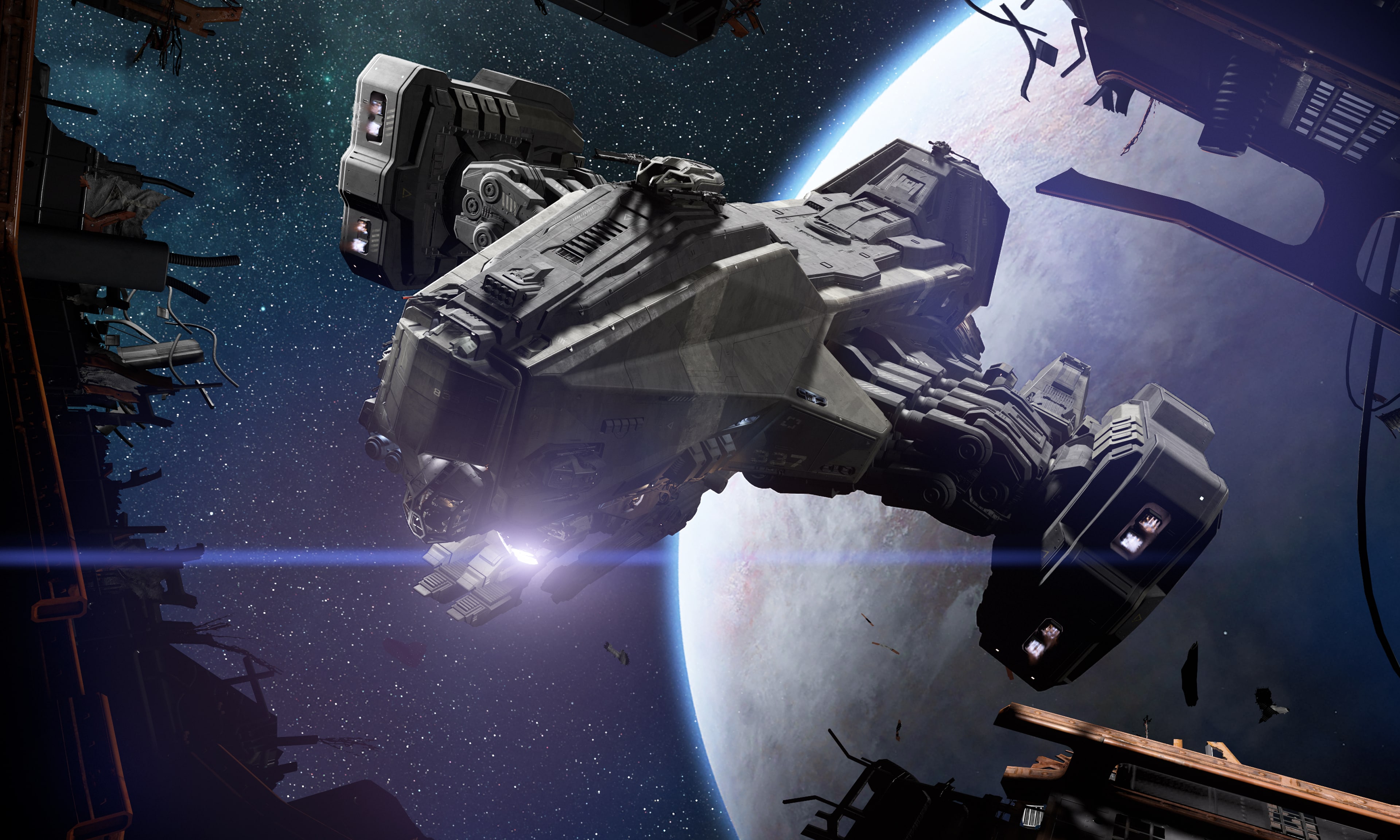
Outside of the Artemis, the Goodman was one of Humanity’s greatest unsolved mysteries. A Type-IV cargo vessel, it had in August of 2262 embarked on a supply run to a station in orbit around Sol VIII. The ship never arrived. Disappearing without a trace, the poor vessel and the eight souls aboard were victims of a phenomenon known then as the Neso Triangle, and what we know today as the Sol-Croshaw jump point.
Professor McGonigal: Researchers have been trying to locate the Goodman since Humans first explored Croshaw in earnest, and some seven hundred years later, Ms. Ganesh had found a major piece of the puzzle. Incredible.
Kamelia Ganesh: Talk about an a-ha! moment. That’s why the coordinates didn’t make sense. They weren’t incomplete, they were for a whole different system. See, since interstellar coordinates hadn’t been put into effect at the time, the Goodman had been forced to relay their emergency position using the old Sol mapping method. Can you imagine how confused the Goodman must have been when they got sucked through and saw a different sun?
I immediately flew back to Croshaw and began the search again. This time, with the starmap set to 2262 and the coordinates transposed from the Sol-method into our current standards, I was able to pinpoint where the Goodman had launched the beacon. Starting there and figuring that the ship must have drifted away from any of the usual flight lanes to have avoided detection for so long, I began doing what I do best, scanning. It took me a while, but the best things worth doing usually do. After weeks of looking, my scanner lit up as I detected the Goodman’s cross-signature and damn it all if it wasn’t right there in the middle of Croshaw floating peacefully in the black.
As soon as it made the press, the discovery was hailed as the archaeological find of the century. People were amazed and captivated by a piece of history that had been floating so close to them, just waiting to be discovered.
Professor McGonigal: We are still trying to piece together what happened to the Goodman’s crew once they arrived in the system, from the remains found aboard, but even if we never know the full story, the ship alone is an important piece of Humanity’s exploration of the stars.
Kamelia Ganesh: People been asking me if I’m going to switch jobs now, discover ancient wrecks full time. But to be honest, one find of a lifetime is probably enough for me. I’m just glad I got to discover a bit more of history’s story.
The Goodman is currently on display at the Mōhio Museum and there are hopes that other wrecks that disappeared through the Neso Triangle may soon be discovered in Croshaw now that archaeologists have a better idea where to look, thanks to the incredible efforts of Kamelia Ganesh.
Während sich viele unserer Features hier bei Discovered auf Entdecker konzentrieren, die tapfer in das Unbekannte eintauchen, wären wir nachlässig, wenn wir uns nicht auch die Zeit nehmen würden, uns auf diejenigen zu konzentrieren, die Größe direkt in unserem eigenen Hinterhof entdecken. Dies war der Fall, als die Amateurarchäologin Kamelia Ganesh im Jahr 2944 einen unglaublichen Fund in Croshaw, dem frühesten System des Imperiums außerhalb von Sol, fand.
Nachfolgend finden Sie Auszüge aus einer mündlichen Geschichte, die vom Mōhio Museum in Kevric City, Angeli, aufgenommen wurde.
Kamelia Ganesh: Eine kleine Minengesellschaft hatte einen Claim im Icarus Cluster[Croshaw Cluster Beta] aufgenommen und mich angeheuert, um ihre Tiefensuche durchzuführen. Ich hatte das Gebiet etwa zwei Monate lang in Folge gescannt. Sie waren die Typen, die Pick-Over-Sites suchten, nachdem das einfache Geld bereits ausgepresst worden war. Viele unabhängige Unternehmen denken nicht, dass es sich lohnt, die schwierigeren Venen zu durchbrechen, und meistens haben sie Recht. Wenn Sie jedoch in die richtige Hardware investieren und einen verdammt guten Scanner auf Ihrer Gehaltsliste haben - alias moi - um sicherzustellen, dass Sie Ihre Zeit nicht verschwenden, dann gibt es einige Punkte, die man beachten muss. Nun, da dies Croshaw war, war die Behauptung mehr als nur ein stundenlanger Aufenthalt in Jele umgedreht worden, also musste ich wirklich gründlich vorgehen. Diese Art des Scannens erfordert Disziplin. Wenn Sie Meter für Meter weiterkriechen, wird es wirklich verlockend, mit dem Schneiden von Kurven zu beginnen, aber das ist es, was die Profis von den Enthusiasten unterscheidet. Wahrscheinlich war ich deshalb der Erste, der das Signal empfangen hat.
Zwei Tage bevor sie ihre Arbeit beenden sollte, entdeckte Kamelia ein schwaches Signal aus einem der kleineren Rand-Asteroiden.
Kamelia Ganesh: Ich wusste anfangs nicht, was ich davon halten sollte. Ich habe die verdammte Sache fast ignoriert, um ehrlich zu sein. Aber es war eine gute Woche gewesen und ich hatte einen besonders dicken Lauf gefunden, der sich durch den Kern eines kürzlich geplatzten Asteroiden schlängelte. Dieser Fund allein war mehr als genug, um die ganze Operation zu bezahlen, also dachte ich, ich könnte eine kleine Pause machen, um meine Neugierde zu befriedigen. Kommt wohl daher, dass man ein Scanner ist. Ich konnte nie gut genug in Ruhe lassen.
Das Signal war kaum da und es verblasste immer wieder, so dass der Versuch, die Quelle zu erfassen, eine echte Aufgabe war. Als ich anfing, mich darauf einzulassen, hatte ich herausgefunden, dass sich das verstümmelte Chaos regelmäßig wiederholte. Da es ein Muster zu ihm hatte, schloss das ein seltsames EM aus, das von einem Floater oder dergleichen kam. Ich fing an, Fantasien zu haben, um ein seltsames außerirdisches Gerät zu entdecken. Mein Herz sprang fast aus meinem Anzug, als ich das dunkle rote blinkende Licht entdeckte.
Sobald es in Sichtweite kam, wusste ich, dass ich etwas fast so Gutes wie Außerirdische gefunden hatte. Es gab keinen Zweifel, dass sich etwas formen lässt. Es war mit Sicherheit ein Notfeuer. Aber so wie er in den Asteroiden eingebettet war, fast so, als wäre er Teil des Felsens, musste er alt sein. Wirklich, wirklich alt.
Entschlossen, mehr über ihre seltsame Entdeckung zu erfahren, wandte sie sich an einen Experten, Professor Scott McGonigal im Mōhio Museum.
Professor McGonigal: Das Leuchtfeuer allein war schon ein ziemlicher Fund und ich akzeptierte es eifrig, als Frau Ganesh großzügig anbot, es dem Museum zu überlassen, wenn ich ihr helfen würde, das Signal zu verstehen, das es gesendet hatte. Gemeinsam machen wir uns an die Arbeit, um seine Geheimnisse zu lüften.
Das Notsignal war von Zeit zu Zeit stark getragen worden. Die Kraftzellen hielten kaum eine Ladung, ihr Gehäuse war stark korrodiert, und die Elektronik war durch die Belastung fast vollständig zerstört, so dass es ein kleines Wunder war, dass sie noch überhaupt senden konnte. Meine ersten Schätzungen, die auf der Rate des Verfalls basieren, haben das Objekt mindestens über ein halbes Jahrtausend alt gemacht. In den Zero-G Konservierungstanks unseres Labors gelang es uns, von der stark beschädigten Speicherbank eine Teilregistrierungsnummer und Startkoordinaten zu erhalten.
Ich durchsuchte die Registrierungsarchive, um zu sehen, ob ich die Identität des vermissten Schiffes aufdecken konnte, das das Leuchtfeuer gestartet hatte, während Frau Ganesh die Koordinaten untersuchte.
Kamelia Ganesh: Die Koordinaten waren immer ein bisschen zu weit weg. Sie waren nicht nur unvollständig, sondern ohne zu wissen, wann sie aufgezeichnet wurden, konnte die extrapolierte Position überall in einem riesigen Bereich des Systems sein. Als ich meine Sternkarte zurückrollte, verfolgte ich eine Route entlang jahrhundertelanger Möglichkeiten, aber ich habe nichts gefunden. Ich wollte nicht zugeben, dass wir in eine Sackgasse geraten waren, aber mit der Tatsache, dass das Wrack höchstwahrscheinlich komplett abgeschaltet sein würde, und der Tatsache, dass es einfach weggetrieben sein könnte, wusste ich, dass es fast unmöglich wäre, über denjenigen zu stolpern, der das Signal gesendet hatte.
Professor McGonigal: Obwohl die Archive zahlreiche mögliche Übereinstimmungen mit der Teilregistrierungsnummer aufwiesen, passte keiner von ihnen in das von uns gesuchte Profil. Alle neueren Schiffe wurden natürlich ausgeschlossen, ebenso wie alle Schiffe, die als erfolgreich abgefahren galten. Nach wochenlanger Suche nach den Geschichten der verbleibenden Kandidaten schien es, dass das Schiff, von dem unser Leuchtfeuer stammt, einfach nicht in den Aufzeichnungen existierte. Leider musste ich die Suche aufgeben und zu meinen Aufgaben hier im Museum zurückkehren.
Da ihre Führung scheinbar erschöpft war, war die Suche des Paares zu einem enttäuschenden Ergebnis gekommen. Als Trost lud Professor McGonigal Kamelien ein, an der Enthüllung der Ausstellung teilzunehmen, die das neue Zuhause des Bakens werden sollte.
Professor McGonigal: Wir hatten das Leuchtfeuer in unsere Geschichte der Raumfahrt integriert. Es wurde neben mehreren anderen bemerkenswerten Notfallbaken platziert, die während der Expansion der Menschheit in die Sterne geborgen wurden. Als Kurator könnte ich nicht zufriedener sein, dass die Aufnahme in die Ausstellung unsere wichtigste Offenbarung war.
Kamelia Ganesh: Die Laserätzung war meist außen abgenutzt, aber es gab noch ein paar Spuren hier und da. Eines davon hatten wir als Überreste eines UNE-Wappens angesehen, da die Muster ungefähr gleich waren, aber als ich es neben einem anderen Leuchtfeuer mit einer ähnlichen Markierung sah, bemerkte ich, dass es ein wenig seltsam war.
Professor McGonigal: Segne ihre Scan-Fähigkeiten, denn ich kenne nicht viele Experten, die die Diskrepanz aufgegriffen hätten. Aber als sie darauf hinwies, war es klar wie der Tag. Das Wappen war überhaupt nicht für die Vereinten Nationen der Erde. Es war in der Tat das sehr ähnliche, aber unterschiedliche Wappen der alten Earth North American Alliance. Das Leuchtfeuer war noch älter, als wir gedacht hatten.
Das NAA-Wappen war seit Mitte des 23. Jahrhunderts nicht mehr benutzt worden, was bedeutete, dass das Leuchtfeuer, das Kamelia entdeckt hatte, aus den ersten Jahren der Raumfahrt der Menschheit stammt. Aber was hat es den ganzen Weg nach Croshaw gemacht?
Professor McGonigal: Mit diesen neuen Informationen in der Hand begann es Sinn zu machen, warum ich das Schiff nicht im Registrierungsarchiv finden konnte. In dem Wissen, dass das Schiff in den NAA-Aufzeichnungen enthalten sein sollte, reiste ich zur University of Rhetor, um direkt auf ihre Datenspeicherbibliothek zuzugreifen. Tatsächlich haben wir durch die Rekonfiguration der alphanumerischen Sequenz in das NAA-Format einen Treffer erzielt. Was Ms. Ganesh entdeckt hatte, war ein echtes Notlichtsignal von einem der ersten Schiffe, die jemals einen Sprungpunkt, die Goodman, passiert hatten.
Außerhalb der Artemis war der Goodman eines der größten ungelösten Geheimnisse der Menschheit. Als Typ-IV-Frachtschiff hatte sie im August 2262 einen Versorgungslauf zu einer Station im Orbit um Sol VIII begonnen. Das Schiff kam nie an. Das arme Schiff und die acht Seelen an Bord, die spurlos verschwanden, waren Opfer eines Phänomens, das damals als Neso-Dreieck bekannt war und das wir heute als Sol-Croshaw-Sprungpunkt kennen.
Professor McGonigal: Forscher haben versucht, den Goodman zu finden, seit die Menschen den Croshaw zum ersten Mal ernsthaft erforscht haben, und etwa siebenhundert Jahre später hatte Frau Ganesh ein großes Stück des Puzzles gefunden. Unglaublich.
Kamelia Ganesh: Sprich über einen a-ha! Moment. Deshalb haben die Koordinaten keinen Sinn ergeben. Sie waren nicht unvollständig, sie waren für ein ganz anderes System. Da die interstellaren Koordinaten zu diesem Zeitpunkt noch nicht umgesetzt waren, waren die Goodman gezwungen, ihre Notfallposition mit der alten Sol-Mapping-Methode zu übermitteln. Kannst du dir vorstellen, wie verwirrt der Goodman gewesen sein muss, als er durchgesaugt wurde und eine andere Sonne sah?
Ich flog sofort zurück nach Croshaw und begann die Suche erneut. Diesmal, mit der auf 2262 eingestellten Sternkarte und den von der Sol-Methode in unsere aktuellen Standards umgesetzten Koordinaten, konnte ich feststellen, wo der Goodman das Bake gestartet hatte. Ausgehend von dort und der Annahme, dass das Schiff von einer der üblichen Flugrouten weggetrieben sein muss, um die Erkennung so lange vermieden zu haben, begann ich das zu tun, was ich am besten kann: zu scannen. Es hat eine Weile gedauert, aber die besten Dinge, die es wert sind, getan zu werden, tun es normalerweise. Nach wochenlangem Suchen leuchtete mein Scanner auf, als ich die Kreuzunterschrift des Goodman entdeckte und alles verfluchte, wenn es nicht genau dort mitten in Croshaw war, das friedlich in Schwarz schwebte.
Sobald es in die Presse kam, wurde die Entdeckung als der archäologische Fund des Jahrhunderts gefeiert. Die Menschen waren erstaunt und fasziniert von einem Stück Geschichte, das so nah an ihnen schwebte und nur darauf wartete, entdeckt zu werden.
Professor McGonigal: Wir versuchen immer noch, das, was mit der Goodman's Crew passiert ist, nachdem sie im System angekommen ist, von den Überresten an Bord zusammenzusetzen, aber selbst wenn wir nie die ganze Geschichte kennen, ist das Schiff allein ein wichtiges Stück der Erforschung der Sterne durch die Menschheit.
Kamelia Ganesh: Die Leute fragten mich, ob ich jetzt den Job wechseln und alte Wracks in Vollzeit entdecken werde. Aber um ehrlich zu sein, ein Fund des Lebens reicht mir wahrscheinlich aus. Ich bin nur froh, dass ich etwas mehr von der Geschichte der Geschichte entdecken konnte.
Der Goodman ist derzeit im Museum Mōhio ausgestellt und es besteht die Hoffnung, dass bald weitere Wracks, die durch das Neso-Dreieck verschwunden sind, in Croshaw entdeckt werden können, nachdem Archäologen dank der unglaublichen Bemühungen von Kamelia Ganesh eine bessere Idee haben, wohin sie schauen sollen.
While many of our features here at Discovered focus on explorers who dive bravely into the unknown, we would be remiss if we did not also take the time to focus on those individuals who unearth greatness right in our own backyard. This was the case in 2944 when scanner-turned-amateur archaeologist, Kamelia Ganesh, unearthed an incredible find in Croshaw, the Empire’s earliest system outside of Sol.
The following are excerpts from an oral history recorded by the Mōhio Museum in Kevric City, Angeli.
Kamelia Ganesh: A small mining outfit had picked up a claim in the Icarus Cluster [Croshaw Cluster Beta] and had hired me to do their deep sweep. I had been scanning the area for about two straight months. They were the types who prospected picked-over sites after the easy money had already been squeezed out. A lot of independent operations don’t think it’s worth going after the more difficult veins, and most of the time, they’re right. However, if you invest in the proper hardware, and you get a damn good scanner on your payroll — aka moi — to make sure that you don’t waste your time, then well, there are some creds to be made. Now, being that this was Croshaw, the claim had been turned over more times than a by-the-hour hab in Jele, so I had to go real thorough. That kind of scanning takes discipline. When you’re crawling along, meter by meter, it gets real tempting to start cutting corners, but that’s what separates the pros from the enthusiasts. Probably why I was the first one to ever pick up the signal.
Two days before she was scheduled to complete her work, Kamelia detected a faint signal from within one of the smaller fringe asteroids.
Kamelia Ganesh: Didn’t know what to make of it at first. Almost ignored the damn thing to be honest. But it had been a good week and I had found a particularly thick run winding its way through the core of a recently cracked asteroid. That find alone was more than enough to pay for the whole operation, so I figured I could take a little break to satisfy my curiosity. Comes with being a scanner, I guess. Never could just leave well enough alone.
The signal was barely there and it kept fading in and out, so trying to lock onto the source was a real chore. By the time I started to home in on it, I had figured out that the garbled mess was repeating regularly. Since it had a pattern to it, that ruled out some weird EM coming off a floater or the like. Started having fantasies of discovering some weird alien device. My heart nearly leapt out of my suit when I spotted that dim red blinking light.
As soon as it came into view, I knew I had found something almost as good as aliens. There was no mistaking that can shape. It was an emergency beacon for sure. But from the way it was embedded in the asteroid, almost like it was part of the rock, it had to be old. Really, really old.
Determined to learn more about her strange discovery, she reached out to an expert, Professor Scott McGonigal at the Mōhio Museum.
Professor McGonigal: The beacon alone was quite the find and I eagerly accepted when Ms. Ganesh generously offered to let the Museum have it if I would help her understand the signal it had been broadcasting. Together we set to work to unravel its secrets.
The emergency beacon had been badly worn by time. The power cells were barely holding a charge, its casing had been severely corroded, and the electronics were near complete deterioration from exposure, so it was a slight miracle that it was still able to broadcast at all. My initial estimates based on the rate of decay placed the object at least over half a millennium old. Working inside our lab’s zero-G preservation tanks, we managed to recover from the heavily damaged memory bank a partial registration number and launch coordinates.
I scoured the registration archives to see if I could uncover the identity of the missing ship that had launched the beacon, while Ms. Ganesh investigated the coordinates.
Kamelia Ganesh: The coordinates were always going to be a bit of a long shot. Not only were they incomplete, but without knowing when they were recorded, the extrapolated position could be anywhere in a huge swath of the system. Rolling back my starmap, I traced a route along centuries of possibilities but I didn’t turn up anything. I didn’t want to admit that we’d hit a dead end, but with the fact that the wreckage would be most likely be completely powered down as well as the fact that it could have just drifted away, I knew stumbling across whoever sent the beacon would be next to impossible.
Professor McGonigal: Despite the archives turning up numerous possible matches for the partial registration number, none of them fit the profile we were looking for. Any of the more recent ships of course were ruled out, as were all the ships who had been noted as successfully retired. After weeks of tracing the histories of the remaining candidates, it seemed that the ship from which our beacon had originated simply did not exist in the records. Sadly, I had to give up the search and return to my duties here at the museum.
With their leads seemingly exhausted, the pair’s search had come to a disappointing conclusion. As a consolation, Professor McGonigal invited Kamelia to attend the unveiling of the exhibit that would become the beacon’s new home.
Professor McGonigal: We had incorporated the beacon into our History of Spaceflight wing. It was placed alongside several other notable emergency beacons that had been recovered during Humanity’s expansion throughout the stars. As a curator, I couldn’t be more pleased that its inclusion in the exhibit is what gave us our most important revelation.
Kamelia Ganesh: The laser etching had been mostly worn away on the outside, but there were still a few marks here and there. One of them we had taken to be the remnants of a UNE crest, since the patterns were about the same, but seeing it next to another beacon with a similar marking, I noticed that it was a little bit off.
Professor McGonigal: Bless her scanning skills, because I don’t know many experts who would have picked up on the discrepancy. But once she pointed it out, it was plain as day. The crest wasn’t for the United Nations of Earth at all. It was in fact the very similar but distinct crest of the old Earth North American Alliance. The beacon was even older than we had thought.
The NAA crest hadn’t been used since the mid-23rd century, which meant that the beacon Kamelia had discovered dated back to Humanity’s earliest years of spaceflight. But what was it doing all the way out in Croshaw?
Professor McGonigal: With this new information in hand, it began to make sense why I was unable to find the ship in the registration archives. Knowing that the ship should be in the NAA records, I traveled to the University of Rhetor to access their datastore library directly. Sure enough, by re-configuring the alphanumeric sequence into the NAA format, we got a hit. What Ms. Ganesh had discovered was an actual emergency beacon from one of the first ships to ever travel through a jump point, the Goodman.
Outside of the Artemis, the Goodman was one of Humanity’s greatest unsolved mysteries. A Type-IV cargo vessel, it had in August of 2262 embarked on a supply run to a station in orbit around Sol VIII. The ship never arrived. Disappearing without a trace, the poor vessel and the eight souls aboard were victims of a phenomenon known then as the Neso Triangle, and what we know today as the Sol-Croshaw jump point.
Professor McGonigal: Researchers have been trying to locate the Goodman since Humans first explored Croshaw in earnest, and some seven hundred years later, Ms. Ganesh had found a major piece of the puzzle. Incredible.
Kamelia Ganesh: Talk about an a-ha! moment. That’s why the coordinates didn’t make sense. They weren’t incomplete, they were for a whole different system. See, since interstellar coordinates hadn’t been put into effect at the time, the Goodman had been forced to relay their emergency position using the old Sol mapping method. Can you imagine how confused the Goodman must have been when they got sucked through and saw a different sun?
I immediately flew back to Croshaw and began the search again. This time, with the starmap set to 2262 and the coordinates transposed from the Sol-method into our current standards, I was able to pinpoint where the Goodman had launched the beacon. Starting there and figuring that the ship must have drifted away from any of the usual flight lanes to have avoided detection for so long, I began doing what I do best, scanning. It took me a while, but the best things worth doing usually do. After weeks of looking, my scanner lit up as I detected the Goodman’s cross-signature and damn it all if it wasn’t right there in the middle of Croshaw floating peacefully in the black.
As soon as it made the press, the discovery was hailed as the archaeological find of the century. People were amazed and captivated by a piece of history that had been floating so close to them, just waiting to be discovered.
Professor McGonigal: We are still trying to piece together what happened to the Goodman’s crew once they arrived in the system, from the remains found aboard, but even if we never know the full story, the ship alone is an important piece of Humanity’s exploration of the stars.
Kamelia Ganesh: People been asking me if I’m going to switch jobs now, discover ancient wrecks full time. But to be honest, one find of a lifetime is probably enough for me. I’m just glad I got to discover a bit more of history’s story.
The Goodman is currently on display at the Mōhio Museum and there are hopes that other wrecks that disappeared through the Neso Triangle may soon be discovered in Croshaw now that archaeologists have a better idea where to look, thanks to the incredible efforts of Kamelia Ganesh.
While many of our features here at Discovered focus on explorers who dive bravely into the unknown, we would be remiss if we did not also take the time to focus on those individuals who unearth greatness right in our own backyard. This was the case in 2944 when scanner-turned-amateur archaeologist, Kamelia Ganesh, unearthed an incredible find in Croshaw, the Empire’s earliest system outside of Sol.
The following are excerpts from an oral history recorded by the Mōhio Museum in Kevric City, Angeli.
Kamelia Ganesh: A small mining outfit had picked up a claim in the Icarus Cluster [Croshaw Cluster Beta] and had hired me to do their deep sweep. I had been scanning the area for about two straight months. They were the types who prospected picked-over sites after the easy money had already been squeezed out. A lot of independent operations don’t think it’s worth going after the more difficult veins, and most of the time, they’re right. However, if you invest in the proper hardware, and you get a damn good scanner on your payroll — aka moi — to make sure that you don’t waste your time, then well, there are some creds to be made. Now, being that this was Croshaw, the claim had been turned over more times than a by-the-hour hab in Jele, so I had to go real thorough. That kind of scanning takes discipline. When you’re crawling along, meter by meter, it gets real tempting to start cutting corners, but that’s what separates the pros from the enthusiasts. Probably why I was the first one to ever pick up the signal.
Two days before she was scheduled to complete her work, Kamelia detected a faint signal from within one of the smaller fringe asteroids.
Kamelia Ganesh: Didn’t know what to make of it at first. Almost ignored the damn thing to be honest. But it had been a good week and I had found a particularly thick run winding its way through the core of a recently cracked asteroid. That find alone was more than enough to pay for the whole operation, so I figured I could take a little break to satisfy my curiosity. Comes with being a scanner, I guess. Never could just leave well enough alone.
The signal was barely there and it kept fading in and out, so trying to lock onto the source was a real chore. By the time I started to home in on it, I had figured out that the garbled mess was repeating regularly. Since it had a pattern to it, that ruled out some weird EM coming off a floater or the like. Started having fantasies of discovering some weird alien device. My heart nearly leapt out of my suit when I spotted that dim red blinking light.
As soon as it came into view, I knew I had found something almost as good as aliens. There was no mistaking that can shape. It was an emergency beacon for sure. But from the way it was embedded in the asteroid, almost like it was part of the rock, it had to be old. Really, really old.
Determined to learn more about her strange discovery, she reached out to an expert, Professor Scott McGonigal at the Mōhio Museum.
Professor McGonigal: The beacon alone was quite the find and I eagerly accepted when Ms. Ganesh generously offered to let the Museum have it if I would help her understand the signal it had been broadcasting. Together we set to work to unravel its secrets.
The emergency beacon had been badly worn by time. The power cells were barely holding a charge, its casing had been severely corroded, and the electronics were near complete deterioration from exposure, so it was a slight miracle that it was still able to broadcast at all. My initial estimates based on the rate of decay placed the object at least over half a millennium old. Working inside our lab’s zero-G preservation tanks, we managed to recover from the heavily damaged memory bank a partial registration number and launch coordinates.
I scoured the registration archives to see if I could uncover the identity of the missing ship that had launched the beacon, while Ms. Ganesh investigated the coordinates.
Kamelia Ganesh: The coordinates were always going to be a bit of a long shot. Not only were they incomplete, but without knowing when they were recorded, the extrapolated position could be anywhere in a huge swath of the system. Rolling back my starmap, I traced a route along centuries of possibilities but I didn’t turn up anything. I didn’t want to admit that we’d hit a dead end, but with the fact that the wreckage would be most likely be completely powered down as well as the fact that it could have just drifted away, I knew stumbling across whoever sent the beacon would be next to impossible.
Professor McGonigal: Despite the archives turning up numerous possible matches for the partial registration number, none of them fit the profile we were looking for. Any of the more recent ships of course were ruled out, as were all the ships who had been noted as successfully retired. After weeks of tracing the histories of the remaining candidates, it seemed that the ship from which our beacon had originated simply did not exist in the records. Sadly, I had to give up the search and return to my duties here at the museum.
With their leads seemingly exhausted, the pair’s search had come to a disappointing conclusion. As a consolation, Professor McGonigal invited Kamelia to attend the unveiling of the exhibit that would become the beacon’s new home.
Professor McGonigal: We had incorporated the beacon into our History of Spaceflight wing. It was placed alongside several other notable emergency beacons that had been recovered during Humanity’s expansion throughout the stars. As a curator, I couldn’t be more pleased that its inclusion in the exhibit is what gave us our most important revelation.
Kamelia Ganesh: The laser etching had been mostly worn away on the outside, but there were still a few marks here and there. One of them we had taken to be the remnants of a UNE crest, since the patterns were about the same, but seeing it next to another beacon with a similar marking, I noticed that it was a little bit off.
Professor McGonigal: Bless her scanning skills, because I don’t know many experts who would have picked up on the discrepancy. But once she pointed it out, it was plain as day. The crest wasn’t for the United Nations of Earth at all. It was in fact the very similar but distinct crest of the old Earth North American Alliance. The beacon was even older than we had thought.
The NAA crest hadn’t been used since the mid-23rd century, which meant that the beacon Kamelia had discovered dated back to Humanity’s earliest years of spaceflight. But what was it doing all the way out in Croshaw?
Professor McGonigal: With this new information in hand, it began to make sense why I was unable to find the ship in the registration archives. Knowing that the ship should be in the NAA records, I traveled to the University of Rhetor to access their datastore library directly. Sure enough, by re-configuring the alphanumeric sequence into the NAA format, we got a hit. What Ms. Ganesh had discovered was an actual emergency beacon from one of the first ships to ever travel through a jump point, the Goodman.
Outside of the Artemis, the Goodman was one of Humanity’s greatest unsolved mysteries. A Type-IV cargo vessel, it had in August of 2262 embarked on a supply run to a station in orbit around Sol VIII. The ship never arrived. Disappearing without a trace, the poor vessel and the eight souls aboard were victims of a phenomenon known then as the Neso Triangle, and what we know today as the Sol-Croshaw jump point.
Professor McGonigal: Researchers have been trying to locate the Goodman since Humans first explored Croshaw in earnest, and some seven hundred years later, Ms. Ganesh had found a major piece of the puzzle. Incredible.
Kamelia Ganesh: Talk about an a-ha! moment. That’s why the coordinates didn’t make sense. They weren’t incomplete, they were for a whole different system. See, since interstellar coordinates hadn’t been put into effect at the time, the Goodman had been forced to relay their emergency position using the old Sol mapping method. Can you imagine how confused the Goodman must have been when they got sucked through and saw a different sun?
I immediately flew back to Croshaw and began the search again. This time, with the starmap set to 2262 and the coordinates transposed from the Sol-method into our current standards, I was able to pinpoint where the Goodman had launched the beacon. Starting there and figuring that the ship must have drifted away from any of the usual flight lanes to have avoided detection for so long, I began doing what I do best, scanning. It took me a while, but the best things worth doing usually do. After weeks of looking, my scanner lit up as I detected the Goodman’s cross-signature and damn it all if it wasn’t right there in the middle of Croshaw floating peacefully in the black.
As soon as it made the press, the discovery was hailed as the archaeological find of the century. People were amazed and captivated by a piece of history that had been floating so close to them, just waiting to be discovered.
Professor McGonigal: We are still trying to piece together what happened to the Goodman’s crew once they arrived in the system, from the remains found aboard, but even if we never know the full story, the ship alone is an important piece of Humanity’s exploration of the stars.
Kamelia Ganesh: People been asking me if I’m going to switch jobs now, discover ancient wrecks full time. But to be honest, one find of a lifetime is probably enough for me. I’m just glad I got to discover a bit more of history’s story.
The Goodman is currently on display at the Mōhio Museum and there are hopes that other wrecks that disappeared through the Neso Triangle may soon be discovered in Croshaw now that archaeologists have a better idea where to look, thanks to the incredible efforts of Kamelia Ganesh.
Links
No links available.


Metadata
- CIG ID
- 15692
- Channel
- Spectrum Dispatch
- Category
- Undefined
- Series
- News Update
- Comments
- 79
- Published
- 9 years ago (2017-02-01T00:00:00+00:00)