Galactic Guide: Kellog System
Spectrum Dispatch Undefined Galactic GuideContent
Galactic Guide: Kellog System
INNOCENCE AND IMMORALITY
The Kellog System is known throughout the UEE as the home to both innocence and immorality. Centered around a G-type main sequence yellow dwarf, the system’s two inhabited planets stand in stark contrast to each other: Kellog II, Xis, is heavily guarded to protect the new species developing there, while Kellog VI, QuarterDeck, is heavily guarded to ensure the hardened criminals imprisoned there can’t escape.
Credit for Kellog’s discovery goes to navjumper Patek Coen, who uncovered the system in 2811. Unfortunately, Coen’s dream of living in a system he discovered never came to pass once initial surveys revealed that Kellog II was brimming with sapient life. Kellog quickly received protection under the Fair Chance Act and seemed destined to be a haven for researchers and scientists from throughout the Empire. However, that wound up not being the case; in less than five years, two jumps into Vanduul space were found.
The UEE knew Kellog needed an alert system to warn of Vanduul incursions. Increases in Navy personnel and standard proximity sensors were considered until Senator Daniela Agren (U-Idris) suggested another unusual option: converting Kellog VI into a prison planet. Senator Agren argued that such a facility would not only solve security concerns, but would do so for fewer credits and have many other additional benefits. With the heavy guard presence such an outpost would need, the prison could serve as a tripwire against Vanduul attacks while also isolating the Empire’s worst criminals. Still, Agren’s masterstroke in the plans for QuarterDeck was including a revenue-generating antimatter facility to be staffed by prisoners.
The Senate approved Agren’s plan, which has turned Kellog into the busiest Fair Chance Act system. Today, Army spacecraft patrol Xis, while antimatter haulers and bounty hunters frequently visit QuarterDeck. All this activity has converted the system from an isolated frontier to an integral part of the UEE.
TRAVEL WARNING
The Kellog System is located just a jump away from what is generally considered Vanduul territory. Although the organization of Vanduul clans is still not well understood, it seems that none have tried to claim Kellog as their own … yet. Though few enemy raiders have been spotted in-system, travelers are advised to take extreme precaution while in Kellog.
KELLOG I
Kellog I is a terrestrial planet located so close to the system’s sun that its surface is lava. If there’s anything of value underneath the molten rocks, Humanity has not yet found a way to reach it.
XIS (KELLOG II)
Xis is the system’s picturesque protected planet. Dotted with deep, multi-canopied jungles and a biodiversity that rivals any other part of the discovered galaxy, Xis is the reason the Kellog System achieved recognition under the Fair Chance Act. Its warm seas are home to a wide variety of creatures, while its dense rainforests play host to millions of insects, primates and most famously, Flo-Pets.
Few can forget the Flo-Pet craze of the early 30th century that saw the rich and powerful desperate to collect and breed the unusual creatures. Since the first few were captured by an intrepid smuggler who thought they might be an easily bred, compact protein source (further study has succinctly established that Flo-Pets are not edible), there was initially a move by the government to outlaw ownership of the creatures. Many, worried that their pet would get them in trouble with the law, set their Flo-Pet free, which has resulted in significant populations of feral Flo-Pets on many worlds. In the end however, the creature’s popularity was such that any attempt at a ban proved all but impossible.
Since the Flo-Pet debacle, the UEE has remained vigilant about protecting Xis from unwanted visitors, particularly protecting a primitive hominid-like species known as the Orms. Populating the planet’s northern polar region, the Orms have, in the past hundred years, begun to develop more complex social interaction schema and extremely primitive tool use.
KELLOG III
Kellog III is a typical smog planet with a thick atmosphere unfit for Human habitation. Even so, there are rumors that the planet’s atmosphere provides cover to crews staging jailbreaks from QuarterDeck.
KELLOG IV
Surveys of this super-Earth suggest it could possess copious resources. Much to the dismay of the mining corporations, Kellog IV’s proximity to both a developing world and a prison planet has made UEE authorities refuse to authorize any mining permits. There have been some suggestions that the prisoner population in the system could be used as a cheap workforce, if legal and environmental concerns could be sorted.
KELLOG V
With its rocky core and expansive atmosphere, Kellog V is technically not a smog planet or a gas giant, but rather a gas dwarf, one of only a few such planets in the UEE.
QUARTERDECK (KELLOG VI)
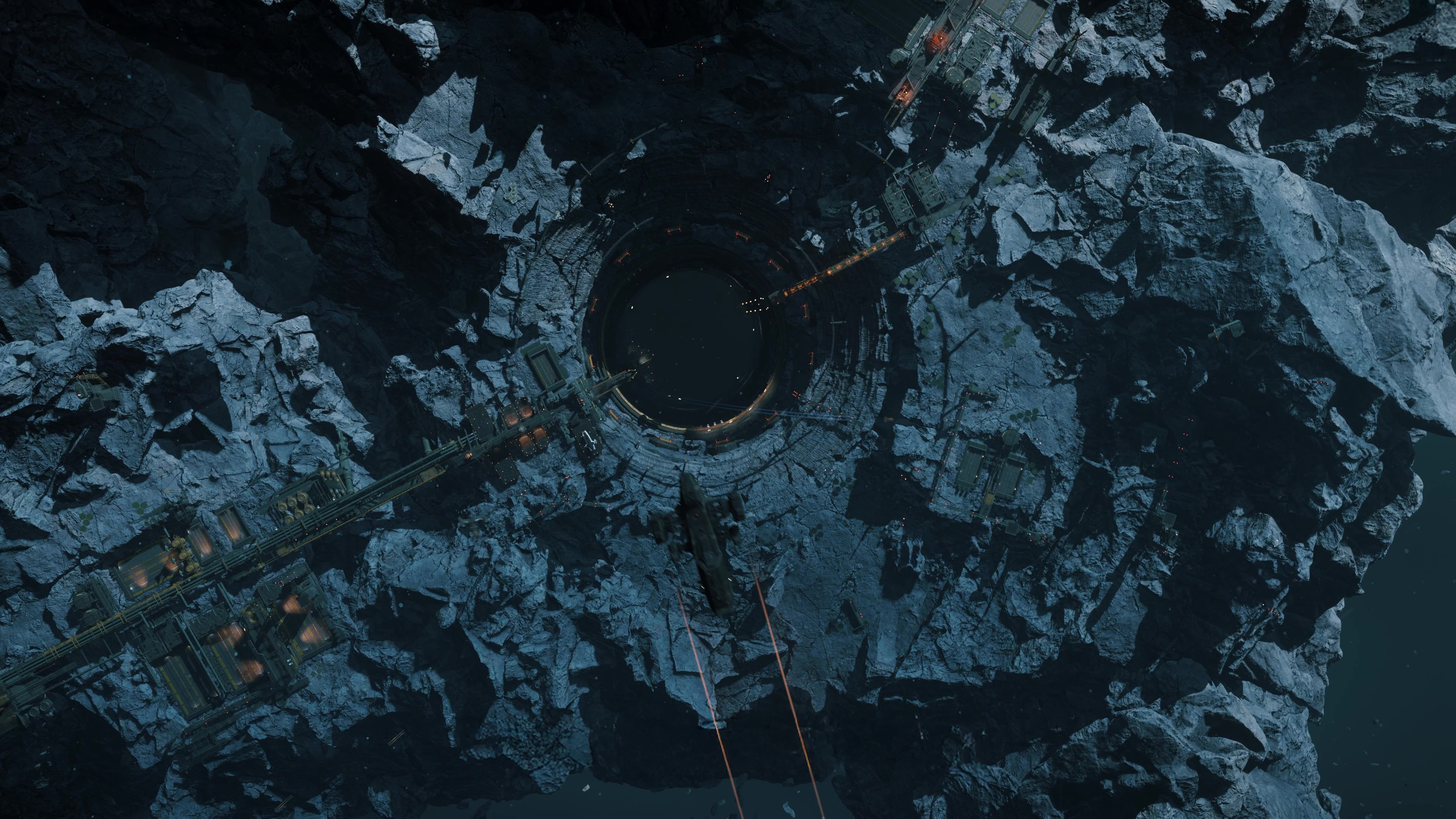
Kellog VI is home to the UEE’s massive QuarterDeck Prison, a maximum security penal facility that houses hundreds of thousands of hardened criminals. Orbiting well past the green band, the planet’s conditions were meant to make escape from QuarterDeck almost impossible. Unfortunately it has not stopped prisoners from orchestrating successful escapes, usually aided by associatess on the outside.
QuarterDeck features a full-process antimatter refinery, which means the resource is more readily available here than in most places in the UEE. Antimatter processing is an incredibly dangerous operation and results in the deaths of prisoners, but the plant finds itself in no shortage of workers since reduced sentences are given to those who volunteer to work in the refinery.
The UEE has also developed a system by which wanted criminals can be delivered directly to QuarterDeck by properly bonded bounty hunters. JusticeStar station sits at the planet’s closest Lagrange point, allowing processing, trial and sentencing to take place swiftly and efficiently. Booking officers on JusticeStar have been known to pay a premium for wanted criminals, reflecting the reduced cost to the UEE that comes with having prisoners delivered directly to the system.
HEARD IN THE WIND
“Flo-Pets adapted swiftly to sewers around the Empire. Much like their home world of Xis, the underbellies of Human cities are wet, humid and teeming with microscopic life that Flo-Pets find delicious.”
- Garret Bedi, Anthology of Unexpected Adaptation, 2921
“My proposal to decommission QuarterDeck’s antimatter facility is motivated by several factors. First, its current conditions are well below the standard mandated of privately run operations. Second, there’s a growing concern that the military is too dependent on the antimatter produced there. A recent report by the SSA stated that loss of antimatter production on QuarterDeck, whether due to cataclysmic event or Vanduul invasion, would severely disrupt the military. Fellow Senators, our military becoming dependent on antimatter produced in a system with two connections to Vanduul space is too dangerous a situation to continue.”
- Senator Ghata Veras (C-Lo-Corel Sys), Senate session 2943-11-18
Galaktischer Leitfaden: Kellog System
UNSCHULD UND UNMORAL
Das Kellog-System ist in der gesamten UEE als die Heimat von Unschuld und Unmoral bekannt. Um einen G-Hauptreihen-Gelben Zwerg herum stehen die beiden bewohnten Planeten des Systems im starken Kontrast zueinander: Kellog II, Xis, wird schwer bewacht, um die sich dort entwickelnden neuen Arten zu schützen, während Kellog VI, QuarterDeck, schwer bewacht wird, um sicherzustellen, dass die dort gefangenen harten Kriminellen nicht entkommen können.
Die Anerkennung für Kellogs Entdeckung geht an den Navjumper Patek Coen, der das System 2811 aufdeckte. Leider kam Coens Traum, in einem System zu leben, das er entdeckte, nie in Erfüllung, nachdem erste Umfragen ergaben, dass Kellog II voller Leben war. Kellog erhielt schnell Schutz durch den Fair Chance Act und schien ein Zufluchtsort für Forscher und Wissenschaftler aus dem ganzen Reich zu sein. Doch das war nicht der Fall; in weniger als fünf Jahren wurden zwei Sprünge in den Vanduul-Raum gefunden.
Die UEE wusste, dass Kellog ein Alarmsystem brauchte, um vor den Übergriffen der Vandule zu warnen. Erhöhungen des Marinepersonals und Standard-Näherungssensoren wurden berücksichtigt, bis Senatorin Daniela Agren (U-Idris) eine weitere ungewöhnliche Option vorschlug: die Umwandlung von Kellog VI in einen Gefängnisplaneten. Senator Agren argumentierte, dass eine solche Einrichtung nicht nur Sicherheitsbedenken lösen würde, sondern dies auch für weniger Kredite tun würde und viele andere zusätzliche Vorteile hätte. Mit der starken Wachmannschaft, die ein solcher Außenposten benötigen würde, könnte das Gefängnis als Stolperdraht gegen Vanduul-Angriffe dienen und gleichzeitig die schlimmsten Verbrecher des Reiches isolieren. Dennoch beinhaltete Agrens Meisterleistung in den Plänen für QuarterDeck eine umsatzbringende Antimaterieanlage, die von Gefangenen besetzt werden sollte.
Der Senat genehmigte den Plan von Agren, der Kellog zum geschäftigsten Fair Chance Act-System gemacht hat. Heute patrouillieren Armee-Raumschiffe Xis, während Antimaterie-Schlepper und Kopfgeldjäger häufig QuarterDeck besuchen. All diese Aktivitäten haben das System von einer isolierten Grenze zu einem integralen Bestandteil der UEE gemacht.
REISEWARNUNG
Das Kellog-System befindet sich nur einen Sprung von dem entfernt, was allgemein als Vanduul-Gebiet gilt. Obwohl die Organisation der Vanduul-Clans immer noch nicht gut verstanden ist, scheint es, dass niemand versucht hat, Kellog als seinen eigenen zu beanspruchen.... noch nicht. Obwohl nur wenige feindliche Raider im System entdeckt wurden, wird Reisenden empfohlen, in Kellog extreme Vorsichtsmaßnahmen zu treffen.
KELLOG I
Kellog I ist ein terrestrischer Planet, der so nah an der Sonne des Systems liegt, dass seine Oberfläche aus Lava besteht. Wenn es etwas Wertvolles unter den geschmolzenen Felsen gibt, hat die Menschheit noch keinen Weg gefunden, es zu erreichen.
XIS (KELLOG II)
Xis ist der malerisch geschützte Planet des Systems. Gepunktet mit tiefem, vielbedecktem Dschungel und einer Artenvielfalt, die mit jedem anderen Teil der entdeckten Galaxie konkurriert, ist Xis der Grund, warum das Kellog System nach dem Fair Chance Act anerkannt wurde. Das warme Meer beherbergt eine Vielzahl von Lebewesen, während die dichten Regenwälder Millionen von Insekten, Primaten und vor allem Flo-Pets beherbergen.
Nur wenige können den Flo-Pet-Wahn des frühen 30. Jahrhunderts vergessen, der die Reichen und Mächtigen dazu brachte, die ungewöhnlichen Kreaturen zu sammeln und zu züchten. Da die ersten paar von einem unerschrockenen Schmuggler gefangen genommen wurden, der dachte, sie könnten eine leicht zu züchtende, kompakte Proteinquelle sein (weitere Studien haben kurz und bündig gezeigt, dass Flo-Pets nicht essbar sind), gab es zunächst einen Schritt der Regierung, den Besitz der Kreaturen zu verbieten. Viele, die sich Sorgen machten, dass ihr Haustier sie in Schwierigkeiten mit dem Gesetz bringen könnte, befreiten ihr Flo-Pet, was zu erheblichen Populationen von wilden Flo-Pets auf vielen Welten geführt hat. Am Ende war die Popularität der Kreatur jedoch so groß, dass jeder Versuch eines Verbots fast unmöglich war.
Seit dem Flo-Pet-Debakel ist die UEE wachsam geblieben, um Xis vor unerwünschten Besuchern zu schützen, insbesondere um eine primitive hominidenähnliche Spezies, die als die Orms bekannt ist. Die Orms, die die nördliche Polarregion des Planeten bevölkern, haben in den letzten hundert Jahren begonnen, komplexere soziale Interaktionsschemata und extrem primitiven Werkzeugeinsatz zu entwickeln.
KELLOG III
Kellog III ist ein typischer Smogplanet mit einer dicken Atmosphäre, die für menschliche Behausung ungeeignet ist. Dennoch gibt es Gerüchte, dass die Atmosphäre des Planeten den Besatzungen, die Gefängnisausbrüche aus QuarterDeck inszenieren, Schutz bietet.
KELLOG IV
Umfragen zu dieser Super-Erde deuten darauf hin, dass sie über umfangreiche Ressourcen verfügen könnte. Sehr zum Entsetzen der Bergbauunternehmen hat die Nähe von Kellog IV sowohl zu einer Dritten Welt als auch zu einem Gefängnisplaneten dazu geführt, dass sich die UEE-Behörden weigern, irgendwelche Bergbaulizenzen zu genehmigen. Es gab einige Vorschläge, dass die Gefangenenpopulation im System als billige Arbeitskraft genutzt werden könnte, wenn rechtliche und ökologische Bedenken ausgeräumt werden könnten.
KELLOG V
Mit seinem felsigen Kern und seiner weitläufigen Atmosphäre ist Kellog V technisch gesehen kein Smogplanet oder Gasriese, sondern ein Gaszwerg, einer von nur wenigen dieser Planeten in der UEE.
ACHTERDECK (KELLOG VI)
Kellog VI ist die Heimat des massiven QuarterDeck-Gefängnisses der UEE, einer Hochsicherheits-Strafanstalt, die Hunderttausende von Schwerverbrechern beherbergt. Die Bedingungen des Planeten, der weit über das grüne Band hinausreicht, sollten eine Flucht aus dem QuarterDeck nahezu unmöglich machen. Leider hat es die Gefangenen nicht davon abgehalten, erfolgreiche Fluchten zu inszenieren, meist mit Hilfe von Mitarbeiterinnen nach außen.
QuarterDeck verfügt über eine Vollprozess-Antimaterie-Raffinerie, was bedeutet, dass die Ressource hier leichter verfügbar ist als an den meisten Orten in der UEE. Die Verarbeitung von Antimaterie ist eine unglaublich gefährliche Operation und führt zum Tod von Gefangenen, aber die Anlage hat keinen Mangel an Arbeitern, da diejenigen, die sich freiwillig in der Raffinerie engagieren, reduzierte Strafen erhalten.
Die UEE hat auch ein System entwickelt, mit dem gewünschte Kriminelle von richtig verbundenen Kopfgeldjägern direkt an QuarterDeck geliefert werden können. Die JusticeStar-Station befindet sich am nächsten Lagrange-Punkt des Planeten, so dass die Verarbeitung, der Prozess und die Verurteilung schnell und effizient erfolgen können. Buchungsbeamte auf JusticeStar sind bekannt dafür, eine Prämie für gesuchte Kriminelle zu zahlen, was die reduzierten Kosten für die UEE widerspiegelt, die dadurch entstehen, dass Gefangene direkt an das System geliefert werden.
IM WIND GEHÖRT
"Flo-Pets passten sich schnell an die Kanalisation im gesamten Imperium an. Ähnlich wie ihre Heimatwelt Xis sind die Unterbäuche der Städte der Menschen nass, feucht und voller mikroskopischer Lebensformen, die Flo-Pets köstlich finden."
- Garret Bedi, Anthologie der unerwarteten Anpassung, 2921
"Mein Vorschlag, die Antimaterieanlage von QuarterDeck stillzulegen, ist von mehreren Faktoren abhängig. Erstens liegen die derzeitigen Bedingungen deutlich unter dem Standard, der für privat geführte Betriebe vorgeschrieben ist. Zweitens wächst die Sorge, dass das Militär zu sehr von der dort produzierten Antimaterie abhängig ist. Ein aktueller Bericht der SSA stellte fest, dass der Verlust der Antimaterieproduktion auf QuarterDeck, sei es aufgrund eines katastrophalen Ereignisses oder einer Vanduul-Invasion, das Militär schwerwiegend stören würde. Liebe Senatoren, unser Militär, das von Antimaterie abhängig wird, die in einem System mit zwei Verbindungen zum Vanduul-Raum produziert wird, ist eine zu gefährliche Situation, um fortzufahren."
- Senator Ghata Veras (C-Lo-Corel Sys), Senatssitzung 2943-11-18-18
Galactic Guide: Kellog System
INNOCENCE AND IMMORALITY
The Kellog System is known throughout the UEE as the home to both innocence and immorality. Centered around a G-type main sequence yellow dwarf, the system’s two inhabited planets stand in stark contrast to each other: Kellog II, Xis, is heavily guarded to protect the new species developing there, while Kellog VI, QuarterDeck, is heavily guarded to ensure the hardened criminals imprisoned there can’t escape.
Credit for Kellog’s discovery goes to navjumper Patek Coen, who uncovered the system in 2811. Unfortunately, Coen’s dream of living in a system he discovered never came to pass once initial surveys revealed that Kellog II was brimming with sapient life. Kellog quickly received protection under the Fair Chance Act and seemed destined to be a haven for researchers and scientists from throughout the Empire. However, that wound up not being the case; in less than five years, two jumps into Vanduul space were found.
The UEE knew Kellog needed an alert system to warn of Vanduul incursions. Increases in Navy personnel and standard proximity sensors were considered until Senator Daniela Agren (U-Idris) suggested another unusual option: converting Kellog VI into a prison planet. Senator Agren argued that such a facility would not only solve security concerns, but would do so for fewer credits and have many other additional benefits. With the heavy guard presence such an outpost would need, the prison could serve as a tripwire against Vanduul attacks while also isolating the Empire’s worst criminals. Still, Agren’s masterstroke in the plans for QuarterDeck was including a revenue-generating antimatter facility to be staffed by prisoners.
The Senate approved Agren’s plan, which has turned Kellog into the busiest Fair Chance Act system. Today, Army spacecraft patrol Xis, while antimatter haulers and bounty hunters frequently visit QuarterDeck. All this activity has converted the system from an isolated frontier to an integral part of the UEE.
TRAVEL WARNING
The Kellog System is located just a jump away from what is generally considered Vanduul territory. Although the organization of Vanduul clans is still not well understood, it seems that none have tried to claim Kellog as their own … yet. Though few enemy raiders have been spotted in-system, travelers are advised to take extreme precaution while in Kellog.
KELLOG I
Kellog I is a terrestrial planet located so close to the system’s sun that its surface is lava. If there’s anything of value underneath the molten rocks, Humanity has not yet found a way to reach it.
XIS (KELLOG II)
Xis is the system’s picturesque protected planet. Dotted with deep, multi-canopied jungles and a biodiversity that rivals any other part of the discovered galaxy, Xis is the reason the Kellog System achieved recognition under the Fair Chance Act. Its warm seas are home to a wide variety of creatures, while its dense rainforests play host to millions of insects, primates and most famously, Flo-Pets.
Few can forget the Flo-Pet craze of the early 30th century that saw the rich and powerful desperate to collect and breed the unusual creatures. Since the first few were captured by an intrepid smuggler who thought they might be an easily bred, compact protein source (further study has succinctly established that Flo-Pets are not edible), there was initially a move by the government to outlaw ownership of the creatures. Many, worried that their pet would get them in trouble with the law, set their Flo-Pet free, which has resulted in significant populations of feral Flo-Pets on many worlds. In the end however, the creature’s popularity was such that any attempt at a ban proved all but impossible.
Since the Flo-Pet debacle, the UEE has remained vigilant about protecting Xis from unwanted visitors, particularly protecting a primitive hominid-like species known as the Orms. Populating the planet’s northern polar region, the Orms have, in the past hundred years, begun to develop more complex social interaction schema and extremely primitive tool use.
KELLOG III
Kellog III is a typical smog planet with a thick atmosphere unfit for Human habitation. Even so, there are rumors that the planet’s atmosphere provides cover to crews staging jailbreaks from QuarterDeck.
KELLOG IV
Surveys of this super-Earth suggest it could possess copious resources. Much to the dismay of the mining corporations, Kellog IV’s proximity to both a developing world and a prison planet has made UEE authorities refuse to authorize any mining permits. There have been some suggestions that the prisoner population in the system could be used as a cheap workforce, if legal and environmental concerns could be sorted.
KELLOG V
With its rocky core and expansive atmosphere, Kellog V is technically not a smog planet or a gas giant, but rather a gas dwarf, one of only a few such planets in the UEE.
QUARTERDECK (KELLOG VI)
Kellog VI is home to the UEE’s massive QuarterDeck Prison, a maximum security penal facility that houses hundreds of thousands of hardened criminals. Orbiting well past the green band, the planet’s conditions were meant to make escape from QuarterDeck almost impossible. Unfortunately it has not stopped prisoners from orchestrating successful escapes, usually aided by associatess on the outside.
QuarterDeck features a full-process antimatter refinery, which means the resource is more readily available here than in most places in the UEE. Antimatter processing is an incredibly dangerous operation and results in the deaths of prisoners, but the plant finds itself in no shortage of workers since reduced sentences are given to those who volunteer to work in the refinery.
The UEE has also developed a system by which wanted criminals can be delivered directly to QuarterDeck by properly bonded bounty hunters. JusticeStar station sits at the planet’s closest Lagrange point, allowing processing, trial and sentencing to take place swiftly and efficiently. Booking officers on JusticeStar have been known to pay a premium for wanted criminals, reflecting the reduced cost to the UEE that comes with having prisoners delivered directly to the system.
HEARD IN THE WIND
“Flo-Pets adapted swiftly to sewers around the Empire. Much like their home world of Xis, the underbellies of Human cities are wet, humid and teeming with microscopic life that Flo-Pets find delicious.”
- Garret Bedi, Anthology of Unexpected Adaptation, 2921
“My proposal to decommission QuarterDeck’s antimatter facility is motivated by several factors. First, its current conditions are well below the standard mandated of privately run operations. Second, there’s a growing concern that the military is too dependent on the antimatter produced there. A recent report by the SSA stated that loss of antimatter production on QuarterDeck, whether due to cataclysmic event or Vanduul invasion, would severely disrupt the military. Fellow Senators, our military becoming dependent on antimatter produced in a system with two connections to Vanduul space is too dangerous a situation to continue.”
- Senator Ghata Veras (C-Lo-Corel Sys), Senate session 2943-11-18
Galactic Guide: Kellog System
INNOCENCE AND IMMORALITY
The Kellog System is known throughout the UEE as the home to both innocence and immorality. Centered around a G-type main sequence yellow dwarf, the system’s two inhabited planets stand in stark contrast to each other: Kellog II, Xis, is heavily guarded to protect the new species developing there, while Kellog VI, QuarterDeck, is heavily guarded to ensure the hardened criminals imprisoned there can’t escape.
Credit for Kellog’s discovery goes to navjumper Patek Coen, who uncovered the system in 2811. Unfortunately, Coen’s dream of living in a system he discovered never came to pass once initial surveys revealed that Kellog II was brimming with sapient life. Kellog quickly received protection under the Fair Chance Act and seemed destined to be a haven for researchers and scientists from throughout the Empire. However, that wound up not being the case; in less than five years, two jumps into Vanduul space were found.
The UEE knew Kellog needed an alert system to warn of Vanduul incursions. Increases in Navy personnel and standard proximity sensors were considered until Senator Daniela Agren (U-Idris) suggested another unusual option: converting Kellog VI into a prison planet. Senator Agren argued that such a facility would not only solve security concerns, but would do so for fewer credits and have many other additional benefits. With the heavy guard presence such an outpost would need, the prison could serve as a tripwire against Vanduul attacks while also isolating the Empire’s worst criminals. Still, Agren’s masterstroke in the plans for QuarterDeck was including a revenue-generating antimatter facility to be staffed by prisoners.
The Senate approved Agren’s plan, which has turned Kellog into the busiest Fair Chance Act system. Today, Army spacecraft patrol Xis, while antimatter haulers and bounty hunters frequently visit QuarterDeck. All this activity has converted the system from an isolated frontier to an integral part of the UEE.
TRAVEL WARNING
The Kellog System is located just a jump away from what is generally considered Vanduul territory. Although the organization of Vanduul clans is still not well understood, it seems that none have tried to claim Kellog as their own … yet. Though few enemy raiders have been spotted in-system, travelers are advised to take extreme precaution while in Kellog.
KELLOG I
Kellog I is a terrestrial planet located so close to the system’s sun that its surface is lava. If there’s anything of value underneath the molten rocks, Humanity has not yet found a way to reach it.
XIS (KELLOG II)
Xis is the system’s picturesque protected planet. Dotted with deep, multi-canopied jungles and a biodiversity that rivals any other part of the discovered galaxy, Xis is the reason the Kellog System achieved recognition under the Fair Chance Act. Its warm seas are home to a wide variety of creatures, while its dense rainforests play host to millions of insects, primates and most famously, Flo-Pets.
Few can forget the Flo-Pet craze of the early 30th century that saw the rich and powerful desperate to collect and breed the unusual creatures. Since the first few were captured by an intrepid smuggler who thought they might be an easily bred, compact protein source (further study has succinctly established that Flo-Pets are not edible), there was initially a move by the government to outlaw ownership of the creatures. Many, worried that their pet would get them in trouble with the law, set their Flo-Pet free, which has resulted in significant populations of feral Flo-Pets on many worlds. In the end however, the creature’s popularity was such that any attempt at a ban proved all but impossible.
Since the Flo-Pet debacle, the UEE has remained vigilant about protecting Xis from unwanted visitors, particularly protecting a primitive hominid-like species known as the Orms. Populating the planet’s northern polar region, the Orms have, in the past hundred years, begun to develop more complex social interaction schema and extremely primitive tool use.
KELLOG III
Kellog III is a typical smog planet with a thick atmosphere unfit for Human habitation. Even so, there are rumors that the planet’s atmosphere provides cover to crews staging jailbreaks from QuarterDeck.
KELLOG IV
Surveys of this super-Earth suggest it could possess copious resources. Much to the dismay of the mining corporations, Kellog IV’s proximity to both a developing world and a prison planet has made UEE authorities refuse to authorize any mining permits. There have been some suggestions that the prisoner population in the system could be used as a cheap workforce, if legal and environmental concerns could be sorted.
KELLOG V
With its rocky core and expansive atmosphere, Kellog V is technically not a smog planet or a gas giant, but rather a gas dwarf, one of only a few such planets in the UEE.
QUARTERDECK (KELLOG VI)
Kellog VI is home to the UEE’s massive QuarterDeck Prison, a maximum security penal facility that houses hundreds of thousands of hardened criminals. Orbiting well past the green band, the planet’s conditions were meant to make escape from QuarterDeck almost impossible. Unfortunately it has not stopped prisoners from orchestrating successful escapes, usually aided by associatess on the outside.
QuarterDeck features a full-process antimatter refinery, which means the resource is more readily available here than in most places in the UEE. Antimatter processing is an incredibly dangerous operation and results in the deaths of prisoners, but the plant finds itself in no shortage of workers since reduced sentences are given to those who volunteer to work in the refinery.
The UEE has also developed a system by which wanted criminals can be delivered directly to QuarterDeck by properly bonded bounty hunters. JusticeStar station sits at the planet’s closest Lagrange point, allowing processing, trial and sentencing to take place swiftly and efficiently. Booking officers on JusticeStar have been known to pay a premium for wanted criminals, reflecting the reduced cost to the UEE that comes with having prisoners delivered directly to the system.
HEARD IN THE WIND
“Flo-Pets adapted swiftly to sewers around the Empire. Much like their home world of Xis, the underbellies of Human cities are wet, humid and teeming with microscopic life that Flo-Pets find delicious.”
- Garret Bedi, Anthology of Unexpected Adaptation, 2921
“My proposal to decommission QuarterDeck’s antimatter facility is motivated by several factors. First, its current conditions are well below the standard mandated of privately run operations. Second, there’s a growing concern that the military is too dependent on the antimatter produced there. A recent report by the SSA stated that loss of antimatter production on QuarterDeck, whether due to cataclysmic event or Vanduul invasion, would severely disrupt the military. Fellow Senators, our military becoming dependent on antimatter produced in a system with two connections to Vanduul space is too dangerous a situation to continue.”
- Senator Ghata Veras (C-Lo-Corel Sys), Senate session 2943-11-18
Links
No links available.
Images
4


Metadata
- CIG ID
- 16359
- Channel
- Spectrum Dispatch
- Category
- Undefined
- Series
- Galactic Guide
- Comments
- 45
- Published
- 8 years ago (2018-01-10T00:00:00+00:00)