Squadron 42 Monthly Report: May 2019
Transmission Undefined Monthly ReportsContent
This is a cross-post of the report that was recently sent out via the monthly Squadron 42 newsletter. We’re publishing this a second time as a Comm-Link to make it easier for the community to reference back to. Attention Recruits,
What you are about to read is the latest information on the continuing development of Squadron 42 (SCI des: SQ42).
Agents devoted countless hours to bringing us this intelligence. Through their hard work, we’ve learned key intel on recent operations concerning Archon Station, AI transitions, inspired use of fog cloud technology, and more.
The information contained in this communication is extremely sensitive and it is of paramount importance that it does not fall into the wrong hands. Purge all records after reading.
UEE Naval High Command
AI
May saw the AI Team begin a project to add areas where players and NPCs can interact with a usable (item) without being in an exact position. These areas will allow for higher-fidelity when players and AI interact with numerous usables in a single space. Optimization continues all round, including the continued developing and fine-tuning of FPS combat tactics. This includes fighting from cover, fighting in open space, simple search behavior, and improvements to first reactions. Improvements were also made to the Posture Manage – the system used during combat to understand if an AI enemy has visibility of the player and a viable shooting direction when taking cover.
Animation
Animation focused on the new player jumping system throughout May. The animations are now much more fluid and incorporate jumping forwards, backwards, sideways, and running and jumping. They also finished setting up usables (beds, seats, consoles, etc.) and are starting to create a pre-visual system for different human AI enemy types and weapon sets. Immediate exits from cover when under duress were also worked on and the team is working on a plan to outsource data sets for animation variants to better prioritize development time.
More female animation sets are currently in development and will now always be worked on alongside the male version. Currently, they’re starting with base re-targets from the male source and then replacing them with female-specific assets.
Finally for Animation, the team worked on a few new weapons and assisted the Feature Development Team on attachments, melee, and takedowns. They also working hard on incorporating all of the story scenes, cinematics, and through lines for [REDACTED].
“Hopefully they don’t censor it this time, because that scene where [REDACTED] and [REDACTED] go to [REDACTED] is really cool!” – SQ42 Animation Director
Art (Characters)
Last month, the Character Art Team continued polishing characters, with focus on chapter four. The team continues to explore the aliens of Squadron 42 and work on the material library, which will affect all armor and outfits in the game and enable the team to further drive visual quality. Similarly, tools for the hair pipeline are being built and tested to help the artists author higher-quality hair.
Art (Environment)
The Environment Team were busy throughout May developing the Javelin’s skybox, which involves working through the entire ship exterior and dissecting parts they can effectively use for the “push & pull” mechanic. With work on the “organic shader” nearing completing, the team can start iterating on the asteroid set; initially focusing on the standard “space potatoes” before progressing to the more technically-challenging shard-like shapes needed for the latter half of the campaign.
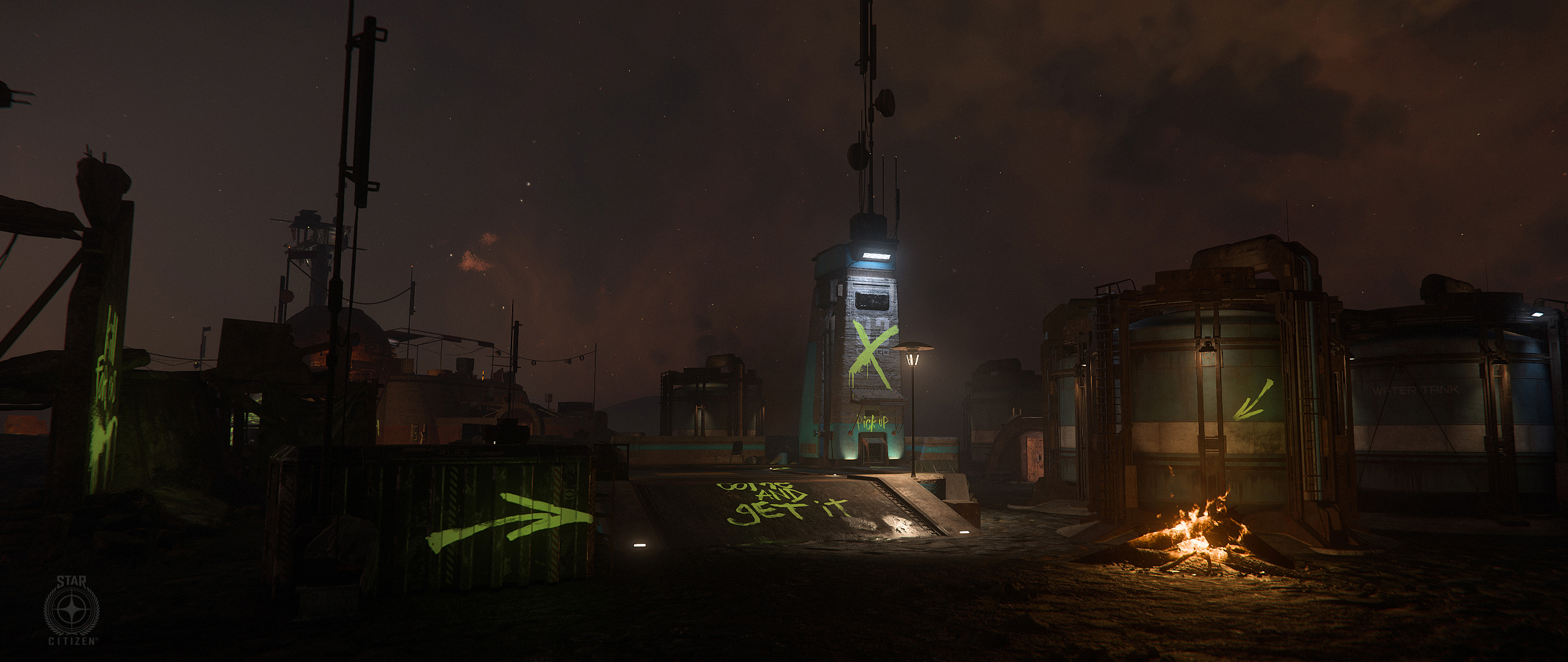
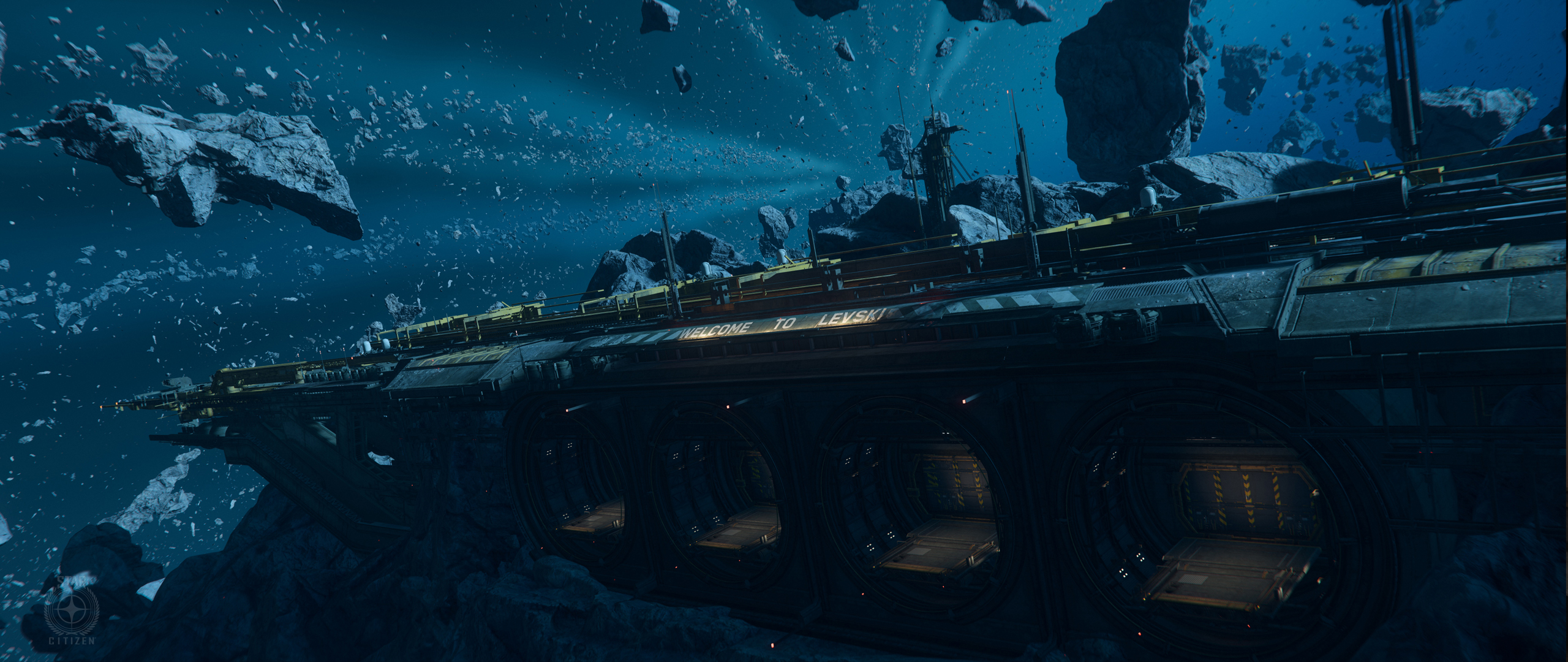
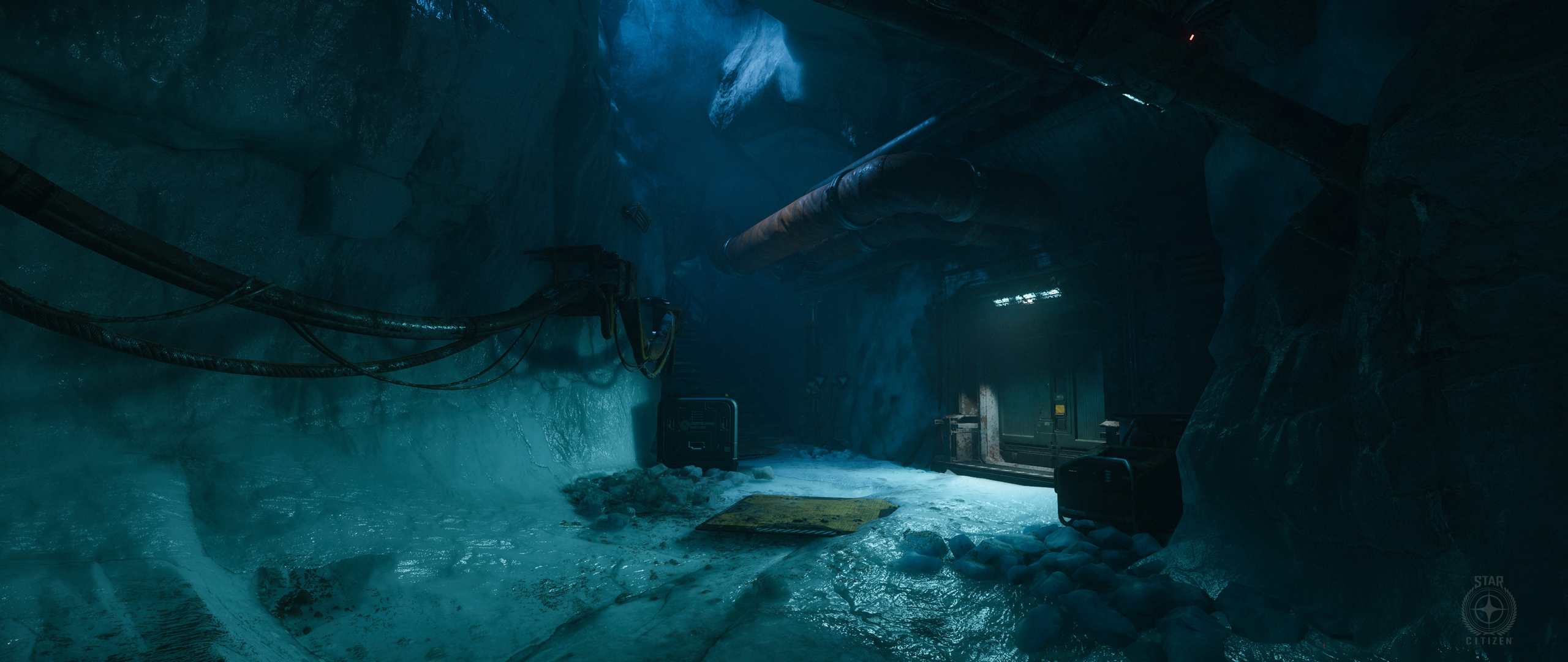
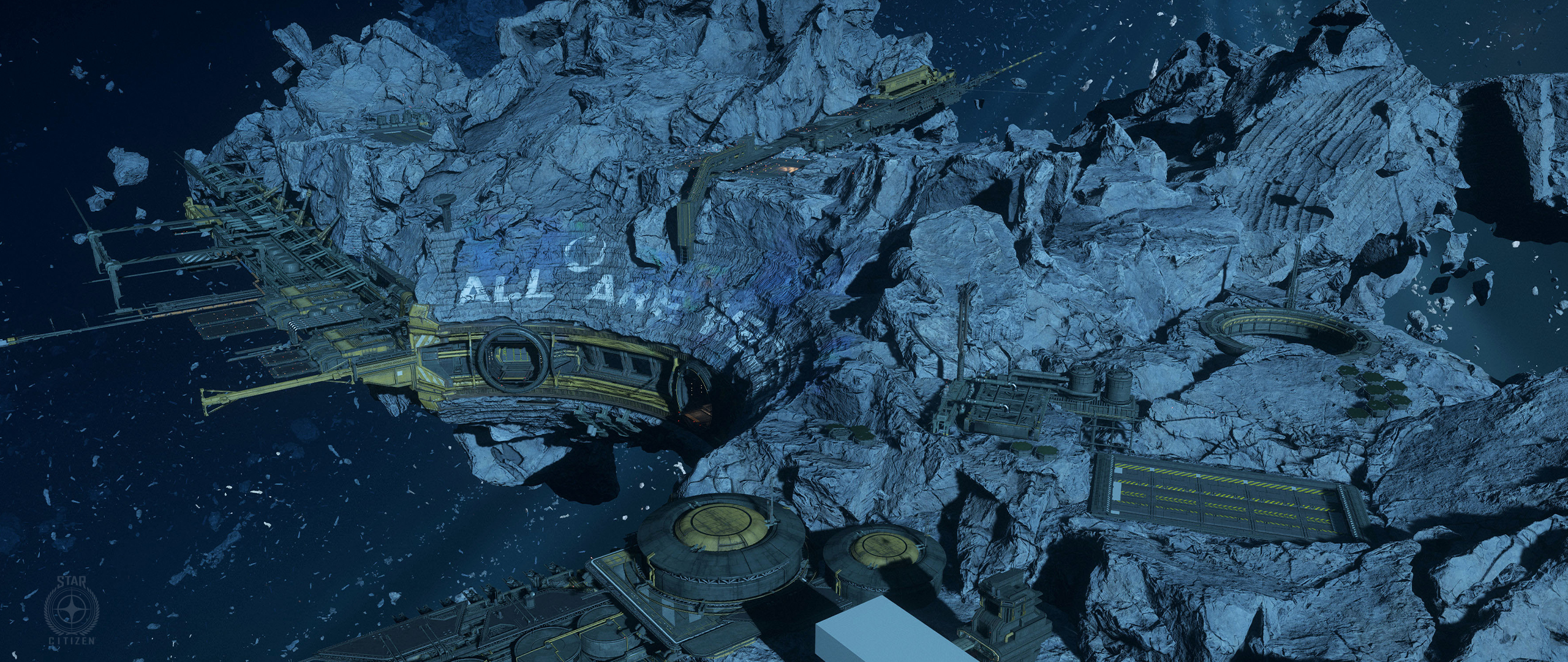
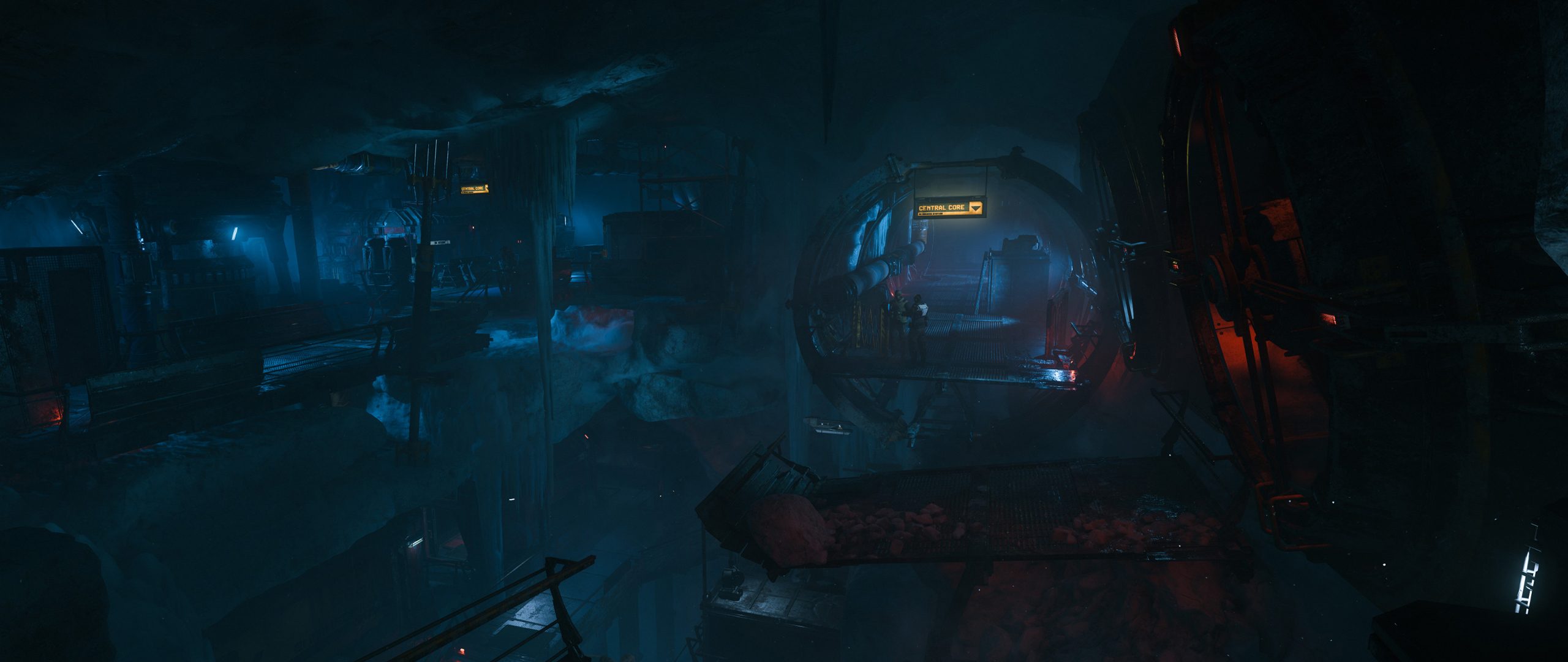
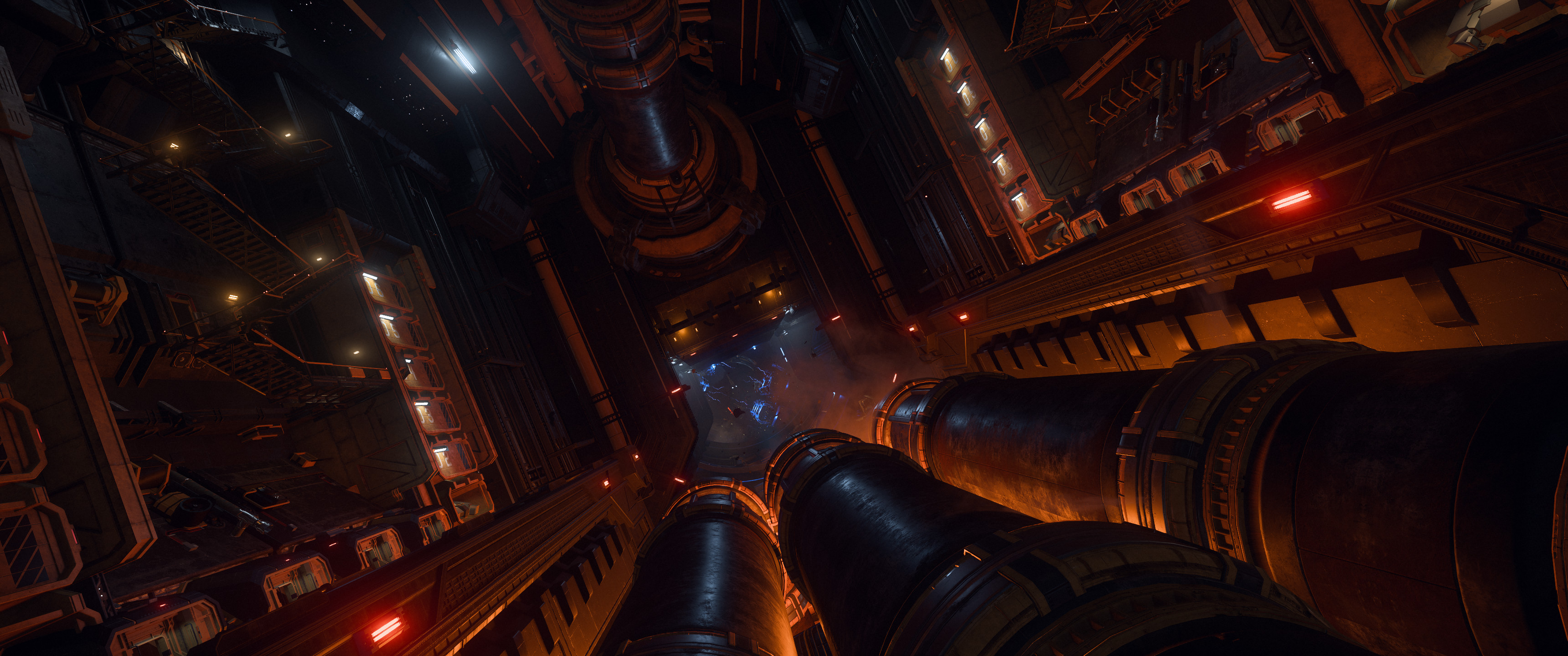
Significant effort was put into the traversable areas found around Archon Station, with the team keen to avoid the standard ‘room, corridor, room’ approach and fully open out the station to highlight its sheer scale. Once these areas are further developed, a dynamics pass will take place to give each corner life and movement using the lessons learned from their investigations earlier in the year.
The team are currently well into the development of a key “comms array” seen in the campaign. The undisclosed array manufacturer has its own unique style that mixes retro design approaches and plenty of real-world references that grounds the entire station in reality.
Volumetric skybox work continues around the Coil, with one mission in particular receiving a lot of attention. It merges the new wind mechanics with the New Flight Model and, though still early days, is giving the team a thorough understanding of how best to create space locations with the speed and scale of the campaign ships.
Art (Weapons)
The Weapons Art Team finished modelling and texturing the Behring S38 pistol, Klaus & Werner Lumin V SMG, and Apocalypse Arms Animus missile launcher. They also started production on the Hedeby Gunworks Salvo frag pistol and Behring GP33 “MOD” grenade launcher.
Cinematics
Last month, Cinematics worked with Level Design to prioritize implementation passes for all remaining scenes and chapters. An implementation pass refers to the process of making a scene function as it will do in the final release and includes AI characters moving in/out of locations. The team also received a major code revision for the Track View tool that enables AI characters to blend in/out of cinematic scenes or Track View sequences in general. The new code is still in early testing, but when complete, will enable the team to add locomotion-based intros and outros. This means characters will smoothly enter scenes from whatever they were doing and transition back when it ends, removing the sudden jar as NPCs rush into position still seen in many modern games.
Engineering
May was a busy month for all engineering teams. Starting with Actor Features, the team continued with the reworked jumping mechanic, making animations when running and jumping (forwards, sideways, or backwards) much more fluid and glitch-free. Progress was all made on “head look”. Previously, when looking down or sideways, there were situations where players could see into their own body or shoulder. They also restricted look movement depending on whether the player character is carrying a weapon and what their pose is, again to stop clipping through the geometry.
Melee takedowns now use the inverse kinematics (IK) system to ensure they appear correctly if the victim is on a different level from the player, such as on a slope or a step. They also started the first pass of punching and knife attacks for melee combat, again using IK to hit specific areas of the target.
The AI Team implemented channel routing for the usable feature, which allows functionality to be routed from one usable to another. For example, a bartender can deliver a drink to a patron whether they’re standing, sitting in a chair, or sitting in a chair at a table. They also implemented area slotting, which allows a usable interaction to be triggered when players enter an area, rather than having to move to a very specific point.
Improvements were also made to the third-person camera, giving options to link motion to the cadence of footsteps to give a more dynamic view. They also created the ability to change video rendered to a texture that simulates changing TV channels.
The Engine Team provided support for the procedural tools, which involved making improvements to automated object layouts and generating ground layers for the lookup texture (LUT) table. In rendering, they made major quality improvements to Screen Space Directional Occlusion (SSDO) shadowing, enabled temporal dithering for dissolving objects and terrain blending, and enhanced the temporal dither pattern for reduced noise on hair cards.
Gameplay Story
The Gameplay Story Team maintained momentum throughout May and implemented a record 18 scenes to a high standard, including one on the bridge of the Idris. They’re also excited to finally get their hands on the Cinematic Team’s tech for blending in and out of track view sequences and to begin testing it out.
Graphics
Continuing last month’s work on the organic shader, the Graphics Team can now re-use assets thanks to better control of the texture tiling for differently-scaled instances of a mesh. This also provides precise control over the height-based blending of the various detail texture layers. These features are being used to great effect in the Art Team’s asteroid field asset library. They also completed the final touches on gas clouds, various optimizations, and integrated the volumetric shadows into the fog system to fix a handful of bugs.
Level Design
The SQ42 Design Teams made a solid start on the bridge crew behaviors now that the usables pipeline is operating at full capacity. This will enable the crew to realistically interact with various props, items, and other NPCs in a fully systemic way. The “landing/take-off module” needed for many of the chapters received more focus, with contribution from the UI, Animation, and Engineering teams.
Finally, the “Outer Odin” levels were put in their correct object containers and can now be traveled to in-game.
Narrative
The Narrative Team went through an assortment of editorial selects for key SQ42 characters. They also wrote several set-dressing documents to guide the Environment Art and Prop teams with environmental storytelling. Plus, they had multiple reviews with Design on several chapter’s narrative moments and made further progress on their ongoing task to complete all in-game text.
QA
QA continued to provide direct support to the Cinematics Team whenever issues affecting their cutscene workflow were encountered. More additions were made to the cinematics “zoo” map mentioned last month, including all remaining “small” ships. They’re now working on creating reliable test levels with specific Track View functionality. Eventually, these levels will be implemented into the TestRunner feature tests made specifically for Track View cinematics. Changes made within the feature stream for combat AI were also tested to ensure that existing cutscenes wouldn’t be affected once they were ported into the game build. A few issues were also tested that could’ve broken the Track View tool itself and crashes were investigated that were introduced as a result of the change.
Tech Art
The Tech Art Team implemented version two of the internal face customizer. The underlying facial rig blending technology was enhanced to not only allow blending globally between four different source heads, but to allow a different choice of four heads for each of the twelve blend regions. While the new tool and its user interface need to expose all this additional functionality to the artists, it’s also critical that users don’t get overwhelmed by the complexity and sheer amount of parameters in use. Therefore, a number of convenience functions were added to allow for the quick randomization of head IDs and their corresponding weights (either per head region or globally). During each stage of the facial customization, symmetry constraints can be turned off to introduce slight asymmetry in distinct regions, which helps to make a face look more natural and realistic. The tool now makes it much easier for the team to create unique-looking NPCs while being more efficient than ever before.
Tech Animation
Tech Animation continued their work on the animation pipeline to provide a massive overhaul to Maya’s core referencing system. This will ultimately provide a pipeline that doesn’t rely on hard path referencing and can support infinite workspaces and streams across the userbase. They’re also currently upgrading the animation pipeline codebase and plugins to support Maya 2019 for a possible future upgrade. Technical Animation have been working closely with Technical Art to co-develop a new facial animation and rigging pipeline to bring a new level of flexibility and fidelity to an already cutting-edge solution. Additionally, animators were spread across many teams to help in the development of combat, weapons, usables, and cinematics.
UI
Last month, the SQ42 UI Team focused on Archon. Logos and signs were created to help make the level feel like an industrial facility, while background screens for machinery and the bridge area also bear the team’s handiwork. SQ42 will also benefit from the ongoing developments to the central flight HUD. This includes indicators for velocity, g-force, afterburner, ESP, and some new mechanics such as the thruster strength limiter and radar altimeter. Players can get a sneak peek when Alpha 3.6 launches in the Persistent Universe, as the HUD is being tested publicly on the Aegis Gladius.
VFX
Last month, the team continued investigating new shaders, including tests for water and raindrops accumulating on ship canopies. They also made improvements to the ‘particle imposter’ shader that has simple-but-effective UV scrolling, tiling and distortion options, and can be assigned to a mesh as a replacement for a particle system. For example, as scrolling smoke or dust effects in the distance. They also continued work on the new gas cloud tech mentioned last month, this time looking at ways the toolset can be used in non-gas cloud locations, such as asteroid fields. Finally, they fixed an issue with the current version of the tool that was causing bounding boxes to export incorrectly. This was rectified by manually forcing the bounding boxes and voxels to a specific size so that everything matched up across the various assets.
WE’LL SEE YOU NEXT MONTH…
Dies ist ein Querverweis auf den Bericht, der kürzlich über den monatlichen Squadron 42 Newsletter verschickt wurde. Wir veröffentlichen dies ein zweites Mal als Comm-Link, um es der Community zu erleichtern, auf die man zurückgreifen kann.
Achtung Rekruten,
Was Sie hier lesen werden, sind die neuesten Informationen über die Weiterentwicklung der Squadron 42 (SCI des: SQ42).
Agenten widmeten unzählige Stunden, um uns diese Informationen zu bringen. Durch ihre harte Arbeit haben wir wichtige Informationen über die jüngsten Operationen in Bezug auf Archon Station, KI-Übergänge, inspirierten Einsatz der Nebelwolkentechnologie und vieles mehr erhalten.
Die in dieser Mitteilung enthaltenen Informationen sind äußerst sensibel, und es ist von größter Bedeutung, dass sie nicht in die falschen Hände geraten. Alle Datensätze nach dem Lesen löschen.
UEE Naval Oberkommando
KI
Möglicherweise hat das KI-Team ein Projekt gestartet, um Bereiche hinzuzufügen, in denen Spieler und NSCs mit einem nutzbaren (Item) interagieren können, ohne sich an einer genauen Position zu befinden. Diese Bereiche ermöglichen eine höhere Genauigkeit, wenn Spieler und KI mit zahlreichen Nutzungsmöglichkeiten in einem einzigen Raum interagieren. Die Optimierung geht rundum weiter, einschließlich der Weiterentwicklung und Feinabstimmung der FPS-Kampftaktiken. Dazu gehören der Kampf aus der Deckung, der Kampf im freien Raum, einfaches Suchverhalten und die Verbesserung der ersten Reaktionen. Verbesserungen wurden auch am Haltungsmanagement vorgenommen - dem System, das während des Kampfes verwendet wird, um zu verstehen, ob ein KI-Feind Sichtbarkeit des Spielers und eine brauchbare Schießrichtung hat, wenn er Schutz sucht.
Animation
Die Animation konzentrierte sich den ganzen Mai über auf das neue Spieler-Sprungsystem. Die Animationen sind jetzt viel flüssiger und beinhalten das Vorwärts-, Rückwärts- und Seitwärtsspringen sowie das Laufen und Springen. Sie haben auch die Einrichtung von Nutzfahrzeugen (Betten, Sitze, Konsolen usw.) abgeschlossen und beginnen, ein prävisuelles System für verschiedene menschliche KI-Feindtypen und Waffensätze zu entwickeln. Sofortige Ausstiege aus der Deckung, wenn auch unter Zwang gearbeitet wurde, und das Team arbeitet an einem Plan, Datensätze für Animationsvarianten auszulagern, um die Entwicklungszeit besser zu priorisieren.
Weitere weibliche Animationssets sind derzeit in Entwicklung und werden nun immer neben der männlichen Version bearbeitet. Derzeit beginnen sie mit Basis-Retargets von der männlichen Quelle und ersetzen sie dann durch femalenspezifische Assets.
Schließlich arbeitete das Team für Animation an ein paar neuen Waffen und unterstützte das Feature Development Team bei Attachments, Nahkampf und Takedowns. Sie arbeiten auch hart daran, alle Geschichten, Kinofilme und Linien für[REDACTED] zu integrieren.
"Hoffentlich zensieren sie es diesmal nicht, denn die Szene, in der[REDACTED] und[REDACTED] zu[REDACTED] gehen, ist wirklich cool!" - SQ42 Animation Director
Kunst (Charaktere)
Letzten Monat setzte das Character Art Team das Polieren der Charaktere fort, mit Schwerpunkt auf Kapitel vier. Das Team erkundet weiterhin die Außerirdischen von Staffel 42 und arbeitet an der Materialbibliothek, die sich auf alle Rüstungen und Outfits im Spiel auswirken wird und es dem Team ermöglicht, die visuelle Qualität weiter zu steigern. Ebenso werden Werkzeuge für die Haarpipeline gebaut und getestet, um den Künstlern zu helfen, qualitativ hochwertigere Haare zu schreiben.
Kunst (Umwelt)
Das Umweltteam war den ganzen Mai über damit beschäftigt, die Skybox des Speerwurfes zu entwickeln, bei der die gesamte Außenseite des Schiffes durcharbeitet und Teile zerlegt werden, die sie für den "Push & Pull"-Mechaniker effektiv nutzen können. Nachdem die Arbeiten am "Organic Shader" kurz vor dem Abschluss stehen, kann das Team mit der Iteration des Asteroiden-Sets beginnen; zunächst konzentriert es sich auf die Standard "Space Potatoes", bevor es zu den technisch anspruchsvolleren Shard-like Shapes übergeht, die für die zweite Hälfte der Kampagne benötigt werden.
Es wurden erhebliche Anstrengungen in die begehbaren Bereiche um die Archon Station herum unternommen, wobei das Team darauf bedacht war, den üblichen "Zimmer-, Korridor- und Zimmeransatz" zu vermeiden und die Station vollständig zu öffnen, um ihre schiere Größe hervorzuheben. Sobald diese Bereiche weiterentwickelt sind, wird ein Dynamikpass stattfinden, der jeder Ecke Leben und Bewegung verleiht und die Erfahrungen aus ihren Untersuchungen zu Beginn des Jahres nutzt.
Das Team befindet sich derzeit in der Entwicklung eines wichtigen "comms array", das in der Kampagne zu sehen ist. Der unbekannte Array-Hersteller hat seinen eigenen einzigartigen Stil, der Retro-Design-Ansätze und viele praktische Referenzen kombiniert, die die gesamte Station in der Realität begründen.
Die Arbeiten an der volumetrischen Skybox werden rund um die Spule fortgesetzt, wobei insbesondere einer Mission große Aufmerksamkeit geschenkt wird. Es verschmilzt die neue Windmechanik mit dem neuen Flugmodell und vermittelt dem Team, obwohl noch in den Anfängen, ein tiefes Verständnis dafür, wie man mit der Geschwindigkeit und Größe der Kampagnenschiffe Raumfahrtpositionen schafft.
Kunst (Waffen)
Das Waffenkunstteam beendete die Modellierung und Texturierung der Behring S38 Pistole, Klaus & Werner Lumin V SMG und Apocalypse Arms Animus Raketenwerfer. Außerdem starteten sie die Produktion der Hedeby Gunworks Salvo frag Pistole und des Behring GP33 "MOD" Granatwerfer.
Kinematiken
Im vergangenen Monat arbeitete Cinematics mit Level Design zusammen, um die Umsetzungsdurchläufe für alle verbleibenden Szenen und Kapitel zu priorisieren. Ein Implementierungspass bezieht sich auf den Prozess, eine Szene so funktionieren zu lassen, wie er es in der endgültigen Version tun wird, und beinhaltet KI-Charaktere, die sich in/aus Standorten bewegen. Das Team erhielt auch eine umfangreiche Code-Revision für das Track View-Tool, mit dem KI-Charaktere in Filmszenen oder Track View-Sequenzen im Allgemeinen ein- und ausblenden können. Der neue Code befindet sich noch im frühen Test, wird es dem Team aber nach Fertigstellung ermöglichen, bewegungsbasierte Intros und Outros hinzuzufügen. Das bedeutet, dass die Charaktere problemlos in Szenen von dem, was sie getan haben, eintauchen und am Ende wieder zurückkehren können, wodurch das plötzliche Glas entfernt wird, wenn die NSCs in Position kommen, die noch in vielen modernen Spielen zu sehen sind.
Ingenieurwesen
Der Mai war ein arbeitsreicher Monat für alle Ingenieurteams. Beginnend mit Actor Features setzte das Team die überarbeitete Sprungmechanik fort, die Animationen beim Laufen und Springen (vorwärts, seitwärts oder rückwärts) viel flüssiger und störungsfreier gestaltet. Beim "Headlook" wurden alle Fortschritte erzielt. Früher, beim Blick nach unten oder zur Seite, gab es Situationen, in denen die Spieler in ihren eigenen Körper oder ihre eigene Schulter sehen konnten. Sie schränkten auch die Blickbewegung ein, je nachdem, ob der Spielercharakter eine Waffe trägt und in welcher Haltung er sich befindet, um das Durchschneiden der Geometrie zu stoppen.
Nahkampfabstürze verwenden nun das System der inversen Kinematik (IK), um sicherzustellen, dass sie korrekt erscheinen, wenn sich das Opfer auf einer anderen Ebene als der Spieler befindet, z.B. auf einer Steigung oder einem Schritt. Sie begannen auch den ersten Durchgang von Schlag- und Messerangriffen für den Nahkampf und benutzten IK erneut, um bestimmte Bereiche des Ziels zu treffen.
Das KI-Team implementierte für das nutzbare Feature ein Kanalrouting, das es ermöglicht, die Funktionalität von einem nutzbarem zum anderen zu routen. So kann beispielsweise ein Barkeeper einem Gast ein Getränk liefern, egal ob er steht, auf einem Stuhl sitzt oder auf einem Stuhl an einem Tisch sitzt. Sie implementierten auch das Area Slotting, das es ermöglicht, eine brauchbare Interaktion auszulösen, wenn Spieler einen Bereich betreten, anstatt sich an einen ganz bestimmten Punkt bewegen zu müssen.
Verbesserungen wurden auch an der Third-Person-Kamera vorgenommen, die Optionen bietet, die Bewegung mit der Trittfrequenz der Schritte zu verknüpfen, um eine dynamischere Ansicht zu ermöglichen. Sie schufen auch die Möglichkeit, das gerenderte Video in eine Textur zu ändern, die wechselnde TV-Kanäle simuliert.
Das Engine-Team unterstützte die verfahrenstechnischen Werkzeuge, die darin bestanden, Verbesserungen an automatisierten Objektlayouts vorzunehmen und Bodenebenen für die Lookup-Textur (LUT)-Tabelle zu generieren. Beim Rendern verbesserten sie die Qualität der Screen Space Directional Occlusion (SSDO)-Shadowing, ermöglichten zeitliches Dithering zum Auflösen von Objekten und Terrain Blending und verbesserten das zeitliche Dither-Muster für weniger Rauschen auf Haarkarten.
Gameplay-Geschichte
Das Gameplay Story Team hielt die Dynamik im Mai aufrecht und realisierte 18 Rekordszenen auf hohem Niveau, darunter eine auf der Brücke des Idris. Sie sind auch gespannt, endlich den Tech des Cinematic Teams in die Finger zu bekommen, um Sequenzen ein- und auszublenden und zu testen.
Grafiken
Das Grafikteam setzt die Arbeit am organischen Shader im vergangenen Monat fort und kann nun Objekte dank einer besseren Kontrolle der Texturkachelung für unterschiedlich skalierte Instanzen eines Mesh wiederverwenden. Dies ermöglicht auch eine präzise Kontrolle über die höhenbasierte Mischung der verschiedenen Detail-Texturschichten. Diese Funktionen werden in der Asteroiden-Feld-Assetbibliothek des Art Teams mit großer Wirkung eingesetzt. Sie vervollständigten auch den letzten Schliff an Gaswolken, verschiedene Optimierungen und integrierten die volumetrischen Schatten in das Nebelsystem, um eine Handvoll Fehler zu beheben.
Leveldesign
Die SQ42 Design Teams haben einen soliden Start in das Verhalten der Brückenbesatzung gemacht, nachdem die nutzbare Pipeline mit voller Kapazität betrieben wird. Dies ermöglicht es der Crew, realistisch mit verschiedenen Requisiten, Gegenständen und anderen NSCs auf eine völlig systemische Weise zu interagieren. Das für viele der Kapitel benötigte "Lande- und Startmodul" wurde stärker fokussiert, wobei die Teams für Benutzeroberfläche, Animation und Technik beteiligt waren.
Schließlich wurden die "Outer Odin"-Level in die richtigen Objektcontainer gelegt und können nun ins Spiel gebracht werden.
Narrativ
Das Narrative Team durchlief eine Reihe von redaktionellen Auswahlverfahren für die wichtigsten SQ42-Charaktere. Sie schrieben auch mehrere Set-Dressing-Dokumente, um die Teams von Environment Art und Prop bei der Erzählung von Umweltgeschichten zu unterstützen. Außerdem hatten sie mehrere Rezensionen mit Design zu den Erzählmomenten mehrerer Kapitel und machten weitere Fortschritte bei ihrer laufenden Aufgabe, den gesamten Text im Spiel zu vervollständigen.
QA
QA leistete weiterhin direkte Unterstützung für das Cinematics-Team, wenn Probleme mit dem Cutscene Workflow auftraten. Die im letzten Monat erwähnte Kinokarte "Zoo" wurde um weitere Ergänzungen ergänzt, darunter alle übrigen "kleinen" Schiffe. Sie arbeiten nun daran, zuverlässige Testebenen mit spezifischen Track View-Funktionen zu erstellen. Schließlich werden diese Ebenen in die TestRunner-Funktionstests implementiert, die speziell für Track View-Kinematiken entwickelt wurden. Änderungen, die innerhalb des Feature-Streams für die Kampf-KI vorgenommen wurden, wurden ebenfalls getestet, um sicherzustellen, dass bestehende Cutscenes nicht beeinträchtigt werden, sobald sie in das Game Build portiert wurden. Es wurden auch einige Probleme getestet, die das Track View-Tool selbst hätten brechen können, und es wurden Abstürze untersucht, die als Folge der Änderung eingeführt wurden.
Technische Kunst
Das Tech Art Team hat die zweite Version des internen Face-Customizers implementiert. Die zugrundeliegende Facial Rig Blending-Technologie wurde verbessert, um nicht nur das globale Blending zwischen vier verschiedenen Quellköpfen zu ermöglichen, sondern auch eine unterschiedliche Auswahl von vier Köpfen für jeden der zwölf Blend-Bereiche. Während das neue Tool und seine Benutzeroberfläche all diese zusätzlichen Funktionen den Künstlern zur Verfügung stellen müssen, ist es auch wichtig, dass die Benutzer nicht von der Komplexität und der Vielzahl der verwendeten Parameter überfordert werden. Daher wurden eine Reihe von Komfortfunktionen hinzugefügt, die eine schnelle Randomisierung der Head-IDs und der entsprechenden Gewichte (entweder pro Kopfregion oder global) ermöglichen. In jeder Phase der Gesichtsanpassung können die Symmetriebeschränkungen deaktiviert werden, um eine leichte Asymmetrie in verschiedenen Regionen zu erzeugen, was dazu beiträgt, dass ein Gesicht natürlicher und realistischer wirkt. Das Tool macht es dem Team nun viel einfacher, einzigartig aussehende NSCs zu erstellen und gleichzeitig effizienter als je zuvor.
Technische Animation
Tech Animation setzte seine Arbeit an der Animationspipeline fort, um eine umfassende Überarbeitung des zentralen Referenzsystems von Maya zu ermöglichen. Dies wird letztendlich eine Pipeline liefern, die nicht auf harte Pfadreferenzen angewiesen ist und unendliche Arbeitsbereiche und Streams über die gesamte Benutzerdatenbank hinweg unterstützen kann. Sie sind auch dabei, die Codebasis und die Plugins der Animationspipeline zu aktualisieren, um Maya 2019 für ein mögliches zukünftiges Upgrade zu unterstützen. Technical Animation arbeitet eng mit Technical Art zusammen, um eine neue Gesichtsanimations- und Rigging-Pipeline zu entwickeln, die ein neues Maß an Flexibilität und Treue zu einer bereits hochmodernen Lösung bietet. Darüber hinaus waren Animatoren über viele Teams verteilt, um bei der Entwicklung von Kampf, Waffen, Gebrauchsgegenständen und Filmen zu helfen.
UI
Im vergangenen Monat konzentrierte sich das SQ42 UI-Team auf Archon. Logos und Schilder wurden entworfen, um die Ebene wie eine Industrieanlage erscheinen zu lassen, während Hintergrundbilder für Maschinen und den Brückenbereich auch die Handarbeit des Teams tragen. SQ42 wird auch von den laufenden Entwicklungen zum zentralen Flug-HUD profitieren. Dazu gehören Indikatoren für Geschwindigkeit, g-Kraft, Nachbrenner, ESP und einige neue Mechaniken wie der Thrusterkraftbegrenzer und der Radarhöhenmesser. Spieler können einen Einblick bekommen, wenn Alpha 3.6 im Persistent Universe startet, da das HUD öffentlich auf der Aegis Gladius getestet wird.
VFX
Im vergangenen Monat setzte das Team die Untersuchung neuer Shader fort, darunter Tests auf Wasser und Regentropfen, die sich auf Schiffsüberdachungen ansammelten. Sie haben auch den "Partikelimposter"-Shader verbessert, der einfache, aber effektive UV-Scroll-, Kachel- und Verzerrungsoptionen bietet und einem Mesh als Ersatz für ein Partikelsystem zugewiesen werden kann. Zum Beispiel als scrollender Rauch oder Staub in der Ferne. Sie setzten auch die Arbeit an der neuen Gaswolkentechnologie fort, die letzten Monat erwähnt wurde, diesmal unter dem Gesichtspunkt, wie das Toolset an Nicht-Gaswolkenstandorten wie Asteroidenfeldern eingesetzt werden kann. Schließlich beheben sie ein Problem mit der aktuellen Version des Tools, das dazu führte, dass Bounding Boxen falsch exportiert wurden. Dies wurde korrigiert, indem die Begrenzungsrahmen und Voxel manuell auf eine bestimmte Größe gezwungen wurden, so dass alles über die verschiedenen Assets hinweg übereinstimmte.
WIR SEHEN UNS NÄCHSTEN MONAT.....
This is a cross-post of the report that was recently sent out via the monthly Squadron 42 newsletter. We’re publishing this a second time as a Comm-Link to make it easier for the community to reference back to. Attention Recruits,
What you are about to read is the latest information on the continuing development of Squadron 42 (SCI des: SQ42).
Agents devoted countless hours to bringing us this intelligence. Through their hard work, we’ve learned key intel on recent operations concerning Archon Station, AI transitions, inspired use of fog cloud technology, and more.
The information contained in this communication is extremely sensitive and it is of paramount importance that it does not fall into the wrong hands. Purge all records after reading.
UEE Naval High Command
AI
May saw the AI Team begin a project to add areas where players and NPCs can interact with a usable (item) without being in an exact position. These areas will allow for higher-fidelity when players and AI interact with numerous usables in a single space. Optimization continues all round, including the continued developing and fine-tuning of FPS combat tactics. This includes fighting from cover, fighting in open space, simple search behavior, and improvements to first reactions. Improvements were also made to the Posture Manage – the system used during combat to understand if an AI enemy has visibility of the player and a viable shooting direction when taking cover.
Animation
Animation focused on the new player jumping system throughout May. The animations are now much more fluid and incorporate jumping forwards, backwards, sideways, and running and jumping. They also finished setting up usables (beds, seats, consoles, etc.) and are starting to create a pre-visual system for different human AI enemy types and weapon sets. Immediate exits from cover when under duress were also worked on and the team is working on a plan to outsource data sets for animation variants to better prioritize development time.
More female animation sets are currently in development and will now always be worked on alongside the male version. Currently, they’re starting with base re-targets from the male source and then replacing them with female-specific assets.
Finally for Animation, the team worked on a few new weapons and assisted the Feature Development Team on attachments, melee, and takedowns. They also working hard on incorporating all of the story scenes, cinematics, and through lines for [REDACTED].
“Hopefully they don’t censor it this time, because that scene where [REDACTED] and [REDACTED] go to [REDACTED] is really cool!” – SQ42 Animation Director
Art (Characters)
Last month, the Character Art Team continued polishing characters, with focus on chapter four. The team continues to explore the aliens of Squadron 42 and work on the material library, which will affect all armor and outfits in the game and enable the team to further drive visual quality. Similarly, tools for the hair pipeline are being built and tested to help the artists author higher-quality hair.
Art (Environment)
The Environment Team were busy throughout May developing the Javelin’s skybox, which involves working through the entire ship exterior and dissecting parts they can effectively use for the “push & pull” mechanic. With work on the “organic shader” nearing completing, the team can start iterating on the asteroid set; initially focusing on the standard “space potatoes” before progressing to the more technically-challenging shard-like shapes needed for the latter half of the campaign.
Significant effort was put into the traversable areas found around Archon Station, with the team keen to avoid the standard ‘room, corridor, room’ approach and fully open out the station to highlight its sheer scale. Once these areas are further developed, a dynamics pass will take place to give each corner life and movement using the lessons learned from their investigations earlier in the year.
The team are currently well into the development of a key “comms array” seen in the campaign. The undisclosed array manufacturer has its own unique style that mixes retro design approaches and plenty of real-world references that grounds the entire station in reality.
Volumetric skybox work continues around the Coil, with one mission in particular receiving a lot of attention. It merges the new wind mechanics with the New Flight Model and, though still early days, is giving the team a thorough understanding of how best to create space locations with the speed and scale of the campaign ships.
Art (Weapons)
The Weapons Art Team finished modelling and texturing the Behring S38 pistol, Klaus & Werner Lumin V SMG, and Apocalypse Arms Animus missile launcher. They also started production on the Hedeby Gunworks Salvo frag pistol and Behring GP33 “MOD” grenade launcher.
Cinematics
Last month, Cinematics worked with Level Design to prioritize implementation passes for all remaining scenes and chapters. An implementation pass refers to the process of making a scene function as it will do in the final release and includes AI characters moving in/out of locations. The team also received a major code revision for the Track View tool that enables AI characters to blend in/out of cinematic scenes or Track View sequences in general. The new code is still in early testing, but when complete, will enable the team to add locomotion-based intros and outros. This means characters will smoothly enter scenes from whatever they were doing and transition back when it ends, removing the sudden jar as NPCs rush into position still seen in many modern games.
Engineering
May was a busy month for all engineering teams. Starting with Actor Features, the team continued with the reworked jumping mechanic, making animations when running and jumping (forwards, sideways, or backwards) much more fluid and glitch-free. Progress was all made on “head look”. Previously, when looking down or sideways, there were situations where players could see into their own body or shoulder. They also restricted look movement depending on whether the player character is carrying a weapon and what their pose is, again to stop clipping through the geometry.
Melee takedowns now use the inverse kinematics (IK) system to ensure they appear correctly if the victim is on a different level from the player, such as on a slope or a step. They also started the first pass of punching and knife attacks for melee combat, again using IK to hit specific areas of the target.
The AI Team implemented channel routing for the usable feature, which allows functionality to be routed from one usable to another. For example, a bartender can deliver a drink to a patron whether they’re standing, sitting in a chair, or sitting in a chair at a table. They also implemented area slotting, which allows a usable interaction to be triggered when players enter an area, rather than having to move to a very specific point.
Improvements were also made to the third-person camera, giving options to link motion to the cadence of footsteps to give a more dynamic view. They also created the ability to change video rendered to a texture that simulates changing TV channels.
The Engine Team provided support for the procedural tools, which involved making improvements to automated object layouts and generating ground layers for the lookup texture (LUT) table. In rendering, they made major quality improvements to Screen Space Directional Occlusion (SSDO) shadowing, enabled temporal dithering for dissolving objects and terrain blending, and enhanced the temporal dither pattern for reduced noise on hair cards.
Gameplay Story
The Gameplay Story Team maintained momentum throughout May and implemented a record 18 scenes to a high standard, including one on the bridge of the Idris. They’re also excited to finally get their hands on the Cinematic Team’s tech for blending in and out of track view sequences and to begin testing it out.
Graphics
Continuing last month’s work on the organic shader, the Graphics Team can now re-use assets thanks to better control of the texture tiling for differently-scaled instances of a mesh. This also provides precise control over the height-based blending of the various detail texture layers. These features are being used to great effect in the Art Team’s asteroid field asset library. They also completed the final touches on gas clouds, various optimizations, and integrated the volumetric shadows into the fog system to fix a handful of bugs.
Level Design
The SQ42 Design Teams made a solid start on the bridge crew behaviors now that the usables pipeline is operating at full capacity. This will enable the crew to realistically interact with various props, items, and other NPCs in a fully systemic way. The “landing/take-off module” needed for many of the chapters received more focus, with contribution from the UI, Animation, and Engineering teams.
Finally, the “Outer Odin” levels were put in their correct object containers and can now be traveled to in-game.
Narrative
The Narrative Team went through an assortment of editorial selects for key SQ42 characters. They also wrote several set-dressing documents to guide the Environment Art and Prop teams with environmental storytelling. Plus, they had multiple reviews with Design on several chapter’s narrative moments and made further progress on their ongoing task to complete all in-game text.
QA
QA continued to provide direct support to the Cinematics Team whenever issues affecting their cutscene workflow were encountered. More additions were made to the cinematics “zoo” map mentioned last month, including all remaining “small” ships. They’re now working on creating reliable test levels with specific Track View functionality. Eventually, these levels will be implemented into the TestRunner feature tests made specifically for Track View cinematics. Changes made within the feature stream for combat AI were also tested to ensure that existing cutscenes wouldn’t be affected once they were ported into the game build. A few issues were also tested that could’ve broken the Track View tool itself and crashes were investigated that were introduced as a result of the change.
Tech Art
The Tech Art Team implemented version two of the internal face customizer. The underlying facial rig blending technology was enhanced to not only allow blending globally between four different source heads, but to allow a different choice of four heads for each of the twelve blend regions. While the new tool and its user interface need to expose all this additional functionality to the artists, it’s also critical that users don’t get overwhelmed by the complexity and sheer amount of parameters in use. Therefore, a number of convenience functions were added to allow for the quick randomization of head IDs and their corresponding weights (either per head region or globally). During each stage of the facial customization, symmetry constraints can be turned off to introduce slight asymmetry in distinct regions, which helps to make a face look more natural and realistic. The tool now makes it much easier for the team to create unique-looking NPCs while being more efficient than ever before.
Tech Animation
Tech Animation continued their work on the animation pipeline to provide a massive overhaul to Maya’s core referencing system. This will ultimately provide a pipeline that doesn’t rely on hard path referencing and can support infinite workspaces and streams across the userbase. They’re also currently upgrading the animation pipeline codebase and plugins to support Maya 2019 for a possible future upgrade. Technical Animation have been working closely with Technical Art to co-develop a new facial animation and rigging pipeline to bring a new level of flexibility and fidelity to an already cutting-edge solution. Additionally, animators were spread across many teams to help in the development of combat, weapons, usables, and cinematics.
UI
Last month, the SQ42 UI Team focused on Archon. Logos and signs were created to help make the level feel like an industrial facility, while background screens for machinery and the bridge area also bear the team’s handiwork. SQ42 will also benefit from the ongoing developments to the central flight HUD. This includes indicators for velocity, g-force, afterburner, ESP, and some new mechanics such as the thruster strength limiter and radar altimeter. Players can get a sneak peek when Alpha 3.6 launches in the Persistent Universe, as the HUD is being tested publicly on the Aegis Gladius.
VFX
Last month, the team continued investigating new shaders, including tests for water and raindrops accumulating on ship canopies. They also made improvements to the ‘particle imposter’ shader that has simple-but-effective UV scrolling, tiling and distortion options, and can be assigned to a mesh as a replacement for a particle system. For example, as scrolling smoke or dust effects in the distance. They also continued work on the new gas cloud tech mentioned last month, this time looking at ways the toolset can be used in non-gas cloud locations, such as asteroid fields. Finally, they fixed an issue with the current version of the tool that was causing bounding boxes to export incorrectly. This was rectified by manually forcing the bounding boxes and voxels to a specific size so that everything matched up across the various assets.
WE’LL SEE YOU NEXT MONTH…
This is a cross-post of the report that was recently sent out via the monthly Squadron 42 newsletter. We’re publishing this a second time as a Comm-Link to make it easier for the community to reference back to. Attention Recruits,
What you are about to read is the latest information on the continuing development of Squadron 42 (SCI des: SQ42).
Agents devoted countless hours to bringing us this intelligence. Through their hard work, we’ve learned key intel on recent operations concerning Archon Station, AI transitions, inspired use of fog cloud technology, and more.
The information contained in this communication is extremely sensitive and it is of paramount importance that it does not fall into the wrong hands. Purge all records after reading.
UEE Naval High Command
AI
May saw the AI Team begin a project to add areas where players and NPCs can interact with a usable (item) without being in an exact position. These areas will allow for higher-fidelity when players and AI interact with numerous usables in a single space. Optimization continues all round, including the continued developing and fine-tuning of FPS combat tactics. This includes fighting from cover, fighting in open space, simple search behavior, and improvements to first reactions. Improvements were also made to the Posture Manage – the system used during combat to understand if an AI enemy has visibility of the player and a viable shooting direction when taking cover.
Animation
Animation focused on the new player jumping system throughout May. The animations are now much more fluid and incorporate jumping forwards, backwards, sideways, and running and jumping. They also finished setting up usables (beds, seats, consoles, etc.) and are starting to create a pre-visual system for different human AI enemy types and weapon sets. Immediate exits from cover when under duress were also worked on and the team is working on a plan to outsource data sets for animation variants to better prioritize development time.
More female animation sets are currently in development and will now always be worked on alongside the male version. Currently, they’re starting with base re-targets from the male source and then replacing them with female-specific assets.
Finally for Animation, the team worked on a few new weapons and assisted the Feature Development Team on attachments, melee, and takedowns. They also working hard on incorporating all of the story scenes, cinematics, and through lines for [REDACTED].
“Hopefully they don’t censor it this time, because that scene where [REDACTED] and [REDACTED] go to [REDACTED] is really cool!” – SQ42 Animation Director
Art (Characters)
Last month, the Character Art Team continued polishing characters, with focus on chapter four. The team continues to explore the aliens of Squadron 42 and work on the material library, which will affect all armor and outfits in the game and enable the team to further drive visual quality. Similarly, tools for the hair pipeline are being built and tested to help the artists author higher-quality hair.
Art (Environment)
The Environment Team were busy throughout May developing the Javelin’s skybox, which involves working through the entire ship exterior and dissecting parts they can effectively use for the “push & pull” mechanic. With work on the “organic shader” nearing completing, the team can start iterating on the asteroid set; initially focusing on the standard “space potatoes” before progressing to the more technically-challenging shard-like shapes needed for the latter half of the campaign.
Significant effort was put into the traversable areas found around Archon Station, with the team keen to avoid the standard ‘room, corridor, room’ approach and fully open out the station to highlight its sheer scale. Once these areas are further developed, a dynamics pass will take place to give each corner life and movement using the lessons learned from their investigations earlier in the year.
The team are currently well into the development of a key “comms array” seen in the campaign. The undisclosed array manufacturer has its own unique style that mixes retro design approaches and plenty of real-world references that grounds the entire station in reality.
Volumetric skybox work continues around the Coil, with one mission in particular receiving a lot of attention. It merges the new wind mechanics with the New Flight Model and, though still early days, is giving the team a thorough understanding of how best to create space locations with the speed and scale of the campaign ships.
Art (Weapons)
The Weapons Art Team finished modelling and texturing the Behring S38 pistol, Klaus & Werner Lumin V SMG, and Apocalypse Arms Animus missile launcher. They also started production on the Hedeby Gunworks Salvo frag pistol and Behring GP33 “MOD” grenade launcher.
Cinematics
Last month, Cinematics worked with Level Design to prioritize implementation passes for all remaining scenes and chapters. An implementation pass refers to the process of making a scene function as it will do in the final release and includes AI characters moving in/out of locations. The team also received a major code revision for the Track View tool that enables AI characters to blend in/out of cinematic scenes or Track View sequences in general. The new code is still in early testing, but when complete, will enable the team to add locomotion-based intros and outros. This means characters will smoothly enter scenes from whatever they were doing and transition back when it ends, removing the sudden jar as NPCs rush into position still seen in many modern games.
Engineering
May was a busy month for all engineering teams. Starting with Actor Features, the team continued with the reworked jumping mechanic, making animations when running and jumping (forwards, sideways, or backwards) much more fluid and glitch-free. Progress was all made on “head look”. Previously, when looking down or sideways, there were situations where players could see into their own body or shoulder. They also restricted look movement depending on whether the player character is carrying a weapon and what their pose is, again to stop clipping through the geometry.
Melee takedowns now use the inverse kinematics (IK) system to ensure they appear correctly if the victim is on a different level from the player, such as on a slope or a step. They also started the first pass of punching and knife attacks for melee combat, again using IK to hit specific areas of the target.
The AI Team implemented channel routing for the usable feature, which allows functionality to be routed from one usable to another. For example, a bartender can deliver a drink to a patron whether they’re standing, sitting in a chair, or sitting in a chair at a table. They also implemented area slotting, which allows a usable interaction to be triggered when players enter an area, rather than having to move to a very specific point.
Improvements were also made to the third-person camera, giving options to link motion to the cadence of footsteps to give a more dynamic view. They also created the ability to change video rendered to a texture that simulates changing TV channels.
The Engine Team provided support for the procedural tools, which involved making improvements to automated object layouts and generating ground layers for the lookup texture (LUT) table. In rendering, they made major quality improvements to Screen Space Directional Occlusion (SSDO) shadowing, enabled temporal dithering for dissolving objects and terrain blending, and enhanced the temporal dither pattern for reduced noise on hair cards.
Gameplay Story
The Gameplay Story Team maintained momentum throughout May and implemented a record 18 scenes to a high standard, including one on the bridge of the Idris. They’re also excited to finally get their hands on the Cinematic Team’s tech for blending in and out of track view sequences and to begin testing it out.
Graphics
Continuing last month’s work on the organic shader, the Graphics Team can now re-use assets thanks to better control of the texture tiling for differently-scaled instances of a mesh. This also provides precise control over the height-based blending of the various detail texture layers. These features are being used to great effect in the Art Team’s asteroid field asset library. They also completed the final touches on gas clouds, various optimizations, and integrated the volumetric shadows into the fog system to fix a handful of bugs.
Level Design
The SQ42 Design Teams made a solid start on the bridge crew behaviors now that the usables pipeline is operating at full capacity. This will enable the crew to realistically interact with various props, items, and other NPCs in a fully systemic way. The “landing/take-off module” needed for many of the chapters received more focus, with contribution from the UI, Animation, and Engineering teams.
Finally, the “Outer Odin” levels were put in their correct object containers and can now be traveled to in-game.
Narrative
The Narrative Team went through an assortment of editorial selects for key SQ42 characters. They also wrote several set-dressing documents to guide the Environment Art and Prop teams with environmental storytelling. Plus, they had multiple reviews with Design on several chapter’s narrative moments and made further progress on their ongoing task to complete all in-game text.
QA
QA continued to provide direct support to the Cinematics Team whenever issues affecting their cutscene workflow were encountered. More additions were made to the cinematics “zoo” map mentioned last month, including all remaining “small” ships. They’re now working on creating reliable test levels with specific Track View functionality. Eventually, these levels will be implemented into the TestRunner feature tests made specifically for Track View cinematics. Changes made within the feature stream for combat AI were also tested to ensure that existing cutscenes wouldn’t be affected once they were ported into the game build. A few issues were also tested that could’ve broken the Track View tool itself and crashes were investigated that were introduced as a result of the change.
Tech Art
The Tech Art Team implemented version two of the internal face customizer. The underlying facial rig blending technology was enhanced to not only allow blending globally between four different source heads, but to allow a different choice of four heads for each of the twelve blend regions. While the new tool and its user interface need to expose all this additional functionality to the artists, it’s also critical that users don’t get overwhelmed by the complexity and sheer amount of parameters in use. Therefore, a number of convenience functions were added to allow for the quick randomization of head IDs and their corresponding weights (either per head region or globally). During each stage of the facial customization, symmetry constraints can be turned off to introduce slight asymmetry in distinct regions, which helps to make a face look more natural and realistic. The tool now makes it much easier for the team to create unique-looking NPCs while being more efficient than ever before.
Tech Animation
Tech Animation continued their work on the animation pipeline to provide a massive overhaul to Maya’s core referencing system. This will ultimately provide a pipeline that doesn’t rely on hard path referencing and can support infinite workspaces and streams across the userbase. They’re also currently upgrading the animation pipeline codebase and plugins to support Maya 2019 for a possible future upgrade. Technical Animation have been working closely with Technical Art to co-develop a new facial animation and rigging pipeline to bring a new level of flexibility and fidelity to an already cutting-edge solution. Additionally, animators were spread across many teams to help in the development of combat, weapons, usables, and cinematics.
UI
Last month, the SQ42 UI Team focused on Archon. Logos and signs were created to help make the level feel like an industrial facility, while background screens for machinery and the bridge area also bear the team’s handiwork. SQ42 will also benefit from the ongoing developments to the central flight HUD. This includes indicators for velocity, g-force, afterburner, ESP, and some new mechanics such as the thruster strength limiter and radar altimeter. Players can get a sneak peek when Alpha 3.6 launches in the Persistent Universe, as the HUD is being tested publicly on the Aegis Gladius.
VFX
Last month, the team continued investigating new shaders, including tests for water and raindrops accumulating on ship canopies. They also made improvements to the ‘particle imposter’ shader that has simple-but-effective UV scrolling, tiling and distortion options, and can be assigned to a mesh as a replacement for a particle system. For example, as scrolling smoke or dust effects in the distance. They also continued work on the new gas cloud tech mentioned last month, this time looking at ways the toolset can be used in non-gas cloud locations, such as asteroid fields. Finally, they fixed an issue with the current version of the tool that was causing bounding boxes to export incorrectly. This was rectified by manually forcing the bounding boxes and voxels to a specific size so that everything matched up across the various assets.
WE’LL SEE YOU NEXT MONTH…
Links
No links available.
Images
19


Metadata
- CIG ID
- 17116
- Channel
- Transmission
- Category
- Undefined
- Series
- Monthly Reports
- Comments
- 13
- Published
- 7 years ago (2019-06-13T00:00:00+00:00)