Squadron 42 Monthly Report: June 2019
Transmission Undefined Monthly ReportsContent
This is a cross-post of the report that was recently sent out via the monthly Squadron 42 newsletter. We’re publishing this a second time as a Comm-Link to make it easier for the community to reference back to. Attention Recruits,
What you are about to read is the latest information on the continuing development of Squadron 42 (SCI des: SQ42).
Through our thorough investigations, we’ve obtained intel on recent operations pertaining to Track View cinematics, AI enhancements, stun mechanics, and more.
The information contained in this communication is extremely sensitive and it is of paramount importance that it does not fall into the wrong hands. Purge all records after reading.
UEE Naval High Command
AI
June’s Squadron 42 roundup starts as always with the AI Team, who enabled a multithreaded update of the Subsumption component, which will have a big impact on overall game performance. They also updated the Tactical Point System to support asynchronous generation, which improves the efficiency of large usable search radiuses and has less impact on frame update. The Character Combat Team spent time refactoring human combat – new tactics have been added, NPCs understand open environments better, and a lot of bugs have been fixed. The first version of an ‘investigate’ behavior was also completed, which will enable NPCs to search for players if they manage to escape during combat.
Ship AI implemented a component that better balances the targeting selection of AI ships. One new element allows the designers to set up suggestions on how the AI should spread individual ships within a group, which in turn allows systemic behaviors to choose which target should be attacked first.
Combat wise, behaviors were added to make better use of the pilot skills and all initial ‘skill sheets’ were completed. Several flying maneuvers, such as the ‘fly by’ and ‘breakaway’ mentioned a couple of reports ago, were reworked to support strafing and the afterburner has been improved when flying over splines. They continued work on 3D pathfinding and are currently implementing a more efficient way to evaluate the environment and build flight paths using information from the distance field calculated by the physics code. This will also allow AI ships to better navigate highly complex environments, such as dense asteroid fields and intricate structures.
Finally for AI, the Social Team introduced several new functionalities to the vendor AI, such as enabling NPCs and players to interact with usables without the need to explicitly trigger interactions.
Animation
Last month, Animation continued to develop human-style enemies, including enabling them to use sidearms and the previsualization of two new enemy types. They worked closely with the Design Team to prototype melee combat and began working out the kinks in the takedown system. Jumping, and closing out the technical needs for it, was a priority too. They also began creating animations for ‘first selects’ (a unique animation for the first time a player holds/equips a weapon) and worked with Design on weapon inspection and how they’re picked up. The team moved forward with ship-to-ship communications, including getting the g-force animations playing properly for AI pilots. Once the pipeline is completed, they’ll be able to start producing ship-to-ship comms calls in earnest. Tying into the AI Team’s work above, Animation started on the motion capture data for the updated bartender and bar patron behavior and began work on a new mission giver coming later in the year.
They also continued on usables, with the aim to have all requested animations complete within the next few months.
Art (Characters)
Character Art continued to focus heavily on bringing up the quality of hair. Work continued on the Vanduul, while the concept stage of the Xi’an race made great headway. Refinements were made to existing outfits and the material library was further expanded, which will help improve the overall quality of costumes in the game.
Art (Environment)
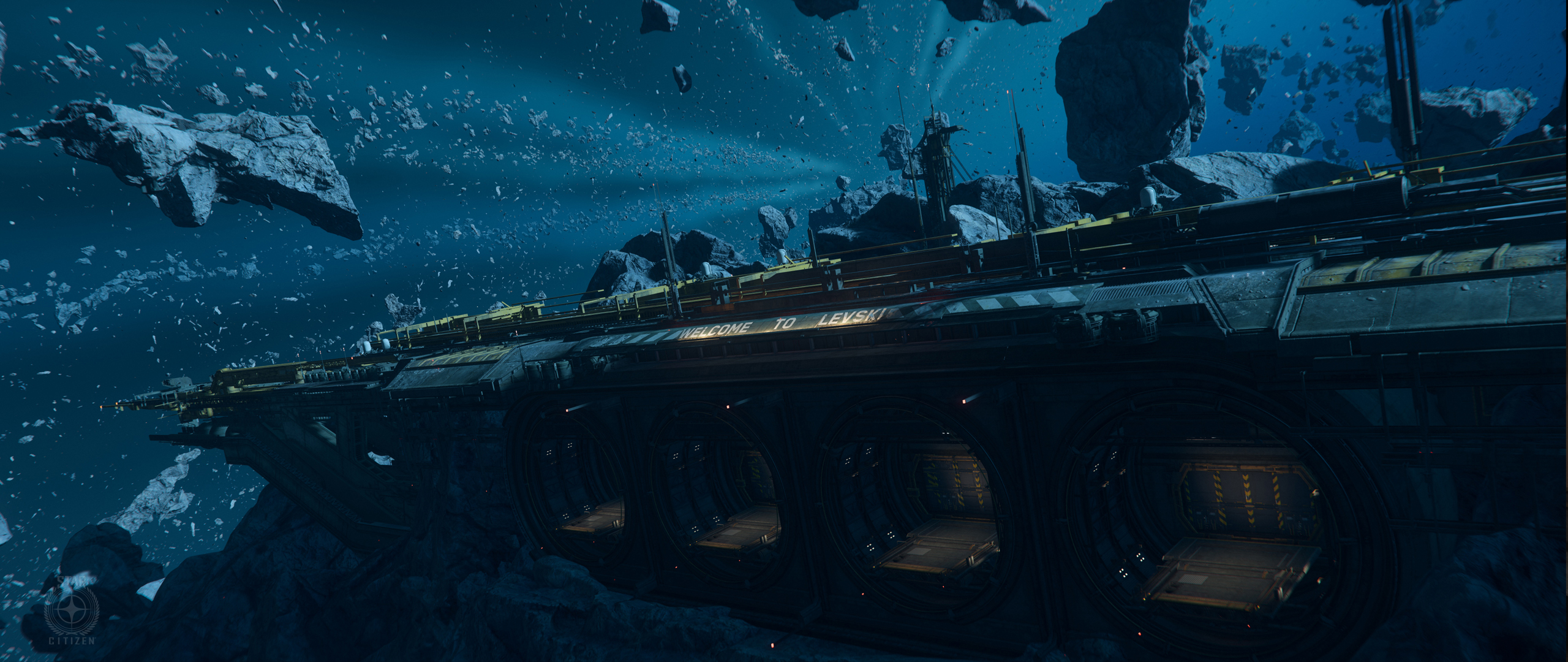
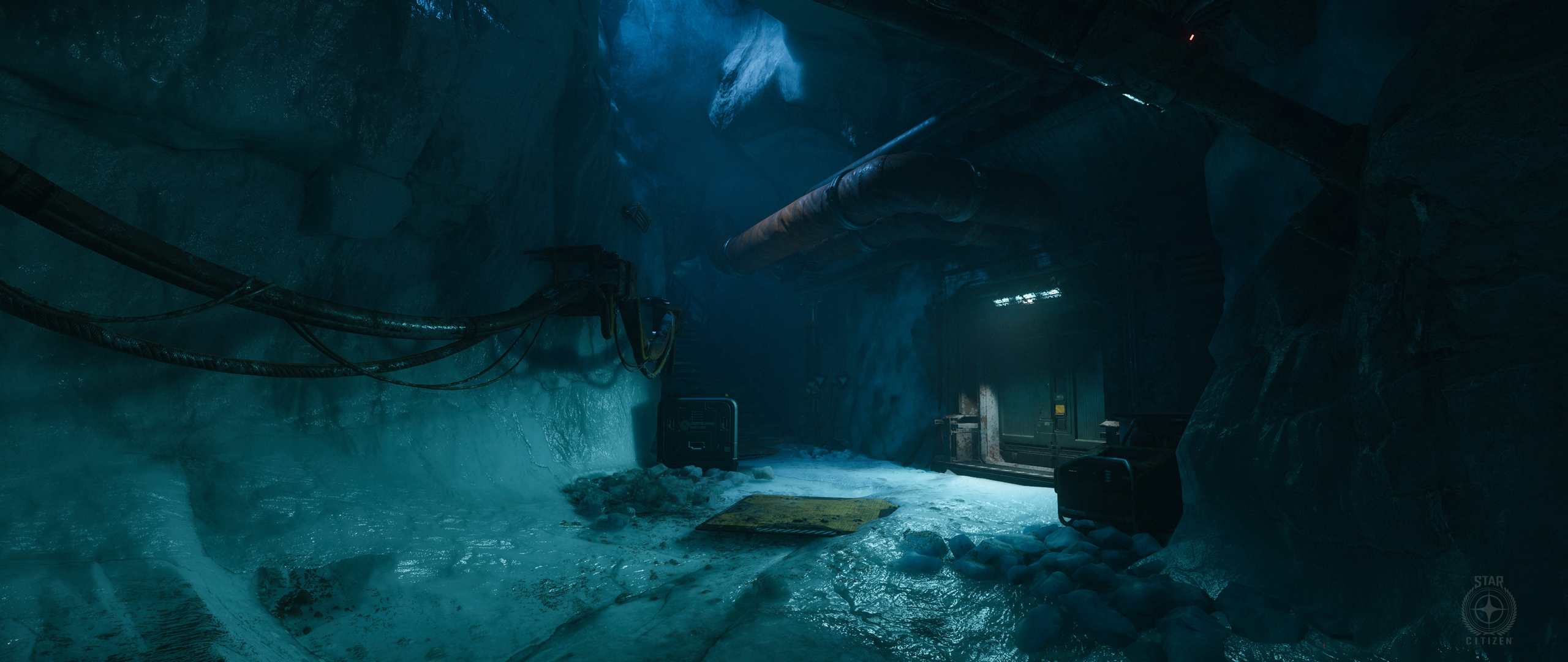
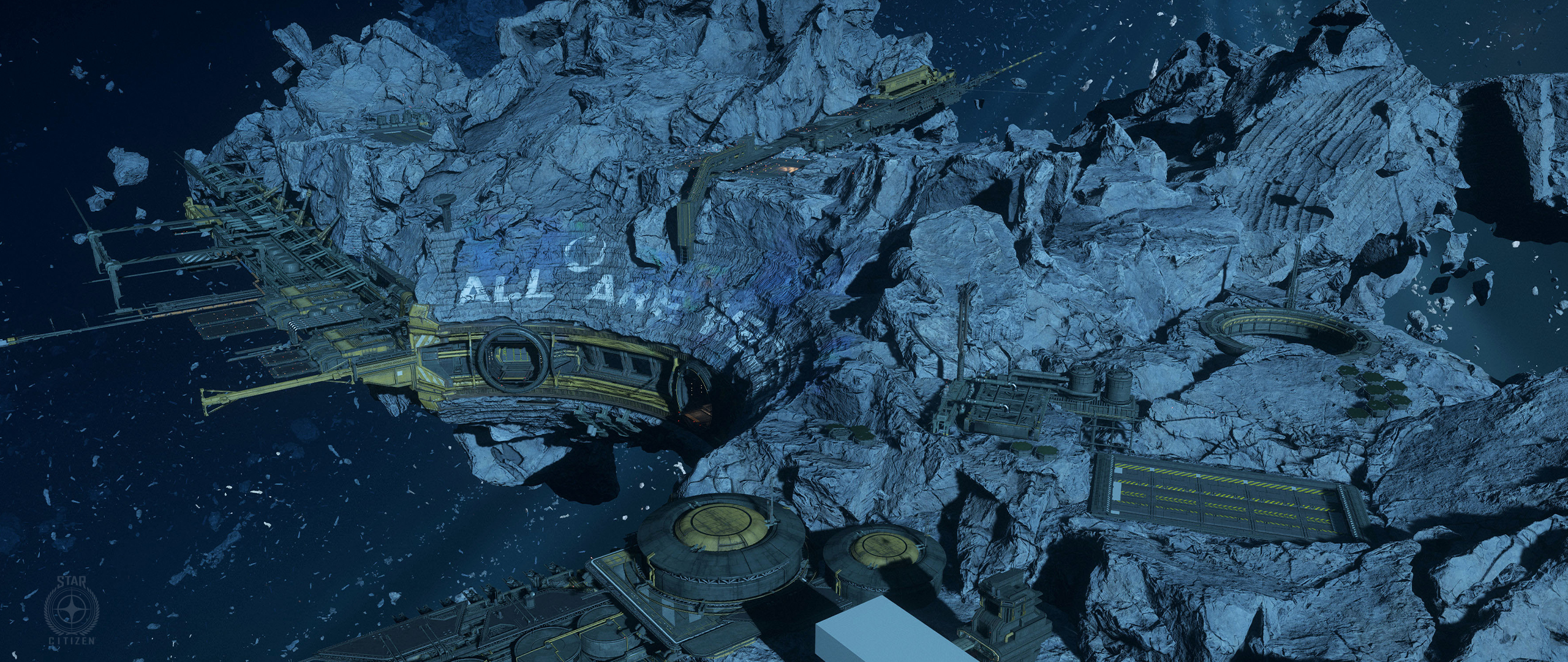
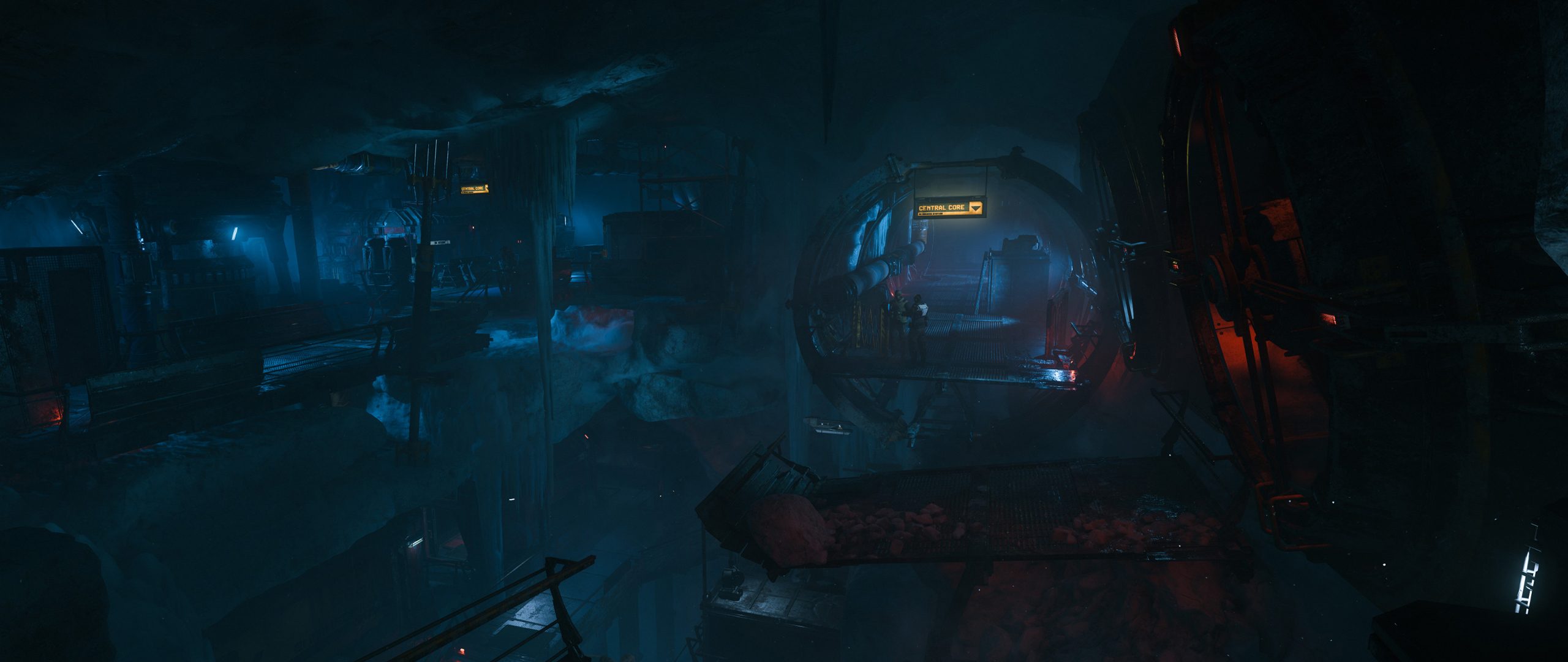
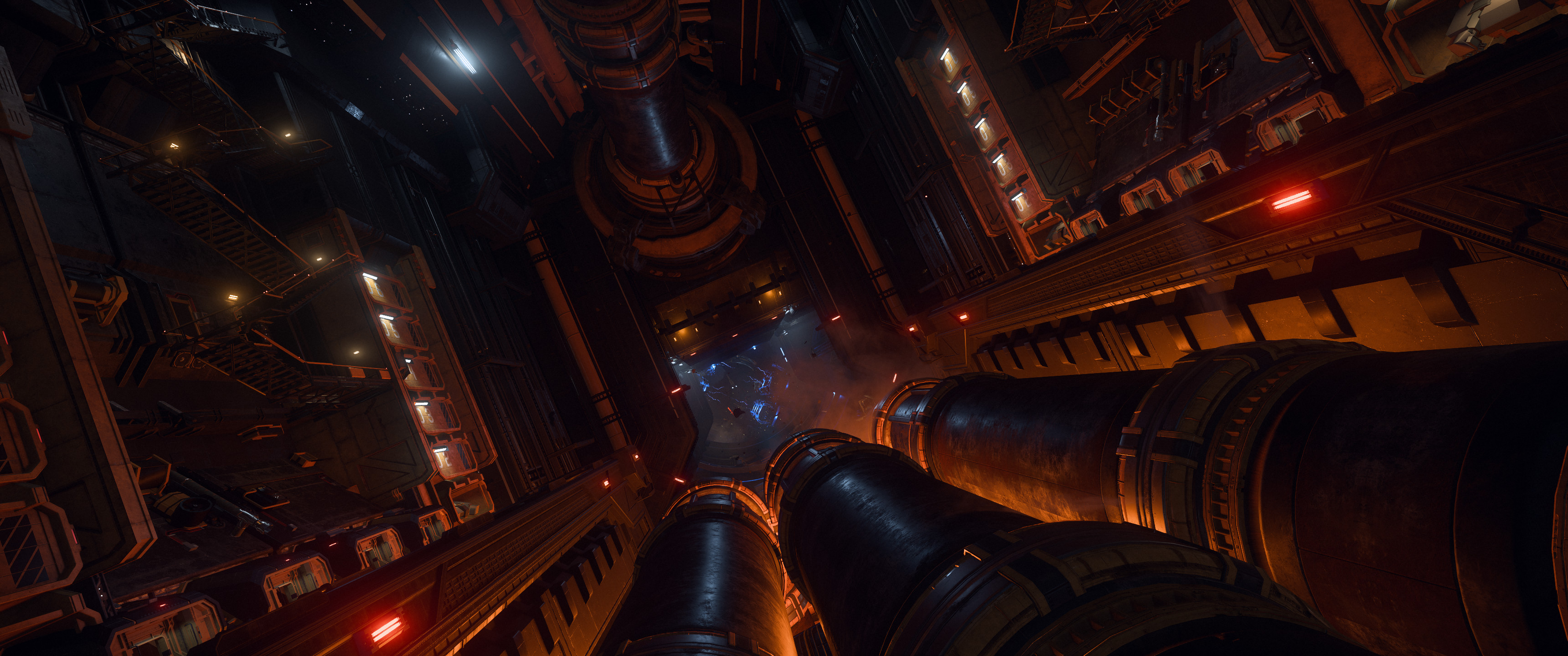
The Environment Art Team finished work on the base asteroid set and began trialing new shaders to great result. The finished set was handed over to Design and features asteroids ranging from 30 meters to 3 kilometers. The current challenge is how to texture such a wide range of sizes and shapes. The team pushed further with Archon Station’s traversable sections, which are now essentially content complete. They’re now moving onto creating the detail, such as the masses of machinery and pipework that fill the station. As mentioned in previous updates, the team is keen to get away from the ‘room, corridor, room, corridor’ mentality and are instead working in traversable paths around important structural features. For example, an oil rig is predominantly designed for a single purpose – how people get around and live on it is worked in afterwards. The team are pushing this approach to really nail believable and natural gameplay spaces.
Work on an important comms array continued. The structure is huge and the team are currently working to ensure both the interior and exterior are fun to explore and play, which involves working on a visual language that makes it clear where and what the various gameplay options are. Players will be encouraged to play the way they want, so rather than holding their hands, they’ll be ‘channeled’ at certain points to ensure they witness crucial scenes relevant to the story.
VDB remains in focus and the team are currently in the process of merging it with their asteroid belt work. The goal is to create ‘sea beds’ of asteroid rings and belts that not only stretch as far as the eye can see but are a challenge to navigate.
Art (Weapons)
The Weapon Art Team finished modeling and texturing the Hedeby Gunworks Salvo frag pistol and Behring GP33 ‘MOD’ grenade launcher. They also spent time cleaning up optical attachments and polished a few other weapons, including the Klaus & Werner Lumin V SMG
Audio
June saw the Audio Team focusing on chapter four and building on the extensive work the other departments have delivered so far. The levels are already incredibly impressive and present the team with some interesting challenges on how to approach sound and audio effects.
Cinematics
This month took a major step forward in terms of new tech and tools. These new additions will give the Cinematics Team a thorough pipeline to aid scene integration within the campaign. New code allows sequences from the cinematic timeline tool to blend seamlessly with AI locomotion before and after the scene ends. This is still being tweaked, but the majority of the heavy lifting is done and is functioning as intended. Another new addition is what the team calls the ‘AI>Trackview>AI sandwich’. This code made positive changes to Track View functionality and made some other internal tools redundant. The update went through QA and was extensively tested by the Cinematics Team to make sure their workflow wasn’t compromised. Initial bugs such as slowdowns in performance while scrubbing the timeline were quickly fixed and the team is now benefiting from a smoother and faster workflow.
Another update gives the team a visual method of selecting a ship’s interior and items. Any ship they pull into the editor can now be opened and its entities visually selected and added to Track View (previously, items were only selectable via a dropdown menu, which was less intuitive).
Improvements were also made to the ‘Actor Action’ track in the sequencer tool. The team can now grab, handover, holster, unholster, and equip items not just from a character’s loadout but any item from the world put into the sequence. For example, this makes scenes possible where a character hands over a weapon to the player and they hand it back.
In addition to testing the new code, the team progressed on some major campaign scenes.
Engineering
The Actor Team began developing animation-driven ragdoll death sequences. This tech enables death animations to play while the body collides with the environment or reacts to external factors in a realistic and believable way. It’s still in the early stages but is beginning to work as intended. More progress has been made on melee attacks, with support added for different attack types, blocks, and directional dodges.
The team also looked at the player status system and began rebalancing the stamina system to improve gameplay. They’re currently implementing a ‘stun’ mechanic, where a player can become unsteady until they’re eventually knocked unconscious for a period.
Finally for Engineering, a new system is currently in development that ties together all the different things that trigger camera shakes into a unified system. It also applies camera shake differently depending on whether the player is in first-person, third-person, or cinematic camera mode.
Gameplay Story
The Gameplay Story Team had another highly productive month, implementing 12 scenes to a high standard and achieving their goal of completing all of chapter 4’s scenes by the end of 2019’s second quarter. They also supported the Design Team, who have begun triggering these scenes in significant numbers. Alongside this, they added new audio to a handful of scenes and fixed errors that could have blocked the exporting of object containers in the future. They’re currently working with the recently integrated Universe Outliner that allow them to animate many doors, cupboards, and flaps that were previously inaccessible.
Graphics
Last month, Graphics finished the optimization of gas clouds, which should bring the cost to under 2ms on most GPUs. They’ll reassess the performance once the assets are finalized and decide whether further steps are required for lower-spec GPUs. The UK studio hosted a mini-summit for the graphics and engine teams to plan out the next stage of the major renderer rework. This rework involves fundamental changes to the structure of the renderer to allow pre-calculation of as much rendering data and entity creation as possible to minimize the work in each frame. When complete, it should result in significant CPU performance improvements, but will take several months to complete.
Level Design
The Design Team continued their work on the various levels, improving the flow and refining technology with the various feature teams. The Social Team continue their work on the interstitial spaces, with improvements to the crew behaviors in numerous areas and implementation of vital narrative scenes. The Tech Team are still improving the wider team’s workflow for consistency and stability, with oversight from the various specialist engineers. The goal here is to have this section in a highly polished state in Q3 to enable them to move forward with the other chapters, all of which have design owners and are being worked on concurrently.
Narrative
The Narrative Team went through an assortment of editorial selects for key Squadron 42 characters. They also wrote several set-dressing documents to guide Environment Art and Props with environmental storytelling. In addition, they had multiple reviews with Design on several chapter’s narrative moments and made further progress on their ongoing task to complete all in-game text.
QA
Changes to AI actors went into the build, which had an impact on the Cinematics Team’s workflow, so QA undertook extensive testing and test map creation specifically for Track View. The team are currently making improvements to the current automated test map as well as creating additional maps, which will make it easier to reproduce the issues the Cinematics Team may encounter.
Tech Animation
Technical Animation worked closely with many other teams on ship comms calls, animation workflows, and processes. They also continued to work through the backlog of outstanding wildline and dogfighting comms animations and are currently implementing the ones already processed. The Maya tools source control refactoring is complete too, which will allow the animators to work unhindered whether there is a source control connection or not. The Vanduul also made a comeback – the team are working with Facial Animation to refine the look and feel of the race to showcase to the game directors very soon.
Tech Art
Last month, Tech Art (together with Core Engine and Tech Animation) took strides towards establishing the new updated in-house facial rigging pipeline. In order to flesh out the DNA gene pool and populate the game with unique looking characters, a large number of face rigs for both female and male characters need to be created. An in-house facial rigging solution will give devs the required flexibility and full control over production scheduling and rig asset quality (and therefore animation and deformation quality). The first test case and benchmark for this new system was the face rig for the female playable character. The challenge now lies in ensuring that the animation quality now matches (or surpasses) that of the male playable character. Initial results look very promising and the team is excited to take the next steps.
UI
The UI Tech Team spent time upgrading the new UI system to include scrolling lists and flexible layouts, as well as supplying the tech for the new Gladius HUD. The Graphic Design Team worked on logos for the three main squadrons in the game, created UI screens to help bring the Archon bridge to life, and looking into retro sci-fi branding for the Aciedo environment.
VFX
Alongside the vertical slice worked on with Environment Art, VFX continued to support the various art and design teams on a couple of key locations.
WE’LL SEE YOU NEXT MONTH…
Dies ist ein Querverweis auf den Bericht, der kürzlich über den monatlichen Squadron 42 Newsletter verschickt wurde. Wir veröffentlichen dies ein zweites Mal als Comm-Link, um es der Community zu erleichtern, auf die man zurückgreifen kann.
Achtung Rekruten,
Was Sie hier lesen werden, sind die neuesten Informationen über die Weiterentwicklung der Squadron 42 (SCI des: SQ42).
Durch unsere gründlichen Untersuchungen haben wir Informationen über die jüngsten Operationen im Zusammenhang mit Track View-Kinematiken, KI-Verbesserungen, Betäubungsmechaniken und mehr erhalten.
Die in dieser Mitteilung enthaltenen Informationen sind äußerst sensibel, und es ist von größter Bedeutung, dass sie nicht in die falschen Hände geraten. Alle Datensätze nach dem Lesen löschen.
UEE Naval Oberkommando
KI
Die Staffel 42 im Juni beginnt wie immer mit dem KI-Team, das ein Multithreading-Update der Subsumption-Komponente ermöglichte, was einen großen Einfluss auf die gesamte Spielleistung haben wird. Sie aktualisierten auch das Tactical Point System, um die asynchrone Generierung zu unterstützen, was die Effizienz großer nutzbarer Suchradien verbessert und weniger Auswirkungen auf die Aktualisierung von Frames hat. Das Charakter-Kampfteam verbrachte Zeit damit, den menschlichen Kampf neu zu gestalten - neue Taktiken wurden hinzugefügt, NSCs verstehen offene Umgebungen besser, und viele Fehler wurden behoben. Die erste Version eines "Untersuchungsverhaltens" wurde ebenfalls fertiggestellt, das es den NSCs ermöglichen wird, nach Spielern zu suchen, wenn sie es schaffen, im Kampf zu entkommen.
Ship AI implementierte eine Komponente, die die Zielauswahl der KI-Schiffe besser ausgleicht. Ein neues Element ermöglicht es den Designern, Vorschläge zu erarbeiten, wie die KI einzelne Schiffe innerhalb einer Gruppe verteilen soll, was wiederum systemischen Verhaltensweisen die Wahl lässt, welches Ziel zuerst angegriffen werden soll.
Kampfmäßig wurden Verhaltensweisen hinzugefügt, um die Pilotfähigkeiten besser zu nutzen, und alle ersten "Qualifikationsblätter" wurden ausgefüllt. Mehrere Flugmanöver, wie das vor einigen Berichten erwähnte "Fly-by" und "Breakaway", wurden zur Unterstützung des Strafings überarbeitet und der Nachbrenner beim Fliegen über Splines verbessert. Sie setzten ihre Arbeit an der 3D-Pfadfindung fort und implementieren derzeit eine effizientere Methode zur Bewertung der Umgebung und zum Aufbau von Flugrouten unter Verwendung von Informationen aus dem durch den Physikcode berechneten Entfernungsfeld. Dies wird es auch KI-Schiffen ermöglichen, hochkomplexe Umgebungen wie dichte Asteroidenfelder und komplexe Strukturen besser zu navigieren.
Schließlich hat das Social Team für die KI des Anbieters mehrere neue Funktionalitäten eingeführt, wie z.B. die Möglichkeit, NSCs und Spieler mit Usables zu interagieren, ohne dass explizit Interaktionen ausgelöst werden müssen.
Animation
Im vergangenen Monat hat Animation die Entwicklung von Feinden im menschlichen Stil fortgesetzt, einschließlich der Möglichkeit, Seitenwaffen zu benutzen und die Visualisierung von zwei neuen Feindtypen. Sie arbeiteten eng mit dem Designteam zusammen, um einen Prototyp des Nahkampfes zu entwickeln, und begannen, die Knicke im Takedown-System zu erarbeiten. Das Springen und das Schließen der technischen Anforderungen war ebenfalls eine Priorität. Sie begannen auch mit der Erstellung von Animationen für "first selects" (eine einzigartige Animation, die zum ersten Mal, wenn ein Spieler eine Waffe hält/ausrüstet) und arbeiteten mit Design an der Waffeninspektion und wie sie aufgenommen werden. Das Team machte Fortschritte bei der Kommunikation zwischen Schiff und Schiff, einschließlich der Bereitstellung der g-force-Animationen, die für KI-Piloten richtig ablaufen. Sobald die Pipeline fertiggestellt ist, können sie mit der Produktion von Schiff-zu-Schiff-Kommunkommandos beginnen. In Anlehnung an die oben beschriebene Arbeit des KI-Teams begann Animation mit der Erfassung der Bewegungsdaten für das aktualisierte Barkeeperverhalten und begann mit der Arbeit an einem neuen Missionsgeber, der später im Jahr kam.
Sie setzten auch auf Usables fort, mit dem Ziel, alle angeforderten Animationen innerhalb der nächsten Monate fertigzustellen.
Kunst (Charaktere)
Character Art konzentrierte sich weiterhin stark darauf, die Qualität der Haare zu verbessern. Die Arbeiten an der Vanduul wurden fortgesetzt, während die Konzeptphase der Xi'an-Rasse große Fortschritte machte. Die bestehenden Outfits wurden verfeinert und die Materialbibliothek weiter ausgebaut, was zur Verbesserung der Gesamtqualität der Kostüme im Spiel beitragen wird.
Kunst (Umwelt)
Das Environment Art Team beendete die Arbeit am Basis-Asteroiden-Set und begann, neue Shader mit großem Erfolg zu testen. Das fertige Set wurde an Design übergeben und verfügt über Asteroiden von 30 Meter bis 3 Kilometer Länge. Die aktuelle Herausforderung besteht darin, wie man eine so große Bandbreite an Größen und Formen strukturiert. Das Team trieb die Arbeit mit den überfahrbaren Abschnitten der Archon Station voran, die nun im Wesentlichen zufriedenstellend abgeschlossen sind. Sie arbeiten nun daran, das Detail zu schaffen, wie z.B. die Massen von Maschinen und Rohrleitungen, die die Station füllen. Wie bereits in früheren Updates erwähnt, ist das Team bestrebt, von der Mentalität des "Zimmers, des Korridors, des Zimmers, des Korridors" wegzukommen und arbeitet stattdessen auf begehbaren Wegen um wichtige strukturelle Merkmale herum. So ist beispielsweise eine Bohrinsel überwiegend für einen einzigen Zweck konzipiert - wie Menschen herumkommen und auf ihr leben, wird anschließend eingearbeitet. Das Team treibt diesen Ansatz voran, um wirklich glaubwürdige und natürliche Spielräume zu schaffen.
Die Arbeiten an einem wichtigen Comms-Array wurden fortgesetzt. Die Struktur ist riesig und das Team arbeitet derzeit daran, sicherzustellen, dass sowohl das Innere als auch das Äußere Spaß am Erkunden und Spielen haben, was die Arbeit an einer Bildsprache beinhaltet, die deutlich macht, wo und was die verschiedenen Spieloptionen sind. Die Spieler werden ermutigt, so zu spielen, wie sie es sich wünschen, so dass sie nicht an den Händen halten, sondern an bestimmten Stellen "kanalisiert" werden, um sicherzustellen, dass sie wichtige, für die Geschichte relevante Szenen erleben.
Der VDB bleibt im Fokus und das Team ist derzeit dabei, es mit seiner Asteroidengürtelarbeit zu verschmelzen. Ziel ist es, "Meeresböden" aus Asteroidenringen und -gürteln zu schaffen, die sich nicht nur so weit erstrecken, wie das Auge sehen kann, sondern auch eine Herausforderung bei der Navigation darstellen.
Kunst (Waffen)
Das Weapon Art Team beendete die Modellierung und Texturierung der Hedeby Gunworks Salvo frag Pistole und des Behring GP33'MOD' Granatwerfer. Sie verbrachten auch Zeit damit, optische Aufsätze zu reinigen und polierten ein paar andere Waffen, darunter die Klaus & Werner Lumin V SMG.
Audio
Im Juni konzentrierte sich das Audio-Team auf Kapitel vier und baute auf der umfangreichen Arbeit auf, die die anderen Abteilungen bisher geleistet haben. Die Pegel sind bereits unglaublich beeindruckend und stellen das Team vor einige interessante Herausforderungen, wie man mit Sound- und Audioeffekten umgeht.
Kinematiken
In diesem Monat wurde ein großer Schritt nach vorne gemacht, was neue Technologien und Werkzeuge betrifft. Mit diesen Neuzugängen verfügt das Cinematics-Team über eine umfassende Pipeline zur Unterstützung der Szenenintegration innerhalb der Kampagne. Neuer Code ermöglicht es, Sequenzen aus dem filmischen Timeline Tool nahtlos in die KI-Lokation vor und nach dem Ende der Szene einzufügen. Dies wird immer noch optimiert, aber der Großteil des Schwertransports ist erledigt und funktioniert wie vorgesehen. Eine weitere Neuerung ist das so genannte 'AI>Trackview>AI Sandwich'. Dieser Code hat die Track View Funktionalität positiv verändert und einige andere interne Tools überflüssig gemacht. Das Update durchlief die QS und wurde vom Cinematics-Team ausgiebig getestet, um sicherzustellen, dass der Workflow nicht beeinträchtigt wird. Erste Fehler wie Leistungseinbußen beim Scrubben der Timeline wurden schnell behoben, und das Team profitiert nun von einem reibungsloseren und schnelleren Workflow.
Ein weiteres Update bietet dem Team eine visuelle Methode zur Auswahl des Schiffsinnenraums und der Gegenstände. Jedes Schiff, das sie in den Editor ziehen, kann nun geöffnet und seine Entitäten visuell ausgewählt und der Track View hinzugefügt werden (früher waren die Elemente nur über ein Dropdown-Menü wählbar, was weniger intuitiv war).
Verbesserungen wurden auch an der Spur "Actor Action" im Sequenzer-Tool vorgenommen. Das Team kann nun Gegenstände greifen, übergeben, haltern, entfalten und ausrüsten, nicht nur von der Auslastung eines Charakters, sondern von jedem Gegenstand aus der Welt, der in die Sequenz eingefügt wird. So werden beispielsweise Szenen möglich, in denen ein Charakter dem Spieler eine Waffe übergibt und diese zurückgibt.
Zusätzlich zum Testen des neuen Codes machte das Team Fortschritte bei einigen wichtigen Kampagnenszenen.
Ingenieurwesen
Das Actor Team begann mit der Entwicklung von animationsgetriebenen Ragdoll-Todessequenzen. Diese Technologie ermöglicht es, Todesanimationen zu spielen, während der Körper mit der Umgebung kollidiert oder realistisch und glaubwürdig auf äußere Faktoren reagiert. Es befindet sich noch in der Anfangsphase, beginnt aber, wie geplant zu funktionieren. Bei Nahkampfangriffen wurden weitere Fortschritte erzielt, wobei die Unterstützung für verschiedene Angriffstypen, Blöcke und Richtungsweichen hinzugefügt wurde.
Das Team betrachtete auch das Spieler-Statussystem und begann, das Ausdauer-System neu auszugleichen, um das Gameplay zu verbessern. Sie implementieren derzeit einen Betäubungsmechanismus, bei dem ein Spieler unsicher werden kann, bis er schließlich für eine gewisse Zeit bewusstlos geschlagen wird.
Schließlich für das Engineering befindet sich derzeit ein neues System in der Entwicklung, das all die verschiedenen Dinge, die das Erschüttern der Kamera auslösen, zu einem einheitlichen System zusammenführt. Es wendet auch die Verwacklung der Kamera unterschiedlich an, je nachdem, ob sich der Spieler im First-Person-, Third-Person- oder Filmkameramodus befindet.
Gameplay-Geschichte
Das Gameplay Story Team hatte einen weiteren hochproduktiven Monat, in dem es 12 Szenen auf hohem Niveau implementierte und sein Ziel, alle Szenen von Kapitel 4 bis Ende des zweiten Quartals 2019 abzuschließen, erreichte. Sie unterstützten auch das Designteam, das damit begonnen hat, diese Szenen in großer Zahl auszulösen. Daneben fügten sie einer Handvoll Szenen neues Audio hinzu und beheben Fehler, die den Export von Objektcontainern in Zukunft hätten verhindern können. Sie arbeiten derzeit mit dem kürzlich integrierten Universe Outliner zusammen, der es ihnen ermöglicht, viele Türen, Schränke und Klappen zu animieren, die bisher unzugänglich waren.
Grafiken
Im vergangenen Monat beendete Graphics die Optimierung der Gaswolken, was die Kosten für die meisten GPUs auf unter 2 ms senken sollte. Sie werden die Leistung nach Fertigstellung der Anlagen neu bewerten und entscheiden, ob weitere Schritte für GPUs mit niedrigerer Spezifikation erforderlich sind. Das britische Studio veranstaltete einen Mini-Gipfel für die Grafik- und Engineteams, um die nächste Phase der großen Renderer-Überarbeitung zu planen. Diese Überarbeitung beinhaltet grundlegende Änderungen an der Struktur des Renderers, um eine Vorberechnung so vieler Rendering-Daten wie möglich zu ermöglichen und eine Entitätsbildung zu ermöglichen, um den Aufwand in jedem Frame zu minimieren. Nach Fertigstellung sollte dies zu erheblichen Verbesserungen der CPU-Leistung führen, die jedoch mehrere Monate dauern werden.
Leveldesign
Das Designteam setzte seine Arbeit auf den verschiedenen Ebenen fort und verbesserte die Strömungs- und Verfeinerungstechnologie mit den verschiedenen Funktionsteams. Das Sozialteam setzt seine Arbeit an den Zwischenräumen fort, mit Verbesserungen des Crewverhaltens in zahlreichen Bereichen und der Umsetzung wichtiger narrativer Szenen. Das Tech Team verbessert weiterhin den Workflow des breiteren Teams für Konsistenz und Stabilität, unter der Aufsicht der verschiedenen Fachingenieure. Ziel ist es, diesen Abschnitt im dritten Quartal in einem hochglanzpolierten Zustand zu haben, damit sie mit den anderen Kapiteln, die alle Designeigentümer haben und gleichzeitig bearbeitet werden, weitermachen können.
Narrativ
Das Narrative Team durchlief eine Reihe von redaktionellen Auswahlverfahren für die wichtigsten 42 Charaktere der Staffel. Sie schrieben auch mehrere Set-Dressing-Dokumente, um Environment Art und Requisiten mit Umwelt-Storytelling zu leiten. Darüber hinaus hatten sie mehrere Rezensionen mit Design zu den Erzählmomenten mehrerer Kapitel und machten weitere Fortschritte bei ihrer laufenden Aufgabe, den gesamten Text im Spiel zu vervollständigen.
QA
Änderungen an den KI-Akteuren gingen in den Build ein, was sich auf den Workflow des Cinematics-Teams auswirkte, so dass QA umfangreiche Tests und die Erstellung von Testkarten speziell für die Track View durchführte. Das Team arbeitet derzeit an der Verbesserung der aktuellen automatisierten Testkarte und erstellt zusätzliche Karten, die es erleichtern, die Probleme, auf die das Cinematics-Team stoßen kann, zu reproduzieren.
Technische Animation
Technical Animation arbeitete eng mit vielen anderen Teams zusammen, um Schiffskommunikationsaufrufe, Animationsabläufe und Prozesse zu entwickeln. Sie haben auch den Rückstand an hervorragenden Wildline und Dogfighting Comms Animationen weiter bearbeitet und implementieren derzeit die bereits verarbeiteten. Das Refactoring der Maya-Tools für die Versionskontrolle ist ebenfalls abgeschlossen, so dass die Animatoren ungehindert arbeiten können, unabhängig davon, ob eine Versionskontrollverbindung besteht oder nicht. Die Vanduul feierten auch ein Comeback - das Team arbeitet mit Facial Animation zusammen, um das Look-and-Feel des Rennens zu verfeinern und den Game-Direktoren sehr bald zu präsentieren.
Technische Kunst
Letzten Monat hat Tech Art (zusammen mit Core Engine und Tech Animation) Schritte unternommen, um die neue, aktualisierte firmeneigene Facial Rigging Pipeline zu etablieren. Um den DNA-Genpool zu vervollständigen und das Spiel mit einzigartig aussehenden Charakteren zu füllen, muss eine große Anzahl von Face-Rigs für weibliche und männliche Charaktere erstellt werden. Eine hauseigene Facial Rigging-Lösung gibt den Entwicklern die erforderliche Flexibilität und volle Kontrolle über die Produktionsplanung und die Qualität der Rigg Assets (und damit die Qualität der Animation und Deformation). Der erste Testfall und Maßstab für dieses neue System war das Gesichtsgerät für die weibliche spielbare Figur. Die Herausforderung besteht nun darin, sicherzustellen, dass die Animationsqualität nun derjenigen des männlichen spielbaren Charakters entspricht (oder diese übertrifft). Die ersten Ergebnisse sehen sehr vielversprechend aus und das Team ist gespannt auf die nächsten Schritte.
UI
Das UI Tech Team verbrachte Zeit damit, das neue UI-System mit Scroll-Listen und flexiblen Layouts zu erweitern und die Technik für das neue Gladius HUD zu liefern. Das Grafikdesign-Team arbeitete an Logos für die drei Hauptgeschwader des Spiels, erstellte Benutzeroberflächen, um die Archon-Brücke zum Leben zu erwecken, und untersuchte das Retro-Science-Fi-Branding für die Aciedo-Umgebung.
VFX
Neben dem vertikalen Schnitt, an dem mit Environment Art gearbeitet wurde, unterstützte VFX weiterhin die verschiedenen Kunst- und Designteams an einigen wichtigen Standorten.
WIR SEHEN UNS NÄCHSTEN MONAT.....
This is a cross-post of the report that was recently sent out via the monthly Squadron 42 newsletter. We’re publishing this a second time as a Comm-Link to make it easier for the community to reference back to. Attention Recruits,
What you are about to read is the latest information on the continuing development of Squadron 42 (SCI des: SQ42).
Through our thorough investigations, we’ve obtained intel on recent operations pertaining to Track View cinematics, AI enhancements, stun mechanics, and more.
The information contained in this communication is extremely sensitive and it is of paramount importance that it does not fall into the wrong hands. Purge all records after reading.
UEE Naval High Command
AI
June’s Squadron 42 roundup starts as always with the AI Team, who enabled a multithreaded update of the Subsumption component, which will have a big impact on overall game performance. They also updated the Tactical Point System to support asynchronous generation, which improves the efficiency of large usable search radiuses and has less impact on frame update. The Character Combat Team spent time refactoring human combat – new tactics have been added, NPCs understand open environments better, and a lot of bugs have been fixed. The first version of an ‘investigate’ behavior was also completed, which will enable NPCs to search for players if they manage to escape during combat.
Ship AI implemented a component that better balances the targeting selection of AI ships. One new element allows the designers to set up suggestions on how the AI should spread individual ships within a group, which in turn allows systemic behaviors to choose which target should be attacked first.
Combat wise, behaviors were added to make better use of the pilot skills and all initial ‘skill sheets’ were completed. Several flying maneuvers, such as the ‘fly by’ and ‘breakaway’ mentioned a couple of reports ago, were reworked to support strafing and the afterburner has been improved when flying over splines. They continued work on 3D pathfinding and are currently implementing a more efficient way to evaluate the environment and build flight paths using information from the distance field calculated by the physics code. This will also allow AI ships to better navigate highly complex environments, such as dense asteroid fields and intricate structures.
Finally for AI, the Social Team introduced several new functionalities to the vendor AI, such as enabling NPCs and players to interact with usables without the need to explicitly trigger interactions.
Animation
Last month, Animation continued to develop human-style enemies, including enabling them to use sidearms and the previsualization of two new enemy types. They worked closely with the Design Team to prototype melee combat and began working out the kinks in the takedown system. Jumping, and closing out the technical needs for it, was a priority too. They also began creating animations for ‘first selects’ (a unique animation for the first time a player holds/equips a weapon) and worked with Design on weapon inspection and how they’re picked up. The team moved forward with ship-to-ship communications, including getting the g-force animations playing properly for AI pilots. Once the pipeline is completed, they’ll be able to start producing ship-to-ship comms calls in earnest. Tying into the AI Team’s work above, Animation started on the motion capture data for the updated bartender and bar patron behavior and began work on a new mission giver coming later in the year.
They also continued on usables, with the aim to have all requested animations complete within the next few months.
Art (Characters)
Character Art continued to focus heavily on bringing up the quality of hair. Work continued on the Vanduul, while the concept stage of the Xi’an race made great headway. Refinements were made to existing outfits and the material library was further expanded, which will help improve the overall quality of costumes in the game.
Art (Environment)
The Environment Art Team finished work on the base asteroid set and began trialing new shaders to great result. The finished set was handed over to Design and features asteroids ranging from 30 meters to 3 kilometers. The current challenge is how to texture such a wide range of sizes and shapes. The team pushed further with Archon Station’s traversable sections, which are now essentially content complete. They’re now moving onto creating the detail, such as the masses of machinery and pipework that fill the station. As mentioned in previous updates, the team is keen to get away from the ‘room, corridor, room, corridor’ mentality and are instead working in traversable paths around important structural features. For example, an oil rig is predominantly designed for a single purpose – how people get around and live on it is worked in afterwards. The team are pushing this approach to really nail believable and natural gameplay spaces.
Work on an important comms array continued. The structure is huge and the team are currently working to ensure both the interior and exterior are fun to explore and play, which involves working on a visual language that makes it clear where and what the various gameplay options are. Players will be encouraged to play the way they want, so rather than holding their hands, they’ll be ‘channeled’ at certain points to ensure they witness crucial scenes relevant to the story.
VDB remains in focus and the team are currently in the process of merging it with their asteroid belt work. The goal is to create ‘sea beds’ of asteroid rings and belts that not only stretch as far as the eye can see but are a challenge to navigate.
Art (Weapons)
The Weapon Art Team finished modeling and texturing the Hedeby Gunworks Salvo frag pistol and Behring GP33 ‘MOD’ grenade launcher. They also spent time cleaning up optical attachments and polished a few other weapons, including the Klaus & Werner Lumin V SMG
Audio
June saw the Audio Team focusing on chapter four and building on the extensive work the other departments have delivered so far. The levels are already incredibly impressive and present the team with some interesting challenges on how to approach sound and audio effects.
Cinematics
This month took a major step forward in terms of new tech and tools. These new additions will give the Cinematics Team a thorough pipeline to aid scene integration within the campaign. New code allows sequences from the cinematic timeline tool to blend seamlessly with AI locomotion before and after the scene ends. This is still being tweaked, but the majority of the heavy lifting is done and is functioning as intended. Another new addition is what the team calls the ‘AI>Trackview>AI sandwich’. This code made positive changes to Track View functionality and made some other internal tools redundant. The update went through QA and was extensively tested by the Cinematics Team to make sure their workflow wasn’t compromised. Initial bugs such as slowdowns in performance while scrubbing the timeline were quickly fixed and the team is now benefiting from a smoother and faster workflow.
Another update gives the team a visual method of selecting a ship’s interior and items. Any ship they pull into the editor can now be opened and its entities visually selected and added to Track View (previously, items were only selectable via a dropdown menu, which was less intuitive).
Improvements were also made to the ‘Actor Action’ track in the sequencer tool. The team can now grab, handover, holster, unholster, and equip items not just from a character’s loadout but any item from the world put into the sequence. For example, this makes scenes possible where a character hands over a weapon to the player and they hand it back.
In addition to testing the new code, the team progressed on some major campaign scenes.
Engineering
The Actor Team began developing animation-driven ragdoll death sequences. This tech enables death animations to play while the body collides with the environment or reacts to external factors in a realistic and believable way. It’s still in the early stages but is beginning to work as intended. More progress has been made on melee attacks, with support added for different attack types, blocks, and directional dodges.
The team also looked at the player status system and began rebalancing the stamina system to improve gameplay. They’re currently implementing a ‘stun’ mechanic, where a player can become unsteady until they’re eventually knocked unconscious for a period.
Finally for Engineering, a new system is currently in development that ties together all the different things that trigger camera shakes into a unified system. It also applies camera shake differently depending on whether the player is in first-person, third-person, or cinematic camera mode.
Gameplay Story
The Gameplay Story Team had another highly productive month, implementing 12 scenes to a high standard and achieving their goal of completing all of chapter 4’s scenes by the end of 2019’s second quarter. They also supported the Design Team, who have begun triggering these scenes in significant numbers. Alongside this, they added new audio to a handful of scenes and fixed errors that could have blocked the exporting of object containers in the future. They’re currently working with the recently integrated Universe Outliner that allow them to animate many doors, cupboards, and flaps that were previously inaccessible.
Graphics
Last month, Graphics finished the optimization of gas clouds, which should bring the cost to under 2ms on most GPUs. They’ll reassess the performance once the assets are finalized and decide whether further steps are required for lower-spec GPUs. The UK studio hosted a mini-summit for the graphics and engine teams to plan out the next stage of the major renderer rework. This rework involves fundamental changes to the structure of the renderer to allow pre-calculation of as much rendering data and entity creation as possible to minimize the work in each frame. When complete, it should result in significant CPU performance improvements, but will take several months to complete.
Level Design
The Design Team continued their work on the various levels, improving the flow and refining technology with the various feature teams. The Social Team continue their work on the interstitial spaces, with improvements to the crew behaviors in numerous areas and implementation of vital narrative scenes. The Tech Team are still improving the wider team’s workflow for consistency and stability, with oversight from the various specialist engineers. The goal here is to have this section in a highly polished state in Q3 to enable them to move forward with the other chapters, all of which have design owners and are being worked on concurrently.
Narrative
The Narrative Team went through an assortment of editorial selects for key Squadron 42 characters. They also wrote several set-dressing documents to guide Environment Art and Props with environmental storytelling. In addition, they had multiple reviews with Design on several chapter’s narrative moments and made further progress on their ongoing task to complete all in-game text.
QA
Changes to AI actors went into the build, which had an impact on the Cinematics Team’s workflow, so QA undertook extensive testing and test map creation specifically for Track View. The team are currently making improvements to the current automated test map as well as creating additional maps, which will make it easier to reproduce the issues the Cinematics Team may encounter.
Tech Animation
Technical Animation worked closely with many other teams on ship comms calls, animation workflows, and processes. They also continued to work through the backlog of outstanding wildline and dogfighting comms animations and are currently implementing the ones already processed. The Maya tools source control refactoring is complete too, which will allow the animators to work unhindered whether there is a source control connection or not. The Vanduul also made a comeback – the team are working with Facial Animation to refine the look and feel of the race to showcase to the game directors very soon.
Tech Art
Last month, Tech Art (together with Core Engine and Tech Animation) took strides towards establishing the new updated in-house facial rigging pipeline. In order to flesh out the DNA gene pool and populate the game with unique looking characters, a large number of face rigs for both female and male characters need to be created. An in-house facial rigging solution will give devs the required flexibility and full control over production scheduling and rig asset quality (and therefore animation and deformation quality). The first test case and benchmark for this new system was the face rig for the female playable character. The challenge now lies in ensuring that the animation quality now matches (or surpasses) that of the male playable character. Initial results look very promising and the team is excited to take the next steps.
UI
The UI Tech Team spent time upgrading the new UI system to include scrolling lists and flexible layouts, as well as supplying the tech for the new Gladius HUD. The Graphic Design Team worked on logos for the three main squadrons in the game, created UI screens to help bring the Archon bridge to life, and looking into retro sci-fi branding for the Aciedo environment.
VFX
Alongside the vertical slice worked on with Environment Art, VFX continued to support the various art and design teams on a couple of key locations.
WE’LL SEE YOU NEXT MONTH…
This is a cross-post of the report that was recently sent out via the monthly Squadron 42 newsletter. We’re publishing this a second time as a Comm-Link to make it easier for the community to reference back to. Attention Recruits,
What you are about to read is the latest information on the continuing development of Squadron 42 (SCI des: SQ42).
Through our thorough investigations, we’ve obtained intel on recent operations pertaining to Track View cinematics, AI enhancements, stun mechanics, and more.
The information contained in this communication is extremely sensitive and it is of paramount importance that it does not fall into the wrong hands. Purge all records after reading.
UEE Naval High Command
AI
June’s Squadron 42 roundup starts as always with the AI Team, who enabled a multithreaded update of the Subsumption component, which will have a big impact on overall game performance. They also updated the Tactical Point System to support asynchronous generation, which improves the efficiency of large usable search radiuses and has less impact on frame update. The Character Combat Team spent time refactoring human combat – new tactics have been added, NPCs understand open environments better, and a lot of bugs have been fixed. The first version of an ‘investigate’ behavior was also completed, which will enable NPCs to search for players if they manage to escape during combat.
Ship AI implemented a component that better balances the targeting selection of AI ships. One new element allows the designers to set up suggestions on how the AI should spread individual ships within a group, which in turn allows systemic behaviors to choose which target should be attacked first.
Combat wise, behaviors were added to make better use of the pilot skills and all initial ‘skill sheets’ were completed. Several flying maneuvers, such as the ‘fly by’ and ‘breakaway’ mentioned a couple of reports ago, were reworked to support strafing and the afterburner has been improved when flying over splines. They continued work on 3D pathfinding and are currently implementing a more efficient way to evaluate the environment and build flight paths using information from the distance field calculated by the physics code. This will also allow AI ships to better navigate highly complex environments, such as dense asteroid fields and intricate structures.
Finally for AI, the Social Team introduced several new functionalities to the vendor AI, such as enabling NPCs and players to interact with usables without the need to explicitly trigger interactions.
Animation
Last month, Animation continued to develop human-style enemies, including enabling them to use sidearms and the previsualization of two new enemy types. They worked closely with the Design Team to prototype melee combat and began working out the kinks in the takedown system. Jumping, and closing out the technical needs for it, was a priority too. They also began creating animations for ‘first selects’ (a unique animation for the first time a player holds/equips a weapon) and worked with Design on weapon inspection and how they’re picked up. The team moved forward with ship-to-ship communications, including getting the g-force animations playing properly for AI pilots. Once the pipeline is completed, they’ll be able to start producing ship-to-ship comms calls in earnest. Tying into the AI Team’s work above, Animation started on the motion capture data for the updated bartender and bar patron behavior and began work on a new mission giver coming later in the year.
They also continued on usables, with the aim to have all requested animations complete within the next few months.
Art (Characters)
Character Art continued to focus heavily on bringing up the quality of hair. Work continued on the Vanduul, while the concept stage of the Xi’an race made great headway. Refinements were made to existing outfits and the material library was further expanded, which will help improve the overall quality of costumes in the game.
Art (Environment)
The Environment Art Team finished work on the base asteroid set and began trialing new shaders to great result. The finished set was handed over to Design and features asteroids ranging from 30 meters to 3 kilometers. The current challenge is how to texture such a wide range of sizes and shapes. The team pushed further with Archon Station’s traversable sections, which are now essentially content complete. They’re now moving onto creating the detail, such as the masses of machinery and pipework that fill the station. As mentioned in previous updates, the team is keen to get away from the ‘room, corridor, room, corridor’ mentality and are instead working in traversable paths around important structural features. For example, an oil rig is predominantly designed for a single purpose – how people get around and live on it is worked in afterwards. The team are pushing this approach to really nail believable and natural gameplay spaces.
Work on an important comms array continued. The structure is huge and the team are currently working to ensure both the interior and exterior are fun to explore and play, which involves working on a visual language that makes it clear where and what the various gameplay options are. Players will be encouraged to play the way they want, so rather than holding their hands, they’ll be ‘channeled’ at certain points to ensure they witness crucial scenes relevant to the story.
VDB remains in focus and the team are currently in the process of merging it with their asteroid belt work. The goal is to create ‘sea beds’ of asteroid rings and belts that not only stretch as far as the eye can see but are a challenge to navigate.
Art (Weapons)
The Weapon Art Team finished modeling and texturing the Hedeby Gunworks Salvo frag pistol and Behring GP33 ‘MOD’ grenade launcher. They also spent time cleaning up optical attachments and polished a few other weapons, including the Klaus & Werner Lumin V SMG
Audio
June saw the Audio Team focusing on chapter four and building on the extensive work the other departments have delivered so far. The levels are already incredibly impressive and present the team with some interesting challenges on how to approach sound and audio effects.
Cinematics
This month took a major step forward in terms of new tech and tools. These new additions will give the Cinematics Team a thorough pipeline to aid scene integration within the campaign. New code allows sequences from the cinematic timeline tool to blend seamlessly with AI locomotion before and after the scene ends. This is still being tweaked, but the majority of the heavy lifting is done and is functioning as intended. Another new addition is what the team calls the ‘AI>Trackview>AI sandwich’. This code made positive changes to Track View functionality and made some other internal tools redundant. The update went through QA and was extensively tested by the Cinematics Team to make sure their workflow wasn’t compromised. Initial bugs such as slowdowns in performance while scrubbing the timeline were quickly fixed and the team is now benefiting from a smoother and faster workflow.
Another update gives the team a visual method of selecting a ship’s interior and items. Any ship they pull into the editor can now be opened and its entities visually selected and added to Track View (previously, items were only selectable via a dropdown menu, which was less intuitive).
Improvements were also made to the ‘Actor Action’ track in the sequencer tool. The team can now grab, handover, holster, unholster, and equip items not just from a character’s loadout but any item from the world put into the sequence. For example, this makes scenes possible where a character hands over a weapon to the player and they hand it back.
In addition to testing the new code, the team progressed on some major campaign scenes.
Engineering
The Actor Team began developing animation-driven ragdoll death sequences. This tech enables death animations to play while the body collides with the environment or reacts to external factors in a realistic and believable way. It’s still in the early stages but is beginning to work as intended. More progress has been made on melee attacks, with support added for different attack types, blocks, and directional dodges.
The team also looked at the player status system and began rebalancing the stamina system to improve gameplay. They’re currently implementing a ‘stun’ mechanic, where a player can become unsteady until they’re eventually knocked unconscious for a period.
Finally for Engineering, a new system is currently in development that ties together all the different things that trigger camera shakes into a unified system. It also applies camera shake differently depending on whether the player is in first-person, third-person, or cinematic camera mode.
Gameplay Story
The Gameplay Story Team had another highly productive month, implementing 12 scenes to a high standard and achieving their goal of completing all of chapter 4’s scenes by the end of 2019’s second quarter. They also supported the Design Team, who have begun triggering these scenes in significant numbers. Alongside this, they added new audio to a handful of scenes and fixed errors that could have blocked the exporting of object containers in the future. They’re currently working with the recently integrated Universe Outliner that allow them to animate many doors, cupboards, and flaps that were previously inaccessible.
Graphics
Last month, Graphics finished the optimization of gas clouds, which should bring the cost to under 2ms on most GPUs. They’ll reassess the performance once the assets are finalized and decide whether further steps are required for lower-spec GPUs. The UK studio hosted a mini-summit for the graphics and engine teams to plan out the next stage of the major renderer rework. This rework involves fundamental changes to the structure of the renderer to allow pre-calculation of as much rendering data and entity creation as possible to minimize the work in each frame. When complete, it should result in significant CPU performance improvements, but will take several months to complete.
Level Design
The Design Team continued their work on the various levels, improving the flow and refining technology with the various feature teams. The Social Team continue their work on the interstitial spaces, with improvements to the crew behaviors in numerous areas and implementation of vital narrative scenes. The Tech Team are still improving the wider team’s workflow for consistency and stability, with oversight from the various specialist engineers. The goal here is to have this section in a highly polished state in Q3 to enable them to move forward with the other chapters, all of which have design owners and are being worked on concurrently.
Narrative
The Narrative Team went through an assortment of editorial selects for key Squadron 42 characters. They also wrote several set-dressing documents to guide Environment Art and Props with environmental storytelling. In addition, they had multiple reviews with Design on several chapter’s narrative moments and made further progress on their ongoing task to complete all in-game text.
QA
Changes to AI actors went into the build, which had an impact on the Cinematics Team’s workflow, so QA undertook extensive testing and test map creation specifically for Track View. The team are currently making improvements to the current automated test map as well as creating additional maps, which will make it easier to reproduce the issues the Cinematics Team may encounter.
Tech Animation
Technical Animation worked closely with many other teams on ship comms calls, animation workflows, and processes. They also continued to work through the backlog of outstanding wildline and dogfighting comms animations and are currently implementing the ones already processed. The Maya tools source control refactoring is complete too, which will allow the animators to work unhindered whether there is a source control connection or not. The Vanduul also made a comeback – the team are working with Facial Animation to refine the look and feel of the race to showcase to the game directors very soon.
Tech Art
Last month, Tech Art (together with Core Engine and Tech Animation) took strides towards establishing the new updated in-house facial rigging pipeline. In order to flesh out the DNA gene pool and populate the game with unique looking characters, a large number of face rigs for both female and male characters need to be created. An in-house facial rigging solution will give devs the required flexibility and full control over production scheduling and rig asset quality (and therefore animation and deformation quality). The first test case and benchmark for this new system was the face rig for the female playable character. The challenge now lies in ensuring that the animation quality now matches (or surpasses) that of the male playable character. Initial results look very promising and the team is excited to take the next steps.
UI
The UI Tech Team spent time upgrading the new UI system to include scrolling lists and flexible layouts, as well as supplying the tech for the new Gladius HUD. The Graphic Design Team worked on logos for the three main squadrons in the game, created UI screens to help bring the Archon bridge to life, and looking into retro sci-fi branding for the Aciedo environment.
VFX
Alongside the vertical slice worked on with Environment Art, VFX continued to support the various art and design teams on a couple of key locations.
WE’LL SEE YOU NEXT MONTH…
Links
No links available.
Images
17


Metadata
- CIG ID
- 17144
- Channel
- Transmission
- Category
- Undefined
- Series
- Monthly Reports
- Comments
- 11
- Published
- 7 years ago (2019-07-09T00:00:00+00:00)