Squadron 42 Monthly Report: September 2019
Transmission Undefined Monthly ReportsContent
This is a cross-post of the report that was recently sent out via the monthly Squadron 42 newsletter. We’re publishing this a second time as a Comm-Link to make it easier for the community to reference back to. Attention Recruits,
What you are about to read is the latest information on the continuing development of Squadron 42 (SCI des: SQ42).
Operatives around the world collected the intel needed to provide you with this progress report. Intelligence suggests we’ve uncovered intel on combat takedowns, an updated MobiGlas for Squadron 42, and fixes to the gas cloud VFX tech.
The information contained in this communication is extremely sensitive and it is of paramount importance that it does not fall into the wrong hands. Purge all records after reading.
UEE Naval High Command
AI
We start with AI, who focused on improving the initial experience when players encounter NPCs. This involved tuning first reactions to something viewable in the players’ peripheral vision and making the first pass on ‘low reaction’ behavior, which represents NPC reaction to something not particularly dangerous. For example, if they see or hear a cup being thrown. In these cases, the team wants to allow the player to draw the attention of an enemy to take them by surprise or drive them away from their location so they can sneak by. They also improved reactions to things NPCs only briefly see, particularly if the detected entity is in their peripheral vision. They achieved this by implementing a more complex first reaction, so being detected is slightly more forgiving to allow the player to better control the situation.
Alongside behaviors, they made the first pass on accuracy and targeting controls for characters. This includes making the chest the preferred targeting location, with the following adjustments based on designer-defined accuracy values. Eventually, this will be connected to the skill system.
Ship AI worked improved and balanced ship behaviors, with a focus on the ‘DefendTarget’ logic. They also cleaned up the landing and takeoff code and slightly refactored how quantum travel (QT) logic works. This included simplifying the 3D pathfinding code by moving all additional steps into the behavior logic and TPS.
Parallel to this, progress continued on new 3D pathfinding code, which involves moving a lot of the processing logic into jobs that execute small calculations while the ship flies around the universe. This allowed them to extend the movement system to support patchable plans that can resume the pathfinding calculation when needed.
Social AI looked at identifying and clarifying the possible scenarios required to implement a large number of social behaviors. They’re currently investigating the details so they can predefine the structural setup of the usables needed to allow the designers to create the infrastructure alongside the behaviors. These scenarios help identify edge cases to tackle on the second pass for the usable slotting code implementation.
A prototype was developed for the ‘item provider’ – a usable that provides an NPC with all the necessary elements to prepare a specific item. This enables the team to create a data-driven process for the designers to quickly implement the required content.
Aside from fixing bugs and making systems more robust and stable, optimization work was done to general character navigation, including a way for navigation links to connect multiple meshes. This allows the modular creation of spaceships and stations to correctly define navigation volumes that can be connected to each other. It also opens up a lot of possibilities to NPCs, who can now systemically path through different sections of spaceships.
Animation
Last month, the team focused on creating useables for the environments. They finalized takedowns (both unarmed and with knives) and reactions to staggers and punches. They’re currently exploring how to show effect types on the player’s body. They also completed animations for two new human enemy types, worked on new weapons for an existing enemy type, and supported the Cinematics and Story teams.
Art (Characters)
The team kicked art production into full gear, including kicking off a new polish process for characters. This included creating a new hairstyle, face, body, and outfit. An existing character was revamped as a template the team moved onto the next character on the list.
Audio
The Audio Team completed several chapters, paying particular attention to improving the ambiance and spot SFX on the Idris, where much of chapter 4 takes place.
Cinematics
The Cinematics Team’s September involved in-mission spaceflight cutaways and on-foot sequences with lots of characters. They also upgraded and adjusted a few sequences to accommodate slight changes to room layouts and locations. The on-going female player tests resulted in a couple of tech requests to the Feature Team – a quick way to switch between female and male characters in-editor, and a way to render sequences with both male and female characters. These additions will make it possible to review sequences without too much manual capture.
The request for a female-character-specific additive positional/rotational adjustment track mentioned last month made progress. This will enable quick adjustments of the (virtual) camera to properly frame the female character model, as it is slightly smaller than the male equivalent.
A complex sequence featuring a navigation ship spline from a space station to a Bengal carrier was completed too.
Engineering
Alongside supporting Track View and comms calls, the Feature Team helped with locker functionality. The feature dynamically populates a locker with an NPC’s outfit and enables the team to swap it out as required. The Actor Feature Team stared adding temperature to the actor status system. This will affect a character’s performance and health depending on how hot and cold they are and takes the environment, humidity, and windchill into account. They also continued developing the personal inventory system using a new personal inner-thought menu. Melee combat improved and now features combos and melee weapons, while staggers and knockdowns based on force were added. For example, a pistol will have less effect than a shotgun.
Physics work included finalizing and submitting the signed distance field (SDF) system, which is used to accelerate collision checks and intersection tests of rays against complex geometry, such as ships. Several optimizations were also made to soft bodies. These included enabled attached vertices to not create n^2 LRA constraints, allowing the sub-step mode to only perform collision detection once instead of multiple times per sub-step, and increasing collision shape counts to account for more complicated geometry.
Gameplay Story
The Gameplay Story Team had a productive September, getting nearly 50 scenes to a good standard during Q3. They’re currently planning for Q4, where they’re aiming to complete a further 50. They also began working with Design to prototype what happens if players interrupt scenes or approach from unexpected directions.
Graphics
Last month, Graphics focused on optimization and adding additional functionality to the art material shaders, including the glass and organic variants. Significant attention went to visual testing, which is the process used to find bugs in the engine as quickly as possible. The automated version was reworked to run on any programmer’s machine before they submit code changes to check that they won’t detrimentally affect the engine. This is important because the sheer size of the engine and its feature set make it extremely difficult to manually test all potential knock-ons from a change.
Level Design
The Social Team continued building social spaces and both high and low priority narrative scenes. Level Design detailed the FPS spaces with support from Art and AI. Workflow tweaks to the scripting tools are now starting to come in to make their lives easier. The team responsible for aerial combat continued to work on space encounters, with focus on layering the AI and pilot profiles to make the scenarios feel more realistic. The team also gained two new members, who are quickly getting up to speed with the more complex features and mechanics. Progress is currently being made on systemic behaviors, which require complex scripting to make use of the numerous intractables.
Narrative
Some of the Narrative Team visited the UK office to review the latest progress and continue to hone the narrative flow of the game, adjusting how certain moments are discovered by the player to ensure they have optimal impact. To this end, they also continued work on game text and collaborated with Design to focus on when they’re triggered and completed. Additionally, they met with Character Art to discuss adjustments to add a deeper sense of backstory to some of the cast’s looks.
QA
Last month, QA worked on the full Squadron 42 flow to better equip themselves to test the different NPC wild lines during the campaign. They also maintained the various cinematic test levels they use to investigate issues the Cinematics Team encounters during their workflow.
Tech Animation
Tech Animation in the UK kept busy building, maintaining, and implementing campaign scenes. Alongside scenes, they worked on the creative and technical processes behind combat AI, social AI, and weapons. They also created new characters and worked closely with Character Art on the alien species featured in SQ42. The team in Frankfurt worked with Cinematics and Character Art to finalize character loadouts, rigged props for cinematic animations, and implemented a large number of comms calls..
Tech Art
Tech Art revisited the facial expression scanning pipeline and evaluated various new photogrammetry-based scan solutions. Since highly detailed scans of facial expressions are the core of the new in-house rigging pipeline, efficient creation, processing, and manual touch-ups of the scan meshes are crucial for quick turnaround. This new solution will ultimately help the team expand the character creator’s ‘DNA’ gene pool and give both the designers and players more options to create unique and interesting faces.
User Interface (UI)
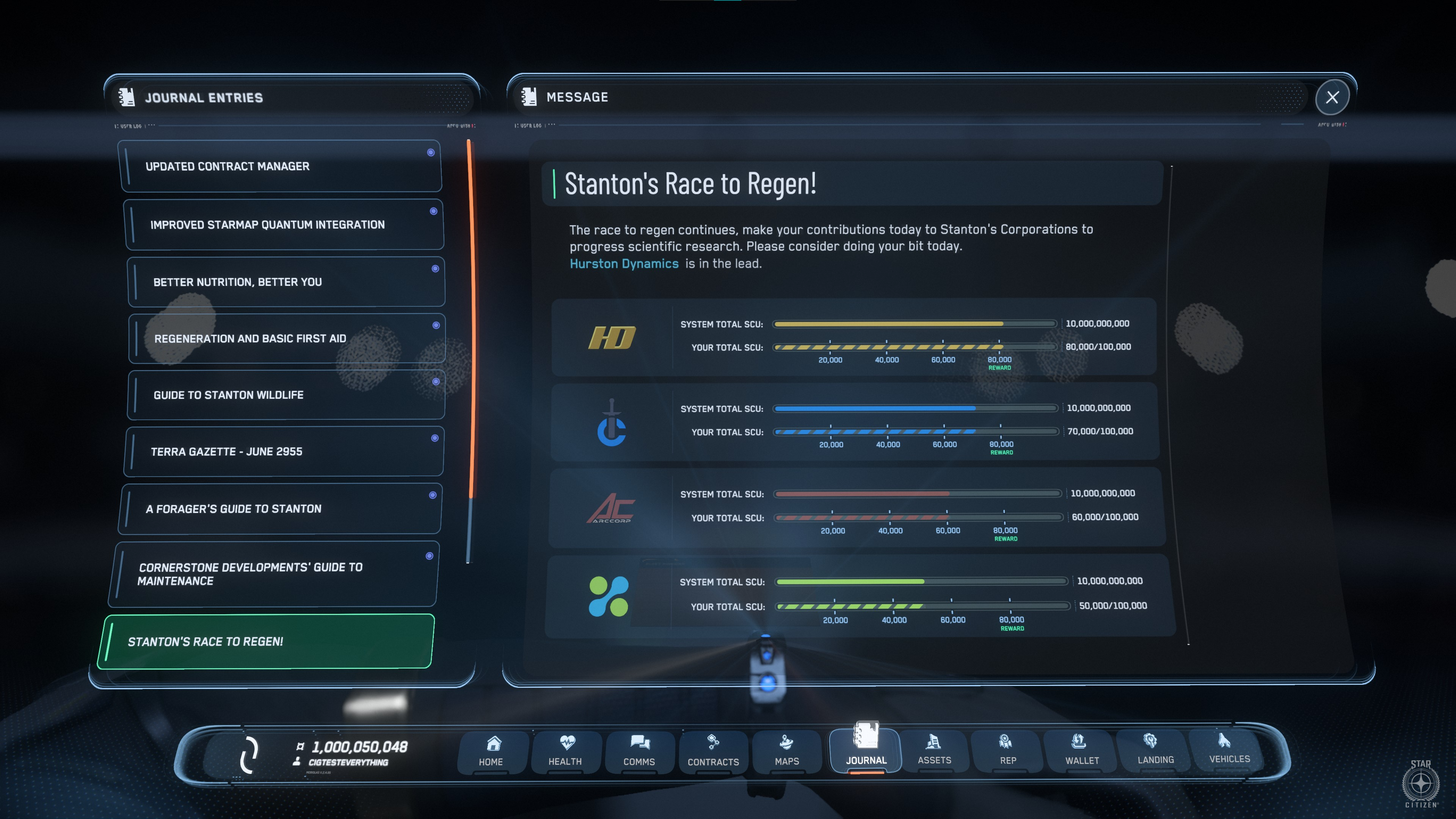
The UI Team created designs and concepts for a new military helmet visor and MobiGlas which will eventually make its way into SQ42. They’re currently creating signage and posters to add a “retro-futuristic” feel to one of the new environments.
VFX
VFX continued to work closely with Art and Design on key space locations, moving onto the polish phase in some cases and exploratory R&D in others. This included significant improvements to the gas cloud setup. They continued to develop the VFX transparency shader based on artist feedback and made raindrop shader improvements. LOD workflow improvements were also made to improve the quality of life for the vehicle artists. In Frankfurt, the team are currently providing tool support and fixing current issues with the gas cloud entity. They recently fixed a noticeable seam between voxel grids, despite them lining up perfectly. They accomplished this by adding an extra layer of voxels around the volume to create an overlap. This not only allows them to blend between different voxel grids but also blend between grids with different resolutions
WE’LL SEE YOU NEXT MONTH…
Dies ist ein Querverweis auf den Bericht, der kürzlich über den monatlichen Squadron 42 Newsletter verschickt wurde. Wir veröffentlichen dies ein zweites Mal als Comm-Link, um es der Community zu erleichtern, auf die man zurückgreifen kann.
Achtung Rekruten,
Was Sie hier lesen werden, sind die neuesten Informationen über die Weiterentwicklung der Squadron 42 (SCI des: SQ42).
Mitarbeiter auf der ganzen Welt sammelten die notwendigen Informationen, um Ihnen diesen Fortschrittsbericht zur Verfügung zu stellen. Die Geheimdienstinformationen deuten darauf hin, dass wir Informationen über Kampfversuche, ein aktualisiertes MobiGlas für Staffel 42 und Fixes für die Gaswolken-VFX-Technologie gefunden haben.
Die in dieser Mitteilung enthaltenen Informationen sind äußerst sensibel, und es ist von größter Bedeutung, dass sie nicht in die falschen Hände geraten. Alle Datensätze nach dem Lesen löschen.
UEE Naval Oberkommando
KI
Wir beginnen mit der KI, die sich darauf konzentrierte, die erste Erfahrung zu verbessern, wenn Spieler auf NSCs treffen. Dies beinhaltete das Abstimmen der ersten Reaktionen auf etwas, das im peripheren Sehvermögen der Spieler sichtbar ist, und das erste Übergeben des Verhaltens der'niedrigen Reaktion', das die NSC-Reaktion auf etwas nicht besonders Gefährliches darstellt. Zum Beispiel, wenn sie eine Tasse sehen oder hören, die geworfen wird. In diesen Fällen möchte das Team es dem Spieler ermöglichen, die Aufmerksamkeit eines Feindes auf sich zu ziehen, um ihn überraschend mitzunehmen oder ihn von seinem Standort wegzujagen, damit er sich vorbeischleichen kann. Sie verbesserten auch die Reaktionen auf Dinge, die NSCs nur kurz sehen, insbesondere wenn sich die erkannte Entität in ihrem peripheren Blickfeld befindet. Sie erreichten dies durch die Implementierung einer komplexeren ersten Reaktion, so dass das Erkennen etwas toleranter ist, um dem Spieler eine bessere Kontrolle der Situation zu ermöglichen.
Neben dem Verhalten machten sie die erste Weitergabe von Genauigkeit und zielgerichteten Kontrollen für Charaktere. Dazu gehört auch, die Truhe zum bevorzugten Zielort zu machen, wobei die folgenden Anpassungen auf der Grundlage von vom Designer definierten Genauigkeitswerten vorgenommen werden. Letztendlich wird dies mit dem Qualifikationssystem verbunden sein.
Die SchiffskI arbeitete mit verbesserten und ausgewogenen Schiffsverhalten, wobei der Schwerpunkt auf der Logik des "DefendTarget" lag. Sie haben auch den Lande- und Startcode bereinigt und die Funktionsweise der Quantum Travel (QT)-Logik leicht verändert. Dazu gehörte die Vereinfachung des 3D-Pfadfindungscodes durch Verschieben aller zusätzlichen Schritte in die Verhaltenslogik und das TPS.
Parallel dazu wurden die Fortschritte bei der Entwicklung eines neuen 3D-Pfadfindungscodes fortgesetzt, bei dem ein Großteil der Verarbeitungslogik in Aufträge verschoben wird, die kleine Berechnungen durchführen, während das Schiff im Universum herumfliegt. Dies ermöglichte es ihnen, das Bewegungssystem zu erweitern, um Patchable-Pläne zu unterstützen, die bei Bedarf die Berechnung der Wegfindung wieder aufnehmen können.
Die soziale KI untersuchte die Identifizierung und Klärung möglicher Szenarien, die für die Implementierung einer großen Anzahl von sozialen Verhaltensweisen erforderlich sind. Sie untersuchen derzeit die Details, um den strukturellen Aufbau der Nutzbarkeit vordefinieren zu können, die es den Designern ermöglichen, die Infrastruktur neben dem Verhalten zu erstellen. Diese Szenarien helfen bei der Identifizierung von Edge-Fällen, die im zweiten Durchgang für die Implementierung von brauchbarem Slotting-Code gelöst werden müssen.
Für den "Item Provider" wurde ein Prototyp entwickelt - ein brauchbarer, der einem NSC alle notwendigen Elemente zur Verfügung stellt, um ein bestimmtes Item vorzubereiten. Dies ermöglicht es dem Team, einen datengesteuerten Prozess zu erstellen, in dem die Designer die gewünschten Inhalte schnell umsetzen können.
Neben der Behebung von Fehlern und der Verbesserung der Robustheit und Stabilität der Systeme wurde auch an der Optimierung der allgemeinen Zeichennavigation gearbeitet, einschließlich einer Möglichkeit für Navigationslinks, um mehrere Netze zu verbinden. Dies ermöglicht die modulare Erstellung von Raumschiffen und Stationen zur korrekten Definition von Navigationsvolumina, die miteinander verbunden werden können. Es eröffnet auch den NSCs viele Möglichkeiten, die sich nun systematisch durch verschiedene Abschnitte von Raumschiffen bewegen können.
Animation
Letzten Monat konzentrierte sich das Team auf die Entwicklung von Nutzmaterialien für die Umgebung. Sie schlossen Takedowns (sowohl unbewaffnet als auch mit Messern) und Reaktionen auf Staggers und Schläge ab. Sie untersuchen derzeit, wie man Effekttypen auf dem Körper des Spielers anzeigen kann. Sie fertigten auch Animationen für zwei neue menschliche Feindtypen, arbeiteten an neuen Waffen für einen bestehenden Feindtyp und unterstützten die Teams Cinematics und Story.
Kunst (Charaktere)
Das Team brachte die Kunstproduktion auf Hochtouren und startete einen neuen Polierprozess für Charaktere. Dazu gehörte auch die Entwicklung einer neuen Frisur, eines neuen Gesichts, eines neuen Körpers und eines neuen Outfits. Ein bestehender Charakter wurde als Vorlage überarbeitet, das Team wechselte zum nächsten Charakter auf der Liste.
Audio
Das Audio-Team beendete mehrere Kapitel und achtete besonders darauf, das Ambiente zu verbessern und SFX auf der Idris zu sehen, wo ein Großteil von Kapitel 4 stattfindet.
Kinematiken
Im September beschäftigte sich das Cinematics Team mit Raumfahrt-Cutaways und On-Foot-Sequenzen mit vielen Charakteren. Sie haben auch einige Sequenzen verbessert und angepasst, um leichten Änderungen an Raumaufteilungen und -standorten Rechnung zu tragen. Die laufenden Tests für weibliche Spieler führten zu einigen technischen Anfragen an das Feature-Team - eine schnelle Möglichkeit, zwischen weiblichen und männlichen Charakteren im Editor zu wechseln und Sequenzen mit männlichen und weiblichen Charakteren zu rendern. Diese Ergänzungen ermöglichen es, Sequenzen ohne zu viel manuelle Erfassung zu überprüfen.
Die im letzten Monat erwähnte Anfrage nach einer weiblich-charakterspezifischen additiven Positions-/Rotationsanpassungsschiene machte Fortschritte. Dies ermöglicht eine schnelle Anpassung der (virtuellen) Kamera an das weibliche Charaktermodell, da es etwas kleiner als das männliche Äquivalent ist.
Eine komplexe Sequenz mit einem Navigationsschiff Spline von einer Raumstation zu einem bengalischen Träger wurde ebenfalls abgeschlossen.
Ingenieurwesen
Neben der Unterstützung von Track View und Comms Calls half das Feature Team bei der Schließfachfunktionalität. Das Feature füllt einen Spind dynamisch mit dem Outfit eines NSCs und ermöglicht es dem Team, ihn bei Bedarf auszutauschen. Das Actor Feature Team starrte daraufhin, dem Darsteller-Statussystem eine Temperatur hinzuzufügen. Dies wirkt sich auf die Leistung und Gesundheit eines Charakters aus, je nachdem, wie heiß und kalt er ist, und berücksichtigt die Umgebung, Feuchtigkeit und Windkälte. Sie entwickelten auch das persönliche Inventarsystem mit Hilfe eines neuen Menüs für innere Gedanken weiter. Der Nahkampf wurde verbessert und verfügt nun über Combos und Nahkampfwaffen, während Staffelungen und Niederschläge basierend auf Gewalt hinzugefügt wurden. Zum Beispiel hat eine Pistole weniger Wirkung als eine Schrotflinte.
Zu den physikalischen Arbeiten gehörte die Fertigstellung und Einreichung des Signed Distance Field (SDF)-Systems, mit dem Kollisionskontrollen und Schnitttests von Strahlen gegen komplexe Geometrien, wie beispielsweise Schiffe, beschleunigt werden können. Auch bei weichen Körpern wurden mehrere Optimierungen vorgenommen. Diese beinhalteten die Möglichkeit, dass angehängte Knoten keine n^2 LRA-Beschränkungen erzeugen, so dass der Teilschrittmodus nur einmal statt mehrmals pro Teilschritt eine Kollisionserkennung durchführen kann, und die Anzahl der Kollisionsformen steigt, um komplexere Geometrien zu berücksichtigen.
Gameplay-Geschichte
Das Gameplay Story Team hatte einen produktiven September und brachte im dritten Quartal fast 50 Szenen auf ein gutes Niveau. Derzeit planen sie für das vierte Quartal, wo sie weitere 50 abschließen wollen. Sie begannen auch mit Design zusammenzuarbeiten, um einen Prototyp zu erstellen, was passiert, wenn Spieler Szenen unterbrechen oder sich aus unerwarteten Richtungen nähern.
Grafiken
Im vergangenen Monat konzentrierte sich Graphics auf die Optimierung und das Hinzufügen zusätzlicher Funktionen zu den Kunstmaterial-Shadern, einschließlich der Glas- und organischen Varianten. Besonderes Augenmerk wurde auf die visuelle Prüfung gelegt, das ist der Prozess, um Fehler im Motor so schnell wie möglich zu finden. Die automatisierte Version wurde überarbeitet, um auf der Maschine eines Programmierers zu laufen, bevor er Code-Änderungen vornimmt, um sicherzustellen, dass sie die Maschine nicht beeinträchtigt. Dies ist wichtig, da die schiere Größe des Motors und sein Funktionsumfang es extrem schwierig machen, alle potenziellen Nachwirkungen einer Änderung manuell zu testen.
Leveldesign
Das Social Team baute weiterhin Sozialräume und sowohl Szenen mit hoher als auch niedriger Priorität. Level Design hat die FPS-Räume mit Unterstützung von Art und AI detailliert beschrieben. Workflow-Optimierungen an den Scripting-Tools beginnen nun zu kommen, um ihnen das Leben leichter zu machen. Das für den Luftkampf verantwortliche Team arbeitete weiterhin an Weltraumbegegnungen, wobei der Schwerpunkt auf der Schichtung der KI- und Pilotprofile lag, um die Szenarien realistischer erscheinen zu lassen. Das Team gewann auch zwei neue Mitglieder, die sich schnell mit den komplexeren Funktionen und Mechaniken vertraut machen. Derzeit werden Fortschritte bei den systemischen Verhaltensweisen erzielt, die ein komplexes Skripting erfordern, um die zahlreichen Widerstände nutzen zu können.
Narrativ
Einige Mitglieder des Narrative Teams besuchten das britische Büro, um die neuesten Fortschritte zu besprechen und den Erzählfluss des Spiels weiter zu verbessern, indem sie anpassten, wie bestimmte Momente vom Spieler entdeckt werden, um sicherzustellen, dass sie eine optimale Wirkung haben. Zu diesem Zweck setzten sie auch die Arbeit am Spieltext fort und arbeiteten mit Design zusammen, um sich darauf zu konzentrieren, wann sie ausgelöst und abgeschlossen werden. Zusätzlich trafen sie sich mit Character Art, um Anpassungen zu besprechen, um einigen der Looks des Darstellers ein tieferes Gefühl für die Hintergrundgeschichte zu geben.
QA
Letzten Monat arbeitete QA an der kompletten Staffel 42, um sich besser zu rüsten, um die verschiedenen NSC-Wildlinien während der Kampagne zu testen. Sie haben auch die verschiedenen filmischen Teststufen beibehalten, mit denen sie Probleme untersuchen, auf die das Cinematics-Team während seines Workflows stößt.
Technische Animation
Tech Animation in Großbritannien war mit dem Aufbau, der Wartung und der Implementierung von Kampagnenszenen beschäftigt. Neben den Szenen arbeiteten sie an den kreativen und technischen Prozessen hinter Kampf-KI, sozialer KI und Waffen. Sie schufen auch neue Charaktere und arbeiteten eng mit Character Art an der fremden Spezies in SQ42 zusammen. Das Frankfurter Team arbeitete mit Cinematics und Character Art zusammen, um Charakter-Auslastungen zu finalisieren, Requisiten für filmische Animationen zu manipulieren und eine große Anzahl von Comms-Aufrufen zu implementieren....
Technische Kunst
Tech Art besuchte erneut die Mimik-Scan-Pipeline und evaluierte verschiedene neue photogrammetriebasierte Scan-Lösungen. Da hochdetaillierte Gesichtsausdruckscans das Herzstück der neuen hauseigenen Rigging-Pipeline bilden, ist eine effiziente Erstellung, Bearbeitung und manuelle Nachbearbeitung der Scan-Netze entscheidend für eine schnelle Bearbeitung. Diese neue Lösung wird dem Team letztendlich helfen, den Genpool des Charakters "DNA" zu erweitern und sowohl den Designern als auch den Spielern mehr Möglichkeiten bieten, einzigartige und interessante Gesichter zu kreieren.
Benutzeroberfläche (UI)
Das UI-Team entwickelte Entwürfe und Konzepte für ein neues Militärhelm-Visier und MobiGlas, das schließlich in das SQ42 einfließen wird. Derzeit kreieren sie Beschilderungen und Poster, um einer der neuen Umgebungen ein "retro-futuristisches" Gefühl zu verleihen.
VFX
VFX arbeitete weiterhin eng mit Art and Design an wichtigen Weltraumstandorten zusammen, wobei VFX in einigen Fällen in die polnische Phase und in anderen in die explorative Forschung und Entwicklung überging. Dazu gehörten auch deutliche Verbesserungen beim Aufbau der Gas-Cloud. Sie entwickelten den VFX-Transparenz-Shader basierend auf Künstlerfeedback weiter und verbesserten den Regentropfen-Shader. LOD-Workflow-Verbesserungen wurden auch vorgenommen, um die Lebensqualität der Fahrzeugkünstler zu verbessern. In Frankfurt bietet das Team derzeit Tool-Support und behebt aktuelle Probleme mit der Gas Cloud Entität. Vor kurzem haben sie eine auffällige Naht zwischen den Voxelgittern angebracht, obwohl sie perfekt aufeinander abgestimmt sind. Sie erreichten dies, indem sie eine zusätzliche Schicht von Voxeln um das Volumen herum hinzufügten, um eine Überlappung zu erzeugen. Dies ermöglicht es ihnen nicht nur, zwischen verschiedenen Voxelgittern zu mischen, sondern auch zwischen Gittern mit unterschiedlicher Auflösung.
WIR SEHEN UNS NÄCHSTEN MONAT.....
This is a cross-post of the report that was recently sent out via the monthly Squadron 42 newsletter. We’re publishing this a second time as a Comm-Link to make it easier for the community to reference back to. Attention Recruits,
What you are about to read is the latest information on the continuing development of Squadron 42 (SCI des: SQ42).
Operatives around the world collected the intel needed to provide you with this progress report. Intelligence suggests we’ve uncovered intel on combat takedowns, an updated MobiGlas for Squadron 42, and fixes to the gas cloud VFX tech.
The information contained in this communication is extremely sensitive and it is of paramount importance that it does not fall into the wrong hands. Purge all records after reading.
UEE Naval High Command
AI
We start with AI, who focused on improving the initial experience when players encounter NPCs. This involved tuning first reactions to something viewable in the players’ peripheral vision and making the first pass on ‘low reaction’ behavior, which represents NPC reaction to something not particularly dangerous. For example, if they see or hear a cup being thrown. In these cases, the team wants to allow the player to draw the attention of an enemy to take them by surprise or drive them away from their location so they can sneak by. They also improved reactions to things NPCs only briefly see, particularly if the detected entity is in their peripheral vision. They achieved this by implementing a more complex first reaction, so being detected is slightly more forgiving to allow the player to better control the situation.
Alongside behaviors, they made the first pass on accuracy and targeting controls for characters. This includes making the chest the preferred targeting location, with the following adjustments based on designer-defined accuracy values. Eventually, this will be connected to the skill system.
Ship AI worked improved and balanced ship behaviors, with a focus on the ‘DefendTarget’ logic. They also cleaned up the landing and takeoff code and slightly refactored how quantum travel (QT) logic works. This included simplifying the 3D pathfinding code by moving all additional steps into the behavior logic and TPS.
Parallel to this, progress continued on new 3D pathfinding code, which involves moving a lot of the processing logic into jobs that execute small calculations while the ship flies around the universe. This allowed them to extend the movement system to support patchable plans that can resume the pathfinding calculation when needed.
Social AI looked at identifying and clarifying the possible scenarios required to implement a large number of social behaviors. They’re currently investigating the details so they can predefine the structural setup of the usables needed to allow the designers to create the infrastructure alongside the behaviors. These scenarios help identify edge cases to tackle on the second pass for the usable slotting code implementation.
A prototype was developed for the ‘item provider’ – a usable that provides an NPC with all the necessary elements to prepare a specific item. This enables the team to create a data-driven process for the designers to quickly implement the required content.
Aside from fixing bugs and making systems more robust and stable, optimization work was done to general character navigation, including a way for navigation links to connect multiple meshes. This allows the modular creation of spaceships and stations to correctly define navigation volumes that can be connected to each other. It also opens up a lot of possibilities to NPCs, who can now systemically path through different sections of spaceships.
Animation
Last month, the team focused on creating useables for the environments. They finalized takedowns (both unarmed and with knives) and reactions to staggers and punches. They’re currently exploring how to show effect types on the player’s body. They also completed animations for two new human enemy types, worked on new weapons for an existing enemy type, and supported the Cinematics and Story teams.
Art (Characters)
The team kicked art production into full gear, including kicking off a new polish process for characters. This included creating a new hairstyle, face, body, and outfit. An existing character was revamped as a template the team moved onto the next character on the list.
Audio
The Audio Team completed several chapters, paying particular attention to improving the ambiance and spot SFX on the Idris, where much of chapter 4 takes place.
Cinematics
The Cinematics Team’s September involved in-mission spaceflight cutaways and on-foot sequences with lots of characters. They also upgraded and adjusted a few sequences to accommodate slight changes to room layouts and locations. The on-going female player tests resulted in a couple of tech requests to the Feature Team – a quick way to switch between female and male characters in-editor, and a way to render sequences with both male and female characters. These additions will make it possible to review sequences without too much manual capture.
The request for a female-character-specific additive positional/rotational adjustment track mentioned last month made progress. This will enable quick adjustments of the (virtual) camera to properly frame the female character model, as it is slightly smaller than the male equivalent.
A complex sequence featuring a navigation ship spline from a space station to a Bengal carrier was completed too.
Engineering
Alongside supporting Track View and comms calls, the Feature Team helped with locker functionality. The feature dynamically populates a locker with an NPC’s outfit and enables the team to swap it out as required. The Actor Feature Team stared adding temperature to the actor status system. This will affect a character’s performance and health depending on how hot and cold they are and takes the environment, humidity, and windchill into account. They also continued developing the personal inventory system using a new personal inner-thought menu. Melee combat improved and now features combos and melee weapons, while staggers and knockdowns based on force were added. For example, a pistol will have less effect than a shotgun.
Physics work included finalizing and submitting the signed distance field (SDF) system, which is used to accelerate collision checks and intersection tests of rays against complex geometry, such as ships. Several optimizations were also made to soft bodies. These included enabled attached vertices to not create n^2 LRA constraints, allowing the sub-step mode to only perform collision detection once instead of multiple times per sub-step, and increasing collision shape counts to account for more complicated geometry.
Gameplay Story
The Gameplay Story Team had a productive September, getting nearly 50 scenes to a good standard during Q3. They’re currently planning for Q4, where they’re aiming to complete a further 50. They also began working with Design to prototype what happens if players interrupt scenes or approach from unexpected directions.
Graphics
Last month, Graphics focused on optimization and adding additional functionality to the art material shaders, including the glass and organic variants. Significant attention went to visual testing, which is the process used to find bugs in the engine as quickly as possible. The automated version was reworked to run on any programmer’s machine before they submit code changes to check that they won’t detrimentally affect the engine. This is important because the sheer size of the engine and its feature set make it extremely difficult to manually test all potential knock-ons from a change.
Level Design
The Social Team continued building social spaces and both high and low priority narrative scenes. Level Design detailed the FPS spaces with support from Art and AI. Workflow tweaks to the scripting tools are now starting to come in to make their lives easier. The team responsible for aerial combat continued to work on space encounters, with focus on layering the AI and pilot profiles to make the scenarios feel more realistic. The team also gained two new members, who are quickly getting up to speed with the more complex features and mechanics. Progress is currently being made on systemic behaviors, which require complex scripting to make use of the numerous intractables.
Narrative
Some of the Narrative Team visited the UK office to review the latest progress and continue to hone the narrative flow of the game, adjusting how certain moments are discovered by the player to ensure they have optimal impact. To this end, they also continued work on game text and collaborated with Design to focus on when they’re triggered and completed. Additionally, they met with Character Art to discuss adjustments to add a deeper sense of backstory to some of the cast’s looks.
QA
Last month, QA worked on the full Squadron 42 flow to better equip themselves to test the different NPC wild lines during the campaign. They also maintained the various cinematic test levels they use to investigate issues the Cinematics Team encounters during their workflow.
Tech Animation
Tech Animation in the UK kept busy building, maintaining, and implementing campaign scenes. Alongside scenes, they worked on the creative and technical processes behind combat AI, social AI, and weapons. They also created new characters and worked closely with Character Art on the alien species featured in SQ42. The team in Frankfurt worked with Cinematics and Character Art to finalize character loadouts, rigged props for cinematic animations, and implemented a large number of comms calls..
Tech Art
Tech Art revisited the facial expression scanning pipeline and evaluated various new photogrammetry-based scan solutions. Since highly detailed scans of facial expressions are the core of the new in-house rigging pipeline, efficient creation, processing, and manual touch-ups of the scan meshes are crucial for quick turnaround. This new solution will ultimately help the team expand the character creator’s ‘DNA’ gene pool and give both the designers and players more options to create unique and interesting faces.
User Interface (UI)
The UI Team created designs and concepts for a new military helmet visor and MobiGlas which will eventually make its way into SQ42. They’re currently creating signage and posters to add a “retro-futuristic” feel to one of the new environments.
VFX
VFX continued to work closely with Art and Design on key space locations, moving onto the polish phase in some cases and exploratory R&D in others. This included significant improvements to the gas cloud setup. They continued to develop the VFX transparency shader based on artist feedback and made raindrop shader improvements. LOD workflow improvements were also made to improve the quality of life for the vehicle artists. In Frankfurt, the team are currently providing tool support and fixing current issues with the gas cloud entity. They recently fixed a noticeable seam between voxel grids, despite them lining up perfectly. They accomplished this by adding an extra layer of voxels around the volume to create an overlap. This not only allows them to blend between different voxel grids but also blend between grids with different resolutions
WE’LL SEE YOU NEXT MONTH…
This is a cross-post of the report that was recently sent out via the monthly Squadron 42 newsletter. We’re publishing this a second time as a Comm-Link to make it easier for the community to reference back to. Attention Recruits,
What you are about to read is the latest information on the continuing development of Squadron 42 (SCI des: SQ42).
Operatives around the world collected the intel needed to provide you with this progress report. Intelligence suggests we’ve uncovered intel on combat takedowns, an updated MobiGlas for Squadron 42, and fixes to the gas cloud VFX tech.
The information contained in this communication is extremely sensitive and it is of paramount importance that it does not fall into the wrong hands. Purge all records after reading.
UEE Naval High Command
AI
We start with AI, who focused on improving the initial experience when players encounter NPCs. This involved tuning first reactions to something viewable in the players’ peripheral vision and making the first pass on ‘low reaction’ behavior, which represents NPC reaction to something not particularly dangerous. For example, if they see or hear a cup being thrown. In these cases, the team wants to allow the player to draw the attention of an enemy to take them by surprise or drive them away from their location so they can sneak by. They also improved reactions to things NPCs only briefly see, particularly if the detected entity is in their peripheral vision. They achieved this by implementing a more complex first reaction, so being detected is slightly more forgiving to allow the player to better control the situation.
Alongside behaviors, they made the first pass on accuracy and targeting controls for characters. This includes making the chest the preferred targeting location, with the following adjustments based on designer-defined accuracy values. Eventually, this will be connected to the skill system.
Ship AI worked improved and balanced ship behaviors, with a focus on the ‘DefendTarget’ logic. They also cleaned up the landing and takeoff code and slightly refactored how quantum travel (QT) logic works. This included simplifying the 3D pathfinding code by moving all additional steps into the behavior logic and TPS.
Parallel to this, progress continued on new 3D pathfinding code, which involves moving a lot of the processing logic into jobs that execute small calculations while the ship flies around the universe. This allowed them to extend the movement system to support patchable plans that can resume the pathfinding calculation when needed.
Social AI looked at identifying and clarifying the possible scenarios required to implement a large number of social behaviors. They’re currently investigating the details so they can predefine the structural setup of the usables needed to allow the designers to create the infrastructure alongside the behaviors. These scenarios help identify edge cases to tackle on the second pass for the usable slotting code implementation.
A prototype was developed for the ‘item provider’ – a usable that provides an NPC with all the necessary elements to prepare a specific item. This enables the team to create a data-driven process for the designers to quickly implement the required content.
Aside from fixing bugs and making systems more robust and stable, optimization work was done to general character navigation, including a way for navigation links to connect multiple meshes. This allows the modular creation of spaceships and stations to correctly define navigation volumes that can be connected to each other. It also opens up a lot of possibilities to NPCs, who can now systemically path through different sections of spaceships.
Animation
Last month, the team focused on creating useables for the environments. They finalized takedowns (both unarmed and with knives) and reactions to staggers and punches. They’re currently exploring how to show effect types on the player’s body. They also completed animations for two new human enemy types, worked on new weapons for an existing enemy type, and supported the Cinematics and Story teams.
Art (Characters)
The team kicked art production into full gear, including kicking off a new polish process for characters. This included creating a new hairstyle, face, body, and outfit. An existing character was revamped as a template the team moved onto the next character on the list.
Audio
The Audio Team completed several chapters, paying particular attention to improving the ambiance and spot SFX on the Idris, where much of chapter 4 takes place.
Cinematics
The Cinematics Team’s September involved in-mission spaceflight cutaways and on-foot sequences with lots of characters. They also upgraded and adjusted a few sequences to accommodate slight changes to room layouts and locations. The on-going female player tests resulted in a couple of tech requests to the Feature Team – a quick way to switch between female and male characters in-editor, and a way to render sequences with both male and female characters. These additions will make it possible to review sequences without too much manual capture.
The request for a female-character-specific additive positional/rotational adjustment track mentioned last month made progress. This will enable quick adjustments of the (virtual) camera to properly frame the female character model, as it is slightly smaller than the male equivalent.
A complex sequence featuring a navigation ship spline from a space station to a Bengal carrier was completed too.
Engineering
Alongside supporting Track View and comms calls, the Feature Team helped with locker functionality. The feature dynamically populates a locker with an NPC’s outfit and enables the team to swap it out as required. The Actor Feature Team stared adding temperature to the actor status system. This will affect a character’s performance and health depending on how hot and cold they are and takes the environment, humidity, and windchill into account. They also continued developing the personal inventory system using a new personal inner-thought menu. Melee combat improved and now features combos and melee weapons, while staggers and knockdowns based on force were added. For example, a pistol will have less effect than a shotgun.
Physics work included finalizing and submitting the signed distance field (SDF) system, which is used to accelerate collision checks and intersection tests of rays against complex geometry, such as ships. Several optimizations were also made to soft bodies. These included enabled attached vertices to not create n^2 LRA constraints, allowing the sub-step mode to only perform collision detection once instead of multiple times per sub-step, and increasing collision shape counts to account for more complicated geometry.
Gameplay Story
The Gameplay Story Team had a productive September, getting nearly 50 scenes to a good standard during Q3. They’re currently planning for Q4, where they’re aiming to complete a further 50. They also began working with Design to prototype what happens if players interrupt scenes or approach from unexpected directions.
Graphics
Last month, Graphics focused on optimization and adding additional functionality to the art material shaders, including the glass and organic variants. Significant attention went to visual testing, which is the process used to find bugs in the engine as quickly as possible. The automated version was reworked to run on any programmer’s machine before they submit code changes to check that they won’t detrimentally affect the engine. This is important because the sheer size of the engine and its feature set make it extremely difficult to manually test all potential knock-ons from a change.
Level Design
The Social Team continued building social spaces and both high and low priority narrative scenes. Level Design detailed the FPS spaces with support from Art and AI. Workflow tweaks to the scripting tools are now starting to come in to make their lives easier. The team responsible for aerial combat continued to work on space encounters, with focus on layering the AI and pilot profiles to make the scenarios feel more realistic. The team also gained two new members, who are quickly getting up to speed with the more complex features and mechanics. Progress is currently being made on systemic behaviors, which require complex scripting to make use of the numerous intractables.
Narrative
Some of the Narrative Team visited the UK office to review the latest progress and continue to hone the narrative flow of the game, adjusting how certain moments are discovered by the player to ensure they have optimal impact. To this end, they also continued work on game text and collaborated with Design to focus on when they’re triggered and completed. Additionally, they met with Character Art to discuss adjustments to add a deeper sense of backstory to some of the cast’s looks.
QA
Last month, QA worked on the full Squadron 42 flow to better equip themselves to test the different NPC wild lines during the campaign. They also maintained the various cinematic test levels they use to investigate issues the Cinematics Team encounters during their workflow.
Tech Animation
Tech Animation in the UK kept busy building, maintaining, and implementing campaign scenes. Alongside scenes, they worked on the creative and technical processes behind combat AI, social AI, and weapons. They also created new characters and worked closely with Character Art on the alien species featured in SQ42. The team in Frankfurt worked with Cinematics and Character Art to finalize character loadouts, rigged props for cinematic animations, and implemented a large number of comms calls..
Tech Art
Tech Art revisited the facial expression scanning pipeline and evaluated various new photogrammetry-based scan solutions. Since highly detailed scans of facial expressions are the core of the new in-house rigging pipeline, efficient creation, processing, and manual touch-ups of the scan meshes are crucial for quick turnaround. This new solution will ultimately help the team expand the character creator’s ‘DNA’ gene pool and give both the designers and players more options to create unique and interesting faces.
User Interface (UI)
The UI Team created designs and concepts for a new military helmet visor and MobiGlas which will eventually make its way into SQ42. They’re currently creating signage and posters to add a “retro-futuristic” feel to one of the new environments.
VFX
VFX continued to work closely with Art and Design on key space locations, moving onto the polish phase in some cases and exploratory R&D in others. This included significant improvements to the gas cloud setup. They continued to develop the VFX transparency shader based on artist feedback and made raindrop shader improvements. LOD workflow improvements were also made to improve the quality of life for the vehicle artists. In Frankfurt, the team are currently providing tool support and fixing current issues with the gas cloud entity. They recently fixed a noticeable seam between voxel grids, despite them lining up perfectly. They accomplished this by adding an extra layer of voxels around the volume to create an overlap. This not only allows them to blend between different voxel grids but also blend between grids with different resolutions
WE’LL SEE YOU NEXT MONTH…
Links
No links available.
Images
17


Metadata
- CIG ID
- 17276
- Channel
- Transmission
- Category
- Undefined
- Series
- Monthly Reports
- Comments
- 15
- Published
- 7 years ago (2019-10-09T00:00:00+00:00)