Squadron 42 Monthly Report: May 2020
Transmission Undefined Monthly ReportsContent
This is a cross-post of the report that was recently sent out via the monthly Squadron 42 newsletter. We’re publishing this a second time as a Comm-Link to make it easier for the community to reference back to. Attention Recruits,
What you are about to read is the latest information on the continuing development of Squadron 42 (SCI des: SQ42).
After heavy analysis, we’ve extracted information on interrupt and abandon work, a large scale opening battle, and a particularly chilling new prop material.
The information contained in this communication is extremely sensitive and it is of paramount importance that it does not fall into the wrong hands. Purge all records after reading.
UEE Naval High Command
AI (Combat)
We kick off as usual with AI Combat, whose main focus was realistic firing and Vanduul combat behaviors. For AI firing, the ultimate aim is for NPC characters to appear real, with players understanding how they manage their ammunition.
To this end, they began using the “item provider approach” to create usables around ammo boxes. This will enable NPCs to find elements in the world that can provide them with magazines or other types of ammunition. They will also be able to run tactics that involve moving closer to sources of ammunition as they need to. The team also want to properly trigger reloads at the correct time in different conditions. For example, while advancing, NPCs will be allowed to shoot and automatically reload. However, the internal components will also notify the necessary behaviors when magazines are expended so that proper subactivities can be executed to handle the situation properly.
Regarding the Vanduul, their behavior is progressing, including iterations on unique actions and navigation traversal, such as special jumps that allow them to climb over large objects. The team are also refactoring the navigation link system to support some of the new flows in the usable code. This means they can rely on the same internal caching to understand animation offsets and the available options for different links.
AI (Social)
The Social AI Team wrapped up the first iteration of the bartender. Alongside cleaning up animations and behaviors, they tweaked different portions of the overall system. For example, they fixed issues with moving between multiple usables using the shortest path between enter/exit locations.
They’re currently enabling patrons to order and consume various drinks and use the booths and different seats around the bar. Work on the bartender and wider vendor behaviors have helped the team bring more stability to slotting and routing functionalities, as these scenarios heavily stress the usable system on every functionality it offers.
For patrol tech, the team introduced an improved debug draw functionality to allow designers to investigate behaviors in-launcher or in-editor when paths are placed inside object containers. They also fixed several animation issues, including one causing ‘idle’ and ‘idle2move’ animations to be pushed between exit animations and locomotion states due to the wrong evaluation of the actor speed.
The refactored Tactical Point System (TPS) and new Tactical Target System (TTS) are now in the common development branch and on track for release in Alpha 3.10. During the upcoming sprints, the team will start replacing the legacy nodes for target selection with the new TTS system to give them finer control over NPC target choices, whether they’re on-foot or airborne.
Animation
Last month, the Animation Team assisted in the development of body dragging, throwing, and knockdowns. They also animated weapon reloads and malfunctions for spec-ops NPCs, completed Vanduul look-dev and locomotion, and animated actions to enable AI to undertake generic inspections, move crates, and complete hangar actions. Work continued on capital ship operator seats, bar patrons, bartender animations, and holo-globe actions too.
Foundational improvements were made to the mo-cap process, such as development of the motion-builder skeleton and the new Take Selection tool.
The Gameplay Story Team continued to develop narrative scenes and abandons.
Audio
The Audio Team continued supporting campaign locations with ambiance setup and music creation, as well as supporting various features for both SQ42 and the PU.
Cinematics
The Cinematics Team routinely work on various scenes from across the whole campaign, though May’s focus was on chapter 1. They started the month completing blockouts for the game’s opening, including gameplay, camera work, and animation for a large-scale turret battle and the introduction of a key character on the Javelin.
They also made updates to several scenes from chapter 2, experimented with single-camera shots for chapter 4, blocked out chapter 5, and set up the cameras for chapter 13.
Cinematic Design finished the initial interrupt setup for all chapter 4’s scenes and are currently awaiting Level Design’s implementation. Once complete, the animators can begin pose matching. Support was also provided for wider level design work.
Engineering
Engineering worked on several tasks that affect both Squadron 42 and the Persistent Universe, including fixing issues with deep hierarchies, zone changes, and area-defining objects. For the entity component update scheduler, they submitted the first change that will add support for optional view ratios to the component aggregate streaming bounds update policy.
Physics-wise, optimizations to the inverse trigonometric function in C++ and HLSL were made and the physics profiler was modified to use thread IDs instead of ‘MAX_PHYS_THREADS’ to fight contention from external threads.
The team fixed performance regression in game-dev and continued to make improvements to body-dragging. They started looking into deformation and how to decouple the renderer and sim-mesh for physical damage and iterated on the damage TDD. They added a new physics runtime profiler in game-dev, enabled tri-mesh splitting, and optimized ‘remove isolated vertices’ in RC, and removed timestep adjustment in physics.
Engineering submitted the first version of Gen12 brush rendering, continued work on the render graph to schedule passes and bound resources, and unified handling and control over texture anisotropy. Shader items were moved to the resource container too. Shader parsing bug fixes were made and the vertex format reflection and setup were simplified.
They also fixed a jitter offset computation error with unified raymarching so that it works in harmony with the guided filter denoiser, and added transmittance-weighted depth-computation, which controls the width of the denoise kernel tin guided filtering and raymarching up-sampling results.
Specifically for SQ42, the UK Engineering Team started work on a new UI display item designed to consolidate the functionality required for displays into a single entity. When complete, it’ll manage multiple outputs and whether the display has power, is damaged, and emits light.
Support for cinematic requirements continued, with the team working on the weapon-firing track to give the designers fine control over when and how weapons fire. This includes everything from small arms to capital-ship turrets.
The Actor Team continued to develop body dragging, improving the visual sync between the player and the dragged body. They also continued work on force reactions, getting on-the-spot knockdowns implemented. Motion matching R&D is currently underway, which involves dynamic blendspaces and improvements to the stride adjustment via motion matching.
Gameplay Story
May saw the Gameplay Story Team begin work on previously untouched scenes from chapters 5 and 13.
“This means we have now implemented over 200 scenes, which is quite a milestone. Many of these scenes will still require additional work and support, but the majority of the animation work is now done, which is great!” – The Gameplay Story Team
They also continued to support the design teams with polish work on chapter 4 scenes and new abandons for chapter 8, including a complicated box-carrying scene.
Graphics
The Graphics Team focused on performance in May, with several major issues resolved and several more in the process of being completed. Most performance fixes related to excess CPU use on specific frames that resulted in a “spikey” and inconsistent framerate. One important performance change was to adjust the texture resolutions on machines without enough video memory to run the game at full quality, especially at higher resolutions. Previously, more memory than would fit on the GPU would be allocated, which would produce serious performance issues due to memory paging.
The work on the Gen12 renderer continues, as do improvements to the automated testing framework and organic shader mentioned last month. The render-to-texture system was also integrated into the texture streaming system.
“This allows us to treat dynamically-created textures like any other texture in the game, such that we can calculate the required resolution for the current camera position, stream/create their content on demand, and cache previously created textures when we have spare memory to avoid redundant rendering. This feature is fundamental to the Canvas Manager, which is a feature that will be used by the art and game teams to create dynamic texture content such as signs, name badges, ship names, serial numbers, etc.” – The Graphics Team
Level Design
The Social Design Team further developed usables and NPC behaviors alongside ongoing scene work. These systems were previously assigned to separate feature teams while the pipelines and technology were being developed.
Level Design continued to work alongside FPS AI to integrate more of the new behaviors that recently came online. They’re currently working closely with Art to build out some of the optional routes through levels.
The Space/Dogfight Team worked on the non-combat investigative behaviors prevalent across many of the early chapters. The “space scaping” of various patrol locations and points of interest continued too.
Narrative
Last month, Narrative continued to support Design by providing notes and feedback during playthrough sessions. They also undertook dedicated playthroughs to identify where new dialogue lines could provide clearer guidance and explanation. This month, scripts will be created and the lines will be recorded using placeholder actors to get them in-game as soon as possible. By minimizing the turnaround time, future pickup sessions with actors will be much more efficient. Narrative provided set-dressing documents for a handful of updated locations to provide environmental storytelling and backstory for players to discover too.
Props
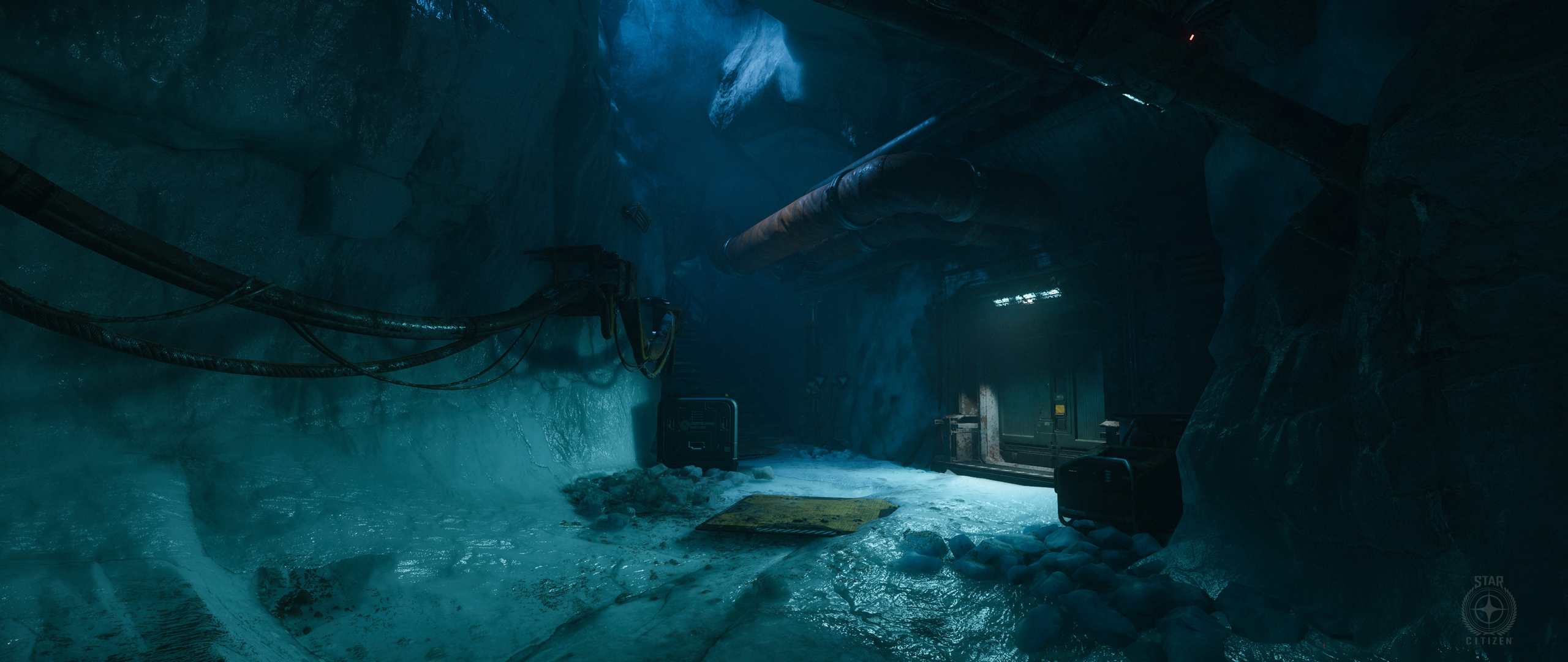
The Props Team created an asset set for a scene with a frozen ship, which includes a new frost material and bespoke storytelling props.
QA
QA were tasked with creating recorded client scene captures of individual chapters, as well as investigating issues hindering the Cinematic Team’s workflow. They also expanded their understanding of tools, such as the Subsumption Visualizer, to better debug the issues encountered. Alongside work on cinematics, focus was on the upkeep of testmaps to better help the development teams access features quickly and troubleshoot issues faster.
Tech Animation
Tech Animation revisited existing assets to support recent code changes, retouching thousands of assets to ensure their quality and suitability. Specifically for SQ42, Tech Animation worked on the Vanduul warrior, as recent animation work highlighted the need to refine character deformation to enable more extreme posing.
User Interface (UI)
The UI Tech Team spent the month working on a new system to allow them to easily add 3D objects to screens, such as icons for the player visor and inventory. The concept artists finalized the look of the lens and scanning UI and are close to having final concepts for the style of the Gladius HUD – one of the key UIs in SQ42.
VFX
The team dedicated much of last month’s SQ42 work to finalizing concept art for a particularly complex scene early on in the game that involves a large amount of VFX work.
“As well as providing good visibility to all other departments on what we hope to achieve, having the concepts well laid out and detailed makes it a lot easier for the artists to actualize the effects” – The VFX Team
The Comms Array interior effects were completed, and a few older levels were reworked to bring them in line with the current design documents. Prototyping of the Vanduul kingship weapons made great progress too. WE’LL SEE YOU NEXT MONTH…
Dies ist ein Cross-Post des Berichts, der kürzlich über den monatlichen Squadron 42 Newsletter verschickt wurde. Wir veröffentlichen ihn ein zweites Mal als Comm-Link, um es für die Community einfacher zu machen, darauf zurückzugreifen.
Achtung Rekruten,
Was ihr gleich lesen werdet, sind die neuesten Informationen über die Weiterentwicklung von Squadron 42 (SCI des: SQ42).
Nach eingehender Analyse haben wir Informationen über Unterbrechungen und Abbruch der Arbeiten, eine groß angelegte Eröffnungsschlacht und ein besonders chilliges neues Requisitenmaterial extrahiert.
Die in dieser Mitteilung enthaltenen Informationen sind äußerst sensibel und es ist von größter Wichtigkeit, dass sie nicht in die falschen Hände geraten. Säubere alle Aufzeichnungen nach dem Lesen.
UEE Marine-Oberkommando
KI (Kampf)
Wir beginnen wie immer mit KI Combat, dessen Hauptaugenmerk auf realistischem Schießen und Vanduul-Kampfverhalten lag. Beim KI-Feuern ist das ultimative Ziel, dass die NSC-Charaktere realistisch erscheinen und die Spieler verstehen, wie sie mit ihrer Munition umgehen.
Zu diesem Zweck begannen sie damit, den "Item-Provider-Ansatz" zu verwenden, um Gebrauchsgegenstände um Munitionskisten herum zu erstellen. Dies wird es den NSCs ermöglichen, Elemente in der Welt zu finden, die sie mit Magazinen oder anderen Arten von Munition versorgen können. Sie werden auch in der Lage sein, Taktiken auszuführen, die es ihnen ermöglichen, näher an die Munitionsquellen heranzukommen, wenn es nötig ist. Das Team möchte auch Nachladungen zur richtigen Zeit und unter verschiedenen Bedingungen korrekt auslösen. Zum Beispiel wird es den NSCs erlaubt sein, beim Vorrücken zu schießen und automatisch nachzuladen. Die internen Komponenten werden jedoch auch die notwendigen Verhaltensweisen melden, wenn Magazine verbraucht werden, so dass korrekte Unteraktivitäten ausgeführt werden können, um die Situation richtig zu handhaben.
Was die Vanduul betrifft, so schreitet ihr Verhalten voran, einschließlich Iterationen bei einzigartigen Aktionen und Navigationstraversen, wie zum Beispiel spezielle Sprünge, die es ihnen erlauben, über große Objekte zu klettern. Das Team überarbeitet auch das Navigationslink-System, um einige der neuen Abläufe im benutzbaren Code zu unterstützen. Das bedeutet, dass sie sich auf das gleiche interne Caching verlassen können, um Animations-Offsets und die verfügbaren Optionen für verschiedene Links zu verstehen.
KI (sozial)
Das Social AI Team hat die erste Iteration des Barkeepers abgeschlossen. Neben der Bereinigung der Animationen und Verhaltensweisen haben sie an verschiedenen Teilen des Gesamtsystems gefeilt. So wurden zum Beispiel Probleme behoben, bei denen sich der Barkeeper auf dem kürzesten Weg zwischen den Ein- und Ausgängen zwischen mehreren Benutzern bewegte.
Zurzeit ermöglichen sie es den Gästen, verschiedene Getränke zu bestellen und zu konsumieren sowie die Kabinen und die verschiedenen Sitzplätze rund um die Bar zu nutzen. Die Arbeit an den Barkeepern und das Verhalten der Verkäufer haben dem Team geholfen, mehr Stabilität in die Slot- und Routing-Funktionen zu bringen, da diese Szenarien das benutzbare System bei jeder Funktionalität, die es bietet, stark beanspruchen.
Für Patrouillentechniker hat das Team eine verbesserte Debug-Draw-Funktionalität eingeführt, die es den Designern ermöglicht, das Verhalten im Launcher oder im Editor zu untersuchen, wenn Pfade in Objektcontainern platziert werden. Außerdem wurden mehrere Animationsprobleme behoben, darunter eines, das dazu führte, dass 'Idle'- und 'idle2move'-Animationen aufgrund der falschen Bewertung der Darstellergeschwindigkeit zwischen Exit-Animationen und Fortbewegungszuständen hin- und hergeschoben wurden.
Das überarbeitete Tactical Point System (TPS) und das neue Tactical Target System (TTS) befinden sich nun im gemeinsamen Entwicklungszweig und sind auf dem Weg zur Veröffentlichung in Alpha 3.10. Während der kommenden Sprints wird das Team damit beginnen, die alten Knoten für die Zielauswahl durch das neue TTS-System zu ersetzen, um ihnen eine feinere Kontrolle über die Zielauswahl der NSCs zu geben, egal ob sie zu Fuß oder in der Luft unterwegs sind.
Animation
Letzten Monat hat das Animationsteam bei der Entwicklung von Body Dragging, Wurf und Knockdowns geholfen. Außerdem animierten sie Waffennachladungen und Fehlfunktionen für Spec-Ops-NSCs, vervollständigten Vanduul-Look-Dev und Fortbewegung und animierten Aktionen, damit KI generische Inspektionen durchführen, Kisten bewegen und Hangar-Aktionen vervollständigen konnte. Die Arbeit an den Sitzen der Betreiber von Großkampfschiffen, Barbesuchern, Barkeeper-Animationen und Holo-Globe-Aktionen wurde ebenfalls fortgesetzt.
Grundlegende Verbesserungen wurden am mo-cap Prozess vorgenommen, wie z.B. die Entwicklung des Motion-Builder Skeletts und das neue Take Selection Tool.
Das Gameplay Story Team hat weiterhin narrative Szenen und Abandons entwickelt.
Audio
Das Audio-Team unterstützte weiterhin die Standorte der Kampagne mit der Einrichtung des Ambientes und der Musikkreation und unterstützte verschiedene Features sowohl für SQ42 als auch für die PU.
Kinematographie
Das Cinematics Team arbeitet routinemäßig an verschiedenen Szenen aus der gesamten Kampagne, wobei Mays Schwerpunkt auf Kapitel 1 lag. Sie begannen den Monat mit der Fertigstellung von Blockouts für die Eröffnung des Spiels, einschließlich Gameplay, Kameraführung und Animation für eine groß angelegte Turmschlacht und die Einführung einer Schlüsselfigur auf dem Speer.
Außerdem machten sie Updates zu verschiedenen Szenen aus Kapitel 2, experimentierten mit Einzelkameraaufnahmen für Kapitel 4, blockten Kapitel 5 aus und richteten die Kameras für Kapitel 13 ein.
Cinematic Design hat das anfängliche Interrupt-Setup für alle Szenen von Kapitel 4 fertig gestellt und wartet derzeit auf die Implementierung des Leveldesigns. Sobald dies abgeschlossen ist, können die Animatoren mit dem Posen-Matching beginnen. Es wurde auch Unterstützung für die weitere Arbeit am Leveldesign geleistet.
Technik
Die Ingenieure arbeiteten an verschiedenen Aufgaben, die sowohl Squadron 42 als auch das Persistent Universe betreffen, einschließlich der Behebung von Problemen mit tiefen Hierarchien, Zonenänderungen und gebietsdefinierenden Objekten. Für den Aktualisierungsplaner der Entitätskomponenten haben sie die erste Änderung eingereicht, die Unterstützung für optionale Ansichtsverhältnisse in die Aktualisierungsrichtlinie der Komponentenaggregat-Streaminggrenzen einführt.
Was die Physik betrifft, wurden Optimierungen an der inversen trigonometrischen Funktion in C++ und HLSL vorgenommen und der Physik-Profiler wurde dahingehend modifiziert, dass er Thread-IDs anstelle von 'MAX_PHYS_THREADS' verwendet, um die Konkurrenz von externen Threads zu bekämpfen.
Das Team korrigierte den Leistungsrückgang in der Spielentwicklung und verbesserte weiterhin das Body-Dragging. Sie fingen an, sich mit der Deformation und der Entkopplung von Renderer und Sim-Mesh für physischen Schaden zu beschäftigen und iterierten mit der Schaden-TDD. Sie fügten einen neuen Physik-Laufzeit-Profiler im Game-Dev hinzu, aktivierten das Splitten von Tri-Meshes und optimierten 'isolierte Vertices entfernen' im RC und entfernten die Zeitschrittanpassung in der Physik.
Die Ingenieure haben die erste Version des Gen12-Pinsel-Renderings eingereicht, die Arbeit am Rendergraph fortgesetzt, um Passes zu planen und Ressourcen zu binden, und die Handhabung und Kontrolle der Texturanisotropie vereinheitlicht. Shader-Gegenstände wurden ebenfalls in den Ressourcen-Container verschoben. Fehler beim Parsen von Shadern wurden behoben und die Spiegelung und Einrichtung des Vertexformats wurde vereinfacht.
Außerdem wurde ein Jitter-Offset-Berechnungsfehler mit vereinheitlichtem Raymarching behoben, so dass es in Harmonie mit dem geführten Filter-Denoiser funktioniert, und es wurde eine durchlässigkeitsgewichtete Tiefenberechnung hinzugefügt, die die Breite des Denoise Kernels kontrolliert, sowie geführte Filter- und Raymarching Up-Sampling-Ergebnisse.
Speziell für SQ42 hat das UK Engineering Team mit der Arbeit an einem neuen UI Display Item begonnen, das die für Displays benötigten Funktionen in einer einzigen Einheit zusammenfassen soll. Wenn es fertig ist, wird es mehrere Ausgaben verwalten und feststellen, ob das Display Strom hat, beschädigt ist und Licht ausstrahlt.
Die Unterstützung für die filmischen Anforderungen wurde fortgesetzt, wobei das Team an der Waffenschießbahn arbeitete, um den Designern eine feine Kontrolle darüber zu geben, wann und wie die Waffen feuern. Dies beinhaltet alles von Kleinwaffen bis hin zu Großkampfschifftürmen.
Das Schauspieler-Team entwickelte das Body-Dragging weiter und verbesserte die visuelle Synchronisierung zwischen dem Spieler und dem gezogenen Körper. Sie arbeiteten auch weiter an den Reaktionen der Truppen und setzten Sofort-Knockdowns ein. Die Forschung und Entwicklung im Bereich Motion Matching ist derzeit im Gange, was dynamische Mischräume und Verbesserungen der Schrittanpassung durch Motion Matching beinhaltet.
Gameplay-Geschichte
Im Mai begann das Gameplay-Story-Team mit der Arbeit an bisher unberührten Szenen aus den Kapiteln 5 und 13.
"Das bedeutet, dass wir jetzt über 200 Szenen implementiert haben, was ein ziemlicher Meilenstein ist. Viele dieser Szenen werden noch zusätzliche Arbeit und Unterstützung benötigen, aber der Großteil der Animationsarbeit ist jetzt fertig, was großartig ist! - Das Gameplay-Story-Team
Außerdem unterstützten sie die Design-Teams weiterhin mit polnischer Arbeit an den Szenen für Kapitel 4 und neuen Abandons für Kapitel 8, einschließlich einer komplizierten Kisten tragenden Szene.
Grafiken
Das Grafikteam konzentrierte sich im Mai auf die Performance, wobei einige wichtige Probleme gelöst wurden und einige weitere im Begriff waren, abgeschlossen zu werden. Die meisten Performance-Fixes bezogen sich auf übermäßige CPU-Nutzung bei bestimmten Frames, was zu einem "Spikey" und inkonsistenter Framerate führte. Eine wichtige Leistungsänderung war die Anpassung der Texturauflösungen auf Maschinen ohne genügend Videospeicher, um das Spiel in voller Qualität laufen zu lassen, insbesondere bei höheren Auflösungen. Zuvor wurde mehr Speicher zugewiesen, als auf die GPU passte, was zu ernsthaften Leistungsproblemen aufgrund von Memory Paging führte.
Die Arbeit am Gen12-Renderer geht weiter, ebenso wie die Verbesserungen des automatisierten Testframeworks und des organischen Shaders, die letzten Monat erwähnt wurden. Das Render-to-Texture-System wurde ebenfalls in das Textur-Streaming-System integriert.
"Dies erlaubt es uns, dynamisch erstellte Texturen wie jede andere Textur im Spiel zu behandeln, so dass wir die erforderliche Auflösung für die aktuelle Kameraposition berechnen, ihren Inhalt bei Bedarf streamen/erstellen und zuvor erstellte Texturen zwischenspeichern können, wenn wir freien Speicherplatz haben, um überflüssiges Rendern zu vermeiden. Dieses Feature ist grundlegend für den Canvas Manager, ein Feature, das von den Kunst- und Spielteams benutzt wird, um dynamische Texturinhalte wie Schilder, Namensschilder, Schiffsnamen, Seriennummern, etc. zu erstellen". - Das Grafik-Team
Level-Design
Das Social Design Team entwickelte neben der laufenden Szenenarbeit die Usables und das Verhalten der NPCs weiter. Diese Systeme wurden zuvor separaten Feature-Teams zugewiesen, während die Pipelines und die Technologie entwickelt wurden.
Das Leveldesign arbeitete weiterhin an der Seite von FPS AI, um mehr von den neuen Verhaltensweisen zu integrieren, die kürzlich online kamen. Derzeit arbeiten sie eng mit Art zusammen, um einige der optionalen Routen durch die Level zu entwickeln.
Das Weltraum-/Hundekampf-Team arbeitete an den nicht-kampfartigen Ermittlungsverhaltensweisen, die in vielen der frühen Kapitel vorherrschen. Das "Space Scaping" verschiedener Patrouillenstandorte und Sehenswürdigkeiten ging ebenfalls weiter.
Erzählung
Letzten Monat hat Narrative weiterhin Design unterstützt, indem es während der Playthrough-Sitzungen Notizen und Feedback zur Verfügung stellte. Sie nahmen auch engagierte Durchspiele vor, um herauszufinden, wo neue Dialogzeilen eine klarere Anleitung und Erklärung bieten könnten. Diesen Monat werden Skripte erstellt und die Zeilen werden mit Platzhalter-Darstellern aufgenommen, damit sie so schnell wie möglich ins Spiel kommen. Durch die Minimierung der Bearbeitungszeit werden zukünftige Aufnahmesitzungen mit Schauspielern viel effizienter sein. Narrative hat für eine Handvoll aktualisierter Schauplätze Setdressing-Dokumente zur Verfügung gestellt, um den Spielern die Möglichkeit zu geben, auch die Umgebung und die Hintergrundgeschichte zu entdecken.
Requisiten
Das Requisiten-Team hat ein Set für eine Szene mit einem gefrorenen Schiff erstellt, das ein neues Frostmaterial und maßgeschneiderte Storytelling-Requisiten enthält.
QUALITÄTSSICHERUNG
Die QA wurde damit beauftragt, aufgenommene Szenenaufnahmen der einzelnen Kapitel zu erstellen, sowie Probleme zu untersuchen, die den Arbeitsablauf des Cinematic Teams behindern. Außerdem erweiterten sie ihr Verständnis von Tools, wie dem Subsumption Visualizer, um die aufgetretenen Probleme besser zu beheben. Neben der Arbeit an den Cinematics lag der Schwerpunkt auf der Pflege von Testmaps, um den Entwicklungsteams einen schnelleren Zugriff auf die Features und eine schnellere Fehlerbehebung zu ermöglichen.
Technische Animation
Tech Animation überprüfte die bestehenden Assets, um die jüngsten Codeänderungen zu unterstützen, und retuschierte Tausende von Assets, um ihre Qualität und Eignung zu gewährleisten. Speziell für SQ42 hat Tech Animation am Vanduul-Krieger gearbeitet, da die jüngsten Animationsarbeiten die Notwendigkeit unterstrichen, die Verformung der Charaktere zu verfeinern, um extremere Posen zu ermöglichen.
Benutzeroberfläche (UI)
Das UI Tech Team hat den Monat damit verbracht, an einem neuen System zu arbeiten, mit dem sie ganz einfach 3D-Objekte auf den Bildschirm bringen können, wie zum Beispiel Icons für das Spielervisier und das Inventar. Die Konzeptkünstler haben den Look der Linse und der Scan-UI fertiggestellt und stehen kurz davor, endgültige Konzepte für den Stil des Gladius HUDs - eine der wichtigsten UIs in SQ42 - zu haben.
VFX
Das Team widmete einen Großteil der SQ42-Arbeiten des letzten Monats der Fertigstellung der Konzeptzeichnungen für eine besonders komplexe Szene, die zu Beginn des Spiels eine große Menge an VFX-Arbeit beinhaltet.
"Das VFX-Team bietet nicht nur allen anderen Abteilungen einen guten Einblick in das, was wir zu erreichen hoffen, sondern macht es den Künstlern auch viel leichter, die Effekte zu realisieren, da die Konzepte gut durchdacht und detailliert sind" - Das VFX-Team
Die Inneneffekte des Comms Array wurden fertiggestellt und einige ältere Level wurden überarbeitet, um sie an die aktuellen Design-Dokumente anzupassen. Der Prototyp der Waffen des Vanduul-Königsschiffs machte ebenfalls große Fortschritte. WIR SEHEN EUCH NÄCHSTEN MONAT...
This is a cross-post of the report that was recently sent out via the monthly Squadron 42 newsletter. We’re publishing this a second time as a Comm-Link to make it easier for the community to reference back to. Attention Recruits,
What you are about to read is the latest information on the continuing development of Squadron 42 (SCI des: SQ42).
After heavy analysis, we’ve extracted information on interrupt and abandon work, a large scale opening battle, and a particularly chilling new prop material.
The information contained in this communication is extremely sensitive and it is of paramount importance that it does not fall into the wrong hands. Purge all records after reading.
UEE Naval High Command
AI (Combat)
We kick off as usual with AI Combat, whose main focus was realistic firing and Vanduul combat behaviors. For AI firing, the ultimate aim is for NPC characters to appear real, with players understanding how they manage their ammunition.
To this end, they began using the “item provider approach” to create usables around ammo boxes. This will enable NPCs to find elements in the world that can provide them with magazines or other types of ammunition. They will also be able to run tactics that involve moving closer to sources of ammunition as they need to. The team also want to properly trigger reloads at the correct time in different conditions. For example, while advancing, NPCs will be allowed to shoot and automatically reload. However, the internal components will also notify the necessary behaviors when magazines are expended so that proper subactivities can be executed to handle the situation properly.
Regarding the Vanduul, their behavior is progressing, including iterations on unique actions and navigation traversal, such as special jumps that allow them to climb over large objects. The team are also refactoring the navigation link system to support some of the new flows in the usable code. This means they can rely on the same internal caching to understand animation offsets and the available options for different links.
AI (Social)
The Social AI Team wrapped up the first iteration of the bartender. Alongside cleaning up animations and behaviors, they tweaked different portions of the overall system. For example, they fixed issues with moving between multiple usables using the shortest path between enter/exit locations.
They’re currently enabling patrons to order and consume various drinks and use the booths and different seats around the bar. Work on the bartender and wider vendor behaviors have helped the team bring more stability to slotting and routing functionalities, as these scenarios heavily stress the usable system on every functionality it offers.
For patrol tech, the team introduced an improved debug draw functionality to allow designers to investigate behaviors in-launcher or in-editor when paths are placed inside object containers. They also fixed several animation issues, including one causing ‘idle’ and ‘idle2move’ animations to be pushed between exit animations and locomotion states due to the wrong evaluation of the actor speed.
The refactored Tactical Point System (TPS) and new Tactical Target System (TTS) are now in the common development branch and on track for release in Alpha 3.10. During the upcoming sprints, the team will start replacing the legacy nodes for target selection with the new TTS system to give them finer control over NPC target choices, whether they’re on-foot or airborne.
Animation
Last month, the Animation Team assisted in the development of body dragging, throwing, and knockdowns. They also animated weapon reloads and malfunctions for spec-ops NPCs, completed Vanduul look-dev and locomotion, and animated actions to enable AI to undertake generic inspections, move crates, and complete hangar actions. Work continued on capital ship operator seats, bar patrons, bartender animations, and holo-globe actions too.
Foundational improvements were made to the mo-cap process, such as development of the motion-builder skeleton and the new Take Selection tool.
The Gameplay Story Team continued to develop narrative scenes and abandons.
Audio
The Audio Team continued supporting campaign locations with ambiance setup and music creation, as well as supporting various features for both SQ42 and the PU.
Cinematics
The Cinematics Team routinely work on various scenes from across the whole campaign, though May’s focus was on chapter 1. They started the month completing blockouts for the game’s opening, including gameplay, camera work, and animation for a large-scale turret battle and the introduction of a key character on the Javelin.
They also made updates to several scenes from chapter 2, experimented with single-camera shots for chapter 4, blocked out chapter 5, and set up the cameras for chapter 13.
Cinematic Design finished the initial interrupt setup for all chapter 4’s scenes and are currently awaiting Level Design’s implementation. Once complete, the animators can begin pose matching. Support was also provided for wider level design work.
Engineering
Engineering worked on several tasks that affect both Squadron 42 and the Persistent Universe, including fixing issues with deep hierarchies, zone changes, and area-defining objects. For the entity component update scheduler, they submitted the first change that will add support for optional view ratios to the component aggregate streaming bounds update policy.
Physics-wise, optimizations to the inverse trigonometric function in C++ and HLSL were made and the physics profiler was modified to use thread IDs instead of ‘MAX_PHYS_THREADS’ to fight contention from external threads.
The team fixed performance regression in game-dev and continued to make improvements to body-dragging. They started looking into deformation and how to decouple the renderer and sim-mesh for physical damage and iterated on the damage TDD. They added a new physics runtime profiler in game-dev, enabled tri-mesh splitting, and optimized ‘remove isolated vertices’ in RC, and removed timestep adjustment in physics.
Engineering submitted the first version of Gen12 brush rendering, continued work on the render graph to schedule passes and bound resources, and unified handling and control over texture anisotropy. Shader items were moved to the resource container too. Shader parsing bug fixes were made and the vertex format reflection and setup were simplified.
They also fixed a jitter offset computation error with unified raymarching so that it works in harmony with the guided filter denoiser, and added transmittance-weighted depth-computation, which controls the width of the denoise kernel tin guided filtering and raymarching up-sampling results.
Specifically for SQ42, the UK Engineering Team started work on a new UI display item designed to consolidate the functionality required for displays into a single entity. When complete, it’ll manage multiple outputs and whether the display has power, is damaged, and emits light.
Support for cinematic requirements continued, with the team working on the weapon-firing track to give the designers fine control over when and how weapons fire. This includes everything from small arms to capital-ship turrets.
The Actor Team continued to develop body dragging, improving the visual sync between the player and the dragged body. They also continued work on force reactions, getting on-the-spot knockdowns implemented. Motion matching R&D is currently underway, which involves dynamic blendspaces and improvements to the stride adjustment via motion matching.
Gameplay Story
May saw the Gameplay Story Team begin work on previously untouched scenes from chapters 5 and 13.
“This means we have now implemented over 200 scenes, which is quite a milestone. Many of these scenes will still require additional work and support, but the majority of the animation work is now done, which is great!” – The Gameplay Story Team
They also continued to support the design teams with polish work on chapter 4 scenes and new abandons for chapter 8, including a complicated box-carrying scene.
Graphics
The Graphics Team focused on performance in May, with several major issues resolved and several more in the process of being completed. Most performance fixes related to excess CPU use on specific frames that resulted in a “spikey” and inconsistent framerate. One important performance change was to adjust the texture resolutions on machines without enough video memory to run the game at full quality, especially at higher resolutions. Previously, more memory than would fit on the GPU would be allocated, which would produce serious performance issues due to memory paging.
The work on the Gen12 renderer continues, as do improvements to the automated testing framework and organic shader mentioned last month. The render-to-texture system was also integrated into the texture streaming system.
“This allows us to treat dynamically-created textures like any other texture in the game, such that we can calculate the required resolution for the current camera position, stream/create their content on demand, and cache previously created textures when we have spare memory to avoid redundant rendering. This feature is fundamental to the Canvas Manager, which is a feature that will be used by the art and game teams to create dynamic texture content such as signs, name badges, ship names, serial numbers, etc.” – The Graphics Team
Level Design
The Social Design Team further developed usables and NPC behaviors alongside ongoing scene work. These systems were previously assigned to separate feature teams while the pipelines and technology were being developed.
Level Design continued to work alongside FPS AI to integrate more of the new behaviors that recently came online. They’re currently working closely with Art to build out some of the optional routes through levels.
The Space/Dogfight Team worked on the non-combat investigative behaviors prevalent across many of the early chapters. The “space scaping” of various patrol locations and points of interest continued too.
Narrative
Last month, Narrative continued to support Design by providing notes and feedback during playthrough sessions. They also undertook dedicated playthroughs to identify where new dialogue lines could provide clearer guidance and explanation. This month, scripts will be created and the lines will be recorded using placeholder actors to get them in-game as soon as possible. By minimizing the turnaround time, future pickup sessions with actors will be much more efficient. Narrative provided set-dressing documents for a handful of updated locations to provide environmental storytelling and backstory for players to discover too.
Props
The Props Team created an asset set for a scene with a frozen ship, which includes a new frost material and bespoke storytelling props.
QA
QA were tasked with creating recorded client scene captures of individual chapters, as well as investigating issues hindering the Cinematic Team’s workflow. They also expanded their understanding of tools, such as the Subsumption Visualizer, to better debug the issues encountered. Alongside work on cinematics, focus was on the upkeep of testmaps to better help the development teams access features quickly and troubleshoot issues faster.
Tech Animation
Tech Animation revisited existing assets to support recent code changes, retouching thousands of assets to ensure their quality and suitability. Specifically for SQ42, Tech Animation worked on the Vanduul warrior, as recent animation work highlighted the need to refine character deformation to enable more extreme posing.
User Interface (UI)
The UI Tech Team spent the month working on a new system to allow them to easily add 3D objects to screens, such as icons for the player visor and inventory. The concept artists finalized the look of the lens and scanning UI and are close to having final concepts for the style of the Gladius HUD – one of the key UIs in SQ42.
VFX
The team dedicated much of last month’s SQ42 work to finalizing concept art for a particularly complex scene early on in the game that involves a large amount of VFX work.
“As well as providing good visibility to all other departments on what we hope to achieve, having the concepts well laid out and detailed makes it a lot easier for the artists to actualize the effects” – The VFX Team
The Comms Array interior effects were completed, and a few older levels were reworked to bring them in line with the current design documents. Prototyping of the Vanduul kingship weapons made great progress too. WE’LL SEE YOU NEXT MONTH…
This is a cross-post of the report that was recently sent out via the monthly Squadron 42 newsletter. We’re publishing this a second time as a Comm-Link to make it easier for the community to reference back to. Attention Recruits,
What you are about to read is the latest information on the continuing development of Squadron 42 (SCI des: SQ42).
After heavy analysis, we’ve extracted information on interrupt and abandon work, a large scale opening battle, and a particularly chilling new prop material.
The information contained in this communication is extremely sensitive and it is of paramount importance that it does not fall into the wrong hands. Purge all records after reading.
UEE Naval High Command
AI (Combat)
We kick off as usual with AI Combat, whose main focus was realistic firing and Vanduul combat behaviors. For AI firing, the ultimate aim is for NPC characters to appear real, with players understanding how they manage their ammunition.
To this end, they began using the “item provider approach” to create usables around ammo boxes. This will enable NPCs to find elements in the world that can provide them with magazines or other types of ammunition. They will also be able to run tactics that involve moving closer to sources of ammunition as they need to. The team also want to properly trigger reloads at the correct time in different conditions. For example, while advancing, NPCs will be allowed to shoot and automatically reload. However, the internal components will also notify the necessary behaviors when magazines are expended so that proper subactivities can be executed to handle the situation properly.
Regarding the Vanduul, their behavior is progressing, including iterations on unique actions and navigation traversal, such as special jumps that allow them to climb over large objects. The team are also refactoring the navigation link system to support some of the new flows in the usable code. This means they can rely on the same internal caching to understand animation offsets and the available options for different links.
AI (Social)
The Social AI Team wrapped up the first iteration of the bartender. Alongside cleaning up animations and behaviors, they tweaked different portions of the overall system. For example, they fixed issues with moving between multiple usables using the shortest path between enter/exit locations.
They’re currently enabling patrons to order and consume various drinks and use the booths and different seats around the bar. Work on the bartender and wider vendor behaviors have helped the team bring more stability to slotting and routing functionalities, as these scenarios heavily stress the usable system on every functionality it offers.
For patrol tech, the team introduced an improved debug draw functionality to allow designers to investigate behaviors in-launcher or in-editor when paths are placed inside object containers. They also fixed several animation issues, including one causing ‘idle’ and ‘idle2move’ animations to be pushed between exit animations and locomotion states due to the wrong evaluation of the actor speed.
The refactored Tactical Point System (TPS) and new Tactical Target System (TTS) are now in the common development branch and on track for release in Alpha 3.10. During the upcoming sprints, the team will start replacing the legacy nodes for target selection with the new TTS system to give them finer control over NPC target choices, whether they’re on-foot or airborne.
Animation
Last month, the Animation Team assisted in the development of body dragging, throwing, and knockdowns. They also animated weapon reloads and malfunctions for spec-ops NPCs, completed Vanduul look-dev and locomotion, and animated actions to enable AI to undertake generic inspections, move crates, and complete hangar actions. Work continued on capital ship operator seats, bar patrons, bartender animations, and holo-globe actions too.
Foundational improvements were made to the mo-cap process, such as development of the motion-builder skeleton and the new Take Selection tool.
The Gameplay Story Team continued to develop narrative scenes and abandons.
Audio
The Audio Team continued supporting campaign locations with ambiance setup and music creation, as well as supporting various features for both SQ42 and the PU.
Cinematics
The Cinematics Team routinely work on various scenes from across the whole campaign, though May’s focus was on chapter 1. They started the month completing blockouts for the game’s opening, including gameplay, camera work, and animation for a large-scale turret battle and the introduction of a key character on the Javelin.
They also made updates to several scenes from chapter 2, experimented with single-camera shots for chapter 4, blocked out chapter 5, and set up the cameras for chapter 13.
Cinematic Design finished the initial interrupt setup for all chapter 4’s scenes and are currently awaiting Level Design’s implementation. Once complete, the animators can begin pose matching. Support was also provided for wider level design work.
Engineering
Engineering worked on several tasks that affect both Squadron 42 and the Persistent Universe, including fixing issues with deep hierarchies, zone changes, and area-defining objects. For the entity component update scheduler, they submitted the first change that will add support for optional view ratios to the component aggregate streaming bounds update policy.
Physics-wise, optimizations to the inverse trigonometric function in C++ and HLSL were made and the physics profiler was modified to use thread IDs instead of ‘MAX_PHYS_THREADS’ to fight contention from external threads.
The team fixed performance regression in game-dev and continued to make improvements to body-dragging. They started looking into deformation and how to decouple the renderer and sim-mesh for physical damage and iterated on the damage TDD. They added a new physics runtime profiler in game-dev, enabled tri-mesh splitting, and optimized ‘remove isolated vertices’ in RC, and removed timestep adjustment in physics.
Engineering submitted the first version of Gen12 brush rendering, continued work on the render graph to schedule passes and bound resources, and unified handling and control over texture anisotropy. Shader items were moved to the resource container too. Shader parsing bug fixes were made and the vertex format reflection and setup were simplified.
They also fixed a jitter offset computation error with unified raymarching so that it works in harmony with the guided filter denoiser, and added transmittance-weighted depth-computation, which controls the width of the denoise kernel tin guided filtering and raymarching up-sampling results.
Specifically for SQ42, the UK Engineering Team started work on a new UI display item designed to consolidate the functionality required for displays into a single entity. When complete, it’ll manage multiple outputs and whether the display has power, is damaged, and emits light.
Support for cinematic requirements continued, with the team working on the weapon-firing track to give the designers fine control over when and how weapons fire. This includes everything from small arms to capital-ship turrets.
The Actor Team continued to develop body dragging, improving the visual sync between the player and the dragged body. They also continued work on force reactions, getting on-the-spot knockdowns implemented. Motion matching R&D is currently underway, which involves dynamic blendspaces and improvements to the stride adjustment via motion matching.
Gameplay Story
May saw the Gameplay Story Team begin work on previously untouched scenes from chapters 5 and 13.
“This means we have now implemented over 200 scenes, which is quite a milestone. Many of these scenes will still require additional work and support, but the majority of the animation work is now done, which is great!” – The Gameplay Story Team
They also continued to support the design teams with polish work on chapter 4 scenes and new abandons for chapter 8, including a complicated box-carrying scene.
Graphics
The Graphics Team focused on performance in May, with several major issues resolved and several more in the process of being completed. Most performance fixes related to excess CPU use on specific frames that resulted in a “spikey” and inconsistent framerate. One important performance change was to adjust the texture resolutions on machines without enough video memory to run the game at full quality, especially at higher resolutions. Previously, more memory than would fit on the GPU would be allocated, which would produce serious performance issues due to memory paging.
The work on the Gen12 renderer continues, as do improvements to the automated testing framework and organic shader mentioned last month. The render-to-texture system was also integrated into the texture streaming system.
“This allows us to treat dynamically-created textures like any other texture in the game, such that we can calculate the required resolution for the current camera position, stream/create their content on demand, and cache previously created textures when we have spare memory to avoid redundant rendering. This feature is fundamental to the Canvas Manager, which is a feature that will be used by the art and game teams to create dynamic texture content such as signs, name badges, ship names, serial numbers, etc.” – The Graphics Team
Level Design
The Social Design Team further developed usables and NPC behaviors alongside ongoing scene work. These systems were previously assigned to separate feature teams while the pipelines and technology were being developed.
Level Design continued to work alongside FPS AI to integrate more of the new behaviors that recently came online. They’re currently working closely with Art to build out some of the optional routes through levels.
The Space/Dogfight Team worked on the non-combat investigative behaviors prevalent across many of the early chapters. The “space scaping” of various patrol locations and points of interest continued too.
Narrative
Last month, Narrative continued to support Design by providing notes and feedback during playthrough sessions. They also undertook dedicated playthroughs to identify where new dialogue lines could provide clearer guidance and explanation. This month, scripts will be created and the lines will be recorded using placeholder actors to get them in-game as soon as possible. By minimizing the turnaround time, future pickup sessions with actors will be much more efficient. Narrative provided set-dressing documents for a handful of updated locations to provide environmental storytelling and backstory for players to discover too.
Props
The Props Team created an asset set for a scene with a frozen ship, which includes a new frost material and bespoke storytelling props.
QA
QA were tasked with creating recorded client scene captures of individual chapters, as well as investigating issues hindering the Cinematic Team’s workflow. They also expanded their understanding of tools, such as the Subsumption Visualizer, to better debug the issues encountered. Alongside work on cinematics, focus was on the upkeep of testmaps to better help the development teams access features quickly and troubleshoot issues faster.
Tech Animation
Tech Animation revisited existing assets to support recent code changes, retouching thousands of assets to ensure their quality and suitability. Specifically for SQ42, Tech Animation worked on the Vanduul warrior, as recent animation work highlighted the need to refine character deformation to enable more extreme posing.
User Interface (UI)
The UI Tech Team spent the month working on a new system to allow them to easily add 3D objects to screens, such as icons for the player visor and inventory. The concept artists finalized the look of the lens and scanning UI and are close to having final concepts for the style of the Gladius HUD – one of the key UIs in SQ42.
VFX
The team dedicated much of last month’s SQ42 work to finalizing concept art for a particularly complex scene early on in the game that involves a large amount of VFX work.
“As well as providing good visibility to all other departments on what we hope to achieve, having the concepts well laid out and detailed makes it a lot easier for the artists to actualize the effects” – The VFX Team
The Comms Array interior effects were completed, and a few older levels were reworked to bring them in line with the current design documents. Prototyping of the Vanduul kingship weapons made great progress too. WE’LL SEE YOU NEXT MONTH…
Links
| Text | URL |
|---|---|
| iframe | https://www.youtube.com/embed/_aCE7gxQOVY?wmode=transparent |
Images
17


Metadata
- CIG ID
- 17641
- Channel
- Transmission
- Category
- Undefined
- Series
- Monthly Reports
- Comments
- 30
- Published
- 6 years ago (2020-06-10T00:00:00+00:00)