Squadron 42 Monthly Report: May 2021
Transmission Undefined Monthly ReportsContent
This is a cross-post of the report that was recently sent out via the monthly Squadron 42 newsletter. We’re publishing this a second time as a Comm-Link to make it easier for the community to reference back to. Attention Recruits,
What you are about to read is the latest information on the continuing development of Squadron 42 (SCI des: SQ42).
Thanks to the work of dedicated field agents and operatives, we’ve uncovered information on security guards, Screaming Galsons, and the Shubin Interstellar Archon Station.
The information contained in this communication is extremely sensitive and it is of paramount importance that it does not fall into the wrong hands. Purge all records after reading.
UEE Naval High Command
AI (Content)
The AI Content Team focused on Invictus Launch Week throughout the month, which included polishing the tourist and tour guide behavior, wildlines, Look IK, and completing the required female animations. They dedicated time to the Mannequin fragments animation selection to ensure they correctly fit their context, and the shopkeeper gained more usables that players would expect to see in food and drink shops. They also started designing possible flow extensions to allow NPCs to serve players differently if they choose to eat in or take away. For example, this will allow food to be given to the player directly or served on a plate and tray.
The security guard was fully designed and prototyped. This behavior offers great gameplay opportunities in an emergent or systemic way as it fulfills scenarios of NPCs acting as law enforcers, information providers, gatekeepers, and greeters. AI Content also continued designing and prototyping background life for the medical room when players respawn, including the systemic janitor and NPCs using the bathroom cubicle and sleeping in the bunk beds.
Specifically for SQ42, the team supported Aciedo station, identifying tactile interaction opportunities and blocking out animations and the usables setup. These usables, working with scripted AI Paths, will help to create mini-scenarios where the AI appears to look for hostages to dry-freeze.
AI (Features)
The AI Feature Team further developed combat, including the ability for enemy fighters to finish off their targets (AI or player) with execution animations. This involved adapting the existing stealth takedown system for use by AI and making it more data-driven so that it supports different types of takedowns with their own settings. For example, the minimum and maximum distance a takedown can be performed from and what quadrant the attacker must be in relative to the target. For spaceships, AI Features adapted the fighter combat behavior to better utilize missiles. This involves selecting the right type and number of missiles to fire so that NPCs don’t exhaust all of their high-damage missiles on smaller targets. In group combat, this ensures that missiles are spread over a range of targets and are rationed for use throughout the fight. This leads to interesting behaviors where fighters will ‘soften up’ targets with a barrage of missiles before engaging in dogfighting, firing occasional missiles at opportune moments. They also worked on the pilot security behavior to fix issues that occur when a target has surrendered or been arrested.
As part of the larger security behavior, work continued on the weapons training sub-behavior, where NPCs can improve their combat abilities by using a firing range. Firstly, a weapon has to be retrieved from the armorer, with the team updating the existing vendor and patron behaviors to support retrieval and return at the armory. For the firing range, the team had to adapt the existing targeting and firing systems to support non-agent targets. This technology will be used in the future to support the targeting of ‘destructibles’ in combat. For example, the AI might need to take out a computer bank to complete a mission objective. The groundwork for targeting specific parts of the body (eg. headshots) and ‘non-human-bodied agents’ (e.g. animals) was completed too.
Finally for AI Features, the team further developed untrained weapons combat. They also prepared for an upcoming mo-cap session for untrained cover behaviors, responding to dead bodies, hostile reactions in usables, cowering, and surrendering.
AI (Tech)
Throughout May, AI Tech completed and addressed feedback for the tier-0 navigation link work. This involved making improvements to how the cache data is used during navigation links with motion-warp animations but also re-computing navigation link connection points when the navigation mesh changes in its proximity. On the EVA side, work on NPCs transitioning from zero-g into a usable (and vice versa) was completed. Following on from this, they began developing zero-g collision avoidance for NPCs, which allows them to avoid other characters (AI or player) and small objects while floating. This will use the 3D ORCA that was implemented for ship AI collision avoidance. The team also added new functionality to movement requests.; they’re now able to re-plane designer paths at the end, allowing them to create loops.
Another feature worked on was planetary navigation. The aim is to generate navigation mesh on planets that can be used by NPCs and animals around outposts. This will use physics information, so each time planetary tiles are physicalized, navigation meshes will be generated too.
For the Subsumption editor tool, the team added new functionality allowing them to create or modify multiple Subsumption functions in the same window view. This will be beneficial to the designers when writing mission scripts or behaviors as they will have an overview of all logic in the same place.
Animation
The Animation team spent May working on Vanduul combat, hurt locomotion, firing range behaviors, SQ42-specific level usables, movement between nav meshes, and medical gameplay (including healing and moving players to beds). They also tested a rig for the Xi’an alien race (both body and face) and supported several story scenes.
Art (Characters)
The Character Art Team progressed with R&D for the Screaming Galsons. Based on the torso-piece tests that began last month, the modular system is looking like a promising way to create a large number of variations cost-effectively. The next step is tightening up and defining rules for other armor types and starting on the bespoke Screaming Galson characters. The team also wrapped up the polish pass for Trejo’s head and passed it to Tech Animation to update the rig. Her hair is currently in skinning, while her undersuit and helmet are in modeling. Finally, they worked on some characters for Aciedo and uniforms for chapter 4G.
Art (Environment)
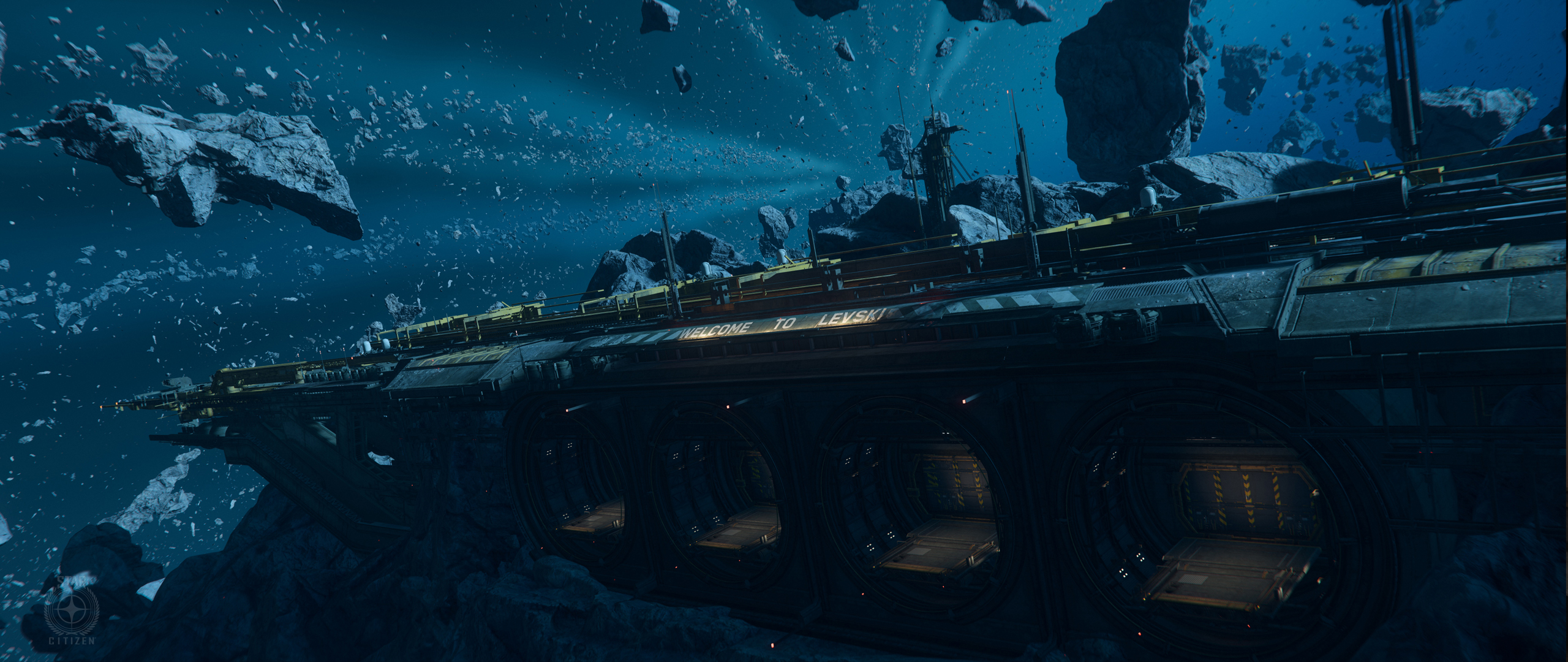
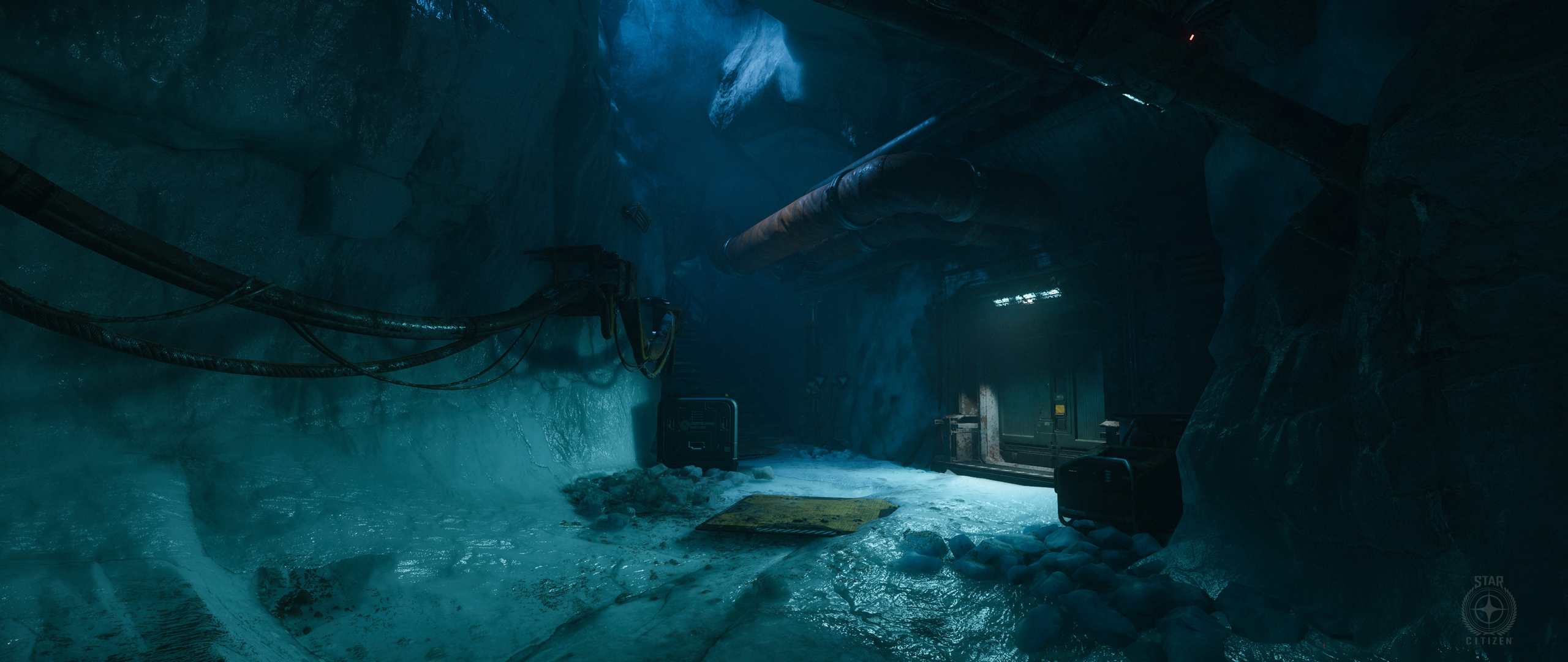
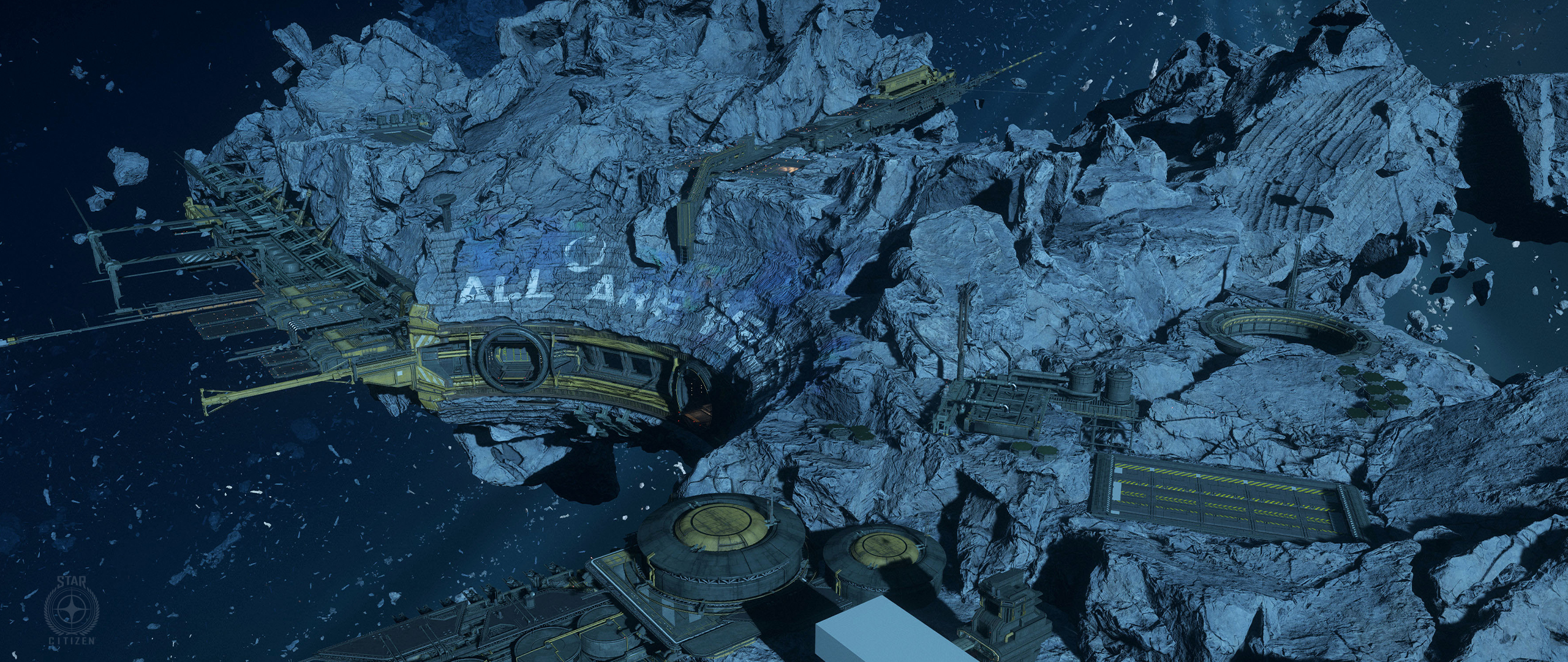
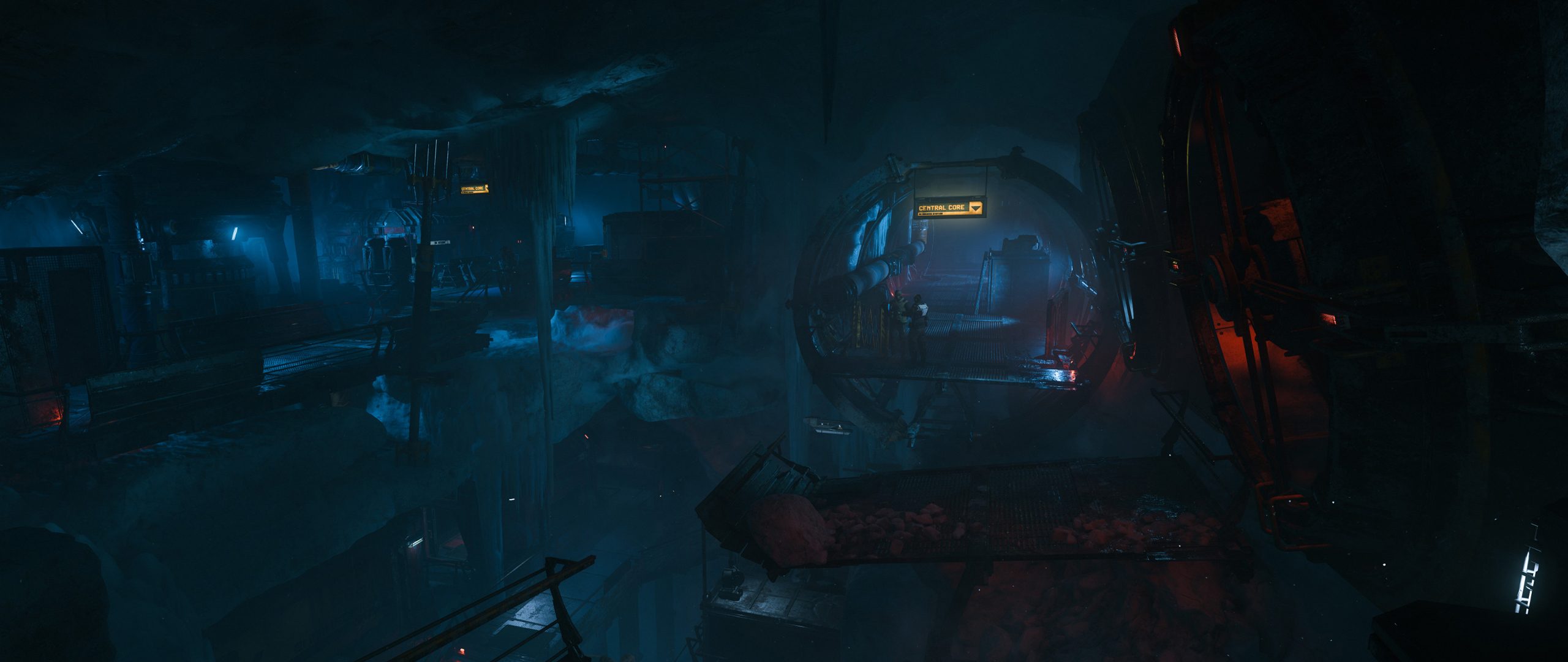
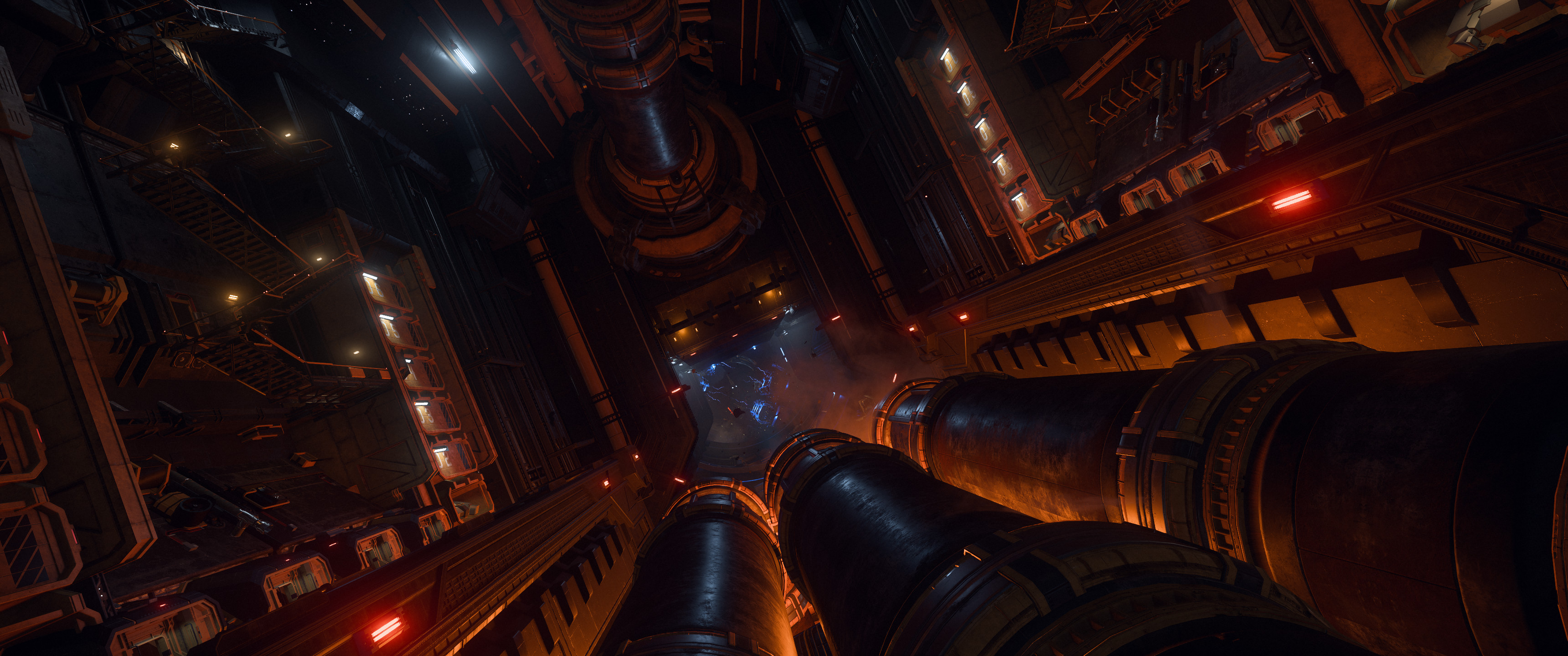
The Environment Art Team progressed with the space-scaping and the approach to Aciedo, which not only looks great but also allows interesting flight gameplay. The station interior received lighting tweaks to portray the desired mood too. Planetside, progress was made on creating interesting and believable terrain that incorporates canyons, which the team had been unable to achieve previously. Development of Archon station’s internal tram system, sewers, social hub, back alleys, and worker’s areas continued, while initial work began for exterior FPS spaces in chapter 13.
Chapter 15 progressed, with Art working alongside Design to build out the environments for key moments throughout the level. Progress was made on the Bengal’s medbay and armory too, both of which are close to completion.
Cinematics
Due to the nature of SQ42’s heavily embedded real-time cinematics, it’s rare for the Cinematics Team to be entirely ‘unblocked’ on scenes and work through them with no interruptions. Blockers can include a scene’s mo-cap delivery needing completion, the state machine for all animation fragments needing to be defined, character assets (like faces, costumes, and rigs) not being ready, and props missing or having incorrectly sized metrics. Sometimes, there are larger issues where level art elements for a set piece or location aren’t solidified enough to give a good understanding of the state machine, placement, flow, or mood. So, the team develops tools to help them work effectively regardless of blockers, which were further developed throughout May. This included tools to control ship functions, the player’s head, settings to suit a female character, the contents of object containers, and a dynamic per-character lighting rig to give a base illumination quality.
A tool was also created to reference and play each landing gear compression spring in the vehicle setup independently. For example, this enables the team to extract or retract a ship’s hind landing skids before the fronts.
Alongside tools, Cinematics worked on specific chapter scenes and sequences, including a key Vanduul encounter and one involving the player hiding among fog and ship parts. Progress was made on the Bengal, including animating the bridge seats and attached screens too.
Engine
The Physics Team finalized their support of tracking floating point exceptions within physics, which began in April. As a side effect, this enabled more efficient vector code generation on the Linux server. The rest of the month was mostly spent on optimizations, including improving the mid and narrow phase of soft body collision detection. There were also several updates to signed distance fields (SDF), such as tile-based polygonization when remeshing SDFs and optimizations in tree traversal when baking SDFs. The team further progressed with the Gen12 renderer, including submitting improvements to the Scaleform (UI) render path that was established last month. The render graph, which is a key component in Gen12, received initial support for resource transition APIs, split barriers, and resource state validation; all of which are important for next-gen, low-level APIs such as Vulkan and DX12. The debuggability of the render graph was also updated.
Furthermore, text rendering was refactored and optimized and support for image draw helper code was added. More pipelines were enabled for Gen12 by default, including tiled shading, SSR, SSDO, shadow mask generation, and scattering queries.
Additionally, significant low-level progress was made in memory management, which involved various types of buffer and packet allocations moving to a more efficient scheme. Lastly for the renderer, various APIs were exposed via common interfaces so higher-level code can eventually make use of them to prepare and package data in advance and offload the renderer.
On the graphics front, hair rendering received various improvements, such as fixed shadow map generation of view-aligned strands and a new experimental scattering model for better looking blonde hair. Eye shading got support for a normal plus-blend map when rendering specular overlays. The eyeball texture can now also be rescaled to make shared textures better fit varying eye geometry.
The volumetric cloud system received support for density queries so various VFX can be spawned and the game can react to the presence of clouds at given locations. Scattering query support was also added so transparent and forward-shaded objects properly take clouds into account when rendered. The work on SDFs for efficient space skipping continued too.
Features (Gameplay)
May saw the Feature Team take the basics of the PU’s reputation system and create a single-player version for use in SQ42. The live version is a service separate from the game, writing out the reputation values to a database, whereas the single-player version runs as a part of the game itself, storing reputations in memory that can then be stored to the save game system. Outside of that, they made quality-of-life improvements and completed several smaller tasks, such as improving the video comm setup for multiple parties.
Gameplay Story
Last month, Gameplay Story focused on the second walk-and-talk for chapter 5 following successful work on the previous scene. This involved restructuring animations and getting them to work with AI and creating interrupt, idle, encouragement, and rejoin animations. “This is quite an undertaking, but it’s been great to maintain momentum and see this chapter rapidly taking shape.” -The Gameplay Story Team
Alongside this, they set up a holographic character, created accurate holstering animations, and updated several scenes to include the new medical gun. Support was also given to Design’s work on chapter 13 and a prototype was made for a scene in chapter 19.
Graphics & VFX Programming
Throughout May, the Graphics & VFX Programming teams made significant improvements to several systems. Work started on a window shader extension to allow views into ‘fake’ interiors with support for randomized room sizes, rotations, colors, and lighting. When live, this will bring extra life to cities and space stations.
The render-to-texture system was modified to allow a more bespoke compositing and post-effect pipeline for the UI Team, which will bring greater visual consistency and higher-quality effects. The level of detail (LOD) merger system was updated so that it can be used in New Babbage and Orison to improve performance and reduce the art burden of creating super-low/distant LODs. Pre-streaming support was added for various game systems (such as vehicle death-masks, muzzle flashes, and quantum travel) to pre-stream any textures required for particle effects before the particles are spawned. This should solve some long-standing visual bugs.
The shield effects setup was reworked to enable a single effect to be used on multiple ships of varying scales, with all effects scaling appropriately. Work on the fire hazard system mentioned in previous reports continued, with May’s focus on the heat management of the room system. The streaming support for gas clouds was also developed to reduce memory use and improve loading times.
For the Gen12 renderer, a new Vulkan extension reporting system was added so that, from Alpha 3.14 onwards, the team will be able to gather data on what hardware and driver support they have for various Vulkan features. This will help them use newer features when sufficiently supported. The team also generalized the GPU-to-CPU read-back system and ported the DX9-era texture sampling code to a modern equivalent.
Level Design
The Space/Dogfight Team continued to ensure the company-wide focus from last quarter’s milestone was applied to the chapters beyond the scope of their milestone work. Some functionality came in late in the quarter and is now being refined to fit what was designed and expected in terms of polish. The Level Design Team had several detailed discussions regarding non-combat AI and behaviors that are now being put into practice for the pre-combat/stealth elements of the current milestone, with significant focus on combat behaviors within small spaces.
As always, the Social Design Team implemented scenes for the various chapter reviews and sign-offs.
Narrative
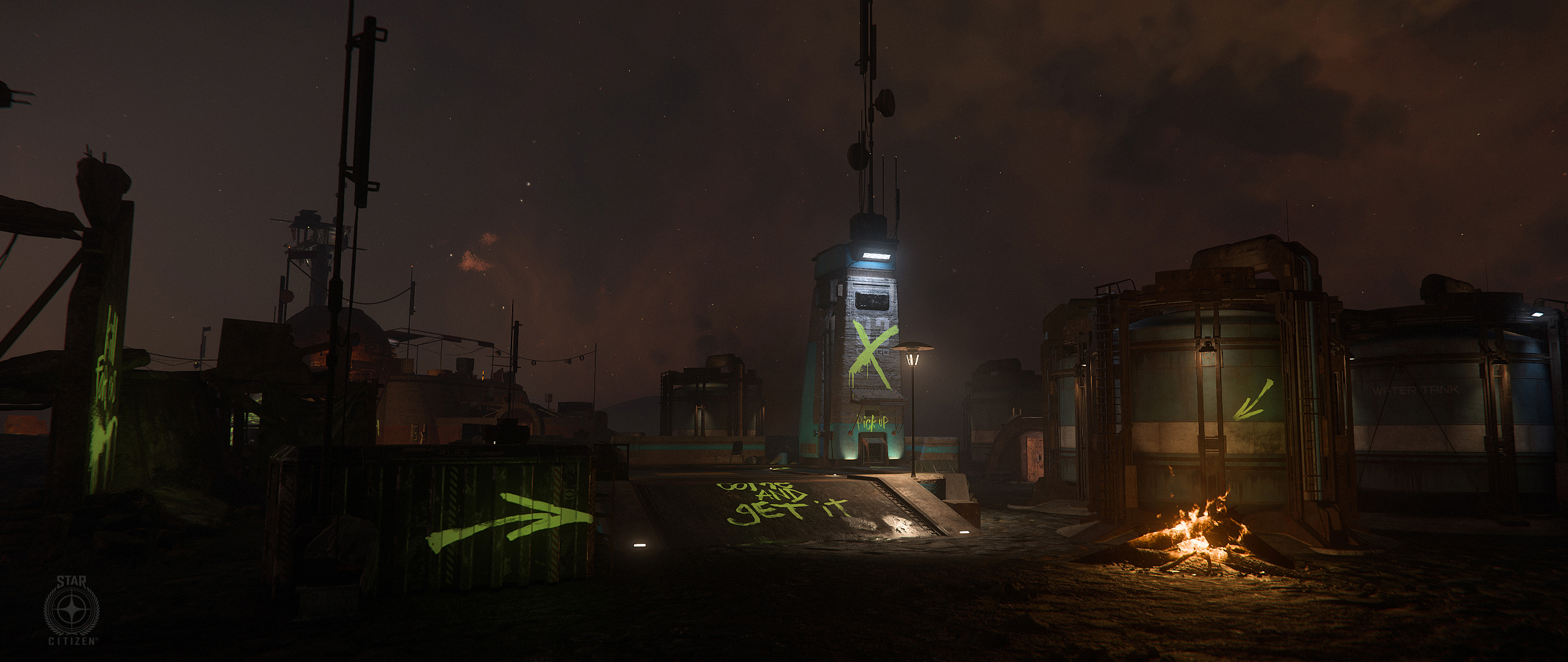
Throughout May, the Narrative Team focused on an expanded environmental storytelling pass for the Shubin Interstellar Archon Station, which included additional posters and advertising to help set the desired mood; the hope is to create a dynamic, living station that immerses the player wherever they look. They also had several reviews of one chapter, discussing how a player’s personal playstyle could impact the narrative and then making sure that the content would react appropriately. These reviews helped highlight a few areas where scenes could be placed differently and additional dialogue could help the gameplay experience. These will be scripted shortly.
Additionally, Narrative planned a mo-cap session to begin getting final recordings of some of the placeholder content outlined in previous reports.
QA
Cinematics continued to rely on QA for recordings of each level for review, while support was given to the various development teams, with their changes and updates to the project tested as needed. QA also continued to support AI, testing the behavior implementations into SQ42, with a focus on Vanduul improvements. They also pushed to clear out any outdated issues and performed an open bug-sweep to ensure their databases were up to date.
Tech Animation
Tech Animation’s quarterly deliverables and long-standing initiatives progressed well throughout May. The team also invested time into R&D around their animation pipeline and exporting processes. “Both are bedrocks of our team and now have many nice-to-have features that the Tech Animation and Animation teams have discussed for a long time.” -The Tech Animation Team
They spent time clearing up several animation bugs, implemented animations, and worked alongside the Art Team on asset skinning too.
VFX
Last month, the much-anticipated particle lighting system was integrated into the artists’ builds, so VFX began updating existing environmental effects to make use of the new settings. The new lighting system is much more physically accurate, which allows the artists to make their effects sit more naturally in the environments regardless of lighting conditions. It generally improves overall visual quality too. As always, the team continued their collaboration with Art and Design on gas clouds. Following on from last month, the VFX artists took a more hands-on approach to the creation of VDBs (previously it was more of an advisory role) along with the gas cloud particle effects.
WE’LL SEE YOU NEXT MONTH…
Dies ist ein Cross-Post des Berichts, der kürzlich über den monatlichen Squadron 42 Newsletter verschickt wurde. Wir veröffentlichen ihn ein zweites Mal als Comm-Link, damit die Community leichter darauf zurückgreifen kann.
Achtung Rekruten,
Was ihr gleich lesen werdet, sind die neuesten Informationen über die weitere Entwicklung von Squadron 42 (SCI des: SQ42).
Dank der Arbeit von engagierten Feldagenten und Agenten haben wir Informationen über Sicherheitskräfte, Screaming Galsons und die Shubin Interstellar Archon Station aufgedeckt.
Die in dieser Mitteilung enthaltenen Informationen sind äußerst sensibel und es ist von größter Wichtigkeit, dass sie nicht in die falschen Hände geraten. Lösche alle Aufzeichnungen nach dem Lesen.
UEE Marine Oberkommando
KI (Inhalt)
Das KI-Inhaltsteam konzentrierte sich den ganzen Monat über auf die Invictus-Launch-Woche, was das Polieren des Touristen- und Reiseleiterverhaltens, der Wildlinien, der Look-IK und die Vervollständigung der erforderlichen weiblichen Animationen beinhaltete. Sie widmeten sich der Auswahl der Animationen für die Mannequin-Fragmente, um sicherzustellen, dass sie korrekt in den Kontext passen, und der Ladenbesitzer erhielt mehr Usables, die die Spieler in Lebensmittel- und Getränkeläden erwarten würden. Sie begannen auch damit, mögliche Flusserweiterungen zu entwerfen, die es NSCs erlauben, Spieler unterschiedlich zu bedienen, wenn sie sich entscheiden, im Laden zu essen oder mitzunehmen. So wird es zum Beispiel möglich sein, dem Spieler Essen direkt zu geben oder es auf einem Teller und Tablett zu servieren.
Der Wachmann wurde vollständig entworfen und prototypisch umgesetzt. Dieses Verhalten bietet großartige Gameplay-Möglichkeiten in einer emergenten oder systemischen Art und Weise, da es Szenarien von NSCs erfüllt, die als Gesetzeshüter, Informationsgeber, Pförtner und Begrüßer agieren.
AI Content hat auch das Design und den Prototyping des Hintergrundlebens für den medizinischen Raum fortgesetzt, wenn die Spieler respawnen, einschließlich des systemischen Hausmeisters und der NSCs, die die Toilettenkabine benutzen und in den Etagenbetten schlafen.
Speziell für SQ42 unterstützte das Team die Aciedo-Station, indem es taktile Interaktionsmöglichkeiten identifizierte und Animationen sowie das Usables-Setup ausblockte. Diese Usables, die mit geskripteten KI-Pfaden arbeiten, helfen dabei, Mini-Szenarien zu erstellen, in denen die KI scheinbar nach Geiseln sucht, die sie einfrieren kann.
KI (Features)
Das KI-Feature-Team hat den Kampf weiterentwickelt, einschließlich der Möglichkeit für feindliche Kämpfer, ihre Ziele (KI oder Spieler) mit Hinrichtungsanimationen zu erledigen. Dazu wurde das bestehende Stealth-Takedown-System für die Nutzung durch die KI angepasst und datengesteuerter gemacht, sodass es verschiedene Arten von Takedowns mit eigenen Einstellungen unterstützt. Zum Beispiel die minimale und maximale Distanz, aus der ein Takedown durchgeführt werden kann und in welchem Quadranten sich der Angreifer relativ zum Ziel befinden muss. Für Raumschiffe haben die KI-Features das Kampfverhalten der Jäger angepasst, um Raketen besser nutzen zu können. Dies beinhaltet die Auswahl des richtigen Typs und der Anzahl der abzufeuernden Raketen, damit die NSCs nicht alle ihre Raketen mit hohem Schaden auf kleineren Zielen verbrauchen. Im Gruppenkampf sorgt dies dafür, dass die Raketen über eine Reihe von Zielen verteilt werden und für den Einsatz während des Kampfes rationiert werden. Dies führt zu interessanten Verhaltensweisen, bei denen Jäger Ziele mit einem Sperrfeuer von Raketen "aufweichen", bevor sie sich in den Nahkampf stürzen und in günstigen Momenten gelegentlich Raketen abfeuern. Sie haben auch am Sicherheitsverhalten der Piloten gearbeitet, um Probleme zu beheben, die auftreten, wenn sich ein Ziel ergeben hat oder festgenommen wurde.
Als Teil des größeren Sicherheitsverhaltens wurde die Arbeit am Subverhalten Waffentraining fortgesetzt, bei dem NSCs ihre Kampffähigkeiten verbessern können, indem sie einen Schießstand benutzen. Zunächst muss eine Waffe vom Waffenschmied abgeholt werden, wobei das Team das bestehende Verkäufer- und Gönnerverhalten aktualisiert hat, um die Abholung und Rückgabe in der Waffenkammer zu unterstützen. Für den Schießstand musste das Team die bestehenden Ziel- und Schießsysteme anpassen, um Nicht-Agenten-Ziele zu unterstützen. Diese Technologie wird in der Zukunft verwendet werden, um das Zielen auf "zerstörbare" Objekte im Kampf zu unterstützen. Zum Beispiel könnte die KI eine Computerbank ausschalten müssen, um ein Missionsziel zu erfüllen. Die Grundlagen für das Zielen auf bestimmte Körperteile (z.B. Kopfschüsse) und "nicht-menschliche Agenten" (z.B. Tiere) wurden ebenfalls fertiggestellt.
Für die KI-Features schließlich entwickelte das Team den untrainierten Waffenkampf weiter. Außerdem bereiteten sie sich auf eine kommende Mo-Cap-Session für untrainiertes Deckungsverhalten, Reaktion auf tote Körper, feindliche Reaktionen in Usables, Cowering und Kapitulation vor.
KI (Tech)
Den ganzen Mai über hat die KI-Abteilung das Feedback für die Arbeit am Tier-0-Navigations-Link vervollständigt und bearbeitet. Dies beinhaltete Verbesserungen bei der Verwendung der Cache-Daten während der Navigationslinks mit Motion-Warp-Animationen, aber auch die Neuberechnung der Navigationslink-Verbindungspunkte, wenn sich das Navigationsnetz in seiner Nähe ändert. Auf der EVA-Seite wurde die Arbeit an NPCs, die aus der Schwerelosigkeit in eine nutzbare übergehen (und umgekehrt), abgeschlossen. Darauf aufbauend wurde mit der Entwicklung der Zero-G-Kollisionsvermeidung für NPCs begonnen, die es ihnen ermöglicht, anderen Charakteren (KI oder Spieler) und kleinen Objekten auszuweichen, während sie schweben. Dies wird das 3D ORCA nutzen, das für die Kollisionsvermeidung der SchiffskI implementiert wurde. Das Team fügte auch neue Funktionen für Bewegungsanfragen hinzu; sie sind nun in der Lage, Designerpfade am Ende umzuplanen, was es ihnen ermöglicht, Schleifen zu erstellen.
Ein weiteres Feature, an dem gearbeitet wurde, war die Planetennavigation. Das Ziel ist es, ein Navigationsnetz auf Planeten zu generieren, das von NPCs und Tieren um Außenposten herum genutzt werden kann. Dies wird Physik-Informationen nutzen, so dass jedes Mal, wenn Planeten-Kacheln physikalisiert werden, auch Navigations-Meshes generiert werden.
Für das Subsumption-Editor-Tool fügte das Team eine neue Funktionalität hinzu, die es erlaubt, mehrere Subsumption-Funktionen in der gleichen Fensteransicht zu erstellen oder zu verändern. Dies wird den Designern beim Schreiben von Missionsskripten oder Verhaltensweisen von Vorteil sein, da sie einen Überblick über die gesamte Logik an einem Ort haben werden.
Animation
Das Animationsteam hat im Mai an den Vanduul-Kämpfen, der Fortbewegung von Verletzten, dem Verhalten im Schussbereich, den SQ42-spezifischen Level-Usables, der Bewegung zwischen Nav-Meshes und dem medizinischen Gameplay (einschließlich der Heilung und dem Bewegen von Spielern in Betten) gearbeitet. Sie testeten auch ein Rig für die Xi'an-Alienrasse (sowohl Körper als auch Gesicht) und unterstützten mehrere Story-Szenen.
Kunst (Charaktere)
Das Character Art Team machte Fortschritte bei der Entwicklung der Screaming Galsons. Basierend auf den Torso-Teil-Tests, die letzten Monat begonnen haben, sieht das modulare System wie ein vielversprechender Weg aus, um eine große Anzahl von Variationen kostengünstig zu erstellen. Der nächste Schritt ist, die Regeln für andere Rüstungstypen festzulegen und mit den maßgeschneiderten Screaming Galson Charakteren zu beginnen. Das Team hat auch den Polishing-Pass für Trejos Kopf abgeschlossen und ihn an Tech Animation übergeben, um das Rig zu aktualisieren. Ihr Haar befindet sich derzeit im Skinning, während ihr Unteranzug und ihr Helm im Modeling sind. Zu guter Letzt arbeiteten sie an einigen Charakteren für Aciedo und Uniformen für Kapitel 4G.
Kunst (Umgebung)
Das Environment Art Team machte Fortschritte beim Space-Scaping und dem Anflug auf Aciedo, was nicht nur toll aussieht, sondern auch ein interessantes Flug-Gameplay ermöglicht. Das Innere der Station wurde in der Beleuchtung überarbeitet, um die gewünschte Stimmung zu erzeugen. Auf der Planetenseite wurden Fortschritte bei der Gestaltung von interessantem und glaubwürdigem Terrain gemacht, das Canyons einschließt, was dem Team zuvor nicht möglich gewesen war. Die Entwicklung des internen Straßenbahnsystems der Archon-Station, der Abwasserkanäle, des sozialen Zentrums, der Hintergassen und der Arbeiterbereiche wurde fortgesetzt, während die ersten Arbeiten für die äußeren FPS-Räume in Kapitel 13 begannen.
Kapitel 15 schritt voran, wobei Art mit Design zusammenarbeitete, um die Umgebungen für die Schlüsselmomente des Levels zu gestalten. Auch an der Krankenstation und der Waffenkammer der Bengalen wurden Fortschritte gemacht, die beide kurz vor der Fertigstellung stehen.
Cinematics
Aufgrund der Natur von SQ42s stark eingebetteten Echtzeit-Cinematics ist es selten, dass das Cinematics Team komplett "unblocked" an Szenen arbeiten kann und ohne Unterbrechungen durchkommt. Blocker können sein, dass das Mo-Cap einer Szene fertiggestellt werden muss, dass die Zustandsmaschine für alle Animationsfragmente definiert werden muss, dass Charakter-Assets (wie Gesichter, Kostüme und Rigs) nicht fertig sind und dass Requisiten fehlen oder eine falsche Größe haben. Manchmal gibt es auch größere Probleme, wenn die Level Art Elemente für ein Set Piece oder eine Location nicht fest genug sind, um ein gutes Verständnis für die State Machine, die Platzierung, den Flow oder die Stimmung zu haben. Also entwickelt das Team Tools, die ihnen helfen, unabhängig von Blockern effektiv zu arbeiten, und die im Mai weiterentwickelt wurden. Dazu gehörten Werkzeuge, um Schiffsfunktionen, den Kopf des Spielers, Einstellungen für einen weiblichen Charakter, den Inhalt von Objektcontainern und ein dynamisches Beleuchtungs-Rig für jeden Charakter zu kontrollieren, um eine Grundbeleuchtungsqualität zu erhalten.
Es wurde auch ein Tool erstellt, um jede Fahrwerksdruckfeder im Fahrzeugsetup unabhängig zu referenzieren und zu spielen. Dies ermöglicht es dem Team zum Beispiel, die hinteren Landekufen eines Schiffes vor den vorderen aus- oder einzufahren.
Neben den Werkzeugen arbeiteten die Cinematics an bestimmten Kapitelszenen und Sequenzen, darunter eine Schlüsselbegegnung mit den Vanduul und eine, in der sich der Spieler zwischen Nebel und Schiffsteilen versteckt. Fortschritte wurden auch bei der Bengal gemacht, einschließlich der Animation der Brückensitze und der angebrachten Bildschirme.
Motor
Das Physics Team hat die im April begonnene Unterstützung für das Tracking von Floating Point Exceptions in der Physik abgeschlossen. Als Nebeneffekt ermöglichte dies eine effizientere Vektorcodegenerierung auf dem Linux Server. Der Rest des Monats wurde hauptsächlich mit Optimierungen verbracht, einschließlich der Verbesserung der mittleren und engen Phase der Soft Body Collision Detection. Es gab auch mehrere Updates für Signed Distance Fields (SDF), wie z.B. kachelbasierte Polygonisierung beim Remeshing von SDFs und Optimierungen im Tree Traversal beim Backen von SDFs. Das Team hat weitere Fortschritte mit dem Gen12 Renderer gemacht, einschließlich der Einreichung von Verbesserungen am Scaleform (UI) Renderpfad, der letzten Monat eingeführt wurde. Der Rendergraph, der eine Schlüsselkomponente in Gen12 ist, erhielt erste Unterstützung für Resource Transition APIs, Split Barriers und Resource State Validation; allesamt wichtig für Next-Gen, Low-Level APIs wie Vulkan und DX12. Die Debuggability des Rendergraphen wurde ebenfalls aktualisiert.
Außerdem wurde das Textrendering refaktorisiert und optimiert und Unterstützung für Bild-Draw-Helper-Code hinzugefügt. Mehr Pipelines wurden für Gen12 standardmäßig aktiviert, darunter Tiled Shading, SSR, SSDO, Shadow Mask Generation und Scattering Queries.
Zusätzlich wurden signifikante Low-Level-Fortschritte in der Speicherverwaltung gemacht, die verschiedene Arten von Puffer- und Paketallokationen beinhaltete, die in ein effizienteres Schema überführt wurden. Schließlich wurden für den Renderer verschiedene APIs über gemeinsame Schnittstellen offengelegt, so dass Code auf höherer Ebene diese nutzen kann, um Daten im Voraus vorzubereiten und zu verpacken und den Renderer zu entlasten.
An der Grafikfront erhielt das Rendering von Haaren verschiedene Verbesserungen, wie z.B. eine fixierte Shadowmap-Generierung von sichtausgerichteten Strähnen und ein neues experimentelles Streumodell für besser aussehendes blondes Haar. Das Eye Shading erhielt Unterstützung für eine Normal plus Blend Map beim Rendern von Specular Overlays. Die Augentextur kann nun auch neu skaliert werden, um geteilte Texturen besser an unterschiedliche Augengeometrien anzupassen.
Das volumetrische Wolkensystem erhielt Unterstützung für Dichteabfragen, sodass verschiedene VFX gespawnt werden können und das Spiel auf das Vorhandensein von Wolken an bestimmten Orten reagieren kann. Scattering Query Support wurde ebenfalls hinzugefügt, so dass transparente und vorwärts schattierte Objekte Wolken beim Rendern korrekt berücksichtigen. Die Arbeit an SDFs für effizientes Space-Skipping wurde ebenfalls fortgesetzt.
Eigenschaften (Gameplay)
Im Mai hat das Feature Team die Grundlagen des Reputationssystems der PU genommen und eine Einzelspielerversion für die Verwendung in SQ42 erstellt. Die Live-Version ist ein vom Spiel getrennter Dienst, der die Reputationswerte in eine Datenbank schreibt, wohingegen die Einzelspielerversion als Teil des Spiels selbst läuft und die Reputationen im Speicher ablegt, die dann in das Speichersystem des Spiels übertragen werden können. Darüber hinaus wurden Verbesserungen an der Lebensqualität vorgenommen und einige kleinere Aufgaben erledigt, wie zum Beispiel die Verbesserung des Videokommunikations-Setups für mehrere Parteien.
Gameplay Geschichte
Im letzten Monat konzentrierte sich Gameplay Story auf den zweiten Walk-and-Talk für Kapitel 5, nachdem die Arbeit an der vorherigen Szene erfolgreich war. Dies beinhaltete die Umstrukturierung der Animationen und die Anpassung an die KI sowie die Erstellung von Unterbrechungs-, Leerlauf-, Ermutigungs- und Rejoin-Animationen. "Das ist ein ziemliches Unterfangen, aber es war großartig, den Schwung beizubehalten und zu sehen, wie dieses Kapitel schnell Form annimmt." -Das Gameplay Story Team
Daneben haben sie einen holografischen Charakter erstellt, akkurate Holsteranimationen erstellt und mehrere Szenen aktualisiert, um die neue medizinische Waffe einzubauen. Außerdem wurde das Design bei der Arbeit an Kapitel 13 unterstützt und ein Prototyp für eine Szene in Kapitel 19 erstellt.
Grafik & VFX Programmierung
Den ganzen Mai über haben die Teams der Grafik- und VFX-Programmierung bedeutende Verbesserungen an mehreren Systemen vorgenommen. Es wurde mit der Arbeit an einer Fenster-Shader-Erweiterung begonnen, die Einblicke in "unechte" Innenräume mit Unterstützung für zufällige Raumgrößen, Drehungen, Farben und Beleuchtung ermöglicht. Wenn sie in Betrieb ist, wird dies zusätzliches Leben in Städte und Raumstationen bringen.
Das Render-to-Texture-System wurde modifiziert, um eine maßgeschneiderte Compositing- und Post-Effekt-Pipeline für das UI-Team zu ermöglichen, die eine größere visuelle Konsistenz und qualitativ hochwertigere Effekte bringen wird. Das Level of Detail (LOD)-Merger-System wurde aktualisiert, so dass es in New Babbage und Orison verwendet werden kann, um die Leistung zu verbessern und den künstlerischen Aufwand bei der Erstellung von super-niedrigen/entfernten LODs zu reduzieren. Pre-Streaming-Unterstützung wurde für verschiedene Spielsysteme (wie z.B. Fahrzeug-Todesmasken, Mündungsfeuer und Quantenreisen) hinzugefügt, um alle Texturen, die für Partikeleffekte benötigt werden, vorzustreamen, bevor die Partikel gespawnt werden. Dies sollte einige lange bestehende visuelle Bugs lösen.
Das Setup der Schildeffekte wurde überarbeitet, damit ein einzelner Effekt auf mehreren Schiffen unterschiedlicher Größe verwendet werden kann, wobei alle Effekte entsprechend skalieren. Die Arbeit an dem in früheren Berichten erwähnten Feuergefährdungssystem wurde fortgesetzt, wobei der Schwerpunkt im Mai auf dem Wärmemanagement des Raumsystems lag. Die Streaming-Unterstützung für Gaswolken wurde ebenfalls weiterentwickelt, um den Speicherverbrauch zu reduzieren und die Ladezeiten zu verbessern.
Für den Gen12-Renderer wurde ein neues Vulkan-Erweiterungs-Reporting-System hinzugefügt, sodass das Team ab Alpha 3.14 in der Lage sein wird, Daten darüber zu sammeln, welche Hardware- und Treiberunterstützung sie für verschiedene Vulkan-Features haben. Dies wird ihnen helfen, neuere Features zu nutzen, wenn sie ausreichend unterstützt werden. Das Team hat auch das GPU-to-CPU Rücklesesystem verallgemeinert und den DX9-Ära Textur-Sampling-Code auf ein modernes Äquivalent portiert.
Level Design
Das Space/Dogfight Team stellte weiterhin sicher, dass der unternehmensweite Fokus aus dem Meilenstein des letzten Quartals auch auf die Kapitel jenseits ihrer Meilensteinarbeit angewendet wurde. Einige Funktionen kamen spät im Quartal herein und werden nun verfeinert, damit sie zu dem passen, was in Bezug auf den Feinschliff entworfen und erwartet wurde. Das Level Design Team hatte mehrere detaillierte Diskussionen bezüglich der Nicht-Kampf-KI und Verhaltensweisen, die nun für die Pre-Combat/Stealth-Elemente des aktuellen Meilensteins in die Praxis umgesetzt werden, wobei der Schwerpunkt auf dem Kampfverhalten in kleinen Räumen liegt.
Wie immer implementierte das Social Design Team Szenen für die verschiedenen Kapitel-Reviews und Sign-Offs.
Erzählung
Den ganzen Mai über konzentrierte sich das Narrative Team auf einen erweiterten Environmental Storytelling Pass für die Shubin Interstellar Archon Station, der zusätzliche Poster und Werbung beinhaltet, um die gewünschte Stimmung zu erzeugen; die Hoffnung ist, eine dynamische, lebendige Station zu erschaffen, die den Spieler eintauchen lässt, wohin er auch schaut. Es gab auch mehrere Reviews eines Kapitels, in denen besprochen wurde, wie sich der persönliche Spielstil eines Spielers auf die Erzählung auswirken könnte und dann dafür gesorgt wurde, dass der Inhalt entsprechend reagiert. Diese Reviews halfen dabei, ein paar Bereiche hervorzuheben, in denen Szenen anders platziert werden könnten und zusätzliche Dialoge dem Spielerlebnis helfen könnten. Diese werden in Kürze geskriptet werden.
Zusätzlich plante Narrative eine Mo-Cap-Session, um mit den finalen Aufnahmen einiger der Platzhalter-Inhalte zu beginnen, die in früheren Berichten beschrieben wurden.
QA
Die Cinematics verließen sich weiterhin auf die QA, um Aufnahmen von jedem Level zur Überprüfung zu erhalten, während die verschiedenen Entwicklungsteams unterstützt wurden, indem ihre Änderungen und Updates am Projekt nach Bedarf getestet wurden. QA unterstützte auch weiterhin die KI und testete die Verhaltensimplementierungen in SQ42, wobei der Fokus auf Verbesserungen für Vanduul lag. Außerdem wurden veraltete Probleme beseitigt und ein offener Bug-Sweep durchgeführt, um sicherzustellen, dass die Datenbanken auf dem neuesten Stand sind.
Technische Animation
Tech Animation's vierteljährliche Ergebnisse und langjährige Initiativen machten im Mai gute Fortschritte. Das Team investierte auch Zeit in Forschung und Entwicklung rund um die Animationspipeline und die Exportprozesse. "Beides sind Grundpfeiler unseres Teams und haben nun viele Nice-to-have-Features, die das Tech Animation- und das Animationsteam schon lange diskutiert haben." -Das Tech Animation Team
Sie verbrachten Zeit damit, verschiedene Animationsbugs zu beseitigen, implementierten Animationen und arbeiteten zusammen mit dem Art Team auch am Asset Skinning.
VFX
Letzten Monat wurde das lang erwartete Partikel-Beleuchtungssystem in die Künstler-Builds integriert, also begann VFX damit, bestehende Umgebungseffekte zu aktualisieren, um die neuen Einstellungen zu nutzen. Das neue Beleuchtungssystem ist viel physikalisch genauer, was es den Künstlern ermöglicht, ihre Effekte natürlicher in die Umgebungen einzupassen, unabhängig von den Lichtverhältnissen. Es verbessert auch die allgemeine visuelle Qualität. Wie immer hat das Team seine Zusammenarbeit mit Art und Design bei den Gaswolken fortgesetzt. Wie schon im letzten Monat haben die VFX-Artists bei der Erstellung der VDBs und den Partikeleffekten der Gaswolken mehr Hand angelegt (vorher war es eher eine beratende Rolle).
WIR SEHEN UNS NÄCHSTEN MONAT...
This is a cross-post of the report that was recently sent out via the monthly Squadron 42 newsletter. We’re publishing this a second time as a Comm-Link to make it easier for the community to reference back to. Attention Recruits,
What you are about to read is the latest information on the continuing development of Squadron 42 (SCI des: SQ42).
Thanks to the work of dedicated field agents and operatives, we’ve uncovered information on security guards, Screaming Galsons, and the Shubin Interstellar Archon Station.
The information contained in this communication is extremely sensitive and it is of paramount importance that it does not fall into the wrong hands. Purge all records after reading.
UEE Naval High Command
AI (Content)
The AI Content Team focused on Invictus Launch Week throughout the month, which included polishing the tourist and tour guide behavior, wildlines, Look IK, and completing the required female animations. They dedicated time to the Mannequin fragments animation selection to ensure they correctly fit their context, and the shopkeeper gained more usables that players would expect to see in food and drink shops. They also started designing possible flow extensions to allow NPCs to serve players differently if they choose to eat in or take away. For example, this will allow food to be given to the player directly or served on a plate and tray.
The security guard was fully designed and prototyped. This behavior offers great gameplay opportunities in an emergent or systemic way as it fulfills scenarios of NPCs acting as law enforcers, information providers, gatekeepers, and greeters. AI Content also continued designing and prototyping background life for the medical room when players respawn, including the systemic janitor and NPCs using the bathroom cubicle and sleeping in the bunk beds.
Specifically for SQ42, the team supported Aciedo station, identifying tactile interaction opportunities and blocking out animations and the usables setup. These usables, working with scripted AI Paths, will help to create mini-scenarios where the AI appears to look for hostages to dry-freeze.
AI (Features)
The AI Feature Team further developed combat, including the ability for enemy fighters to finish off their targets (AI or player) with execution animations. This involved adapting the existing stealth takedown system for use by AI and making it more data-driven so that it supports different types of takedowns with their own settings. For example, the minimum and maximum distance a takedown can be performed from and what quadrant the attacker must be in relative to the target. For spaceships, AI Features adapted the fighter combat behavior to better utilize missiles. This involves selecting the right type and number of missiles to fire so that NPCs don’t exhaust all of their high-damage missiles on smaller targets. In group combat, this ensures that missiles are spread over a range of targets and are rationed for use throughout the fight. This leads to interesting behaviors where fighters will ‘soften up’ targets with a barrage of missiles before engaging in dogfighting, firing occasional missiles at opportune moments. They also worked on the pilot security behavior to fix issues that occur when a target has surrendered or been arrested.
As part of the larger security behavior, work continued on the weapons training sub-behavior, where NPCs can improve their combat abilities by using a firing range. Firstly, a weapon has to be retrieved from the armorer, with the team updating the existing vendor and patron behaviors to support retrieval and return at the armory. For the firing range, the team had to adapt the existing targeting and firing systems to support non-agent targets. This technology will be used in the future to support the targeting of ‘destructibles’ in combat. For example, the AI might need to take out a computer bank to complete a mission objective. The groundwork for targeting specific parts of the body (eg. headshots) and ‘non-human-bodied agents’ (e.g. animals) was completed too.
Finally for AI Features, the team further developed untrained weapons combat. They also prepared for an upcoming mo-cap session for untrained cover behaviors, responding to dead bodies, hostile reactions in usables, cowering, and surrendering.
AI (Tech)
Throughout May, AI Tech completed and addressed feedback for the tier-0 navigation link work. This involved making improvements to how the cache data is used during navigation links with motion-warp animations but also re-computing navigation link connection points when the navigation mesh changes in its proximity. On the EVA side, work on NPCs transitioning from zero-g into a usable (and vice versa) was completed. Following on from this, they began developing zero-g collision avoidance for NPCs, which allows them to avoid other characters (AI or player) and small objects while floating. This will use the 3D ORCA that was implemented for ship AI collision avoidance. The team also added new functionality to movement requests.; they’re now able to re-plane designer paths at the end, allowing them to create loops.
Another feature worked on was planetary navigation. The aim is to generate navigation mesh on planets that can be used by NPCs and animals around outposts. This will use physics information, so each time planetary tiles are physicalized, navigation meshes will be generated too.
For the Subsumption editor tool, the team added new functionality allowing them to create or modify multiple Subsumption functions in the same window view. This will be beneficial to the designers when writing mission scripts or behaviors as they will have an overview of all logic in the same place.
Animation
The Animation team spent May working on Vanduul combat, hurt locomotion, firing range behaviors, SQ42-specific level usables, movement between nav meshes, and medical gameplay (including healing and moving players to beds). They also tested a rig for the Xi’an alien race (both body and face) and supported several story scenes.
Art (Characters)
The Character Art Team progressed with R&D for the Screaming Galsons. Based on the torso-piece tests that began last month, the modular system is looking like a promising way to create a large number of variations cost-effectively. The next step is tightening up and defining rules for other armor types and starting on the bespoke Screaming Galson characters. The team also wrapped up the polish pass for Trejo’s head and passed it to Tech Animation to update the rig. Her hair is currently in skinning, while her undersuit and helmet are in modeling. Finally, they worked on some characters for Aciedo and uniforms for chapter 4G.
Art (Environment)
The Environment Art Team progressed with the space-scaping and the approach to Aciedo, which not only looks great but also allows interesting flight gameplay. The station interior received lighting tweaks to portray the desired mood too. Planetside, progress was made on creating interesting and believable terrain that incorporates canyons, which the team had been unable to achieve previously. Development of Archon station’s internal tram system, sewers, social hub, back alleys, and worker’s areas continued, while initial work began for exterior FPS spaces in chapter 13.
Chapter 15 progressed, with Art working alongside Design to build out the environments for key moments throughout the level. Progress was made on the Bengal’s medbay and armory too, both of which are close to completion.
Cinematics
Due to the nature of SQ42’s heavily embedded real-time cinematics, it’s rare for the Cinematics Team to be entirely ‘unblocked’ on scenes and work through them with no interruptions. Blockers can include a scene’s mo-cap delivery needing completion, the state machine for all animation fragments needing to be defined, character assets (like faces, costumes, and rigs) not being ready, and props missing or having incorrectly sized metrics. Sometimes, there are larger issues where level art elements for a set piece or location aren’t solidified enough to give a good understanding of the state machine, placement, flow, or mood. So, the team develops tools to help them work effectively regardless of blockers, which were further developed throughout May. This included tools to control ship functions, the player’s head, settings to suit a female character, the contents of object containers, and a dynamic per-character lighting rig to give a base illumination quality.
A tool was also created to reference and play each landing gear compression spring in the vehicle setup independently. For example, this enables the team to extract or retract a ship’s hind landing skids before the fronts.
Alongside tools, Cinematics worked on specific chapter scenes and sequences, including a key Vanduul encounter and one involving the player hiding among fog and ship parts. Progress was made on the Bengal, including animating the bridge seats and attached screens too.
Engine
The Physics Team finalized their support of tracking floating point exceptions within physics, which began in April. As a side effect, this enabled more efficient vector code generation on the Linux server. The rest of the month was mostly spent on optimizations, including improving the mid and narrow phase of soft body collision detection. There were also several updates to signed distance fields (SDF), such as tile-based polygonization when remeshing SDFs and optimizations in tree traversal when baking SDFs. The team further progressed with the Gen12 renderer, including submitting improvements to the Scaleform (UI) render path that was established last month. The render graph, which is a key component in Gen12, received initial support for resource transition APIs, split barriers, and resource state validation; all of which are important for next-gen, low-level APIs such as Vulkan and DX12. The debuggability of the render graph was also updated.
Furthermore, text rendering was refactored and optimized and support for image draw helper code was added. More pipelines were enabled for Gen12 by default, including tiled shading, SSR, SSDO, shadow mask generation, and scattering queries.
Additionally, significant low-level progress was made in memory management, which involved various types of buffer and packet allocations moving to a more efficient scheme. Lastly for the renderer, various APIs were exposed via common interfaces so higher-level code can eventually make use of them to prepare and package data in advance and offload the renderer.
On the graphics front, hair rendering received various improvements, such as fixed shadow map generation of view-aligned strands and a new experimental scattering model for better looking blonde hair. Eye shading got support for a normal plus-blend map when rendering specular overlays. The eyeball texture can now also be rescaled to make shared textures better fit varying eye geometry.
The volumetric cloud system received support for density queries so various VFX can be spawned and the game can react to the presence of clouds at given locations. Scattering query support was also added so transparent and forward-shaded objects properly take clouds into account when rendered. The work on SDFs for efficient space skipping continued too.
Features (Gameplay)
May saw the Feature Team take the basics of the PU’s reputation system and create a single-player version for use in SQ42. The live version is a service separate from the game, writing out the reputation values to a database, whereas the single-player version runs as a part of the game itself, storing reputations in memory that can then be stored to the save game system. Outside of that, they made quality-of-life improvements and completed several smaller tasks, such as improving the video comm setup for multiple parties.
Gameplay Story
Last month, Gameplay Story focused on the second walk-and-talk for chapter 5 following successful work on the previous scene. This involved restructuring animations and getting them to work with AI and creating interrupt, idle, encouragement, and rejoin animations. “This is quite an undertaking, but it’s been great to maintain momentum and see this chapter rapidly taking shape.” -The Gameplay Story Team
Alongside this, they set up a holographic character, created accurate holstering animations, and updated several scenes to include the new medical gun. Support was also given to Design’s work on chapter 13 and a prototype was made for a scene in chapter 19.
Graphics & VFX Programming
Throughout May, the Graphics & VFX Programming teams made significant improvements to several systems. Work started on a window shader extension to allow views into ‘fake’ interiors with support for randomized room sizes, rotations, colors, and lighting. When live, this will bring extra life to cities and space stations.
The render-to-texture system was modified to allow a more bespoke compositing and post-effect pipeline for the UI Team, which will bring greater visual consistency and higher-quality effects. The level of detail (LOD) merger system was updated so that it can be used in New Babbage and Orison to improve performance and reduce the art burden of creating super-low/distant LODs. Pre-streaming support was added for various game systems (such as vehicle death-masks, muzzle flashes, and quantum travel) to pre-stream any textures required for particle effects before the particles are spawned. This should solve some long-standing visual bugs.
The shield effects setup was reworked to enable a single effect to be used on multiple ships of varying scales, with all effects scaling appropriately. Work on the fire hazard system mentioned in previous reports continued, with May’s focus on the heat management of the room system. The streaming support for gas clouds was also developed to reduce memory use and improve loading times.
For the Gen12 renderer, a new Vulkan extension reporting system was added so that, from Alpha 3.14 onwards, the team will be able to gather data on what hardware and driver support they have for various Vulkan features. This will help them use newer features when sufficiently supported. The team also generalized the GPU-to-CPU read-back system and ported the DX9-era texture sampling code to a modern equivalent.
Level Design
The Space/Dogfight Team continued to ensure the company-wide focus from last quarter’s milestone was applied to the chapters beyond the scope of their milestone work. Some functionality came in late in the quarter and is now being refined to fit what was designed and expected in terms of polish. The Level Design Team had several detailed discussions regarding non-combat AI and behaviors that are now being put into practice for the pre-combat/stealth elements of the current milestone, with significant focus on combat behaviors within small spaces.
As always, the Social Design Team implemented scenes for the various chapter reviews and sign-offs.
Narrative
Throughout May, the Narrative Team focused on an expanded environmental storytelling pass for the Shubin Interstellar Archon Station, which included additional posters and advertising to help set the desired mood; the hope is to create a dynamic, living station that immerses the player wherever they look. They also had several reviews of one chapter, discussing how a player’s personal playstyle could impact the narrative and then making sure that the content would react appropriately. These reviews helped highlight a few areas where scenes could be placed differently and additional dialogue could help the gameplay experience. These will be scripted shortly.
Additionally, Narrative planned a mo-cap session to begin getting final recordings of some of the placeholder content outlined in previous reports.
QA
Cinematics continued to rely on QA for recordings of each level for review, while support was given to the various development teams, with their changes and updates to the project tested as needed. QA also continued to support AI, testing the behavior implementations into SQ42, with a focus on Vanduul improvements. They also pushed to clear out any outdated issues and performed an open bug-sweep to ensure their databases were up to date.
Tech Animation
Tech Animation’s quarterly deliverables and long-standing initiatives progressed well throughout May. The team also invested time into R&D around their animation pipeline and exporting processes. “Both are bedrocks of our team and now have many nice-to-have features that the Tech Animation and Animation teams have discussed for a long time.” -The Tech Animation Team
They spent time clearing up several animation bugs, implemented animations, and worked alongside the Art Team on asset skinning too.
VFX
Last month, the much-anticipated particle lighting system was integrated into the artists’ builds, so VFX began updating existing environmental effects to make use of the new settings. The new lighting system is much more physically accurate, which allows the artists to make their effects sit more naturally in the environments regardless of lighting conditions. It generally improves overall visual quality too. As always, the team continued their collaboration with Art and Design on gas clouds. Following on from last month, the VFX artists took a more hands-on approach to the creation of VDBs (previously it was more of an advisory role) along with the gas cloud particle effects.
WE’LL SEE YOU NEXT MONTH…
This is a cross-post of the report that was recently sent out via the monthly Squadron 42 newsletter. We’re publishing this a second time as a Comm-Link to make it easier for the community to reference back to. Attention Recruits,
What you are about to read is the latest information on the continuing development of Squadron 42 (SCI des: SQ42).
Thanks to the work of dedicated field agents and operatives, we’ve uncovered information on security guards, Screaming Galsons, and the Shubin Interstellar Archon Station.
The information contained in this communication is extremely sensitive and it is of paramount importance that it does not fall into the wrong hands. Purge all records after reading.
UEE Naval High Command
AI (Content)
The AI Content Team focused on Invictus Launch Week throughout the month, which included polishing the tourist and tour guide behavior, wildlines, Look IK, and completing the required female animations. They dedicated time to the Mannequin fragments animation selection to ensure they correctly fit their context, and the shopkeeper gained more usables that players would expect to see in food and drink shops. They also started designing possible flow extensions to allow NPCs to serve players differently if they choose to eat in or take away. For example, this will allow food to be given to the player directly or served on a plate and tray.
The security guard was fully designed and prototyped. This behavior offers great gameplay opportunities in an emergent or systemic way as it fulfills scenarios of NPCs acting as law enforcers, information providers, gatekeepers, and greeters. AI Content also continued designing and prototyping background life for the medical room when players respawn, including the systemic janitor and NPCs using the bathroom cubicle and sleeping in the bunk beds.
Specifically for SQ42, the team supported Aciedo station, identifying tactile interaction opportunities and blocking out animations and the usables setup. These usables, working with scripted AI Paths, will help to create mini-scenarios where the AI appears to look for hostages to dry-freeze.
AI (Features)
The AI Feature Team further developed combat, including the ability for enemy fighters to finish off their targets (AI or player) with execution animations. This involved adapting the existing stealth takedown system for use by AI and making it more data-driven so that it supports different types of takedowns with their own settings. For example, the minimum and maximum distance a takedown can be performed from and what quadrant the attacker must be in relative to the target. For spaceships, AI Features adapted the fighter combat behavior to better utilize missiles. This involves selecting the right type and number of missiles to fire so that NPCs don’t exhaust all of their high-damage missiles on smaller targets. In group combat, this ensures that missiles are spread over a range of targets and are rationed for use throughout the fight. This leads to interesting behaviors where fighters will ‘soften up’ targets with a barrage of missiles before engaging in dogfighting, firing occasional missiles at opportune moments. They also worked on the pilot security behavior to fix issues that occur when a target has surrendered or been arrested.
As part of the larger security behavior, work continued on the weapons training sub-behavior, where NPCs can improve their combat abilities by using a firing range. Firstly, a weapon has to be retrieved from the armorer, with the team updating the existing vendor and patron behaviors to support retrieval and return at the armory. For the firing range, the team had to adapt the existing targeting and firing systems to support non-agent targets. This technology will be used in the future to support the targeting of ‘destructibles’ in combat. For example, the AI might need to take out a computer bank to complete a mission objective. The groundwork for targeting specific parts of the body (eg. headshots) and ‘non-human-bodied agents’ (e.g. animals) was completed too.
Finally for AI Features, the team further developed untrained weapons combat. They also prepared for an upcoming mo-cap session for untrained cover behaviors, responding to dead bodies, hostile reactions in usables, cowering, and surrendering.
AI (Tech)
Throughout May, AI Tech completed and addressed feedback for the tier-0 navigation link work. This involved making improvements to how the cache data is used during navigation links with motion-warp animations but also re-computing navigation link connection points when the navigation mesh changes in its proximity. On the EVA side, work on NPCs transitioning from zero-g into a usable (and vice versa) was completed. Following on from this, they began developing zero-g collision avoidance for NPCs, which allows them to avoid other characters (AI or player) and small objects while floating. This will use the 3D ORCA that was implemented for ship AI collision avoidance. The team also added new functionality to movement requests.; they’re now able to re-plane designer paths at the end, allowing them to create loops.
Another feature worked on was planetary navigation. The aim is to generate navigation mesh on planets that can be used by NPCs and animals around outposts. This will use physics information, so each time planetary tiles are physicalized, navigation meshes will be generated too.
For the Subsumption editor tool, the team added new functionality allowing them to create or modify multiple Subsumption functions in the same window view. This will be beneficial to the designers when writing mission scripts or behaviors as they will have an overview of all logic in the same place.
Animation
The Animation team spent May working on Vanduul combat, hurt locomotion, firing range behaviors, SQ42-specific level usables, movement between nav meshes, and medical gameplay (including healing and moving players to beds). They also tested a rig for the Xi’an alien race (both body and face) and supported several story scenes.
Art (Characters)
The Character Art Team progressed with R&D for the Screaming Galsons. Based on the torso-piece tests that began last month, the modular system is looking like a promising way to create a large number of variations cost-effectively. The next step is tightening up and defining rules for other armor types and starting on the bespoke Screaming Galson characters. The team also wrapped up the polish pass for Trejo’s head and passed it to Tech Animation to update the rig. Her hair is currently in skinning, while her undersuit and helmet are in modeling. Finally, they worked on some characters for Aciedo and uniforms for chapter 4G.
Art (Environment)
The Environment Art Team progressed with the space-scaping and the approach to Aciedo, which not only looks great but also allows interesting flight gameplay. The station interior received lighting tweaks to portray the desired mood too. Planetside, progress was made on creating interesting and believable terrain that incorporates canyons, which the team had been unable to achieve previously. Development of Archon station’s internal tram system, sewers, social hub, back alleys, and worker’s areas continued, while initial work began for exterior FPS spaces in chapter 13.
Chapter 15 progressed, with Art working alongside Design to build out the environments for key moments throughout the level. Progress was made on the Bengal’s medbay and armory too, both of which are close to completion.
Cinematics
Due to the nature of SQ42’s heavily embedded real-time cinematics, it’s rare for the Cinematics Team to be entirely ‘unblocked’ on scenes and work through them with no interruptions. Blockers can include a scene’s mo-cap delivery needing completion, the state machine for all animation fragments needing to be defined, character assets (like faces, costumes, and rigs) not being ready, and props missing or having incorrectly sized metrics. Sometimes, there are larger issues where level art elements for a set piece or location aren’t solidified enough to give a good understanding of the state machine, placement, flow, or mood. So, the team develops tools to help them work effectively regardless of blockers, which were further developed throughout May. This included tools to control ship functions, the player’s head, settings to suit a female character, the contents of object containers, and a dynamic per-character lighting rig to give a base illumination quality.
A tool was also created to reference and play each landing gear compression spring in the vehicle setup independently. For example, this enables the team to extract or retract a ship’s hind landing skids before the fronts.
Alongside tools, Cinematics worked on specific chapter scenes and sequences, including a key Vanduul encounter and one involving the player hiding among fog and ship parts. Progress was made on the Bengal, including animating the bridge seats and attached screens too.
Engine
The Physics Team finalized their support of tracking floating point exceptions within physics, which began in April. As a side effect, this enabled more efficient vector code generation on the Linux server. The rest of the month was mostly spent on optimizations, including improving the mid and narrow phase of soft body collision detection. There were also several updates to signed distance fields (SDF), such as tile-based polygonization when remeshing SDFs and optimizations in tree traversal when baking SDFs. The team further progressed with the Gen12 renderer, including submitting improvements to the Scaleform (UI) render path that was established last month. The render graph, which is a key component in Gen12, received initial support for resource transition APIs, split barriers, and resource state validation; all of which are important for next-gen, low-level APIs such as Vulkan and DX12. The debuggability of the render graph was also updated.
Furthermore, text rendering was refactored and optimized and support for image draw helper code was added. More pipelines were enabled for Gen12 by default, including tiled shading, SSR, SSDO, shadow mask generation, and scattering queries.
Additionally, significant low-level progress was made in memory management, which involved various types of buffer and packet allocations moving to a more efficient scheme. Lastly for the renderer, various APIs were exposed via common interfaces so higher-level code can eventually make use of them to prepare and package data in advance and offload the renderer.
On the graphics front, hair rendering received various improvements, such as fixed shadow map generation of view-aligned strands and a new experimental scattering model for better looking blonde hair. Eye shading got support for a normal plus-blend map when rendering specular overlays. The eyeball texture can now also be rescaled to make shared textures better fit varying eye geometry.
The volumetric cloud system received support for density queries so various VFX can be spawned and the game can react to the presence of clouds at given locations. Scattering query support was also added so transparent and forward-shaded objects properly take clouds into account when rendered. The work on SDFs for efficient space skipping continued too.
Features (Gameplay)
May saw the Feature Team take the basics of the PU’s reputation system and create a single-player version for use in SQ42. The live version is a service separate from the game, writing out the reputation values to a database, whereas the single-player version runs as a part of the game itself, storing reputations in memory that can then be stored to the save game system. Outside of that, they made quality-of-life improvements and completed several smaller tasks, such as improving the video comm setup for multiple parties.
Gameplay Story
Last month, Gameplay Story focused on the second walk-and-talk for chapter 5 following successful work on the previous scene. This involved restructuring animations and getting them to work with AI and creating interrupt, idle, encouragement, and rejoin animations. “This is quite an undertaking, but it’s been great to maintain momentum and see this chapter rapidly taking shape.” -The Gameplay Story Team
Alongside this, they set up a holographic character, created accurate holstering animations, and updated several scenes to include the new medical gun. Support was also given to Design’s work on chapter 13 and a prototype was made for a scene in chapter 19.
Graphics & VFX Programming
Throughout May, the Graphics & VFX Programming teams made significant improvements to several systems. Work started on a window shader extension to allow views into ‘fake’ interiors with support for randomized room sizes, rotations, colors, and lighting. When live, this will bring extra life to cities and space stations.
The render-to-texture system was modified to allow a more bespoke compositing and post-effect pipeline for the UI Team, which will bring greater visual consistency and higher-quality effects. The level of detail (LOD) merger system was updated so that it can be used in New Babbage and Orison to improve performance and reduce the art burden of creating super-low/distant LODs. Pre-streaming support was added for various game systems (such as vehicle death-masks, muzzle flashes, and quantum travel) to pre-stream any textures required for particle effects before the particles are spawned. This should solve some long-standing visual bugs.
The shield effects setup was reworked to enable a single effect to be used on multiple ships of varying scales, with all effects scaling appropriately. Work on the fire hazard system mentioned in previous reports continued, with May’s focus on the heat management of the room system. The streaming support for gas clouds was also developed to reduce memory use and improve loading times.
For the Gen12 renderer, a new Vulkan extension reporting system was added so that, from Alpha 3.14 onwards, the team will be able to gather data on what hardware and driver support they have for various Vulkan features. This will help them use newer features when sufficiently supported. The team also generalized the GPU-to-CPU read-back system and ported the DX9-era texture sampling code to a modern equivalent.
Level Design
The Space/Dogfight Team continued to ensure the company-wide focus from last quarter’s milestone was applied to the chapters beyond the scope of their milestone work. Some functionality came in late in the quarter and is now being refined to fit what was designed and expected in terms of polish. The Level Design Team had several detailed discussions regarding non-combat AI and behaviors that are now being put into practice for the pre-combat/stealth elements of the current milestone, with significant focus on combat behaviors within small spaces.
As always, the Social Design Team implemented scenes for the various chapter reviews and sign-offs.
Narrative
Throughout May, the Narrative Team focused on an expanded environmental storytelling pass for the Shubin Interstellar Archon Station, which included additional posters and advertising to help set the desired mood; the hope is to create a dynamic, living station that immerses the player wherever they look. They also had several reviews of one chapter, discussing how a player’s personal playstyle could impact the narrative and then making sure that the content would react appropriately. These reviews helped highlight a few areas where scenes could be placed differently and additional dialogue could help the gameplay experience. These will be scripted shortly.
Additionally, Narrative planned a mo-cap session to begin getting final recordings of some of the placeholder content outlined in previous reports.
QA
Cinematics continued to rely on QA for recordings of each level for review, while support was given to the various development teams, with their changes and updates to the project tested as needed. QA also continued to support AI, testing the behavior implementations into SQ42, with a focus on Vanduul improvements. They also pushed to clear out any outdated issues and performed an open bug-sweep to ensure their databases were up to date.
Tech Animation
Tech Animation’s quarterly deliverables and long-standing initiatives progressed well throughout May. The team also invested time into R&D around their animation pipeline and exporting processes. “Both are bedrocks of our team and now have many nice-to-have features that the Tech Animation and Animation teams have discussed for a long time.” -The Tech Animation Team
They spent time clearing up several animation bugs, implemented animations, and worked alongside the Art Team on asset skinning too.
VFX
Last month, the much-anticipated particle lighting system was integrated into the artists’ builds, so VFX began updating existing environmental effects to make use of the new settings. The new lighting system is much more physically accurate, which allows the artists to make their effects sit more naturally in the environments regardless of lighting conditions. It generally improves overall visual quality too. As always, the team continued their collaboration with Art and Design on gas clouds. Following on from last month, the VFX artists took a more hands-on approach to the creation of VDBs (previously it was more of an advisory role) along with the gas cloud particle effects.
WE’LL SEE YOU NEXT MONTH…
Links
No links available.
Images
18


Metadata
- CIG ID
- 18180
- Channel
- Transmission
- Category
- Undefined
- Series
- Monthly Reports
- Comments
- 9
- Published
- 5 years ago (2021-06-09T00:00:00+00:00)