The Fate of the UEES Flyssa
Spectrum Dispatch Undefined News UpdateContent
This portfolio originally appeared in Jump Point 8.12.
In a comms call made early in March of 2862, Admiral Pavlina Marlin confessed to a friend that she felt frustrated with her posting. Assigned to oversee the naval shipyards positioned among the clouds of Stanton II (it wouldn’t become known as Crusader until 2865), she didn’t see it as the plum position others claimed it to be. The command was one others coveted, sporting some of the most extraordinary views in the UEE, but it felt too quiet and calm for the ambitious admiral who was certain that, despite the prestige of the position, her skills were being wasted.
Marlin made it clear through her entire career that her ultimate goal lay in leading the defense of the Vanduul front. It’s why she joined the navy. Her grandparents had fled the Vanduul conquest of Virgil in 2737 and told her harrowing stories of their escape and tragic demise of those less fortunate. In her office, she kept a framed photo of the former family home on Virgil, telling any who asked that it was “long since burned, bombed, and churned through a Vanduul Harvester to fuel their war against us.” Despite Admiral Marlin’s crystal-clear ambition, she always found herself commanding fleets assigned to rearguard or administrative duties. She constantly lamented her lack of combat command experience and believed this shortcoming truly kept her from the frontline. This trend continued in 2858 when she was reassigned to sleepy and safe Stanton. While High-Commander Irya Ruybal admired Admiral Marlin’s ambition, he hoped a few more years away from the frontlines would season her into a more patient and cautious commander.
Admiral Marlin knew the assignment was a test and sought to prove her potential. She improved the shipyard’s production output and convinced the tight-fisted budgetary committee to expand the network of platforms to increase manufacturing capabilities. To break the administrative monotony and hone her combat command experience, she frequently organized wargames to test her fleet’s readiness for anything, from outlaws blockading a space station to a Vanduul clan appearing insystem via an undiscovered jump point. Yet, after four years at the post, she saw herself no closer to her ultimate goal and wondered privately if she had done too good of a job for Naval Command to let her leave.
Amid this growing frustration in 2862, Admiral Marlin received a report that an illegal mining operation had sprung up on Daymar. The UEE had restricted most commercial and industrial development in Stanton since its discovery a decade earlier, a stance that confused and angered many at the time. The reasoning behind it only made sense when, in 2865, the UEE sold each planet to the highest bidder. Still, in the fourteen years between Stanton’s discovery and sale, independent miners often visited the system to extract a little ore and the navy mostly ignored them. People were still reeling from the economic downturn of the late 2850s and many still struggled to eke out a living. The navy had little interest in harassing hardworking civilians, as long as their mining runs were within reason.
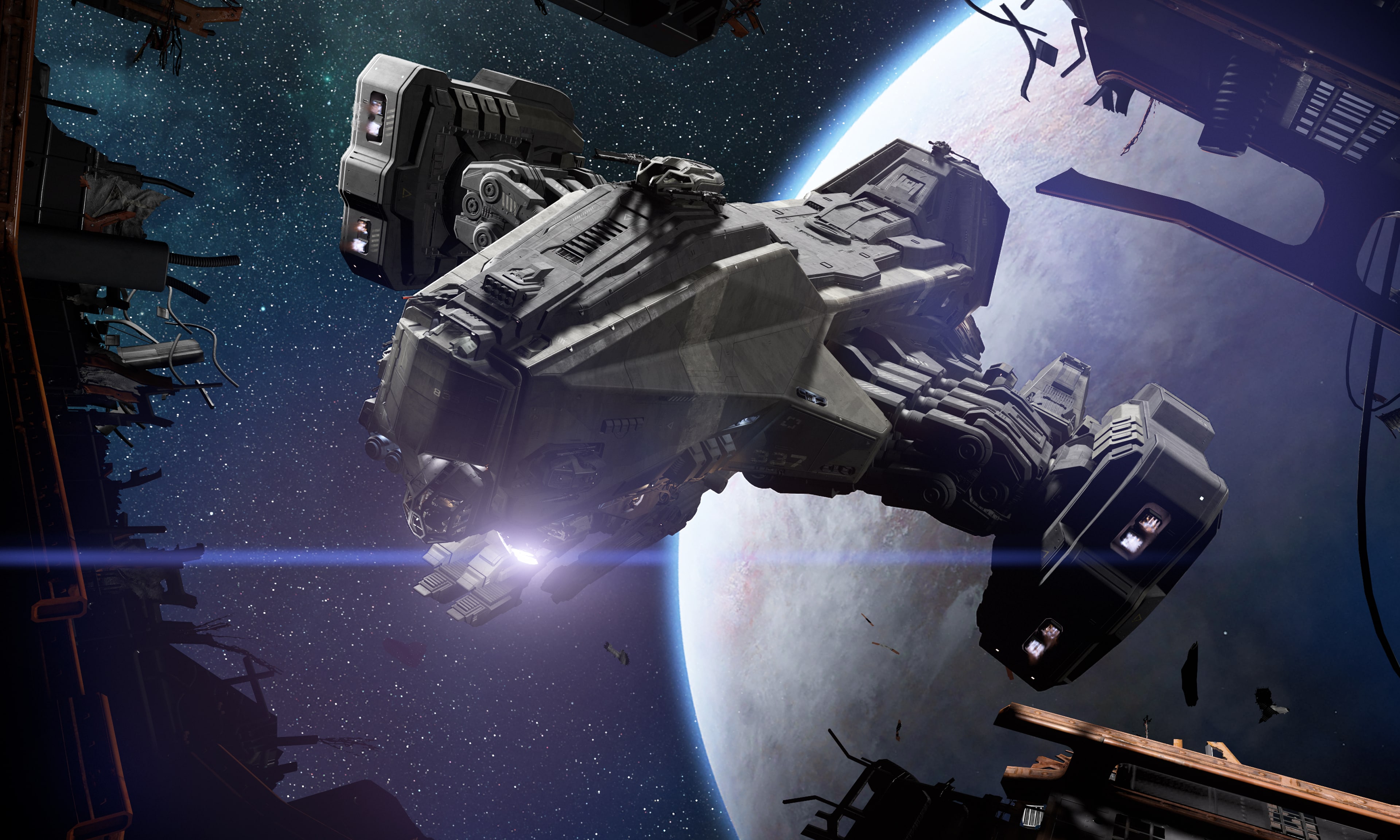
Reports of this new Daymar operation went well beyond anything the Admiral had seen during her command. With a fleet of ships working together, they were stripping an incredible amount of ore in a very short period of time. Understanding that inaction would only encourage further incursions of such scale, Admiral Marlin sent a fleet of fighters and the UEES Flyssa, a Javelin-class destroyer, to Daymar to escort the offending ships to an impound lot and levy severe fines to dissuade similar operations. Admiral Marlin authorized the use of non-lethal force if they proved uncooperative and insisted that all ships involved in the operation be brought to justice. She was determined to drive home the point in emphatic fashion and give her crew some valuable in-field experience. She believed the proactive response would be a good test for her starmen and read well on her report to Naval High-Command. She never could have expected the terrible fate to come.
UEES Flyssa positioned itself above Daymar as the other navy ships entered atmosphere to find and escort the offending ships off-world. Admiral Marlin’s insistence that all involved be detained meant the navy sent no comms alerting the miners to their presence and intentions. The navy’s ships located the active mining site and approached it fast and hard, inspired by Admiral Marlin’s directive to announce their presence in a way that would “rattle their screws loose and shock them into immediate submission.” Instead, their sudden appearance scared the miners, who immediately ceased operations and fled in different directions. While most of the ships were quickly subdued via non-lethal ordnance, one managed to slip away and began to exit the atmosphere. UEES Flyssa tracked the fleeing ship and moved into position to neutralize it once free from Daymar’s gravity. Tragedy struck the moment it did. The mining ship, long overdue for much needed repairs, suffered a series of catastrophic component failures moments after it exited atmosphere. This triggered a chain reaction of explosions only intensified by a cargo hold filled to capacity with highly unstable ore. The concussive wave unleashed by the massive explosion hit the UEES Flyssa as it approached. Unable to adjust course or quickly reinforce its shield, ship debris and ore fragments peppered the UEES Flyssa, piercing the hull in dozens of places. Captain Chin Ormiston, believing the Javelin to be under attack, ordered a quick retreat only to realize too late that two of the ship’s thrusters had been damaged. The sudden directional change caused them to overload, followed rapidly by a series of system failures. Fires spread throughout the ship as the UEES Flyssa began to uncontrollably careen to the moon’s surface.
Already shedding parts due to the cascading onboard explosions, UEES Flyssa crashed upon a high ridge and came to rest with its bow dangling over a precarious ledge. All 65 crewmembers aboard died, making it one of the worst naval crashes of the 29th century. The subsequent naval investigation acknowledged the unlikelihood of the entire series of events, grading the chance of such a crash to happen again as infinitesimal, but still placed the blame squarely on Admiral Marlin. They deemed her order to send ships after the miners without first broadcasting their intentions to be the fatal decision. They highlighted comms where Admiral Marlin expressed frustration over her command and desire to distinguish herself as a motive for her ordering “overly intimidating and aggressive tactics not commensurate with the situation.” With this report, a once promising career was destroyed.
Admiral Marlin was finally transferred out of Stanton, but not to the Vanduul front. She would be pushed into administrative duty in Kilian until she was granted a general discharge in 2868. Her dream of commanding a frontline fleet would never come true. Today, few remember Admiral Marlin, or her role in the crash of UEES Flyssa, but the ship’s skeleton remains a landmark on Daymar. The navy decommissioned the ship of its ordnance and military computers with the intent to remove the wreck on a future date, but with the privatization of the moon, the plans never fully materialized. The site receives few visitors despite its historical significance and impressive views, as rumors abound that outlaws often inhabit it. A tragic fate for the ship, its crew, and the ambitious admiral who only wanted to prove herself.
Dieses Portfolio erschien ursprünglich in Jump Point 8.12.
In einem Comms-Anruf Anfang März 2862 gestand Admiral Pavlina Marlin einem Freund, dass sie von ihrem Posten frustriert war. Ihr wurde die Aufsicht über die Marinewerften zugewiesen, die sich zwischen den Wolken von Stanton II befanden (es würde erst 2865 als Crusader bekannt werden), und sie sah es nicht als die Pflaumenposition an, für die andere sie hielten. Das Kommando war eines, das andere begehrten, mit einigen der außergewöhnlichsten Aussichten in der UEE, aber es fühlte sich zu ruhig und gelassen an für den ehrgeizigen Admiral, der sicher war, dass trotz des Prestiges der Position, ihre Fähigkeiten verschwendet wurden.
Marlin machte während ihrer gesamten Karriere deutlich, dass ihr ultimatives Ziel darin bestand, die Verteidigung der Vanduul-Front anzuführen. Deshalb ist sie der Marine beigetreten. Ihre Großeltern waren vor der Eroberung Virgils durch die Vanduul im Jahr 2737 geflohen und erzählten ihr erschütternde Geschichten von ihrer Flucht und dem tragischen Untergang der weniger Glücklichen. In ihrem Büro bewahrte sie ein gerahmtes Foto des ehemaligen Familienhauses auf Virgil auf und erzählte jedem, der danach fragte, dass es "schon lange verbrannt, bombardiert und durch einen Vanduul Harvester gejagt wurde, um ihren Krieg gegen uns anzuheizen." Trotz Admiral Marlins kristallklarem Ehrgeiz fand sie sich immer wieder als Kommandeurin von Flotten wieder, die der Nachhut oder administrativen Aufgaben zugewiesen waren. Sie beklagte ständig ihren Mangel an Kampferfahrung und glaubte, dass dieses Manko sie wirklich von der Front fernhielt. Dieser Trend setzte sich im Jahr 2858 fort, als sie dem verschlafenen und sicheren Stanton zugewiesen wurde. Während High-Commander Irya Ruybal Admiral Marlins Ehrgeiz bewunderte, hoffte er, dass ein paar weitere Jahre weg von der Front sie zu einer geduldigeren und vorsichtigeren Kommandantin reifen lassen würden.
Admiral Marlin wusste, dass der Auftrag ein Test war und wollte ihr Potenzial unter Beweis stellen. Sie verbesserte den Produktionsausstoß der Werft und überzeugte das knauserige Haushaltskomitee, das Netzwerk der Plattformen zu erweitern, um die Produktionsmöglichkeiten zu erhöhen. Um die administrative Monotonie zu durchbrechen und ihre Erfahrung als Kampfkommandantin zu verbessern, organisierte sie häufig Wargames, um die Bereitschaft ihrer Flotte für alles Mögliche zu testen, von Geächteten, die eine Raumstation blockieren, bis hin zu einem Vanduul-Klan, der über einen unentdeckten Sprungpunkt im System auftaucht. Doch nach vier Jahren auf dem Posten sah sie sich ihrem eigentlichen Ziel nicht näher und fragte sich insgeheim, ob sie zu gute Arbeit geleistet hatte, als dass das Marinekommando sie hätte gehen lassen.
Inmitten dieser wachsenden Frustration erhielt Admiral Marlin im Jahr 2862 einen Bericht, dass auf Daymar ein illegaler Bergbaubetrieb entstanden war. Die UEE hatte die meisten kommerziellen und industriellen Entwicklungen in Stanton seit seiner Entdeckung ein Jahrzehnt zuvor eingeschränkt, eine Haltung, die zu dieser Zeit viele verwirrte und verärgerte. Die Argumentation dahinter machte erst Sinn, als die UEE im Jahr 2865 jeden Planeten an den Meistbietenden verkaufte. Dennoch besuchten in den vierzehn Jahren zwischen Stantons Entdeckung und dem Verkauf oft unabhängige Bergleute das System, um ein wenig Erz abzubauen, und die Marine ignorierte sie meist. Die Menschen litten immer noch unter dem wirtschaftlichen Abschwung der späten 2850er Jahre und viele kämpften immer noch um ihren Lebensunterhalt. Die Marine hatte wenig Interesse daran, hart arbeitende Zivilisten zu schikanieren, solange ihre Minenfahrten im Rahmen blieben.
Berichte über diese neue Daymar-Operation gingen weit über alles hinaus, was der Admiral während ihres Kommandos gesehen hatte. Mit einer Flotte von Schiffen, die zusammenarbeiteten, bauten sie eine unglaubliche Menge an Erz in einer sehr kurzen Zeit ab. Admiral Marlin erkannte, dass Untätigkeit nur zu weiteren Übergriffen dieses Ausmaßes ermutigen würde, und schickte eine Flotte von Jägern und die UEES Flyssa, einen Zerstörer der Javelin-Klasse, nach Daymar, um die angreifenden Schiffe zu einem Beschlagnahmungsplatz zu eskortieren und hohe Geldstrafen zu verhängen, um ähnliche Operationen zu unterbinden. Admiral Marlin autorisierte den Einsatz nicht-tödlicher Gewalt, falls sie sich als unkooperativ erwiesen und bestand darauf, dass alle an der Operation beteiligten Schiffe vor Gericht gestellt werden. Sie war entschlossen, die Sache mit Nachdruck voranzutreiben und ihrer Crew wertvolle Erfahrungen im Einsatz zu vermitteln. Sie glaubte, dass die proaktive Reaktion ein guter Test für ihre Sternenmänner sein würde und sich gut in ihrem Bericht an das Oberkommando der Marine lesen würde. Sie hätte niemals mit dem schrecklichen Schicksal gerechnet, das sie ereilen würde.
Die UEES Flyssa positionierte sich über Daymar, während die anderen Marineschiffe in die Atmosphäre eintraten, um die angreifenden Schiffe zu finden und von der Welt zu eskortieren. Admiral Marlins Beharren darauf, dass alle Beteiligten festgehalten werden sollten, bedeutete, dass die Marine keine Kommandos sendete, um die Bergleute über ihre Anwesenheit und ihre Absichten zu informieren. Die Schiffe der Marine lokalisierten die aktive Bergbaustelle und näherten sich ihr schnell und hart, inspiriert von Admiral Marlins Direktive, ihre Anwesenheit auf eine Art und Weise anzukündigen, die "ihre Schrauben locker machen und sie zur sofortigen Unterwerfung schocken würde." Stattdessen erschreckte ihr plötzliches Auftauchen die Bergleute, die sofort den Betrieb einstellten und in verschiedene Richtungen flohen. Während die meisten der Schiffe schnell mit nicht-tödlichen Geschützen überwältigt werden konnten, gelang es einem, zu entkommen und begann, die Atmosphäre zu verlassen. Die UEES Flyssa verfolgte das fliehende Schiff und ging in Position, um es zu neutralisieren, sobald es die Schwerkraft von Daymar verlassen hatte. Die Tragödie schlug in dem Moment zu. Das Bergbauschiff, bei dem dringend benötigte Reparaturen längst überfällig waren, erlitt eine Reihe von katastrophalen Komponentenausfällen, kurz nachdem es die Atmosphäre verlassen hatte. Dies löste eine Kettenreaktion von Explosionen aus, die durch den mit hochinstabilen Erzen gefüllten Frachtraum noch verstärkt wurde. Die Erschütterungswelle, die durch die massive Explosion ausgelöst wurde, traf die UEES Flyssa, als sie sich näherte. Die UEES Flyssa war nicht in der Lage, ihren Kurs zu korrigieren oder ihren Schild schnell zu verstärken, so dass Schiffstrümmer und Erzfragmente die Hülle an Dutzenden von Stellen durchschlugen. Captain Chin Ormiston, der glaubte, dass die Javelin angegriffen wurde, ordnete einen schnellen Rückzug an, nur um zu spät zu erkennen, dass zwei der Triebwerke des Schiffes beschädigt worden waren. Durch die plötzliche Richtungsänderung wurden sie überlastet, woraufhin schnell eine Reihe von Systemausfällen folgte. Brände breiteten sich im ganzen Schiff aus, als die UEES Flyssa begann, unkontrolliert auf die Oberfläche des Mondes zuzusteuern.
Die UEES Flyssa, die durch die kaskadenartigen Explosionen an Bord bereits Teile verloren hatte, stürzte auf einen hohen Bergrücken und kam mit dem Bug über einer prekären Kante baumelnd zum Stillstand. Alle 65 Besatzungsmitglieder an Bord starben, was den Absturz zu einem der schlimmsten Marineabstürze des 29. Jahrhunderts machte. Die anschließende Untersuchung der Marine erkannte die Unwahrscheinlichkeit der gesamten Serie von Ereignissen an und stufte die Chance, dass sich ein solcher Absturz wiederholen könnte, als verschwindend gering ein, gab aber dennoch Admiral Marlin die Schuld. Sie erachteten ihren Befehl, Schiffe hinter den Bergleuten herzuschicken, ohne vorher ihre Absichten zu verkünden, als die fatale Entscheidung. Sie hoben die Kommunikation hervor, in der Admiral Marlin ihre Frustration über ihr Kommando und ihren Wunsch, sich selbst zu profilieren, als Motiv für ihre Anordnung einer "übermäßig einschüchternden und aggressiven Taktik, die der Situation nicht angemessen war, zum Ausdruck brachte." Mit diesem Bericht wurde eine einst vielversprechende Karriere zerstört.
Admiral Marlin wurde schließlich aus Stanton versetzt, aber nicht an die Vanduul-Front. Sie würde in den administrativen Dienst in Kilian gedrängt werden, bis sie im Jahr 2868 ihre allgemeine Entlassung erhielt. Ihr Traum, eine Frontflotte zu kommandieren, sollte sich nie erfüllen. Heute erinnern sich nur wenige an Admiral Marlin oder ihre Rolle beim Absturz der UEES Flyssa, aber das Skelett des Schiffes bleibt ein Wahrzeichen auf Daymar. Die Marine hat das Schiff von seinen Geschützen und Militärcomputern außer Dienst gestellt, mit der Absicht, das Wrack zu einem späteren Zeitpunkt zu entfernen, aber mit der Privatisierung des Mondes wurden die Pläne nie ganz verwirklicht. Die Stätte wird trotz ihrer historischen Bedeutung und der beeindruckenden Aussicht nur selten besucht, da Gerüchte kursieren, dass sich dort oft Gesetzlose aufhalten. Ein tragisches Schicksal für das Schiff, seine Besatzung und den ehrgeizigen Admiral, der sich nur beweisen wollte.
This portfolio originally appeared in Jump Point 8.12.
In a comms call made early in March of 2862, Admiral Pavlina Marlin confessed to a friend that she felt frustrated with her posting. Assigned to oversee the naval shipyards positioned among the clouds of Stanton II (it wouldn’t become known as Crusader until 2865), she didn’t see it as the plum position others claimed it to be. The command was one others coveted, sporting some of the most extraordinary views in the UEE, but it felt too quiet and calm for the ambitious admiral who was certain that, despite the prestige of the position, her skills were being wasted.
Marlin made it clear through her entire career that her ultimate goal lay in leading the defense of the Vanduul front. It’s why she joined the navy. Her grandparents had fled the Vanduul conquest of Virgil in 2737 and told her harrowing stories of their escape and tragic demise of those less fortunate. In her office, she kept a framed photo of the former family home on Virgil, telling any who asked that it was “long since burned, bombed, and churned through a Vanduul Harvester to fuel their war against us.” Despite Admiral Marlin’s crystal-clear ambition, she always found herself commanding fleets assigned to rearguard or administrative duties. She constantly lamented her lack of combat command experience and believed this shortcoming truly kept her from the frontline. This trend continued in 2858 when she was reassigned to sleepy and safe Stanton. While High-Commander Irya Ruybal admired Admiral Marlin’s ambition, he hoped a few more years away from the frontlines would season her into a more patient and cautious commander.
Admiral Marlin knew the assignment was a test and sought to prove her potential. She improved the shipyard’s production output and convinced the tight-fisted budgetary committee to expand the network of platforms to increase manufacturing capabilities. To break the administrative monotony and hone her combat command experience, she frequently organized wargames to test her fleet’s readiness for anything, from outlaws blockading a space station to a Vanduul clan appearing insystem via an undiscovered jump point. Yet, after four years at the post, she saw herself no closer to her ultimate goal and wondered privately if she had done too good of a job for Naval Command to let her leave.
Amid this growing frustration in 2862, Admiral Marlin received a report that an illegal mining operation had sprung up on Daymar. The UEE had restricted most commercial and industrial development in Stanton since its discovery a decade earlier, a stance that confused and angered many at the time. The reasoning behind it only made sense when, in 2865, the UEE sold each planet to the highest bidder. Still, in the fourteen years between Stanton’s discovery and sale, independent miners often visited the system to extract a little ore and the navy mostly ignored them. People were still reeling from the economic downturn of the late 2850s and many still struggled to eke out a living. The navy had little interest in harassing hardworking civilians, as long as their mining runs were within reason.
Reports of this new Daymar operation went well beyond anything the Admiral had seen during her command. With a fleet of ships working together, they were stripping an incredible amount of ore in a very short period of time. Understanding that inaction would only encourage further incursions of such scale, Admiral Marlin sent a fleet of fighters and the UEES Flyssa, a Javelin-class destroyer, to Daymar to escort the offending ships to an impound lot and levy severe fines to dissuade similar operations. Admiral Marlin authorized the use of non-lethal force if they proved uncooperative and insisted that all ships involved in the operation be brought to justice. She was determined to drive home the point in emphatic fashion and give her crew some valuable in-field experience. She believed the proactive response would be a good test for her starmen and read well on her report to Naval High-Command. She never could have expected the terrible fate to come.
UEES Flyssa positioned itself above Daymar as the other navy ships entered atmosphere to find and escort the offending ships off-world. Admiral Marlin’s insistence that all involved be detained meant the navy sent no comms alerting the miners to their presence and intentions. The navy’s ships located the active mining site and approached it fast and hard, inspired by Admiral Marlin’s directive to announce their presence in a way that would “rattle their screws loose and shock them into immediate submission.” Instead, their sudden appearance scared the miners, who immediately ceased operations and fled in different directions. While most of the ships were quickly subdued via non-lethal ordnance, one managed to slip away and began to exit the atmosphere. UEES Flyssa tracked the fleeing ship and moved into position to neutralize it once free from Daymar’s gravity. Tragedy struck the moment it did. The mining ship, long overdue for much needed repairs, suffered a series of catastrophic component failures moments after it exited atmosphere. This triggered a chain reaction of explosions only intensified by a cargo hold filled to capacity with highly unstable ore. The concussive wave unleashed by the massive explosion hit the UEES Flyssa as it approached. Unable to adjust course or quickly reinforce its shield, ship debris and ore fragments peppered the UEES Flyssa, piercing the hull in dozens of places. Captain Chin Ormiston, believing the Javelin to be under attack, ordered a quick retreat only to realize too late that two of the ship’s thrusters had been damaged. The sudden directional change caused them to overload, followed rapidly by a series of system failures. Fires spread throughout the ship as the UEES Flyssa began to uncontrollably careen to the moon’s surface.
Already shedding parts due to the cascading onboard explosions, UEES Flyssa crashed upon a high ridge and came to rest with its bow dangling over a precarious ledge. All 65 crewmembers aboard died, making it one of the worst naval crashes of the 29th century. The subsequent naval investigation acknowledged the unlikelihood of the entire series of events, grading the chance of such a crash to happen again as infinitesimal, but still placed the blame squarely on Admiral Marlin. They deemed her order to send ships after the miners without first broadcasting their intentions to be the fatal decision. They highlighted comms where Admiral Marlin expressed frustration over her command and desire to distinguish herself as a motive for her ordering “overly intimidating and aggressive tactics not commensurate with the situation.” With this report, a once promising career was destroyed.
Admiral Marlin was finally transferred out of Stanton, but not to the Vanduul front. She would be pushed into administrative duty in Kilian until she was granted a general discharge in 2868. Her dream of commanding a frontline fleet would never come true. Today, few remember Admiral Marlin, or her role in the crash of UEES Flyssa, but the ship’s skeleton remains a landmark on Daymar. The navy decommissioned the ship of its ordnance and military computers with the intent to remove the wreck on a future date, but with the privatization of the moon, the plans never fully materialized. The site receives few visitors despite its historical significance and impressive views, as rumors abound that outlaws often inhabit it. A tragic fate for the ship, its crew, and the ambitious admiral who only wanted to prove herself.
This portfolio originally appeared in Jump Point 8.12.
In a comms call made early in March of 2862, Admiral Pavlina Marlin confessed to a friend that she felt frustrated with her posting. Assigned to oversee the naval shipyards positioned among the clouds of Stanton II (it wouldn’t become known as Crusader until 2865), she didn’t see it as the plum position others claimed it to be. The command was one others coveted, sporting some of the most extraordinary views in the UEE, but it felt too quiet and calm for the ambitious admiral who was certain that, despite the prestige of the position, her skills were being wasted.
Marlin made it clear through her entire career that her ultimate goal lay in leading the defense of the Vanduul front. It’s why she joined the navy. Her grandparents had fled the Vanduul conquest of Virgil in 2737 and told her harrowing stories of their escape and tragic demise of those less fortunate. In her office, she kept a framed photo of the former family home on Virgil, telling any who asked that it was “long since burned, bombed, and churned through a Vanduul Harvester to fuel their war against us.” Despite Admiral Marlin’s crystal-clear ambition, she always found herself commanding fleets assigned to rearguard or administrative duties. She constantly lamented her lack of combat command experience and believed this shortcoming truly kept her from the frontline. This trend continued in 2858 when she was reassigned to sleepy and safe Stanton. While High-Commander Irya Ruybal admired Admiral Marlin’s ambition, he hoped a few more years away from the frontlines would season her into a more patient and cautious commander.
Admiral Marlin knew the assignment was a test and sought to prove her potential. She improved the shipyard’s production output and convinced the tight-fisted budgetary committee to expand the network of platforms to increase manufacturing capabilities. To break the administrative monotony and hone her combat command experience, she frequently organized wargames to test her fleet’s readiness for anything, from outlaws blockading a space station to a Vanduul clan appearing insystem via an undiscovered jump point. Yet, after four years at the post, she saw herself no closer to her ultimate goal and wondered privately if she had done too good of a job for Naval Command to let her leave.
Amid this growing frustration in 2862, Admiral Marlin received a report that an illegal mining operation had sprung up on Daymar. The UEE had restricted most commercial and industrial development in Stanton since its discovery a decade earlier, a stance that confused and angered many at the time. The reasoning behind it only made sense when, in 2865, the UEE sold each planet to the highest bidder. Still, in the fourteen years between Stanton’s discovery and sale, independent miners often visited the system to extract a little ore and the navy mostly ignored them. People were still reeling from the economic downturn of the late 2850s and many still struggled to eke out a living. The navy had little interest in harassing hardworking civilians, as long as their mining runs were within reason.
Reports of this new Daymar operation went well beyond anything the Admiral had seen during her command. With a fleet of ships working together, they were stripping an incredible amount of ore in a very short period of time. Understanding that inaction would only encourage further incursions of such scale, Admiral Marlin sent a fleet of fighters and the UEES Flyssa, a Javelin-class destroyer, to Daymar to escort the offending ships to an impound lot and levy severe fines to dissuade similar operations. Admiral Marlin authorized the use of non-lethal force if they proved uncooperative and insisted that all ships involved in the operation be brought to justice. She was determined to drive home the point in emphatic fashion and give her crew some valuable in-field experience. She believed the proactive response would be a good test for her starmen and read well on her report to Naval High-Command. She never could have expected the terrible fate to come.
UEES Flyssa positioned itself above Daymar as the other navy ships entered atmosphere to find and escort the offending ships off-world. Admiral Marlin’s insistence that all involved be detained meant the navy sent no comms alerting the miners to their presence and intentions. The navy’s ships located the active mining site and approached it fast and hard, inspired by Admiral Marlin’s directive to announce their presence in a way that would “rattle their screws loose and shock them into immediate submission.” Instead, their sudden appearance scared the miners, who immediately ceased operations and fled in different directions. While most of the ships were quickly subdued via non-lethal ordnance, one managed to slip away and began to exit the atmosphere. UEES Flyssa tracked the fleeing ship and moved into position to neutralize it once free from Daymar’s gravity. Tragedy struck the moment it did. The mining ship, long overdue for much needed repairs, suffered a series of catastrophic component failures moments after it exited atmosphere. This triggered a chain reaction of explosions only intensified by a cargo hold filled to capacity with highly unstable ore. The concussive wave unleashed by the massive explosion hit the UEES Flyssa as it approached. Unable to adjust course or quickly reinforce its shield, ship debris and ore fragments peppered the UEES Flyssa, piercing the hull in dozens of places. Captain Chin Ormiston, believing the Javelin to be under attack, ordered a quick retreat only to realize too late that two of the ship’s thrusters had been damaged. The sudden directional change caused them to overload, followed rapidly by a series of system failures. Fires spread throughout the ship as the UEES Flyssa began to uncontrollably careen to the moon’s surface.
Already shedding parts due to the cascading onboard explosions, UEES Flyssa crashed upon a high ridge and came to rest with its bow dangling over a precarious ledge. All 65 crewmembers aboard died, making it one of the worst naval crashes of the 29th century. The subsequent naval investigation acknowledged the unlikelihood of the entire series of events, grading the chance of such a crash to happen again as infinitesimal, but still placed the blame squarely on Admiral Marlin. They deemed her order to send ships after the miners without first broadcasting their intentions to be the fatal decision. They highlighted comms where Admiral Marlin expressed frustration over her command and desire to distinguish herself as a motive for her ordering “overly intimidating and aggressive tactics not commensurate with the situation.” With this report, a once promising career was destroyed.
Admiral Marlin was finally transferred out of Stanton, but not to the Vanduul front. She would be pushed into administrative duty in Kilian until she was granted a general discharge in 2868. Her dream of commanding a frontline fleet would never come true. Today, few remember Admiral Marlin, or her role in the crash of UEES Flyssa, but the ship’s skeleton remains a landmark on Daymar. The navy decommissioned the ship of its ordnance and military computers with the intent to remove the wreck on a future date, but with the privatization of the moon, the plans never fully materialized. The site receives few visitors despite its historical significance and impressive views, as rumors abound that outlaws often inhabit it. A tragic fate for the ship, its crew, and the ambitious admiral who only wanted to prove herself.
Links
No links available.


Metadata
- CIG ID
- 18203
- Channel
- Spectrum Dispatch
- Category
- Undefined
- Series
- News Update
- Comments
- 34
- Published
- 5 years ago (2021-06-23T00:00:00+00:00)