Squadron 42 Monthly Report: June 2021
Transmission Undefined Monthly ReportsContent
This is a cross-post of the report that was recently sent out via the monthly Squadron 42 newsletter. We’re publishing this a second time as a Comm-Link to make it easier for the community to reference back to. Attention Recruits,
What you are about to read is the latest information on the continuing development of Squadron 42 (SCI des: SQ42).
Thanks to the work of dedicated field agents and operatives, we’ve uncovered information on Aciedo station, Screaming Galsons, and the Greycat tractor beam and salvage tools.
The information contained in this communication is extremely sensitive and it is of paramount importance that it does not fall into the wrong hands. Purge all records after reading.
UEE Naval High Command
AI (Content)
For Squadron 42, the AI designers further developed Aciedo station, supporting the creation of several usables required for the mission’s story. This gave them the opportunity to set up ‘stocked AI’ that interact with usables for the first time. For example, attack spot, search spot, rail lean, door opening iterations, console hacking, stare spot, and more. The next step is to work alongside the Design Team to implement them into the level, finish the cryopod interactions, and make use of the First Reactions system to allow transitions from systemic behaviors to the combat activity.
Animation
Throughout June, the Animation Team progressed with player idles to ensure that, when the player character is standing still, they don’t look like an inanimate mannequin. Development of zero-g movement continued along with the medical pen, wake up, medical beds, player jumping, and the drunk locomotion set. AI-wise, the team began closing out character wildlines and improved seating poses in the mess hall to make it look like a real cafeteria. The male ‘hurt’ locomotion set was completed, with the team moving onto the female set. They’re currently editing juking assets for combat, assets for perception reactions from useables, and Vanduul combat locomotion.
A motion-capture (mo-cap) shoot was conducted to gather content needed for the work mentioned above. The team is currently working through the results before handing them to the animators. The Facial Team continued with the character improvements mentioned in previous reports.
Art (Characters)
The Character Art Team wrapped up the final rules of the modularity system for the Screaming Galsons, creating initial loadouts to test the system and provide placeholder characters for the designers when they begin working on related gameplay. Though the team is moving onto higher priority tasks in Q3, they’ll return to the Screaming Galsons later to flesh out the assets and create the required bespoke characters. Trejo’s outfit and helmet are in the final stages of modeling and will be ready for the tech artists to skin soon. Once complete, they’ll will focus on chapter 1, which includes major characters like Bishop, Wade, MacLaren, and Mason.
Art (Environment)
Environment Art continued to work towards their quarterly milestone, and planetary work made significant strides, with the team preparing to focus on secondary points-of-interest to allow Level Design to progress with their primary objective. The interior of the Bengal is approaching completion. The team closed out several small iterations in support of the Cinematics and Gameplay Story team’s scene work and made the main Hangar feel more alive, lived in, and like there’s a process to launching ships.
Archon received further interior and exterior work, while chapters 15 and 19 made great progress.
Art (Weapons)
Development of the standalone Greycat tractor beam and salvage tools continued, with the Art Team beginning the animation pass and finished iterating on the rigs.
Audio
Alongside composer Geoff Zanelli, the Audio Team produced music for chapter four of the campaign and recorded additional dialogue as required.
Cinematics
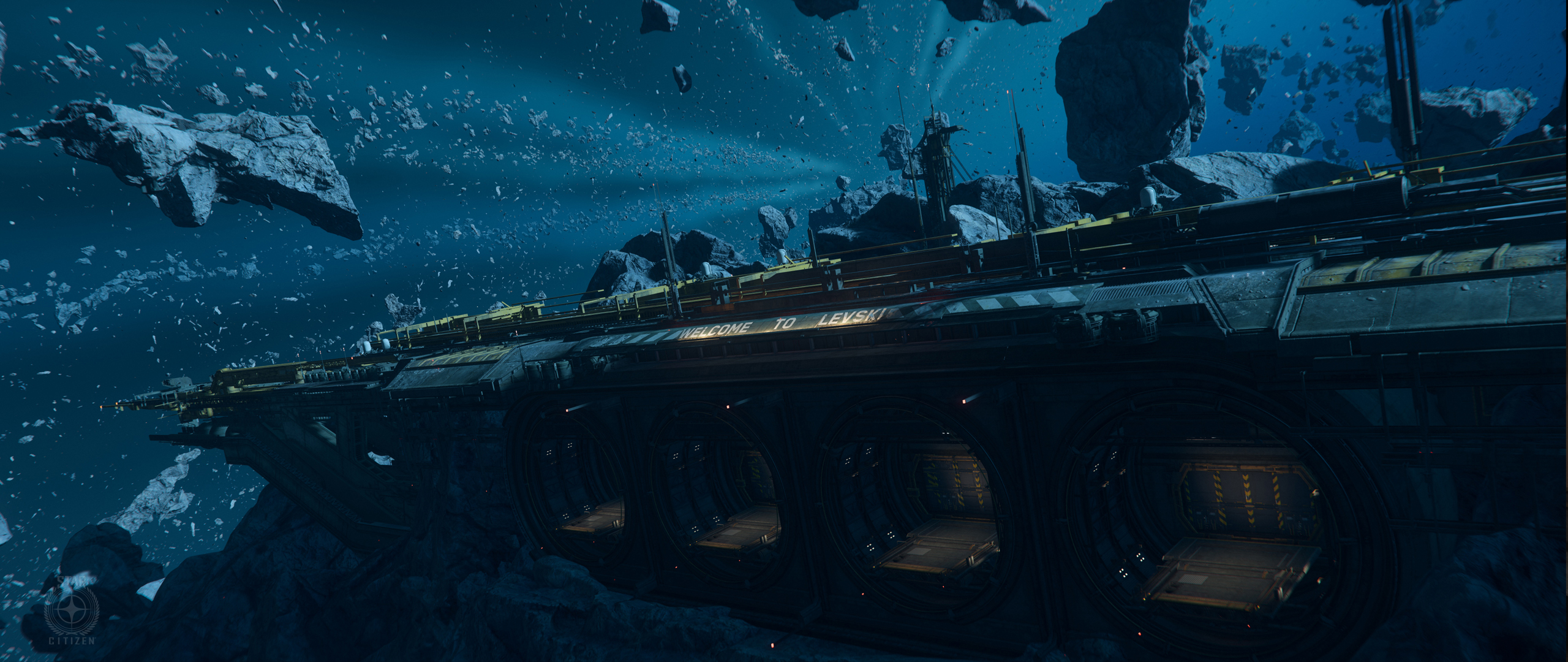
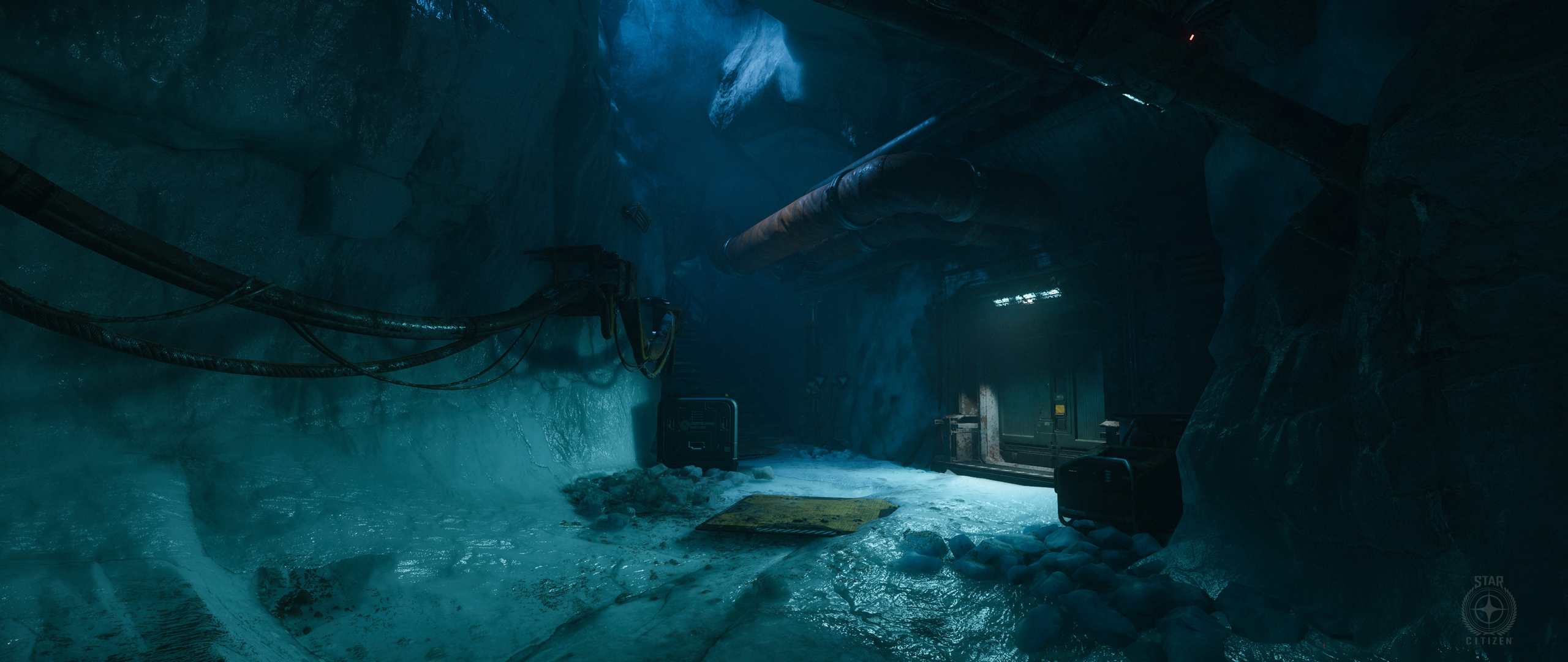
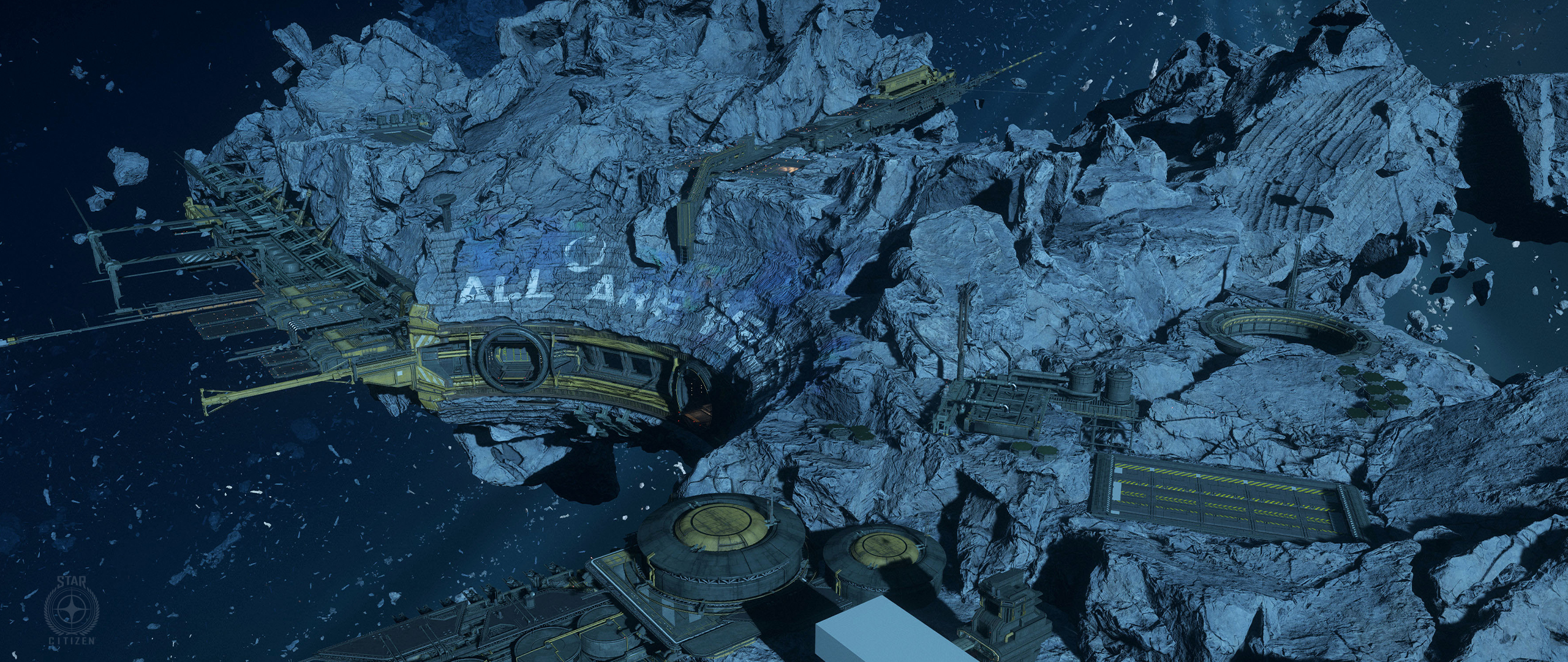
In June, the SQ42 Feature Team’s engineers worked on adding ‘frames of reference’ to cinematic sequences that run relative to a scene. For example, a scene in a tram would have the tram specified as the frame of reference and work automatically at all points across the scene. Before this, scenes required parent/child linking, so the team is excited to add this new functionality to some of the game’s more complex moments. Another major focus was on a cutaway that introduces players to a remote mining outpost. As art is still in progress, the team built a previs blockout to inform how the scene will play out and how it should look and feel. This encounter features the player and Old Man flying their Gladiuses towards an outpost located on a remote asteroid in the Odin system.
A lot of animation polish was also completed last month as scenes progressed from implementation to the production pass. One key scene received an arms, hands, and fingers contact pass to adds significant impact to the characters’ interaction.
Engine
In June, the Physics Team moved the generation of surfel data used for radar cross-section queries to an offline precomputation step in the resource compiler which, in general, optimizes various types of assets (textures, meshes, sounds, metadata, etc.) for final consumption in-game. A great deal of time was also spent on various optimizations. All tiers of physics geometry instancing were completed. As a result, the cloning and sharing of brush physics was enabled, leading to physics now using only 50% of the memory it previously had on the client and server. This was made possible by sharing all common geometry-related data (such as geometry transforms, sub-mtls, and surface types) across all clones of the same static instance. For example, a set of static objects using the same geometry. With the pending release of Orison in the PU, the tracking of terrain is skipped for gas giants. AVX instructions are now utilized to block set entries in spatial grids and ray-box intersections in spatial grids have been optimized.
Networking-related data was moved between internal structures for more efficient access and synchronization, while the structure size of physical entities and alignment was optimized to ensure hot members are always on the same cache line. Page sizes for event factories were tuned, resulting in a net gain of 100 MB in system memory. Additionally, the physics queue for the biome builder was reduced, several areas of thread contention were reduced, and a race condition in the optimized priority queue was fixed. Lastly, the precision of quantized bounding volume hierarchy trees was improved.
For the renderer, the team continued working on the transition to Gen12. A Gen12-exclusive mode for forward-rendered deferred pipelines was added, numerous rendering issues were fixed, and editor support was improved. Support for instance constant buffers with reflection data was added and vertex input caching was extended. In terms of visual features, support for detail cavity and gloss blending was added too.
With regards to volumetric clouds, the rendering of secondary views (runtime cubemaps, RTTs, etc.) including clouds was addressed. For empty space skipping, which is still in the very early experimental stages, computation of the narrow band SDF for cloud coverage has been revised along with the generation of associated MIP maps in a signed format. An initial set of quality options was exposed to the game menu (combined as a single quality option). These quality settings will see further refinement and extensions as the system matures in releases post Alpha 3.14. A driver issue on the 10xx GTX line of video cards affecting the computation of scattering queries was investigated and a workaround implemented. The team are still in the process of clarifying whether this issue is a driver bug and, if that’s the case, hope that it can be fixed properly.
The Core Engine Team finalized the switch to Clang 11, which is used to compile the game server. Clang-related code vectorization and math optimizations were enabled and a code generation bug was identified, worked around, and reported. The memory tracker was improved to detect deallocation of memory that’s not allocated (double free, without the use of page heap). Also, it can now filter allocation stacks by specified engine modules and the engine’s memory statistics update has been optimized. Preliminary support for a new profiler frontend was added alongside various improvements and optimizations on relevant engine components to utilize the profiler to its full capabilities. The component update scheduler received support for multiple passes and event handlers were separated from component updates. Vis areas now use more fine-grained locking for updates to reduce contention and the queuing of animation vis area updates is now lockless, as is event queuing.
Features (Gameplay)
Aside from the usual bug fixing and quality-of-life support, Gameplay Features added additional UI functionality to the firing range to give more detailed feedback to the player. They also wrote an editor tool to help identify rogue entities that have, for various reasons, ended up in invalid positions, costing performance and memory. A new task mode was added to allow the designers to script target selection for the player, meaning NPCs can share their targets with the player. The team began designing a new system for development skip points, which allows a developer to start the game at any point through any mission. This will behave in a similar manner to the save game checkpoints, simplifying the whole setup and flow.
Gameplay Story
Gameplay Story made great progress on chapter 5 last month, taking responsibility for another scene with characters getting in and out of a lift. “This proved to be quite complicated but we were able to work with Design to break down what was required and deliver placeholder animations so they could set the scene up. We are now eagerly awaiting the delivery of some new mo-cap that will allow us to bring this scene up to a really high standard.” -The Gameplay Story Team
The team also tested and documented new tech that should get trams and elevators working correctly in-game, which will allow them to play chapter 5 from start to finish.
They also updated various scenes in the mess hall and supporting Design with their work on chapters 12, 13, and 14. Planning for Q3 began and a two-day mo-cap session was booked for the first week of July. This will allow the team to record everything they need for the additional chapter 1 scenes and to add additional lines to many of the random-to-NPC conversations mentioned in previous reports.
Graphics & VFX Programming
June saw the Graphics Team complete work on the window and PingCIG shaders. The window shader allows them to simulate the windows of static rooms without actually modeling the interior, enabling large buildings filled with ‘fake’ interiors for minimal cost. This approach has been used in several other games and, while the visuals are naturally constrained compared to bespoke rooms (which would be impractical for performance), the results are vastly better than black or empty spaces. The PingCIG shader is a new version of the ping effect that will be used for the upcoming improvements to the radar and scanning feature; it creates waves that trigger various visual effects when they intersect solid geometry, such as an edge highlight. For Orison, improvements were made to the performance of real-time environment probes and bugs were squashed ahead of release. Improvements to the LOD Merger to support tint-palettes and wear were also completed to allow huge draw-call savings for distant renderings of the city.
The team also made improvements to the UI compositing and post-effect pipeline to achieve the specific look the team want, such as drop shadows, glow, brightness adaptation, and color correction while minimizing performance impact.
The VFX Programming Team added support for querying cloud density from planets and used this to trigger a variety of effects. Several particle-streaming issues were addressed and the final bugs with the new lighting system were resolved. The fire feature progressed well too.
Both the Graphics and VFX Programming teams also made great progress on the Gen12 renderer and Vulkan backends, with the vast majority of post effects now running Gen12 by default. This doesn’t result in major CPU performance savings as the post effects were already cheap on the CPU side, though major benefits will be seen in scene rendering.
Level Design
The Space/Dogfight Team continued with the ‘AI buddy’ space flight behaviors that mostly relate to Oldman. They also updated existing chapters with the additional functionality for radar, ping, and scanning that came in last quarter. Space-based stealth gameplay was built out too, meaning the player needs to be aware of their own emissions and cross-section to avoid being spotted. The Level Design Team pushed hard to make the most of increased support from the various feature teams, making their first FPS space as polished as possible. There were a number of technical challenges to overcome and there’s still more to do this quarter.
As always, the Social Design Team implemented scenes for the various chapters for review and signoff, which now encompasses all FPS crossover scenes that could switch into combat at any time.
Narrative
Last month, Narrative met with Design to go over the latest milestone goals and determine what support was needed to achieve them. This included walking through the latest iterations of levels to outline additional content. Once agreed upon, the team would generate an initial pass of lines and review with Design to see what was working and what wasn’t. This back-and-forth allows the teams to understand exactly what’s necessary before capturing the final dialogue with actors and mo-cap. They also worked with Design and Gameplay Story to prepare for the upcoming mo-cap shoot in July, where they’ll capture some of the lines mentioned in last month’s report.
Narrative also supported a Production initiative to assess the descriptions in the Character Pipeline so that all teams and disciplines have the same expectations for delivery. For example, whether a character is expected to have a bespoke face or whether they can be modeled using the DNA system.
QA
Cinematics again relied on QA for recordings of each level for review, and support for the dev teams continued, with QA testing changes and updates to the project. They also tested Vanduul behavior implementations for the AI Team and performed an open bug sweep to ensure the QA databases were up to date.
Tech Animation
Looking back over the quarter, Tech Animation made great progress with their pipeline and tasks, balancing the fine line between user support and productivity to deliver many of the features and content they wanted to. R&D into streamlining the ‘facial-scan’ and ‘scan-creation’ pipelines was completed, with the outcome saving the art teams significant man-hours over the coming years. This also formed the cornerstone in Tech Animation’s own facial rig building process and will ultimately expedite the entire facial pipeline.
One main aim of the quarter was to upgrade the head asset and facial animation system codebase, which is currently well underway. The team also managed to overhaul the weapons pipeline with a facelift and new toolsets to assist with technical elements.
Tech Animation were supported by Tech Art in upgrading their export processes. Once complete, they moved onto the skeletal optimization process that will improve character hitboxes when completed.
UI
Throughout June, the UI programmers worked on a system to allow the level designers to connect one of their tools, Flowgraph, to the main UI tool. This will give them more independence when adding screens to new gameplay elements. Work also continued on improving the underlying tech of the Starmap, and they began investigating how the final version of the mobiGlas UI will look and move.
The artists also continued adding screens to SQ42’s levels and began work on environmental branding to help build the backstory and ambiance for one of the locations.
VFX
The VFX artists continued updating SQ42’s location effects to make use of the new lighting model, this month focusing on a flagship location being worked on by Art and Design for an internal milestone. Work also continued on the internal space of a key location that makes great use of gas cloud tech. WE’LL SEE YOU NEXT MONTH…
Dies ist ein Cross-Post des Berichts, der kürzlich über den monatlichen Squadron 42 Newsletter verschickt wurde. Wir veröffentlichen ihn ein zweites Mal als Comm-Link, damit die Community leichter darauf zurückgreifen kann.
Achtung Rekruten,
Was ihr gleich lesen werdet, sind die neuesten Informationen über die weitere Entwicklung von Squadron 42 (SCI des: SQ42).
Dank der Arbeit von engagierten Feldagenten und Agenten haben wir Informationen über die Aciedo-Station, die Screaming Galsons, den Greycat-Traktorstrahl und die Bergungswerkzeuge aufgedeckt.
Die in dieser Mitteilung enthaltenen Informationen sind äußerst sensibel und es ist von größter Wichtigkeit, dass sie nicht in die falschen Hände geraten. Lösche alle Aufzeichnungen nach dem Lesen.
UEE Naval High Command
KI (Inhalt)
Für Squadron 42 entwickelten die KI-Designer die Aciedo-Station weiter und unterstützten die Erstellung mehrerer Usables, die für die Story der Mission benötigt werden. Dies gab ihnen die Möglichkeit, zum ersten Mal eine "bestückte KI" zu erstellen, die mit Usables interagiert. Zum Beispiel Angriffs-Spot, Such-Spot, Rail-Lean, Tür-Öffnungs-Iterationen, Konsolen-Hacking, Stare-Spot, und mehr. Der nächste Schritt ist die Zusammenarbeit mit dem Design Team, um diese in das Level zu implementieren, die Kryopod-Interaktionen fertigzustellen und das First Reactions-System zu nutzen, um Übergänge von systemischen Verhaltensweisen zur Kampfaktivität zu ermöglichen.
Animation
Den ganzen Juni über arbeitete das Animationsteam an den Leerlaufbewegungen des Spielers, um sicherzustellen, dass der Spielercharakter, wenn er still steht, nicht wie eine leblose Schaufensterpuppe aussieht. Die Entwicklung der Null-G-Bewegung wurde zusammen mit dem medizinischen Stift, dem Aufwachen, den medizinischen Betten, dem Springen des Spielers und dem Bewegungsset für Betrunkene fortgesetzt. KI-mäßig begann das Team damit, die Wildlinien der Charaktere zu schließen und die Sitzpositionen in der Kantine zu verbessern, damit sie wie eine echte Cafeteria aussieht. Das männliche "verletzte" Fortbewegungsset wurde fertiggestellt und das Team macht sich an das weibliche Set. Derzeit werden die Juking-Assets für den Kampf, die Assets für die Wahrnehmungsreaktionen von Useables und die Vanduul-Kampfbewegung bearbeitet.
Ein Motion-Capture (Mo-Cap) Shooting wurde durchgeführt, um Inhalte zu sammeln, die für die oben erwähnte Arbeit benötigt werden. Das Team arbeitet derzeit die Ergebnisse durch, bevor es sie an die Animatoren übergibt. Das Facial Team fuhr mit den Charakterverbesserungen fort, die in früheren Berichten erwähnt wurden.
Kunst (Charaktere)
Das Character Art Team hat die letzten Regeln des Modularitätssystems für die Screaming Galsons fertiggestellt und erste Loadouts erstellt, um das System zu testen und den Designern Platzhalter-Charaktere zur Verfügung zu stellen, wenn sie mit der Arbeit am entsprechenden Gameplay beginnen. Obwohl sich das Team im dritten Quartal vorrangigen Aufgaben widmen wird, werden sie später zu den Screaming Galsons zurückkehren, um die Assets zu vervollständigen und die benötigten maßgeschneiderten Charaktere zu erstellen. Trejos Outfit und Helm befinden sich in der finalen Phase der Modellierung und werden bald von den Technikern gezeichnet. Sobald sie fertig sind, werden sie sich auf Kapitel 1 konzentrieren, das Hauptcharaktere wie Bishop, Wade, MacLaren und Mason beinhaltet.
Kunst (Umgebung)
Das Team bereitet sich darauf vor, sich auf die sekundären Punkte zu konzentrieren, damit das Level Design mit seinem primären Ziel vorankommen kann. Das Innere des Bengalen nähert sich der Fertigstellung. Das Team schloss mehrere kleine Iterationen ab, um die Arbeit des Cinematics- und Gameplay-Story-Teams an den Szenen zu unterstützen und sorgte dafür, dass sich der Haupthangar lebendiger und bewohnter anfühlt und als gäbe es einen Prozess beim Starten von Schiffen.
Archon erhielt weitere Innen- und Außenarbeiten, während die Kapitel 15 und 19 große Fortschritte machten.
Kunst (Waffen)
Die Entwicklung des eigenständigen Greycat Traktorstrahls und der Bergungswerkzeuge wurde fortgesetzt, wobei das Art Team mit dem Animationspass begann und die Iteration an den Rigs abschloss.
Audio
Zusammen mit dem Komponisten Geoff Zanelli produzierte das Audio Team die Musik für das vierte Kapitel der Kampagne und nahm zusätzliche Dialoge auf, die benötigt wurden.
Cinematics
Im Juni arbeiteten die Ingenieure des SQ42 Feature Teams daran, 'Bezugsrahmen' zu filmischen Sequenzen hinzuzufügen, die relativ zu einer Szene ablaufen. Zum Beispiel würde eine Szene in einer Straßenbahn die Straßenbahn als Referenzrahmen festlegen und automatisch an allen Punkten der Szene funktionieren. Zuvor benötigten Szenen eine Eltern/Kind-Verknüpfung, daher freut sich das Team darauf, diese neue Funktionalität zu einigen der komplexeren Momente des Spiels hinzuzufügen. Ein weiterer Schwerpunkt lag auf einem Cutaway, der die Spieler in einen abgelegenen Bergbau-Außenposten einführt. Da die Kunst noch in Arbeit ist, hat das Team einen Previs-Blockout erstellt, um zu erfahren, wie die Szene ablaufen wird und wie sie aussehen und sich anfühlen soll. In dieser Begegnung fliegen der Spieler und Old Man mit ihren Gladiuses zu einem Außenposten, der sich auf einem abgelegenen Asteroiden im Odin-System befindet.
Im letzten Monat wurde auch viel an den Animationen gefeilt, als die Szenen von der Implementierung in den Produktionspass übergingen. Eine Schlüsselszene erhielt einen Kontaktpass für Arme, Hände und Finger, um die Interaktion der Charaktere deutlich zu verbessern.
Engine
Im Juni hat das Physik-Team die Generierung von Oberflächen-Daten, die für Radar-Querschnittsabfragen verwendet werden, in einen Offline-Vorberechnungsschritt im Ressourcen-Compiler verlegt, der im Allgemeinen verschiedene Arten von Assets (Texturen, Meshes, Sounds, Metadaten, etc.) für den endgültigen Verbrauch im Spiel optimiert. Es wurde auch viel Zeit auf verschiedene Optimierungen verwendet. Alle Ebenen der Physik-Geometrie-Instanzierung wurden abgeschlossen. Als Ergebnis wurde das Klonen und Teilen der Pinselphysik ermöglicht, was dazu führte, dass die Physik nun nur noch 50% des Speichers benötigt, den sie vorher auf dem Client und Server hatte. Dies wurde möglich, indem alle gemeinsamen geometriebezogenen Daten (wie Geometrietransformationen, Sub-Mtls und Oberflächentypen) über alle Klone der gleichen statischen Instanz geteilt wurden. Zum Beispiel ein Set von statischen Objekten, die die gleiche Geometrie verwenden. Mit der bevorstehenden Veröffentlichung von Orison in der PU wird das Tracking von Terrain für Gasriesen übersprungen. AVX-Befehle werden nun genutzt, um Set-Einträge in räumlichen Gittern zu blockieren und Ray-Box-Schnittpunkte in räumlichen Gittern wurden optimiert.
Netzwerkbezogene Daten wurden zwischen internen Strukturen für effizienteren Zugriff und Synchronisation verschoben, während die Strukturgröße von physischen Entitäten und die Ausrichtung optimiert wurden, um sicherzustellen, dass heiße Mitglieder immer in der gleichen Cache-Zeile liegen. Die Seitengrößen für Event Factories wurden angepasst, was zu einem Nettogewinn von 100 MB an Systemspeicher führte. Zusätzlich wurde die Physik-Warteschlange für den Biome-Builder verkleinert, mehrere Bereiche mit Thread-Konflikten wurden reduziert und eine Race Condition in der optimierten Prioritäts-Warteschlange wurde behoben. Zu guter Letzt wurde die Genauigkeit der quantisierten Bounding-Volume-Hierarchiebäume verbessert.
Für den Renderer arbeitete das Team weiter an der Umstellung auf Gen12. Ein Gen12-exklusiver Modus für vorwärtsgerenderte Deferred Pipelines wurde hinzugefügt, zahlreiche Rendering-Probleme wurden behoben und die Editor-Unterstützung wurde verbessert. Unterstützung für Instanzkonstantenpuffer mit Reflexionsdaten wurde hinzugefügt und das Vertex-Input-Caching wurde erweitert. In Bezug auf visuelle Features wurde auch die Unterstützung für Detail Cavity und Gloss Blending hinzugefügt.
In Bezug auf volumetrische Wolken wurde das Rendering von sekundären Ansichten (Runtime Cubemaps, RTTs, etc.) inklusive Wolken adressiert. Für das Leerraum-Skipping, das sich noch in einem sehr frühen experimentellen Stadium befindet, wurde die Berechnung der Schmalband-SDF für die Wolkenabdeckung überarbeitet, zusammen mit der Generierung der zugehörigen MIP-Karten in einem signierten Format. Ein erstes Set von Qualitätsoptionen wurde dem Spielmenü hinzugefügt (kombiniert als eine einzige Qualitätsoption). Diese Qualitätseinstellungen werden weiter verfeinert und erweitert, wenn das System in Versionen nach Alpha 3.14 ausgereift ist. Ein Treiberproblem auf der 10xx GTX Serie von Grafikkarten, das die Berechnung von Streuungsabfragen beeinflusste, wurde untersucht und ein Workaround implementiert. Das Team ist noch dabei zu klären, ob es sich bei diesem Problem um einen Treiberbug handelt und hofft, dass es in diesem Fall richtig behoben werden kann.
Das Core Engine Team hat die Umstellung auf Clang 11 abgeschlossen, welches zum Kompilieren des Gameservers verwendet wird. Clang-bezogene Code-Vektorisierung und mathematische Optimierungen wurden aktiviert und ein Code-Generierungs-Bug wurde identifiziert, umgangen und gemeldet. Der Memory Tracker wurde verbessert, um die Deallokation von Speicher zu erkennen, der nicht allokiert ist (double free, ohne die Verwendung des Page Heaps). Außerdem können nun Allokationsstapel nach bestimmten Engine-Modulen gefiltert werden und die Aktualisierung der Speicherstatistiken der Engine wurde optimiert. Vorläufige Unterstützung für ein neues Profiler-Frontend wurde zusammen mit verschiedenen Verbesserungen und Optimierungen an relevanten Engine-Komponenten hinzugefügt, um den Profiler in vollem Umfang nutzen zu können. Der Komponenten-Update-Scheduler erhielt Unterstützung für mehrere Durchläufe und Event-Handler wurden von Komponenten-Updates getrennt. Vis-Areas verwenden nun ein feinkörnigeres Locking für Updates, um Konflikte zu reduzieren und die Warteschlange für Animations-Updates ist nun sperrfrei, ebenso wie das Event-Queuing.
Eigenschaften (Gameplay)
Neben der üblichen Fehlerbehebung und dem Quality-of-Life-Support wurden im Bereich Gameplay Features zusätzliche UI-Funktionen für den Schießstand hinzugefügt, um dem Spieler ein detaillierteres Feedback zu geben. Außerdem wurde ein Editor-Tool geschrieben, das dabei hilft, abtrünnige Entitäten zu identifizieren, die aus verschiedenen Gründen in ungültigen Positionen gelandet sind, was Performance und Speicher kostet. Ein neuer Aufgabenmodus wurde hinzugefügt, der es den Designern erlaubt, die Zielauswahl für den Spieler zu skripten, was bedeutet, dass NPCs ihre Ziele mit dem Spieler teilen können. Das Team begann ein neues System für Entwicklungs-Sprungpunkte zu entwerfen, das es einem Entwickler erlaubt, das Spiel an einem beliebigen Punkt durch jede Mission zu starten. Dies wird sich ähnlich wie die Checkpoints im Spiel verhalten und den gesamten Aufbau und Ablauf vereinfachen.
Gameplay Geschichte
Gameplay Story hat im letzten Monat große Fortschritte in Kapitel 5 gemacht und die Verantwortung für eine weitere Szene übernommen, in der Charaktere in einen Aufzug ein- und aussteigen. "Dies erwies sich als ziemlich kompliziert, aber wir waren in der Lage, mit dem Design zusammenzuarbeiten, um aufzuschlüsseln, was benötigt wurde und Platzhalter-Animationen zu liefern, damit sie die Szene einrichten konnten. Wir warten nun sehnsüchtig auf die Lieferung einiger neuer Mo-Caps, die es uns ermöglichen werden, diese Szene auf einen wirklich hohen Standard zu bringen." -Das Gameplay Story Team
Das Team testete und dokumentierte auch neue Technik, die Straßenbahnen und Aufzüge im Spiel zum Laufen bringen sollte, was es ihnen ermöglichen wird, Kapitel 5 von Anfang bis Ende zu spielen.
Sie aktualisierten auch verschiedene Szenen in der Messehalle und unterstützten das Design mit ihrer Arbeit an den Kapiteln 12, 13 und 14. Die Planung für Q3 hat begonnen und eine zweitägige Mo-Cap Session wurde für die erste Juliwoche gebucht. Dies wird es dem Team ermöglichen, alles aufzunehmen, was sie für die zusätzlichen Szenen in Kapitel 1 benötigen und zusätzliche Zeilen zu vielen der in früheren Berichten erwähnten Gespräche zwischen Zufalls- und NSCs hinzuzufügen.
Grafik & VFX Programmierung
Im Juni hat das Grafikteam die Arbeit an den Fenster- und PingCIG-Shadern abgeschlossen. Der Fenstershader erlaubt es ihnen, die Fenster von statischen Räumen zu simulieren, ohne das Innere zu modellieren, was große Gebäude mit "gefälschten" Innenräumen zu minimalen Kosten ermöglicht. Dieser Ansatz wurde bereits in mehreren anderen Spielen verwendet und obwohl die Optik im Vergleich zu maßgeschneiderten Räumen natürlich eingeschränkt ist (was für die Leistung unpraktisch wäre), sind die Ergebnisse weitaus besser als schwarze oder leere Räume. Der PingCIG-Shader ist eine neue Version des Ping-Effekts, der für die kommenden Verbesserungen des Radars und des Scan-Features verwendet wird; er erzeugt Wellen, die verschiedene visuelle Effekte auslösen, wenn sie feste Geometrie schneiden, wie z.B. eine Kantenmarkierung. Für Orison wurden Verbesserungen an der Leistung der Echtzeit-Umgebungssonden vorgenommen und Bugs wurden vor der Veröffentlichung ausgemerzt. Verbesserungen am LOD Merger zur Unterstützung von Tint-Paletten und Abnutzung wurden ebenfalls fertiggestellt, um enorme Draw-Call-Einsparungen für weit entfernte Renderings der Stadt zu ermöglichen.
Das Team hat auch Verbesserungen an der UI-Compositing- und Post-Effekt-Pipeline vorgenommen, um den vom Team gewünschten spezifischen Look zu erreichen, wie z.B. Schlagschatten, Glühen, Helligkeitsanpassung und Farbkorrekturen, während die Auswirkungen auf die Leistung minimiert wurden.
Das VFX Programming Team fügte Unterstützung für die Abfrage der Wolkendichte von Planeten hinzu und nutzte dies, um eine Vielzahl von Effekten auszulösen. Mehrere Partikel-Streaming-Probleme wurden angegangen und die letzten Bugs mit dem neuen Beleuchtungssystem wurden behoben. Auch das Feuer-Feature kam gut voran.
Sowohl die Grafik- als auch die VFX-Programmierungsteams haben auch große Fortschritte beim Gen12-Renderer und den Vulkan-Backends gemacht, wobei die große Mehrheit der Post-Effekte nun standardmäßig mit Gen12 läuft. Dies führt nicht zu großen Einsparungen bei der CPU-Leistung, da die Post-Effekte bereits auf der CPU-Seite billig waren, aber große Vorteile werden beim Szenen-Rendering zu sehen sein.
Level Design
Das Space/Dogfight Team hat mit dem 'AI buddy' Raumflugverhalten weitergemacht, das sich hauptsächlich auf Oldman bezieht. Sie aktualisierten auch bestehende Kapitel mit den zusätzlichen Funktionen für Radar, Ping und Scanning, die im letzten Quartal hinzukamen. Das weltraumbasierte Stealth-Gameplay wurde ebenfalls ausgebaut, was bedeutet, dass der Spieler sich seiner eigenen Emissionen und seines Querschnitts bewusst sein muss, um nicht entdeckt zu werden. Das Level Design Team hat hart daran gearbeitet, das Beste aus der verstärkten Unterstützung der verschiedenen Feature-Teams zu machen, um ihren ersten FPS-Raum so poliert wie möglich zu gestalten. Es gab eine Reihe von technischen Herausforderungen zu bewältigen und es gibt noch mehr zu tun in diesem Quartal.
Wie immer implementierte das Social Design Team Szenen für die verschiedenen Kapitel zur Überprüfung und Absegnung, was nun alle FPS-Crossover-Szenen umfasst, die jederzeit in den Kampf übergehen können.
Narrative
Letzten Monat hat sich das Narrative Team mit dem Design Team getroffen, um die letzten Meilensteinziele durchzugehen und zu bestimmen, welche Unterstützung benötigt wird, um diese zu erreichen. Dazu gehörte auch, die letzten Iterationen der Levels durchzugehen, um zusätzliche Inhalte zu skizzieren. Sobald man sich darauf geeinigt hatte, erstellte das Team einen ersten Durchlauf von Zeilen und besprach diese mit dem Design, um zu sehen, was funktionierte und was nicht. Dieses Hin und Her ermöglicht es den Teams, genau zu verstehen, was notwendig ist, bevor sie den endgültigen Dialog mit Schauspielern und Mo-Cap aufnehmen. Sie arbeiteten auch mit Design und Gameplay Story zusammen, um sich auf den kommenden Mo-Cap-Dreh im Juli vorzubereiten, bei dem sie einige der im letzten Bericht erwähnten Zeilen aufnehmen werden.
Narrative unterstützte auch eine Initiative der Produktion, um die Beschreibungen in der Character Pipeline zu bewerten, damit alle Teams und Disziplinen die gleichen Erwartungen für die Lieferung haben. Zum Beispiel, ob ein Charakter ein maßgeschneidertes Gesicht haben muss oder ob er mit dem DNA-System modelliert werden kann.
QA
Cinematics verließ sich wieder auf die QA, um Aufnahmen von jedem Level zur Überprüfung zu erhalten. Die Unterstützung der Dev-Teams wurde fortgesetzt, indem die QA Änderungen und Updates des Projekts testete. Sie testeten auch Vanduul-Verhaltensimplementierungen für das KI-Team und führten eine offene Fehlersuche durch, um sicherzustellen, dass die QA-Datenbanken auf dem neuesten Stand waren.
Tech Animation
Rückblickend auf das Quartal hat Tech Animation große Fortschritte mit ihrer Pipeline und ihren Aufgaben gemacht und dabei den Spagat zwischen Benutzerunterstützung und Produktivität geschafft, um viele der gewünschten Features und Inhalte zu liefern. Die Forschung und Entwicklung zur Rationalisierung der "Gesichts-Scan"- und "Scan-Erstellungs"-Pipelines wurde abgeschlossen, mit dem Ergebnis, dass die Art-Teams in den kommenden Jahren erhebliche Arbeitsstunden einsparen werden. Dies bildete auch den Grundstein für Tech Animations eigenen Facial-Rig-Building-Prozess und wird letztendlich die gesamte Facial-Pipeline beschleunigen.
Ein Hauptziel des Quartals war es, die Codebasis des Head-Asset- und Facial-Animationssystems zu aktualisieren, was derzeit in vollem Gange ist. Das Team schaffte es auch, die Waffenpipeline mit einem Facelifting und neuen Toolsets zu überarbeiten, die bei technischen Elementen helfen.
Tech Animation wurde von Tech Art dabei unterstützt, ihre Exportprozesse zu verbessern. Nach der Fertigstellung wurde der Prozess der Skelettoptimierung in Angriff genommen, der die Hitboxen der Charaktere verbessern wird.
UI
Den ganzen Juni über haben die UI-Programmierer an einem System gearbeitet, das es den Leveldesignern erlaubt, eines ihrer Tools, Flowgraph, mit dem Haupt-UI-Tool zu verbinden. Dies wird ihnen mehr Unabhängigkeit beim Hinzufügen von Screens zu neuen Gameplay-Elementen geben. Außerdem wurde die Arbeit an der Verbesserung der zugrundeliegenden Technologie der Starmap fortgesetzt und sie begannen zu untersuchen, wie die finale Version des mobiGlas UI aussehen und sich bewegen wird.
Die Künstler fügten auch weiterhin Screens zu den Levels von SQ42 hinzu und begannen mit der Arbeit an einem Umgebungsbranding, um die Hintergrundgeschichte und das Ambiente für einen der Orte zu schaffen.
VFX
Die VFX Artists setzten die Aktualisierung von SQ42s Lichteffekten fort, um das neue Beleuchtungsmodell zu nutzen. Diesen Monat konzentrierten sie sich auf einen Hauptschauplatz, der von Art und Design für einen internen Meilenstein bearbeitet wurde. Außerdem wurde die Arbeit am Innenraum eines wichtigen Drehortes fortgesetzt, der die Gaswolkentechnologie hervorragend nutzt. WIR SEHEN UNS NÄCHSTEN MONAT...
This is a cross-post of the report that was recently sent out via the monthly Squadron 42 newsletter. We’re publishing this a second time as a Comm-Link to make it easier for the community to reference back to. Attention Recruits,
What you are about to read is the latest information on the continuing development of Squadron 42 (SCI des: SQ42).
Thanks to the work of dedicated field agents and operatives, we’ve uncovered information on Aciedo station, Screaming Galsons, and the Greycat tractor beam and salvage tools.
The information contained in this communication is extremely sensitive and it is of paramount importance that it does not fall into the wrong hands. Purge all records after reading.
UEE Naval High Command
AI (Content)
For Squadron 42, the AI designers further developed Aciedo station, supporting the creation of several usables required for the mission’s story. This gave them the opportunity to set up ‘stocked AI’ that interact with usables for the first time. For example, attack spot, search spot, rail lean, door opening iterations, console hacking, stare spot, and more. The next step is to work alongside the Design Team to implement them into the level, finish the cryopod interactions, and make use of the First Reactions system to allow transitions from systemic behaviors to the combat activity.
Animation
Throughout June, the Animation Team progressed with player idles to ensure that, when the player character is standing still, they don’t look like an inanimate mannequin. Development of zero-g movement continued along with the medical pen, wake up, medical beds, player jumping, and the drunk locomotion set. AI-wise, the team began closing out character wildlines and improved seating poses in the mess hall to make it look like a real cafeteria. The male ‘hurt’ locomotion set was completed, with the team moving onto the female set. They’re currently editing juking assets for combat, assets for perception reactions from useables, and Vanduul combat locomotion.
A motion-capture (mo-cap) shoot was conducted to gather content needed for the work mentioned above. The team is currently working through the results before handing them to the animators. The Facial Team continued with the character improvements mentioned in previous reports.
Art (Characters)
The Character Art Team wrapped up the final rules of the modularity system for the Screaming Galsons, creating initial loadouts to test the system and provide placeholder characters for the designers when they begin working on related gameplay. Though the team is moving onto higher priority tasks in Q3, they’ll return to the Screaming Galsons later to flesh out the assets and create the required bespoke characters. Trejo’s outfit and helmet are in the final stages of modeling and will be ready for the tech artists to skin soon. Once complete, they’ll will focus on chapter 1, which includes major characters like Bishop, Wade, MacLaren, and Mason.
Art (Environment)
Environment Art continued to work towards their quarterly milestone, and planetary work made significant strides, with the team preparing to focus on secondary points-of-interest to allow Level Design to progress with their primary objective. The interior of the Bengal is approaching completion. The team closed out several small iterations in support of the Cinematics and Gameplay Story team’s scene work and made the main Hangar feel more alive, lived in, and like there’s a process to launching ships.
Archon received further interior and exterior work, while chapters 15 and 19 made great progress.
Art (Weapons)
Development of the standalone Greycat tractor beam and salvage tools continued, with the Art Team beginning the animation pass and finished iterating on the rigs.
Audio
Alongside composer Geoff Zanelli, the Audio Team produced music for chapter four of the campaign and recorded additional dialogue as required.
Cinematics
In June, the SQ42 Feature Team’s engineers worked on adding ‘frames of reference’ to cinematic sequences that run relative to a scene. For example, a scene in a tram would have the tram specified as the frame of reference and work automatically at all points across the scene. Before this, scenes required parent/child linking, so the team is excited to add this new functionality to some of the game’s more complex moments. Another major focus was on a cutaway that introduces players to a remote mining outpost. As art is still in progress, the team built a previs blockout to inform how the scene will play out and how it should look and feel. This encounter features the player and Old Man flying their Gladiuses towards an outpost located on a remote asteroid in the Odin system.
A lot of animation polish was also completed last month as scenes progressed from implementation to the production pass. One key scene received an arms, hands, and fingers contact pass to adds significant impact to the characters’ interaction.
Engine
In June, the Physics Team moved the generation of surfel data used for radar cross-section queries to an offline precomputation step in the resource compiler which, in general, optimizes various types of assets (textures, meshes, sounds, metadata, etc.) for final consumption in-game. A great deal of time was also spent on various optimizations. All tiers of physics geometry instancing were completed. As a result, the cloning and sharing of brush physics was enabled, leading to physics now using only 50% of the memory it previously had on the client and server. This was made possible by sharing all common geometry-related data (such as geometry transforms, sub-mtls, and surface types) across all clones of the same static instance. For example, a set of static objects using the same geometry. With the pending release of Orison in the PU, the tracking of terrain is skipped for gas giants. AVX instructions are now utilized to block set entries in spatial grids and ray-box intersections in spatial grids have been optimized.
Networking-related data was moved between internal structures for more efficient access and synchronization, while the structure size of physical entities and alignment was optimized to ensure hot members are always on the same cache line. Page sizes for event factories were tuned, resulting in a net gain of 100 MB in system memory. Additionally, the physics queue for the biome builder was reduced, several areas of thread contention were reduced, and a race condition in the optimized priority queue was fixed. Lastly, the precision of quantized bounding volume hierarchy trees was improved.
For the renderer, the team continued working on the transition to Gen12. A Gen12-exclusive mode for forward-rendered deferred pipelines was added, numerous rendering issues were fixed, and editor support was improved. Support for instance constant buffers with reflection data was added and vertex input caching was extended. In terms of visual features, support for detail cavity and gloss blending was added too.
With regards to volumetric clouds, the rendering of secondary views (runtime cubemaps, RTTs, etc.) including clouds was addressed. For empty space skipping, which is still in the very early experimental stages, computation of the narrow band SDF for cloud coverage has been revised along with the generation of associated MIP maps in a signed format. An initial set of quality options was exposed to the game menu (combined as a single quality option). These quality settings will see further refinement and extensions as the system matures in releases post Alpha 3.14. A driver issue on the 10xx GTX line of video cards affecting the computation of scattering queries was investigated and a workaround implemented. The team are still in the process of clarifying whether this issue is a driver bug and, if that’s the case, hope that it can be fixed properly.
The Core Engine Team finalized the switch to Clang 11, which is used to compile the game server. Clang-related code vectorization and math optimizations were enabled and a code generation bug was identified, worked around, and reported. The memory tracker was improved to detect deallocation of memory that’s not allocated (double free, without the use of page heap). Also, it can now filter allocation stacks by specified engine modules and the engine’s memory statistics update has been optimized. Preliminary support for a new profiler frontend was added alongside various improvements and optimizations on relevant engine components to utilize the profiler to its full capabilities. The component update scheduler received support for multiple passes and event handlers were separated from component updates. Vis areas now use more fine-grained locking for updates to reduce contention and the queuing of animation vis area updates is now lockless, as is event queuing.
Features (Gameplay)
Aside from the usual bug fixing and quality-of-life support, Gameplay Features added additional UI functionality to the firing range to give more detailed feedback to the player. They also wrote an editor tool to help identify rogue entities that have, for various reasons, ended up in invalid positions, costing performance and memory. A new task mode was added to allow the designers to script target selection for the player, meaning NPCs can share their targets with the player. The team began designing a new system for development skip points, which allows a developer to start the game at any point through any mission. This will behave in a similar manner to the save game checkpoints, simplifying the whole setup and flow.
Gameplay Story
Gameplay Story made great progress on chapter 5 last month, taking responsibility for another scene with characters getting in and out of a lift. “This proved to be quite complicated but we were able to work with Design to break down what was required and deliver placeholder animations so they could set the scene up. We are now eagerly awaiting the delivery of some new mo-cap that will allow us to bring this scene up to a really high standard.” -The Gameplay Story Team
The team also tested and documented new tech that should get trams and elevators working correctly in-game, which will allow them to play chapter 5 from start to finish.
They also updated various scenes in the mess hall and supporting Design with their work on chapters 12, 13, and 14. Planning for Q3 began and a two-day mo-cap session was booked for the first week of July. This will allow the team to record everything they need for the additional chapter 1 scenes and to add additional lines to many of the random-to-NPC conversations mentioned in previous reports.
Graphics & VFX Programming
June saw the Graphics Team complete work on the window and PingCIG shaders. The window shader allows them to simulate the windows of static rooms without actually modeling the interior, enabling large buildings filled with ‘fake’ interiors for minimal cost. This approach has been used in several other games and, while the visuals are naturally constrained compared to bespoke rooms (which would be impractical for performance), the results are vastly better than black or empty spaces. The PingCIG shader is a new version of the ping effect that will be used for the upcoming improvements to the radar and scanning feature; it creates waves that trigger various visual effects when they intersect solid geometry, such as an edge highlight. For Orison, improvements were made to the performance of real-time environment probes and bugs were squashed ahead of release. Improvements to the LOD Merger to support tint-palettes and wear were also completed to allow huge draw-call savings for distant renderings of the city.
The team also made improvements to the UI compositing and post-effect pipeline to achieve the specific look the team want, such as drop shadows, glow, brightness adaptation, and color correction while minimizing performance impact.
The VFX Programming Team added support for querying cloud density from planets and used this to trigger a variety of effects. Several particle-streaming issues were addressed and the final bugs with the new lighting system were resolved. The fire feature progressed well too.
Both the Graphics and VFX Programming teams also made great progress on the Gen12 renderer and Vulkan backends, with the vast majority of post effects now running Gen12 by default. This doesn’t result in major CPU performance savings as the post effects were already cheap on the CPU side, though major benefits will be seen in scene rendering.
Level Design
The Space/Dogfight Team continued with the ‘AI buddy’ space flight behaviors that mostly relate to Oldman. They also updated existing chapters with the additional functionality for radar, ping, and scanning that came in last quarter. Space-based stealth gameplay was built out too, meaning the player needs to be aware of their own emissions and cross-section to avoid being spotted. The Level Design Team pushed hard to make the most of increased support from the various feature teams, making their first FPS space as polished as possible. There were a number of technical challenges to overcome and there’s still more to do this quarter.
As always, the Social Design Team implemented scenes for the various chapters for review and signoff, which now encompasses all FPS crossover scenes that could switch into combat at any time.
Narrative
Last month, Narrative met with Design to go over the latest milestone goals and determine what support was needed to achieve them. This included walking through the latest iterations of levels to outline additional content. Once agreed upon, the team would generate an initial pass of lines and review with Design to see what was working and what wasn’t. This back-and-forth allows the teams to understand exactly what’s necessary before capturing the final dialogue with actors and mo-cap. They also worked with Design and Gameplay Story to prepare for the upcoming mo-cap shoot in July, where they’ll capture some of the lines mentioned in last month’s report.
Narrative also supported a Production initiative to assess the descriptions in the Character Pipeline so that all teams and disciplines have the same expectations for delivery. For example, whether a character is expected to have a bespoke face or whether they can be modeled using the DNA system.
QA
Cinematics again relied on QA for recordings of each level for review, and support for the dev teams continued, with QA testing changes and updates to the project. They also tested Vanduul behavior implementations for the AI Team and performed an open bug sweep to ensure the QA databases were up to date.
Tech Animation
Looking back over the quarter, Tech Animation made great progress with their pipeline and tasks, balancing the fine line between user support and productivity to deliver many of the features and content they wanted to. R&D into streamlining the ‘facial-scan’ and ‘scan-creation’ pipelines was completed, with the outcome saving the art teams significant man-hours over the coming years. This also formed the cornerstone in Tech Animation’s own facial rig building process and will ultimately expedite the entire facial pipeline.
One main aim of the quarter was to upgrade the head asset and facial animation system codebase, which is currently well underway. The team also managed to overhaul the weapons pipeline with a facelift and new toolsets to assist with technical elements.
Tech Animation were supported by Tech Art in upgrading their export processes. Once complete, they moved onto the skeletal optimization process that will improve character hitboxes when completed.
UI
Throughout June, the UI programmers worked on a system to allow the level designers to connect one of their tools, Flowgraph, to the main UI tool. This will give them more independence when adding screens to new gameplay elements. Work also continued on improving the underlying tech of the Starmap, and they began investigating how the final version of the mobiGlas UI will look and move.
The artists also continued adding screens to SQ42’s levels and began work on environmental branding to help build the backstory and ambiance for one of the locations.
VFX
The VFX artists continued updating SQ42’s location effects to make use of the new lighting model, this month focusing on a flagship location being worked on by Art and Design for an internal milestone. Work also continued on the internal space of a key location that makes great use of gas cloud tech. WE’LL SEE YOU NEXT MONTH…
This is a cross-post of the report that was recently sent out via the monthly Squadron 42 newsletter. We’re publishing this a second time as a Comm-Link to make it easier for the community to reference back to. Attention Recruits,
What you are about to read is the latest information on the continuing development of Squadron 42 (SCI des: SQ42).
Thanks to the work of dedicated field agents and operatives, we’ve uncovered information on Aciedo station, Screaming Galsons, and the Greycat tractor beam and salvage tools.
The information contained in this communication is extremely sensitive and it is of paramount importance that it does not fall into the wrong hands. Purge all records after reading.
UEE Naval High Command
AI (Content)
For Squadron 42, the AI designers further developed Aciedo station, supporting the creation of several usables required for the mission’s story. This gave them the opportunity to set up ‘stocked AI’ that interact with usables for the first time. For example, attack spot, search spot, rail lean, door opening iterations, console hacking, stare spot, and more. The next step is to work alongside the Design Team to implement them into the level, finish the cryopod interactions, and make use of the First Reactions system to allow transitions from systemic behaviors to the combat activity.
Animation
Throughout June, the Animation Team progressed with player idles to ensure that, when the player character is standing still, they don’t look like an inanimate mannequin. Development of zero-g movement continued along with the medical pen, wake up, medical beds, player jumping, and the drunk locomotion set. AI-wise, the team began closing out character wildlines and improved seating poses in the mess hall to make it look like a real cafeteria. The male ‘hurt’ locomotion set was completed, with the team moving onto the female set. They’re currently editing juking assets for combat, assets for perception reactions from useables, and Vanduul combat locomotion.
A motion-capture (mo-cap) shoot was conducted to gather content needed for the work mentioned above. The team is currently working through the results before handing them to the animators. The Facial Team continued with the character improvements mentioned in previous reports.
Art (Characters)
The Character Art Team wrapped up the final rules of the modularity system for the Screaming Galsons, creating initial loadouts to test the system and provide placeholder characters for the designers when they begin working on related gameplay. Though the team is moving onto higher priority tasks in Q3, they’ll return to the Screaming Galsons later to flesh out the assets and create the required bespoke characters. Trejo’s outfit and helmet are in the final stages of modeling and will be ready for the tech artists to skin soon. Once complete, they’ll will focus on chapter 1, which includes major characters like Bishop, Wade, MacLaren, and Mason.
Art (Environment)
Environment Art continued to work towards their quarterly milestone, and planetary work made significant strides, with the team preparing to focus on secondary points-of-interest to allow Level Design to progress with their primary objective. The interior of the Bengal is approaching completion. The team closed out several small iterations in support of the Cinematics and Gameplay Story team’s scene work and made the main Hangar feel more alive, lived in, and like there’s a process to launching ships.
Archon received further interior and exterior work, while chapters 15 and 19 made great progress.
Art (Weapons)
Development of the standalone Greycat tractor beam and salvage tools continued, with the Art Team beginning the animation pass and finished iterating on the rigs.
Audio
Alongside composer Geoff Zanelli, the Audio Team produced music for chapter four of the campaign and recorded additional dialogue as required.
Cinematics
In June, the SQ42 Feature Team’s engineers worked on adding ‘frames of reference’ to cinematic sequences that run relative to a scene. For example, a scene in a tram would have the tram specified as the frame of reference and work automatically at all points across the scene. Before this, scenes required parent/child linking, so the team is excited to add this new functionality to some of the game’s more complex moments. Another major focus was on a cutaway that introduces players to a remote mining outpost. As art is still in progress, the team built a previs blockout to inform how the scene will play out and how it should look and feel. This encounter features the player and Old Man flying their Gladiuses towards an outpost located on a remote asteroid in the Odin system.
A lot of animation polish was also completed last month as scenes progressed from implementation to the production pass. One key scene received an arms, hands, and fingers contact pass to adds significant impact to the characters’ interaction.
Engine
In June, the Physics Team moved the generation of surfel data used for radar cross-section queries to an offline precomputation step in the resource compiler which, in general, optimizes various types of assets (textures, meshes, sounds, metadata, etc.) for final consumption in-game. A great deal of time was also spent on various optimizations. All tiers of physics geometry instancing were completed. As a result, the cloning and sharing of brush physics was enabled, leading to physics now using only 50% of the memory it previously had on the client and server. This was made possible by sharing all common geometry-related data (such as geometry transforms, sub-mtls, and surface types) across all clones of the same static instance. For example, a set of static objects using the same geometry. With the pending release of Orison in the PU, the tracking of terrain is skipped for gas giants. AVX instructions are now utilized to block set entries in spatial grids and ray-box intersections in spatial grids have been optimized.
Networking-related data was moved between internal structures for more efficient access and synchronization, while the structure size of physical entities and alignment was optimized to ensure hot members are always on the same cache line. Page sizes for event factories were tuned, resulting in a net gain of 100 MB in system memory. Additionally, the physics queue for the biome builder was reduced, several areas of thread contention were reduced, and a race condition in the optimized priority queue was fixed. Lastly, the precision of quantized bounding volume hierarchy trees was improved.
For the renderer, the team continued working on the transition to Gen12. A Gen12-exclusive mode for forward-rendered deferred pipelines was added, numerous rendering issues were fixed, and editor support was improved. Support for instance constant buffers with reflection data was added and vertex input caching was extended. In terms of visual features, support for detail cavity and gloss blending was added too.
With regards to volumetric clouds, the rendering of secondary views (runtime cubemaps, RTTs, etc.) including clouds was addressed. For empty space skipping, which is still in the very early experimental stages, computation of the narrow band SDF for cloud coverage has been revised along with the generation of associated MIP maps in a signed format. An initial set of quality options was exposed to the game menu (combined as a single quality option). These quality settings will see further refinement and extensions as the system matures in releases post Alpha 3.14. A driver issue on the 10xx GTX line of video cards affecting the computation of scattering queries was investigated and a workaround implemented. The team are still in the process of clarifying whether this issue is a driver bug and, if that’s the case, hope that it can be fixed properly.
The Core Engine Team finalized the switch to Clang 11, which is used to compile the game server. Clang-related code vectorization and math optimizations were enabled and a code generation bug was identified, worked around, and reported. The memory tracker was improved to detect deallocation of memory that’s not allocated (double free, without the use of page heap). Also, it can now filter allocation stacks by specified engine modules and the engine’s memory statistics update has been optimized. Preliminary support for a new profiler frontend was added alongside various improvements and optimizations on relevant engine components to utilize the profiler to its full capabilities. The component update scheduler received support for multiple passes and event handlers were separated from component updates. Vis areas now use more fine-grained locking for updates to reduce contention and the queuing of animation vis area updates is now lockless, as is event queuing.
Features (Gameplay)
Aside from the usual bug fixing and quality-of-life support, Gameplay Features added additional UI functionality to the firing range to give more detailed feedback to the player. They also wrote an editor tool to help identify rogue entities that have, for various reasons, ended up in invalid positions, costing performance and memory. A new task mode was added to allow the designers to script target selection for the player, meaning NPCs can share their targets with the player. The team began designing a new system for development skip points, which allows a developer to start the game at any point through any mission. This will behave in a similar manner to the save game checkpoints, simplifying the whole setup and flow.
Gameplay Story
Gameplay Story made great progress on chapter 5 last month, taking responsibility for another scene with characters getting in and out of a lift. “This proved to be quite complicated but we were able to work with Design to break down what was required and deliver placeholder animations so they could set the scene up. We are now eagerly awaiting the delivery of some new mo-cap that will allow us to bring this scene up to a really high standard.” -The Gameplay Story Team
The team also tested and documented new tech that should get trams and elevators working correctly in-game, which will allow them to play chapter 5 from start to finish.
They also updated various scenes in the mess hall and supporting Design with their work on chapters 12, 13, and 14. Planning for Q3 began and a two-day mo-cap session was booked for the first week of July. This will allow the team to record everything they need for the additional chapter 1 scenes and to add additional lines to many of the random-to-NPC conversations mentioned in previous reports.
Graphics & VFX Programming
June saw the Graphics Team complete work on the window and PingCIG shaders. The window shader allows them to simulate the windows of static rooms without actually modeling the interior, enabling large buildings filled with ‘fake’ interiors for minimal cost. This approach has been used in several other games and, while the visuals are naturally constrained compared to bespoke rooms (which would be impractical for performance), the results are vastly better than black or empty spaces. The PingCIG shader is a new version of the ping effect that will be used for the upcoming improvements to the radar and scanning feature; it creates waves that trigger various visual effects when they intersect solid geometry, such as an edge highlight. For Orison, improvements were made to the performance of real-time environment probes and bugs were squashed ahead of release. Improvements to the LOD Merger to support tint-palettes and wear were also completed to allow huge draw-call savings for distant renderings of the city.
The team also made improvements to the UI compositing and post-effect pipeline to achieve the specific look the team want, such as drop shadows, glow, brightness adaptation, and color correction while minimizing performance impact.
The VFX Programming Team added support for querying cloud density from planets and used this to trigger a variety of effects. Several particle-streaming issues were addressed and the final bugs with the new lighting system were resolved. The fire feature progressed well too.
Both the Graphics and VFX Programming teams also made great progress on the Gen12 renderer and Vulkan backends, with the vast majority of post effects now running Gen12 by default. This doesn’t result in major CPU performance savings as the post effects were already cheap on the CPU side, though major benefits will be seen in scene rendering.
Level Design
The Space/Dogfight Team continued with the ‘AI buddy’ space flight behaviors that mostly relate to Oldman. They also updated existing chapters with the additional functionality for radar, ping, and scanning that came in last quarter. Space-based stealth gameplay was built out too, meaning the player needs to be aware of their own emissions and cross-section to avoid being spotted. The Level Design Team pushed hard to make the most of increased support from the various feature teams, making their first FPS space as polished as possible. There were a number of technical challenges to overcome and there’s still more to do this quarter.
As always, the Social Design Team implemented scenes for the various chapters for review and signoff, which now encompasses all FPS crossover scenes that could switch into combat at any time.
Narrative
Last month, Narrative met with Design to go over the latest milestone goals and determine what support was needed to achieve them. This included walking through the latest iterations of levels to outline additional content. Once agreed upon, the team would generate an initial pass of lines and review with Design to see what was working and what wasn’t. This back-and-forth allows the teams to understand exactly what’s necessary before capturing the final dialogue with actors and mo-cap. They also worked with Design and Gameplay Story to prepare for the upcoming mo-cap shoot in July, where they’ll capture some of the lines mentioned in last month’s report.
Narrative also supported a Production initiative to assess the descriptions in the Character Pipeline so that all teams and disciplines have the same expectations for delivery. For example, whether a character is expected to have a bespoke face or whether they can be modeled using the DNA system.
QA
Cinematics again relied on QA for recordings of each level for review, and support for the dev teams continued, with QA testing changes and updates to the project. They also tested Vanduul behavior implementations for the AI Team and performed an open bug sweep to ensure the QA databases were up to date.
Tech Animation
Looking back over the quarter, Tech Animation made great progress with their pipeline and tasks, balancing the fine line between user support and productivity to deliver many of the features and content they wanted to. R&D into streamlining the ‘facial-scan’ and ‘scan-creation’ pipelines was completed, with the outcome saving the art teams significant man-hours over the coming years. This also formed the cornerstone in Tech Animation’s own facial rig building process and will ultimately expedite the entire facial pipeline.
One main aim of the quarter was to upgrade the head asset and facial animation system codebase, which is currently well underway. The team also managed to overhaul the weapons pipeline with a facelift and new toolsets to assist with technical elements.
Tech Animation were supported by Tech Art in upgrading their export processes. Once complete, they moved onto the skeletal optimization process that will improve character hitboxes when completed.
UI
Throughout June, the UI programmers worked on a system to allow the level designers to connect one of their tools, Flowgraph, to the main UI tool. This will give them more independence when adding screens to new gameplay elements. Work also continued on improving the underlying tech of the Starmap, and they began investigating how the final version of the mobiGlas UI will look and move.
The artists also continued adding screens to SQ42’s levels and began work on environmental branding to help build the backstory and ambiance for one of the locations.
VFX
The VFX artists continued updating SQ42’s location effects to make use of the new lighting model, this month focusing on a flagship location being worked on by Art and Design for an internal milestone. Work also continued on the internal space of a key location that makes great use of gas cloud tech. WE’LL SEE YOU NEXT MONTH…
Links
No links available.
Images
16


Metadata
- CIG ID
- 18233
- Channel
- Transmission
- Category
- Undefined
- Series
- Monthly Reports
- Comments
- 10
- Published
- 5 years ago (2021-07-14T00:00:00+00:00)