Squadron 42 Monthly Report: July 2021
Transmission Undefined Monthly ReportsContent
This is a cross-post of the report that was recently sent out via the monthly Squadron 42 newsletter. We’re publishing this a second time as a Comm-Link to make it easier for the community to reference back to. Attention Recruits,
What you are about to read is the latest information on the continuing development of Squadron 42 (SCI des: SQ42).
Thanks to the work of dedicated field agents and operatives, we’ve uncovered information on the Aciedo comm relay, the Bengal, Vanduul Warriors, and more.
The information contained in this communication is extremely sensitive and it is of paramount importance that it does not fall into the wrong hands. Purge all records after reading.
UEE Naval High Command
AI (Content)
AI Content progressed with their work on SQ42’s wildlines, with July seeing them finishing various clean up tasks. Currently, the only remaining characters are specific cases that need in-level implementation. The team also wrapped up the usables for the Aciedo level. Aside from a handful of usables that require further design discussion with the Art team, all usables are now implemented with working blockouts. The designers are currently implementing the new ‘usables first reaction system,’ which allows NPCs to break out of the usables when being interrupted by the player.
AI (Feature)
Last month, the AI Feature team primarily focused on reviewing combat, with the aim of refining the existing behaviors and functionality to provide a more intelligible and enjoyable experience. The first part of this was reviewing the settings for perception and reactions to give the designers greater control over how the AI behaves when encountering a stimulus. Next, they worked on the basic combat behaviors, ensuring cover selection is working as intended and that the AI provides the base level of functionality after the first reaction to the enemy. “Often the majority of the technology for improving combat already exists; it’s more a case of reviewing very specific situations and ensuring that the AI behaves as intended and fixing sometimes simple bugs that produce bad behavior. From these beginnings, we hope to do a full review over all of the combat behaviors, which will lead to better and more enjoyable gameplay.” – AI Feature Team
They also worked on specific behaviors to enable AI to spread out and surround the player and taunt them while in melee combat. This required changes to the tactical point system to support a new metric allowing them to weight points spread out from other AI. Melee behaviors received attention to ensure they quickly switch to combat when the situation requires too
Finally, the animators continued working on the ‘speed protocol’ and ‘polish’ stages for the mo-capped cowering and surrendering animations. This will be useful for both unarmed and untrained AI and the AI combat behaviors currently under review.
AI (Tech)
AI Tech enabled the planetary navigation system to make connections between adjacent mesh tiles, which is part of the base work to add support for planetary pathfinding. This means that triangles from a navigation mesh tile will create links to triangles from other adjacent tiles at the generation step. They updated the tile generator debug draw to also work with planetary navigation mesh tiles to help them debug issues that could appear during the planet mesh generation step.
Work was submitted to allow NPCs to push a trolley along a path. The work for this includes playing an animation to connect to the trolley, selecting a path, pushing the trolley along the path, disconnecting from the trolley at the end, and moving away. For movement with the trolley, the team considered the size of the agent for collision avoidance and looked at the animations used for pushing it uphill and downhill or when NPC needs to turn the trolley to orient it with the path.
Work was also done to automate testing by extending functionality on the flowgraph to use references to other entities inside the same object container. Related to this, the AI teams began creating small levels and test behaviors that will be enabled later for automated testing, which will ultimately provide better stability to their systems. The previously mentioned collision avoidance work continued in July, this time on performance optimization and creating cleaner functionality. Time was also dedicated to improving quantum travel behavior in a group. Now, the leader checks that all participants (including the player if they’re part of the group) have finished spooling before sending the signal to jump.
Development of the Subsumption editor continued too, with AI Tech adding functionality to watch or modify multiple Subsumption functions from the same view, which was named the ‘multi-graph view.’ They also adjusted save functionality to work alongside it.
Animation
July saw the Animation team refactor weapons select and deselect to better work with the new character editor UI. They also continued developing zero-g movement, drunk locomotion, Vanduul locomotion, cowering and surrender, arcade machine state machines, hacking blockouts, and vendor development. (The latter of which is used for getting food, drinks, and other items.) The salvage weapon and useables for medical gameplay were also worked on, and they began refactoring the AI locomotion system to prepare for the new personality-based locomotion cycles, which will ultimately improve realism.
Elsewhere, the aircraft carrier launch crew animations were factored to the female character model. Work on vending machine use is in progress, and the team looked at existing assets, closed out any useables requiring further work, and resurrected any worthy but unused usables.
For facial animation, the team improved facial animation results for the new incoming models, added facial animation to various useables, and supported Narrative on a motion-capture shoot.
Art (Characters)
Character Art finalized work on all ‘hero’ heads, including Wade, MacLaren, and Mason. They also made a geo polish pass, added an eye assembly, completed a hair refinement pass, and tested a new in-house skin shader. They’ll implement the same procedure as they move onto other character heads later in the quarter. Additionally, they put the finishing touches to Trejo’s outfit, the Concept Team began creating Vanduul warrior variants, and the first pass on the Screaming Galsons was completed.
Art (Environment)
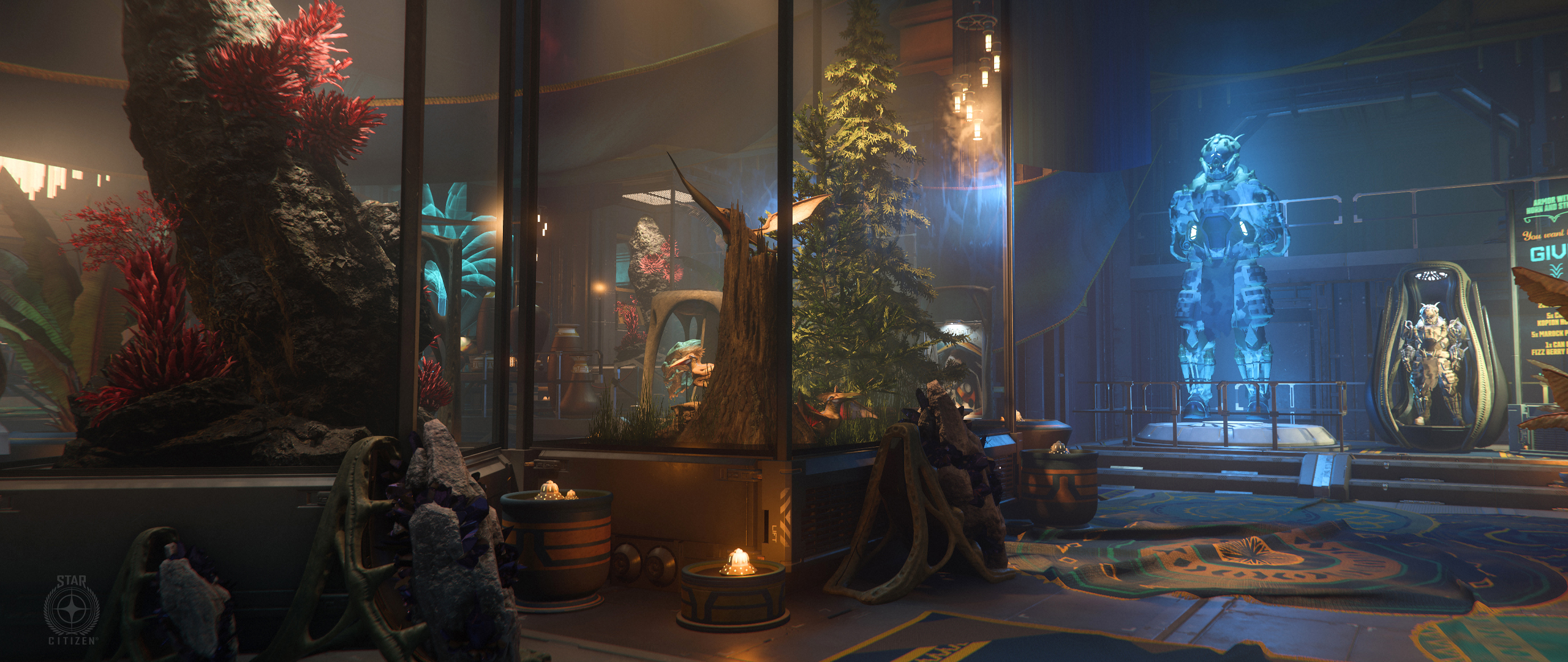
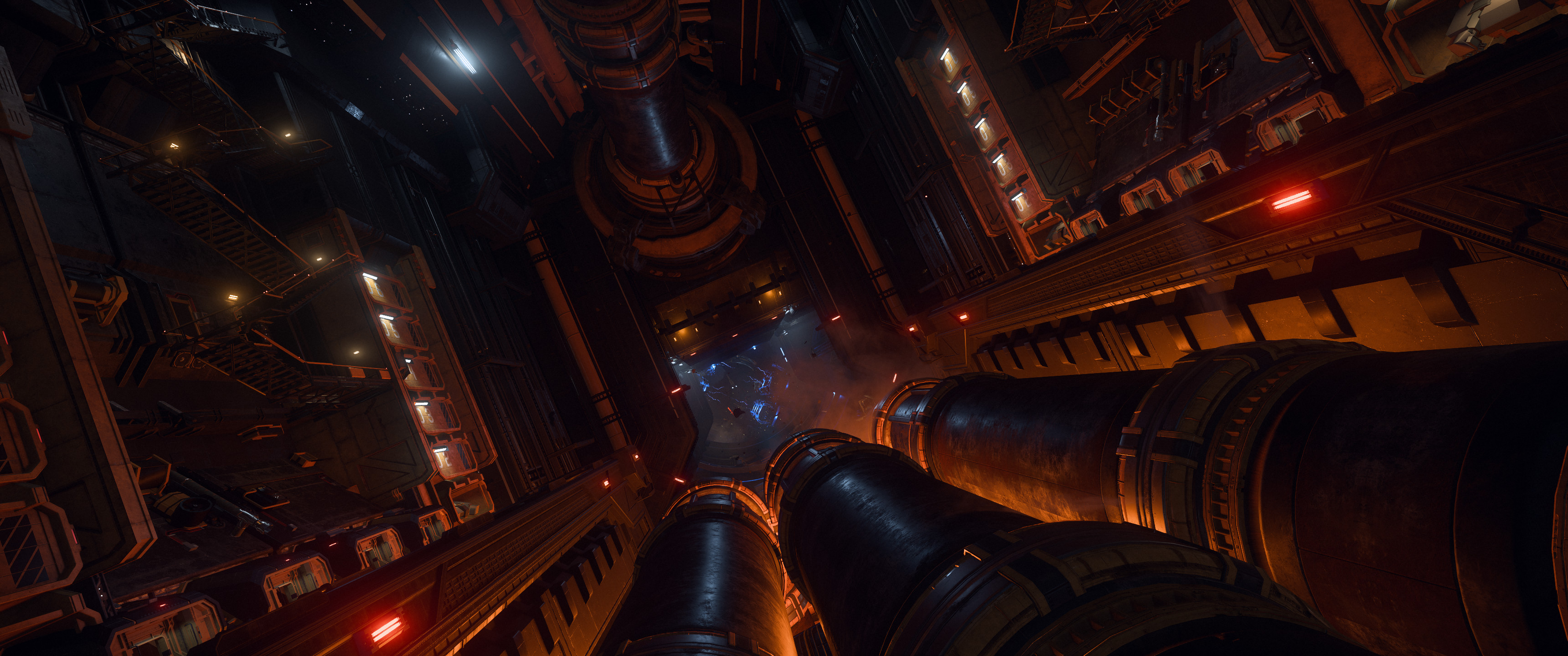
Throughout July, Environment Art provided support for chapter 4g’s quarterly milestone goals and an internal showcase for all CIG staff. The Bengal’s medical bay is approaching completion:
“We are extremely pleased with the results as we fine tweak it to hit a standard of quality we aim to set within Squadron 42.” – Environment Art
For chapter 19a, the team pushed towards a visual target that will set the tone, style, and quality of the tail end of the campaign. For chapter 7, they began the initial investigation and breakdown into secondary points-of-interest along the critical path, and progress was made on chapters 12, 13, and 15.
Audio
July saw the Dialogue team record additional voiceovers, which are currently being prepared for implementation. Composition also continued, with Pedro Camacho working on music for quantum travel.
Engine
In June, the Physics team finished support for compressed meshes. This means the representation of render meshes inside physics is now compressed, leading to memory and bandwidth savings. More code, such as preparation of vertex positions and normals for planetary patches, was also moved from C++ to ISPC to allow for faster processing on the CPU. Further optimizations include pre-allocating mesh blocks to avoid stalls during on-demand allocation, caching the current grid of vehicles to prevent stalls in physics, optimized binding of secondary node data during CGF loading, and a new round of terrain mesh generation improvements. Additionally, the set of analytical SDF primitives supported by physics was extended and torus added. For the renderer, the team continued with the transition to Gen12. A lot of work was completed on the global draw packet cache and related changes on the high-level render and 3D engine code, which will be used to speed up the streaming in of object containers and sharing of data for multiple instances. Additionally, Gen12 received the following changes: support for referencing refraction during rendering, tessellation support in the G-buffer pass, and a ported z-prepass. Several pieces of legacy code were removed to simplify the render pipeline. Also, Gen12 now runs with async shader compilation enabled by default.
Volumetric clouds and atmospheric rendering saw improvements throughout July as well as continued research. For example, runtime cube maps that are used for ambient lighting around the player. Density queries now also include the cloud’s tint at the requested location, which is important for the seamless integration of particles into cloud volumes. Cloud shaping was changed slightly to improve the local vs global read, particularly with regards to combatting the occasional tiled look of cloud details when viewed from orbit.
For rendering performance, the entire filter chain that reprojects and upsamples raymarching results is being revisited to improve quality so that this performance mode can always be enabled. Lastly, work on SDF integration into the raymarcher (efficient empty space skipping) is still ongoing.
On the core engine side, work continued on the entity component update scheduler (ECUS). Its internal structure was revisited to allow more than one update within a pass. Several improvements were also made to support and improve the new profiler frontend that was introduced in June. For instance, CPU sampling support was added for Linux builds of the server. Moreover, several tree optimizations were made inside StarHash.
Features (Gameplay)
The SQ42 Feature team continued their ongoing TrackView support. Added functionality includes a new frame of reference where the content creators can specify what the entities in a sequence are relative to so, when the sequence moves, everything else in the sequence automatically moves relative to it. For example, in an elevator sequence moves, the carriage and all the characters inside move along with it. Development began on the new checkpoint tool – basic creation and positioning functionality was implemented, which will allow a large amount of scripted setup to be removed. There was also additional support for the weapons track, allowing more control over firing.
Gameplay Story
At the start of July, Gameplay Story completed a two-day mo-cap shoot and are currently preparing to process the captured animations, facials, and audio. They also continued to work on a variety of chapters, each with a slightly different focus: For chapter 4 they completed maintenance work; for chapter 14 they made a polish pass; and for chapter 18 they worked on scenes for the first time.
However, Gameplay Story’s major focus was on chapter 5, where they replaced all placeholder content with new mo-cap animations to bring its scenes up to a particularly high standard.
“It has been great to see all this work pay off as the entire first half of chapter 05 is now playable from start to finish. This was no easy feat, as there were lots of animations, two walk-and-talk sequences, and plenty of technical challenges involved.” – Gameplay Story Team
Graphics & VFX Programming
For the shader, Graphics and VFX Programming made improvements to the quality of hair rendering in comms calls (though work continues) and refactored the shared code responsible for the depth pass, shadows, motion blur, and silhouette rendering. This will fix various bugs and prepare for some of the Gen12 features and requirements. The reworked render-to-texture post-effect pipeline was completed and is now with the UI artists for testing. This introduces custom bloom, drop shadow, color correction, and brightness adaptation that will apply to all visor and lens UIs, improving the visuals and legibility. The logic controlling the allocation of memory between the various UI screens was also adjusted to maximize quality while sticking to a fixed memory budget.
For Gen12, various validation issues were fixed along with issues on specific laptops where the dedicated GPU was disabled from the OS/driver level, meaning the Vulkan renderer wouldn’t initialize. Several architectural amendments were also made to improve the readability and usability of the new renderer.
On the VFX-programming side, various new features were added such as tinting for space-loop particles based on planetary cloud albedo, new rotation features for particles, and the ability to attach vector fields to characters to achieve effects. The latter includes leaves being pushed around by characters’ feet.
Level Design
The Space/Dogfight team are currently finalizing how the AI buddy works for space flight, which involves both combat and non-combat ambient behaviors. They’re also in the process of implementing and refining the new features they received last quarter, such as scanning and ping, and how they’re used by the AI. The team also focused on maintaining the handshake between the FPS and social areas of the game to allow continuous play.
Meanwhile, the Social Design Team continued to implement various in-game chapter scenes for review and sign off.
Narrative
Narrative kicked off the month with a motion-capture shoot in the UK, with several team members attending remotely. They worked closely with the Gameplay Story, Audio, and Animation teams to pick up some of the additional vignettes and conversations mentioned in previous reports. The editorial selects were turned around the following week so the data could start making its way through the pipeline. The team also reviewed several levels with Design to look at updated layouts and flows. Some moments that would benefit from additional scripted content were identified, so drafts were written and passed along so placeholder versions of the lines could be added in-game.
With additional work being done on the scanning mechanic, Narrative attended several meetings to talk over various topics, such as how various enemy groups will be identified and what kind of information will be visible to the player.
QA
Cinematics relied on QA for recordings of each level so they can ensure scenes are working and are of the intended quality. Support continues for the development teams too, with QA testing changes and updates to the wider project. QA also tested behavior implementation, running daily checklists and reproducing issues so they can be fixed by the relevant teams.
Tech Animation
Tech Animation completed their planning for this quarter and are well underway with deliveries. This quarter sees the team coming back to their support roles, assisting in the creation and implementation of key deliverables, including AI combat iteration, usables, and head assets that require art refinements. Additionally, the team took on some interesting challenges, one of which is to create a cross-platform RBF solder to assist in character deformation. The mandate is to create the same codebase to be used in Maya and the engine for improved usability. This will also speed up the processing of Maya animation assets and potentially the game too.
The team also began alembic cache animation support. While existing tools already support this technology, the team need to further integrate it into the animation toolset for a number of key deliverables.
UI
The embedded UI team members supported various HUD-related features, such as the scanning, inventory, and vehicle UI. The core team worked on various tech used across the game, including improved holographic 3D objects, lists, and controls.
VFX
Last month, the team put the finishing touches to a key location for their internal milestone. This included effects for a key location and a vast interior environment. VFX also helped prototype and test a new tool to allow artists to export positional data from Houdini straight into the game engine. This opens up various opportunities for creating more-complex but flexible art and design setups.
WE’LL SEE YOU NEXT MONTH…
Dies ist ein Cross-Post des Berichts, der kürzlich über den monatlichen Squadron 42 Newsletter verschickt wurde. Wir veröffentlichen ihn ein zweites Mal als Comm-Link, damit die Community leichter darauf zurückgreifen kann.
Achtung Rekruten,
Was ihr gleich lesen werdet, sind die neuesten Informationen über die weitere Entwicklung von Squadron 42 (SCI des: SQ42).
Dank der Arbeit von engagierten Feldagenten und Agenten haben wir Informationen über das Aciedo-Kommunikationsrelais, die Bengalen, die Vanduul-Krieger und mehr aufgedeckt.
Die in dieser Mitteilung enthaltenen Informationen sind äußerst sensibel und es ist von größter Wichtigkeit, dass sie nicht in die falschen Hände geraten. Lösche alle Aufzeichnungen nach dem Lesen.
UEE Naval High Command
KI (Inhalt)
Der KI-Content hat seine Arbeit an den Wildlines von SQ42 vorangetrieben und im Juli verschiedene Aufräumarbeiten abgeschlossen. Derzeit sind die einzigen verbleibenden Charaktere spezielle Fälle, die im Level implementiert werden müssen. Das Team hat auch die Usables für den Aciedo-Level fertiggestellt. Abgesehen von einer Handvoll Usables, die noch weitere Design-Diskussionen mit dem Art-Team erfordern, sind nun alle Usables mit funktionierenden Blockouts implementiert. Die Designer implementieren derzeit das neue "Usables First Reaction System", das es NSCs erlaubt, aus den Usables auszubrechen, wenn sie vom Spieler unterbrochen werden.
KI (Feature)
Im letzten Monat hat sich das KI-Feature-Team vor allem auf die Überarbeitung der Kämpfe konzentriert, mit dem Ziel, die bestehenden Verhaltensweisen und Funktionen zu verfeinern, um ein verständlicheres und angenehmeres Erlebnis zu bieten. Der erste Teil davon war die Überarbeitung der Einstellungen für Wahrnehmung und Reaktionen, um den Designern mehr Kontrolle darüber zu geben, wie sich die KI verhält, wenn sie auf einen Reiz trifft. Als nächstes arbeiteten sie an den grundlegenden Kampfverhalten, um sicherzustellen, dass die Auswahl der Deckung wie vorgesehen funktioniert und dass die KI nach der ersten Reaktion auf den Feind das Basisniveau an Funktionalität bietet. "Oftmals existiert der Großteil der Technologie zur Verbesserung des Kampfes bereits; es geht eher darum, sehr spezifische Situationen zu überprüfen und sicherzustellen, dass sich die KI wie beabsichtigt verhält und manchmal einfache Bugs zu beheben, die schlechtes Verhalten produzieren. Von diesen Anfängen ausgehend, hoffen wir, eine vollständige Überprüfung aller Kampfverhaltensweisen durchzuführen, was zu einem besseren und angenehmeren Gameplay führen wird." - KI Feature Team
Sie arbeiteten auch an bestimmten Verhaltensweisen, um es der KI zu ermöglichen, sich auszubreiten, den Spieler zu umzingeln und ihn im Nahkampf zu verspotten. Dies erforderte Änderungen am taktischen Punktesystem, um eine neue Metrik zu unterstützen, die es ihnen erlaubt, Punkte zu gewichten, die sich von anderen KIs ausbreiten. Das Nahkampfverhalten wurde überarbeitet, um sicherzustellen, dass die KI schnell in den Kampf wechselt, wenn die Situation dies erfordert.
Zu guter Letzt arbeiteten die Animatoren weiter an dem 'Geschwindigkeitsprotokoll' und dem 'Feinschliff' für die Animationen des Kauerns und des Sich-Ergebens. Dies wird sowohl für unbewaffnete und untrainierte KI als auch für die KI-Kampfverhaltensweisen, die derzeit überarbeitet werden, nützlich sein.
KI (Tech)
AI Tech hat das planetare Navigationssystem in die Lage versetzt, Verbindungen zwischen benachbarten Mesh-Tiles herzustellen, was ein Teil der Basisarbeit ist, um Unterstützung für planetare Pfadfindung hinzuzufügen. Das bedeutet, dass Dreiecke aus einer Navigationskachel beim Generierungsschritt Verbindungen zu Dreiecken aus anderen benachbarten Kacheln herstellen. Sie haben die Debug-Zeichnung des Kachelgenerators aktualisiert, damit sie auch mit planetaren Navigationsnetzkacheln funktioniert, um Probleme zu beheben, die während des Schrittes der Planetennetzgenerierung auftreten können.
Es wurden Arbeiten eingereicht, die es NSCs erlauben, einen Wagen entlang eines Pfades zu schieben. Die Arbeit dafür beinhaltet das Abspielen einer Animation, um sich mit dem Wagen zu verbinden, die Auswahl eines Pfades, das Schieben des Wagens entlang des Pfades, das Abkoppeln vom Wagen am Ende und das Wegfahren. Für die Bewegung mit dem Trolley berücksichtigte das Team die Größe des Agenten zur Kollisionsvermeidung und schaute sich die Animationen an, die verwendet werden, um ihn bergauf und bergab zu schieben oder wenn der NPC den Trolley drehen muss, um ihn am Pfad auszurichten.
Es wurde auch daran gearbeitet, das Testen zu automatisieren, indem die Funktionalität des Flowgraphs erweitert wurde, um Referenzen auf andere Entitäten innerhalb des gleichen Objektcontainers zu verwenden. In diesem Zusammenhang begannen die KI-Teams damit, kleine Level und Testverhalten zu erstellen, die später für automatisiertes Testen aktiviert werden, was letztendlich für eine bessere Stabilität ihrer Systeme sorgen wird. Die bereits erwähnte Arbeit an der Kollisionsvermeidung wurde im Juli fortgesetzt, dieses Mal mit dem Ziel der Leistungsoptimierung und der Schaffung einer saubereren Funktionalität. Es wurde auch Zeit darauf verwendet, das Quantenreiseverhalten in einer Gruppe zu verbessern. Jetzt prüft der Anführer, ob alle Teilnehmer (einschließlich des Spielers, wenn er Teil der Gruppe ist) das Spulen beendet haben, bevor er das Signal zum Sprung sendet.
Die Entwicklung des Subsumption-Editors wurde ebenfalls fortgesetzt. AI Tech fügte eine Funktion hinzu, mit der man mehrere Subsumption-Funktionen in der gleichen Ansicht beobachten oder verändern kann, was als 'Multi-Graph-Ansicht' bezeichnet wurde. Sie passten auch die Speicherfunktion an, um damit zu arbeiten.
Animation
Im Juli hat das Animationsteam die Waffenauswahl und -abwahl überarbeitet, damit sie besser mit der neuen Benutzeroberfläche des Charaktereditors funktionieren. Außerdem wurde die Entwicklung der Null-G-Bewegung, der betrunkenen Fortbewegung, der Vanduul-Bewegung, des Kauerns und der Kapitulation, der Arcade-Automaten, der Hacking-Blockouts und der Vendor-Entwicklung fortgesetzt. (Die Bergungswaffe und die Nutzgegenstände für das medizinische Gameplay wurden ebenfalls bearbeitet und sie begannen mit dem Refactoring des KI-Lokomotionssystems, um sich auf die neuen persönlichkeitsbasierten Lokomotionszyklen vorzubereiten, die letztendlich den Realismus verbessern werden.
An anderer Stelle wurden die Animationen der Flugzeugträger-Startmannschaft an das weibliche Charaktermodell angepasst. Die Arbeit an den Automaten ist in vollem Gange und das Team hat sich die bestehenden Assets angesehen, alle Useables, die weitere Arbeit erfordern, geschlossen und alle wertvollen, aber ungenutzten Useables wiederbelebt.
Im Bereich der Gesichtsanimation verbesserte das Team die Ergebnisse der Gesichtsanimation für die neu eintreffenden Modelle, fügte Gesichtsanimation zu verschiedenen Useables hinzu und unterstützte Narrative bei einem Motion-Capture-Shooting.
Kunst (Charaktere)
Character Art hat die Arbeit an allen "Helden"-Köpfen abgeschlossen, darunter Wade, MacLaren und Mason. Sie haben auch einen Geo-Polishing-Durchgang gemacht, eine Augenanordnung hinzugefügt, einen Haar-Verfeinerungs-Durchgang abgeschlossen und einen neuen internen Skin-Shader getestet. Die gleiche Prozedur werden sie später im Quartal bei den anderen Charakterköpfen anwenden. Außerdem wurde Trejos Outfit der letzte Schliff verpasst, das Konzeptteam begann mit der Erstellung von Vanduul-Krieger-Varianten und der erste Durchgang der Screaming Galsons wurde abgeschlossen.
Kunst (Umgebung)
Den ganzen Juli hindurch unterstützte Environment Art die vierteljährlichen Meilensteinziele des Kapitels 4g und bot ein internes Schaufenster für alle CIG-Mitarbeiter. Die medizinische Bucht der Bengalen nähert sich der Fertigstellung:
"Wir sind sehr zufrieden mit dem Ergebnis, während wir an der Feinabstimmung arbeiten, um einen Qualitätsstandard zu erreichen, den wir innerhalb von Squadron 42 anstreben." - Umwelt Kunst
Für Kapitel 19a hat das Team auf ein visuelles Ziel hingearbeitet, das den Ton, den Stil und die Qualität des Endes der Kampagne bestimmen wird. Für Kapitel 7 begannen sie mit der anfänglichen Untersuchung und Aufschlüsselung der sekundären Interessenspunkte entlang des kritischen Pfades, und es wurden Fortschritte bei den Kapiteln 12, 13 und 15 gemacht.
Audio
Im Juli nahm das Dialog-Team weitere Voiceovers auf, die derzeit für die Umsetzung vorbereitet werden. Auch die Komposition wurde fortgesetzt, wobei Pedro Camacho an der Musik für die Quantenreise arbeitete.
Motor
Im Juni hat das Physics Team die Unterstützung für komprimierte Meshes fertiggestellt. Das bedeutet, dass die Darstellung von Rendermeshes innerhalb von Physics nun komprimiert ist, was zu Speicher- und Bandbreiteneinsparungen führt. Weiterer Code, wie z.B. die Vorbereitung von Vertex-Positionen und Normalen für planetare Patches, wurde ebenfalls von C++ zu ISPC verschoben, um eine schnellere Verarbeitung auf der CPU zu ermöglichen. Weitere Optimierungen beinhalten die Vorab-Zuweisung von Mesh-Blöcken, um Stalls während der On-Demand-Allokation zu vermeiden, das Zwischenspeichern des aktuellen Fahrzeuggitters, um Stalls in der Physik zu verhindern, optimiertes Binden von sekundären Node-Daten während des CGF-Ladens und eine neue Runde von Verbesserungen bei der Terrain-Mesh-Generierung. Zusätzlich wurde das Set der analytischen SDF-Primitive, die von der Physik unterstützt werden, erweitert und Torus hinzugefügt. Für den Renderer setzte das Team den Übergang zu Gen12 fort. Es wurden viele Arbeiten am globalen Draw Packet Cache und damit verbundene Änderungen am High-Level Render- und 3D-Engine-Code abgeschlossen, die das Einströmen von Objekt-Containern und das Teilen von Daten für mehrere Instanzen beschleunigen werden. Zusätzlich erhielt Gen12 die folgenden Änderungen: Unterstützung für die Referenzierung von Refraktion während des Renderings, Tesselation-Unterstützung im G-Buffer-Pass und einen portierten z-Prepass. Mehrere Teile des Legacy-Codes wurden entfernt, um die Render-Pipeline zu vereinfachen. Außerdem läuft Gen12 nun mit standardmäßig aktivierter asynchroner Shaderkompilierung.
Volumetrische Wolken und atmosphärisches Rendering wurden im Juli verbessert und weiter erforscht. Zum Beispiel Laufzeit-Würfelkarten, die für die Umgebungsbeleuchtung um den Spieler herum verwendet werden. Dichteabfragen beinhalten nun auch den Farbton der Wolke an der angeforderten Stelle, was für die nahtlose Integration von Partikeln in Wolkenvolumina wichtig ist. Die Wolkenformung wurde leicht verändert, um das lokale vs. globale Lesen zu verbessern, insbesondere im Hinblick auf die Bekämpfung des gelegentlichen Kachel-Looks von Wolkendetails, wenn man sie aus dem Orbit betrachtet.
Für die Rendering-Performance wird die gesamte Filterkette, die die Ergebnisse des Raymarching reprojiziert und upsampelt, überarbeitet, um die Qualität zu verbessern, so dass dieser Performance-Modus immer aktiviert werden kann. Schließlich wird noch an der SDF-Integration in den Raymarcher gearbeitet (effizientes Überspringen von Leerräumen).
Auf der Seite der Core Engine wurde die Arbeit am Entity Component Update Scheduler (ECUS) fortgesetzt. Seine interne Struktur wurde überarbeitet, um mehr als ein Update innerhalb eines Durchgangs zu ermöglichen. Es wurden auch einige Verbesserungen vorgenommen, um das neue Profiler-Frontend, das im Juni eingeführt wurde, zu unterstützen und zu verbessern. Zum Beispiel wurde CPU-Sampling-Unterstützung für Linux-Builds des Servers hinzugefügt. Außerdem wurden mehrere Baumoptimierungen innerhalb von StarHash vorgenommen.
Features (Gameplay)
Das SQ42 Feature Team hat die Unterstützung für TrackView fortgesetzt. Zu den hinzugefügten Funktionen gehört ein neuer Bezugsrahmen, bei dem die Ersteller von Inhalten angeben können, worauf sich die Einheiten in einer Sequenz beziehen, so dass sich bei einer Bewegung der Sequenz alles andere in der Sequenz automatisch relativ dazu bewegt. Wenn sich zum Beispiel eine Aufzugssequenz bewegt, bewegen sich der Wagen und alle darin befindlichen Figuren mit. Die Entwicklung des neuen Checkpoint-Tools hat begonnen - grundlegende Erstellungs- und Positionierungsfunktionen wurden implementiert, wodurch ein großer Teil der geskripteten Einstellungen entfernt werden kann. Es gab auch zusätzliche Unterstützung für die Waffenspur, die mehr Kontrolle über das Feuern erlaubt.
Gameplay Geschichte
Anfang Juli schloss Gameplay Story einen zweitägigen Mo-Cap-Dreh ab und bereitet sich derzeit darauf vor, die aufgenommenen Animationen, Gesichter und den Ton zu bearbeiten. Außerdem arbeiteten sie weiter an einer Reihe von Kapiteln, jedes mit einem etwas anderen Schwerpunkt: Für Kapitel 4 haben sie Wartungsarbeiten abgeschlossen, für Kapitel 14 haben sie einen Polishing-Pass gemacht und für Kapitel 18 haben sie zum ersten Mal an Szenen gearbeitet.
Der Hauptfokus von Gameplay Story lag jedoch auf Kapitel 5, wo sie alle Platzhalterinhalte durch neue Mo-Cap-Animationen ersetzten, um die Szenen auf einen besonders hohen Standard zu bringen.
"Es war großartig zu sehen, wie sich all diese Arbeit auszahlt, da die gesamte erste Hälfte von Kapitel 05 nun von Anfang bis Ende spielbar ist. Das war keine leichte Aufgabe, da es viele Animationen, zwei Walk-and-Talk-Sequenzen und viele technische Herausforderungen gab." - Gameplay Story Team
Grafik & VFX Programmierung
Für den Shader hat Graphics & VFX Programming Verbesserungen an der Qualität des Haar-Renderings in den Komm-Aufrufen vorgenommen (die Arbeit geht allerdings weiter) und den gemeinsamen Code, der für den Tiefenpass, die Schatten, die Bewegungsunschärfe und das Silhouetten-Rendering verantwortlich ist, refaktorisiert. Dies behebt verschiedene Bugs und bereitet auf einige der Gen12-Features und Anforderungen vor. Die überarbeitete Render-to-Texture-Post-Effekt-Pipeline wurde fertiggestellt und ist nun bei den UI-Artists zum Testen. Dies führt benutzerdefinierte Bloom-, Schlagschatten-, Farbkorrektur- und Helligkeitsanpassungen ein, die auf alle Visor- und Linsen-UIs angewendet werden, um die Optik und Lesbarkeit zu verbessern. Die Logik, die die Zuweisung des Speichers zwischen den verschiedenen UI-Bildschirmen steuert, wurde ebenfalls angepasst, um die Qualität zu maximieren und gleichzeitig ein festes Speicherbudget einzuhalten.
Für die Gen12 wurden verschiedene Validierungsprobleme behoben, sowie Probleme auf bestimmten Laptops, bei denen die dedizierte GPU auf Betriebssystem-/Treiberebene deaktiviert war, was bedeutete, dass der Vulkan-Renderer nicht initialisiert werden konnte. Es wurden auch einige architektonische Änderungen vorgenommen, um die Lesbarkeit und Nutzbarkeit des neuen Renderers zu verbessern.
Auf der Seite der VFX-Programmierung wurden verschiedene neue Features hinzugefügt, wie z.B. die Färbung von Space-Loop-Partikeln basierend auf der Albedo von planetaren Wolken, neue Rotationsfunktionen für Partikel und die Möglichkeit, Vektorfelder an Charaktere anzuhängen, um Effekte zu erzielen. Letzteres beinhaltet Blätter, die von den Füßen der Charaktere herumgeschoben werden.
Level Design
Das Space/Dogfight-Team arbeitet derzeit daran, wie der KI-Kumpel für den Weltraumflug funktioniert, was sowohl kämpfende als auch nicht-kämpfende Umgebungsbedingungen beinhaltet. Außerdem sind sie dabei, die neuen Features, die sie im letzten Quartal erhalten haben, zu implementieren und zu verfeinern, wie zum Beispiel Scanning und Ping, und wie sie von der KI genutzt werden. Das Team hat sich auch darauf konzentriert, den Handshake zwischen dem FPS- und dem sozialen Bereich des Spiels aufrechtzuerhalten, um ein kontinuierliches Spiel zu ermöglichen.
In der Zwischenzeit implementierte das Social Design Team weiterhin verschiedene Kapitelszenen im Spiel zur Überprüfung und Freigabe.
Narrative
Narrative begann den Monat mit einem Motion-Capture-Dreh in Großbritannien, bei dem mehrere Teammitglieder aus der Ferne teilnahmen. Sie arbeiteten eng mit den Gameplay-Story-, Audio- und Animationsteams zusammen, um einige der zusätzlichen Vignetten und Gespräche aufzunehmen, die in früheren Berichten erwähnt wurden. Die redaktionellen Auswahlen wurden in der darauffolgenden Woche umgedreht, damit die Daten ihren Weg durch die Pipeline nehmen konnten. Das Team besprach auch mehrere Levels mit dem Designteam, um aktualisierte Layouts und Abläufe zu betrachten. Es wurden einige Momente identifiziert, die von zusätzlichen geskripteten Inhalten profitieren würden, also wurden Entwürfe geschrieben und weitergegeben, damit Platzhalterversionen der Zeilen im Spiel hinzugefügt werden konnten.
Da zusätzliche Arbeit an der Scan-Mechanik geleistet wurde, nahm Narrative an mehreren Meetings teil, um verschiedene Themen zu besprechen, wie z.B. wie verschiedene Gegnergruppen identifiziert werden und welche Art von Informationen für den Spieler sichtbar sein werden.
QA
Cinematics hat sich auf die QA verlassen, um Aufnahmen von jedem Level zu machen, damit sie sicherstellen können, dass die Szenen funktionieren und die beabsichtigte Qualität haben. Die Unterstützung für die Entwicklungsteams geht ebenfalls weiter, wobei die QA Änderungen und Updates für das gesamte Projekt testet. QA testete auch die Implementierung des Verhaltens, indem sie tägliche Checklisten durchführten und Probleme reproduzierten, damit sie von den entsprechenden Teams behoben werden können.
Tech Animation
Tech Animation hat die Planung für dieses Quartal abgeschlossen und ist mit den Lieferungen gut vorangekommen. In diesem Quartal kehrt das Team zu seinen Support-Rollen zurück und hilft bei der Erstellung und Implementierung von Schlüsselergebnissen, einschließlich KI-Kampf-Iteration, Usables und Kopf-Assets, die künstlerische Verfeinerungen erfordern. Zusätzlich hat das Team einige interessante Herausforderungen angenommen, eine davon ist die Erstellung eines plattformübergreifenden RBF-Lots zur Unterstützung der Charakterverformung. Der Auftrag ist es, die gleiche Codebasis zu erstellen, die in Maya und der Engine für eine verbesserte Benutzerfreundlichkeit verwendet werden kann. Dies wird auch die Verarbeitung von Maya-Animations-Assets und potentiell auch das Spiel beschleunigen.
Das Team begann auch mit der Unterstützung von Alembic Cache Animationen. Während bestehende Tools diese Technologie bereits unterstützen, muss das Team sie für eine Reihe von Schlüsselergebnissen weiter in das Animationstoolset integrieren.
UI
Die eingebetteten UI-Teammitglieder unterstützten verschiedene HUD-bezogene Features, wie z.B. die Scan-, Inventar- und Fahrzeug-UI. Das Kernteam arbeitete an verschiedenen Technologien, die im gesamten Spiel verwendet werden, einschließlich verbesserter holografischer 3D-Objekte, Listen und Kontrollen.
VFX
Letzten Monat hat das Team den letzten Schliff an einer Schlüsselstelle für ihren internen Meilenstein vorgenommen. Dazu gehörten Effekte für einen wichtigen Ort und eine riesige Innenumgebung. VFX half auch beim Prototyping und Testen eines neuen Tools, mit dem Künstler Positionsdaten aus Houdini direkt in die Spiel-Engine exportieren können. Dies eröffnet verschiedene Möglichkeiten, um komplexere, aber flexible Art- und Design-Setups zu erstellen.
WIR SEHEN UNS NÄCHSTEN MONAT...
This is a cross-post of the report that was recently sent out via the monthly Squadron 42 newsletter. We’re publishing this a second time as a Comm-Link to make it easier for the community to reference back to. Attention Recruits,
What you are about to read is the latest information on the continuing development of Squadron 42 (SCI des: SQ42).
Thanks to the work of dedicated field agents and operatives, we’ve uncovered information on the Aciedo comm relay, the Bengal, Vanduul Warriors, and more.
The information contained in this communication is extremely sensitive and it is of paramount importance that it does not fall into the wrong hands. Purge all records after reading.
UEE Naval High Command
AI (Content)
AI Content progressed with their work on SQ42’s wildlines, with July seeing them finishing various clean up tasks. Currently, the only remaining characters are specific cases that need in-level implementation. The team also wrapped up the usables for the Aciedo level. Aside from a handful of usables that require further design discussion with the Art team, all usables are now implemented with working blockouts. The designers are currently implementing the new ‘usables first reaction system,’ which allows NPCs to break out of the usables when being interrupted by the player.
AI (Feature)
Last month, the AI Feature team primarily focused on reviewing combat, with the aim of refining the existing behaviors and functionality to provide a more intelligible and enjoyable experience. The first part of this was reviewing the settings for perception and reactions to give the designers greater control over how the AI behaves when encountering a stimulus. Next, they worked on the basic combat behaviors, ensuring cover selection is working as intended and that the AI provides the base level of functionality after the first reaction to the enemy. “Often the majority of the technology for improving combat already exists; it’s more a case of reviewing very specific situations and ensuring that the AI behaves as intended and fixing sometimes simple bugs that produce bad behavior. From these beginnings, we hope to do a full review over all of the combat behaviors, which will lead to better and more enjoyable gameplay.” – AI Feature Team
They also worked on specific behaviors to enable AI to spread out and surround the player and taunt them while in melee combat. This required changes to the tactical point system to support a new metric allowing them to weight points spread out from other AI. Melee behaviors received attention to ensure they quickly switch to combat when the situation requires too
Finally, the animators continued working on the ‘speed protocol’ and ‘polish’ stages for the mo-capped cowering and surrendering animations. This will be useful for both unarmed and untrained AI and the AI combat behaviors currently under review.
AI (Tech)
AI Tech enabled the planetary navigation system to make connections between adjacent mesh tiles, which is part of the base work to add support for planetary pathfinding. This means that triangles from a navigation mesh tile will create links to triangles from other adjacent tiles at the generation step. They updated the tile generator debug draw to also work with planetary navigation mesh tiles to help them debug issues that could appear during the planet mesh generation step.
Work was submitted to allow NPCs to push a trolley along a path. The work for this includes playing an animation to connect to the trolley, selecting a path, pushing the trolley along the path, disconnecting from the trolley at the end, and moving away. For movement with the trolley, the team considered the size of the agent for collision avoidance and looked at the animations used for pushing it uphill and downhill or when NPC needs to turn the trolley to orient it with the path.
Work was also done to automate testing by extending functionality on the flowgraph to use references to other entities inside the same object container. Related to this, the AI teams began creating small levels and test behaviors that will be enabled later for automated testing, which will ultimately provide better stability to their systems. The previously mentioned collision avoidance work continued in July, this time on performance optimization and creating cleaner functionality. Time was also dedicated to improving quantum travel behavior in a group. Now, the leader checks that all participants (including the player if they’re part of the group) have finished spooling before sending the signal to jump.
Development of the Subsumption editor continued too, with AI Tech adding functionality to watch or modify multiple Subsumption functions from the same view, which was named the ‘multi-graph view.’ They also adjusted save functionality to work alongside it.
Animation
July saw the Animation team refactor weapons select and deselect to better work with the new character editor UI. They also continued developing zero-g movement, drunk locomotion, Vanduul locomotion, cowering and surrender, arcade machine state machines, hacking blockouts, and vendor development. (The latter of which is used for getting food, drinks, and other items.) The salvage weapon and useables for medical gameplay were also worked on, and they began refactoring the AI locomotion system to prepare for the new personality-based locomotion cycles, which will ultimately improve realism.
Elsewhere, the aircraft carrier launch crew animations were factored to the female character model. Work on vending machine use is in progress, and the team looked at existing assets, closed out any useables requiring further work, and resurrected any worthy but unused usables.
For facial animation, the team improved facial animation results for the new incoming models, added facial animation to various useables, and supported Narrative on a motion-capture shoot.
Art (Characters)
Character Art finalized work on all ‘hero’ heads, including Wade, MacLaren, and Mason. They also made a geo polish pass, added an eye assembly, completed a hair refinement pass, and tested a new in-house skin shader. They’ll implement the same procedure as they move onto other character heads later in the quarter. Additionally, they put the finishing touches to Trejo’s outfit, the Concept Team began creating Vanduul warrior variants, and the first pass on the Screaming Galsons was completed.
Art (Environment)
Throughout July, Environment Art provided support for chapter 4g’s quarterly milestone goals and an internal showcase for all CIG staff. The Bengal’s medical bay is approaching completion:
“We are extremely pleased with the results as we fine tweak it to hit a standard of quality we aim to set within Squadron 42.” – Environment Art
For chapter 19a, the team pushed towards a visual target that will set the tone, style, and quality of the tail end of the campaign. For chapter 7, they began the initial investigation and breakdown into secondary points-of-interest along the critical path, and progress was made on chapters 12, 13, and 15.
Audio
July saw the Dialogue team record additional voiceovers, which are currently being prepared for implementation. Composition also continued, with Pedro Camacho working on music for quantum travel.
Engine
In June, the Physics team finished support for compressed meshes. This means the representation of render meshes inside physics is now compressed, leading to memory and bandwidth savings. More code, such as preparation of vertex positions and normals for planetary patches, was also moved from C++ to ISPC to allow for faster processing on the CPU. Further optimizations include pre-allocating mesh blocks to avoid stalls during on-demand allocation, caching the current grid of vehicles to prevent stalls in physics, optimized binding of secondary node data during CGF loading, and a new round of terrain mesh generation improvements. Additionally, the set of analytical SDF primitives supported by physics was extended and torus added. For the renderer, the team continued with the transition to Gen12. A lot of work was completed on the global draw packet cache and related changes on the high-level render and 3D engine code, which will be used to speed up the streaming in of object containers and sharing of data for multiple instances. Additionally, Gen12 received the following changes: support for referencing refraction during rendering, tessellation support in the G-buffer pass, and a ported z-prepass. Several pieces of legacy code were removed to simplify the render pipeline. Also, Gen12 now runs with async shader compilation enabled by default.
Volumetric clouds and atmospheric rendering saw improvements throughout July as well as continued research. For example, runtime cube maps that are used for ambient lighting around the player. Density queries now also include the cloud’s tint at the requested location, which is important for the seamless integration of particles into cloud volumes. Cloud shaping was changed slightly to improve the local vs global read, particularly with regards to combatting the occasional tiled look of cloud details when viewed from orbit.
For rendering performance, the entire filter chain that reprojects and upsamples raymarching results is being revisited to improve quality so that this performance mode can always be enabled. Lastly, work on SDF integration into the raymarcher (efficient empty space skipping) is still ongoing.
On the core engine side, work continued on the entity component update scheduler (ECUS). Its internal structure was revisited to allow more than one update within a pass. Several improvements were also made to support and improve the new profiler frontend that was introduced in June. For instance, CPU sampling support was added for Linux builds of the server. Moreover, several tree optimizations were made inside StarHash.
Features (Gameplay)
The SQ42 Feature team continued their ongoing TrackView support. Added functionality includes a new frame of reference where the content creators can specify what the entities in a sequence are relative to so, when the sequence moves, everything else in the sequence automatically moves relative to it. For example, in an elevator sequence moves, the carriage and all the characters inside move along with it. Development began on the new checkpoint tool – basic creation and positioning functionality was implemented, which will allow a large amount of scripted setup to be removed. There was also additional support for the weapons track, allowing more control over firing.
Gameplay Story
At the start of July, Gameplay Story completed a two-day mo-cap shoot and are currently preparing to process the captured animations, facials, and audio. They also continued to work on a variety of chapters, each with a slightly different focus: For chapter 4 they completed maintenance work; for chapter 14 they made a polish pass; and for chapter 18 they worked on scenes for the first time.
However, Gameplay Story’s major focus was on chapter 5, where they replaced all placeholder content with new mo-cap animations to bring its scenes up to a particularly high standard.
“It has been great to see all this work pay off as the entire first half of chapter 05 is now playable from start to finish. This was no easy feat, as there were lots of animations, two walk-and-talk sequences, and plenty of technical challenges involved.” – Gameplay Story Team
Graphics & VFX Programming
For the shader, Graphics and VFX Programming made improvements to the quality of hair rendering in comms calls (though work continues) and refactored the shared code responsible for the depth pass, shadows, motion blur, and silhouette rendering. This will fix various bugs and prepare for some of the Gen12 features and requirements. The reworked render-to-texture post-effect pipeline was completed and is now with the UI artists for testing. This introduces custom bloom, drop shadow, color correction, and brightness adaptation that will apply to all visor and lens UIs, improving the visuals and legibility. The logic controlling the allocation of memory between the various UI screens was also adjusted to maximize quality while sticking to a fixed memory budget.
For Gen12, various validation issues were fixed along with issues on specific laptops where the dedicated GPU was disabled from the OS/driver level, meaning the Vulkan renderer wouldn’t initialize. Several architectural amendments were also made to improve the readability and usability of the new renderer.
On the VFX-programming side, various new features were added such as tinting for space-loop particles based on planetary cloud albedo, new rotation features for particles, and the ability to attach vector fields to characters to achieve effects. The latter includes leaves being pushed around by characters’ feet.
Level Design
The Space/Dogfight team are currently finalizing how the AI buddy works for space flight, which involves both combat and non-combat ambient behaviors. They’re also in the process of implementing and refining the new features they received last quarter, such as scanning and ping, and how they’re used by the AI. The team also focused on maintaining the handshake between the FPS and social areas of the game to allow continuous play.
Meanwhile, the Social Design Team continued to implement various in-game chapter scenes for review and sign off.
Narrative
Narrative kicked off the month with a motion-capture shoot in the UK, with several team members attending remotely. They worked closely with the Gameplay Story, Audio, and Animation teams to pick up some of the additional vignettes and conversations mentioned in previous reports. The editorial selects were turned around the following week so the data could start making its way through the pipeline. The team also reviewed several levels with Design to look at updated layouts and flows. Some moments that would benefit from additional scripted content were identified, so drafts were written and passed along so placeholder versions of the lines could be added in-game.
With additional work being done on the scanning mechanic, Narrative attended several meetings to talk over various topics, such as how various enemy groups will be identified and what kind of information will be visible to the player.
QA
Cinematics relied on QA for recordings of each level so they can ensure scenes are working and are of the intended quality. Support continues for the development teams too, with QA testing changes and updates to the wider project. QA also tested behavior implementation, running daily checklists and reproducing issues so they can be fixed by the relevant teams.
Tech Animation
Tech Animation completed their planning for this quarter and are well underway with deliveries. This quarter sees the team coming back to their support roles, assisting in the creation and implementation of key deliverables, including AI combat iteration, usables, and head assets that require art refinements. Additionally, the team took on some interesting challenges, one of which is to create a cross-platform RBF solder to assist in character deformation. The mandate is to create the same codebase to be used in Maya and the engine for improved usability. This will also speed up the processing of Maya animation assets and potentially the game too.
The team also began alembic cache animation support. While existing tools already support this technology, the team need to further integrate it into the animation toolset for a number of key deliverables.
UI
The embedded UI team members supported various HUD-related features, such as the scanning, inventory, and vehicle UI. The core team worked on various tech used across the game, including improved holographic 3D objects, lists, and controls.
VFX
Last month, the team put the finishing touches to a key location for their internal milestone. This included effects for a key location and a vast interior environment. VFX also helped prototype and test a new tool to allow artists to export positional data from Houdini straight into the game engine. This opens up various opportunities for creating more-complex but flexible art and design setups.
WE’LL SEE YOU NEXT MONTH…
This is a cross-post of the report that was recently sent out via the monthly Squadron 42 newsletter. We’re publishing this a second time as a Comm-Link to make it easier for the community to reference back to. Attention Recruits,
What you are about to read is the latest information on the continuing development of Squadron 42 (SCI des: SQ42).
Thanks to the work of dedicated field agents and operatives, we’ve uncovered information on the Aciedo comm relay, the Bengal, Vanduul Warriors, and more.
The information contained in this communication is extremely sensitive and it is of paramount importance that it does not fall into the wrong hands. Purge all records after reading.
UEE Naval High Command
AI (Content)
AI Content progressed with their work on SQ42’s wildlines, with July seeing them finishing various clean up tasks. Currently, the only remaining characters are specific cases that need in-level implementation. The team also wrapped up the usables for the Aciedo level. Aside from a handful of usables that require further design discussion with the Art team, all usables are now implemented with working blockouts. The designers are currently implementing the new ‘usables first reaction system,’ which allows NPCs to break out of the usables when being interrupted by the player.
AI (Feature)
Last month, the AI Feature team primarily focused on reviewing combat, with the aim of refining the existing behaviors and functionality to provide a more intelligible and enjoyable experience. The first part of this was reviewing the settings for perception and reactions to give the designers greater control over how the AI behaves when encountering a stimulus. Next, they worked on the basic combat behaviors, ensuring cover selection is working as intended and that the AI provides the base level of functionality after the first reaction to the enemy. “Often the majority of the technology for improving combat already exists; it’s more a case of reviewing very specific situations and ensuring that the AI behaves as intended and fixing sometimes simple bugs that produce bad behavior. From these beginnings, we hope to do a full review over all of the combat behaviors, which will lead to better and more enjoyable gameplay.” – AI Feature Team
They also worked on specific behaviors to enable AI to spread out and surround the player and taunt them while in melee combat. This required changes to the tactical point system to support a new metric allowing them to weight points spread out from other AI. Melee behaviors received attention to ensure they quickly switch to combat when the situation requires too
Finally, the animators continued working on the ‘speed protocol’ and ‘polish’ stages for the mo-capped cowering and surrendering animations. This will be useful for both unarmed and untrained AI and the AI combat behaviors currently under review.
AI (Tech)
AI Tech enabled the planetary navigation system to make connections between adjacent mesh tiles, which is part of the base work to add support for planetary pathfinding. This means that triangles from a navigation mesh tile will create links to triangles from other adjacent tiles at the generation step. They updated the tile generator debug draw to also work with planetary navigation mesh tiles to help them debug issues that could appear during the planet mesh generation step.
Work was submitted to allow NPCs to push a trolley along a path. The work for this includes playing an animation to connect to the trolley, selecting a path, pushing the trolley along the path, disconnecting from the trolley at the end, and moving away. For movement with the trolley, the team considered the size of the agent for collision avoidance and looked at the animations used for pushing it uphill and downhill or when NPC needs to turn the trolley to orient it with the path.
Work was also done to automate testing by extending functionality on the flowgraph to use references to other entities inside the same object container. Related to this, the AI teams began creating small levels and test behaviors that will be enabled later for automated testing, which will ultimately provide better stability to their systems. The previously mentioned collision avoidance work continued in July, this time on performance optimization and creating cleaner functionality. Time was also dedicated to improving quantum travel behavior in a group. Now, the leader checks that all participants (including the player if they’re part of the group) have finished spooling before sending the signal to jump.
Development of the Subsumption editor continued too, with AI Tech adding functionality to watch or modify multiple Subsumption functions from the same view, which was named the ‘multi-graph view.’ They also adjusted save functionality to work alongside it.
Animation
July saw the Animation team refactor weapons select and deselect to better work with the new character editor UI. They also continued developing zero-g movement, drunk locomotion, Vanduul locomotion, cowering and surrender, arcade machine state machines, hacking blockouts, and vendor development. (The latter of which is used for getting food, drinks, and other items.) The salvage weapon and useables for medical gameplay were also worked on, and they began refactoring the AI locomotion system to prepare for the new personality-based locomotion cycles, which will ultimately improve realism.
Elsewhere, the aircraft carrier launch crew animations were factored to the female character model. Work on vending machine use is in progress, and the team looked at existing assets, closed out any useables requiring further work, and resurrected any worthy but unused usables.
For facial animation, the team improved facial animation results for the new incoming models, added facial animation to various useables, and supported Narrative on a motion-capture shoot.
Art (Characters)
Character Art finalized work on all ‘hero’ heads, including Wade, MacLaren, and Mason. They also made a geo polish pass, added an eye assembly, completed a hair refinement pass, and tested a new in-house skin shader. They’ll implement the same procedure as they move onto other character heads later in the quarter. Additionally, they put the finishing touches to Trejo’s outfit, the Concept Team began creating Vanduul warrior variants, and the first pass on the Screaming Galsons was completed.
Art (Environment)
Throughout July, Environment Art provided support for chapter 4g’s quarterly milestone goals and an internal showcase for all CIG staff. The Bengal’s medical bay is approaching completion:
“We are extremely pleased with the results as we fine tweak it to hit a standard of quality we aim to set within Squadron 42.” – Environment Art
For chapter 19a, the team pushed towards a visual target that will set the tone, style, and quality of the tail end of the campaign. For chapter 7, they began the initial investigation and breakdown into secondary points-of-interest along the critical path, and progress was made on chapters 12, 13, and 15.
Audio
July saw the Dialogue team record additional voiceovers, which are currently being prepared for implementation. Composition also continued, with Pedro Camacho working on music for quantum travel.
Engine
In June, the Physics team finished support for compressed meshes. This means the representation of render meshes inside physics is now compressed, leading to memory and bandwidth savings. More code, such as preparation of vertex positions and normals for planetary patches, was also moved from C++ to ISPC to allow for faster processing on the CPU. Further optimizations include pre-allocating mesh blocks to avoid stalls during on-demand allocation, caching the current grid of vehicles to prevent stalls in physics, optimized binding of secondary node data during CGF loading, and a new round of terrain mesh generation improvements. Additionally, the set of analytical SDF primitives supported by physics was extended and torus added. For the renderer, the team continued with the transition to Gen12. A lot of work was completed on the global draw packet cache and related changes on the high-level render and 3D engine code, which will be used to speed up the streaming in of object containers and sharing of data for multiple instances. Additionally, Gen12 received the following changes: support for referencing refraction during rendering, tessellation support in the G-buffer pass, and a ported z-prepass. Several pieces of legacy code were removed to simplify the render pipeline. Also, Gen12 now runs with async shader compilation enabled by default.
Volumetric clouds and atmospheric rendering saw improvements throughout July as well as continued research. For example, runtime cube maps that are used for ambient lighting around the player. Density queries now also include the cloud’s tint at the requested location, which is important for the seamless integration of particles into cloud volumes. Cloud shaping was changed slightly to improve the local vs global read, particularly with regards to combatting the occasional tiled look of cloud details when viewed from orbit.
For rendering performance, the entire filter chain that reprojects and upsamples raymarching results is being revisited to improve quality so that this performance mode can always be enabled. Lastly, work on SDF integration into the raymarcher (efficient empty space skipping) is still ongoing.
On the core engine side, work continued on the entity component update scheduler (ECUS). Its internal structure was revisited to allow more than one update within a pass. Several improvements were also made to support and improve the new profiler frontend that was introduced in June. For instance, CPU sampling support was added for Linux builds of the server. Moreover, several tree optimizations were made inside StarHash.
Features (Gameplay)
The SQ42 Feature team continued their ongoing TrackView support. Added functionality includes a new frame of reference where the content creators can specify what the entities in a sequence are relative to so, when the sequence moves, everything else in the sequence automatically moves relative to it. For example, in an elevator sequence moves, the carriage and all the characters inside move along with it. Development began on the new checkpoint tool – basic creation and positioning functionality was implemented, which will allow a large amount of scripted setup to be removed. There was also additional support for the weapons track, allowing more control over firing.
Gameplay Story
At the start of July, Gameplay Story completed a two-day mo-cap shoot and are currently preparing to process the captured animations, facials, and audio. They also continued to work on a variety of chapters, each with a slightly different focus: For chapter 4 they completed maintenance work; for chapter 14 they made a polish pass; and for chapter 18 they worked on scenes for the first time.
However, Gameplay Story’s major focus was on chapter 5, where they replaced all placeholder content with new mo-cap animations to bring its scenes up to a particularly high standard.
“It has been great to see all this work pay off as the entire first half of chapter 05 is now playable from start to finish. This was no easy feat, as there were lots of animations, two walk-and-talk sequences, and plenty of technical challenges involved.” – Gameplay Story Team
Graphics & VFX Programming
For the shader, Graphics and VFX Programming made improvements to the quality of hair rendering in comms calls (though work continues) and refactored the shared code responsible for the depth pass, shadows, motion blur, and silhouette rendering. This will fix various bugs and prepare for some of the Gen12 features and requirements. The reworked render-to-texture post-effect pipeline was completed and is now with the UI artists for testing. This introduces custom bloom, drop shadow, color correction, and brightness adaptation that will apply to all visor and lens UIs, improving the visuals and legibility. The logic controlling the allocation of memory between the various UI screens was also adjusted to maximize quality while sticking to a fixed memory budget.
For Gen12, various validation issues were fixed along with issues on specific laptops where the dedicated GPU was disabled from the OS/driver level, meaning the Vulkan renderer wouldn’t initialize. Several architectural amendments were also made to improve the readability and usability of the new renderer.
On the VFX-programming side, various new features were added such as tinting for space-loop particles based on planetary cloud albedo, new rotation features for particles, and the ability to attach vector fields to characters to achieve effects. The latter includes leaves being pushed around by characters’ feet.
Level Design
The Space/Dogfight team are currently finalizing how the AI buddy works for space flight, which involves both combat and non-combat ambient behaviors. They’re also in the process of implementing and refining the new features they received last quarter, such as scanning and ping, and how they’re used by the AI. The team also focused on maintaining the handshake between the FPS and social areas of the game to allow continuous play.
Meanwhile, the Social Design Team continued to implement various in-game chapter scenes for review and sign off.
Narrative
Narrative kicked off the month with a motion-capture shoot in the UK, with several team members attending remotely. They worked closely with the Gameplay Story, Audio, and Animation teams to pick up some of the additional vignettes and conversations mentioned in previous reports. The editorial selects were turned around the following week so the data could start making its way through the pipeline. The team also reviewed several levels with Design to look at updated layouts and flows. Some moments that would benefit from additional scripted content were identified, so drafts were written and passed along so placeholder versions of the lines could be added in-game.
With additional work being done on the scanning mechanic, Narrative attended several meetings to talk over various topics, such as how various enemy groups will be identified and what kind of information will be visible to the player.
QA
Cinematics relied on QA for recordings of each level so they can ensure scenes are working and are of the intended quality. Support continues for the development teams too, with QA testing changes and updates to the wider project. QA also tested behavior implementation, running daily checklists and reproducing issues so they can be fixed by the relevant teams.
Tech Animation
Tech Animation completed their planning for this quarter and are well underway with deliveries. This quarter sees the team coming back to their support roles, assisting in the creation and implementation of key deliverables, including AI combat iteration, usables, and head assets that require art refinements. Additionally, the team took on some interesting challenges, one of which is to create a cross-platform RBF solder to assist in character deformation. The mandate is to create the same codebase to be used in Maya and the engine for improved usability. This will also speed up the processing of Maya animation assets and potentially the game too.
The team also began alembic cache animation support. While existing tools already support this technology, the team need to further integrate it into the animation toolset for a number of key deliverables.
UI
The embedded UI team members supported various HUD-related features, such as the scanning, inventory, and vehicle UI. The core team worked on various tech used across the game, including improved holographic 3D objects, lists, and controls.
VFX
Last month, the team put the finishing touches to a key location for their internal milestone. This included effects for a key location and a vast interior environment. VFX also helped prototype and test a new tool to allow artists to export positional data from Houdini straight into the game engine. This opens up various opportunities for creating more-complex but flexible art and design setups.
WE’LL SEE YOU NEXT MONTH…
Links
No links available.
Images
16


Metadata
- CIG ID
- 18264
- Channel
- Transmission
- Category
- Undefined
- Series
- Monthly Reports
- Comments
- 5
- Published
- 5 years ago (2021-08-11T00:00:00+00:00)