Whitley's Guide - Prospector
Spectrum Dispatch Undefined News UpdateContent
This article originally appeared in Jump Point 6.06.
MISC Prospector
DEVELOPMENT HISTORY
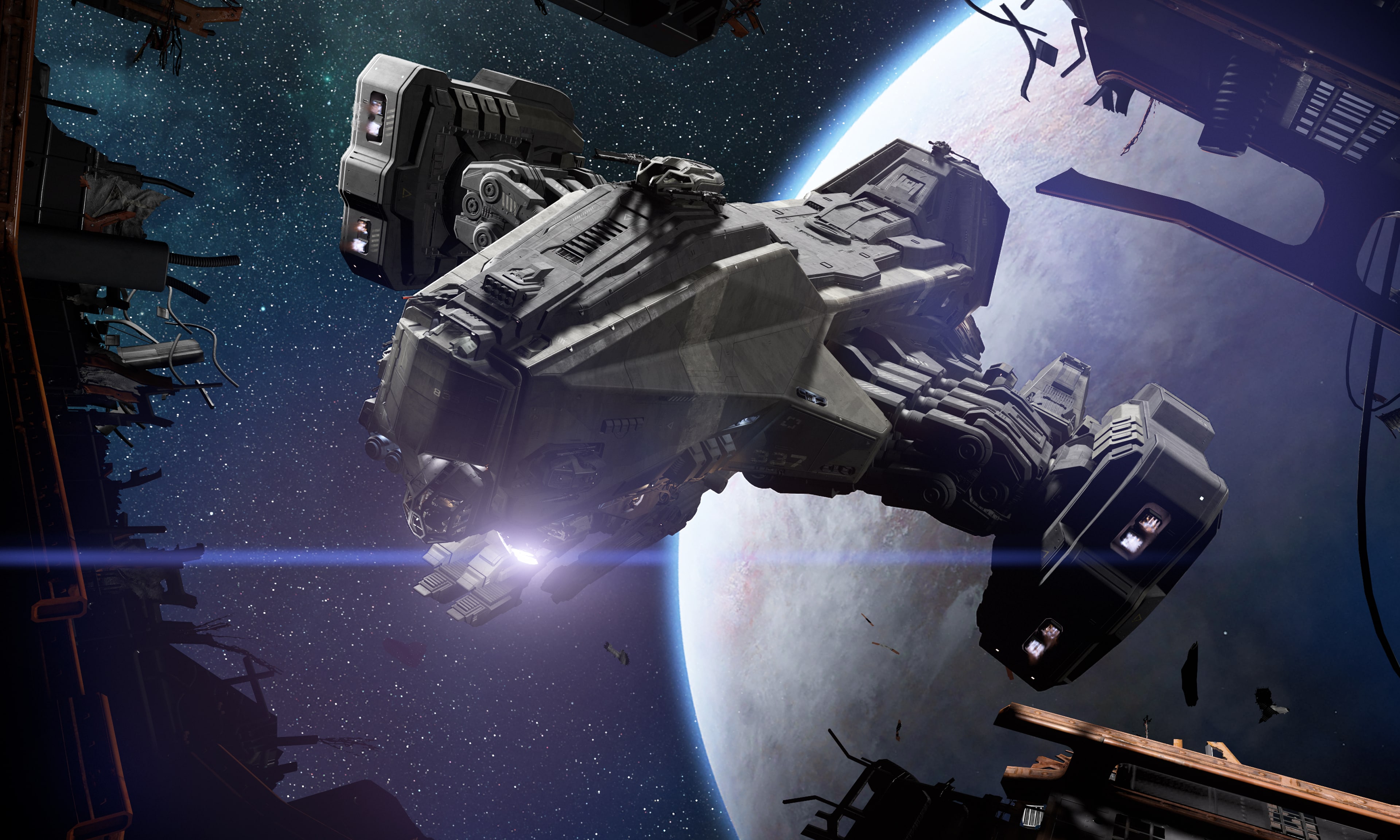
The MISC Prospector is the most famous (and possibly most tortured) project to come out of MISC High Industrial’s infamous Project Cold Boot, an engineering team organized to develop additional revenue streams from existing MISC assets using limited resources. Development of the Prospector began in 2910 as an outgrowth of a review of the Freelancer light transport project. Having already seen success modifying the base Freelancer for both survey and fire suppression missions, MISC was keen to study even more unlikely uses for the chassis. To that end, MISC’s management reluctantly agreed to write off nine Freelancers which were transferred to the Cold Boot team. Three were complete and space tested, while the others were left in various stages of construction and shipped alongside their intended components.
The Cold Boot team began by spit-balling potential roles for a purpose-built Freelancer variant, which ranged from ordinary combat support drones to fire suppression spacecraft. From nearly three hundred rough concepts, the team voted to divide into three design groups to pursue more advanced physical development of the top three options. The first was a business oriented design dubbed the ‘Freeminder,’ which was to be a secure data relay ‘brain ship’. The second project opted to angle for a military contract with an armored space-to-ground reconnaissance vehicle called the Observer. The third, and considered the most unlikely to go forward, was to be a dedicated mining ship nicknamed simply ‘The Miner’.
The mining ship was least likely to go forward for a very simple reason: in 2910 there were very few small mining ships. This was not for lack of technology, but rather both terrestrial and asteroid mining were simply considered to be large-scale propositions which could only be profitable when funded by major corporations. In a world where 400-meter mining platforms could strip small asteroids in a matter of hours, there was simply no thought that an individual operator would ever pursue mining. MISC was, essentially, co-opting the Roberts Space Industries ‘common man’ approach to ship sales with a ship that had no proven audience.
By 2914, the first two conversion attempts had petered out entirely. The Freeminder team proved unable to produce an effective prototype, with the Freelancer’s internal space unsuited to shielding the number of system blades needed for the project. The Observer concept had proven spaceworthy in simulations and a great deal of work had been done constructing the alternative, transparent nose cone for the physical build when word that the rumored ground reconnaissance contract had been withdrawn due to a shifting military budget. The incomplete prototype remained on display at MISC’s Los Arenas laboratory for years and was eventually scrapped. Although the Miner had proceeded to the physical prototype stage, its situation seemed equally dire. The first prototype, retroactively designated ‘Prospector Proof of Concept Demonstrator A-1’, was an unpleasant and ungainly beast. The team found themselves unable to budget for custom-manufactured mining equipment and was instead forced to adopt an off-the-shelf solution: the smallest size of a Daylan Kruz laser-head emitter, a component roughly the size of a Freelancer’s entire cockpit. Rather than being integrated into the design, the emitter was nano-welded tandem to the cockpit and attached via four metal booms. This created an unwieldy spacecraft without the aerodynamics necessary to function predictably in an atmosphere. Initial test flights were conducted via carrier spacecraft, with the prototype miner being dropped into space close to asteroid targets.
What the A-1 technology demonstrator lacked in looks or handling, it made up for in functionality. Over the course of twenty-six flights conducted by MISC test pilots, the A-1 racked up success in a number of areas considered necessary for the program to continue. These flights proved that the Freelancer’s stock drive could power a mining apparatus, that the hull could be modified to load ore and other materials while in flight and that, with some practice, a trained pilot could very effectively conduct more delicate, high-value mining operations using the ship’s thrusters. The prototype program continued with four of the Freelancer chassis ultimately being converted into increasingly advanced demonstrators (designated A-2, A-3, and B-1).
By the space trials for the final demonstrator, the B-1, the mining attachment had instead been integrated into a large sheath astride the underside of the cockpit. The result was a mechanism that the pilot could very effectively maneuver, giving him the ability to make the kind of delicate mining maneuvers for which larger ships had to deploy specialized surface craft. The management at MISC-HI was elated at the prospect of joining the ranks of spacecraft manufacturers producing lucrative mining ships and saw the potential for the ship to create a new market for independent mining crews (many of whom would lease these ships at extremely positive corporate rates of return). The board was ultimately so convinced that they removed the effort from Cold Boot entirely, funding the project and assigning a team of top engineers to develop it into a distinct design rather than a Freelancer conversion.
Over the next eight years, MISC-HI internal teams worked together on two projects: The prime design team focused on developing a unique Freelancer-inspired spacecraft hull that, while using many off-the-shelf parts, would be constructed ground up and organized to best support how they envisioned small-scale mining would be most effective. Meanwhile, a handsomely funded research and development team focused on the biggest technological hurdle to the project: miniaturizing a mining array to the point that it could be stored within a small ship’s fuselage while still giving it an effective energy output. To meet this task, MISC licensed the Daylan Kruz design and relentlessly cut down and miniaturized components in a painstaking, multi-year process.
The ship, now named the Prospector, began proper space trials in 2923 after an extended time in jump tunnel simulations. Live testing went extremely well with only limited teething difficulties resulting from a late-in-process software update. The base ship was ready for flight some six months before the first version of the drill was completed, so the initial test flights focused on handling and were flown with only a weighted simulation. Late in the year, the first mining assembly came off the line and delighted thousands of aerospace engineers by slotting into place aboard a Prospector hull and then immediately humming to life.
MISC unveiled the Prospector to the galaxy in what it called a ‘special preview showing’ at the 2924 Intergalactic Aerospace Expo. The crowd reaction was harsh, with reviewers praising the design but strongly (and often cruelly) criticizing the existence of the ship in the first place. No one, went the refrain, would ever need such a specialist spacecraft. As a result, there was almost no interest from buyers at the show and pre-orders for the next Freelancer immediately outshone the Prospector.
Although MISC’s management opted to continue the expensive planned 2925 model year rollout for the commercial model, many employees privately expressed doubts because of the media’s reaction. Where Roberts Space Industries was given carte blanche to ‘sell the dream’ with every new design, it seemed no one was willing to think of MISC in the same way. Sadly for MISC’s stock prices, the media reaction was prophetic; sales of the Prospector hit rock bottom shortly after launch and stayed there for two full years.
Then came the Chessex Lode, a massive discovery of previously ignored raw materials on Ferron II. News reports around the Empire reported on the lode’s discovery, the most valuable of the year, which had been made using precision instruments deep in a canyon of a planet that had been effectively ignored for years. Making the story all the more appealing was the fact that it was not Shubin Interstellar or another large mining outfit with the new mineral claim. Instead, it was Chloe Raznick, owner and operator of one of the first 2925 MISC Prospectors off the assembly line. She had made the legal purchase of several hundred parcels of former military ground testing area in the hopes of salvaging expended shells and claiming the small bounties on radioactive debris collection. In the process of surveying her lot, she discovered a deep chasm into which she navigated her Prospector. The rest was history and Raznick was an overnight sensation, charming the Empire and impressing trillions with her graceful entrance into a world of excess riches.
Within days of the discovery, Prospector sales shot through the roof as people rushed to try their hands at this new career. Just as the Cold Boot team once predicted, the Prospector had given rise to a new class of miner; and now their work had equipped those independent miners to take on the galaxy. Since 2925, MISC has made several iterative updates to the basic Prospector with two models (2929 and 2938) being considered the most significant. The 2947 model is planned to incorporate a completely reworked mining array and a new system for ore storage, which is significantly more efficient than the original.
Dieser Artikel erschien ursprünglich in Jump Point 6.06.
MISC Prospector
ENTWICKLUNGSGESCHICHTE
Der MISC Prospector ist das berühmteste (und wahrscheinlich auch gequälteste) Projekt, das aus dem berüchtigten Projekt Cold Boot der MISC High Industrial hervorging, einem Ingenieurteam, das mit begrenzten Ressourcen zusätzliche Einnahmequellen aus bestehenden MISC-Anlagen entwickeln sollte. Die Entwicklung des Prospector begann im Jahr 2910 als Ergebnis einer Überarbeitung des Freelancer-Leichttransportprojekts. Nachdem der Freelancer bereits erfolgreich für Vermessungs- und Feuerlöscheinsätze modifiziert worden war, wollte die MISC noch mehr unwahrscheinliche Einsatzmöglichkeiten für das Fahrgestell untersuchen. Zu diesem Zweck stimmte die MISC-Leitung widerwillig der Abschreibung von neun Freelancern zu, die an das Cold Boot Team übergeben wurden. Drei wurden fertiggestellt und im Weltraum getestet, während die anderen in verschiedenen Stadien der Konstruktion belassen und zusammen mit den für sie vorgesehenen Komponenten verschifft wurden.
Das Cold Boot Team begann damit, potenzielle Aufgaben für eine eigens gebaute Freelancer-Variante zu skizzieren, die von einfachen Kampfdrohnen bis hin zu Raumschiffen zur Feuerbekämpfung reichten. Aus fast dreihundert groben Konzepten entschied das Team, sich in drei Designgruppen aufzuteilen, um die drei besten Optionen physisch weiterzuentwickeln. Die erste Gruppe war ein geschäftsorientierter Entwurf mit dem Namen "Freeminder", der ein sicheres Datenrelais, ein "Gehirnschiff", sein sollte. Das zweite Projekt entschied sich für einen militärischen Auftrag mit einem gepanzerten Raum-Boden-Aufklärungsfahrzeug namens Observer. Das dritte Projekt, das als das unwahrscheinlichste gilt, sollte ein Bergbauschiff mit dem Spitznamen "The Miner" werden.
Das Bergbauschiff war aus einem ganz einfachen Grund am unwahrscheinlichsten: Im Jahr 2910 gab es nur sehr wenige kleine Bergbauschiffe. Das lag nicht an mangelnder Technologie, sondern daran, dass sowohl der Erd- als auch der Asteroidenbergbau als Großprojekte angesehen wurden, die nur dann rentabel waren, wenn sie von großen Konzernen finanziert wurden. In einer Welt, in der 400-Meter-Bergbauplattformen kleine Asteroiden in wenigen Stunden abbauen können, war es einfach nicht vorstellbar, dass ein einzelner Betreiber jemals Bergbau betreiben würde. Die MISC machte sich den Ansatz von Roberts Space Industries zu eigen, mit einem Schiff, für das es keine Zielgruppe gab, den "einfachen Mann" zu verkaufen.
Im Jahr 2914 waren die ersten beiden Umrüstungsversuche bereits im Sande verlaufen. Das Freeminder-Team war nicht in der Lage, einen effektiven Prototyp zu bauen, da der Innenraum der Freelancer nicht ausreichte, um die für das Projekt benötigte Anzahl von Systemblättern zu schützen. Das Observer-Konzept hatte sich in Simulationen als weltraumtauglich erwiesen, und es wurde bereits viel Arbeit in die Konstruktion des alternativen, transparenten Nasenkonus für den physischen Bau gesteckt, als bekannt wurde, dass der gemunkelte Auftrag für die Bodenaufklärung aufgrund von Umschichtungen im Militärhaushalt zurückgezogen worden war. Der unvollständige Prototyp blieb jahrelang im MISC-Labor in Los Arenas ausgestellt und wurde schließlich verschrottet. Obwohl der Miner das Stadium des Prototyps erreicht hatte, schien seine Lage ebenso düster. Der erste Prototyp, der rückwirkend als "Prospector Proof of Concept Demonstrator A-1" bezeichnet wurde, war ein unangenehmes und plumpes Biest. Das Team war nicht in der Lage, das Budget für eine speziell angefertigte Bergbauausrüstung aufzubringen und war stattdessen gezwungen, auf eine Lösung von der Stange zurückzugreifen: die kleinste Größe eines Daylan-Kruz-Laserkopf-Emitters, ein Bauteil, das ungefähr so groß ist wie das gesamte Cockpit eines Freelancers. Anstatt in das Design integriert zu werden, wurde der Emitter mit dem Cockpit verschweißt und mit vier Metallauslegern befestigt. Dadurch entstand ein unhandliches Raumschiff ohne die nötige Aerodynamik, um in einer Atmosphäre vorhersehbar zu funktionieren. Die ersten Testflüge wurden mit Trägerraumschiffen durchgeführt, wobei der Prototyp des Miners in der Nähe von Asteroiden abgeworfen wurde.
Was dem A-1 Technologie-Demonstrator an Aussehen oder Handhabung fehlte, machte er durch seine Funktionalität wett. Im Laufe von sechsundzwanzig Flügen, die von MISC-Testpiloten durchgeführt wurden, erzielte der A-1 Erfolge in einer Reihe von Bereichen, die für die Fortsetzung des Programms notwendig waren. Diese Flüge bewiesen, dass der Standardantrieb des Freelancers ein Bergbaugerät antreiben konnte, dass der Rumpf so modifiziert werden konnte, dass er während des Flugs Erz und andere Materialien laden konnte, und dass ein geschulter Pilot mit etwas Übung sehr effektiv heikle, hochwertige Bergbauarbeiten mit den Triebwerken des Schiffs durchführen konnte. Das Prototypenprogramm wurde fortgesetzt und vier der Freelancer-Fahrgestelle wurden schließlich zu immer fortschrittlicheren Demonstratoren umgebaut (mit den Bezeichnungen A-2, A-3 und B-1).
Bei den Weltraumtests für den letzten Demonstrator, den B-1, wurde die Bergbauvorrichtung stattdessen in eine große Hülle an der Unterseite des Cockpits integriert. Das Ergebnis war ein Mechanismus, den der Pilot sehr effektiv steuern konnte und der ihm die Möglichkeit gab, die Art von heiklen Minenmanövern durchzuführen, für die größere Schiffe spezielle Überwasserfahrzeuge einsetzen mussten. Die Geschäftsführung von MISC-HI war begeistert von der Aussicht, sich in die Riege der Raumschiffhersteller einzureihen, die lukrative Bergbauschiffe herstellen, und sah das Potenzial, mit dem Schiff einen neuen Markt für unabhängige Bergbau-Crews zu schaffen (von denen viele diese Schiffe zu extrem positiven Unternehmensrenditen leasen würden). Der Vorstand war schließlich so überzeugt, dass er das Projekt komplett aus Cold Boot herausnahm, es finanzierte und ein Team von Top-Ingenieuren damit beauftragte, es zu einem eigenständigen Design und nicht zu einem Freelancer-Umbau zu entwickeln.
In den nächsten acht Jahren arbeiteten die internen Teams von MISC-HI gemeinsam an zwei Projekten: Das Hauptdesignteam konzentrierte sich auf die Entwicklung einer einzigartigen, von den Freelancern inspirierten Raumschiffhülle, die zwar viele Standardteile enthielt, aber von Grund auf neu konstruiert und so organisiert wurde, dass sie den Kleinbergbau am effektivsten unterstützt. In der Zwischenzeit konzentrierte sich ein gut finanziertes Forschungs- und Entwicklungsteam auf die größte technologische Hürde des Projekts: die Miniaturisierung einer Minenanlage, so dass sie im Rumpf eines kleinen Schiffes untergebracht werden kann und trotzdem eine effektive Energieabgabe ermöglicht. Um diese Aufgabe zu bewältigen, lizenzierte das MISC das Design von Daylan Kruz und verkleinerte und miniaturisierte die Komponenten in einem mühsamen, mehrjährigen Prozess unerbittlich.
Das Schiff, das nun den Namen Prospector trug, begann 2923 nach einer längeren Zeit in Sprungtunnelsimulationen mit den eigentlichen Weltraumtests. Die Live-Tests verliefen äußerst erfolgreich, mit nur wenigen Kinderkrankheiten, die auf ein verspätetes Software-Update zurückzuführen waren. Das Basisschiff war etwa sechs Monate vor der Fertigstellung der ersten Version des Bohrers flugbereit, so dass sich die ersten Testflüge auf die Handhabung konzentrierten und nur mit einer gewichteten Simulation geflogen wurden. Ende des Jahres lief die erste Minenbaugruppe vom Band und begeisterte Tausende von Raumfahrtingenieuren, indem sie sich in einen Prospector-Rumpf einfügte und sofort anfing zu brummen.
Die MISC stellte den Prospector auf der Intergalaktischen Raumfahrtausstellung 2924 in einer "speziellen Vorpremiere" der Galaxie vor. Die Reaktionen des Publikums waren harsch: Die Kritiker lobten das Design, kritisierten aber auch heftig (und oft grausam), dass es das Schiff überhaupt gibt. Niemand, so hieß es, würde jemals ein solches Spezialraumschiff brauchen. Infolgedessen gab es auf der Messe so gut wie kein Interesse von Käufern und die Vorbestellungen für den nächsten Freelancer übertrafen den Prospector sofort.
Obwohl sich die Geschäftsführung von MISC dafür entschied, das teure geplante Modelljahr 2925 für das kommerzielle Modell beizubehalten, äußerten viele Angestellte aufgrund der Reaktion der Medien insgeheim Zweifel. Während Roberts Space Industries mit jedem neuen Design einen Freibrief zum "Verkaufen des Traums" erhielt, schien niemand bereit zu sein, die MISC auf die gleiche Weise zu betrachten. Zum Leidwesen der Aktienkurse von MISC war die Reaktion der Medien prophetisch: Die Verkaufszahlen des Prospector erreichten kurz nach dem Start den Tiefpunkt und blieben dort zwei Jahre lang.
Dann kam die Chessex Lode, eine riesige Entdeckung von bisher ignorierten Rohstoffen auf Ferron II. Nachrichten im ganzen Imperium berichteten über die Entdeckung der Lode, der wertvollsten Entdeckung des Jahres, die mit Hilfe von Präzisionsinstrumenten tief in einer Schlucht auf einem Planeten gemacht worden war, der jahrelang praktisch ignoriert worden war. Die Tatsache, dass es nicht Shubin Interstellar oder ein anderes großes Bergbauunternehmen war, das das neue Vorkommen besaß, machte die Geschichte noch interessanter. Stattdessen war es Chloe Raznick, Besitzerin und Betreiberin eines der ersten 2925 MISC Prospectors, die vom Fließband liefen. Sie hatte mehrere hundert Parzellen ehemaliger militärischer Versuchsgelände legal erworben, in der Hoffnung, verbrauchte Granaten zu bergen und die geringen Prämien für die Sammlung radioaktiver Trümmer zu kassieren. Bei der Vermessung ihres Grundstücks entdeckte sie einen tiefen Abgrund, in den sie ihren Prospector steuerte. Der Rest war Geschichte und Raznick wurde über Nacht zur Sensation. Sie bezauberte das Imperium und beeindruckte Billionen mit ihrem anmutigen Auftritt in einer Welt voller überschüssiger Reichtümer.
Schon wenige Tage nach ihrer Entdeckung schossen die Verkaufszahlen für Prospector durch die Decke, weil die Leute sich beeilten, diese neue Karriere auszuprobieren. Genau wie das Cold Boot Team einst vorausgesagt hatte, hatte der Prospector eine neue Klasse von Bergleuten hervorgebracht; und nun rüstete ihre Arbeit diese unabhängigen Bergleute aus, um die Galaxie zu erobern. Seit 2925 hat die MISC den Prospector mehrmals überarbeitet, wobei zwei Modelle (2929 und 2938) als die wichtigsten gelten. Das Modell 2947 soll ein komplett überarbeitetes Abbauprogramm und ein neues System zur Erzlagerung enthalten, das deutlich effizienter ist als das Original.
This article originally appeared in Jump Point 6.06.
MISC Prospector
DEVELOPMENT HISTORY
The MISC Prospector is the most famous (and possibly most tortured) project to come out of MISC High Industrial’s infamous Project Cold Boot, an engineering team organized to develop additional revenue streams from existing MISC assets using limited resources. Development of the Prospector began in 2910 as an outgrowth of a review of the Freelancer light transport project. Having already seen success modifying the base Freelancer for both survey and fire suppression missions, MISC was keen to study even more unlikely uses for the chassis. To that end, MISC’s management reluctantly agreed to write off nine Freelancers which were transferred to the Cold Boot team. Three were complete and space tested, while the others were left in various stages of construction and shipped alongside their intended components.
The Cold Boot team began by spit-balling potential roles for a purpose-built Freelancer variant, which ranged from ordinary combat support drones to fire suppression spacecraft. From nearly three hundred rough concepts, the team voted to divide into three design groups to pursue more advanced physical development of the top three options. The first was a business oriented design dubbed the ‘Freeminder,’ which was to be a secure data relay ‘brain ship’. The second project opted to angle for a military contract with an armored space-to-ground reconnaissance vehicle called the Observer. The third, and considered the most unlikely to go forward, was to be a dedicated mining ship nicknamed simply ‘The Miner’.
The mining ship was least likely to go forward for a very simple reason: in 2910 there were very few small mining ships. This was not for lack of technology, but rather both terrestrial and asteroid mining were simply considered to be large-scale propositions which could only be profitable when funded by major corporations. In a world where 400-meter mining platforms could strip small asteroids in a matter of hours, there was simply no thought that an individual operator would ever pursue mining. MISC was, essentially, co-opting the Roberts Space Industries ‘common man’ approach to ship sales with a ship that had no proven audience.
By 2914, the first two conversion attempts had petered out entirely. The Freeminder team proved unable to produce an effective prototype, with the Freelancer’s internal space unsuited to shielding the number of system blades needed for the project. The Observer concept had proven spaceworthy in simulations and a great deal of work had been done constructing the alternative, transparent nose cone for the physical build when word that the rumored ground reconnaissance contract had been withdrawn due to a shifting military budget. The incomplete prototype remained on display at MISC’s Los Arenas laboratory for years and was eventually scrapped. Although the Miner had proceeded to the physical prototype stage, its situation seemed equally dire. The first prototype, retroactively designated ‘Prospector Proof of Concept Demonstrator A-1’, was an unpleasant and ungainly beast. The team found themselves unable to budget for custom-manufactured mining equipment and was instead forced to adopt an off-the-shelf solution: the smallest size of a Daylan Kruz laser-head emitter, a component roughly the size of a Freelancer’s entire cockpit. Rather than being integrated into the design, the emitter was nano-welded tandem to the cockpit and attached via four metal booms. This created an unwieldy spacecraft without the aerodynamics necessary to function predictably in an atmosphere. Initial test flights were conducted via carrier spacecraft, with the prototype miner being dropped into space close to asteroid targets.
What the A-1 technology demonstrator lacked in looks or handling, it made up for in functionality. Over the course of twenty-six flights conducted by MISC test pilots, the A-1 racked up success in a number of areas considered necessary for the program to continue. These flights proved that the Freelancer’s stock drive could power a mining apparatus, that the hull could be modified to load ore and other materials while in flight and that, with some practice, a trained pilot could very effectively conduct more delicate, high-value mining operations using the ship’s thrusters. The prototype program continued with four of the Freelancer chassis ultimately being converted into increasingly advanced demonstrators (designated A-2, A-3, and B-1).
By the space trials for the final demonstrator, the B-1, the mining attachment had instead been integrated into a large sheath astride the underside of the cockpit. The result was a mechanism that the pilot could very effectively maneuver, giving him the ability to make the kind of delicate mining maneuvers for which larger ships had to deploy specialized surface craft. The management at MISC-HI was elated at the prospect of joining the ranks of spacecraft manufacturers producing lucrative mining ships and saw the potential for the ship to create a new market for independent mining crews (many of whom would lease these ships at extremely positive corporate rates of return). The board was ultimately so convinced that they removed the effort from Cold Boot entirely, funding the project and assigning a team of top engineers to develop it into a distinct design rather than a Freelancer conversion.
Over the next eight years, MISC-HI internal teams worked together on two projects: The prime design team focused on developing a unique Freelancer-inspired spacecraft hull that, while using many off-the-shelf parts, would be constructed ground up and organized to best support how they envisioned small-scale mining would be most effective. Meanwhile, a handsomely funded research and development team focused on the biggest technological hurdle to the project: miniaturizing a mining array to the point that it could be stored within a small ship’s fuselage while still giving it an effective energy output. To meet this task, MISC licensed the Daylan Kruz design and relentlessly cut down and miniaturized components in a painstaking, multi-year process.
The ship, now named the Prospector, began proper space trials in 2923 after an extended time in jump tunnel simulations. Live testing went extremely well with only limited teething difficulties resulting from a late-in-process software update. The base ship was ready for flight some six months before the first version of the drill was completed, so the initial test flights focused on handling and were flown with only a weighted simulation. Late in the year, the first mining assembly came off the line and delighted thousands of aerospace engineers by slotting into place aboard a Prospector hull and then immediately humming to life.
MISC unveiled the Prospector to the galaxy in what it called a ‘special preview showing’ at the 2924 Intergalactic Aerospace Expo. The crowd reaction was harsh, with reviewers praising the design but strongly (and often cruelly) criticizing the existence of the ship in the first place. No one, went the refrain, would ever need such a specialist spacecraft. As a result, there was almost no interest from buyers at the show and pre-orders for the next Freelancer immediately outshone the Prospector.
Although MISC’s management opted to continue the expensive planned 2925 model year rollout for the commercial model, many employees privately expressed doubts because of the media’s reaction. Where Roberts Space Industries was given carte blanche to ‘sell the dream’ with every new design, it seemed no one was willing to think of MISC in the same way. Sadly for MISC’s stock prices, the media reaction was prophetic; sales of the Prospector hit rock bottom shortly after launch and stayed there for two full years.
Then came the Chessex Lode, a massive discovery of previously ignored raw materials on Ferron II. News reports around the Empire reported on the lode’s discovery, the most valuable of the year, which had been made using precision instruments deep in a canyon of a planet that had been effectively ignored for years. Making the story all the more appealing was the fact that it was not Shubin Interstellar or another large mining outfit with the new mineral claim. Instead, it was Chloe Raznick, owner and operator of one of the first 2925 MISC Prospectors off the assembly line. She had made the legal purchase of several hundred parcels of former military ground testing area in the hopes of salvaging expended shells and claiming the small bounties on radioactive debris collection. In the process of surveying her lot, she discovered a deep chasm into which she navigated her Prospector. The rest was history and Raznick was an overnight sensation, charming the Empire and impressing trillions with her graceful entrance into a world of excess riches.
Within days of the discovery, Prospector sales shot through the roof as people rushed to try their hands at this new career. Just as the Cold Boot team once predicted, the Prospector had given rise to a new class of miner; and now their work had equipped those independent miners to take on the galaxy. Since 2925, MISC has made several iterative updates to the basic Prospector with two models (2929 and 2938) being considered the most significant. The 2947 model is planned to incorporate a completely reworked mining array and a new system for ore storage, which is significantly more efficient than the original.
This article originally appeared in Jump Point 6.06.
MISC Prospector
DEVELOPMENT HISTORY
The MISC Prospector is the most famous (and possibly most tortured) project to come out of MISC High Industrial’s infamous Project Cold Boot, an engineering team organized to develop additional revenue streams from existing MISC assets using limited resources. Development of the Prospector began in 2910 as an outgrowth of a review of the Freelancer light transport project. Having already seen success modifying the base Freelancer for both survey and fire suppression missions, MISC was keen to study even more unlikely uses for the chassis. To that end, MISC’s management reluctantly agreed to write off nine Freelancers which were transferred to the Cold Boot team. Three were complete and space tested, while the others were left in various stages of construction and shipped alongside their intended components.
The Cold Boot team began by spit-balling potential roles for a purpose-built Freelancer variant, which ranged from ordinary combat support drones to fire suppression spacecraft. From nearly three hundred rough concepts, the team voted to divide into three design groups to pursue more advanced physical development of the top three options. The first was a business oriented design dubbed the ‘Freeminder,’ which was to be a secure data relay ‘brain ship’. The second project opted to angle for a military contract with an armored space-to-ground reconnaissance vehicle called the Observer. The third, and considered the most unlikely to go forward, was to be a dedicated mining ship nicknamed simply ‘The Miner’.
The mining ship was least likely to go forward for a very simple reason: in 2910 there were very few small mining ships. This was not for lack of technology, but rather both terrestrial and asteroid mining were simply considered to be large-scale propositions which could only be profitable when funded by major corporations. In a world where 400-meter mining platforms could strip small asteroids in a matter of hours, there was simply no thought that an individual operator would ever pursue mining. MISC was, essentially, co-opting the Roberts Space Industries ‘common man’ approach to ship sales with a ship that had no proven audience.
By 2914, the first two conversion attempts had petered out entirely. The Freeminder team proved unable to produce an effective prototype, with the Freelancer’s internal space unsuited to shielding the number of system blades needed for the project. The Observer concept had proven spaceworthy in simulations and a great deal of work had been done constructing the alternative, transparent nose cone for the physical build when word that the rumored ground reconnaissance contract had been withdrawn due to a shifting military budget. The incomplete prototype remained on display at MISC’s Los Arenas laboratory for years and was eventually scrapped. Although the Miner had proceeded to the physical prototype stage, its situation seemed equally dire. The first prototype, retroactively designated ‘Prospector Proof of Concept Demonstrator A-1’, was an unpleasant and ungainly beast. The team found themselves unable to budget for custom-manufactured mining equipment and was instead forced to adopt an off-the-shelf solution: the smallest size of a Daylan Kruz laser-head emitter, a component roughly the size of a Freelancer’s entire cockpit. Rather than being integrated into the design, the emitter was nano-welded tandem to the cockpit and attached via four metal booms. This created an unwieldy spacecraft without the aerodynamics necessary to function predictably in an atmosphere. Initial test flights were conducted via carrier spacecraft, with the prototype miner being dropped into space close to asteroid targets.
What the A-1 technology demonstrator lacked in looks or handling, it made up for in functionality. Over the course of twenty-six flights conducted by MISC test pilots, the A-1 racked up success in a number of areas considered necessary for the program to continue. These flights proved that the Freelancer’s stock drive could power a mining apparatus, that the hull could be modified to load ore and other materials while in flight and that, with some practice, a trained pilot could very effectively conduct more delicate, high-value mining operations using the ship’s thrusters. The prototype program continued with four of the Freelancer chassis ultimately being converted into increasingly advanced demonstrators (designated A-2, A-3, and B-1).
By the space trials for the final demonstrator, the B-1, the mining attachment had instead been integrated into a large sheath astride the underside of the cockpit. The result was a mechanism that the pilot could very effectively maneuver, giving him the ability to make the kind of delicate mining maneuvers for which larger ships had to deploy specialized surface craft. The management at MISC-HI was elated at the prospect of joining the ranks of spacecraft manufacturers producing lucrative mining ships and saw the potential for the ship to create a new market for independent mining crews (many of whom would lease these ships at extremely positive corporate rates of return). The board was ultimately so convinced that they removed the effort from Cold Boot entirely, funding the project and assigning a team of top engineers to develop it into a distinct design rather than a Freelancer conversion.
Over the next eight years, MISC-HI internal teams worked together on two projects: The prime design team focused on developing a unique Freelancer-inspired spacecraft hull that, while using many off-the-shelf parts, would be constructed ground up and organized to best support how they envisioned small-scale mining would be most effective. Meanwhile, a handsomely funded research and development team focused on the biggest technological hurdle to the project: miniaturizing a mining array to the point that it could be stored within a small ship’s fuselage while still giving it an effective energy output. To meet this task, MISC licensed the Daylan Kruz design and relentlessly cut down and miniaturized components in a painstaking, multi-year process.
The ship, now named the Prospector, began proper space trials in 2923 after an extended time in jump tunnel simulations. Live testing went extremely well with only limited teething difficulties resulting from a late-in-process software update. The base ship was ready for flight some six months before the first version of the drill was completed, so the initial test flights focused on handling and were flown with only a weighted simulation. Late in the year, the first mining assembly came off the line and delighted thousands of aerospace engineers by slotting into place aboard a Prospector hull and then immediately humming to life.
MISC unveiled the Prospector to the galaxy in what it called a ‘special preview showing’ at the 2924 Intergalactic Aerospace Expo. The crowd reaction was harsh, with reviewers praising the design but strongly (and often cruelly) criticizing the existence of the ship in the first place. No one, went the refrain, would ever need such a specialist spacecraft. As a result, there was almost no interest from buyers at the show and pre-orders for the next Freelancer immediately outshone the Prospector.
Although MISC’s management opted to continue the expensive planned 2925 model year rollout for the commercial model, many employees privately expressed doubts because of the media’s reaction. Where Roberts Space Industries was given carte blanche to ‘sell the dream’ with every new design, it seemed no one was willing to think of MISC in the same way. Sadly for MISC’s stock prices, the media reaction was prophetic; sales of the Prospector hit rock bottom shortly after launch and stayed there for two full years.
Then came the Chessex Lode, a massive discovery of previously ignored raw materials on Ferron II. News reports around the Empire reported on the lode’s discovery, the most valuable of the year, which had been made using precision instruments deep in a canyon of a planet that had been effectively ignored for years. Making the story all the more appealing was the fact that it was not Shubin Interstellar or another large mining outfit with the new mineral claim. Instead, it was Chloe Raznick, owner and operator of one of the first 2925 MISC Prospectors off the assembly line. She had made the legal purchase of several hundred parcels of former military ground testing area in the hopes of salvaging expended shells and claiming the small bounties on radioactive debris collection. In the process of surveying her lot, she discovered a deep chasm into which she navigated her Prospector. The rest was history and Raznick was an overnight sensation, charming the Empire and impressing trillions with her graceful entrance into a world of excess riches.
Within days of the discovery, Prospector sales shot through the roof as people rushed to try their hands at this new career. Just as the Cold Boot team once predicted, the Prospector had given rise to a new class of miner; and now their work had equipped those independent miners to take on the galaxy. Since 2925, MISC has made several iterative updates to the basic Prospector with two models (2929 and 2938) being considered the most significant. The 2947 model is planned to incorporate a completely reworked mining array and a new system for ore storage, which is significantly more efficient than the original.
Links
No links available.


Metadata
- CIG ID
- 19251
- Channel
- Spectrum Dispatch
- Category
- Undefined
- Series
- News Update
- Comments
- 17
- Published
- 3 years ago (2023-05-09T00:00:00+00:00)