Whitley's Guide - 890 Jump
Spectrum Dispatch Undefined News UpdateContent
This article originally appeared in Jump Point 7.6.
Origin Jumpworks 890 Jump
DEVELOPMENT HISTORY
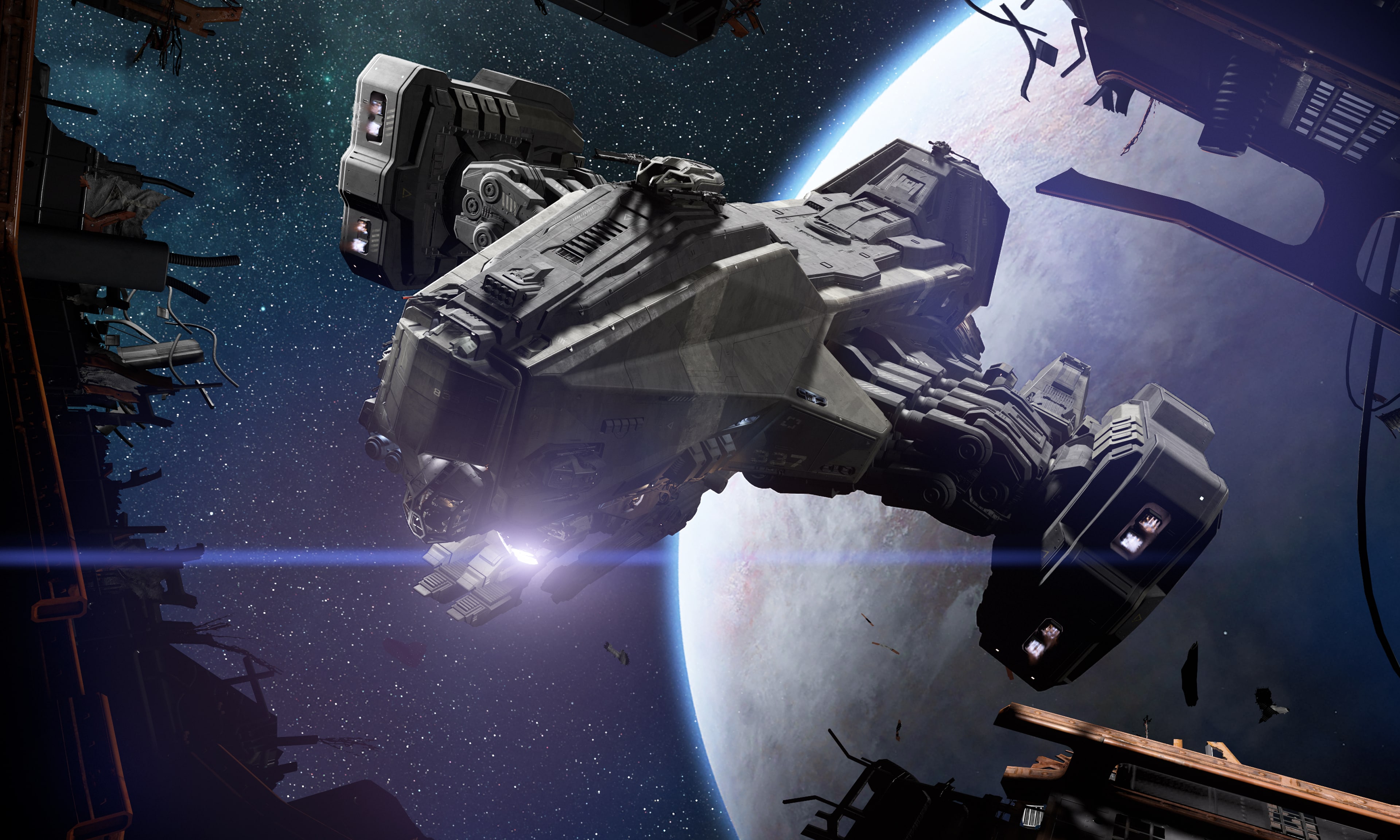
By the fourth decade of the 29th century, Origin Jumpworks had cemented their reputation as a major player in the burgeoning personal spacecraft industry with several lines of accessible, luxury oriented spacecraft that offered distinct alternatives to the output of its contemporary rivals. Origin designs belied the company’s industrial beginnings and largely focused on smaller-crewed and single-seat vessels, each reinforcing the sense that every individual piece was as carefully considered as those of a classic timepiece. Then, in 2852, acting CEO Kain Yolsen made a public announcement that shocked both industry watchers and his own board of executives alike: Origin would risk billions on the creation of a “flagship of the fleet.” That flagship, he further specified, would be known as the 890 Jump, following Origin’s unpredictable system of numbering new spacecraft designs rather than naming them. Before the development of the 890 Jump, high-end corporate spacecraft were a mixed bag of conversions and custom designs, with the ultra-rich favoring everything from adapting surplus military cruisers to constructing purpose-built hulls around standardized cargo ship components. These approaches could cost hundreds of millions of credits and would invariably lead to high running costs and demanding maintenance schedules, making the pursuit tolerable only by a tiny percentage of the potential audience. The 890 Jump, Yolsen announced, would completely change the game by making the personal corporate starship easily accessible to the very and ultra-rich alike.
The only problem was that there was no 890 Jump. At the time of the project’s announcement, no development work had been done beyond the determination that such a spacecraft had potential buyers. It quickly came out that Origin’s financial analysts hadn’t studied the costs of designing and constructing a ship significantly larger than anything in their history, nor had they considered the massive outlay of outfitting facilities and production lines. Yolsen was undeterred, promising Origin’s full resources to making the 890 Jump a true shift in luxury space travel.
To develop the 890 Jump’s overall look, Origin eschewed ordinary spacecraft engineers in favor of contracting industrial designer, Hadrian Wells, who began his time on the project by stating that the spacecraft “must look as at home on the sea as in the stars.” In 2852, this was easier said than done. It was only in recent years that single-seat ships had begun to escape the function-as-form approach that had defined human spacecraft for centuries. Both military and civilian space-faring vehicles of the era were extremely modular and completely utilitarian; full of harsh lines designed to weather the extreme dangers of the vacuum and to function in extant dockyard facilities rather than with an eye to impressing onlookers. The idea that a hundred-plus meter capital ship would be designed around any aesthetic beyond being a capital ship was a genuine shock.
Origin’s development team persisted and within 18 months developed a reasonable (albeit expensive) plan for both the 890 Jump’s overall design and construction. The company invested heavily in broad simulations early in order to allow the 890 Jump to make use of existing docking facilities and repair yards despite its significantly different design aesthetic. The biggest problem for the company was that, for perhaps the first time in modern aerospace history, the industry knew that this was happening. To this day, ship developers typically do not announce projects until either a military contract has been signed or, in the case of civil designs, a functional prototype has flown. The 890 Jump, already an unusual prospect in its own right, was being put together in the eyes of hostile competitors and a bemused press. From day one of Yolsen’s announcement, the 890 Jump was pilloried as everything from a go-nowhere fool’s errand to a criminal waste of a previously successful company’s resources. Few headlines were kind and as the lead prototype’s construction ran into the usual series of snags and issues, the press decried Yolsen’s “fifty billion credit disaster.”
As a result, Origin’s stock fell significantly despite general success across all of their current production lines. Then, just over two years after the first mention of the project, the company went silent. Origin ceased issuing updates on the 890 Jump and restructured the project’s organization to bring it into what internal memos referred to as “the event horizon.” Until the first ship was spaceworthy, the 890 Jump would not be mentioned directly. The tenor of the press changed overnight; where reporters once sought to turn typical teething issues into worrisome projections about Origin’s future, they became increasingly desperate to know what had happened to the ship. “JUMPED OUT?” read a famous Mars Today headline that speculated that Origin had secretly canceled the project or, perhaps, was intending to convert their existing work into a new type of high-end cargo transport. Ultimately, the gambit worked – stock prices stabilized and the 890 Jump faded into the public’s memory as the long process of designing and building both a new kind of starship and the infrastructure needed to support it continued behind the scenes. On March 2857, at a special event in Earth’s orbit, Origin lifted the veil and revealed the production prototype of the 890 Jump to an eager audience. Between its flowing nautical lines, surprising functionality, and unparalleled in-class specifications, the new design was an immediate hit. Overnight, the mood changed completely. Outlet after outlet asked variations of the same question: “Is this the future of spaceflight?” When markets opened the following day, Origin reached a new high and continued climbing well through the 890 Jump’s release the next year. The company had seemingly done what had seemed to onlookers completely impossible by building the elite luxury flagship Yolsen had announced six years earlier.
Over the following nine months and as the first prototypes went through certification and the assembly lines began to spin up, Origin promoted the ship to what they initially feared was a galaxy not ready to accept such a radical design. The company spent significant sums marketing the distinct new look of the 890 Jump, attempting to associate it with luxury in all of the typical ways: 890 Jumps pictured over grand tropical vistas, positioned near beautiful interstellar phenomena, and carrying noted celebrities and popular politicians in extreme luxury. Their post mortem would suggest this was unnecessary and, in fact, the 890 Jump remains the only Origin spacecraft ever to have its marketing budget lowered in the first three months after launch. New and hopeful owners were eager to spread the word about the new ship as far and wide as possible and preorders for hull allocation quickly filled up for seven years’ worth of production. Over the next decade, Origin would struggle to keep up with demand for the ship as it became clear that anyone who was anyone wanted their own luxury space platform.
Throughout the following century, Origin continued to improve the 890 Jump without significantly altering Wells’ original silhouette. Although there have been nineteen models of Jump released during its lifetime to date (not including dozens of custom models outfitted for elite customers), almost all of them have been minor modifications aimed at either upgrading the spacecraft’s technology to adapt to modern developments or at revamping the ship’s interior to keep it aligned with the current generation’s definition of luxury. Origin has continued to pay special attention to making sure the ship remains in the public consciousness, going so far as to employ a dedicated media relations department to pitch and manage 890 Jump appearances in films, vid series, and other media. The greatest challenge of the project, Wells noted as he departed the company following the 2858 launch, would not be the work they had put into building such an unlikely design. Rather, it would be making sure that the design continues to resonate with customers as it becomes more commonplace. By all accounts, Origin has managed exactly this for almost a century.
The major change to the standard package came in 2943 when Origin added launch capabilities and revealed the custom-designed 85x Limited snub craft, which would become a permanent inclusion with all 890 Jump orders. In October 2944, Origin CEO Jennifer Friskers announced that the latest iteration of the Jump was ready to enter production, featuring the addition of a swimming pool and other amenities deemed most appropriate for the celebrity buyers of the mid 2940s.
Dieser Artikel erschien ursprünglich in Jump Point 7.6.
Origin Jumpworks 890 Jump
ENTWICKLUNGSGESCHICHTE
Im vierten Jahrzehnt des 29. Jahrhunderts hatte Origin Jumpworks seinen Ruf als einer der Hauptakteure in der aufstrebenden Raumschiffindustrie gefestigt, indem es eine Reihe von erschwinglichen, luxuriösen Raumschiffen herstellte, die eine deutliche Alternative zu den Produkten der Konkurrenz darstellten. Die Origin-Designs verrieten die industriellen Anfänge des Unternehmens und konzentrierten sich hauptsächlich auf kleinere Raumschiffe mit Besatzung und Einzelsitzen, die das Gefühl vermittelten, dass jedes einzelne Teil so sorgfältig durchdacht war wie ein klassisches Uhrwerk. Dann, im Jahr 2852, machte der amtierende CEO Kain Yolsen eine öffentliche Ankündigung, die sowohl Branchenbeobachter als auch seinen eigenen Vorstand schockierte: Origin würde Milliarden für den Bau eines "Flaggschiffs der Flotte" riskieren. Dieses Flaggschiff, so Yolsen weiter, würde den Namen 890 Jump tragen und damit Origins unvorhersehbarem System folgen, bei dem neue Raumschiffdesigns nummeriert und nicht benannt werden. Vor der Entwicklung des 890 Jump waren High-End-Raumschiffe für Unternehmen eine bunte Mischung aus Umbauten und Sonderanfertigungen, wobei die Superreichen alles Mögliche bevorzugten, von der Umrüstung überschüssiger Militärkreuzer bis hin zum Bau von Spezialhüllen aus standardisierten Frachtschiffkomponenten. Diese Ansätze konnten Hunderte von Millionen Credits kosten und führten unweigerlich zu hohen Betriebskosten und anspruchsvollen Wartungsplänen, so dass sie nur für einen winzigen Prozentsatz des potenziellen Publikums erträglich waren. Der 890 Jump, so kündigte Yolsen an, würde das Spiel komplett verändern, indem er das persönliche Firmenraumschiff für sehr reiche und ultra-reiche Menschen leicht zugänglich macht.
Das einzige Problem war, dass es keinen 890 Jump gab. Zum Zeitpunkt der Ankündigung des Projekts war noch keine Entwicklungsarbeit geleistet worden, abgesehen von der Feststellung, dass es für ein solches Raumschiff potenzielle Käufer gab. Es stellte sich schnell heraus, dass die Finanzanalysten von Origin weder die Kosten für die Entwicklung und den Bau eines Raumschiffs, das deutlich größer ist als alle anderen in der Geschichte des Unternehmens, noch die massiven Kosten für die Ausstattung der Anlagen und Produktionslinien berücksichtigt hatten. Yolsen ließ sich nicht entmutigen und versprach, dass Origin alle Ressourcen einsetzen würde, um die 890 Jump zu einem echten Fortschritt in der Luxus-Raumfahrt zu machen.
Um das Aussehen des 890 Jump zu entwickeln, verzichtete Origin auf gewöhnliche Raumfahrtingenieure und beauftragte stattdessen den Industriedesigner Hadrian Wells, der seine Arbeit an dem Projekt mit der Aussage begann, dass das Raumschiff "auf dem Meer genauso gut aussehen muss wie auf den Sternen". Im Jahr 2852 war das leichter gesagt als getan. Erst in den letzten Jahren hatten die einsitzigen Raumschiffe begonnen, sich von dem "Funktion-als-Form"-Ansatz zu lösen, der die menschlichen Raumfahrzeuge seit Jahrhunderten geprägt hatte. Sowohl die militärischen als auch die zivilen Raumfahrzeuge der damaligen Zeit waren extrem modular und völlig utilitaristisch; voller harter Linien, die entwickelt wurden, um den extremen Gefahren des Vakuums zu trotzen und um in den vorhandenen Werftanlagen zu funktionieren, anstatt Schaulustige zu beeindrucken. Die Vorstellung, dass ein über hundert Meter langes Großraumschiff nicht nur aus ästhetischen Gründen entworfen werden sollte, war ein echter Schock.
Origins Entwicklungsteam blieb hartnäckig und entwickelte innerhalb von 18 Monaten einen vernünftigen (wenn auch teuren) Plan für das Gesamtdesign und die Konstruktion der 890 Jump. Das Unternehmen investierte frühzeitig in umfangreiche Simulationen, damit die 890 Jump trotz ihres deutlich anderen Designs die bestehenden Andockstellen und Reparaturwerften nutzen konnte. Das größte Problem für das Unternehmen war, dass die Branche vielleicht zum ersten Mal in der modernen Geschichte der Luft- und Raumfahrt wusste, dass dies geschah. Bis heute geben Schiffsentwickler ihre Projekte in der Regel erst dann bekannt, wenn entweder ein militärischer Vertrag unterzeichnet wurde oder - im Falle von zivilen Entwürfen - ein funktionsfähiger Prototyp geflogen ist. Die 890 Jump, die an sich schon ein ungewöhnliches Projekt war, wurde unter den Augen feindlicher Konkurrenten und einer verwirrten Presse entwickelt. Vom ersten Tag an, als Yolsen das Projekt ankündigte, wurde der 890 Jump an den Pranger gestellt - von einem sinnlosen Unterfangen bis hin zu einer kriminellen Verschwendung der Ressourcen eines zuvor erfolgreichen Unternehmens. Nur wenige Schlagzeilen waren wohlwollend, und als die Konstruktion des Prototyps auf die üblichen Schwierigkeiten und Probleme stieß, sprach die Presse von einem "Fünfzig-Milliarden-Kredit-Desaster" für Yolsen.
Infolgedessen sank der Aktienkurs von Origin trotz des allgemeinen Erfolgs in allen laufenden Produktionslinien erheblich. Etwas mehr als zwei Jahre nach der ersten Erwähnung des Projekts wurde es still um das Unternehmen. Origin hörte auf, Updates zum 890 Jump herauszugeben und strukturierte die Organisation des Projekts um, um es in das zu bringen, was in internen Notizen als "der Ereignishorizont" bezeichnet wurde. Bis das erste Schiff weltraumtauglich war, wurde der 890 Jump nicht mehr direkt erwähnt. Der Tenor der Presse änderte sich über Nacht; wo die Reporter früher versuchten, typische Kinderkrankheiten in besorgniserregende Prognosen über die Zukunft von Origin zu verwandeln, wollten sie nun immer verzweifelter wissen, was mit dem Schiff passiert war. "Rausgesprungen?", lautete eine berühmte Schlagzeile von Mars Today, in der spekuliert wurde, dass Origin das Projekt heimlich abgebrochen hatte oder vielleicht beabsichtigte, die bestehenden Arbeiten in eine neue Art von hochwertigem Frachttransport umzuwandeln. Letztendlich funktionierte der Schachzug - die Aktienkurse stabilisierten sich und der 890 Jump verschwand aus dem Gedächtnis der Öffentlichkeit, während der lange Prozess der Entwicklung und des Baus eines neuartigen Raumschiffs und der dafür notwendigen Infrastruktur hinter den Kulissen weiterging. Im März 2857 lüftete Origin auf einer besonderen Veranstaltung im Orbit der Erde den Schleier und enthüllte den Produktionsprototyp der 890 Jump vor einem gespannten Publikum. Mit seinen fließenden, nautischen Linien, seiner überraschenden Funktionalität und seinen unvergleichlichen Spezifikationen war das neue Design sofort ein Hit. Über Nacht änderte sich die Stimmung komplett. Ein Outlet nach dem anderen stellte die gleiche Frage: "Ist das die Zukunft der Raumfahrt?" Als die Märkte am nächsten Tag öffneten, erreichte Origin einen neuen Höchststand und kletterte bis zur Veröffentlichung des 890 Jump im nächsten Jahr weiter. Das Unternehmen hatte scheinbar geschafft, was den Beobachtern völlig unmöglich erschien, nämlich das Luxus-Flaggschiff der Elite zu bauen, das Yolsen sechs Jahre zuvor angekündigt hatte.
In den folgenden neun Monaten, als die ersten Prototypen die Zertifizierung durchliefen und die Fließbänder hochgefahren wurden, warb Origin für das Schiff in einer Galaxie, von der man anfangs befürchtete, dass sie nicht bereit sei, ein so radikales Design zu akzeptieren. Das Unternehmen gab viel Geld aus, um den neuen Look des 890 Jump zu vermarkten, und versuchte, ihn auf die typische Weise mit Luxus zu assoziieren: 890 Jumps wurden über großartigen tropischen Landschaften abgebildet, in der Nähe wunderschöner interstellarer Phänomene positioniert und beförderten berühmte Persönlichkeiten und beliebte Politiker in extremem Luxus. Tatsächlich ist der 890 Jump das einzige Origin-Raumschiff, bei dem das Marketingbudget in den ersten drei Monaten nach dem Start gekürzt wurde. Neue und hoffnungsvolle Besitzer waren eifrig dabei, das neue Schiff so weit wie möglich bekannt zu machen, und die Vorbestellungen für die Rumpfflugzeuge, die sieben Jahre lang produziert werden sollten, waren schnell ausgebucht. In den nächsten zehn Jahren hatte Origin Mühe, mit der Nachfrage nach dem Schiff Schritt zu halten, denn es wurde deutlich, dass jeder, der etwas auf sich hielt, seine eigene Luxus-Raumplattform haben wollte.
Im Laufe des folgenden Jahrhunderts verbesserte Origin die 890 Jump immer weiter, ohne die ursprüngliche Silhouette von Wells wesentlich zu verändern. Obwohl bis heute neunzehn Jump-Modelle auf den Markt gekommen sind (Dutzende von Sondermodellen für Elitekunden nicht mitgerechnet), handelte es sich bei fast allen um kleinere Modifikationen, die entweder darauf abzielten, die Technologie des Raumschiffs auf den neuesten Stand zu bringen oder das Innere des Schiffes zu überarbeiten, um es an die Definition von Luxus der heutigen Generation anzupassen. Origin hat sich auch weiterhin besonders darum bemüht, dass das Schiff im Bewusstsein der Öffentlichkeit bleibt. Das geht so weit, dass eine eigene Abteilung für Medienarbeit damit beauftragt wurde, 890 Jump-Auftritte in Filmen, Videoserien und anderen Medien zu organisieren. Als Wells das Unternehmen nach dem Start von 2858 verließ, stellte er fest, dass die größte Herausforderung des Projekts nicht die Arbeit war, die sie in den Bau eines so ungewöhnlichen Designs gesteckt hatten. Vielmehr muss sichergestellt werden, dass das Design bei den Kunden weiterhin Anklang findet, wenn es alltäglich wird. Nach allem, was man hört, hat Origin genau das seit fast einem Jahrhundert geschafft.
Die größte Änderung des Standardpakets kam 2943, als Origin die Startfähigkeiten hinzufügte und das speziell entworfene 85x Limited Snub Craft enthüllte, das bei allen 890 Jump-Bestellungen zum festen Bestandteil werden sollte. Im Oktober 2944 verkündete Jennifer Friskers, die Geschäftsführerin von Origin, dass die neueste Version der Jump bereit für die Produktion war und mit einem Swimmingpool und anderen Annehmlichkeiten ausgestattet war, die den prominenten Käufern Mitte der 2940er Jahre am besten passten.
This article originally appeared in Jump Point 7.6.
Origin Jumpworks 890 Jump
DEVELOPMENT HISTORY
By the fourth decade of the 29th century, Origin Jumpworks had cemented their reputation as a major player in the burgeoning personal spacecraft industry with several lines of accessible, luxury oriented spacecraft that offered distinct alternatives to the output of its contemporary rivals. Origin designs belied the company’s industrial beginnings and largely focused on smaller-crewed and single-seat vessels, each reinforcing the sense that every individual piece was as carefully considered as those of a classic timepiece. Then, in 2852, acting CEO Kain Yolsen made a public announcement that shocked both industry watchers and his own board of executives alike: Origin would risk billions on the creation of a “flagship of the fleet.” That flagship, he further specified, would be known as the 890 Jump, following Origin’s unpredictable system of numbering new spacecraft designs rather than naming them. Before the development of the 890 Jump, high-end corporate spacecraft were a mixed bag of conversions and custom designs, with the ultra-rich favoring everything from adapting surplus military cruisers to constructing purpose-built hulls around standardized cargo ship components. These approaches could cost hundreds of millions of credits and would invariably lead to high running costs and demanding maintenance schedules, making the pursuit tolerable only by a tiny percentage of the potential audience. The 890 Jump, Yolsen announced, would completely change the game by making the personal corporate starship easily accessible to the very and ultra-rich alike.
The only problem was that there was no 890 Jump. At the time of the project’s announcement, no development work had been done beyond the determination that such a spacecraft had potential buyers. It quickly came out that Origin’s financial analysts hadn’t studied the costs of designing and constructing a ship significantly larger than anything in their history, nor had they considered the massive outlay of outfitting facilities and production lines. Yolsen was undeterred, promising Origin’s full resources to making the 890 Jump a true shift in luxury space travel.
To develop the 890 Jump’s overall look, Origin eschewed ordinary spacecraft engineers in favor of contracting industrial designer, Hadrian Wells, who began his time on the project by stating that the spacecraft “must look as at home on the sea as in the stars.” In 2852, this was easier said than done. It was only in recent years that single-seat ships had begun to escape the function-as-form approach that had defined human spacecraft for centuries. Both military and civilian space-faring vehicles of the era were extremely modular and completely utilitarian; full of harsh lines designed to weather the extreme dangers of the vacuum and to function in extant dockyard facilities rather than with an eye to impressing onlookers. The idea that a hundred-plus meter capital ship would be designed around any aesthetic beyond being a capital ship was a genuine shock.
Origin’s development team persisted and within 18 months developed a reasonable (albeit expensive) plan for both the 890 Jump’s overall design and construction. The company invested heavily in broad simulations early in order to allow the 890 Jump to make use of existing docking facilities and repair yards despite its significantly different design aesthetic. The biggest problem for the company was that, for perhaps the first time in modern aerospace history, the industry knew that this was happening. To this day, ship developers typically do not announce projects until either a military contract has been signed or, in the case of civil designs, a functional prototype has flown. The 890 Jump, already an unusual prospect in its own right, was being put together in the eyes of hostile competitors and a bemused press. From day one of Yolsen’s announcement, the 890 Jump was pilloried as everything from a go-nowhere fool’s errand to a criminal waste of a previously successful company’s resources. Few headlines were kind and as the lead prototype’s construction ran into the usual series of snags and issues, the press decried Yolsen’s “fifty billion credit disaster.”
As a result, Origin’s stock fell significantly despite general success across all of their current production lines. Then, just over two years after the first mention of the project, the company went silent. Origin ceased issuing updates on the 890 Jump and restructured the project’s organization to bring it into what internal memos referred to as “the event horizon.” Until the first ship was spaceworthy, the 890 Jump would not be mentioned directly. The tenor of the press changed overnight; where reporters once sought to turn typical teething issues into worrisome projections about Origin’s future, they became increasingly desperate to know what had happened to the ship. “JUMPED OUT?” read a famous Mars Today headline that speculated that Origin had secretly canceled the project or, perhaps, was intending to convert their existing work into a new type of high-end cargo transport. Ultimately, the gambit worked – stock prices stabilized and the 890 Jump faded into the public’s memory as the long process of designing and building both a new kind of starship and the infrastructure needed to support it continued behind the scenes. On March 2857, at a special event in Earth’s orbit, Origin lifted the veil and revealed the production prototype of the 890 Jump to an eager audience. Between its flowing nautical lines, surprising functionality, and unparalleled in-class specifications, the new design was an immediate hit. Overnight, the mood changed completely. Outlet after outlet asked variations of the same question: “Is this the future of spaceflight?” When markets opened the following day, Origin reached a new high and continued climbing well through the 890 Jump’s release the next year. The company had seemingly done what had seemed to onlookers completely impossible by building the elite luxury flagship Yolsen had announced six years earlier.
Over the following nine months and as the first prototypes went through certification and the assembly lines began to spin up, Origin promoted the ship to what they initially feared was a galaxy not ready to accept such a radical design. The company spent significant sums marketing the distinct new look of the 890 Jump, attempting to associate it with luxury in all of the typical ways: 890 Jumps pictured over grand tropical vistas, positioned near beautiful interstellar phenomena, and carrying noted celebrities and popular politicians in extreme luxury. Their post mortem would suggest this was unnecessary and, in fact, the 890 Jump remains the only Origin spacecraft ever to have its marketing budget lowered in the first three months after launch. New and hopeful owners were eager to spread the word about the new ship as far and wide as possible and preorders for hull allocation quickly filled up for seven years’ worth of production. Over the next decade, Origin would struggle to keep up with demand for the ship as it became clear that anyone who was anyone wanted their own luxury space platform.
Throughout the following century, Origin continued to improve the 890 Jump without significantly altering Wells’ original silhouette. Although there have been nineteen models of Jump released during its lifetime to date (not including dozens of custom models outfitted for elite customers), almost all of them have been minor modifications aimed at either upgrading the spacecraft’s technology to adapt to modern developments or at revamping the ship’s interior to keep it aligned with the current generation’s definition of luxury. Origin has continued to pay special attention to making sure the ship remains in the public consciousness, going so far as to employ a dedicated media relations department to pitch and manage 890 Jump appearances in films, vid series, and other media. The greatest challenge of the project, Wells noted as he departed the company following the 2858 launch, would not be the work they had put into building such an unlikely design. Rather, it would be making sure that the design continues to resonate with customers as it becomes more commonplace. By all accounts, Origin has managed exactly this for almost a century.
The major change to the standard package came in 2943 when Origin added launch capabilities and revealed the custom-designed 85x Limited snub craft, which would become a permanent inclusion with all 890 Jump orders. In October 2944, Origin CEO Jennifer Friskers announced that the latest iteration of the Jump was ready to enter production, featuring the addition of a swimming pool and other amenities deemed most appropriate for the celebrity buyers of the mid 2940s.
This article originally appeared in Jump Point 7.6.
Origin Jumpworks 890 Jump
DEVELOPMENT HISTORY
By the fourth decade of the 29th century, Origin Jumpworks had cemented their reputation as a major player in the burgeoning personal spacecraft industry with several lines of accessible, luxury oriented spacecraft that offered distinct alternatives to the output of its contemporary rivals. Origin designs belied the company’s industrial beginnings and largely focused on smaller-crewed and single-seat vessels, each reinforcing the sense that every individual piece was as carefully considered as those of a classic timepiece. Then, in 2852, acting CEO Kain Yolsen made a public announcement that shocked both industry watchers and his own board of executives alike: Origin would risk billions on the creation of a “flagship of the fleet.” That flagship, he further specified, would be known as the 890 Jump, following Origin’s unpredictable system of numbering new spacecraft designs rather than naming them. Before the development of the 890 Jump, high-end corporate spacecraft were a mixed bag of conversions and custom designs, with the ultra-rich favoring everything from adapting surplus military cruisers to constructing purpose-built hulls around standardized cargo ship components. These approaches could cost hundreds of millions of credits and would invariably lead to high running costs and demanding maintenance schedules, making the pursuit tolerable only by a tiny percentage of the potential audience. The 890 Jump, Yolsen announced, would completely change the game by making the personal corporate starship easily accessible to the very and ultra-rich alike.
The only problem was that there was no 890 Jump. At the time of the project’s announcement, no development work had been done beyond the determination that such a spacecraft had potential buyers. It quickly came out that Origin’s financial analysts hadn’t studied the costs of designing and constructing a ship significantly larger than anything in their history, nor had they considered the massive outlay of outfitting facilities and production lines. Yolsen was undeterred, promising Origin’s full resources to making the 890 Jump a true shift in luxury space travel.
To develop the 890 Jump’s overall look, Origin eschewed ordinary spacecraft engineers in favor of contracting industrial designer, Hadrian Wells, who began his time on the project by stating that the spacecraft “must look as at home on the sea as in the stars.” In 2852, this was easier said than done. It was only in recent years that single-seat ships had begun to escape the function-as-form approach that had defined human spacecraft for centuries. Both military and civilian space-faring vehicles of the era were extremely modular and completely utilitarian; full of harsh lines designed to weather the extreme dangers of the vacuum and to function in extant dockyard facilities rather than with an eye to impressing onlookers. The idea that a hundred-plus meter capital ship would be designed around any aesthetic beyond being a capital ship was a genuine shock.
Origin’s development team persisted and within 18 months developed a reasonable (albeit expensive) plan for both the 890 Jump’s overall design and construction. The company invested heavily in broad simulations early in order to allow the 890 Jump to make use of existing docking facilities and repair yards despite its significantly different design aesthetic. The biggest problem for the company was that, for perhaps the first time in modern aerospace history, the industry knew that this was happening. To this day, ship developers typically do not announce projects until either a military contract has been signed or, in the case of civil designs, a functional prototype has flown. The 890 Jump, already an unusual prospect in its own right, was being put together in the eyes of hostile competitors and a bemused press. From day one of Yolsen’s announcement, the 890 Jump was pilloried as everything from a go-nowhere fool’s errand to a criminal waste of a previously successful company’s resources. Few headlines were kind and as the lead prototype’s construction ran into the usual series of snags and issues, the press decried Yolsen’s “fifty billion credit disaster.”
As a result, Origin’s stock fell significantly despite general success across all of their current production lines. Then, just over two years after the first mention of the project, the company went silent. Origin ceased issuing updates on the 890 Jump and restructured the project’s organization to bring it into what internal memos referred to as “the event horizon.” Until the first ship was spaceworthy, the 890 Jump would not be mentioned directly. The tenor of the press changed overnight; where reporters once sought to turn typical teething issues into worrisome projections about Origin’s future, they became increasingly desperate to know what had happened to the ship. “JUMPED OUT?” read a famous Mars Today headline that speculated that Origin had secretly canceled the project or, perhaps, was intending to convert their existing work into a new type of high-end cargo transport. Ultimately, the gambit worked – stock prices stabilized and the 890 Jump faded into the public’s memory as the long process of designing and building both a new kind of starship and the infrastructure needed to support it continued behind the scenes. On March 2857, at a special event in Earth’s orbit, Origin lifted the veil and revealed the production prototype of the 890 Jump to an eager audience. Between its flowing nautical lines, surprising functionality, and unparalleled in-class specifications, the new design was an immediate hit. Overnight, the mood changed completely. Outlet after outlet asked variations of the same question: “Is this the future of spaceflight?” When markets opened the following day, Origin reached a new high and continued climbing well through the 890 Jump’s release the next year. The company had seemingly done what had seemed to onlookers completely impossible by building the elite luxury flagship Yolsen had announced six years earlier.
Over the following nine months and as the first prototypes went through certification and the assembly lines began to spin up, Origin promoted the ship to what they initially feared was a galaxy not ready to accept such a radical design. The company spent significant sums marketing the distinct new look of the 890 Jump, attempting to associate it with luxury in all of the typical ways: 890 Jumps pictured over grand tropical vistas, positioned near beautiful interstellar phenomena, and carrying noted celebrities and popular politicians in extreme luxury. Their post mortem would suggest this was unnecessary and, in fact, the 890 Jump remains the only Origin spacecraft ever to have its marketing budget lowered in the first three months after launch. New and hopeful owners were eager to spread the word about the new ship as far and wide as possible and preorders for hull allocation quickly filled up for seven years’ worth of production. Over the next decade, Origin would struggle to keep up with demand for the ship as it became clear that anyone who was anyone wanted their own luxury space platform.
Throughout the following century, Origin continued to improve the 890 Jump without significantly altering Wells’ original silhouette. Although there have been nineteen models of Jump released during its lifetime to date (not including dozens of custom models outfitted for elite customers), almost all of them have been minor modifications aimed at either upgrading the spacecraft’s technology to adapt to modern developments or at revamping the ship’s interior to keep it aligned with the current generation’s definition of luxury. Origin has continued to pay special attention to making sure the ship remains in the public consciousness, going so far as to employ a dedicated media relations department to pitch and manage 890 Jump appearances in films, vid series, and other media. The greatest challenge of the project, Wells noted as he departed the company following the 2858 launch, would not be the work they had put into building such an unlikely design. Rather, it would be making sure that the design continues to resonate with customers as it becomes more commonplace. By all accounts, Origin has managed exactly this for almost a century.
The major change to the standard package came in 2943 when Origin added launch capabilities and revealed the custom-designed 85x Limited snub craft, which would become a permanent inclusion with all 890 Jump orders. In October 2944, Origin CEO Jennifer Friskers announced that the latest iteration of the Jump was ready to enter production, featuring the addition of a swimming pool and other amenities deemed most appropriate for the celebrity buyers of the mid 2940s.
Links
No links available.


Metadata
- CIG ID
- 19844
- Channel
- Spectrum Dispatch
- Category
- Undefined
- Series
- News Update
- Comments
- 25
- Published
- 2 years ago (2024-03-12T00:00:00+00:00)