Whitley's Guide - Vulture
Spectrum Dispatch Undefined News UpdateContent
This article originally appeared in Jump Point 7.8.
Drake Interplanetary Vulture
THE HUNT
Most spacecraft have a common point of origin – they’re developed to military specification or they’re designed to fill a market need for civilians or corporate groups. The Drake Interplanetary Vulture has a different story – its development originates from a rush to complete a treasure hunt. On the 9th of August 2895, the Terra-flagged freighter Empire Slipper suffered what was later determined to be an unlikely cascade of system failures which resulted in the bridge terminals receiving a completely incorrect set of navigation overlays. The error caused Slipper’s navigation officer to chart a course into a dense asteroid belt within close proximity to the danger zone of a red giant’s corona. A debris strike subsequently disabled the aging freighter’s shield generators and unfortunately delivered a dose of fatal radiation to the crew. Empire Slipper was left adrift, its specific location unknown. As the freighter was known to be carrying a wealth of precious metals and a consignment of rare artwork, intense media interest and a massive search and recovery operation followed. After eight months of searches, a UEEN picket ship identified the wreckage of the Slipper adrift in the irradiated debris belt, putting an end to conspiracy theories that the freighter had been hijacked. However, it quickly became clear that the region was practically inaccessible to any dedicated salvage ship with enough protection to survive the operation. MISC, the transport’s builder, offered a ten million credit bounty to anyone capable of recovering the black box data recorder in an effort to explain what had happened.
Unexpectedly, upstart spacecraft manufacturer Drake Interplanetary came to the rescue. Seeking both the bounty and the salvage rights to the Slipper’s cargo, an elite team convened on Borea to create a makeshift spacecraft capable of solving this peculiar problem. The basis for this oneoff construction was an existing AS-1 Cutlass prototype, Vertical Landing Test 3 (VLT-3). With all testing equipment removed, VLT-3 quickly became a specialized platform intended to reach the Empire Slipper and recover its cargo. Heavy shield generators replaced much of the prototype ship’s standard cargo capacity and a pair of versatile remote manipulator arms were bolted to the prow. The result was something unlike any other spacecraft currently flying: an over-shielded, underpowered amalgamation that was small enough to navigate the debris field while keeping its crew of two safe. What’s more, VLT-3 could engage in the necessary salvage operations using its external arms without requiring EVA, which was made impossible by the amount of radiation involved.
Fourteen months after the Empire Slipper disappeared, Drake’s test crew began salvage operations from a hastily established modular space station positioned just outside the danger zone. Over the course of thirty-six perilous expeditions, VLT-3 repeatedly entered the debris field and carefully removed the Slipper’s flight recorders and then, one by one, the valuable cargo containers. Drake claimed and received salvage rights for the valuable cargo and promptly delivered the recovered flight recorders to MISC. However, the promised ten million credits did not materialize as Drake executives were ultimately taken to court over the bounty when it was discovered that they had covertly opened and copied the flight data aboard a runner ship before passing it along.
PRODUCTION MODELS
The success of VLT-3’s mission wasn’t only beneficial to Drake’s bottom line. Public fascination with the lost freighter gave the company’s recovery mission significant airplay and was seen as a positive reprieve for the corporation, which was battling accusations of profiting from piracy. For a time, Drake was seen as a positive if rough force just as the small personal spacecraft market was beginning to heat up. To play off this success, the company sent VLT-3, its paint seared off and hull covered with micrometeoroid impacts, on a nine system PR tour to be displayed at aerospace shows and museum exhibits.
Excitement over the feat faded and Drake soon found itself again mired in controversy. VLT-3 was put back into storage just as the corporation was again accused of supporting piracy following the coordinated destruction of a MISC Hull-D by four unmarked Cutlasses. The company seemed to have little interest in the formal development of a salvage ship and instead moved its focus to the Caterpillar command ship concept.
In 2932, an Aegis Dynamics Reclaimer, the General Dogsbody, made history with the single most profitable salvage mission in human history when it discovered and recovered a failed 22nd-century colony ship adrift in deep space. The ship’s crew became millionaires and minor celebrities overnight and the event prompted much greater interest in the previously uncelebrated task of space salvage. As interest in salvage boomed and crews began pooling money to purchase their own Reclaimer platforms, Drake executives realized they already had a more appealing option in their back pocket.
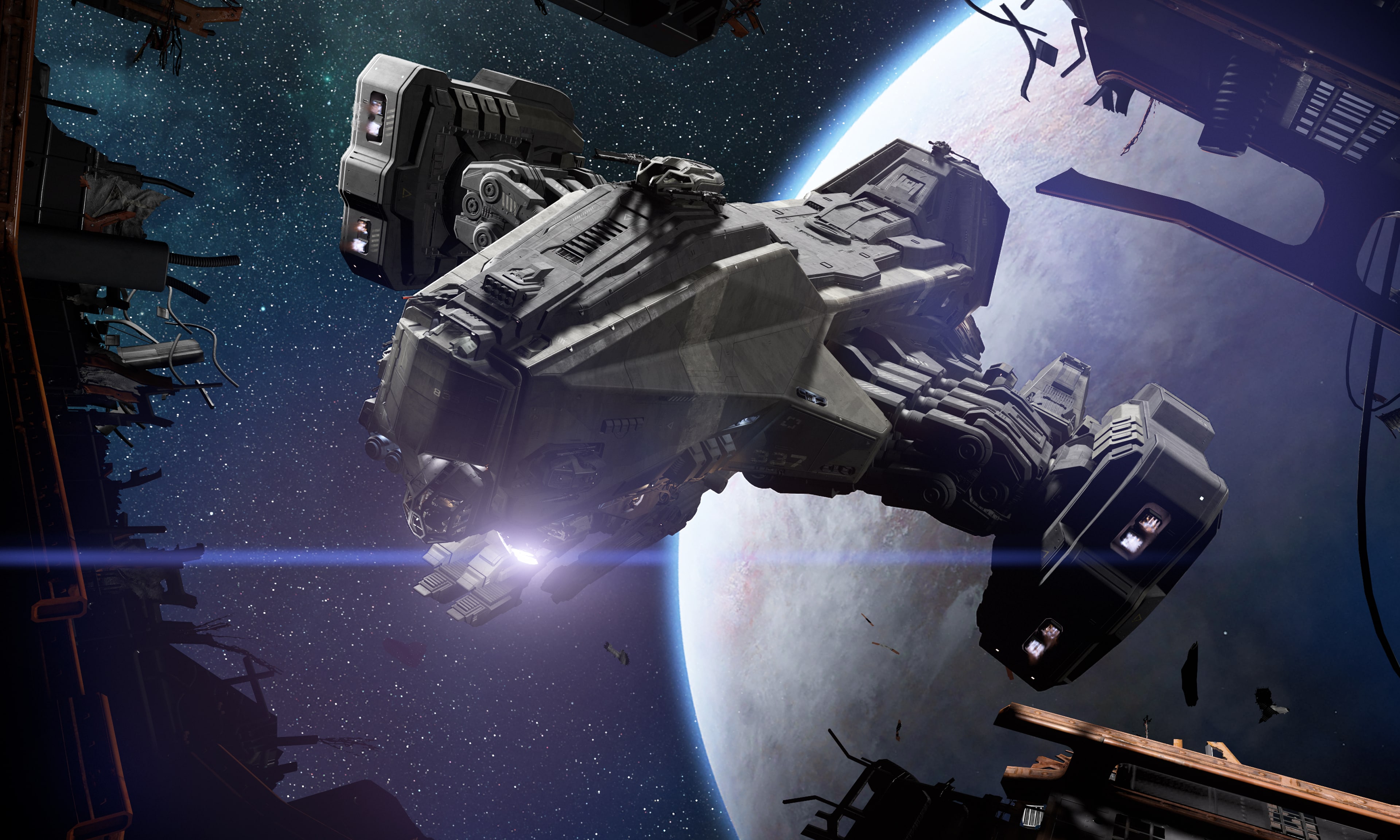
A team of aerospace engineers led by Drake’s in-house designer Sod Perkins began work on developing the VLT-3 concept into a standalone salvage spacecraft. While the new design would be built from the ground up and wouldn’t need the heavy shielding of the original, the overall layout and functionality would remain surprisingly similar to the prototype. The early manipulator arms were replaced with what Drake would ultimately call Rippers – stand-alone salvage booms supported by a Lariot tractor beam and Tomium scraper rig. These booms would allow the craft (soon named the Vulture) to identify, move, and cut space salvage and then store it in the ship’s rear bay. Like VLT-3, the production Vulture was oriented around shipboard controls rather than EVA support. The crew capacity was reduced from two to one, reinforcing the idea that a single pilot could operate a Vulture and potentially make their fortune the same way the Dogsbody’s crew had. A small rear living section would allow the solo operator to endure long voyages as salvage sites were rarely close to well-traveled spacelanes. Finally, the Vulture would feature maneuvering thrusters and an oversized shield generator to enable it to make careful movements not possible with larger ships like the Reclaimer.
Drake premiered the Vulture in 2938 with marketing that called back to the success of VLT-3, including stylizing the spacecraft’s name as VuLTur3 in some advertising. Public interest in salvage and personal fortune-seeking continued and orders quickly outpaced the production capacity at Borea. Within eight months, Drake was forced to open two remote factories to meet demand. While the company was roundly accused of over-promising inexperienced captains the chance to turn incredible profits by competing manufacturers, Vultures immediately found success with the discovery and parting of several high-profile hulls. These included a Genesis Starliner long thought destroyed and two Hull-As that had collided and spun away from their planned routes in an unexpected manner. These stories were major news and prompted continued interest in the Vulture.
In 2941, Drake launched the first updated model of the Vulture. While the first civilian release had been completely unarmed, the 2941 model added a pair of size one weapons mounts, which appealed to pilots who would be flying the ships in unsafe and unexplored areas of the galaxy. In 2943, the United Empire of Earth Navy requisitioned 300 Vultures for battlefield support operations. The military versions weren’t hardened and didn’t feature additional weapons as they were never intended for use in combat. Delivery of these ships began the following year where they immediately saw service with the fleet support arm, clearing destroyed spacecraft in the wake of ever-increasing battles with the Vanduul. Drake has continued to develop the government version of the Vulture, as the expectation is large-scale naval battles will only increase in frequency and furor in the years to come. The most recent civilian update was made for the 2949 model year, with the launch of the now-standard extended cab, which ups internal cargo capacity from 8 to 12 SCU. Drake currently offers a low-cost dealer upgrade for earlier Vultures to convert them to roughly the same capacity – a similar process has been made available for adding weapons mounts to the initial 2938 version.
Dieser Artikel erschien ursprünglich in Jump Point 7.8.
Drake Interplanetarer Geier
DIE JAGD
Die meisten Raumschiffe haben einen gemeinsamen Ausgangspunkt - sie werden nach militärischen Vorgaben entwickelt oder sie werden entworfen, um einen Marktbedarf für Zivilisten oder Konzerne zu decken. Der Drake Interplanetary Vulture hat eine andere Geschichte - seine Entwicklung geht auf eine überstürzte Schatzsuche zurück. Am 9. August 2895 kam es auf dem unter der Flagge von Terra fahrenden Frachter Empire Slipper zu einer unwahrscheinlichen Kaskade von Systemfehlern, die dazu führten, dass die Brückenterminals einen völlig falschen Satz von Navigations-Overlays empfingen. Der Fehler führte dazu, dass der Navigationsoffizier der Slipper einen Kurs in einen dichten Asteroidengürtel in unmittelbarer Nähe der Gefahrenzone der Korona eines Roten Riesen setzte. Ein Trümmerstück setzte daraufhin die Schildgeneratoren des alternden Frachters außer Betrieb und versetzte die Besatzung unglücklicherweise in eine tödliche Strahlendosis. Empire Slipper wurde treibend zurückgelassen, sein genauer Standort war unbekannt. Da bekannt war, dass der Frachter eine große Menge an Edelmetallen und seltenen Kunstwerken an Bord hatte, war das Medieninteresse groß und es wurde eine umfangreiche Such- und Bergungsaktion durchgeführt. Nach achtmonatiger Suche entdeckte ein Mahnwachschiff der UEEN das Wrack der Slipper im verstrahlten Trümmergürtel und beendete damit die Verschwörungstheorien, dass der Frachter gekapert worden war. Es wurde jedoch schnell klar, dass die Region für ein spezielles Bergungsschiff, das ausreichend geschützt war, um die Operation zu überleben, praktisch unzugänglich war. MISC, der Erbauer des Frachters, setzte ein Kopfgeld von zehn Millionen Credits auf denjenigen aus, der den Blackbox-Datenrekorder bergen kann, um zu erklären, was passiert war.
Unerwartet kam der aufstrebende Raumschiffhersteller Drake Interplanetary zur Rettung. Auf der Suche nach dem Kopfgeld und den Rechten an der Ladung der Slipper kam ein Eliteteam auf Borea zusammen, um ein behelfsmäßiges Raumschiff zu bauen, das dieses merkwürdige Problem lösen konnte. Die Grundlage für diese einmalige Konstruktion war ein bestehender AS-1 Cutlass-Prototyp, Vertical Landing Test 3 (VLT-3). Ohne die gesamte Testausrüstung wurde VLT-3 schnell zu einer spezialisierten Plattform, die das Empire Slipper erreichen und dessen Ladung bergen sollte. Schwere Schildgeneratoren ersetzten einen Großteil der Standard-Ladekapazität des Prototyps und ein Paar vielseitiger ferngesteuerter Manipulatorarme wurde an den Bug des Schiffes geschraubt. Das Ergebnis war etwas, das mit keinem anderen Raumschiff vergleichbar ist, das derzeit in der Luft ist: ein übermäßig abgeschirmtes, untermotorisiertes Raumschiff, das klein genug ist, um das Trümmerfeld zu durchqueren und gleichzeitig seine zweiköpfige Besatzung in Sicherheit zu bringen. Außerdem konnte VLT-3 die notwendigen Bergungsarbeiten mit seinen Außenarmen durchführen, ohne dass EVA erforderlich war, was aufgrund der hohen Strahlung unmöglich war.
Vierzehn Monate nach dem Verschwinden der Empire Slipper begann die Testcrew von Drake mit den Bergungsarbeiten von einer eilig errichteten modularen Raumstation aus, die direkt außerhalb der Gefahrenzone lag. Im Laufe von sechsunddreißig gefahrvollen Expeditionen drang VLT-3 immer wieder in das Trümmerfeld ein und entfernte vorsichtig die Flugschreiber des Slippers und dann einen nach dem anderen die wertvollen Frachtcontainer. Drake beanspruchte und erhielt die Bergungsrechte für die wertvolle Fracht und lieferte die geborgenen Flugschreiber umgehend an MISC. Die versprochenen zehn Millionen Credits kamen jedoch nicht zustande, da die Drake-Führungskräfte schließlich wegen des Kopfgeldes verklagt wurden, als herauskam, dass sie die Flugdaten an Bord eines Runner-Schiffes heimlich geöffnet und kopiert hatten, bevor sie sie weitergaben.
PRODUKTIONSMODELLE
Der Erfolg der VLT-3-Mission kam nicht nur dem Unternehmen Drake zugute. Die Faszination der Öffentlichkeit für den verschollenen Frachter verschaffte der Bergungsmission des Unternehmens große Aufmerksamkeit und wurde als positive Erholung für das Unternehmen gesehen, das mit dem Vorwurf kämpfte, von der Piraterie zu profitieren. Eine Zeit lang galt Drake als eine positive, wenn auch raue Kraft, gerade als der Markt für kleine Raumschiffe zu wachsen begann. Um mit diesem Erfolg zu spielen, schickte das Unternehmen VLT-3, dessen Lack abgeplatzt und dessen Rumpf von Mikrometeoriteneinschlägen übersät war, auf eine PR-Tour durch neun Systeme, um es auf Raumfahrtmessen und in Museen auszustellen.
Die Begeisterung über das Kunststück verflog und Drake fand sich bald in einer Kontroverse wieder. VLT-3 wurde wieder eingelagert, als das Unternehmen nach der koordinierten Zerstörung einer MISC Hull-D durch vier unmarkierte Cutlasses erneut der Unterstützung von Piraterie beschuldigt wurde. Das Unternehmen schien wenig Interesse an der formalen Entwicklung eines Bergungsschiffs zu haben und konzentrierte sich stattdessen auf das Konzept des Caterpillar-Kommandoschiffs.
Im Jahr 2932 ging ein Aegis Dynamics-Reclaimer, die General Dogsbody, mit der profitabelsten Bergungsmission in der Geschichte der Menschheit in die Geschichte ein, als er ein gescheitertes Kolonieschiff aus dem 22. Jahrhundert, das in den Tiefen des Weltraums trieb, entdeckte und rettete. Die Besatzung des Schiffes wurde über Nacht zu Millionären und kleinen Berühmtheiten, und das Ereignis weckte ein viel größeres Interesse an der bis dahin wenig beachteten Aufgabe der Weltraumbergung. Als das Interesse an der Bergung boomte und die Besatzungen begannen, Geld zusammenzulegen, um ihre eigenen Reclaimer-Plattformen zu kaufen, erkannten die Verantwortlichen von Drake, dass sie bereits eine attraktivere Option in der Tasche hatten.
Ein Team von Raumfahrtingenieuren unter der Leitung des Drake-Ingenieurs Sod Perkins begann mit der Entwicklung des VLT-3-Konzepts zu einem eigenständigen Bergungsraumschiff. Obwohl das neue Design von Grund auf neu konstruiert werden sollte und nicht die schwere Abschirmung des Originals benötigte, blieben der Gesamtaufbau und die Funktionalität dem Prototyp erstaunlich ähnlich. Die frühen Manipulatorarme wurden durch das ersetzt, was Drake später Ripper nennen würde - eigenständige Bergungsausleger, die von einem Lariot-Traktorstrahl und einer Tomium-Kratzvorrichtung unterstützt werden. Mit diesen Auslegern konnte das Raumschiff (das bald den Namen Vulture erhielt) Weltraumschrott identifizieren, bewegen und zerschneiden, um ihn dann im hinteren Bereich des Schiffes zu lagern. Wie VLT-3 war auch der Serien-Vulture eher auf die Steuerung an Bord als auf EVA-Unterstützung ausgerichtet. Die Zahl der Besatzungsmitglieder wurde von zwei auf eins reduziert, um die Idee zu untermauern, dass ein einzelner Pilot einen Vulture steuern und sein Glück genauso machen kann wie die Besatzung des Dogsbody. Eine kleine Wohnsektion im Heck würde es dem Alleinfahrer ermöglichen, lange Reisen zu überstehen, da die Bergungsorte selten in der Nähe von gut befahrenen Raumspuren liegen. Schließlich verfügt der Vulture über Manövriertriebwerke und einen übergroßen Schildgenerator, um vorsichtige Bewegungen zu ermöglichen, die mit größeren Schiffen wie dem Reclaimer nicht möglich sind.
Drake stellte den Vulture im Jahr 2938 mit einer Werbung vor, die an den Erfolg von VLT-3 anknüpfte und den Namen des Raumschiffs in einigen Anzeigen als VuLTur3 bezeichnete. Das öffentliche Interesse an der Bergung und der persönlichen Glückssuche hielt an und die Bestellungen überstiegen schnell die Produktionskapazitäten auf Borea. Innerhalb von acht Monaten war Drake gezwungen, zwei weitere Fabriken zu eröffnen, um die Nachfrage zu decken. Während das Unternehmen von konkurrierenden Herstellern beschuldigt wurde, unerfahrenen Kapitänen zu viel zu versprechen, um unglaubliche Gewinne zu erzielen, hatte Vultures sofort Erfolg mit der Entdeckung und dem Verkauf mehrerer hochkarätiger Schiffsrümpfe. Dazu gehörten ein Genesis Starliner, der schon lange als zerstört galt, und zwei Hull-As, die zusammengestoßen waren und auf unerwartete Weise von ihrer geplanten Route abkamen. Diese Geschichten sorgten für Schlagzeilen und weckten das Interesse am Geier.
Im Jahr 2941 brachte Drake das erste aktualisierte Modell des Vulture auf den Markt. Während die erste zivile Version noch völlig unbewaffnet war, verfügte das Modell von 2941 über ein Paar Waffenhalterungen der Größe 1, was für Piloten interessant war, die die Schiffe in unsicheren und unerforschten Gebieten der Galaxie fliegen würden. Im Jahr 2943 beschaffte die Marine des Vereinigten Imperiums der Erde 300 Vultures für Unterstützungseinsätze auf dem Schlachtfeld. Die Militärversionen waren nicht gehärtet und verfügten über keine zusätzlichen Waffen, da sie nie für den Einsatz im Kampf vorgesehen waren. Die Auslieferung dieser Schiffe begann im darauffolgenden Jahr, wo sie sofort in der Flottenunterstützung eingesetzt wurden, um zerstörte Raumschiffe im Zuge der zunehmenden Kämpfe mit den Vanduul zu säubern. Drake hat die Regierungsversion des Vulture weiterentwickelt, da man davon ausgeht, dass groß angelegte Seeschlachten in den kommenden Jahren immer häufiger und wütender werden. Das jüngste zivile Update erfolgte für das Modelljahr 2949 mit der Einführung der inzwischen standardmäßigen erweiterten Kabine, die die interne Ladekapazität von 8 auf 12 SCU erhöht. Drake bietet derzeit ein kostengünstiges Händler-Upgrade für frühere Vultures an, um sie auf ungefähr die gleiche Kapazität umzurüsten - ein ähnliches Verfahren wurde für das Hinzufügen von Waffenhalterungen für die ursprüngliche Version 2938 zur Verfügung gestellt.
This article originally appeared in Jump Point 7.8.
Drake Interplanetary Vulture
THE HUNT
Most spacecraft have a common point of origin – they’re developed to military specification or they’re designed to fill a market need for civilians or corporate groups. The Drake Interplanetary Vulture has a different story – its development originates from a rush to complete a treasure hunt. On the 9th of August 2895, the Terra-flagged freighter Empire Slipper suffered what was later determined to be an unlikely cascade of system failures which resulted in the bridge terminals receiving a completely incorrect set of navigation overlays. The error caused Slipper’s navigation officer to chart a course into a dense asteroid belt within close proximity to the danger zone of a red giant’s corona. A debris strike subsequently disabled the aging freighter’s shield generators and unfortunately delivered a dose of fatal radiation to the crew. Empire Slipper was left adrift, its specific location unknown. As the freighter was known to be carrying a wealth of precious metals and a consignment of rare artwork, intense media interest and a massive search and recovery operation followed. After eight months of searches, a UEEN picket ship identified the wreckage of the Slipper adrift in the irradiated debris belt, putting an end to conspiracy theories that the freighter had been hijacked. However, it quickly became clear that the region was practically inaccessible to any dedicated salvage ship with enough protection to survive the operation. MISC, the transport’s builder, offered a ten million credit bounty to anyone capable of recovering the black box data recorder in an effort to explain what had happened.
Unexpectedly, upstart spacecraft manufacturer Drake Interplanetary came to the rescue. Seeking both the bounty and the salvage rights to the Slipper’s cargo, an elite team convened on Borea to create a makeshift spacecraft capable of solving this peculiar problem. The basis for this oneoff construction was an existing AS-1 Cutlass prototype, Vertical Landing Test 3 (VLT-3). With all testing equipment removed, VLT-3 quickly became a specialized platform intended to reach the Empire Slipper and recover its cargo. Heavy shield generators replaced much of the prototype ship’s standard cargo capacity and a pair of versatile remote manipulator arms were bolted to the prow. The result was something unlike any other spacecraft currently flying: an over-shielded, underpowered amalgamation that was small enough to navigate the debris field while keeping its crew of two safe. What’s more, VLT-3 could engage in the necessary salvage operations using its external arms without requiring EVA, which was made impossible by the amount of radiation involved.
Fourteen months after the Empire Slipper disappeared, Drake’s test crew began salvage operations from a hastily established modular space station positioned just outside the danger zone. Over the course of thirty-six perilous expeditions, VLT-3 repeatedly entered the debris field and carefully removed the Slipper’s flight recorders and then, one by one, the valuable cargo containers. Drake claimed and received salvage rights for the valuable cargo and promptly delivered the recovered flight recorders to MISC. However, the promised ten million credits did not materialize as Drake executives were ultimately taken to court over the bounty when it was discovered that they had covertly opened and copied the flight data aboard a runner ship before passing it along.
PRODUCTION MODELS
The success of VLT-3’s mission wasn’t only beneficial to Drake’s bottom line. Public fascination with the lost freighter gave the company’s recovery mission significant airplay and was seen as a positive reprieve for the corporation, which was battling accusations of profiting from piracy. For a time, Drake was seen as a positive if rough force just as the small personal spacecraft market was beginning to heat up. To play off this success, the company sent VLT-3, its paint seared off and hull covered with micrometeoroid impacts, on a nine system PR tour to be displayed at aerospace shows and museum exhibits.
Excitement over the feat faded and Drake soon found itself again mired in controversy. VLT-3 was put back into storage just as the corporation was again accused of supporting piracy following the coordinated destruction of a MISC Hull-D by four unmarked Cutlasses. The company seemed to have little interest in the formal development of a salvage ship and instead moved its focus to the Caterpillar command ship concept.
In 2932, an Aegis Dynamics Reclaimer, the General Dogsbody, made history with the single most profitable salvage mission in human history when it discovered and recovered a failed 22nd-century colony ship adrift in deep space. The ship’s crew became millionaires and minor celebrities overnight and the event prompted much greater interest in the previously uncelebrated task of space salvage. As interest in salvage boomed and crews began pooling money to purchase their own Reclaimer platforms, Drake executives realized they already had a more appealing option in their back pocket.
A team of aerospace engineers led by Drake’s in-house designer Sod Perkins began work on developing the VLT-3 concept into a standalone salvage spacecraft. While the new design would be built from the ground up and wouldn’t need the heavy shielding of the original, the overall layout and functionality would remain surprisingly similar to the prototype. The early manipulator arms were replaced with what Drake would ultimately call Rippers – stand-alone salvage booms supported by a Lariot tractor beam and Tomium scraper rig. These booms would allow the craft (soon named the Vulture) to identify, move, and cut space salvage and then store it in the ship’s rear bay. Like VLT-3, the production Vulture was oriented around shipboard controls rather than EVA support. The crew capacity was reduced from two to one, reinforcing the idea that a single pilot could operate a Vulture and potentially make their fortune the same way the Dogsbody’s crew had. A small rear living section would allow the solo operator to endure long voyages as salvage sites were rarely close to well-traveled spacelanes. Finally, the Vulture would feature maneuvering thrusters and an oversized shield generator to enable it to make careful movements not possible with larger ships like the Reclaimer.
Drake premiered the Vulture in 2938 with marketing that called back to the success of VLT-3, including stylizing the spacecraft’s name as VuLTur3 in some advertising. Public interest in salvage and personal fortune-seeking continued and orders quickly outpaced the production capacity at Borea. Within eight months, Drake was forced to open two remote factories to meet demand. While the company was roundly accused of over-promising inexperienced captains the chance to turn incredible profits by competing manufacturers, Vultures immediately found success with the discovery and parting of several high-profile hulls. These included a Genesis Starliner long thought destroyed and two Hull-As that had collided and spun away from their planned routes in an unexpected manner. These stories were major news and prompted continued interest in the Vulture.
In 2941, Drake launched the first updated model of the Vulture. While the first civilian release had been completely unarmed, the 2941 model added a pair of size one weapons mounts, which appealed to pilots who would be flying the ships in unsafe and unexplored areas of the galaxy. In 2943, the United Empire of Earth Navy requisitioned 300 Vultures for battlefield support operations. The military versions weren’t hardened and didn’t feature additional weapons as they were never intended for use in combat. Delivery of these ships began the following year where they immediately saw service with the fleet support arm, clearing destroyed spacecraft in the wake of ever-increasing battles with the Vanduul. Drake has continued to develop the government version of the Vulture, as the expectation is large-scale naval battles will only increase in frequency and furor in the years to come. The most recent civilian update was made for the 2949 model year, with the launch of the now-standard extended cab, which ups internal cargo capacity from 8 to 12 SCU. Drake currently offers a low-cost dealer upgrade for earlier Vultures to convert them to roughly the same capacity – a similar process has been made available for adding weapons mounts to the initial 2938 version.
This article originally appeared in Jump Point 7.8.
Drake Interplanetary Vulture
THE HUNT
Most spacecraft have a common point of origin – they’re developed to military specification or they’re designed to fill a market need for civilians or corporate groups. The Drake Interplanetary Vulture has a different story – its development originates from a rush to complete a treasure hunt. On the 9th of August 2895, the Terra-flagged freighter Empire Slipper suffered what was later determined to be an unlikely cascade of system failures which resulted in the bridge terminals receiving a completely incorrect set of navigation overlays. The error caused Slipper’s navigation officer to chart a course into a dense asteroid belt within close proximity to the danger zone of a red giant’s corona. A debris strike subsequently disabled the aging freighter’s shield generators and unfortunately delivered a dose of fatal radiation to the crew. Empire Slipper was left adrift, its specific location unknown. As the freighter was known to be carrying a wealth of precious metals and a consignment of rare artwork, intense media interest and a massive search and recovery operation followed. After eight months of searches, a UEEN picket ship identified the wreckage of the Slipper adrift in the irradiated debris belt, putting an end to conspiracy theories that the freighter had been hijacked. However, it quickly became clear that the region was practically inaccessible to any dedicated salvage ship with enough protection to survive the operation. MISC, the transport’s builder, offered a ten million credit bounty to anyone capable of recovering the black box data recorder in an effort to explain what had happened.
Unexpectedly, upstart spacecraft manufacturer Drake Interplanetary came to the rescue. Seeking both the bounty and the salvage rights to the Slipper’s cargo, an elite team convened on Borea to create a makeshift spacecraft capable of solving this peculiar problem. The basis for this oneoff construction was an existing AS-1 Cutlass prototype, Vertical Landing Test 3 (VLT-3). With all testing equipment removed, VLT-3 quickly became a specialized platform intended to reach the Empire Slipper and recover its cargo. Heavy shield generators replaced much of the prototype ship’s standard cargo capacity and a pair of versatile remote manipulator arms were bolted to the prow. The result was something unlike any other spacecraft currently flying: an over-shielded, underpowered amalgamation that was small enough to navigate the debris field while keeping its crew of two safe. What’s more, VLT-3 could engage in the necessary salvage operations using its external arms without requiring EVA, which was made impossible by the amount of radiation involved.
Fourteen months after the Empire Slipper disappeared, Drake’s test crew began salvage operations from a hastily established modular space station positioned just outside the danger zone. Over the course of thirty-six perilous expeditions, VLT-3 repeatedly entered the debris field and carefully removed the Slipper’s flight recorders and then, one by one, the valuable cargo containers. Drake claimed and received salvage rights for the valuable cargo and promptly delivered the recovered flight recorders to MISC. However, the promised ten million credits did not materialize as Drake executives were ultimately taken to court over the bounty when it was discovered that they had covertly opened and copied the flight data aboard a runner ship before passing it along.
PRODUCTION MODELS
The success of VLT-3’s mission wasn’t only beneficial to Drake’s bottom line. Public fascination with the lost freighter gave the company’s recovery mission significant airplay and was seen as a positive reprieve for the corporation, which was battling accusations of profiting from piracy. For a time, Drake was seen as a positive if rough force just as the small personal spacecraft market was beginning to heat up. To play off this success, the company sent VLT-3, its paint seared off and hull covered with micrometeoroid impacts, on a nine system PR tour to be displayed at aerospace shows and museum exhibits.
Excitement over the feat faded and Drake soon found itself again mired in controversy. VLT-3 was put back into storage just as the corporation was again accused of supporting piracy following the coordinated destruction of a MISC Hull-D by four unmarked Cutlasses. The company seemed to have little interest in the formal development of a salvage ship and instead moved its focus to the Caterpillar command ship concept.
In 2932, an Aegis Dynamics Reclaimer, the General Dogsbody, made history with the single most profitable salvage mission in human history when it discovered and recovered a failed 22nd-century colony ship adrift in deep space. The ship’s crew became millionaires and minor celebrities overnight and the event prompted much greater interest in the previously uncelebrated task of space salvage. As interest in salvage boomed and crews began pooling money to purchase their own Reclaimer platforms, Drake executives realized they already had a more appealing option in their back pocket.
A team of aerospace engineers led by Drake’s in-house designer Sod Perkins began work on developing the VLT-3 concept into a standalone salvage spacecraft. While the new design would be built from the ground up and wouldn’t need the heavy shielding of the original, the overall layout and functionality would remain surprisingly similar to the prototype. The early manipulator arms were replaced with what Drake would ultimately call Rippers – stand-alone salvage booms supported by a Lariot tractor beam and Tomium scraper rig. These booms would allow the craft (soon named the Vulture) to identify, move, and cut space salvage and then store it in the ship’s rear bay. Like VLT-3, the production Vulture was oriented around shipboard controls rather than EVA support. The crew capacity was reduced from two to one, reinforcing the idea that a single pilot could operate a Vulture and potentially make their fortune the same way the Dogsbody’s crew had. A small rear living section would allow the solo operator to endure long voyages as salvage sites were rarely close to well-traveled spacelanes. Finally, the Vulture would feature maneuvering thrusters and an oversized shield generator to enable it to make careful movements not possible with larger ships like the Reclaimer.
Drake premiered the Vulture in 2938 with marketing that called back to the success of VLT-3, including stylizing the spacecraft’s name as VuLTur3 in some advertising. Public interest in salvage and personal fortune-seeking continued and orders quickly outpaced the production capacity at Borea. Within eight months, Drake was forced to open two remote factories to meet demand. While the company was roundly accused of over-promising inexperienced captains the chance to turn incredible profits by competing manufacturers, Vultures immediately found success with the discovery and parting of several high-profile hulls. These included a Genesis Starliner long thought destroyed and two Hull-As that had collided and spun away from their planned routes in an unexpected manner. These stories were major news and prompted continued interest in the Vulture.
In 2941, Drake launched the first updated model of the Vulture. While the first civilian release had been completely unarmed, the 2941 model added a pair of size one weapons mounts, which appealed to pilots who would be flying the ships in unsafe and unexplored areas of the galaxy. In 2943, the United Empire of Earth Navy requisitioned 300 Vultures for battlefield support operations. The military versions weren’t hardened and didn’t feature additional weapons as they were never intended for use in combat. Delivery of these ships began the following year where they immediately saw service with the fleet support arm, clearing destroyed spacecraft in the wake of ever-increasing battles with the Vanduul. Drake has continued to develop the government version of the Vulture, as the expectation is large-scale naval battles will only increase in frequency and furor in the years to come. The most recent civilian update was made for the 2949 model year, with the launch of the now-standard extended cab, which ups internal cargo capacity from 8 to 12 SCU. Drake currently offers a low-cost dealer upgrade for earlier Vultures to convert them to roughly the same capacity – a similar process has been made available for adding weapons mounts to the initial 2938 version.
Links
No links available.

Metadata
- CIG ID
- 19899
- Channel
- Spectrum Dispatch
- Category
- Undefined
- Series
- News Update
- Comments
- 21
- Published
- 2 years ago (2024-04-09T00:00:00+00:00)