Whitley's Guide - Hercules
Spectrum Dispatch Undefined News UpdateContent
This article originally appeared in Jump Point 7.10.
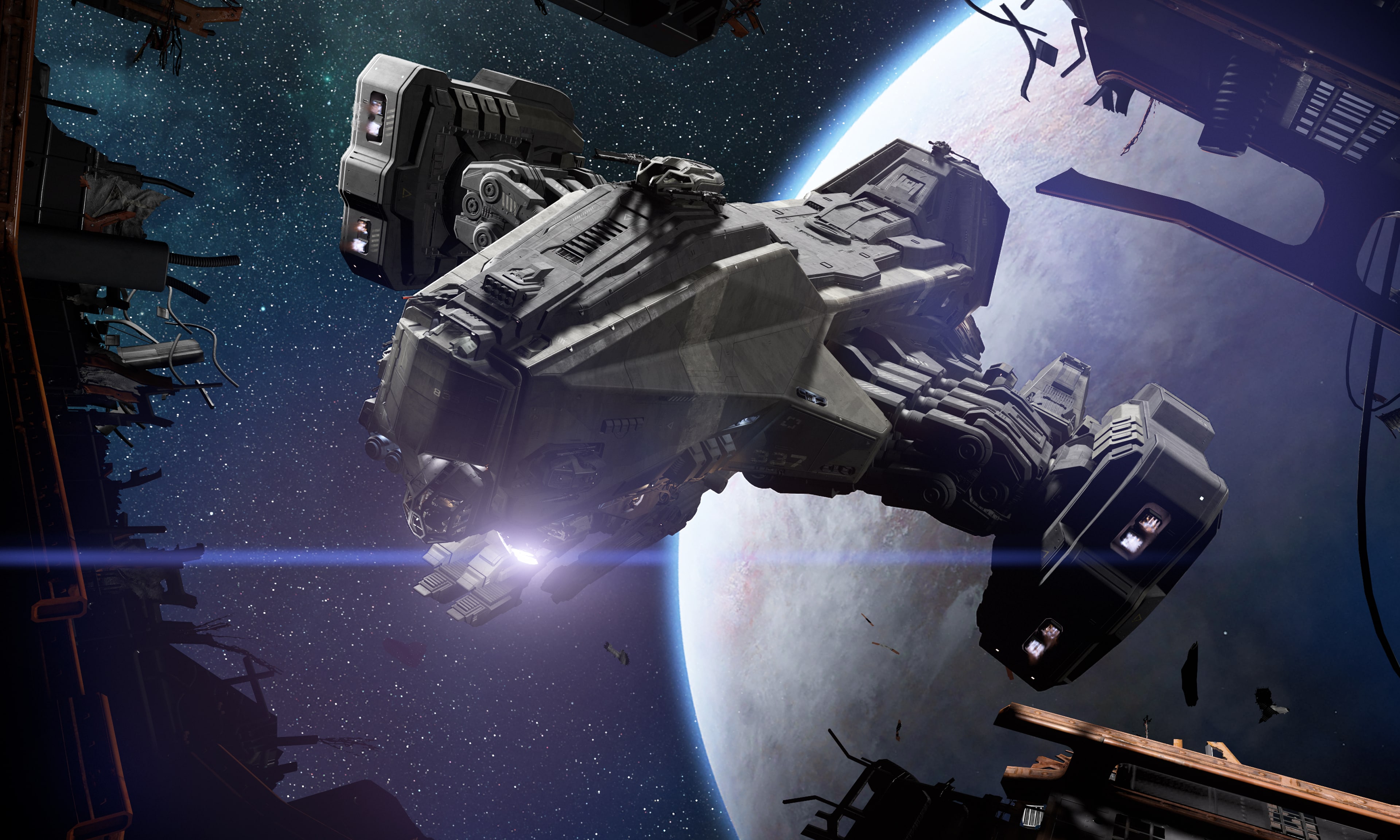
Crusader Industries Hercules
DEVELOPMENT HISTORY
Development of the spacecraft that would become the modern Hercules began in the mid-28th century during a particularly introspective period for UEE military leadership. Keen to examine the potential lessons of the last war, UEE commanders undertook an unprecedented analysis of the Second Tevarin War followed by a series of simulated wargames covering major battles. One of the outcomes of this effort was a new understanding of the impact of support logistics on interstellar warfare. During the Tevarin wars and prior, interplanetary operations meant establishing an initial beachhead on a hostile world using small, heavily armored landing assault craft. Once a base was established, heavier equipment would be brought in using a support column of freighters and transporters not specially equipped for combat. Analysis of this practice in action suggested it had created a major choke point that had significantly delayed necessary assets in several cases. Not only did transporting weaponry crated aboard traditional transports slow the ability to deploy heavier artillery, missile launchers, and armored tanks, it also limited their immediate range once deployed. Even successes like the famed 2605 Battle of Koren Pass were cited as examples of situations where casualties resulted from a lack of logistics: if the UEE had the lift capacity to deliver fighting vehicles directly from orbit, losses on the ground could have been significantly reduced.
The solution, military leaders determined, was two-fold. The first was organizational. In an attempt to reduce time lost to inter-service confusion, the decision was made to establish UEE Starlift Command – a cross-service support framework intended to better coordinate the UEEN assets responsible for delivering personnel and materiel that would address the UEEA and UEEM’s granular battlefield needs. The second was to set forth the specifications for a complete quantum-to-battlefield support spacecraft that could deploy armored units and other assets to a variety of alien terrains while under fire. Instead of amphibious operations focusing on establishing individual fire bases to bring in heavier assault weaponry, this command and its theoretical spacecraft could deliver advanced units directly to active theaters. The plan would prove incredibly effective and significantly alter the shape of planetary-scale battlefields. Additionally, this new spacecraft could be maintained locally and be used to quickly relocate already deployed assets should flashpoints evolve.
The formal request for a proposal was issued in 2814. It asked for a large, well-protected transport that was jump-capable, able to sustain concentrated artillery fire, and able to deploy multiple armored vehicles quickly. Significant proposals were developed by both Aegis Dynamics and Crusader Industries. Crusader, then a premiere manufacturer of carriers and associated industrial conversions, was expected to adapt their serving Jupiter-class carrier for combat operations. Aegis was expected to develop a bespoke design specific to the UEEN’s needs. In an unexpected twist, the opposite proved true: Aegis suggested adapting existing military freighters with armor and defensive turrets, while Crusader developed a much more expensive proposal to create an entirely new design that would eventually become the Hercules starlifter. Despite Crusader’s proposal having three times the price tag of the Aegis conversion, the feeling was that such a major reorganization of tactical doctrine would be better supported with an entirely new spacecraft. The military decided to invest, despite the cost of developing such a system and the inevitable organizational issues that would come with its adoption. With that, Crusader Industries launched an all-out four-year program to develop their first dedicated military support spacecraft.
The first active-duty starlifter unit was formed in May 2821 with a dozen first model spacecraft (formally designated the ‘M2 Hercules’). In initial training exercises, the new ship worked perfectly. Capable of taking sustained fire and deploying a tank or armored car in minutes, the Hercules met the military’s requirements and then some. However, delays to Hercules deployment occurred due to the difficulty of integrating the new interservice command, with those involved facing a great deal of bureaucracy in order to allow these new processes to supplant the tried-and-true support chain. Nevertheless, the wisdom of the decision became clear in March 2824 with the first active combat deployment of the Hercules system, when UEE armed forces were called upon to put down a heavily armed group of pirate forces located on a frontier world near the Xi’an border. Instead of attacking the site from orbit, planners determined that it would be worthwhile to capture assets intact in order to pursue further antipiracy operations elsewhere. Two Hercules squadrons, escorted by deep space support fighters, quietly deployed troops and an armored column which defeated the stunned criminal forces in short order. The battle, previously thought to be a particularly hazardous prospect, was won with no losses of UEE personnel and the resulting capture of information would lead directly to the destruction of two pirate outposts and a small capital ship.
As use of the Crusader starlifter normalized, it quickly became a favorite among soldiers and ground crews. Crusader’s experience with civil space transport meant they understood how to build a spacecraft intended for ease of maintenance. Additionally, the hulky, armored appearance of the Hercules became a comfort to soldiers and marines, who came to associate it with much safer deployments. The sight of a Hercules on the battlefield inevitably meant the delivery of additional supplies or reinforcements. Within two decades, Starlift Command had organizational structures in place across the empire that would allow the rapid movement of Hercules to any battlefield within a jump of a currently settled star system. Several units of starlifters are kept on ‘ready five’ status around the Empire already loaded with tanks and missile launchers and teamed with special operations troops that can be used to address rapidly developing situations.
Over the decades, Crusader has continued to update and enhance the original Hercules design and has made a tidy profit performing fleet enhancements and producing battlefield update kits in the progress. This steady dedication to modernizing the fleet has been strongly supported by Starlift Command and has allowed individual examples to remain in service well past their intended retirement. As of 2948, a significant number of first and second generation Hercules hulls were still being operated thanks to these extensive maintenance processes. Similarly, Crusader has continued to apply their ‘frame-and-role’ design process developed in starliner construction to the Hercules line, which has allowed the rapid creation of a number of role-specific variants including refuelers, heavy armor support ships, and information runners. Crusader’s philosophy allows the creation of variants to proceed rapidly as the need requires without disrupting existing production lines. This has allowed role-specific Hercules to be constructed as needed and retired just as quickly. One of these variants has become a significant part of the UEEN inventory: the A2 is a dedicated heavy gunship that adapts the Hercules’ heavy armor and other defensive systems for more a sustained combat role and uses the design’s extensive cargo capacity for munitions storage. The A2 Hercules is now constructed on its own factory line and has seen extensive combat operations against planetside forces.
In 2940, Crusader surprised the aerospace industry by announcing the development of the first standalone civilian variant of the Hercules, the C2. Long seen as a military-only spacecraft design, the decision was especially unexpected as Crusader’s factories did not have the immediate capacity to produce more than the Hercules already requisitioned by the military. In order to produce the C2, three more Hercules lines would need to be opened. Crusader, however, saw this as less of a gamble, believing that even if interest in a civilianized Hercules was not immediately apparent, the investment would ultimately be useful as military demand increased in the face of increased conflict with the Vanduul. The C2 Hercules design drops some of the armor and specialized hardware from the current generation military type in exchange for an overall improvement in cargo. Formally targeted at frontier concerns, the C2 variant has been positioned as a way for planets with less developed infrastructures to rapidly move vehicles from place to place. In their example study, Crusader imagined a mining corporation seeking to reallocate heavy equipment to sites around a newly explored planet in order to make use of claims before unlicensed jumpers could move in. The move proved to be a success, with civilian organizations quickly taking to the sturdy spacecraft design and corporate partners happy to have a ship with such a well-developed lineage and extant support apparatus. In addition to miners and explorers, the C2 Hercules quickly proved to be popular among militia groups eager to move small spacecraft and ground vehicles from place to place on individual worlds
Dieser Artikel erschien ursprünglich in Jump Point 7.10.
Crusader Industries Hercules
ENTWICKLUNGSGESCHICHTE
Die Entwicklung des Raumschiffs, aus dem die moderne Hercules werden sollte, begann Mitte des 28. Jahrhunderts, als die militärische Führung der UEE besonders nachdenklich war. In dem Bestreben, die möglichen Lehren aus dem letzten Krieg zu ziehen, unternahmen die UEE-Kommandeure eine beispiellose Analyse des Zweiten Tevarin-Krieges, gefolgt von einer Reihe simulierter Kriegsspiele, die die wichtigsten Schlachten abdeckten. Eines der Ergebnisse dieser Bemühungen war ein neues Verständnis für den Einfluss der Unterstützungslogistik auf die interstellare Kriegsführung. Während der Tevarin-Kriege und davor bedeuteten interplanetarische Operationen, dass man mit kleinen, schwer gepanzerten Landungsschiffen einen ersten Landekopf auf einer feindlichen Welt errichtete. Sobald ein Stützpunkt errichtet war, wurde schwerere Ausrüstung mit Hilfe einer Unterstützungskolonne aus Frachtern und Transportern, die nicht speziell für den Kampf ausgerüstet waren, herangeschafft. Eine Analyse dieser Praxis ergab, dass sie zu einem großen Engpass geführt hatte, der in mehreren Fällen zu erheblichen Verzögerungen bei der Bereitstellung der benötigten Mittel führte. Der Transport von Waffen in traditionellen Transportern verlangsamte nicht nur den Einsatz von schwerer Artillerie, Raketenwerfern und Panzern, sondern schränkte auch deren unmittelbare Reichweite ein, sobald sie eingesetzt wurden. Selbst Erfolge wie die berühmte Schlacht am Koren-Pass im Jahr 2605 wurden als Beispiele für Situationen angeführt, in denen die Verluste auf einen Mangel an Logistik zurückzuführen waren: Hätte die UEE die Möglichkeit gehabt, Kampffahrzeuge direkt aus dem Orbit zu transportieren, hätten die Verluste am Boden deutlich verringert werden können.
Die militärische Führung kam zu dem Schluss, dass es zwei Lösungen gab. Die erste war organisatorischer Natur. Um Zeitverluste durch dienststellenübergreifende Verwirrung zu vermeiden, wurde beschlossen, das UEE Starlift Command einzurichten - ein dienststellenübergreifender Unterstützungsrahmen, der die UEEN-Mittel, die für die Bereitstellung von Personal und Material verantwortlich sind, besser koordinieren sollte, um den detaillierten Bedürfnissen der UEEA und UEEM auf dem Schlachtfeld gerecht zu werden. Die zweite Aufgabe bestand darin, die Spezifikationen für ein komplettes Quantum-to-Battlefield-Support-Raumschiff festzulegen, das gepanzerte Einheiten und andere Mittel in einer Vielzahl von fremden Terrains unter Beschuss nehmen kann. Anstelle von amphibischen Operationen, die sich darauf konzentrieren, einzelne Feuerbasen einzurichten, um schwerere Angriffswaffen herbeizuschaffen, könnten dieses Kommando und sein theoretisches Raumschiff fortschrittliche Einheiten direkt auf aktive Schauplätze bringen. Dieser Plan würde sich als unglaublich effektiv erweisen und die Form der Schlachtfelder auf dem Planeten erheblich verändern. Außerdem könnte dieses neue Raumschiff vor Ort gewartet und genutzt werden, um bereits eingesetzte Einheiten schnell zu verlagern, wenn sich Krisenherde entwickeln.
Die offizielle Aufforderung zur Angebotsabgabe wurde im Jahr 2814 veröffentlicht. Gefordert wurde ein großes, gut geschütztes Transportmittel, das sprungfähig ist, konzentriertem Artilleriebeschuss standhalten kann und in der Lage ist, mehrere gepanzerte Fahrzeuge schnell zu verlegen. Sowohl Aegis Dynamics als auch Crusader Industries legten wichtige Vorschläge vor. Crusader, damals ein führender Hersteller von Flugzeugträgern und entsprechenden industriellen Umbauten, sollte seinen Flugzeugträger der Jupiter-Klasse für den Kampfeinsatz umrüsten. Von Aegis wurde erwartet, dass sie ein maßgeschneidertes Design für die Bedürfnisse der UEEN entwickelt. Unerwartet erwies sich jedoch das Gegenteil als wahr: Aegis schlug vor, bestehende militärische Frachter mit Panzerung und Verteidigungstürmen auszustatten, während Crusader einen viel teureren Vorschlag für ein völlig neues Design entwickelte, das schließlich zum Hercules Starlifter wurde. Obwohl der Vorschlag von Crusader dreimal so teuer war wie der Umbau von Aegis, war man der Meinung, dass eine so umfassende Umstrukturierung der taktischen Doktrin besser mit einem völlig neuen Raumschiff unterstützt werden sollte. Das Militär beschloss zu investieren, trotz der Kosten für die Entwicklung eines solchen Systems und der unvermeidlichen organisatorischen Probleme, die mit seiner Einführung einhergehen würden. So startete Crusader Industries ein vierjähriges Programm zur Entwicklung des ersten speziellen militärischen Unterstützungsraumschiffs.
Die erste aktive Starlifter-Einheit wurde im Mai 2821 mit einem Dutzend Raumschiffen des ersten Modells (offiziell als "M2 Hercules" bezeichnet) gegründet. In den ersten Trainingsübungen funktionierte das neue Schiff perfekt. Die Hercules war in der Lage, unter Dauerfeuer zu stehen und einen Panzer oder ein gepanzertes Fahrzeug innerhalb weniger Minuten zu transportieren. Der Einsatz der Hercules verzögerte sich jedoch aufgrund der Schwierigkeiten bei der Integration des neuen dienststellenübergreifenden Kommandos, da die Beteiligten mit viel Bürokratie zu kämpfen hatten, damit die neuen Prozesse die bewährte Unterstützungskette ablösen konnten. Wie weise diese Entscheidung war, zeigte sich im März 2824 beim ersten aktiven Kampfeinsatz des Herkules-Systems, als die Streitkräfte der UEE eine schwer bewaffnete Gruppe von Piraten auf einer Grenzwelt nahe der Grenze zu Xi'an niederschlagen mussten. Anstatt den Ort aus dem Orbit anzugreifen, entschieden die Planer, dass es sich lohnen würde, die Anlagen intakt zu erobern, um weitere Anti-Piraten-Operationen anderswo durchzuführen. Zwei Hercules-Staffeln, die von Tiefraumjägern eskortiert wurden, setzten in aller Ruhe Truppen und eine gepanzerte Kolonne ein, die die verblüfften kriminellen Kräfte in kurzer Zeit besiegten. Die Schlacht, die zuvor als besonders gefährlich galt, wurde ohne Verluste an UEE-Personal gewonnen und die gewonnenen Informationen führten direkt zur Zerstörung von zwei Piratenaußenposten und einem kleinen Hauptschiff.
Als sich der Einsatz des Crusader Starlifters normalisierte, wurde er schnell zu einem Favoriten unter Soldaten und Bodencrews. Dank ihrer Erfahrung im zivilen Raumtransport wussten die Crusader, wie man ein wartungsfreundliches Raumschiff baut. Außerdem wurde das bullige, gepanzerte Aussehen des Hercules für die Soldaten und Marines zu einem Trostpflaster, das sie mit viel sichereren Einsätzen in Verbindung brachten. Der Anblick einer Hercules auf dem Schlachtfeld bedeutete unweigerlich die Lieferung von Nachschub oder Verstärkung. Innerhalb von zwei Jahrzehnten hatte das Starlift Command im ganzen Imperium Organisationsstrukturen geschaffen, die eine schnelle Verlegung von Hercules zu jedem Schlachtfeld innerhalb eines Sprungs von einem derzeit besiedelten Sternensystem ermöglichten. Mehrere Einheiten von Starliftern werden im ganzen Imperium in Bereitschaft gehalten, die bereits mit Panzern und Raketenwerfern beladen sind und mit Sondereinsatztruppen ausgestattet sind, die in sich schnell entwickelnden Situationen eingesetzt werden können.
Im Laufe der Jahrzehnte hat Crusader die ursprüngliche Hercules-Konstruktion immer wieder aktualisiert und verbessert und dabei einen ordentlichen Gewinn mit Flottenverbesserungen und der Herstellung von Update-Kits für das Schlachtfeld erzielt. Dieses stetige Engagement für die Modernisierung der Flotte wurde vom Starlift Command nachdrücklich unterstützt und hat es ermöglicht, dass einzelne Exemplare weit über ihre geplante Ausmusterung hinaus im Einsatz bleiben. Im Jahr 2948 war eine beträchtliche Anzahl von Hercules-Rümpfen der ersten und zweiten Generation dank dieser umfangreichen Wartungsarbeiten immer noch im Einsatz. In ähnlicher Weise hat Crusader sein "Frame-and-Role"-Designverfahren, das beim Bau von Starlinern entwickelt wurde, auch auf die Hercules-Linie angewandt, was die schnelle Entwicklung einer Reihe von rollenspezifischen Varianten ermöglichte, wie z. B. Tanker, schwer gepanzerte Unterstützungsschiffe und Informationsflugzeuge. Die Philosophie von Crusader erlaubt es, Varianten je nach Bedarf schnell zu entwickeln, ohne die bestehenden Produktionslinien zu unterbrechen. So konnten rollenspezifische Hercules nach Bedarf gebaut und ebenso schnell wieder außer Dienst gestellt werden. Eine dieser Varianten ist zu einem wichtigen Bestandteil des UEEN-Inventars geworden: Die A2 ist ein schweres Kanonenboot, das die schwere Panzerung und andere Verteidigungssysteme der Hercules für einen dauerhaften Kampfeinsatz anpasst und die große Ladekapazität der Konstruktion für die Lagerung von Munition nutzt. Die A2 Hercules wird jetzt auf einer eigenen Fertigungsstraße gebaut und hat bereits zahlreiche Kampfeinsätze gegen Streitkräfte auf dem Planeten hinter sich.
Im Jahr 2940 überraschte Crusader die Raumfahrtindustrie mit der Ankündigung der Entwicklung der ersten eigenständigen zivilen Variante der Hercules, der C2. Diese Entscheidung kam besonders unerwartet, da die Fabriken von Crusader nicht über die Kapazitäten verfügten, um mehr als die bereits vom Militär angeforderten Hercules zu produzieren. Um die C2 zu produzieren, müssten drei weitere Hercules-Linien eröffnet werden. Crusader sah dies jedoch als weniger riskant an, da sie der Meinung waren, dass sich die Investition, auch wenn das Interesse an einer zivilisierten Hercules nicht sofort erkennbar war, letztendlich als nützlich erweisen würde, wenn die militärische Nachfrage angesichts des zunehmenden Konflikts mit den Vanduul steigt. Das C2 Hercules-Design verzichtet auf einige der Panzerungen und Spezialausrüstungen der aktuellen Generation des militärischen Typs und bietet im Gegenzug ein insgesamt besseres Ladevolumen. Die C2-Variante ist offiziell für Grenzregionen gedacht und soll Planeten mit weniger entwickelter Infrastruktur die Möglichkeit geben, Fahrzeuge schnell von einem Ort zum anderen zu bringen. In ihrer Beispielstudie stellte sich Crusader ein Bergbauunternehmen vor, das schweres Gerät an Standorte rund um einen neu erforschten Planeten verlagern wollte, um Claims zu nutzen, bevor nicht lizenzierte Jumper anrücken konnten. Der Umzug erwies sich als Erfolg, da zivile Organisationen das robuste Raumschiffdesign schnell annahmen und die Unternehmenspartner froh waren, ein Schiff mit einem so gut entwickelten Stammbaum und vorhandenen Hilfsgeräten zu haben. Neben Bergleuten und Forschern war die C2 Hercules auch bei Milizen beliebt, die kleine Raum- und Bodenfahrzeuge von Ort zu Ort auf einzelnen Welten transportieren wollten.
This article originally appeared in Jump Point 7.10.
Crusader Industries Hercules
DEVELOPMENT HISTORY
Development of the spacecraft that would become the modern Hercules began in the mid-28th century during a particularly introspective period for UEE military leadership. Keen to examine the potential lessons of the last war, UEE commanders undertook an unprecedented analysis of the Second Tevarin War followed by a series of simulated wargames covering major battles. One of the outcomes of this effort was a new understanding of the impact of support logistics on interstellar warfare. During the Tevarin wars and prior, interplanetary operations meant establishing an initial beachhead on a hostile world using small, heavily armored landing assault craft. Once a base was established, heavier equipment would be brought in using a support column of freighters and transporters not specially equipped for combat. Analysis of this practice in action suggested it had created a major choke point that had significantly delayed necessary assets in several cases. Not only did transporting weaponry crated aboard traditional transports slow the ability to deploy heavier artillery, missile launchers, and armored tanks, it also limited their immediate range once deployed. Even successes like the famed 2605 Battle of Koren Pass were cited as examples of situations where casualties resulted from a lack of logistics: if the UEE had the lift capacity to deliver fighting vehicles directly from orbit, losses on the ground could have been significantly reduced.
The solution, military leaders determined, was two-fold. The first was organizational. In an attempt to reduce time lost to inter-service confusion, the decision was made to establish UEE Starlift Command – a cross-service support framework intended to better coordinate the UEEN assets responsible for delivering personnel and materiel that would address the UEEA and UEEM’s granular battlefield needs. The second was to set forth the specifications for a complete quantum-to-battlefield support spacecraft that could deploy armored units and other assets to a variety of alien terrains while under fire. Instead of amphibious operations focusing on establishing individual fire bases to bring in heavier assault weaponry, this command and its theoretical spacecraft could deliver advanced units directly to active theaters. The plan would prove incredibly effective and significantly alter the shape of planetary-scale battlefields. Additionally, this new spacecraft could be maintained locally and be used to quickly relocate already deployed assets should flashpoints evolve.
The formal request for a proposal was issued in 2814. It asked for a large, well-protected transport that was jump-capable, able to sustain concentrated artillery fire, and able to deploy multiple armored vehicles quickly. Significant proposals were developed by both Aegis Dynamics and Crusader Industries. Crusader, then a premiere manufacturer of carriers and associated industrial conversions, was expected to adapt their serving Jupiter-class carrier for combat operations. Aegis was expected to develop a bespoke design specific to the UEEN’s needs. In an unexpected twist, the opposite proved true: Aegis suggested adapting existing military freighters with armor and defensive turrets, while Crusader developed a much more expensive proposal to create an entirely new design that would eventually become the Hercules starlifter. Despite Crusader’s proposal having three times the price tag of the Aegis conversion, the feeling was that such a major reorganization of tactical doctrine would be better supported with an entirely new spacecraft. The military decided to invest, despite the cost of developing such a system and the inevitable organizational issues that would come with its adoption. With that, Crusader Industries launched an all-out four-year program to develop their first dedicated military support spacecraft.
The first active-duty starlifter unit was formed in May 2821 with a dozen first model spacecraft (formally designated the ‘M2 Hercules’). In initial training exercises, the new ship worked perfectly. Capable of taking sustained fire and deploying a tank or armored car in minutes, the Hercules met the military’s requirements and then some. However, delays to Hercules deployment occurred due to the difficulty of integrating the new interservice command, with those involved facing a great deal of bureaucracy in order to allow these new processes to supplant the tried-and-true support chain. Nevertheless, the wisdom of the decision became clear in March 2824 with the first active combat deployment of the Hercules system, when UEE armed forces were called upon to put down a heavily armed group of pirate forces located on a frontier world near the Xi’an border. Instead of attacking the site from orbit, planners determined that it would be worthwhile to capture assets intact in order to pursue further antipiracy operations elsewhere. Two Hercules squadrons, escorted by deep space support fighters, quietly deployed troops and an armored column which defeated the stunned criminal forces in short order. The battle, previously thought to be a particularly hazardous prospect, was won with no losses of UEE personnel and the resulting capture of information would lead directly to the destruction of two pirate outposts and a small capital ship.
As use of the Crusader starlifter normalized, it quickly became a favorite among soldiers and ground crews. Crusader’s experience with civil space transport meant they understood how to build a spacecraft intended for ease of maintenance. Additionally, the hulky, armored appearance of the Hercules became a comfort to soldiers and marines, who came to associate it with much safer deployments. The sight of a Hercules on the battlefield inevitably meant the delivery of additional supplies or reinforcements. Within two decades, Starlift Command had organizational structures in place across the empire that would allow the rapid movement of Hercules to any battlefield within a jump of a currently settled star system. Several units of starlifters are kept on ‘ready five’ status around the Empire already loaded with tanks and missile launchers and teamed with special operations troops that can be used to address rapidly developing situations.
Over the decades, Crusader has continued to update and enhance the original Hercules design and has made a tidy profit performing fleet enhancements and producing battlefield update kits in the progress. This steady dedication to modernizing the fleet has been strongly supported by Starlift Command and has allowed individual examples to remain in service well past their intended retirement. As of 2948, a significant number of first and second generation Hercules hulls were still being operated thanks to these extensive maintenance processes. Similarly, Crusader has continued to apply their ‘frame-and-role’ design process developed in starliner construction to the Hercules line, which has allowed the rapid creation of a number of role-specific variants including refuelers, heavy armor support ships, and information runners. Crusader’s philosophy allows the creation of variants to proceed rapidly as the need requires without disrupting existing production lines. This has allowed role-specific Hercules to be constructed as needed and retired just as quickly. One of these variants has become a significant part of the UEEN inventory: the A2 is a dedicated heavy gunship that adapts the Hercules’ heavy armor and other defensive systems for more a sustained combat role and uses the design’s extensive cargo capacity for munitions storage. The A2 Hercules is now constructed on its own factory line and has seen extensive combat operations against planetside forces.
In 2940, Crusader surprised the aerospace industry by announcing the development of the first standalone civilian variant of the Hercules, the C2. Long seen as a military-only spacecraft design, the decision was especially unexpected as Crusader’s factories did not have the immediate capacity to produce more than the Hercules already requisitioned by the military. In order to produce the C2, three more Hercules lines would need to be opened. Crusader, however, saw this as less of a gamble, believing that even if interest in a civilianized Hercules was not immediately apparent, the investment would ultimately be useful as military demand increased in the face of increased conflict with the Vanduul. The C2 Hercules design drops some of the armor and specialized hardware from the current generation military type in exchange for an overall improvement in cargo. Formally targeted at frontier concerns, the C2 variant has been positioned as a way for planets with less developed infrastructures to rapidly move vehicles from place to place. In their example study, Crusader imagined a mining corporation seeking to reallocate heavy equipment to sites around a newly explored planet in order to make use of claims before unlicensed jumpers could move in. The move proved to be a success, with civilian organizations quickly taking to the sturdy spacecraft design and corporate partners happy to have a ship with such a well-developed lineage and extant support apparatus. In addition to miners and explorers, the C2 Hercules quickly proved to be popular among militia groups eager to move small spacecraft and ground vehicles from place to place on individual worlds
This article originally appeared in Jump Point 7.10.
Crusader Industries Hercules
DEVELOPMENT HISTORY
Development of the spacecraft that would become the modern Hercules began in the mid-28th century during a particularly introspective period for UEE military leadership. Keen to examine the potential lessons of the last war, UEE commanders undertook an unprecedented analysis of the Second Tevarin War followed by a series of simulated wargames covering major battles. One of the outcomes of this effort was a new understanding of the impact of support logistics on interstellar warfare. During the Tevarin wars and prior, interplanetary operations meant establishing an initial beachhead on a hostile world using small, heavily armored landing assault craft. Once a base was established, heavier equipment would be brought in using a support column of freighters and transporters not specially equipped for combat. Analysis of this practice in action suggested it had created a major choke point that had significantly delayed necessary assets in several cases. Not only did transporting weaponry crated aboard traditional transports slow the ability to deploy heavier artillery, missile launchers, and armored tanks, it also limited their immediate range once deployed. Even successes like the famed 2605 Battle of Koren Pass were cited as examples of situations where casualties resulted from a lack of logistics: if the UEE had the lift capacity to deliver fighting vehicles directly from orbit, losses on the ground could have been significantly reduced.
The solution, military leaders determined, was two-fold. The first was organizational. In an attempt to reduce time lost to inter-service confusion, the decision was made to establish UEE Starlift Command – a cross-service support framework intended to better coordinate the UEEN assets responsible for delivering personnel and materiel that would address the UEEA and UEEM’s granular battlefield needs. The second was to set forth the specifications for a complete quantum-to-battlefield support spacecraft that could deploy armored units and other assets to a variety of alien terrains while under fire. Instead of amphibious operations focusing on establishing individual fire bases to bring in heavier assault weaponry, this command and its theoretical spacecraft could deliver advanced units directly to active theaters. The plan would prove incredibly effective and significantly alter the shape of planetary-scale battlefields. Additionally, this new spacecraft could be maintained locally and be used to quickly relocate already deployed assets should flashpoints evolve.
The formal request for a proposal was issued in 2814. It asked for a large, well-protected transport that was jump-capable, able to sustain concentrated artillery fire, and able to deploy multiple armored vehicles quickly. Significant proposals were developed by both Aegis Dynamics and Crusader Industries. Crusader, then a premiere manufacturer of carriers and associated industrial conversions, was expected to adapt their serving Jupiter-class carrier for combat operations. Aegis was expected to develop a bespoke design specific to the UEEN’s needs. In an unexpected twist, the opposite proved true: Aegis suggested adapting existing military freighters with armor and defensive turrets, while Crusader developed a much more expensive proposal to create an entirely new design that would eventually become the Hercules starlifter. Despite Crusader’s proposal having three times the price tag of the Aegis conversion, the feeling was that such a major reorganization of tactical doctrine would be better supported with an entirely new spacecraft. The military decided to invest, despite the cost of developing such a system and the inevitable organizational issues that would come with its adoption. With that, Crusader Industries launched an all-out four-year program to develop their first dedicated military support spacecraft.
The first active-duty starlifter unit was formed in May 2821 with a dozen first model spacecraft (formally designated the ‘M2 Hercules’). In initial training exercises, the new ship worked perfectly. Capable of taking sustained fire and deploying a tank or armored car in minutes, the Hercules met the military’s requirements and then some. However, delays to Hercules deployment occurred due to the difficulty of integrating the new interservice command, with those involved facing a great deal of bureaucracy in order to allow these new processes to supplant the tried-and-true support chain. Nevertheless, the wisdom of the decision became clear in March 2824 with the first active combat deployment of the Hercules system, when UEE armed forces were called upon to put down a heavily armed group of pirate forces located on a frontier world near the Xi’an border. Instead of attacking the site from orbit, planners determined that it would be worthwhile to capture assets intact in order to pursue further antipiracy operations elsewhere. Two Hercules squadrons, escorted by deep space support fighters, quietly deployed troops and an armored column which defeated the stunned criminal forces in short order. The battle, previously thought to be a particularly hazardous prospect, was won with no losses of UEE personnel and the resulting capture of information would lead directly to the destruction of two pirate outposts and a small capital ship.
As use of the Crusader starlifter normalized, it quickly became a favorite among soldiers and ground crews. Crusader’s experience with civil space transport meant they understood how to build a spacecraft intended for ease of maintenance. Additionally, the hulky, armored appearance of the Hercules became a comfort to soldiers and marines, who came to associate it with much safer deployments. The sight of a Hercules on the battlefield inevitably meant the delivery of additional supplies or reinforcements. Within two decades, Starlift Command had organizational structures in place across the empire that would allow the rapid movement of Hercules to any battlefield within a jump of a currently settled star system. Several units of starlifters are kept on ‘ready five’ status around the Empire already loaded with tanks and missile launchers and teamed with special operations troops that can be used to address rapidly developing situations.
Over the decades, Crusader has continued to update and enhance the original Hercules design and has made a tidy profit performing fleet enhancements and producing battlefield update kits in the progress. This steady dedication to modernizing the fleet has been strongly supported by Starlift Command and has allowed individual examples to remain in service well past their intended retirement. As of 2948, a significant number of first and second generation Hercules hulls were still being operated thanks to these extensive maintenance processes. Similarly, Crusader has continued to apply their ‘frame-and-role’ design process developed in starliner construction to the Hercules line, which has allowed the rapid creation of a number of role-specific variants including refuelers, heavy armor support ships, and information runners. Crusader’s philosophy allows the creation of variants to proceed rapidly as the need requires without disrupting existing production lines. This has allowed role-specific Hercules to be constructed as needed and retired just as quickly. One of these variants has become a significant part of the UEEN inventory: the A2 is a dedicated heavy gunship that adapts the Hercules’ heavy armor and other defensive systems for more a sustained combat role and uses the design’s extensive cargo capacity for munitions storage. The A2 Hercules is now constructed on its own factory line and has seen extensive combat operations against planetside forces.
In 2940, Crusader surprised the aerospace industry by announcing the development of the first standalone civilian variant of the Hercules, the C2. Long seen as a military-only spacecraft design, the decision was especially unexpected as Crusader’s factories did not have the immediate capacity to produce more than the Hercules already requisitioned by the military. In order to produce the C2, three more Hercules lines would need to be opened. Crusader, however, saw this as less of a gamble, believing that even if interest in a civilianized Hercules was not immediately apparent, the investment would ultimately be useful as military demand increased in the face of increased conflict with the Vanduul. The C2 Hercules design drops some of the armor and specialized hardware from the current generation military type in exchange for an overall improvement in cargo. Formally targeted at frontier concerns, the C2 variant has been positioned as a way for planets with less developed infrastructures to rapidly move vehicles from place to place. In their example study, Crusader imagined a mining corporation seeking to reallocate heavy equipment to sites around a newly explored planet in order to make use of claims before unlicensed jumpers could move in. The move proved to be a success, with civilian organizations quickly taking to the sturdy spacecraft design and corporate partners happy to have a ship with such a well-developed lineage and extant support apparatus. In addition to miners and explorers, the C2 Hercules quickly proved to be popular among militia groups eager to move small spacecraft and ground vehicles from place to place on individual worlds
Links
No links available.

Metadata
- CIG ID
- 19967
- Channel
- Spectrum Dispatch
- Category
- Undefined
- Series
- News Update
- Comments
- 14
- Published
- 2 years ago (2024-05-14T00:00:00+00:00)