Star Citizen Monthly Report: August 2024
Transmission Undefined NoneContent
PU Monthly Report
August 2024
Welcome to August’s PU Monthly Report! With the recent release of Alpha 3.24: Cargo Empires, most development teams spent the month both finalizing patch tasks and progressing with exciting new features coming further down the road. Read on for all the details.
AI (Features)
Last month, AI Features polished various reactions, including the ‘first reactions’ when AIs respond to audio or visual events. While these behaviors had a solid base, various combat styles, weapons, and scenarios didn’t play consistently, such as when escalating from a low reaction to a high reaction. To improve this, the team built a new AI test level called a ‘test cell.’ This is a Building Block setup with different character types, weapons, cover, usables, etc. that allows the team to pick and mix different setups to produce a consistent version of test scenarios. A particular combination can be exported as one ‘cell’ and imported into a single level where multiple test scenarios can be played simultaneously, allowing the team to quickly identify mistakes, fix them, and retest.
The test cell level is also being used for cover-hit reactions, which have different animation setups per cover type, combat style, and weapon type. Going forward, the test cell will be expanded to provide more consistency across a wide range of areas.
AI (Tech)
AI tech continued to improve how NPCs transition between servers, including serializing movement requests and navigation paths.
They also updated navigation generation elements, including one relating to computing navigation islands and one used when exporting processes into object containers. Progress was also made on converting the Apollo tool’s UI style. A new feature continued development too, which the team will share more about in the future.
AI (Content)
In August, the Social AI designers joined the Narrative team to form a larger group focused on improving the Star Citizen experience. As part of this, they began meeting with Design and the creative directors to walk through various locations, looking for opportunities to clean up existing behaviors or add new ones. While many of the behaviors will be based on work done for Squadron 42, the expansive nature of the PU will require bespoke additions.
AI Content is also in the process of reviewing locations throughout Pyro, ensuring the environment and behavior setups work correctly together and instill a sense of the intended narrative. The team also met with the designers of an upcoming mission to provide support for some of the locations that will be visited by players, including applying believable behaviors to NPCs.
Aside from outlining behavior improvements and needs for Star Citizen 1.0, Narrative Design kicked off several initiatives to determine the required tech and use cases for future social spaces. This will ultimately lead to a vertical slice showing a gold-standard social space with the level of interaction the game will aim for.
AI (Game Intelligence Development Team)
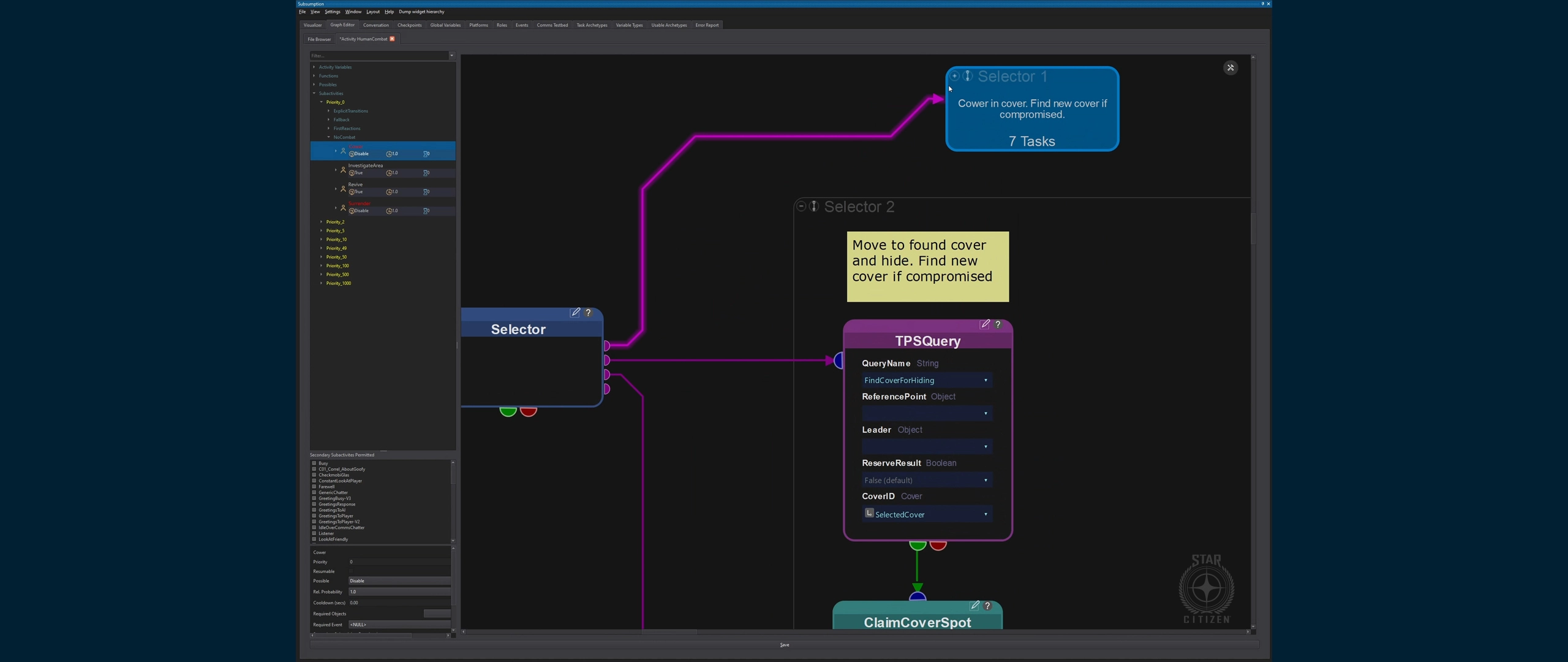
In August, the Game Intelligence Development team concentrated on delivering a clean and stable Apollo StarScript UX update. This involved adding support for higher icon resolutions so they stay sharp when zoomed in and straightening lines for a clearer read.
Drag and drop was improved too. Now, when hovering, ports with a bigger selection range are highlighted. The devs corrected the color and size of imported notes, added arrowheads to links leading to closed groups, and enlarged the hovering area and highlights on links and ports. Drop points were also added to links to identify the desired select line.
Animation
August saw the Facial Animation team developing content to flesh out more of the game world’s characters.
Gameplay Animation continued to work on a selection of creatures previously seen in teaser videos alongside improving the creatures already in the PU. They also progressed with an unannounced addition that the team is “looking forward to seeing in-game.”
Art (Characters)
Character Art continued working on utility and specialist armors, while Character Concept Art supported IAE and progressed with their ongoing exploration of fauna.
Art (Ships)
Last month, Ship Art moved several unannounced vehicles toward their greybox reviews, while others approached their LOD-zero and final-content reviews.
Work on the RSI Polaris also continued, with the ship’s exterior approaching completion.
Community
In support of Alpha 3.24, the Community team made improvements and updates to the New Player and Welcome Back Pilot guides. They also provided an update to the Cargo Guide alongside a Q&A for the recently released Aegis Sabre Peregrine. The team also focused heavily on compiling and sharing player feedback internally.
The team’s standout event last month was Ship Showdown 2954, with players from across the community submitting creative entries to determine which ships made it to the top. Phase 1 saw citizens submitting original creations of their favorite vehicles to the Community Hub and social media before the Top 16 faced off in daily voting battles.
After much voting, the Anvil F8C Lighting was crowned Ship Showdown Champion 2954.
The Community team also supported the release of a limited number of General Admission CitizenCon 2954 tickets before connecting with the community at Gamescom 2024 in Cologne.
“This stop on the Bar Citizen Tour brought together players for an unforgettable experience, including a treasure hunt, prizes, and two Bar Citizens events! Later in August, the team met with more fans in Seattle at PAX West during another Bar Citizen event at Stoup Brewing. Looking ahead, we’re excited to meet even more Star Citizen players in Marinha Grande, Portugal, and during TwitchCon US in California!” Community Team
The Progress Tracker was also updated with the latest production schedule through 2024. It introduces a significant shift in how deliverables are tracked while maintaining transparency throughout the year. Further updates, including 2025, will follow soon.
With CitizenCon 2954 coming in October, the team spent much of August gearing up for the event, including setting up the venue layout, preparing community booths, and more.
Core Gameplay
Throughout August, the various Gameplay Feature teams continued to improve the hangar and cargo flows for Alpha 3.24 based on feedback from the PTU. Meanwhile, a lot of behind-the-scenes changes progressed that will improve how various gameplay systems handle environments that span multiple servers.
Progress was made on the ‘overheat’ mechanic, with Core Gameplay adding support for different atmospheric temperatures. For example, weapons will overheat at different rates based on their environment.
‘Charge and drain’ progressed too and now features client-side prediction to give immediate feedback to players when they’re charging or draining, even if there’s latency between the client and server.
The team began adding logic to declutter the UI by grouping markers of the same type, while the implementation of weapon groups and group presets continued.
August saw continued progress on jump points, which began with improved debugging tools to better visualize potential exit points for players. Turbulence was also implemented, which will affect the flight experience within the tunnel; the designers are currently tweaking the strength to get the desired impact. Visual effects were added too, including cockpit vibration based on where in the tunnel the player is located, and obstacles were placed that players will be required to navigate around. Further failure states for jump tunnels were determined before the feature was submitted to QA for testing.
Progress was then made on the resource network, engineering gameplay, and life support.
For example, Core Gameplay implemented a new behavior for critical components, which will replace the existing soft death mechanic. When live, only certain items, like powerplants, will trigger an explosion or soft death when destroyed.
The engineering screen was polished, while a new room selection UI was added for life support. The team also gave Design the ability to control the total power output of multiple active powerplants. This way, more powerplants don’t necessarily result in linearly increasing power production. Significant time was also dedicated to fixing stability issues and bugs following QA testing.
July’s work on ‘radar and scanning’ continued throughout August, with the team reviewing it in Arena Commander to assess the impact on the player experience and tune values to achieve the desired effect.
They also focused on closing out feature work for delta signatures, giving Design more control over how to react to changes. Tasks were completed for audio signatures too.
Core Gameplay continued supporting transit in the run-up to the live release while adjusting how transit data is stored to lower the maintenance overhead on Level Design.
Elsewhere, the team reworked the ‘shot’ annunciator - it will turn red if someone targets the player and fires their weapon. Annunciators for weapons, power, thrusters, and shields were completed, while ‘overheating’ and ‘off’ states were implemented.
The ongoing mission-system refactor progressed, with the team fixing various issues causing existing behaviors to break or function incorrectly. The mission system can now run in minimal mode, allowing it to be included in the seeding service and upcoming ‘MissionFactory’ service, which generates contracts.
Clients can now query available missions, and the contract generator can apply legacy settings to work with the previous system too.
Implementation of service beacons for the mission-system refactor began, while Core Gameplay supported Mission Design on remaining Blockade Runner and cargo-hauling issues.
Developers working on cargo gameplay primarily focused on major remaining stability and gameplay issues. For example, they fixed several problems with hangar instance queues getting stuck and players being assigned the wrong hangar. Functionality was also added to the instanced interior manager to better support removing non-active hangar instances.
Several hauling-mission bugs were solved relating to warehouse-manager and freight-elevator-kiosk interactions alongside issues with the kiosk transferring items on/off the loading platform.
Bugs were also fixed relating to Hull C auto-loading, auto-loaded commodity transactions, and ship-loading platforms getting broken by obstructions, with the fixes set to be implemented in the near future.
Finally for Core Gameplay, the devs spent considerable time reviewing internal and external feedback to plan further improvements to the features released in Alpha 3.24.
Economy
The Economy team spent the month getting closer to uniting all their work into a cohesive economy consisting of ships, items, missions, fuel, consumables, freelancing, careers, and more. Progress was also made on the economy setup for Pyro.
Graphics, VFX Programming & Planet Tech
Alongside the ongoing stability and performance improvements for Vulkan, the Graphics team improved debug tooling for the long-term health of the dev experience.
For global illumination, support was added for high-gloss specular reflections, which builds on the previous rough-specular work. The team also added live updates to GPU raytracing acceleration structures and began working on improvements to transparent objects.
Performance wise, the global illumination system now supports both temporal and spatial subsampling to accumulate the same visual result with fewer rays fired per frame.
Ongoing tasks consist of async creation and additional types of destructible renderer objects (such as gas cloud chunks) to reduce frame time spikes on the CPU.
For Planet Tech v5, the team focused on enhancing terrain performance through a compute shader-driven pipeline that caches material attributes to reduce redundant computations.
Alongside this, the revamped material scattering system now supports physically based distribution, allowing for denser biomes, such as jungles and forests, by eliminating distinctions between small and large mesh ground covers.
A new per-object climate concept and new terrain attributes were introduced, including geology and soil maps.
Planet Tech also spent part of August supporting the Montreal Tools team on the location-scatter tool. For this, they provided a new terrain query API for large-scale queries and extended query capabilities, with future tasks aimed at supporting SDF-based terrain queries.
Support for the live release included fixes for the ‘invisible asteroid’ bug and other issues.
Following on from last month’s report, the VFX team focused on fire hazards. The feature work is now complete, with focus shifting to bug fixing and design balance.
Particle effect connections for jump tunnels were implemented. The devs are now focusing on polishing the VFX and supporting graphics technology.
The team also progressed with a significant data conversion to add GUIDs, which will help the VFX artists manage particle effects more efficiently.
Elsewhere, performance improvements are underway, including using multiple threads for particle updates and adjusting VFX regression tests to detect issues earlier.
Interactables
The Interactables team spent time in August on items for Pyro mission content.
Lighting
The Lighting team continued to support multiple areas of development, including Pyro’s space stations, acidic caves, and closeout work for Alpha 3.24.
Locations
Last month, the Landing Zone team progressed with tasks for Alpha 4.0, including adding new areas and additional polish to Pyro’s space stations.
The Locations team pressed forward with ground bases, moving the initial modules through greybox. Improvements were also made to several new location types coming with Pyro.
Mission Design
Mission Design spent time in August updating the Salvage Mission archetype, enabling it to spawn ground panels and provide FPS gameplay at scrapyards.
They also continued to work on the Repair Location missions recently shown on the ‘Social Gameplay of Pyro’ episode of Inside Star Citizen. The team is targeting three main gameplay elements for the initial release:
Charge and drain: Charging devices that use batteries for operation
Replace component: Replacing fuses in relays
Repair pipe: Fixing damaged pipes using RMC
The team also continued to design resource gathering, including determining which commodities buyers in Stanton would want extracting from Pyro.
They’re also expanding the mechanic to include FPS resource gathering, which will be the first step toward basic MMO-type fetch quests. Elsewhere, a new mission type progressed that the team will discuss in a future update.
Narrative
The Narrative Team spent time last month working with Design and Branding to further develop the new Contested Zones and enhance the gameplay that players will experience there. The team also made improvements to the cargo-hauling missions and continued work on unannounced mission content that will be coming to Stanton and Pyro.
The Narrative Design team focused on improving AI behaviors at settlements to give a more natural feel to the NPCs that players will encounter there. They also fleshed out the new social AI testbed.
New lore was added to the website, with a Whitley’s Guide to the Cutlass Red and additional Galactapedia Entries. Plus, there was a very special Star Citizen Live with the Narrative Team.
Online Technology
In August, the Online Services team progressed with features scheduled for Alpha 4.0. Significant progress was made on the updates for the Mission and Marker systems, and the team completed the new Player Trade service, which will allow players to trade game currencies in a server-meshed environment.
Time was also spent testing and gathering metrics for a newly enabled EAC anti-cheat feature in Evocati and the PTU.
Alongside helping to stabilize the Alpha 3.24 release, Online Services helped Player Relations unblock accounts with lingering login issues.
Regarding Live Tools, the team met with Player Support and Player Experience during a visit to the Montreal studio.
“It was a great opportunity for both teams to sit together and work on the future of the Network Operation Center and how it could improve the quality of life for the support teams with its current and upcoming features.” Live Tools Team
Elsewhere, the architecture for the error-reporting tool progressed well.
VFX
The VFX team continued their support for jump points and dynamic fire, both of which were shown in recent episodes of Inside Star Citizen.
They also completed their work on acidic caves, two vehicles, and an unnamed energy weapon that has functionality not seen before in the PU.
Image by
lulzmanforevarImage by
lulzmanforevar
PU-Monatsbericht
August 2024
Willkommen zum PU-Monatsbericht für August! Mit der kürzlichen Veröffentlichung von Alpha 3.24: Cargo Empires haben die meisten Entwicklerteams den Monat damit verbracht, Patches fertigzustellen und an aufregenden neuen Funktionen zu arbeiten, die in Zukunft kommen werden. Lies weiter, um alle Details zu erfahren.
KI (Features)
Im letzten Monat wurde an den KI-Features gefeilt, unter anderem an den "ersten Reaktionen", wenn die KI auf akustische oder visuelle Ereignisse reagiert. Diese Verhaltensweisen hatten zwar eine solide Basis, aber verschiedene Kampfstile, Waffen und Szenarien spielten sich nicht einheitlich, z. B. bei der Eskalation von einer niedrigen Reaktion zu einer hohen Reaktion. Um dies zu verbessern, baute das Team eine neue KI-Testebene, die "Testzelle". Dabei handelt es sich um ein Baustein-Setup mit verschiedenen Charaktertypen, Waffen, Deckungen, nutzbaren Gegenständen usw., das es dem Team ermöglicht, verschiedene Setups auszuwählen und zu mischen, um eine konsistente Version von Testszenarien zu erstellen. Eine bestimmte Kombination kann als eine "Zelle" exportiert und in eine einzelne Ebene importiert werden, in der mehrere Testszenarien gleichzeitig gespielt werden können, so dass das Team Fehler schnell erkennen, beheben und erneut testen kann.
Die Testzellenebene wird auch für Deckungstreffer-Reaktionen verwendet, die je nach Deckungstyp, Kampfstil und Waffentyp unterschiedliche Animationen haben. In Zukunft wird die Testzelle erweitert, um mehr Konsistenz in einer Vielzahl von Bereichen zu gewährleisten.
KI (Tech)
Die KI-Technologie hat den Übergang von NSCs zwischen Servern weiter verbessert, einschließlich der Serialisierung von Bewegungsanfragen und Navigationspfaden.
Außerdem wurden Elemente zur Navigationsgenerierung aktualisiert, darunter ein Element zur Berechnung von Navigationsinseln und eines, das beim Export von Prozessen in Objektcontainer verwendet wird. Außerdem wurden Fortschritte bei der Umwandlung des UI-Stils des Apollo-Tools erzielt. Eine neue Funktion wurde ebenfalls weiterentwickelt, über die das Team in Zukunft mehr berichten wird.
KI (Inhalt)
Im August schlossen sich die Social AI Designer dem Narrative Team an, um eine größere Gruppe zu bilden, die sich auf die Verbesserung der Star Citizen Erfahrung konzentriert. In diesem Zusammenhang trafen sie sich mit dem Designteam und den Kreativdirektoren, um verschiedene Orte zu besuchen und nach Möglichkeiten zu suchen, bestehende Verhaltensweisen zu verbessern oder neue hinzuzufügen. Viele der Verhaltensweisen werden auf der Arbeit für Squadron 42 basieren, aber die umfangreiche Natur des PU wird maßgeschneiderte Ergänzungen erfordern.
Das Team von AI Content ist außerdem dabei, die Schauplätze in Pyro zu überprüfen, um sicherzustellen, dass die Umgebung und die Verhaltensweisen richtig zusammenpassen und ein Gefühl für die beabsichtigte Erzählung vermitteln. Das Team hat sich auch mit den Designern einer kommenden Mission getroffen, um Unterstützung für einige der Orte zu leisten, die von den Spielern besucht werden, einschließlich der Anwendung glaubwürdiger Verhaltensweisen auf NSCs.
Neben dem Entwurf von Verhaltensverbesserungen und Bedürfnissen für Star Citizen 1.0 hat das Narrative Design mehrere Initiativen gestartet, um die erforderliche Technologie und die Anwendungsfälle für zukünftige soziale Räume zu bestimmen. Dies wird letztendlich zu einem vertikalen Schnitt führen, der einen Goldstandard-Sozialraum mit dem Interaktionsniveau zeigt, das das Spiel anstreben wird.
KI (Game Intelligence Development Team)
Im August hat sich das Game Intelligence Development Team darauf konzentriert, ein sauberes und stabiles Apollo StarScript UX-Update zu liefern. Dazu gehörte die Unterstützung höherer Icon-Auflösungen, damit sie auch beim Heranzoomen scharf bleiben, und die Begradigung von Linien, damit sie besser lesbar sind.
Auch das Drag & Drop wurde verbessert. Jetzt werden Ports mit einem größeren Auswahlbereich hervorgehoben, wenn du den Mauszeiger darüber bewegst. Die Entwickler haben die Farbe und Größe von importierten Notizen korrigiert, Pfeilspitzen zu Links hinzugefügt, die zu geschlossenen Gruppen führen, und den Hovering-Bereich und die Hervorhebungen von Links und Ports vergrößert. Außerdem wurden den Links Droppoints hinzugefügt, um die gewünschte Auswahllinie zu kennzeichnen.
Animation
Im August hat das Team für Gesichtsanimation weitere Inhalte entwickelt, um die Charaktere der Spielwelt zu verschönern.
Die Gameplay-Animation arbeitete weiter an einer Auswahl von Kreaturen, die bereits in Teaser-Videos zu sehen waren, und verbesserte die Kreaturen, die bereits in der PU enthalten sind. Außerdem wurde an einer unangekündigten Erweiterung gearbeitet, auf die sich das Team "sehr freut".
Kunst (Charaktere)
Character Art arbeitete weiter an Gebrauchs- und Spezialrüstungen, während Character Concept Art die IAE unterstützte und die Erforschung der Fauna vorantrieb.
Kunst (Schiffe)
Im letzten Monat hat Ship Art mehrere unangekündigte Fahrzeuge in Richtung ihrer Greybox-Reviews gebracht, während andere sich ihren LOD-Zero- und Final-Content-Reviews näherten.
Auch die Arbeiten an der RSI Polaris wurden fortgesetzt und das Äußere des Schiffes nähert sich der Fertigstellung.
Community
Zur Unterstützung der Alpha 3.24 nahm das Community-Team Verbesserungen und Aktualisierungen an den Leitfäden für neue Spieler und für "Welcome Back Pilot" vor. Außerdem wurde der Cargo Guide aktualisiert und eine Frage und Antwort für die kürzlich veröffentlichte Aegis Sabre Peregrine veröffentlicht. Das Team konzentrierte sich außerdem darauf, das Feedback der Spieler zu sammeln und intern zu teilen.
Das herausragende Ereignis des Teams im letzten Monat war der Ship Showdown 2954, bei dem Spieler aus der ganzen Community kreative Beiträge einreichten, um zu bestimmen, welche Schiffe es an die Spitze schafften. In Phase 1 reichten die Bürger/innen originelle Kreationen ihrer Lieblingsfahrzeuge im Community Hub und in den sozialen Medien ein, bevor die Top 16 in täglichen Abstimmungsschlachten gegeneinander antraten.
Nach vielen Abstimmungen wurde der Anvil F8C Lighting zum Ship Showdown Champion 2954 gekürt.
Das Community-Team unterstützte auch die Veröffentlichung einer begrenzten Anzahl von Eintrittskarten für die CitizenCon 2954, bevor es sich mit der Community auf der Gamescom 2024 in Köln traf.
"Dieser Stopp auf der Bar Citizen Tour brachte Spieler für ein unvergessliches Erlebnis zusammen, einschließlich einer Schatzsuche, Preisen und zwei Bar Citizens Events! Später im August traf sich das Team mit weiteren Fans in Seattle auf der PAX West während eines weiteren Bar Citizen-Events bei Stoup Brewing. Wir freuen uns darauf, noch mehr Star Citizen-Spieler in Marinha Grande, Portugal, und auf der TwitchCon US in Kalifornien zu treffen!" Community Team
Der Progress Tracker wurde außerdem mit dem neuesten Produktionsplan bis 2024 aktualisiert. Damit ändert sich die Art und Weise, wie die Ergebnisse verfolgt werden, erheblich, während die Transparenz über das ganze Jahr hinweg erhalten bleibt. Weitere Updates, auch für 2025, werden bald folgen.
Da die CitizenCon 2954 im Oktober stattfinden wird, verbrachte das Team einen Großteil des Augusts damit, sich auf die Veranstaltung vorzubereiten, z. B. mit dem Aufbau des Veranstaltungsortes und der Vorbereitung der Gemeinschaftsstände.
Kern-Gameplay
Den ganzen August über arbeiteten die verschiedenen Gameplay-Teams an der Verbesserung der Hangar- und Frachtabläufe für Alpha 3.24, basierend auf dem Feedback der PTU. Gleichzeitig wurden viele Änderungen hinter den Kulissen vorgenommen, die den Umgang mit Umgebungen, die sich über mehrere Server erstrecken, verbessern werden.
Es wurden Fortschritte bei der Überhitzungsmechanik gemacht, indem das Kern-Gameplay die Unterstützung für unterschiedliche atmosphärische Temperaturen hinzugefügt hat. Zum Beispiel überhitzen Waffen je nach Umgebung unterschiedlich schnell.
Die Funktion "Aufladen und Entladen" wurde ebenfalls weiterentwickelt und bietet jetzt eine clientseitige Vorhersage, die den Spieler/innen sofortiges Feedback gibt, wenn sie aufgeladen oder entladen werden, selbst wenn es eine Latenz zwischen Client und Server gibt.
Das Team hat damit begonnen, die Benutzeroberfläche zu entrümpeln, indem Markierungen desselben Typs gruppiert werden, während die Implementierung von Waffengruppen und Gruppenvoreinstellungen fortgesetzt wurde.
Im August wurden weitere Fortschritte bei den Sprungpunkten gemacht, angefangen mit verbesserten Debugging-Tools, um potenzielle Ausstiegspunkte für die Spieler/innen besser sichtbar zu machen. Außerdem wurden Turbulenzen implementiert, die sich auf das Flugerlebnis im Tunnel auswirken werden; die Designer sind gerade dabei, die Stärke zu optimieren, um die gewünschte Wirkung zu erzielen. Außerdem wurden visuelle Effekte hinzugefügt, wie z. B. Cockpitvibrationen, die davon abhängen, wo sich der Spieler im Tunnel befindet, und es wurden Hindernisse eingebaut, die die Spieler umgehen müssen. Weitere Fehlerzustände für Sprungtunnel wurden festgelegt, bevor das Feature an die QA zum Testen weitergeleitet wurde.
Anschließend wurden Fortschritte beim Ressourcennetzwerk, dem technischen Gameplay und der Lebenserhaltung gemacht.
Zum Beispiel wurde im Core Gameplay ein neues Verhalten für kritische Komponenten implementiert, das die bisherige Soft-Death-Mechanik ersetzen wird. Wenn sie in Betrieb sind, lösen nur bestimmte Gegenstände, wie z. B. Triebwerke, eine Explosion oder einen sanften Tod aus, wenn sie zerstört werden.
Der Ingenieursbildschirm wurde aufpoliert, während eine neue Raumauswahl-UI für die Lebenserhaltung hinzugefügt wurde. Das Team gab dem Design außerdem die Möglichkeit, die Gesamtleistung mehrerer aktiver Triebwerke zu kontrollieren. Auf diese Weise führen mehr Triebwerke nicht unbedingt zu einem linearen Anstieg der Energieproduktion. Außerdem wurde viel Zeit darauf verwendet, Stabilitätsprobleme und Fehler nach den QA-Tests zu beheben.
Die Arbeit an "Radar und Scanning" vom Juli wurde im August fortgesetzt. Das Team überprüfte sie im Arena Commander, um die Auswirkungen auf das Spielerlebnis zu bewerten und die Werte so zu optimieren, dass der gewünschte Effekt erzielt wird.
Das Team konzentrierte sich außerdem auf den Abschluss der Arbeiten an den Delta-Signaturen, um dem Design mehr Kontrolle darüber zu geben, wie es auf Änderungen reagieren soll. Auch die Aufgaben für die Audiosignaturen wurden abgeschlossen.
Core Gameplay unterstützte den Transit im Vorfeld der Live-Veröffentlichung weiter und passte die Speicherung der Transitdaten an, um den Wartungsaufwand für das Level Design zu verringern.
Außerdem hat das Team die Schussanzeige überarbeitet - sie wird rot, wenn jemand den Spieler anvisiert und seine Waffe abfeuert. Die Anzeigen für Waffen, Energie, Schubdüsen und Schilde wurden vervollständigt, während die Zustände "Überhitzung" und "Aus" implementiert wurden.
Die Überarbeitung des Missionssystems wurde vorangetrieben und das Team hat verschiedene Probleme behoben, die dazu geführt haben, dass bestehende Verhaltensweisen nicht mehr funktionieren oder falsch funktionieren. Das Missionssystem kann jetzt im Minimalmodus laufen, so dass es in den Seeding Service und den kommenden "MissionFactory" Service, der Verträge generiert, eingebunden werden kann.
Kunden können nun verfügbare Missionen abfragen, und der Vertragsgenerator kann alte Einstellungen übernehmen, um auch mit dem vorherigen System zu arbeiten.
Die Implementierung von Service-Baken für die Überarbeitung des Missionssystems hat begonnen, während Core Gameplay das Missionsdesign bei verbleibenden Problemen mit Blockade-Runnern und Frachttransporten unterstützt hat.
Die Entwickler, die am Cargo Gameplay arbeiteten, konzentrierten sich vor allem auf die wichtigsten verbleibenden Stabilitäts- und Gameplay-Probleme. So wurden z. B. mehrere Probleme behoben, bei denen die Warteschlangen von Hangar-Instanzen stecken blieben und Spieler/innen den falschen Hangar zugewiesen bekamen. Außerdem wurde die Funktionalität des Innenraummanagers erweitert, um das Entfernen nicht aktiver Hangar-Instanzen besser zu unterstützen.
Mehrere Fehler in der Transportmission wurden behoben, die mit der Interaktion zwischen dem Lagerhaus-Manager und dem Frachtaufzug-Kiosk zu tun hatten, sowie Probleme mit dem Kiosk, der Gegenstände auf die Ladeplattform transferierte.
Außerdem wurden Fehler im Zusammenhang mit der automatischen Beladung von Hülle C, automatischen Warentransaktionen und Schiffsladeplattformen, die durch Hindernisse beschädigt wurden, behoben, wobei die Korrekturen in naher Zukunft implementiert werden sollen.
Im Bereich Core Gameplay haben die Entwickler/innen viel Zeit damit verbracht, internes und externes Feedback zu prüfen, um weitere Verbesserungen für die in Alpha 3.24 veröffentlichten Funktionen zu planen.
Wirtschaft
Das Wirtschaftsteam verbrachte den Monat damit, die Arbeit an einer zusammenhängenden Wirtschaft mit Schiffen, Gegenständen, Missionen, Treibstoff, Verbrauchsgütern, Freelancing, Karrieren und mehr zu vereinen. Auch bei der Einrichtung der Wirtschaft für Pyro wurden Fortschritte gemacht.
Grafik, VFX-Programmierung & Planet Tech
Neben den laufenden Stabilitäts- und Leistungsverbesserungen für Vulkan hat das Grafikteam auch die Debugging-Tools verbessert, um die Entwicklung langfristig zu sichern.
Für die globale Beleuchtung wurde die Unterstützung für hochglänzende Spiegelungen hinzugefügt, die auf der vorherigen Arbeit mit groben Spiegelungen aufbaut. Das Team fügte außerdem Live-Updates der GPU-Raytracing-Beschleunigungsstrukturen hinzu und begann mit der Arbeit an Verbesserungen für transparente Objekte.
In Bezug auf die Leistung unterstützt das globale Beleuchtungssystem jetzt sowohl zeitliches als auch räumliches Subsampling, um das gleiche visuelle Ergebnis mit weniger abgefeuerten Strahlen pro Frame zu erzielen.
Zu den laufenden Aufgaben gehören die asynchrone Erstellung und zusätzliche Arten von zerstörbaren Renderer-Objekten (z. B. Gaswolken), um Framerate-Spitzen auf der CPU zu reduzieren.
Bei Planet Tech v5 konzentrierte sich das Team darauf, die Leistung des Geländes durch eine Compute-Shader-gesteuerte Pipeline zu verbessern, die Materialattribute zwischenspeichert, um redundante Berechnungen zu reduzieren.
Außerdem unterstützt das überarbeitete Materialstreuungssystem jetzt eine physikalisch basierte Verteilung, die dichtere Biome wie Dschungel und Wälder ermöglicht, indem es die Unterscheidung zwischen kleinen und großen Mesh-Bodenbedeckungen aufhebt.
Ein neues objektbezogenes Klimakonzept und neue Geländeattribute wurden eingeführt, darunter Geologie- und Bodenkarten.
Im August unterstützte Planet Tech das Montreal Tools Team bei der Entwicklung des Location Scatter Tools. Dafür wurde eine neue API für großflächige Abfragen und erweiterte Abfragemöglichkeiten bereitgestellt, wobei zukünftige Aufgaben auf die Unterstützung von SDF-basierten Geländeabfragen abzielen.
Die Unterstützung für das Live-Release umfasste die Behebung des Fehlers "unsichtbarer Asteroid" und anderer Probleme.
Im Anschluss an den Bericht vom letzten Monat konzentrierte sich das VFX-Team auf Feuergefahren. Die Arbeit an den Funktionen ist nun abgeschlossen und der Schwerpunkt liegt nun auf der Fehlerbehebung und der Designbalance.
Partikeleffektverbindungen für Sprungtunnel wurden implementiert. Die Entwickler konzentrieren sich jetzt auf den Feinschliff der VFX und der unterstützenden Grafiktechnologie.
Das Team hat auch eine umfangreiche Datenkonvertierung vorgenommen, um GUIDs hinzuzufügen, die den VFX-Künstlern helfen, Partikeleffekte effizienter zu verwalten.
Außerdem werden Leistungsverbesserungen vorgenommen, z. B. die Verwendung mehrerer Threads für Partikel-Updates und die Anpassung der VFX-Regressionstests, um Probleme früher zu erkennen.
Interactables
Das Interactables-Team hat im August an den Inhalten der Pyro-Missionen gearbeitet.
Beleuchtung
Das Beleuchtungsteam unterstützte mehrere Bereiche der Entwicklung, darunter die Raumstationen von Pyro, die Säurehöhlen und die Abschlussarbeiten für Alpha 3.24.
Orte
Im letzten Monat hat das Landezonen-Team die Aufgaben für Alpha 4.0 vorangetrieben, darunter das Hinzufügen neuer Gebiete und die Aufpolierung von Pyros Raumstationen.
Das Locations-Team machte Fortschritte bei den Bodenbasen und brachte die ersten Module durch die Greybox. Außerdem wurden Verbesserungen an mehreren neuen Ortstypen vorgenommen, die mit Pyro eingeführt werden.
Missionsdesign
Das Missionsdesign verbrachte im August Zeit damit, den Archetyp der Bergungsmissionen zu aktualisieren, damit er Bodenplatten spawnen kann und FPS-Gameplay auf Schrottplätzen ermöglicht.
Außerdem arbeiteten sie weiter an den Reparaturmissionen, die kürzlich in der Episode "Social Gameplay of Pyro" von Inside Star Citizen gezeigt wurden. Das Team hat drei Hauptelemente für die erste Veröffentlichung im Visier:
Aufladen und Entladen: Aufladen von Geräten, die Batterien für den Betrieb benötigen
Ersetzen von Komponenten: Sicherungen in Relais auswechseln
Rohr reparieren: Beschädigte Rohre mit RMC reparieren
Das Team arbeitete auch weiter an der Planung der Rohstoffbeschaffung und ermittelte unter anderem, welche Rohstoffe die Käufer in Stanton von Pyro abbauen wollen.
Außerdem wird die Mechanik auf das Sammeln von Rohstoffen in FPS erweitert, was der erste Schritt zu grundlegenden MMO-ähnlichen Fetch-Quests sein wird. Außerdem wurde ein neuer Missionstyp entwickelt, den das Team in einem zukünftigen Update vorstellen wird.
Narrative
Das Narrative Team hat im letzten Monat zusammen mit dem Design- und Branding-Team an der Weiterentwicklung der neuen Contested Zones gearbeitet und das Gameplay, das die Spieler/innen dort erleben werden, verbessert. Außerdem hat das Team die Frachttransportmissionen verbessert und die Arbeit an unangekündigten Missionsinhalten fortgesetzt, die in Stanton und Pyro erscheinen werden.
Das Narrative Design Team konzentrierte sich auf die Verbesserung des KI-Verhaltens in den Siedlungen, um den NSCs, denen die Spieler/innen dort begegnen werden, ein natürlicheres Gefühl zu geben. Außerdem haben sie das neue soziale KI-Testfeld ausgearbeitet.
Die Website wurde mit einem Whitley's Guide to the Cutlass Red und zusätzlichen Galactapedia-Einträgen um neue Informationen erweitert. Außerdem gab es ein ganz besonderes Star Citizen Live mit dem Narrative Team.
Online-Technologie
Im August arbeitete das Team der Online-Dienste an den für die Alpha 4.0 geplanten Funktionen. Die Updates für das Missions- und das Markierungssystem wurden deutlich vorangetrieben und das Team stellte den neuen Player Trade Service fertig, der es den Spielern ermöglicht, Spielwährungen in einer serververmaschten Umgebung zu handeln.
Außerdem wurde viel Zeit damit verbracht, die neu aktivierte EAC-Anti-Cheat-Funktion in Evocati und der PTU zu testen und Daten zu sammeln.
Neben der Stabilisierung der Alpha 3.24 halfen die Online-Dienste Player Relations dabei, Accounts mit anhaltenden Login-Problemen zu entsperren.
Was die Live-Tools angeht, so traf sich das Team mit dem Spieler-Support und der Spielerfahrung bei einem Besuch im Studio in Montreal.
"Es war eine großartige Gelegenheit für beide Teams, sich zusammenzusetzen und an der Zukunft des Network Operation Center zu arbeiten und zu überlegen, wie es mit seinen aktuellen und zukünftigen Funktionen die Lebensqualität der Support-Teams verbessern kann." Live Tools Team
Auch die Architektur für das Fehlermeldungs-Tool kam gut voran.
VFX
Das VFX-Team arbeitete weiter an der Unterstützung von Sprungpunkten und dynamischem Feuer, die beide in den letzten Episoden von Inside Star Citizen gezeigt wurden.
Außerdem haben sie ihre Arbeit an den Säurehöhlen, zwei Fahrzeugen und einer unbenannten Energiewaffe abgeschlossen, die über Funktionen verfügt, die es in der PU noch nicht gab.
PU Monthly Report
August 2024
Welcome to August’s PU Monthly Report! With the recent release of Alpha 3.24: Cargo Empires, most development teams spent the month both finalizing patch tasks and progressing with exciting new features coming further down the road. Read on for all the details.
AI (Features)
Last month, AI Features polished various reactions, including the ‘first reactions’ when AIs respond to audio or visual events. While these behaviors had a solid base, various combat styles, weapons, and scenarios didn’t play consistently, such as when escalating from a low reaction to a high reaction. To improve this, the team built a new AI test level called a ‘test cell.’ This is a Building Block setup with different character types, weapons, cover, usables, etc. that allows the team to pick and mix different setups to produce a consistent version of test scenarios. A particular combination can be exported as one ‘cell’ and imported into a single level where multiple test scenarios can be played simultaneously, allowing the team to quickly identify mistakes, fix them, and retest.
The test cell level is also being used for cover-hit reactions, which have different animation setups per cover type, combat style, and weapon type. Going forward, the test cell will be expanded to provide more consistency across a wide range of areas.
AI (Tech)
AI tech continued to improve how NPCs transition between servers, including serializing movement requests and navigation paths.
They also updated navigation generation elements, including one relating to computing navigation islands and one used when exporting processes into object containers. Progress was also made on converting the Apollo tool’s UI style. A new feature continued development too, which the team will share more about in the future.
AI (Content)
In August, the Social AI designers joined the Narrative team to form a larger group focused on improving the Star Citizen experience. As part of this, they began meeting with Design and the creative directors to walk through various locations, looking for opportunities to clean up existing behaviors or add new ones. While many of the behaviors will be based on work done for Squadron 42, the expansive nature of the PU will require bespoke additions.
AI Content is also in the process of reviewing locations throughout Pyro, ensuring the environment and behavior setups work correctly together and instill a sense of the intended narrative. The team also met with the designers of an upcoming mission to provide support for some of the locations that will be visited by players, including applying believable behaviors to NPCs.
Aside from outlining behavior improvements and needs for Star Citizen 1.0, Narrative Design kicked off several initiatives to determine the required tech and use cases for future social spaces. This will ultimately lead to a vertical slice showing a gold-standard social space with the level of interaction the game will aim for.
AI (Game Intelligence Development Team)
In August, the Game Intelligence Development team concentrated on delivering a clean and stable Apollo StarScript UX update. This involved adding support for higher icon resolutions so they stay sharp when zoomed in and straightening lines for a clearer read.
Drag and drop was improved too. Now, when hovering, ports with a bigger selection range are highlighted. The devs corrected the color and size of imported notes, added arrowheads to links leading to closed groups, and enlarged the hovering area and highlights on links and ports. Drop points were also added to links to identify the desired select line.
Animation
August saw the Facial Animation team developing content to flesh out more of the game world’s characters.
Gameplay Animation continued to work on a selection of creatures previously seen in teaser videos alongside improving the creatures already in the PU. They also progressed with an unannounced addition that the team is “looking forward to seeing in-game.”
Art (Characters)
Character Art continued working on utility and specialist armors, while Character Concept Art supported IAE and progressed with their ongoing exploration of fauna.
Art (Ships)
Last month, Ship Art moved several unannounced vehicles toward their greybox reviews, while others approached their LOD-zero and final-content reviews.
Work on the RSI Polaris also continued, with the ship’s exterior approaching completion.
Community
In support of Alpha 3.24, the Community team made improvements and updates to the New Player and Welcome Back Pilot guides. They also provided an update to the Cargo Guide alongside a Q&A for the recently released Aegis Sabre Peregrine. The team also focused heavily on compiling and sharing player feedback internally.
The team’s standout event last month was Ship Showdown 2954, with players from across the community submitting creative entries to determine which ships made it to the top. Phase 1 saw citizens submitting original creations of their favorite vehicles to the Community Hub and social media before the Top 16 faced off in daily voting battles.
After much voting, the Anvil F8C Lighting was crowned Ship Showdown Champion 2954.
The Community team also supported the release of a limited number of General Admission CitizenCon 2954 tickets before connecting with the community at Gamescom 2024 in Cologne.
“This stop on the Bar Citizen Tour brought together players for an unforgettable experience, including a treasure hunt, prizes, and two Bar Citizens events! Later in August, the team met with more fans in Seattle at PAX West during another Bar Citizen event at Stoup Brewing. Looking ahead, we’re excited to meet even more Star Citizen players in Marinha Grande, Portugal, and during TwitchCon US in California!” Community Team
The Progress Tracker was also updated with the latest production schedule through 2024. It introduces a significant shift in how deliverables are tracked while maintaining transparency throughout the year. Further updates, including 2025, will follow soon.
With CitizenCon 2954 coming in October, the team spent much of August gearing up for the event, including setting up the venue layout, preparing community booths, and more.
Core Gameplay
Throughout August, the various Gameplay Feature teams continued to improve the hangar and cargo flows for Alpha 3.24 based on feedback from the PTU. Meanwhile, a lot of behind-the-scenes changes progressed that will improve how various gameplay systems handle environments that span multiple servers.
Progress was made on the ‘overheat’ mechanic, with Core Gameplay adding support for different atmospheric temperatures. For example, weapons will overheat at different rates based on their environment.
‘Charge and drain’ progressed too and now features client-side prediction to give immediate feedback to players when they’re charging or draining, even if there’s latency between the client and server.
The team began adding logic to declutter the UI by grouping markers of the same type, while the implementation of weapon groups and group presets continued.
August saw continued progress on jump points, which began with improved debugging tools to better visualize potential exit points for players. Turbulence was also implemented, which will affect the flight experience within the tunnel; the designers are currently tweaking the strength to get the desired impact. Visual effects were added too, including cockpit vibration based on where in the tunnel the player is located, and obstacles were placed that players will be required to navigate around. Further failure states for jump tunnels were determined before the feature was submitted to QA for testing.
Progress was then made on the resource network, engineering gameplay, and life support.
For example, Core Gameplay implemented a new behavior for critical components, which will replace the existing soft death mechanic. When live, only certain items, like powerplants, will trigger an explosion or soft death when destroyed.
The engineering screen was polished, while a new room selection UI was added for life support. The team also gave Design the ability to control the total power output of multiple active powerplants. This way, more powerplants don’t necessarily result in linearly increasing power production. Significant time was also dedicated to fixing stability issues and bugs following QA testing.
July’s work on ‘radar and scanning’ continued throughout August, with the team reviewing it in Arena Commander to assess the impact on the player experience and tune values to achieve the desired effect.
They also focused on closing out feature work for delta signatures, giving Design more control over how to react to changes. Tasks were completed for audio signatures too.
Core Gameplay continued supporting transit in the run-up to the live release while adjusting how transit data is stored to lower the maintenance overhead on Level Design.
Elsewhere, the team reworked the ‘shot’ annunciator - it will turn red if someone targets the player and fires their weapon. Annunciators for weapons, power, thrusters, and shields were completed, while ‘overheating’ and ‘off’ states were implemented.
The ongoing mission-system refactor progressed, with the team fixing various issues causing existing behaviors to break or function incorrectly. The mission system can now run in minimal mode, allowing it to be included in the seeding service and upcoming ‘MissionFactory’ service, which generates contracts.
Clients can now query available missions, and the contract generator can apply legacy settings to work with the previous system too.
Implementation of service beacons for the mission-system refactor began, while Core Gameplay supported Mission Design on remaining Blockade Runner and cargo-hauling issues.
Developers working on cargo gameplay primarily focused on major remaining stability and gameplay issues. For example, they fixed several problems with hangar instance queues getting stuck and players being assigned the wrong hangar. Functionality was also added to the instanced interior manager to better support removing non-active hangar instances.
Several hauling-mission bugs were solved relating to warehouse-manager and freight-elevator-kiosk interactions alongside issues with the kiosk transferring items on/off the loading platform.
Bugs were also fixed relating to Hull C auto-loading, auto-loaded commodity transactions, and ship-loading platforms getting broken by obstructions, with the fixes set to be implemented in the near future.
Finally for Core Gameplay, the devs spent considerable time reviewing internal and external feedback to plan further improvements to the features released in Alpha 3.24.
Economy
The Economy team spent the month getting closer to uniting all their work into a cohesive economy consisting of ships, items, missions, fuel, consumables, freelancing, careers, and more. Progress was also made on the economy setup for Pyro.
Graphics, VFX Programming & Planet Tech
Alongside the ongoing stability and performance improvements for Vulkan, the Graphics team improved debug tooling for the long-term health of the dev experience.
For global illumination, support was added for high-gloss specular reflections, which builds on the previous rough-specular work. The team also added live updates to GPU raytracing acceleration structures and began working on improvements to transparent objects.
Performance wise, the global illumination system now supports both temporal and spatial subsampling to accumulate the same visual result with fewer rays fired per frame.
Ongoing tasks consist of async creation and additional types of destructible renderer objects (such as gas cloud chunks) to reduce frame time spikes on the CPU.
For Planet Tech v5, the team focused on enhancing terrain performance through a compute shader-driven pipeline that caches material attributes to reduce redundant computations.
Alongside this, the revamped material scattering system now supports physically based distribution, allowing for denser biomes, such as jungles and forests, by eliminating distinctions between small and large mesh ground covers.
A new per-object climate concept and new terrain attributes were introduced, including geology and soil maps.
Planet Tech also spent part of August supporting the Montreal Tools team on the location-scatter tool. For this, they provided a new terrain query API for large-scale queries and extended query capabilities, with future tasks aimed at supporting SDF-based terrain queries.
Support for the live release included fixes for the ‘invisible asteroid’ bug and other issues.
Following on from last month’s report, the VFX team focused on fire hazards. The feature work is now complete, with focus shifting to bug fixing and design balance.
Particle effect connections for jump tunnels were implemented. The devs are now focusing on polishing the VFX and supporting graphics technology.
The team also progressed with a significant data conversion to add GUIDs, which will help the VFX artists manage particle effects more efficiently.
Elsewhere, performance improvements are underway, including using multiple threads for particle updates and adjusting VFX regression tests to detect issues earlier.
Interactables
The Interactables team spent time in August on items for Pyro mission content.
Lighting
The Lighting team continued to support multiple areas of development, including Pyro’s space stations, acidic caves, and closeout work for Alpha 3.24.
Locations
Last month, the Landing Zone team progressed with tasks for Alpha 4.0, including adding new areas and additional polish to Pyro’s space stations.
The Locations team pressed forward with ground bases, moving the initial modules through greybox. Improvements were also made to several new location types coming with Pyro.
Mission Design
Mission Design spent time in August updating the Salvage Mission archetype, enabling it to spawn ground panels and provide FPS gameplay at scrapyards.
They also continued to work on the Repair Location missions recently shown on the ‘Social Gameplay of Pyro’ episode of Inside Star Citizen. The team is targeting three main gameplay elements for the initial release:
Charge and drain: Charging devices that use batteries for operation
Replace component: Replacing fuses in relays
Repair pipe: Fixing damaged pipes using RMC
The team also continued to design resource gathering, including determining which commodities buyers in Stanton would want extracting from Pyro.
They’re also expanding the mechanic to include FPS resource gathering, which will be the first step toward basic MMO-type fetch quests. Elsewhere, a new mission type progressed that the team will discuss in a future update.
Narrative
The Narrative Team spent time last month working with Design and Branding to further develop the new Contested Zones and enhance the gameplay that players will experience there. The team also made improvements to the cargo-hauling missions and continued work on unannounced mission content that will be coming to Stanton and Pyro.
The Narrative Design team focused on improving AI behaviors at settlements to give a more natural feel to the NPCs that players will encounter there. They also fleshed out the new social AI testbed.
New lore was added to the website, with a Whitley’s Guide to the Cutlass Red and additional Galactapedia Entries. Plus, there was a very special Star Citizen Live with the Narrative Team.
Online Technology
In August, the Online Services team progressed with features scheduled for Alpha 4.0. Significant progress was made on the updates for the Mission and Marker systems, and the team completed the new Player Trade service, which will allow players to trade game currencies in a server-meshed environment.
Time was also spent testing and gathering metrics for a newly enabled EAC anti-cheat feature in Evocati and the PTU.
Alongside helping to stabilize the Alpha 3.24 release, Online Services helped Player Relations unblock accounts with lingering login issues.
Regarding Live Tools, the team met with Player Support and Player Experience during a visit to the Montreal studio.
“It was a great opportunity for both teams to sit together and work on the future of the Network Operation Center and how it could improve the quality of life for the support teams with its current and upcoming features.” Live Tools Team
Elsewhere, the architecture for the error-reporting tool progressed well.
VFX
The VFX team continued their support for jump points and dynamic fire, both of which were shown in recent episodes of Inside Star Citizen.
They also completed their work on acidic caves, two vehicles, and an unnamed energy weapon that has functionality not seen before in the PU.
Image by
lulzmanforevarImage by
lulzmanforevar
PU Monthly Report
August 2024
Welcome to August’s PU Monthly Report! With the recent release of Alpha 3.24: Cargo Empires, most development teams spent the month both finalizing patch tasks and progressing with exciting new features coming further down the road. Read on for all the details.
AI (Features)
Last month, AI Features polished various reactions, including the ‘first reactions’ when AIs respond to audio or visual events. While these behaviors had a solid base, various combat styles, weapons, and scenarios didn’t play consistently, such as when escalating from a low reaction to a high reaction. To improve this, the team built a new AI test level called a ‘test cell.’ This is a Building Block setup with different character types, weapons, cover, usables, etc. that allows the team to pick and mix different setups to produce a consistent version of test scenarios. A particular combination can be exported as one ‘cell’ and imported into a single level where multiple test scenarios can be played simultaneously, allowing the team to quickly identify mistakes, fix them, and retest.
The test cell level is also being used for cover-hit reactions, which have different animation setups per cover type, combat style, and weapon type. Going forward, the test cell will be expanded to provide more consistency across a wide range of areas.
AI (Tech)
AI tech continued to improve how NPCs transition between servers, including serializing movement requests and navigation paths.
They also updated navigation generation elements, including one relating to computing navigation islands and one used when exporting processes into object containers. Progress was also made on converting the Apollo tool’s UI style. A new feature continued development too, which the team will share more about in the future.
AI (Content)
In August, the Social AI designers joined the Narrative team to form a larger group focused on improving the Star Citizen experience. As part of this, they began meeting with Design and the creative directors to walk through various locations, looking for opportunities to clean up existing behaviors or add new ones. While many of the behaviors will be based on work done for Squadron 42, the expansive nature of the PU will require bespoke additions.
AI Content is also in the process of reviewing locations throughout Pyro, ensuring the environment and behavior setups work correctly together and instill a sense of the intended narrative. The team also met with the designers of an upcoming mission to provide support for some of the locations that will be visited by players, including applying believable behaviors to NPCs.
Aside from outlining behavior improvements and needs for Star Citizen 1.0, Narrative Design kicked off several initiatives to determine the required tech and use cases for future social spaces. This will ultimately lead to a vertical slice showing a gold-standard social space with the level of interaction the game will aim for.
AI (Game Intelligence Development Team)
In August, the Game Intelligence Development team concentrated on delivering a clean and stable Apollo StarScript UX update. This involved adding support for higher icon resolutions so they stay sharp when zoomed in and straightening lines for a clearer read.
Drag and drop was improved too. Now, when hovering, ports with a bigger selection range are highlighted. The devs corrected the color and size of imported notes, added arrowheads to links leading to closed groups, and enlarged the hovering area and highlights on links and ports. Drop points were also added to links to identify the desired select line.
Animation
August saw the Facial Animation team developing content to flesh out more of the game world’s characters.
Gameplay Animation continued to work on a selection of creatures previously seen in teaser videos alongside improving the creatures already in the PU. They also progressed with an unannounced addition that the team is “looking forward to seeing in-game.”
Art (Characters)
Character Art continued working on utility and specialist armors, while Character Concept Art supported IAE and progressed with their ongoing exploration of fauna.
Art (Ships)
Last month, Ship Art moved several unannounced vehicles toward their greybox reviews, while others approached their LOD-zero and final-content reviews.
Work on the RSI Polaris also continued, with the ship’s exterior approaching completion.
Community
In support of Alpha 3.24, the Community team made improvements and updates to the New Player and Welcome Back Pilot guides. They also provided an update to the Cargo Guide alongside a Q&A for the recently released Aegis Sabre Peregrine. The team also focused heavily on compiling and sharing player feedback internally.
The team’s standout event last month was Ship Showdown 2954, with players from across the community submitting creative entries to determine which ships made it to the top. Phase 1 saw citizens submitting original creations of their favorite vehicles to the Community Hub and social media before the Top 16 faced off in daily voting battles.
After much voting, the Anvil F8C Lighting was crowned Ship Showdown Champion 2954.
The Community team also supported the release of a limited number of General Admission CitizenCon 2954 tickets before connecting with the community at Gamescom 2024 in Cologne.
“This stop on the Bar Citizen Tour brought together players for an unforgettable experience, including a treasure hunt, prizes, and two Bar Citizens events! Later in August, the team met with more fans in Seattle at PAX West during another Bar Citizen event at Stoup Brewing. Looking ahead, we’re excited to meet even more Star Citizen players in Marinha Grande, Portugal, and during TwitchCon US in California!” Community Team
The Progress Tracker was also updated with the latest production schedule through 2024. It introduces a significant shift in how deliverables are tracked while maintaining transparency throughout the year. Further updates, including 2025, will follow soon.
With CitizenCon 2954 coming in October, the team spent much of August gearing up for the event, including setting up the venue layout, preparing community booths, and more.
Core Gameplay
Throughout August, the various Gameplay Feature teams continued to improve the hangar and cargo flows for Alpha 3.24 based on feedback from the PTU. Meanwhile, a lot of behind-the-scenes changes progressed that will improve how various gameplay systems handle environments that span multiple servers.
Progress was made on the ‘overheat’ mechanic, with Core Gameplay adding support for different atmospheric temperatures. For example, weapons will overheat at different rates based on their environment.
‘Charge and drain’ progressed too and now features client-side prediction to give immediate feedback to players when they’re charging or draining, even if there’s latency between the client and server.
The team began adding logic to declutter the UI by grouping markers of the same type, while the implementation of weapon groups and group presets continued.
August saw continued progress on jump points, which began with improved debugging tools to better visualize potential exit points for players. Turbulence was also implemented, which will affect the flight experience within the tunnel; the designers are currently tweaking the strength to get the desired impact. Visual effects were added too, including cockpit vibration based on where in the tunnel the player is located, and obstacles were placed that players will be required to navigate around. Further failure states for jump tunnels were determined before the feature was submitted to QA for testing.
Progress was then made on the resource network, engineering gameplay, and life support.
For example, Core Gameplay implemented a new behavior for critical components, which will replace the existing soft death mechanic. When live, only certain items, like powerplants, will trigger an explosion or soft death when destroyed.
The engineering screen was polished, while a new room selection UI was added for life support. The team also gave Design the ability to control the total power output of multiple active powerplants. This way, more powerplants don’t necessarily result in linearly increasing power production. Significant time was also dedicated to fixing stability issues and bugs following QA testing.
July’s work on ‘radar and scanning’ continued throughout August, with the team reviewing it in Arena Commander to assess the impact on the player experience and tune values to achieve the desired effect.
They also focused on closing out feature work for delta signatures, giving Design more control over how to react to changes. Tasks were completed for audio signatures too.
Core Gameplay continued supporting transit in the run-up to the live release while adjusting how transit data is stored to lower the maintenance overhead on Level Design.
Elsewhere, the team reworked the ‘shot’ annunciator - it will turn red if someone targets the player and fires their weapon. Annunciators for weapons, power, thrusters, and shields were completed, while ‘overheating’ and ‘off’ states were implemented.
The ongoing mission-system refactor progressed, with the team fixing various issues causing existing behaviors to break or function incorrectly. The mission system can now run in minimal mode, allowing it to be included in the seeding service and upcoming ‘MissionFactory’ service, which generates contracts.
Clients can now query available missions, and the contract generator can apply legacy settings to work with the previous system too.
Implementation of service beacons for the mission-system refactor began, while Core Gameplay supported Mission Design on remaining Blockade Runner and cargo-hauling issues.
Developers working on cargo gameplay primarily focused on major remaining stability and gameplay issues. For example, they fixed several problems with hangar instance queues getting stuck and players being assigned the wrong hangar. Functionality was also added to the instanced interior manager to better support removing non-active hangar instances.
Several hauling-mission bugs were solved relating to warehouse-manager and freight-elevator-kiosk interactions alongside issues with the kiosk transferring items on/off the loading platform.
Bugs were also fixed relating to Hull C auto-loading, auto-loaded commodity transactions, and ship-loading platforms getting broken by obstructions, with the fixes set to be implemented in the near future.
Finally for Core Gameplay, the devs spent considerable time reviewing internal and external feedback to plan further improvements to the features released in Alpha 3.24.
Economy
The Economy team spent the month getting closer to uniting all their work into a cohesive economy consisting of ships, items, missions, fuel, consumables, freelancing, careers, and more. Progress was also made on the economy setup for Pyro.
Graphics, VFX Programming & Planet Tech
Alongside the ongoing stability and performance improvements for Vulkan, the Graphics team improved debug tooling for the long-term health of the dev experience.
For global illumination, support was added for high-gloss specular reflections, which builds on the previous rough-specular work. The team also added live updates to GPU raytracing acceleration structures and began working on improvements to transparent objects.
Performance wise, the global illumination system now supports both temporal and spatial subsampling to accumulate the same visual result with fewer rays fired per frame.
Ongoing tasks consist of async creation and additional types of destructible renderer objects (such as gas cloud chunks) to reduce frame time spikes on the CPU.
For Planet Tech v5, the team focused on enhancing terrain performance through a compute shader-driven pipeline that caches material attributes to reduce redundant computations.
Alongside this, the revamped material scattering system now supports physically based distribution, allowing for denser biomes, such as jungles and forests, by eliminating distinctions between small and large mesh ground covers.
A new per-object climate concept and new terrain attributes were introduced, including geology and soil maps.
Planet Tech also spent part of August supporting the Montreal Tools team on the location-scatter tool. For this, they provided a new terrain query API for large-scale queries and extended query capabilities, with future tasks aimed at supporting SDF-based terrain queries.
Support for the live release included fixes for the ‘invisible asteroid’ bug and other issues.
Following on from last month’s report, the VFX team focused on fire hazards. The feature work is now complete, with focus shifting to bug fixing and design balance.
Particle effect connections for jump tunnels were implemented. The devs are now focusing on polishing the VFX and supporting graphics technology.
The team also progressed with a significant data conversion to add GUIDs, which will help the VFX artists manage particle effects more efficiently.
Elsewhere, performance improvements are underway, including using multiple threads for particle updates and adjusting VFX regression tests to detect issues earlier.
Interactables
The Interactables team spent time in August on items for Pyro mission content.
Lighting
The Lighting team continued to support multiple areas of development, including Pyro’s space stations, acidic caves, and closeout work for Alpha 3.24.
Locations
Last month, the Landing Zone team progressed with tasks for Alpha 4.0, including adding new areas and additional polish to Pyro’s space stations.
The Locations team pressed forward with ground bases, moving the initial modules through greybox. Improvements were also made to several new location types coming with Pyro.
Mission Design
Mission Design spent time in August updating the Salvage Mission archetype, enabling it to spawn ground panels and provide FPS gameplay at scrapyards.
They also continued to work on the Repair Location missions recently shown on the ‘Social Gameplay of Pyro’ episode of Inside Star Citizen. The team is targeting three main gameplay elements for the initial release:
Charge and drain: Charging devices that use batteries for operation
Replace component: Replacing fuses in relays
Repair pipe: Fixing damaged pipes using RMC
The team also continued to design resource gathering, including determining which commodities buyers in Stanton would want extracting from Pyro.
They’re also expanding the mechanic to include FPS resource gathering, which will be the first step toward basic MMO-type fetch quests. Elsewhere, a new mission type progressed that the team will discuss in a future update.
Narrative
The Narrative Team spent time last month working with Design and Branding to further develop the new Contested Zones and enhance the gameplay that players will experience there. The team also made improvements to the cargo-hauling missions and continued work on unannounced mission content that will be coming to Stanton and Pyro.
The Narrative Design team focused on improving AI behaviors at settlements to give a more natural feel to the NPCs that players will encounter there. They also fleshed out the new social AI testbed.
New lore was added to the website, with a Whitley’s Guide to the Cutlass Red and additional Galactapedia Entries. Plus, there was a very special Star Citizen Live with the Narrative Team.
Online Technology
In August, the Online Services team progressed with features scheduled for Alpha 4.0. Significant progress was made on the updates for the Mission and Marker systems, and the team completed the new Player Trade service, which will allow players to trade game currencies in a server-meshed environment.
Time was also spent testing and gathering metrics for a newly enabled EAC anti-cheat feature in Evocati and the PTU.
Alongside helping to stabilize the Alpha 3.24 release, Online Services helped Player Relations unblock accounts with lingering login issues.
Regarding Live Tools, the team met with Player Support and Player Experience during a visit to the Montreal studio.
“It was a great opportunity for both teams to sit together and work on the future of the Network Operation Center and how it could improve the quality of life for the support teams with its current and upcoming features.” Live Tools Team
Elsewhere, the architecture for the error-reporting tool progressed well.
VFX
The VFX team continued their support for jump points and dynamic fire, both of which were shown in recent episodes of Inside Star Citizen.
They also completed their work on acidic caves, two vehicles, and an unnamed energy weapon that has functionality not seen before in the PU.
Image by
lulzmanforevarImage by
lulzmanforevar
Links
No links available.
Images
6



Metadata
- CIG ID
- 20141
- Channel
- Transmission
- Category
- Undefined
- Series
- None
- Comments
- 0
- Published
- 4 months ago (2026-05-25T11:00:00+00:00)