Whitley's Guide - Idris
Spectrum Dispatch Undefined News UpdateContent
This article originally appeared in Jump Point 8.6.
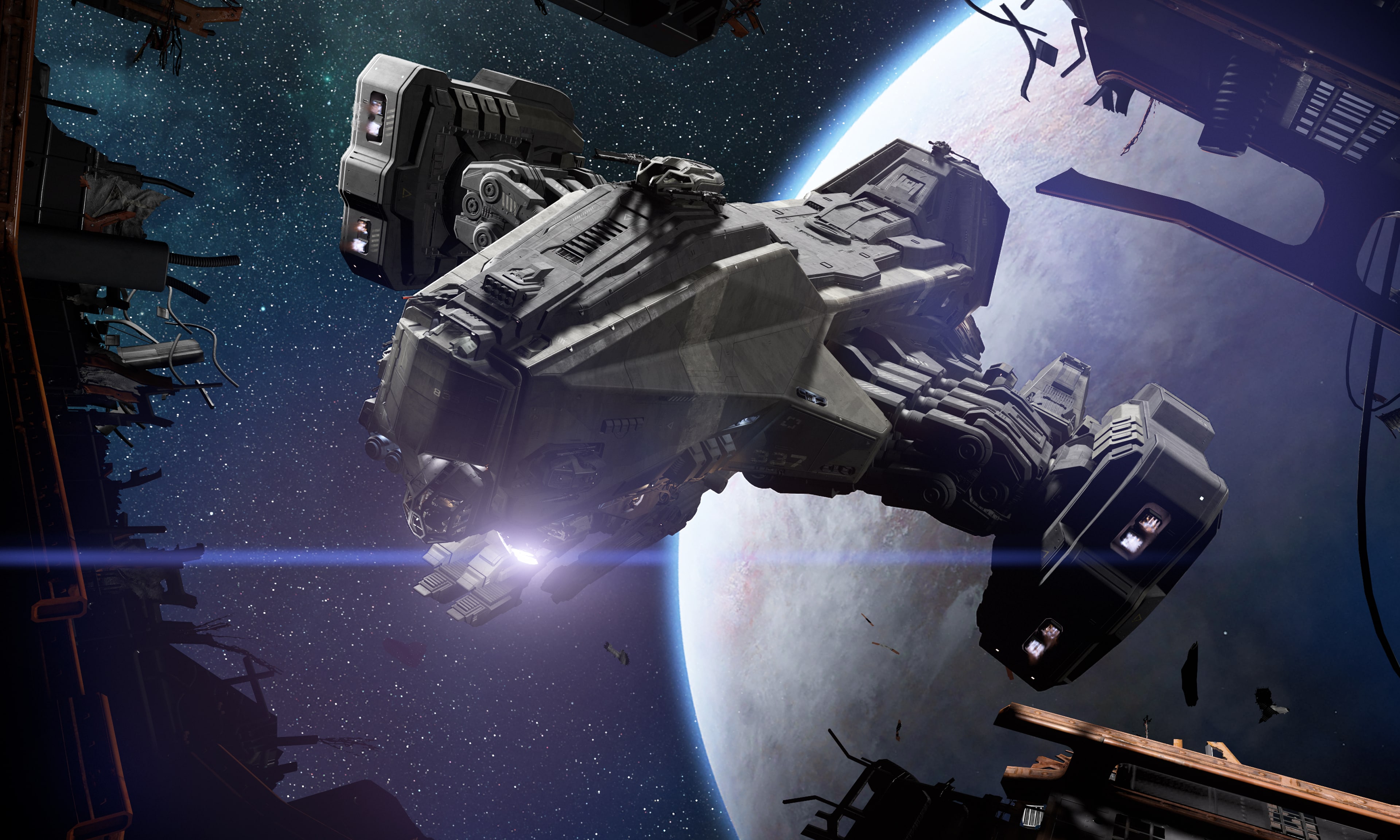
Aegis Idris
SPACECRAFT DEVELOPMENT
The initial specification for what would become the Idris was established in 2545 by the United Planets of Earth’s (UPE) Weapons Development Bureau (WepDev). The frigate was part of a range of forward-thinking plans that attempted to imagine the form that Earth’s military would need to take after the successful conclusion of the then-raging First Tevarin War. These plans imagined a peacetime UPE with significantly expanded borders, both with territory annexed from the Tevarin and the increased colonization of more distant planets. The specifics of what would be the Idris called for the development of an 85-meter, corvette-class spacecraft that could dock a pair of patrol fighters. These corvettes would be built more affordably and in greater numbers than current ships-of-the-line and would be rapidly deployed to help patrol the burgeoning Empire. The prime contractor role (covering both design and manufacturing) for the new ship was assigned to Aegis Dynamics via no-bid contract with a number of component and support contracts going to smaller, now defunct concerns.
To outside observers, the result of the ensuing three years of development was a model of typical bureaucratic confusion. The namesake Idris that would begin its space trials in 2549 was a completely different beast to the initial specification: a massive frigate-class spacecraft massing several times the original proposal, mounting an enormous railgun, and carrying a fully functional flight deck capable of supporting multiple classes of fighters and bombers. In fact, the Idris’ move from the proposed corvette to the frigate that was actually constructed was painless and seemingly natural for those involved, with the design specifications being revised multiple times as the reality of the post-war Empire became increasingly clear. The newly-christened Empire’s cadre of fresh-faced, Messer aligned planners quickly identified the project as important to establishing their own power base and they worked carefully with Aegis and other contractors (particularly Aim-Krug, responsible for the railgun installed on the first flight of ships) to expand the scope of design to define a model for the modern warship. Expansion from the original corvette to the frigate was a rare decision that was in the best interests of all persons involved. Highlighting the suggested importance of the project, the first ship was named after the recent victory at Idris IV, already being mythologized as a foundational element of the new Empire.
The first frigate was commissioned in 2551 in a ceremony at Aegis’ newly constructed Idris System factory complex. The launch was attended by Imperator Ivar Messer, who presented a famous speech seen today as a prelude to him taking increased control of the UEE in the name of public safety. The initial factory constructed by Aegis to produce the ships included six berths that would work around the clock. The first six Idrises laid down were all commissioned by May 2552 and began service tryouts then extended patrol assignments later that year. From the start, the high-tech ships were desired assignments for navy crewmen who correctly identified that the then-lavish ships would play a major role in coming events.
A major delay in production occurred the next year following the revelation that there were significant issues with the layout of the original six ships that made them particularly prone to fires. Poor placement of firefighting equipment and personnel combined with limited availability of shipboard retardants led to several significant fires, culminating in the deaths of seventeen sailors when one such fire spread to the forward magazine aboard the UEEN Ashton. Production of additional Idrises was delayed for eighteen months while a full review and redesign was conducted, culminating in the launch of the first flight-two spacecraft in 2555. With the early issues resolved, Idris production continued at pace and the powerful frigates quickly became a common site around the Empire.
The average Idris-class frigate commissioned between 2560 and 2800 had a thirty-year operational lifespan; in modern days, this average has been nearly doubled through both updated technologies and a greatly specialized overhaul process that essentially rebuilds any given ship once over the course of a decade. Aegis has continued to expand the number of available berths at their Idris IV factory over the centuries as demand increases from both the military and civilian users. The original UEEN Idris was decommissioned in August 2587 with 43 tours and nine combat stars. Today it is the sole remaining Flight I Idris, mothballed in drydock at MacArthur, where it is often discussed as a potential museum piece highlighting the military’s role during the Messer era.
CIVILIAN LAUNCH
For the first two hundred years of production, Idrises were reliably scrapped upon decommissioning; a requirement specified by law for all capital assets by the early UEE government. While Aegis’ shipbreakers were forbidden from salvaging and reusing systems, they were able to recycle roughly 35% of the scrap tonnage in the construction of newly produced frigates. This lifecycle was drastically altered in 2801 with the passage of the first Surplus Act that gave approved civilian organizations the rights to bid on properly-demilitarized but still-functional spacecraft up to and including destroyer-class vessels. In the case of the era’s Idrises, this meant the permanent disabling of the keel-mounted gun and the removal of all classified subsystems, such as military-spec targeting software. The law was primarily passed to allow citizens to purchase former freighters and the initial reception to the availability of former military frigates was generally cold. Within two decades, however, the need for larger-scale fighting ships had become greater and Aegis was forced to significantly expand its investment in mining corporations in order to make up for lost scrap resources. Simultaneously, additional citizen armament laws loosened the restrictions on what equipment could be sold off and to whom it could be sold to, gradually going from authorized militia forces to corporate and finally private entities.
By 2875, the demand for civilianized Idrises combined with expanding life cycles for existing military ships had outstripped the Navy’s ability to decommission existing ships. The result of this schism was the launch of the first-ever Idris Peacekeeper (Idris P), a purpose-built ship nearly identical in form to the military model (retroactively called the Idris Military or Idris M), lacking only the main gun mount (which could be readily rebuilt on the secondary market). For the first time, civilian organizations could purchase not only the increasingly limited number of UEEN surplus ships but also commission the construction of their own spacecraft directly from Aegis. The popularity of the Idris platform, already cushioned by generations of developed support system, exploded and had quadrupled by the turn of the century.
CIVILIAN EXAMPLES
The following examples are a sample of different Idris-class ships used by civilian entities. As Idrises have been available to civilian organizations for well over a century, this list is representative but not exhaustive.
• BX214, BX215, and BX218 were Idris-class frigates purchased via fundraising by aid organizations in 2812 in response to a disaster in the Corel System. Unexpected solar activity caused a nearly total crop loss in the system for an 18-month period, prompting a major aid effort to ship food and other aid supplies in. The three Idrises, their flight bays converted for freight for the first time, served as armored transports as part of a large, ragtag fleet of similarly repurposed vessels.
• Anax was an early model Idris supposedly purchased by a civilian historical salvage group in 2815. Anax was equipped with ultra-high-tech sensor systems and a force of powerful drone spacecraft. The ship was credited with the discovery of several major wrecks and the surprise recovery of a stranded starliner thought to have been destroyed in an accident. In response to a 2915 formal information request filed by a group of journalists reviewing historical starships, it was revealed that the Imperial government funded a significant portion of Anax’s expeditions for reasons that remain classified.
• Helne’s Canard was a purpose-built Idris-P owned by weapons magnate Jaer Forsythe. In his later years, Forsythe became increasingly paranoid and ultimately interested in avoiding human contact altogether. Shortly after his 75th birthday, he sold off his terrestrial real estate and invested a significant portion of his weapons investments in the conversion of the Idris into an armored luxury spacecraft. The details of how the ship was crewed and its current whereabouts remain unknown.
• Home Force One was an Idris-class ship belonging to the so-called Free Republic of Lamia, a fringe political group that claimed ‘ownership’ of a large asteroid in the Goss System. The group considered Home Force One, a military surplus Idris which was never actually re-equipped with weaponry, to be their flagship and utilized it in a number of media stunts to promote their cause. The Lamian organization fell into bankruptcy within a year of the ship’s purchase and it was ultimately taken into custody and later scuttled by the Advocacy.
Dieser Artikel erschien ursprünglich in Jump Point 8.6.
Aegis Idris
ENTWICKLUNG DES RAUMSCHIFFS
Die ersten Spezifikationen für die spätere Idris wurden 2545 vom Weapons Development Bureau (WepDev) der United Planets of Earth (UPE) erstellt. Die Fregatte war Teil einer Reihe von zukunftsweisenden Plänen, mit denen versucht wurde, sich vorzustellen, wie das Militär der Erde nach dem erfolgreichen Abschluss des damals tobenden Ersten Tevarin-Krieges aussehen sollte. Diese Pläne sahen eine UPE in Friedenszeiten mit deutlich erweiterten Grenzen vor, sowohl durch die Annexion von Gebieten der Tevarin als auch durch die verstärkte Kolonisierung weiter entfernter Planeten. Die Pläne für die Idris sahen die Entwicklung eines 85 Meter langen Raumschiffs der Korvettenklasse vor, an das ein Paar Patrouillenjäger andocken konnte. Diese Korvetten sollten kostengünstiger und in größerer Stückzahl gebaut werden als die aktuellen Raumschiffe und schnell eingesetzt werden, um das aufstrebende Imperium zu patrouillieren. Die Rolle des Hauptauftragnehmers (sowohl für die Konstruktion als auch für die Herstellung) für das neue Schiff wurde Aegis Dynamics im Rahmen eines No-Bid-Vertrages zugewiesen, wobei eine Reihe von Komponenten- und Unterstützungsverträgen an kleinere, inzwischen aufgelöste Unternehmen gingen.
Für außenstehende Beobachter war das Ergebnis der folgenden dreijährigen Entwicklungsphase ein Musterbeispiel für typisches bürokratisches Durcheinander. Die namensgebende Idris, die im Jahr 2549 in die Erprobung ging, unterschied sich völlig von der ursprünglichen Spezifikation: ein massives Raumschiff der Fregattenklasse, das ein Vielfaches des ursprünglichen Vorschlags wog, mit einer riesigen Railgun ausgestattet war und ein voll funktionsfähiges Flugdeck besaß, das mehrere Klassen von Jägern und Bombern aufnehmen konnte. Tatsächlich war die Entwicklung der Idris von der vorgeschlagenen Korvette zur tatsächlich gebauten Fregatte für alle Beteiligten schmerzlos und scheinbar selbstverständlich, wobei die Konstruktionsspezifikationen mehrfach überarbeitet wurden, als die Realität des Nachkriegsimperiums immer deutlicher wurde. Die frischgebackenen, auf Messer ausgerichteten Planer des neu getauften Imperiums erkannten schnell, dass das Projekt für den Aufbau ihrer eigenen Machtbasis wichtig war, und sie arbeiteten sorgfältig mit Aegis und anderen Auftragnehmern zusammen (vor allem mit Aim-Krug, der für die Railgun auf der ersten Schiffsflotte verantwortlich war), um den Umfang des Entwurfs zu erweitern und ein Modell für das moderne Kriegsschiff zu definieren. Die Erweiterung von der ursprünglichen Korvette zur Fregatte war eine seltene Entscheidung, die im besten Interesse aller Beteiligten lag. Um die vermutete Bedeutung des Projekts zu unterstreichen, wurde das erste Schiff nach dem jüngsten Sieg bei Idris IV benannt, der bereits als Gründungselement des neuen Reiches mythologisiert wurde.
Die erste Fregatte wurde 2551 in einer Zeremonie im neu errichteten Fabrikkomplex von Aegis im Idris-System in Betrieb genommen. Der Stapellauf fand im Beisein von Imperator Ivar Messer statt, der eine berühmte Rede hielt, die heute als Auftakt dafür gilt, dass er im Namen der öffentlichen Sicherheit die Kontrolle über die UEE übernahm. Die erste Fabrik, die Aegis für die Produktion der Schiffe errichtete, umfasste sechs Liegeplätze, die rund um die Uhr in Betrieb waren. Die ersten sechs Idrises wurden im Mai 2552 in Dienst gestellt und begannen noch im selben Jahr mit Probefahrten und erweiterten Patrouillenaufträgen. Von Anfang an waren die Hightech-Schiffe begehrte Aufgaben für die Marine, die richtig erkannte, dass die damals luxuriösen Schiffe eine wichtige Rolle bei den kommenden Ereignissen spielen würden.
Ein Jahr später kam es zu einer erheblichen Verzögerung der Produktion, nachdem sich herausstellte, dass die ursprünglichen sechs Schiffe aufgrund ihrer Bauweise besonders anfällig für Brände waren. Die unzureichende Platzierung von Feuerlöschgeräten und -personal in Verbindung mit der begrenzten Verfügbarkeit von Löschmitteln an Bord führte zu mehreren großen Bränden, bei denen siebzehn Matrosen ums Leben kamen, als ein solches Feuer auf das vordere Magazin an Bord der UEEN Ashton übergriff. Die Produktion weiterer Idrises verzögerte sich um achtzehn Monate, während eine vollständige Überarbeitung und Neugestaltung durchgeführt wurde, die im Jahr 2555 mit dem Start des ersten Raumschiffs mit zwei Flügen ihren Höhepunkt fand. Nachdem die ersten Probleme behoben waren, ging die Produktion der Idris zügig weiter und die leistungsstarken Fregatten wurden schnell zu einem beliebten Objekt im ganzen Reich.
Eine durchschnittliche Fregatte der Idris-Klasse, die zwischen 2560 und 2800 in Dienst gestellt wurde, hatte eine Lebensdauer von dreißig Jahren; in der heutigen Zeit hat sich dieser Durchschnitt durch modernste Technologien und ein hochspezialisiertes Überholungsverfahren, bei dem jedes Schiff im Laufe eines Jahrzehnts einmal umgebaut wird, fast verdoppelt. Aegis hat die Anzahl der verfügbaren Liegeplätze in der Idris IV-Fabrik im Laufe der Jahrhunderte ständig erweitert, da die Nachfrage sowohl von Seiten des Militärs als auch der zivilen Nutzer gestiegen ist. Die ursprüngliche UEEN Idris wurde im August 2587 mit 43 Einsätzen und neun Kampfsternen außer Dienst gestellt. Heute ist sie die einzige verbliebene Flight I Idris, die im Trockendock von MacArthur eingemottet ist, wo sie oft als potenzielles Museumsstück diskutiert wird, das die Rolle des Militärs während der Messer-Ära beleuchtet.
ZIVILER START
In den ersten zweihundert Jahren ihrer Produktion wurden die Idris bei ihrer Stilllegung zuverlässig verschrottet - eine Vorschrift, die die frühe UEE-Regierung für alle Investitionsgüter gesetzlich festlegte. Obwohl es den Schiffsabwrackern von Aegis verboten war, Systeme zu bergen und wiederzuverwenden, konnten sie etwa 35 % der Schrotttonnage für den Bau neuer Fregatten wiederverwenden. Dieser Lebenszyklus wurde 2801 mit der Verabschiedung des ersten Surplus Acts drastisch verändert, der zugelassenen zivilen Organisationen das Recht gab, auf ordnungsgemäß entmilitarisierte, aber noch funktionsfähige Raumschiffe zu bieten - bis hin zu Schiffen der Zerstörerklasse. Im Fall der Idrises bedeutete dies, dass die auf dem Kiel montierte Kanone dauerhaft deaktiviert und alle geheimen Subsysteme, wie die militärische Zielsoftware, entfernt wurden. Das Gesetz wurde in erster Linie erlassen, um den Bürgern den Kauf ehemaliger Frachter zu ermöglichen, und die anfängliche Reaktion auf die Verfügbarkeit ehemaliger Militärfregatten war im Allgemeinen kalt. Innerhalb von zwei Jahrzehnten wurde der Bedarf an größeren Kampfschiffen jedoch immer größer und Aegis war gezwungen, seine Investitionen in Bergbauunternehmen erheblich auszuweiten, um die verlorenen Schrottressourcen auszugleichen. Gleichzeitig wurden durch zusätzliche Bürgerrüstungsgesetze die Beschränkungen gelockert, welche Ausrüstung verkauft werden durfte und an wen sie verkauft werden konnte. So wurden nach und nach nicht mehr nur autorisierte Miliztruppen, sondern auch Unternehmen und schließlich private Einrichtungen zugelassen.
Im Jahr 2875 überstieg die Nachfrage nach zivilisierten Idrises in Verbindung mit der Verlängerung der Lebenszyklen bestehender Militärschiffe die Fähigkeit der Marine, bestehende Schiffe außer Dienst zu stellen. Das Ergebnis dieser Spaltung war die Einführung der allerersten Idris Peacekeeper (Idris P), eines zweckbestimmten Schiffes, das fast identisch mit dem militärischen Modell war (rückwirkend Idris Military oder Idris M genannt) und dem nur die Hauptkanonenlafette fehlte (die auf dem Sekundärmarkt leicht nachgebaut werden konnte). Zum ersten Mal konnten zivile Organisationen nicht nur die zunehmend begrenzte Anzahl an überschüssigen UEEN-Schiffen erwerben, sondern auch den Bau eigener Raumschiffe direkt bei Aegis in Auftrag geben. Die Popularität der Idris-Plattform, die bereits seit Generationen durch ein entwickeltes Unterstützungssystem abgefedert wurde, explodierte und hatte sich bis zur Jahrhundertwende vervierfacht.
ZIVILE BEISPIELE
Die folgenden Beispiele sind eine Auswahl verschiedener Schiffe der Idris-Klasse, die von zivilen Einrichtungen genutzt werden. Da Idris-Schiffe für zivile Organisationen schon seit weit über einem Jahrhundert zur Verfügung stehen, ist diese Liste zwar repräsentativ, aber nicht erschöpfend.
- BX214, BX215 und BX218 waren Fregatten der Idris-Klasse, die von Hilfsorganisationen im Jahr 2812 als Reaktion auf eine Katastrophe im Corel-System durch Spendenaktionen erworben wurden. Eine unerwartete Sonnenaktivität führte dazu, dass die Ernte in dem System 18 Monate lang fast vollständig ausfiel, was eine große Hilfsaktion auslöste, um Lebensmittel und andere Hilfsgüter dorthin zu bringen. Die drei Idrises, deren Flugschächte zum ersten Mal für Fracht umgerüstet wurden, dienten als gepanzerte Transporter und waren Teil einer großen, zusammengewürfelten Flotte von ähnlich umfunktionierten Schiffen.
- Die Anax war ein frühes Idris-Modell, das vermutlich 2815 von einer zivilen historischen Bergungsgruppe gekauft wurde. Die Anax war mit Hightech-Sensorsystemen und einer Flotte leistungsstarker Drohnen ausgestattet. Dem Schiff wurde die Entdeckung mehrerer großer Wracks und die überraschende Bergung eines gestrandeten Raumschiffs zugeschrieben, von dem man annahm, dass es bei einem Unfall zerstört worden war. Als Antwort auf eine formelle Informationsanfrage aus dem Jahr 2915, die von einer Gruppe von Journalisten gestellt wurde, die sich mit historischen Raumschiffen befasst, wurde enthüllt, dass die imperiale Regierung einen großen Teil der Expeditionen von Anax aus Gründen finanziert, die geheim bleiben.
- Helne's Canard war eine speziell gebaute Idris-P, die dem Waffenmagnaten Jaer Forsythe gehörte. In seinen späteren Jahren wurde Forsythe zunehmend paranoid und wollte schließlich den Kontakt zu Menschen ganz vermeiden. Kurz nach seinem 75. Geburtstag verkaufte er seine irdischen Immobilien und investierte einen großen Teil seiner Waffeninvestitionen in den Umbau der Idris zu einem gepanzerten Luxusraumschiff. Die Einzelheiten über die Besatzung des Schiffes und seinen derzeitigen Verbleib sind unbekannt.
- Die Home Force One war ein Schiff der Idris-Klasse, das der so genannten Freien Republik Lamia gehörte, einer politischen Randgruppe, die einen großen Asteroiden im Goss-System ihr Eigen nannte. Die Gruppe betrachtete die Home Force One, eine militärische Überschuss-Idris, die nie wirklich mit Waffen ausgestattet wurde, als ihr Flaggschiff und nutzte sie für eine Reihe von Medienauftritten, um für ihre Sache zu werben. Die lamianische Organisation ging bereits ein Jahr nach dem Kauf des Schiffes in Konkurs und das Schiff wurde schließlich von der Advocacy in Gewahrsam genommen und später versenkt.
This article originally appeared in Jump Point 8.6.
Aegis Idris
SPACECRAFT DEVELOPMENT
The initial specification for what would become the Idris was established in 2545 by the United Planets of Earth’s (UPE) Weapons Development Bureau (WepDev). The frigate was part of a range of forward-thinking plans that attempted to imagine the form that Earth’s military would need to take after the successful conclusion of the then-raging First Tevarin War. These plans imagined a peacetime UPE with significantly expanded borders, both with territory annexed from the Tevarin and the increased colonization of more distant planets. The specifics of what would be the Idris called for the development of an 85-meter, corvette-class spacecraft that could dock a pair of patrol fighters. These corvettes would be built more affordably and in greater numbers than current ships-of-the-line and would be rapidly deployed to help patrol the burgeoning Empire. The prime contractor role (covering both design and manufacturing) for the new ship was assigned to Aegis Dynamics via no-bid contract with a number of component and support contracts going to smaller, now defunct concerns.
To outside observers, the result of the ensuing three years of development was a model of typical bureaucratic confusion. The namesake Idris that would begin its space trials in 2549 was a completely different beast to the initial specification: a massive frigate-class spacecraft massing several times the original proposal, mounting an enormous railgun, and carrying a fully functional flight deck capable of supporting multiple classes of fighters and bombers. In fact, the Idris’ move from the proposed corvette to the frigate that was actually constructed was painless and seemingly natural for those involved, with the design specifications being revised multiple times as the reality of the post-war Empire became increasingly clear. The newly-christened Empire’s cadre of fresh-faced, Messer aligned planners quickly identified the project as important to establishing their own power base and they worked carefully with Aegis and other contractors (particularly Aim-Krug, responsible for the railgun installed on the first flight of ships) to expand the scope of design to define a model for the modern warship. Expansion from the original corvette to the frigate was a rare decision that was in the best interests of all persons involved. Highlighting the suggested importance of the project, the first ship was named after the recent victory at Idris IV, already being mythologized as a foundational element of the new Empire.
The first frigate was commissioned in 2551 in a ceremony at Aegis’ newly constructed Idris System factory complex. The launch was attended by Imperator Ivar Messer, who presented a famous speech seen today as a prelude to him taking increased control of the UEE in the name of public safety. The initial factory constructed by Aegis to produce the ships included six berths that would work around the clock. The first six Idrises laid down were all commissioned by May 2552 and began service tryouts then extended patrol assignments later that year. From the start, the high-tech ships were desired assignments for navy crewmen who correctly identified that the then-lavish ships would play a major role in coming events.
A major delay in production occurred the next year following the revelation that there were significant issues with the layout of the original six ships that made them particularly prone to fires. Poor placement of firefighting equipment and personnel combined with limited availability of shipboard retardants led to several significant fires, culminating in the deaths of seventeen sailors when one such fire spread to the forward magazine aboard the UEEN Ashton. Production of additional Idrises was delayed for eighteen months while a full review and redesign was conducted, culminating in the launch of the first flight-two spacecraft in 2555. With the early issues resolved, Idris production continued at pace and the powerful frigates quickly became a common site around the Empire.
The average Idris-class frigate commissioned between 2560 and 2800 had a thirty-year operational lifespan; in modern days, this average has been nearly doubled through both updated technologies and a greatly specialized overhaul process that essentially rebuilds any given ship once over the course of a decade. Aegis has continued to expand the number of available berths at their Idris IV factory over the centuries as demand increases from both the military and civilian users. The original UEEN Idris was decommissioned in August 2587 with 43 tours and nine combat stars. Today it is the sole remaining Flight I Idris, mothballed in drydock at MacArthur, where it is often discussed as a potential museum piece highlighting the military’s role during the Messer era.
CIVILIAN LAUNCH
For the first two hundred years of production, Idrises were reliably scrapped upon decommissioning; a requirement specified by law for all capital assets by the early UEE government. While Aegis’ shipbreakers were forbidden from salvaging and reusing systems, they were able to recycle roughly 35% of the scrap tonnage in the construction of newly produced frigates. This lifecycle was drastically altered in 2801 with the passage of the first Surplus Act that gave approved civilian organizations the rights to bid on properly-demilitarized but still-functional spacecraft up to and including destroyer-class vessels. In the case of the era’s Idrises, this meant the permanent disabling of the keel-mounted gun and the removal of all classified subsystems, such as military-spec targeting software. The law was primarily passed to allow citizens to purchase former freighters and the initial reception to the availability of former military frigates was generally cold. Within two decades, however, the need for larger-scale fighting ships had become greater and Aegis was forced to significantly expand its investment in mining corporations in order to make up for lost scrap resources. Simultaneously, additional citizen armament laws loosened the restrictions on what equipment could be sold off and to whom it could be sold to, gradually going from authorized militia forces to corporate and finally private entities.
By 2875, the demand for civilianized Idrises combined with expanding life cycles for existing military ships had outstripped the Navy’s ability to decommission existing ships. The result of this schism was the launch of the first-ever Idris Peacekeeper (Idris P), a purpose-built ship nearly identical in form to the military model (retroactively called the Idris Military or Idris M), lacking only the main gun mount (which could be readily rebuilt on the secondary market). For the first time, civilian organizations could purchase not only the increasingly limited number of UEEN surplus ships but also commission the construction of their own spacecraft directly from Aegis. The popularity of the Idris platform, already cushioned by generations of developed support system, exploded and had quadrupled by the turn of the century.
CIVILIAN EXAMPLES
The following examples are a sample of different Idris-class ships used by civilian entities. As Idrises have been available to civilian organizations for well over a century, this list is representative but not exhaustive.
• BX214, BX215, and BX218 were Idris-class frigates purchased via fundraising by aid organizations in 2812 in response to a disaster in the Corel System. Unexpected solar activity caused a nearly total crop loss in the system for an 18-month period, prompting a major aid effort to ship food and other aid supplies in. The three Idrises, their flight bays converted for freight for the first time, served as armored transports as part of a large, ragtag fleet of similarly repurposed vessels.
• Anax was an early model Idris supposedly purchased by a civilian historical salvage group in 2815. Anax was equipped with ultra-high-tech sensor systems and a force of powerful drone spacecraft. The ship was credited with the discovery of several major wrecks and the surprise recovery of a stranded starliner thought to have been destroyed in an accident. In response to a 2915 formal information request filed by a group of journalists reviewing historical starships, it was revealed that the Imperial government funded a significant portion of Anax’s expeditions for reasons that remain classified.
• Helne’s Canard was a purpose-built Idris-P owned by weapons magnate Jaer Forsythe. In his later years, Forsythe became increasingly paranoid and ultimately interested in avoiding human contact altogether. Shortly after his 75th birthday, he sold off his terrestrial real estate and invested a significant portion of his weapons investments in the conversion of the Idris into an armored luxury spacecraft. The details of how the ship was crewed and its current whereabouts remain unknown.
• Home Force One was an Idris-class ship belonging to the so-called Free Republic of Lamia, a fringe political group that claimed ‘ownership’ of a large asteroid in the Goss System. The group considered Home Force One, a military surplus Idris which was never actually re-equipped with weaponry, to be their flagship and utilized it in a number of media stunts to promote their cause. The Lamian organization fell into bankruptcy within a year of the ship’s purchase and it was ultimately taken into custody and later scuttled by the Advocacy.
This article originally appeared in Jump Point 8.6.
Aegis Idris
SPACECRAFT DEVELOPMENT
The initial specification for what would become the Idris was established in 2545 by the United Planets of Earth’s (UPE) Weapons Development Bureau (WepDev). The frigate was part of a range of forward-thinking plans that attempted to imagine the form that Earth’s military would need to take after the successful conclusion of the then-raging First Tevarin War. These plans imagined a peacetime UPE with significantly expanded borders, both with territory annexed from the Tevarin and the increased colonization of more distant planets. The specifics of what would be the Idris called for the development of an 85-meter, corvette-class spacecraft that could dock a pair of patrol fighters. These corvettes would be built more affordably and in greater numbers than current ships-of-the-line and would be rapidly deployed to help patrol the burgeoning Empire. The prime contractor role (covering both design and manufacturing) for the new ship was assigned to Aegis Dynamics via no-bid contract with a number of component and support contracts going to smaller, now defunct concerns.
To outside observers, the result of the ensuing three years of development was a model of typical bureaucratic confusion. The namesake Idris that would begin its space trials in 2549 was a completely different beast to the initial specification: a massive frigate-class spacecraft massing several times the original proposal, mounting an enormous railgun, and carrying a fully functional flight deck capable of supporting multiple classes of fighters and bombers. In fact, the Idris’ move from the proposed corvette to the frigate that was actually constructed was painless and seemingly natural for those involved, with the design specifications being revised multiple times as the reality of the post-war Empire became increasingly clear. The newly-christened Empire’s cadre of fresh-faced, Messer aligned planners quickly identified the project as important to establishing their own power base and they worked carefully with Aegis and other contractors (particularly Aim-Krug, responsible for the railgun installed on the first flight of ships) to expand the scope of design to define a model for the modern warship. Expansion from the original corvette to the frigate was a rare decision that was in the best interests of all persons involved. Highlighting the suggested importance of the project, the first ship was named after the recent victory at Idris IV, already being mythologized as a foundational element of the new Empire.
The first frigate was commissioned in 2551 in a ceremony at Aegis’ newly constructed Idris System factory complex. The launch was attended by Imperator Ivar Messer, who presented a famous speech seen today as a prelude to him taking increased control of the UEE in the name of public safety. The initial factory constructed by Aegis to produce the ships included six berths that would work around the clock. The first six Idrises laid down were all commissioned by May 2552 and began service tryouts then extended patrol assignments later that year. From the start, the high-tech ships were desired assignments for navy crewmen who correctly identified that the then-lavish ships would play a major role in coming events.
A major delay in production occurred the next year following the revelation that there were significant issues with the layout of the original six ships that made them particularly prone to fires. Poor placement of firefighting equipment and personnel combined with limited availability of shipboard retardants led to several significant fires, culminating in the deaths of seventeen sailors when one such fire spread to the forward magazine aboard the UEEN Ashton. Production of additional Idrises was delayed for eighteen months while a full review and redesign was conducted, culminating in the launch of the first flight-two spacecraft in 2555. With the early issues resolved, Idris production continued at pace and the powerful frigates quickly became a common site around the Empire.
The average Idris-class frigate commissioned between 2560 and 2800 had a thirty-year operational lifespan; in modern days, this average has been nearly doubled through both updated technologies and a greatly specialized overhaul process that essentially rebuilds any given ship once over the course of a decade. Aegis has continued to expand the number of available berths at their Idris IV factory over the centuries as demand increases from both the military and civilian users. The original UEEN Idris was decommissioned in August 2587 with 43 tours and nine combat stars. Today it is the sole remaining Flight I Idris, mothballed in drydock at MacArthur, where it is often discussed as a potential museum piece highlighting the military’s role during the Messer era.
CIVILIAN LAUNCH
For the first two hundred years of production, Idrises were reliably scrapped upon decommissioning; a requirement specified by law for all capital assets by the early UEE government. While Aegis’ shipbreakers were forbidden from salvaging and reusing systems, they were able to recycle roughly 35% of the scrap tonnage in the construction of newly produced frigates. This lifecycle was drastically altered in 2801 with the passage of the first Surplus Act that gave approved civilian organizations the rights to bid on properly-demilitarized but still-functional spacecraft up to and including destroyer-class vessels. In the case of the era’s Idrises, this meant the permanent disabling of the keel-mounted gun and the removal of all classified subsystems, such as military-spec targeting software. The law was primarily passed to allow citizens to purchase former freighters and the initial reception to the availability of former military frigates was generally cold. Within two decades, however, the need for larger-scale fighting ships had become greater and Aegis was forced to significantly expand its investment in mining corporations in order to make up for lost scrap resources. Simultaneously, additional citizen armament laws loosened the restrictions on what equipment could be sold off and to whom it could be sold to, gradually going from authorized militia forces to corporate and finally private entities.
By 2875, the demand for civilianized Idrises combined with expanding life cycles for existing military ships had outstripped the Navy’s ability to decommission existing ships. The result of this schism was the launch of the first-ever Idris Peacekeeper (Idris P), a purpose-built ship nearly identical in form to the military model (retroactively called the Idris Military or Idris M), lacking only the main gun mount (which could be readily rebuilt on the secondary market). For the first time, civilian organizations could purchase not only the increasingly limited number of UEEN surplus ships but also commission the construction of their own spacecraft directly from Aegis. The popularity of the Idris platform, already cushioned by generations of developed support system, exploded and had quadrupled by the turn of the century.
CIVILIAN EXAMPLES
The following examples are a sample of different Idris-class ships used by civilian entities. As Idrises have been available to civilian organizations for well over a century, this list is representative but not exhaustive.
• BX214, BX215, and BX218 were Idris-class frigates purchased via fundraising by aid organizations in 2812 in response to a disaster in the Corel System. Unexpected solar activity caused a nearly total crop loss in the system for an 18-month period, prompting a major aid effort to ship food and other aid supplies in. The three Idrises, their flight bays converted for freight for the first time, served as armored transports as part of a large, ragtag fleet of similarly repurposed vessels.
• Anax was an early model Idris supposedly purchased by a civilian historical salvage group in 2815. Anax was equipped with ultra-high-tech sensor systems and a force of powerful drone spacecraft. The ship was credited with the discovery of several major wrecks and the surprise recovery of a stranded starliner thought to have been destroyed in an accident. In response to a 2915 formal information request filed by a group of journalists reviewing historical starships, it was revealed that the Imperial government funded a significant portion of Anax’s expeditions for reasons that remain classified.
• Helne’s Canard was a purpose-built Idris-P owned by weapons magnate Jaer Forsythe. In his later years, Forsythe became increasingly paranoid and ultimately interested in avoiding human contact altogether. Shortly after his 75th birthday, he sold off his terrestrial real estate and invested a significant portion of his weapons investments in the conversion of the Idris into an armored luxury spacecraft. The details of how the ship was crewed and its current whereabouts remain unknown.
• Home Force One was an Idris-class ship belonging to the so-called Free Republic of Lamia, a fringe political group that claimed ‘ownership’ of a large asteroid in the Goss System. The group considered Home Force One, a military surplus Idris which was never actually re-equipped with weaponry, to be their flagship and utilized it in a number of media stunts to promote their cause. The Lamian organization fell into bankruptcy within a year of the ship’s purchase and it was ultimately taken into custody and later scuttled by the Advocacy.
Links
No links available.


Metadata
- CIG ID
- 20238
- Channel
- Spectrum Dispatch
- Category
- Undefined
- Series
- News Update
- Comments
- 13
- Published
- 2 years ago (2024-10-08T00:00:00+00:00)