Star Citizen Monthly Report: October 2024
Transmission Undefined NoneContent
PU Monthly Report
October 2024
October was a busy month for all CIG staff, with patch launches, Pyro in the PTU, and (of course) CitizenCon 2954. Alongside these major events, progress on upcoming features continued, with many teams finalizing content for Alpha 4.0 and 2025. Read on for all the details.
To note, this will be the last PU Report of the year, with November and December’s entry coming in January. We’ll see you next time!
AI (Content)
Last month, the AI Content team supported the social behaviors tied to Stanton’s derelict outposts and settlements, which will be used for new mission content. As neutral players can visit these locations, NPCs need to behave ‘normally’ when not under threat or under mission conditions.
The team also worked on tasks for Alpha 4.0, including validating social AI in various stations around Pyro. They also reviewed Stanton’s landing zones to see where improvements could be made. After additional conversations, the team is looking to capture new content to provide more dynamic conversations to both Stanton and Pyro.
AI Director Francesco Roccucci also hosted the Brave New Worlds presentation at CitizenCon, which included bringing AI to life and how it affects combat experiences in the ‘verse.
AI (Features)
October saw AI Features improving Human combat features for Alpha 4.0. For first reactions, the behavior was refactored to provide more consistent responses across a range of situations. This was thoroughly tested in the ‘test cell’ mentioned in previous reports.
The team continued to iterate on functionality for NPCs healing downed friendlies, including changes to the actor states to ensure the animation flow continues correctly between individual and synchronized animations. A test cell was also created to ensure the medic works consistently across different setups, including from different directions around the patient’s body.
For ammo and weapon management, the devs looked at reload functionality, including behavior for switching to a sidearm when picking up ammo or looting from bodies and then switching back.
Improvements were also made to NPCs with rocket launchers, who now enter combat even when no cover is available and switch to their sidearm if an enemy gets too close.
The AI Features and Audio teams partnered to implement and fix wildlines across all AI behaviors, including first reactions, tactics, and investigations.
The team also debuted the first valakkar gameplay at CitizenCon.
“This has been a really fun and interesting creature to work on as it is very different from anything else we have in the game so far. We’ll be sharing more details of its implementation and the challenges we’ve faced in the run-up to its release.” AI Features Team
AI (Tech)
AI Tech continued to support Server Meshing, synchronizing the Subsumption component between dedicated servers so that NPCs continue their assigned behaviors when switching.
They then implemented the first pass on several features presented during CitizenCon, including improvements to enemy vision perception, which now takes planetary lighting cycles into account.
The first pass of dynamic cover generation for planets was also completed; this can also be used in other locations with navigation areas. As seen at CitizenCon, the team can now generate cover locations and surfaces at the same time as a navigation mesh.
Functionality was also added to link ‘navigation cost volume’ and ‘navigation exclusion volume’ to areas in different object containers. For example, outpost object containers that feature exclusion or cost volumes can influence how planet navigation mesh is generated.
They also made improvements to Ship AI features, including planetary surface avoidance, and optimized ship weapon fire validation against allies. They also optimized perception-related components, like vision and hearing. For example, vision zone queries are now faster, while audio stimuli propagation is more accurate as it utilizes a room system graph.
AI (Game Intelligence Development Team)
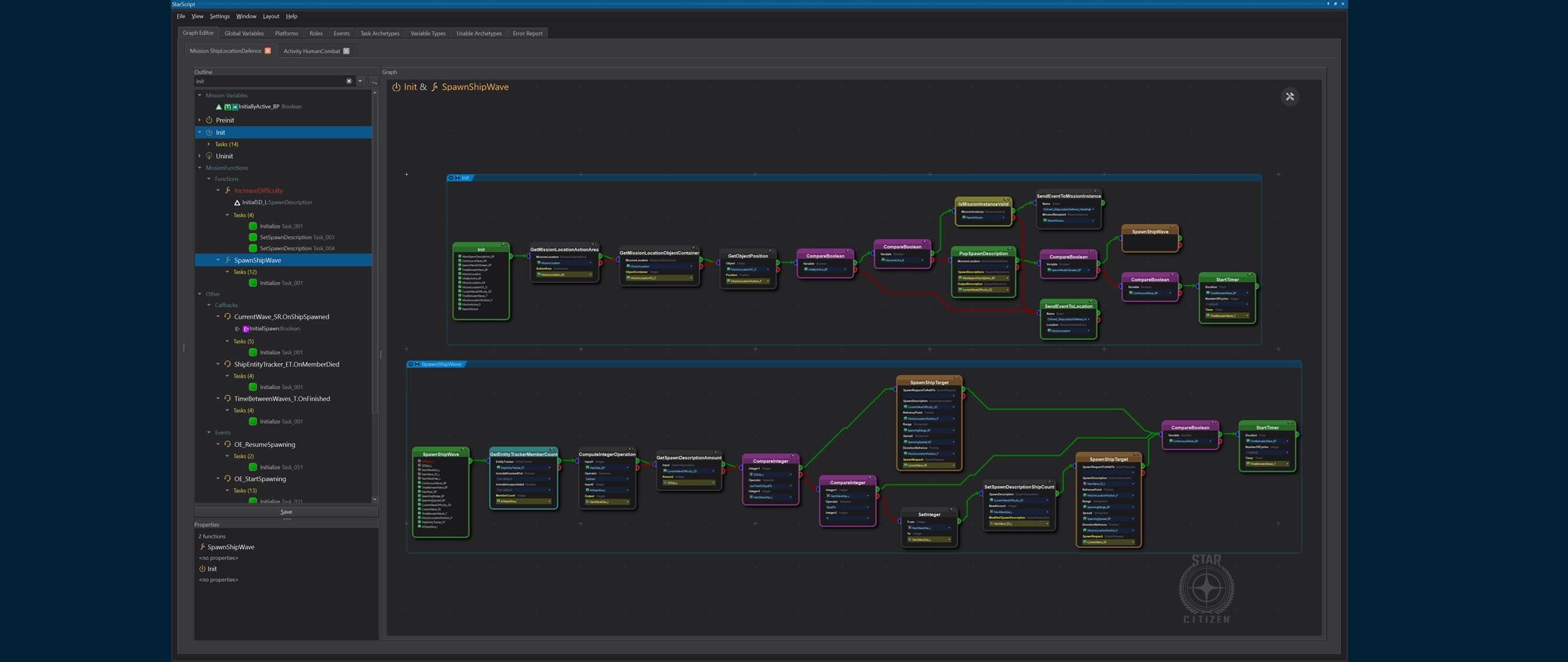
Throughout October, the Game Intelligence Development team polished StarScript v1.0 for its internal release. For example, they reduced the loading time for the majority of large containers (e.g. a whole solar system) from 10 to 2 seconds and integrated the new ‘groups’ look to more clearly differentiate between groups.
They also introduced min and max zoom ranges in the graph editor to avoid view breaks, stopped the ‘help’ popup from obscuring task nodes, and implemented the Smart Panel. Graphs are now presented in the same order as their names in the outline, misplaced parallel ports on task nodes were corrected, and displaying two graphs now works correctly too.
The relationship between the proprieties panel and the selected item on the Smart Panel was improved, while rounded square tasks were integrated into the SmartPanel to mimic the tasks in the graph viewer. Boxes in collapsed groups were enlarged to include long titles, while an icon was added to differentiate activity and mission variables in the outliner.
Finally for StarScript, a QA testing procedure was created to properly test the most important activities and missions.
Animation
Last month, the Animation team worked on the valakkar and ‘space cow’ alongside adjustments to the kopion. They also continued to provide facial animation support for PU characters and prepped for an upcoming narrative shoot.
Animation are currently supporting Level Design with a number of player-interaction animations for level traversal.
Art (Characters)
In October, the Character Art team focused on tasks related to CitizenCon. After the event, the team continued creating the utility and specialist armors, including color and material variants to support factions and missions. Work also began on armors for upcoming events.
The Character Concept Art team created new armors, including utility battle tech and a super-heavy armor.
Art (Ships)
October saw the Ship team complete the final content review for the RSI Polaris, while the final content tasks are currently in progress for the MISC Starlancer MAX.
The team is nearly finished with two unannounced vehicles, while several more are approaching their whitebox and greybox reviews. Six additional vehicles will begin production soon, too.
Community
The Community team began the month supporting Day of the Vara with the Pumpkin Decorating and Killer Klips from Outer Space contests.
Alongside the launch of Alpha 3.24.2, the team published a Patch Watch to spotlight lesser-known features and updates, including improvements to the Character Creator, changes to quantum fuel consumption, and visual and quality-of-life enhancements for Arena Commander.
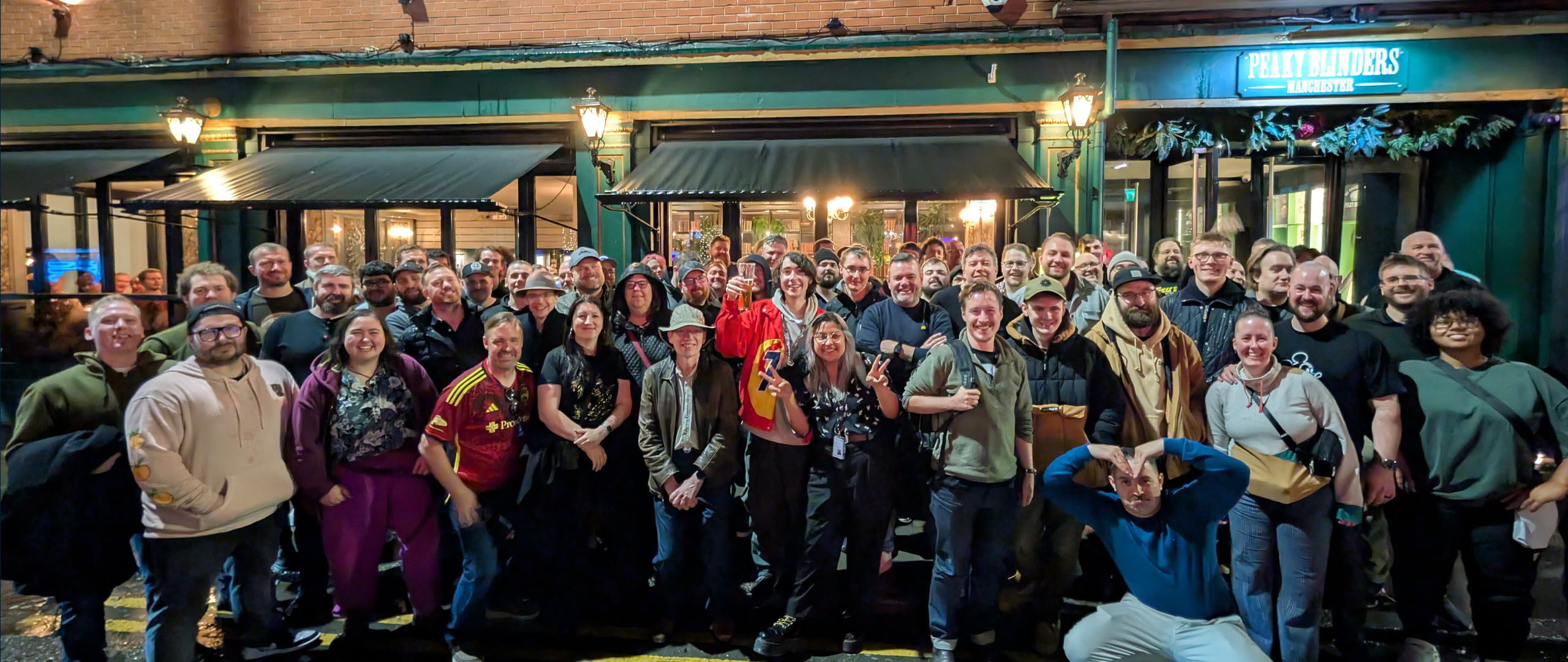
The team also attended several Bar Citizen events in the run-up to CitizenCon.
“The CitizenCon New Wakefield Street Takeover was the largest Bar Citizen we’ve ever attended, with an entire street shut down for the occasion! A massive thank you to the Bar Citizen International team for organizing such a memorable event and to every Citizen who joined us. It was an incredible evening that set the perfect tone for CitizenCon weekend.
However, the highlight of October was undoubtedly CitizenCon 2954. With nearly 5000 attendees at Manchester Central, it didn’t just break records, it completely shattered them, becoming the largest Star Citizen event to date.
This achievement was a true testament to everyone’s hard work, dedication, and commitment, and we’re incredibly grateful to everyone who made the event unforgettable for the entire community. Special thanks go out to the amazing BTS team who worked tirelessly behind the scenes, the talented cosplayers who brought the 'verse to life, and the community booths that added so much energy and excitement to the event. Thank you!” Community Team
Economy
The Economy team continued their ongoing work on Pyro and began implementing some of the balance changes mentioned in previous Monthly Reports.
Mission Design
In October, the Mission Design team finalized the Save Stanton quest chain. This features three new modular missions. They also created a journal entry for players to track their progression through the event.
The mission-system refactor progressed, while future ‘handyman’ missions entered QATR and are currently going through the final polish phase.
“We had a blast attending CitizenCon, met a lot of backers, had a lot of conversations on missions, and shared our plans for Star Citizen 1.0.” Mission Design Team
They also planned tasks for future releases alongside the fundamental archetypes for some of the guilds unveiled at CitizenCon.
Narrative
The Narrative team tackled a multitude of tasks in the leadup to CitizenCon alongside ongoing work outside of the event. For example, generating mission text and discoverables for Alpha 3.24 point patches and working through the significant amount of text needed to support mission content in Alpha 4.0.
The team’s major announcement for the month came during The Stars My Destination presentation at CitizenCon, which outlined what Star Citizen 1.0 will look like and the extensive narrative work that will come with it. The talk outlined the introduction of a main story, guilds and factions, and location stories to inject character into the Persistent Universe.
A Whitley’s Guide for the Idris and a Portfolio on Wildstar Racing were published alongside October’s Jump Point, which featured a deep dive into the People’s Alliance of Levski. There was also another drop of Galactapedia entries to check out here.
Online Technology
In October, the Online Services team progressed with features for Alpha 4.0. As part of this, the refactor of the entity subscription service (used for markers) was completed and is currently in testing.
The backend social-system changes needed for Server Meshing began internal QA testing. The mission system is also starting its first round of testing, with additional features currently in development to support larger coordinated missions.
The Live Tools team began finalizing a new tool to provide more detailed and powerful access management to Hex. The testing phase began with the player support teams, with their feedback driving future improvements. The work on the new architecture for the internal error reporting pipeline progressed too.
R&D
The R&D team spent the last few months supporting the introduction of dynamic weather.
To support evolving clouds, a compute pass was done to animate the global cloudscape based on local planet properties, such as temperature, humidity, and wind. This data is used as a base to shape cloud fronts, which are then locally refined via procedural noise. This data is also used to build a weather map to allow weather to drive VFX, physics, and gameplay. This currently includes precipitation information as well as the extracted positions of potential lightning locations. An API was also implemented to allow the game to sample these weather attributes from both the GPU and CPU in a consistent, simple, and efficient way.
To render believable wet weather, support for ‘rain volume’ rendering was added to the atmosphere raymarcher. Rain volumes are essentially columns of rain underneath heavy clouds that self-shadow alongside casting shadows into the environment. This is important to prevent incorrectly lit scenes where players would expect dense rain volumes to partially block sunlight (most noticeably at dusk and dawn). Also, changes to indirect lighting were implemented to improve the effect of multi-scattering on the atmosphere and clouds (referred to as "new multi-scatter LUT" at CitizenCon). Multi-scattering is now aware of cloud presence alongside the atmosphere. As a result, overcast skies are less hazy and blue and cloud tops appear brighter.
To give moving clouds a smoother look, changes were made to account for their movement when sampling cloud shadows as well as the GPU weather map (the latter directly influencing the appearance of rain volumes). Further improvements are being worked on to reduce the noticeable stepping of cloud shadows when the camera moves, which can often be seen when the sun is set low.
Also, work on rain volumes inspired a prototype for improved ground fog rendering. This will be cheaper to evaluate and render alongside improving the modeling aspect and lighting. It will also self-shadow and cast shadows, like rain volumes and clouds.
Finally, work began to support and maintain the map storing the accumulated amount of rain. Among other things, this will allow puddles to remain for a while after rain.
VFX
October saw the VFX team supporting various CitizenCon presentations, including those featuring new biomes, base building, and Levski.
The artists continued to support the Vehicle and Location teams with upcoming deliverables.
PU-Monatsbericht
Oktober 2024
Der Oktober war ein arbeitsreicher Monat für alle CIG-Mitarbeiter: Patch-Launches, Pyro in der PTU und (natürlich) CitizenCon 2954. Neben diesen großen Ereignissen wurden auch die Fortschritte bei den kommenden Features fortgesetzt. Viele Teams arbeiteten an der Fertigstellung der Inhalte für die Alpha 4.0 im Dezember und 2025. Lies weiter, um alle Details zu erfahren.
Dies ist der letzte PU-Bericht in diesem Jahr, der November- und Dezemberbericht folgt im Januar. Wir sehen uns beim nächsten Mal!
AI (Inhalt)
Im letzten Monat hat das KI-Inhaltsteam die sozialen Verhaltensweisen unterstützt, die mit Stantons verlassenen Außenposten und Siedlungen verbunden sind und für neue Missionsinhalte genutzt werden. Da neutrale Spieler diese Orte besuchen können, müssen sich die NSCs "normal" verhalten, wenn sie nicht bedroht werden oder unter Missionsbedingungen stehen.
Das Team arbeitete auch an Aufgaben für Alpha 4.0, darunter die Validierung der sozialen KI in verschiedenen Stationen rund um Pyro. Außerdem überprüften sie Stantons Landezonen, um herauszufinden, wo Verbesserungen vorgenommen werden können. Nach weiteren Gesprächen will das Team neue Inhalte erfassen, um Stanton und Pyro dynamischere Unterhaltungen zu ermöglichen.
KI-Direktor Francesco Roccucci war auch Gastgeber der Brave New Worlds-Präsentation auf der CitizenCon, in der es darum ging, KI zum Leben zu erwecken und zu zeigen, wie sie die Kampferfahrungen im Verse beeinflusst.
KI (Features)
Im Oktober haben die KI-Features die menschlichen Kampffunktionen für Alpha 4.0 verbessert. Für die ersten Reaktionen wurde das Verhalten überarbeitet, um konsistentere Reaktionen in einer Reihe von Situationen zu ermöglichen. Dies wurde in der in früheren Berichten erwähnten "Testzelle" gründlich getestet.
Das Team arbeitete weiter an der Funktionalität für NSCs, die niedergeschlagene Freunde heilen. Dazu gehörten auch Änderungen an den Akteurszuständen, um sicherzustellen, dass der Animationsfluss zwischen individuellen und synchronisierten Animationen korrekt weiterläuft. Außerdem wurde eine Testzelle erstellt, um sicherzustellen, dass der Sanitäter in verschiedenen Setups konsistent funktioniert, auch aus verschiedenen Richtungen um den Körper des Patienten herum.
Für das Munitions- und Waffenmanagement haben sich die Entwickler die Nachladefunktionalität angesehen, einschließlich des Verhaltens beim Umschalten auf eine Seitenwaffe, wenn man Munition aufhebt oder von Leichen plündert und dann wieder zurückwechselt.
Verbessert wurden auch die NSCs mit Raketenwerfern, die jetzt auch dann in den Kampf gehen, wenn keine Deckung vorhanden ist, und zu ihrer Seitenwaffe wechseln, wenn ein Feind zu nahe kommt.
Die Teams für KI-Features und Audio haben gemeinsam an der Implementierung und Verbesserung aller KI-Verhaltensweisen gearbeitet, einschließlich erster Reaktionen, Taktiken und Untersuchungen.
Auf der CitizenCon stellte das Team außerdem das erste Valakkar-Gameplay vor.
"Die Arbeit an dieser Kreatur hat wirklich Spaß gemacht und war sehr interessant, denn sie unterscheidet sich von allen anderen, die wir bisher im Spiel hatten. Wir werden mehr Details über seine Implementierung und die Herausforderungen, denen wir uns im Vorfeld der Veröffentlichung stellen mussten, bekannt geben." Team KI-Funktionen
KI (Tech)
AI Tech hat die Unterstützung von Server Meshing fortgesetzt und die Subsumption-Komponente zwischen dedizierten Servern synchronisiert, damit NSCs ihr zugewiesenes Verhalten beim Wechsel beibehalten.
Außerdem haben sie den ersten Durchlauf mehrerer Features implementiert, die auf der CitizenCon vorgestellt wurden, darunter Verbesserungen der Feindwahrnehmung, die jetzt auch die Lichtzyklen des Planeten berücksichtigt.
Der erste Durchlauf der dynamischen Deckungsgenerierung für Planeten wurde ebenfalls fertiggestellt; dies kann auch an anderen Orten mit Navigationsbereichen verwendet werden. Wie auf der CitizenCon zu sehen war, kann das Team jetzt Deckungsorte und Oberflächen gleichzeitig mit einem Navigationsnetz generieren.
Außerdem wurde eine Funktion hinzugefügt, mit der das "Navigationskostenvolumen" und das "Navigationsausschlussvolumen" mit Flächen in verschiedenen Objektcontainern verknüpft werden können. So können zum Beispiel Außenposten-Objektcontainer mit Ausschluss- oder Kostenvolumen beeinflussen, wie das Navigationsnetz des Planeten erstellt wird.
Außerdem wurden Verbesserungen an der SchiffskI vorgenommen, wie z. B. die Vermeidung von Planetenoberflächen, und die Überprüfung des Waffeneinsatzes von Schiffen gegen Verbündete optimiert. Außerdem wurden wahrnehmungsbezogene Komponenten wie das Sehen und Hören optimiert. Zum Beispiel sind die Abfragen von Sichtzonen jetzt schneller, während die Ausbreitung von Audiostimuli genauer ist, da sie einen Raumsystemgraphen verwendet.
KI (Game Intelligence Development Team)
Im Oktober hat das Game Intelligence Development Team StarScript v1.0 für die interne Veröffentlichung aufpoliert. So wurde zum Beispiel die Ladezeit für die meisten großen Container (z. B. ein ganzes Sonnensystem) von 10 auf 2 Sekunden reduziert und der neue "Gruppen"-Look integriert, um die Gruppen deutlicher zu unterscheiden.
Außerdem wurden im Diagrammeditor minimale und maximale Zoombereiche eingeführt, um Unterbrechungen der Ansicht zu vermeiden, das Hilfe-Popup verdeckt nun nicht mehr die Aufgabenknoten und das Smart Panel wurde eingeführt. Die Diagramme werden jetzt in der gleichen Reihenfolge wie ihre Namen in der Gliederung angezeigt, falsch platzierte parallele Anschlüsse an Aufgabenknoten wurden korrigiert und die Anzeige von zwei Diagrammen funktioniert jetzt ebenfalls korrekt.
Die Beziehung zwischen dem Eigenschaften-Panel und dem ausgewählten Element im SmartPanel wurde verbessert, während abgerundete quadratische Aufgaben in das SmartPanel integriert wurden, um die Aufgaben im Diagramm-Viewer nachzuahmen. Kästchen in zusammengeklappten Gruppen wurden vergrößert, damit sie lange Titel enthalten, während ein Symbol hinzugefügt wurde, um Aktivitäts- und Missionsvariablen im Outliner zu unterscheiden.
Schließlich wurde für StarScript ein QA-Testverfahren erstellt, um die wichtigsten Aktivitäten und Missionen richtig zu testen.
Animation
Im letzten Monat arbeitete das Animationsteam an der Valakkar und der "Weltraumkuh" sowie an der Anpassung des Kopions. Außerdem wurden die Gesichtsanimationen für die PU-Charaktere weiterentwickelt und die Vorbereitungen für einen bevorstehenden Dreh der Geschichte getroffen.
Das Animationsteam unterstützt derzeit das Leveldesign mit einer Reihe von Spielerinteraktionsanimationen für das Durchqueren der Level.
Kunst (Charaktere)
Im Oktober konzentrierte sich das Character Art Team auf Aufgaben im Zusammenhang mit der CitizenCon. Nach dem Event arbeitete das Team weiter an der Erstellung der Gebrauchs- und Spezialrüstungen, einschließlich Farb- und Materialvarianten zur Unterstützung der Fraktionen und Missionen. Außerdem wurde mit der Arbeit an den Rüstungen für die kommenden Events begonnen.
Das Character Concept Art Team entwarf neue Rüstungen, darunter die Utility Battle Tech und eine superschwere Rüstung.
Kunst (Schiffe)
Im Oktober schloss das Schiffsteam die letzte Inhaltsüberprüfung für die RSI Polaris ab, während die letzten Arbeiten für die MISC Starlancer MAX im Gange sind.
Das Team ist mit zwei unangekündigten Fahrzeugen fast fertig, während sich mehrere weitere ihren Whitebox- und Greybox-Reviews nähern. Sechs weitere Fahrzeuge werden ebenfalls bald in Produktion gehen.
Community
Das Community-Team hat den Monat damit begonnen, den Day of the Vara mit den Wettbewerben "Kürbis verzieren" und "Killer Klips from Outer Space" zu unterstützen.
Parallel zum Start der Alpha 3.24.2 hat das Team einen Patch Watch veröffentlicht, der weniger bekannte Funktionen und Updates vorstellt, darunter Verbesserungen für den Charakterersteller, Änderungen am Quantentreibstoffverbrauch sowie optische und lebensqualitätsverbessernde Verbesserungen für Arena Commander.
Außerdem hat das Team im Vorfeld der CitizenCon an mehreren Bar Citizen-Events teilgenommen.
"Die CitizenCon New Wakefield Street Takeover war die größte Bar Citizen, an der wir je teilgenommen haben, und eine ganze Straße wurde für diesen Anlass gesperrt! Ein großes Dankeschön an das Team von Bar Citizen International für die Organisation eines solch denkwürdigen Events und an alle Bürgerinnen und Bürger, die sich uns angeschlossen haben. Es war ein unglaublicher Abend, der den perfekten Rahmen für das CitizenCon-Wochenende bildete.
Der Höhepunkt des Oktobers war jedoch zweifellos die CitizenCon 2954. Mit fast 5000 Teilnehmern im Manchester Central hat sie nicht nur Rekorde gebrochen, sondern das bisher größte Star Citizen-Event überhaupt.
Diese Leistung war ein echter Beweis für die harte Arbeit, das Engagement und die Hingabe aller Beteiligten, und wir sind allen, die dieses Event für die gesamte Community unvergesslich gemacht haben, unglaublich dankbar. Unser besonderer Dank gilt dem fantastischen BTS-Team, das unermüdlich hinter den Kulissen gearbeitet hat, den talentierten Cosplayern, die das Verse zum Leben erweckt haben, und den Ständen der Community, die der Veranstaltung so viel Energie und Spannung verliehen haben. Vielen Dank!" Community-Team
Wirtschaft
Das Wirtschaftsteam hat seine Arbeit an Pyro fortgesetzt und damit begonnen, einige der in früheren Monatsberichten erwähnten Änderungen an der Balance umzusetzen.
Missionsdesign
Im Oktober hat das Missionsdesign-Team die Questkette "Rettet Stanton" fertiggestellt. Sie besteht aus drei neuen modularen Missionen. Außerdem haben sie einen Tagebucheintrag erstellt, mit dem die Spieler/innen ihren Fortschritt während des Events verfolgen können.
Die Überarbeitung des Missionssystems wurde vorangetrieben, während die zukünftigen "Handwerker"-Missionen in die QATR-Phase aufgenommen wurden und derzeit den letzten Schliff erhalten.
"Wir hatten einen Riesenspaß auf der CitizenCon, haben viele Unterstützer getroffen, viele Gespräche über Missionen geführt und unsere Pläne für Star Citizen 1.0 vorgestellt. Missionsdesign-Team
Neben den grundlegenden Archetypen für einige der auf der CitizenCon vorgestellten Gilden haben sie auch Aufgaben für zukünftige Veröffentlichungen geplant.
Narrative
Das Narrative Team nahm im Vorfeld der CitizenCon eine Vielzahl von Aufgaben in Angriff und arbeitete auch außerhalb der Veranstaltung weiter. So wurden zum Beispiel Missionstexte und Discoverables für die Patches der Alpha 3.24 erstellt und die große Menge an Text bearbeitet, die zur Unterstützung der Missionsinhalte in der Alpha 4.0 benötigt wird.
Die wichtigste Ankündigung des Teams in diesem Monat kam während der Präsentation "The Stars My Destination" auf der CitizenCon, in der das Team darlegte, wie Star Citizen 1.0 aussehen wird und welche umfangreiche erzählerische Arbeit damit verbunden sein wird. In dem Vortrag wurde die Einführung einer Hauptgeschichte, von Gilden und Fraktionen sowie von Ortsgeschichten vorgestellt, die dem persistenten Universum Charakter verleihen.
Ein Whitley's Guide für die Idris und ein Portfolio über Wildstar Racing wurden zusammen mit dem Jump Point vom Oktober veröffentlicht, der einen tiefen Einblick in die People's Alliance of Levski bot. Außerdem gab es wieder eine Reihe von Galactapedia-Einträgen, die du dir hier ansehen kannst.
Online-Technologie
Im Oktober arbeitete das Team der Online-Dienste an den Funktionen für Alpha 4.0. In diesem Zusammenhang wurde die Überarbeitung des Abonnementdienstes für Entitäten (die für Markierungen verwendet werden) abgeschlossen und befindet sich derzeit in der Testphase.
Die Änderungen am sozialen Backend-System, die für das Server Meshing benötigt werden, wurden intern getestet. Auch das Missionssystem geht in die erste Testrunde, wobei derzeit zusätzliche Funktionen entwickelt werden, um größere koordinierte Missionen zu unterstützen.
Das Live-Tools-Team begann mit der Fertigstellung eines neuen Tools, das eine detailliertere und leistungsfähigere Zugangsverwaltung für Hex ermöglicht. Die Testphase begann mit den Spieler-Support-Teams, deren Feedback in zukünftige Verbesserungen einfließt. Auch die Arbeit an der neuen Architektur für die interne Fehlermeldungspipeline schritt voran.
F&E
Das F&E-Team hat die letzten Monate damit verbracht, die Einführung des dynamischen Wetters zu unterstützen.
Um die sich entwickelnden Wolken zu unterstützen, wurde ein Berechnungsdurchgang durchgeführt, um die globale Wolkenlandschaft auf der Grundlage lokaler Planeteneigenschaften wie Temperatur, Luftfeuchtigkeit und Wind zu animieren. Diese Daten werden als Grundlage für die Gestaltung von Wolkenfronten verwendet, die dann lokal durch prozedurales Rauschen verfeinert werden. Diese Daten werden auch verwendet, um eine Wetterkarte zu erstellen, damit das Wetter die VFX, die Physik und das Gameplay beeinflussen kann. Dazu gehören derzeit auch Informationen über den Niederschlag und die Positionen potenzieller Blitzstandorte. Außerdem wurde eine API implementiert, die es dem Spiel ermöglicht, diese Wetterattribute sowohl von der GPU als auch von der CPU auf konsistente, einfache und effiziente Weise abzurufen.
Um glaubhaftes nasses Wetter zu rendern, wurde dem Atmosphären-Raymarcher Unterstützung für das Rendering von "Regenvolumen" hinzugefügt. Regenvolumina sind im Wesentlichen Regensäulen unter schweren Wolken, die sich selbst verdunkeln und Schatten in die Umgebung werfen. Dies ist wichtig, um falsch beleuchtete Szenen zu verhindern, in denen Spieler/innen erwarten würden, dass dichte Regenmengen das Sonnenlicht teilweise blockieren (besonders auffällig in der Dämmerung). Außerdem wurden Änderungen an der indirekten Beleuchtung vorgenommen, um den Effekt der Mehrfachstreuung auf die Atmosphäre und die Wolken zu verbessern (auf der CitizenCon als "neue Multi-Streuungs-LUT" bezeichnet). Die Mehrfachstreuung erkennt nun neben der Atmosphäre auch die Anwesenheit von Wolken. Dadurch ist der bedeckte Himmel weniger dunstig und blau und die Wolkengipfel erscheinen heller.
Um sich bewegende Wolken glatter aussehen zu lassen, wurden Änderungen vorgenommen, um ihre Bewegung beim Sampling von Wolkenschatten und der GPU-Wetterkarte zu berücksichtigen (letztere hat einen direkten Einfluss auf das Aussehen von Regenmengen). An weiteren Verbesserungen wird gearbeitet, um das auffällige Treten der Wolkenschatten bei Kamerabewegungen zu reduzieren, das oft bei tief stehender Sonne zu sehen ist.
Die Arbeit an den Regenvolumina inspirierte auch zu einem Prototyp für ein verbessertes Bodennebel-Rendering. Neben der Verbesserung des Modellierungsaspekts und der Beleuchtung wird es billiger sein, diesen zu bewerten und zu rendern. Außerdem wird er sich selbst schattieren und Schatten werfen, wie Regenmengen und Wolken.
Schließlich wurde damit begonnen, die Karte zu unterstützen und zu pflegen, die die angesammelte Regenmenge speichert. Das wird unter anderem dafür sorgen, dass Pfützen nach dem Regen noch eine Weile bestehen bleiben.
VFX
Im Oktober unterstützte das VFX-Team verschiedene CitizenCon-Präsentationen, unter anderem zu den Themen neue Biome, Basenbau und Levski.
Die Artists unterstützten auch weiterhin die Teams für Fahrzeuge und Schauplätze bei den anstehenden Aufgaben.
PU Monthly Report
October 2024
October was a busy month for all CIG staff, with patch launches, Pyro in the PTU, and (of course) CitizenCon 2954. Alongside these major events, progress on upcoming features continued, with many teams finalizing content for Alpha 4.0 and 2025. Read on for all the details.
To note, this will be the last PU Report of the year, with November and December’s entry coming in January. We’ll see you next time!
AI (Content)
Last month, the AI Content team supported the social behaviors tied to Stanton’s derelict outposts and settlements, which will be used for new mission content. As neutral players can visit these locations, NPCs need to behave ‘normally’ when not under threat or under mission conditions.
The team also worked on tasks for Alpha 4.0, including validating social AI in various stations around Pyro. They also reviewed Stanton’s landing zones to see where improvements could be made. After additional conversations, the team is looking to capture new content to provide more dynamic conversations to both Stanton and Pyro.
AI Director Francesco Roccucci also hosted the Brave New Worlds presentation at CitizenCon, which included bringing AI to life and how it affects combat experiences in the ‘verse.
AI (Features)
October saw AI Features improving Human combat features for Alpha 4.0. For first reactions, the behavior was refactored to provide more consistent responses across a range of situations. This was thoroughly tested in the ‘test cell’ mentioned in previous reports.
The team continued to iterate on functionality for NPCs healing downed friendlies, including changes to the actor states to ensure the animation flow continues correctly between individual and synchronized animations. A test cell was also created to ensure the medic works consistently across different setups, including from different directions around the patient’s body.
For ammo and weapon management, the devs looked at reload functionality, including behavior for switching to a sidearm when picking up ammo or looting from bodies and then switching back.
Improvements were also made to NPCs with rocket launchers, who now enter combat even when no cover is available and switch to their sidearm if an enemy gets too close.
The AI Features and Audio teams partnered to implement and fix wildlines across all AI behaviors, including first reactions, tactics, and investigations.
The team also debuted the first valakkar gameplay at CitizenCon.
“This has been a really fun and interesting creature to work on as it is very different from anything else we have in the game so far. We’ll be sharing more details of its implementation and the challenges we’ve faced in the run-up to its release.” AI Features Team
AI (Tech)
AI Tech continued to support Server Meshing, synchronizing the Subsumption component between dedicated servers so that NPCs continue their assigned behaviors when switching.
They then implemented the first pass on several features presented during CitizenCon, including improvements to enemy vision perception, which now takes planetary lighting cycles into account.
The first pass of dynamic cover generation for planets was also completed; this can also be used in other locations with navigation areas. As seen at CitizenCon, the team can now generate cover locations and surfaces at the same time as a navigation mesh.
Functionality was also added to link ‘navigation cost volume’ and ‘navigation exclusion volume’ to areas in different object containers. For example, outpost object containers that feature exclusion or cost volumes can influence how planet navigation mesh is generated.
They also made improvements to Ship AI features, including planetary surface avoidance, and optimized ship weapon fire validation against allies. They also optimized perception-related components, like vision and hearing. For example, vision zone queries are now faster, while audio stimuli propagation is more accurate as it utilizes a room system graph.
AI (Game Intelligence Development Team)
Throughout October, the Game Intelligence Development team polished StarScript v1.0 for its internal release. For example, they reduced the loading time for the majority of large containers (e.g. a whole solar system) from 10 to 2 seconds and integrated the new ‘groups’ look to more clearly differentiate between groups.
They also introduced min and max zoom ranges in the graph editor to avoid view breaks, stopped the ‘help’ popup from obscuring task nodes, and implemented the Smart Panel. Graphs are now presented in the same order as their names in the outline, misplaced parallel ports on task nodes were corrected, and displaying two graphs now works correctly too.
The relationship between the proprieties panel and the selected item on the Smart Panel was improved, while rounded square tasks were integrated into the SmartPanel to mimic the tasks in the graph viewer. Boxes in collapsed groups were enlarged to include long titles, while an icon was added to differentiate activity and mission variables in the outliner.
Finally for StarScript, a QA testing procedure was created to properly test the most important activities and missions.
Animation
Last month, the Animation team worked on the valakkar and ‘space cow’ alongside adjustments to the kopion. They also continued to provide facial animation support for PU characters and prepped for an upcoming narrative shoot.
Animation are currently supporting Level Design with a number of player-interaction animations for level traversal.
Art (Characters)
In October, the Character Art team focused on tasks related to CitizenCon. After the event, the team continued creating the utility and specialist armors, including color and material variants to support factions and missions. Work also began on armors for upcoming events.
The Character Concept Art team created new armors, including utility battle tech and a super-heavy armor.
Art (Ships)
October saw the Ship team complete the final content review for the RSI Polaris, while the final content tasks are currently in progress for the MISC Starlancer MAX.
The team is nearly finished with two unannounced vehicles, while several more are approaching their whitebox and greybox reviews. Six additional vehicles will begin production soon, too.
Community
The Community team began the month supporting Day of the Vara with the Pumpkin Decorating and Killer Klips from Outer Space contests.
Alongside the launch of Alpha 3.24.2, the team published a Patch Watch to spotlight lesser-known features and updates, including improvements to the Character Creator, changes to quantum fuel consumption, and visual and quality-of-life enhancements for Arena Commander.
The team also attended several Bar Citizen events in the run-up to CitizenCon.
“The CitizenCon New Wakefield Street Takeover was the largest Bar Citizen we’ve ever attended, with an entire street shut down for the occasion! A massive thank you to the Bar Citizen International team for organizing such a memorable event and to every Citizen who joined us. It was an incredible evening that set the perfect tone for CitizenCon weekend.
However, the highlight of October was undoubtedly CitizenCon 2954. With nearly 5000 attendees at Manchester Central, it didn’t just break records, it completely shattered them, becoming the largest Star Citizen event to date.
This achievement was a true testament to everyone’s hard work, dedication, and commitment, and we’re incredibly grateful to everyone who made the event unforgettable for the entire community. Special thanks go out to the amazing BTS team who worked tirelessly behind the scenes, the talented cosplayers who brought the 'verse to life, and the community booths that added so much energy and excitement to the event. Thank you!” Community Team
Economy
The Economy team continued their ongoing work on Pyro and began implementing some of the balance changes mentioned in previous Monthly Reports.
Mission Design
In October, the Mission Design team finalized the Save Stanton quest chain. This features three new modular missions. They also created a journal entry for players to track their progression through the event.
The mission-system refactor progressed, while future ‘handyman’ missions entered QATR and are currently going through the final polish phase.
“We had a blast attending CitizenCon, met a lot of backers, had a lot of conversations on missions, and shared our plans for Star Citizen 1.0.” Mission Design Team
They also planned tasks for future releases alongside the fundamental archetypes for some of the guilds unveiled at CitizenCon.
Narrative
The Narrative team tackled a multitude of tasks in the leadup to CitizenCon alongside ongoing work outside of the event. For example, generating mission text and discoverables for Alpha 3.24 point patches and working through the significant amount of text needed to support mission content in Alpha 4.0.
The team’s major announcement for the month came during The Stars My Destination presentation at CitizenCon, which outlined what Star Citizen 1.0 will look like and the extensive narrative work that will come with it. The talk outlined the introduction of a main story, guilds and factions, and location stories to inject character into the Persistent Universe.
A Whitley’s Guide for the Idris and a Portfolio on Wildstar Racing were published alongside October’s Jump Point, which featured a deep dive into the People’s Alliance of Levski. There was also another drop of Galactapedia entries to check out here.
Online Technology
In October, the Online Services team progressed with features for Alpha 4.0. As part of this, the refactor of the entity subscription service (used for markers) was completed and is currently in testing.
The backend social-system changes needed for Server Meshing began internal QA testing. The mission system is also starting its first round of testing, with additional features currently in development to support larger coordinated missions.
The Live Tools team began finalizing a new tool to provide more detailed and powerful access management to Hex. The testing phase began with the player support teams, with their feedback driving future improvements. The work on the new architecture for the internal error reporting pipeline progressed too.
R&D
The R&D team spent the last few months supporting the introduction of dynamic weather.
To support evolving clouds, a compute pass was done to animate the global cloudscape based on local planet properties, such as temperature, humidity, and wind. This data is used as a base to shape cloud fronts, which are then locally refined via procedural noise. This data is also used to build a weather map to allow weather to drive VFX, physics, and gameplay. This currently includes precipitation information as well as the extracted positions of potential lightning locations. An API was also implemented to allow the game to sample these weather attributes from both the GPU and CPU in a consistent, simple, and efficient way.
To render believable wet weather, support for ‘rain volume’ rendering was added to the atmosphere raymarcher. Rain volumes are essentially columns of rain underneath heavy clouds that self-shadow alongside casting shadows into the environment. This is important to prevent incorrectly lit scenes where players would expect dense rain volumes to partially block sunlight (most noticeably at dusk and dawn). Also, changes to indirect lighting were implemented to improve the effect of multi-scattering on the atmosphere and clouds (referred to as "new multi-scatter LUT" at CitizenCon). Multi-scattering is now aware of cloud presence alongside the atmosphere. As a result, overcast skies are less hazy and blue and cloud tops appear brighter.
To give moving clouds a smoother look, changes were made to account for their movement when sampling cloud shadows as well as the GPU weather map (the latter directly influencing the appearance of rain volumes). Further improvements are being worked on to reduce the noticeable stepping of cloud shadows when the camera moves, which can often be seen when the sun is set low.
Also, work on rain volumes inspired a prototype for improved ground fog rendering. This will be cheaper to evaluate and render alongside improving the modeling aspect and lighting. It will also self-shadow and cast shadows, like rain volumes and clouds.
Finally, work began to support and maintain the map storing the accumulated amount of rain. Among other things, this will allow puddles to remain for a while after rain.
VFX
October saw the VFX team supporting various CitizenCon presentations, including those featuring new biomes, base building, and Levski.
The artists continued to support the Vehicle and Location teams with upcoming deliverables.
PU Monthly Report
October 2024
October was a busy month for all CIG staff, with patch launches, Pyro in the PTU, and (of course) CitizenCon 2954. Alongside these major events, progress on upcoming features continued, with many teams finalizing content for Alpha 4.0 and 2025. Read on for all the details.
To note, this will be the last PU Report of the year, with November and December’s entry coming in January. We’ll see you next time!
AI (Content)
Last month, the AI Content team supported the social behaviors tied to Stanton’s derelict outposts and settlements, which will be used for new mission content. As neutral players can visit these locations, NPCs need to behave ‘normally’ when not under threat or under mission conditions.
The team also worked on tasks for Alpha 4.0, including validating social AI in various stations around Pyro. They also reviewed Stanton’s landing zones to see where improvements could be made. After additional conversations, the team is looking to capture new content to provide more dynamic conversations to both Stanton and Pyro.
AI Director Francesco Roccucci also hosted the Brave New Worlds presentation at CitizenCon, which included bringing AI to life and how it affects combat experiences in the ‘verse.
AI (Features)
October saw AI Features improving Human combat features for Alpha 4.0. For first reactions, the behavior was refactored to provide more consistent responses across a range of situations. This was thoroughly tested in the ‘test cell’ mentioned in previous reports.
The team continued to iterate on functionality for NPCs healing downed friendlies, including changes to the actor states to ensure the animation flow continues correctly between individual and synchronized animations. A test cell was also created to ensure the medic works consistently across different setups, including from different directions around the patient’s body.
For ammo and weapon management, the devs looked at reload functionality, including behavior for switching to a sidearm when picking up ammo or looting from bodies and then switching back.
Improvements were also made to NPCs with rocket launchers, who now enter combat even when no cover is available and switch to their sidearm if an enemy gets too close.
The AI Features and Audio teams partnered to implement and fix wildlines across all AI behaviors, including first reactions, tactics, and investigations.
The team also debuted the first valakkar gameplay at CitizenCon.
“This has been a really fun and interesting creature to work on as it is very different from anything else we have in the game so far. We’ll be sharing more details of its implementation and the challenges we’ve faced in the run-up to its release.” AI Features Team
AI (Tech)
AI Tech continued to support Server Meshing, synchronizing the Subsumption component between dedicated servers so that NPCs continue their assigned behaviors when switching.
They then implemented the first pass on several features presented during CitizenCon, including improvements to enemy vision perception, which now takes planetary lighting cycles into account.
The first pass of dynamic cover generation for planets was also completed; this can also be used in other locations with navigation areas. As seen at CitizenCon, the team can now generate cover locations and surfaces at the same time as a navigation mesh.
Functionality was also added to link ‘navigation cost volume’ and ‘navigation exclusion volume’ to areas in different object containers. For example, outpost object containers that feature exclusion or cost volumes can influence how planet navigation mesh is generated.
They also made improvements to Ship AI features, including planetary surface avoidance, and optimized ship weapon fire validation against allies. They also optimized perception-related components, like vision and hearing. For example, vision zone queries are now faster, while audio stimuli propagation is more accurate as it utilizes a room system graph.
AI (Game Intelligence Development Team)
Throughout October, the Game Intelligence Development team polished StarScript v1.0 for its internal release. For example, they reduced the loading time for the majority of large containers (e.g. a whole solar system) from 10 to 2 seconds and integrated the new ‘groups’ look to more clearly differentiate between groups.
They also introduced min and max zoom ranges in the graph editor to avoid view breaks, stopped the ‘help’ popup from obscuring task nodes, and implemented the Smart Panel. Graphs are now presented in the same order as their names in the outline, misplaced parallel ports on task nodes were corrected, and displaying two graphs now works correctly too.
The relationship between the proprieties panel and the selected item on the Smart Panel was improved, while rounded square tasks were integrated into the SmartPanel to mimic the tasks in the graph viewer. Boxes in collapsed groups were enlarged to include long titles, while an icon was added to differentiate activity and mission variables in the outliner.
Finally for StarScript, a QA testing procedure was created to properly test the most important activities and missions.
Animation
Last month, the Animation team worked on the valakkar and ‘space cow’ alongside adjustments to the kopion. They also continued to provide facial animation support for PU characters and prepped for an upcoming narrative shoot.
Animation are currently supporting Level Design with a number of player-interaction animations for level traversal.
Art (Characters)
In October, the Character Art team focused on tasks related to CitizenCon. After the event, the team continued creating the utility and specialist armors, including color and material variants to support factions and missions. Work also began on armors for upcoming events.
The Character Concept Art team created new armors, including utility battle tech and a super-heavy armor.
Art (Ships)
October saw the Ship team complete the final content review for the RSI Polaris, while the final content tasks are currently in progress for the MISC Starlancer MAX.
The team is nearly finished with two unannounced vehicles, while several more are approaching their whitebox and greybox reviews. Six additional vehicles will begin production soon, too.
Community
The Community team began the month supporting Day of the Vara with the Pumpkin Decorating and Killer Klips from Outer Space contests.
Alongside the launch of Alpha 3.24.2, the team published a Patch Watch to spotlight lesser-known features and updates, including improvements to the Character Creator, changes to quantum fuel consumption, and visual and quality-of-life enhancements for Arena Commander.
The team also attended several Bar Citizen events in the run-up to CitizenCon.
“The CitizenCon New Wakefield Street Takeover was the largest Bar Citizen we’ve ever attended, with an entire street shut down for the occasion! A massive thank you to the Bar Citizen International team for organizing such a memorable event and to every Citizen who joined us. It was an incredible evening that set the perfect tone for CitizenCon weekend.
However, the highlight of October was undoubtedly CitizenCon 2954. With nearly 5000 attendees at Manchester Central, it didn’t just break records, it completely shattered them, becoming the largest Star Citizen event to date.
This achievement was a true testament to everyone’s hard work, dedication, and commitment, and we’re incredibly grateful to everyone who made the event unforgettable for the entire community. Special thanks go out to the amazing BTS team who worked tirelessly behind the scenes, the talented cosplayers who brought the 'verse to life, and the community booths that added so much energy and excitement to the event. Thank you!” Community Team
Economy
The Economy team continued their ongoing work on Pyro and began implementing some of the balance changes mentioned in previous Monthly Reports.
Mission Design
In October, the Mission Design team finalized the Save Stanton quest chain. This features three new modular missions. They also created a journal entry for players to track their progression through the event.
The mission-system refactor progressed, while future ‘handyman’ missions entered QATR and are currently going through the final polish phase.
“We had a blast attending CitizenCon, met a lot of backers, had a lot of conversations on missions, and shared our plans for Star Citizen 1.0.” Mission Design Team
They also planned tasks for future releases alongside the fundamental archetypes for some of the guilds unveiled at CitizenCon.
Narrative
The Narrative team tackled a multitude of tasks in the leadup to CitizenCon alongside ongoing work outside of the event. For example, generating mission text and discoverables for Alpha 3.24 point patches and working through the significant amount of text needed to support mission content in Alpha 4.0.
The team’s major announcement for the month came during The Stars My Destination presentation at CitizenCon, which outlined what Star Citizen 1.0 will look like and the extensive narrative work that will come with it. The talk outlined the introduction of a main story, guilds and factions, and location stories to inject character into the Persistent Universe.
A Whitley’s Guide for the Idris and a Portfolio on Wildstar Racing were published alongside October’s Jump Point, which featured a deep dive into the People’s Alliance of Levski. There was also another drop of Galactapedia entries to check out here.
Online Technology
In October, the Online Services team progressed with features for Alpha 4.0. As part of this, the refactor of the entity subscription service (used for markers) was completed and is currently in testing.
The backend social-system changes needed for Server Meshing began internal QA testing. The mission system is also starting its first round of testing, with additional features currently in development to support larger coordinated missions.
The Live Tools team began finalizing a new tool to provide more detailed and powerful access management to Hex. The testing phase began with the player support teams, with their feedback driving future improvements. The work on the new architecture for the internal error reporting pipeline progressed too.
R&D
The R&D team spent the last few months supporting the introduction of dynamic weather.
To support evolving clouds, a compute pass was done to animate the global cloudscape based on local planet properties, such as temperature, humidity, and wind. This data is used as a base to shape cloud fronts, which are then locally refined via procedural noise. This data is also used to build a weather map to allow weather to drive VFX, physics, and gameplay. This currently includes precipitation information as well as the extracted positions of potential lightning locations. An API was also implemented to allow the game to sample these weather attributes from both the GPU and CPU in a consistent, simple, and efficient way.
To render believable wet weather, support for ‘rain volume’ rendering was added to the atmosphere raymarcher. Rain volumes are essentially columns of rain underneath heavy clouds that self-shadow alongside casting shadows into the environment. This is important to prevent incorrectly lit scenes where players would expect dense rain volumes to partially block sunlight (most noticeably at dusk and dawn). Also, changes to indirect lighting were implemented to improve the effect of multi-scattering on the atmosphere and clouds (referred to as "new multi-scatter LUT" at CitizenCon). Multi-scattering is now aware of cloud presence alongside the atmosphere. As a result, overcast skies are less hazy and blue and cloud tops appear brighter.
To give moving clouds a smoother look, changes were made to account for their movement when sampling cloud shadows as well as the GPU weather map (the latter directly influencing the appearance of rain volumes). Further improvements are being worked on to reduce the noticeable stepping of cloud shadows when the camera moves, which can often be seen when the sun is set low.
Also, work on rain volumes inspired a prototype for improved ground fog rendering. This will be cheaper to evaluate and render alongside improving the modeling aspect and lighting. It will also self-shadow and cast shadows, like rain volumes and clouds.
Finally, work began to support and maintain the map storing the accumulated amount of rain. Among other things, this will allow puddles to remain for a while after rain.
VFX
October saw the VFX team supporting various CitizenCon presentations, including those featuring new biomes, base building, and Levski.
The artists continued to support the Vehicle and Location teams with upcoming deliverables.
Links
No links available.
Images
4
Metadata
- CIG ID
- 20282
- Channel
- Transmission
- Category
- Undefined
- Series
- None
- Comments
- 0
- Published
- 4 months ago (2026-05-25T11:00:00+00:00)