Star Citizen Monthly Report: January 2025
Transmission Undefined NoneContent
PU Monthly Report
January 2025
Welcome to January’s PU Monthly Report! Hot on the heels of the recent November/December report, we’re back detailing everything done for the Persistent Universe at the beginning of 2025. Read on for all the latest updates on AI, core gameplay, missions, narrative, and much more.
AI (Content)
The AI Content team began the year prototyping an upcoming NPC that will utilize an amalgamation of several behavior types. Work was done on a proprietary tool that will allow the designers to generate a script of the in-engine dialogue flow to ensure the lines work as intended. This will allow for much more efficiency in the writing and capturing of future characters.
The team then began updating Stanton’s landing zones with bespoke air traffic controllers that better represent the city. While there is still some required technical validation, these characters will start appearing soon.
Finally, the designers continued their ongoing review of Stanton, this time focusing on Grim HEX to refactor the population to ensure it’s using the correct behaviors and acting appropriately.
AI (Features)
In January, AI Feature’s primary focus was split between bug fixes and creature-behavior improvements.
For example, the code for throwing grenades was updated to unify some of the code paths. This gives more consistent functionality between cover and open-space launches.
For Human combat behavior, friendly-fire checks were updated to not consider the large bounding boxes of vehicles as 'friendly,' which could block firing.
For creatures, the team focused on improving the valakkar’s behavior.
“We are working hard to make sure this creature arrives in your hands in the best possible way!” AI Features Team
The devs are currently expanding the ‘group’ system to be more dynamic and better support dynamically spawned entities. The first use case is the Quasi grazer, as having a better understanding of the group they belong to will improve the look and behavior of the herd.
AI Features also continued to sync their work between projects to ensure that the improvements made for Squadron 42 are available for use in the Persistent Universe as quickly as possible.
AI (Game Intelligence Development Team)
The Game Intelligence Development (GID) team continued their work on StarScript, with January’s goal being the implementation of the ‘views’ feature. This was requested by the designers, who consider it a significant feature of the tool.
Work involved creating the ‘views object’ and ‘views folder’ in the Smart Outline, managing views functionalities, ordering and deleting views, and grouping graphs. It also involved presenting views and its header in the script graph and implementing back and forward functionality.
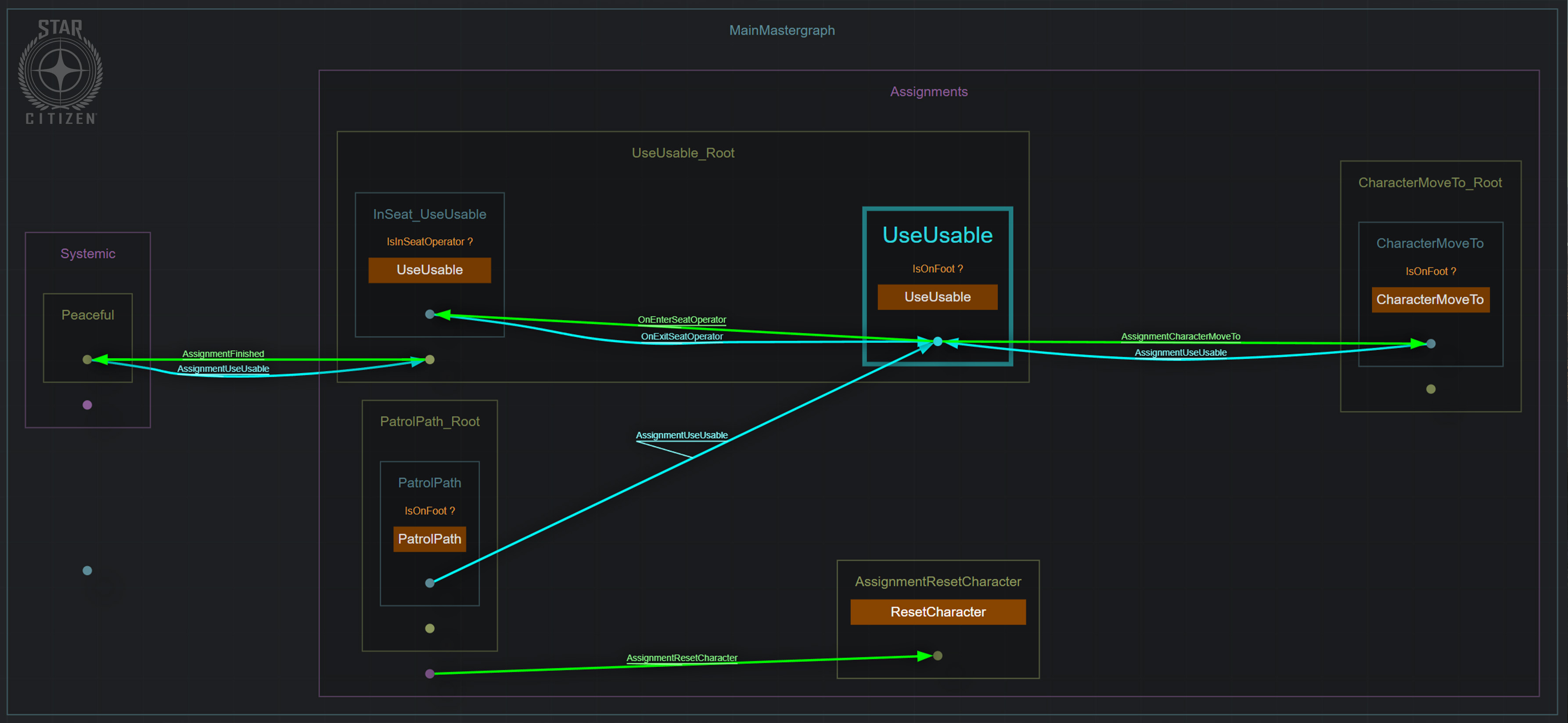
Once complete, GID began implementing StarScript's new MasterGraph design, which will be presented in a sectioned format rather than a global display as in Apollo. This means it will be viewed from the perception of a selected state (this visual design will be created for each hierarchical state).
A visual improvement was also made to the automatic parenting groups for parallel and selector nodes, making the graph appear less crowded.
QA are currently testing the tool to identify any issues following procedures.
AI (Tech)
AI Tech began the year fixing bugs, improving features, and kicking off new tech.
For the latter, work began on a new 3D-pathfinding implementation that will give better results in tight spaces or areas with concave shapes. This will also be utilized by ship AI when traversing complex asteroids or space stations and can also be used by NPCs when EVAing inside ships.
The internal StartScript tool received multiple usability improvements for creating new behaviors and missions.
AI Tech also finalized December’s work on the ‘chase’ and ‘melee attack’ movement requests, which delivers a boost in both performance and visual fidelity compared to the previous implementation.
The ‘conversation’ system also received updates to how avoidance bubbles are computed so that NPCs don’t disturb an ongoing conversation.
For Alpha 4.0.1, fixes were made to the navigation and boids systems.
Alongside this, planning was done for the work still required to fully synchronize AI components with the Server Meshing authority transition and other features and systems planned for development this year.
Animation
The Gameplay Animation team began the year working on the kopion hound and various sizes of the valakkar.
They also created facial animations for various PU characters and events and worked alongside the AI designers on more robust social-AI behaviors.
AI for the ‘spec ops’ set, alongside two others, is currently underway to add more challenge to combat.
Art (Characters)
In January, the Character team continued working on StarWear art debt. They also modified the Duster armor, progressed with a stealth armor, designed a new backpack, and developed additional creature variants for future patch releases.
The Concept art team explored ideas for various new items and are currently looking into paint schemes for existing armors.
Community
The Community team kicked off the year by announcing the winners of the Gift that Keeps on Giving video contest. To showcase what was coming up, they released An Epic Month Ahead Comm-link, which previewed the events and activities planned for the rest of January and into February.
The team also managed the first revamped Squadron 42 Newsletter, alongside launching a contest that offered the chance to win a page of sheet music from the Squadron 42 score. They also supported the Fight for Pyro Global Event with miscellaneous publishing tasks and a comprehensive information post.
Lastly, but most importantly, the team carried on with evergreen tasks related to gathering/distributing feedback directly to development, and is already deep in discussion on how they can shed more light on the details of any ongoing issues the community may be encountering.
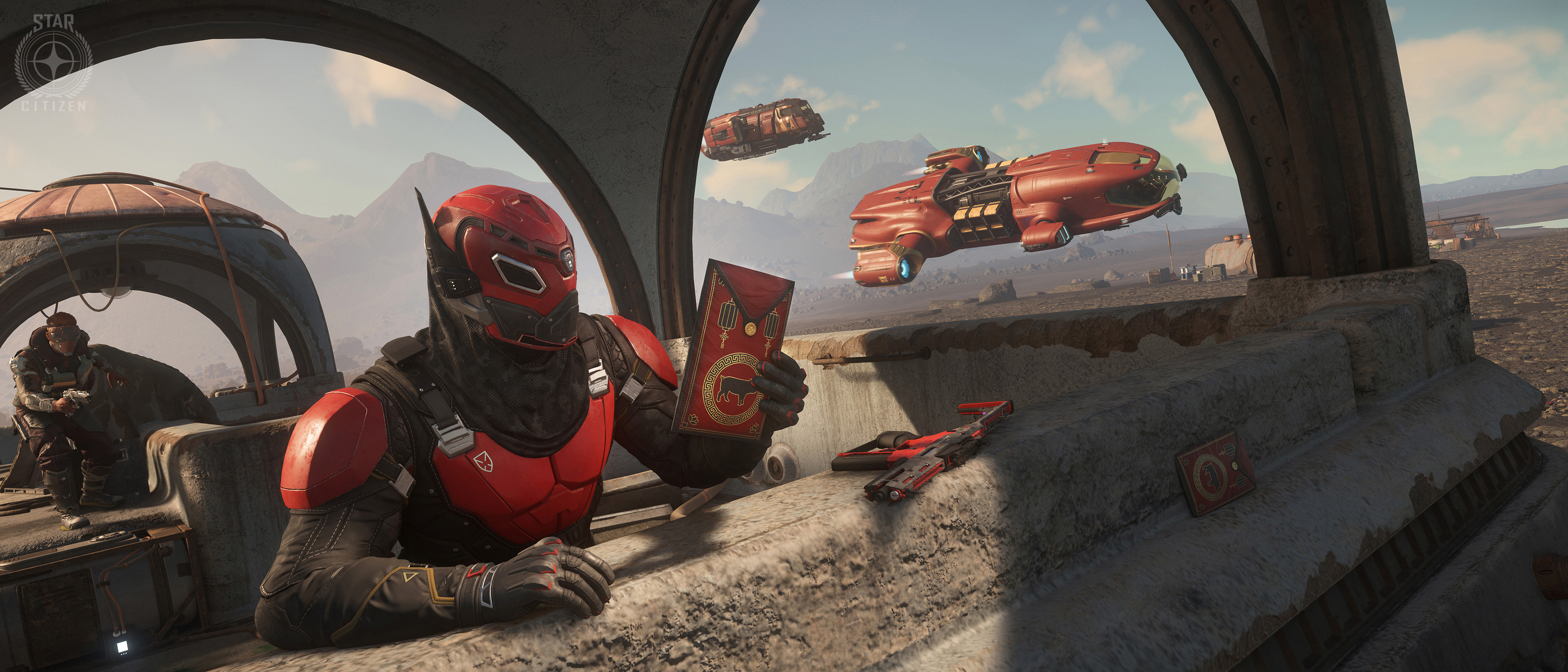
The team continued to support Red Festival 2955, including a catch-all post, the Envelop the 'Verse in Kindness screenshot contest, a referral bonus, and an updated Arena Commander Schedule.
Additionally, they supported ATMO Esports’ Daymar Rally 2955 and began finalizing plans for this year’s Bar Citizen World Tour, alongside a variety of other event-related initiatives.
"We’re eagerly looking forward to meeting you all across the globe as we continue the Bar Citizen World Tour in 2025. We welcome your input on future locations, whether you're interested in a large gathering or a smaller meetup, we want to hear your suggestions. Check out full details here." Community Team
Core Gameplay
Throughout January, the Core Gameplay teams investigated and improved many issues found during Alpha 4.0 Live Preview. Some of these proved difficult to reproduce and resolve, leading to a few false positive fixes. The teams are currently expanding their debugging tools and logging to better understand future problems and ensure the correct solutions are applied.
Core Gameplay also began planning for the rest of the year, laying the groundwork for upcoming patches and planned features and content.
Alongside this, technical documentation was created for fundamental improvements or rewrites to some of the core systems, including the transit and hangar flows. This involved cross-team collaboration to ensure that improvements are not solely on the game side but also support content setup and the latest engine features.
Economy
The Economy team kicked off the year gathering feedback and data regarding the changes they implemented in Alpha 4.0. They then tweaked commodity prices and fixed several issues identified in Pyro.
Mission Design
Mission Design spent time fixing bugs for Fight For Pyro, ensuring it was ready for release. Following this, they continued the ongoing mission refactor and shared an update on the status of some old missions on Spectrum.
They also continued to create new, unannounced content that will improve the quality of all missions, including retroactively improving all existing missions.
Narrative
The Narrative team began 2025 meeting with multiple disciplines to solidify new ways of delivering in-game narrative content. They also focused on increasing the number of characters that players will meet in the ’verse. Through these efforts, their hope is that they will expand on the storytelling opportunities that players will be able to experience and discover in upcoming patches.
In addition, the team fixed any remaining issues for the Alpha 4.0.1 patch and generated mission text, location strings, and item records for the new content coming in upcoming releases.
Online Technology
In January, the Live Tools team released a new major feature to manage access and permissions in a more granular and versatile way. They’re currently gathering feedback from the different users to discuss future improvements.
Following the holiday break, the Online Services team continued to add various improvements to the ongoing mission-system refactor, including Global Events and new features. Furthermore, the social and entity-subscription services also received various improvements.
In the last week of January, both teams met in the Montreal office to establish and plan their 2025/2026 roadmaps.
“This planning session resulted in more surprises we will share with you in the coming months!” Online Technology Team
R&D
The R&D team began January investigating rare PU crashes inside the planet-spawning code. A bug was found inside the serialization framework causing a concurrency issue with on-demand type ID generation. A fix was made that is now live in the PU.
Moreover, work started on prototyping a new method for large-scale soft-terrain shadow generation. This will improve quality while reducing the fairly high cost of generating the needed shadow maps.
As mentioned in October’s report, work on rain volumes inspired a prototype for improved ground-fog rendering. This will be cheaper to evaluate and render and improve the modeling aspect of ground fog and its lighting by self-shadowing and casting shadows (like rain volumes and clouds). Work began on transforming the prototype into production code.
VFX
For Alpha 4.0.1, the VFX team worked on the MISC Fortune and elements of another vehicle, which will be shared soon.
A big push was also made on previous location work that hadn’t been ready for polish at the time of Alpha 4.0’s release.
PU-Monatsbericht
Januar 2025
Willkommen zum PU-Monatsbericht für den Januar! Im Anschluss an den November/Dezember-Bericht berichten wir wieder über alles, was Anfang 2025 im Persistent Universe passiert ist. Lies weiter und erfahre alles über die neuesten Updates zu KI, Gameplay, Missionen, Erzählung und vielem mehr.
KI (Inhalt)
Das KI-Inhaltsteam begann das Jahr mit der Entwicklung eines Prototyps für einen neuen NSC, der eine Mischung aus verschiedenen Verhaltensweisen nutzen wird. Es wurde an einem proprietären Tool gearbeitet, mit dem die Designer/innen ein Skript des Dialogflusses in der Engine erstellen können, um sicherzustellen, dass die Zeilen wie vorgesehen funktionieren. Dies wird das Schreiben und Erfassen zukünftiger Charaktere wesentlich effizienter machen.
Dann begann das Team damit, die Landezonen von Stanton mit maßgeschneiderten Fluglotsen zu aktualisieren, die die Stadt besser repräsentieren. Diese Charaktere müssen zwar noch technisch validiert werden, werden aber schon bald zu sehen sein.
Schließlich setzten die Designer ihre laufende Überprüfung von Stanton fort, wobei sie sich dieses Mal auf Grim HEX konzentrierten, um die Bevölkerung zu überarbeiten und sicherzustellen, dass sie das richtige Verhalten an den Tag legt und sich angemessen verhält.
KI (Features)
Im Januar lag der Schwerpunkt bei den KI-Features auf der Behebung von Fehlern und der Verbesserung des Verhaltens der Kreaturen.
So wurde zum Beispiel der Code für das Werfen von Granaten aktualisiert, um einige der Codepfade zu vereinheitlichen. Das sorgt für eine einheitlichere Funktionalität beim Werfen aus der Deckung und im offenen Raum.
Für das Kampfverhalten der Menschen wurden die Checks für den Beschuss durch eigene Truppen aktualisiert, damit die großen Begrenzungskästen von Fahrzeugen nicht mehr als "eigene Truppen" betrachtet werden, die den Beschuss blockieren können.
Bei den Kreaturen konzentrierte sich das Team auf die Verbesserung des Verhaltens der Valakkar.
"Wir arbeiten hart daran, dass diese Kreatur auf die bestmögliche Art und Weise in deinen Händen ankommt! KI-Funktionen-Team
Die Entwickler bauen derzeit das Gruppensystem aus, damit es dynamischer wird und dynamisch gespawnte Wesen besser unterstützt. Der erste Anwendungsfall ist der Quasi-Weider, da ein besseres Verständnis der Gruppe, zu der er gehört, das Aussehen und Verhalten der Herde verbessern wird.
Die KI-Features haben ihre Arbeit zwischen den Projekten weiter synchronisiert, um sicherzustellen, dass die Verbesserungen für Squadron 42 so schnell wie möglich für das Persistent Universe zur Verfügung stehen.
AI (Game Intelligence Development Team)
Das Team für die Entwicklung der Spielintelligenz (Game Intelligence Development, GID) setzte seine Arbeit an StarScript fort und implementierte im Januar die Funktion "Ansichten". Diese wurde von den Designern gewünscht, die sie als wichtige Funktion des Tools ansehen.
Die Arbeit umfasste die Erstellung des "Ansichten-Objekts" und des "Ansichten-Ordners" in der Smart Outline, die Verwaltung der Ansichten-Funktionen, das Ordnen und Löschen von Ansichten und das Gruppieren von Diagrammen. Außerdem ging es darum, die Ansichten und ihre Überschrift im Skriptdiagramm darzustellen und eine Vor- und Zurück-Funktion zu implementieren.
Nach der Fertigstellung begann GID mit der Implementierung von StarScripts neuem MasterGraph-Design, das in einem abgetrennten Format und nicht wie in Apollo in einer globalen Anzeige dargestellt wird. Das bedeutet, dass es aus der Sicht eines ausgewählten Zustands betrachtet wird (dieses visuelle Design wird für jeden hierarchischen Zustand erstellt).
Auch die automatischen Elterngruppen für Parallel- und Selektorknoten wurden optisch verbessert, so dass der Graph weniger überladen wirkt.
Die Qualitätssicherung testet das Tool derzeit, um eventuelle Probleme mit den Verfahren zu identifizieren.
KI (Technik)
Die KI-Abteilung hat das Jahr damit begonnen, Fehler zu beheben, Funktionen zu verbessern und neue Technologien einzuführen.
Im letzteren Fall wurde mit der Arbeit an einer neuen 3D-Wegfindung begonnen, die in engen Räumen oder Gebieten mit konkaven Formen bessere Ergebnisse liefern wird. Diese Funktion wird auch von der SchiffskI genutzt, wenn sie komplexe Asteroiden oder Raumstationen durchquert, und kann auch von NSCs genutzt werden, wenn sie sich in Schiffen fortbewegen.
Das interne StartScript-Tool wurde mehrfach verbessert, um neue Verhaltensweisen und Missionen zu erstellen.
Außerdem hat die KI-Abteilung im Dezember die Arbeit an den Bewegungsanforderungen "Verfolgung" und "Nahkampfangriff" abgeschlossen, die sowohl die Leistung als auch die visuelle Darstellung im Vergleich zur vorherigen Implementierung verbessert haben.
Das "Gesprächssystem" wurde ebenfalls überarbeitet, damit NSCs eine laufende Unterhaltung nicht stören.
Für die Alpha 4.0.1 wurden Korrekturen an den Navigations- und Boids-Systemen vorgenommen.
Außerdem wurden die Arbeiten geplant, die noch erforderlich sind, um die KI-Komponenten vollständig mit der Umstellung auf die Server-Meshing-Behörde und anderen für dieses Jahr geplanten Funktionen und Systemen zu synchronisieren.
Animation
Das Gameplay-Animationsteam begann das Jahr mit der Arbeit am Kopion-Hund und verschiedenen Größen des Valakkar.
Außerdem erstellten sie Gesichtsanimationen für verschiedene PU-Charaktere und Ereignisse und arbeiteten zusammen mit den KI-Designern an robusteren sozialen KI-Verhaltensweisen.
Die KI für das "Spec Ops"-Set ist zusammen mit zwei anderen in Arbeit, um den Kampf noch herausfordernder zu gestalten.
Kunst (Charaktere)
Im Januar hat das Charakterteam die Arbeit an der StarWear-Kunstschuld fortgesetzt. Außerdem haben sie die Duster-Rüstung überarbeitet, eine Stealth-Rüstung entwickelt, einen neuen Rucksack entworfen und zusätzliche Kreaturenvarianten für zukünftige Patches entwickelt.
Das Konzeptkunst-Team erforschte Ideen für verschiedene neue Gegenstände und prüft derzeit die Farbgebung für bestehende Rüstungen.
Community
Das Community-Team hat das Jahr mit der Bekanntgabe der Gewinner des Videowettbewerbs "Gift that Keeps on Giving" begonnen. Um zu zeigen, was alles auf uns zukommt, veröffentlichten sie den Comm-Link An Epic Month Ahead, der eine Vorschau auf die für den Rest des Januars und den Februar geplanten Events und Aktivitäten enthält.
Das Team kümmerte sich auch um den ersten überarbeiteten Squadron 42 Newsletter und startete ein Gewinnspiel, bei dem man eine Seite mit Noten aus der Squadron 42 Partitur gewinnen konnte. Außerdem unterstützten sie das Fight for Pyro Global Event mit verschiedenen Veröffentlichungsaufgaben und einem umfassenden Informationsbeitrag.
Zu guter Letzt, aber am wichtigsten, hat das Team die immergrünen Aufgaben im Zusammenhang mit dem Sammeln/Verteilen von Feedback direkt an die Entwickler fortgesetzt und ist bereits in Diskussionen darüber vertieft, wie sie mehr Licht in die Details von Problemen bringen können, die in der Community auftauchen könnten.
Das Team hat das Rote Fest 2955 weiter unterstützt, u.a. mit einem Übersichtspost, dem Screenshot-Wettbewerb "Envelop the 'Verse in Kindness", einem Empfehlungsbonus und einem aktualisierten Arenakommandantenplan.
Außerdem unterstützte das Team die Daymar Rally 2955 von ATMO Esports und begann mit der Planung der diesjährigen Bar Citizen World Tour sowie mit einer Reihe anderer eventbezogener Initiativen.
"Wir freuen uns darauf, euch auf der ganzen Welt zu treffen, wenn wir die Bar Citizen World Tour im Jahr 2025 fortsetzen. Wir freuen uns auf deine Vorschläge für zukünftige Veranstaltungsorte, egal ob du an einer großen Versammlung oder einem kleineren Treffen interessiert bist. Alle Details findest du hier." Community Team
Core Gameplay
Im Januar haben die Core Gameplay Teams viele Probleme untersucht und verbessert, die während der Alpha 4.0 Live Preview aufgetreten sind. Einige davon erwiesen sich als schwierig zu reproduzieren und zu beheben, was zu einigen falsch positiven Korrekturen führte. Die Teams erweitern derzeit ihre Debugging-Tools und die Protokollierung, um zukünftige Probleme besser zu verstehen und sicherzustellen, dass die richtigen Lösungen angewendet werden.
Core Gameplay hat außerdem mit der Planung für den Rest des Jahres begonnen, um die Grundlage für kommende Patches und geplante Funktionen und Inhalte zu schaffen.
Parallel dazu wurde die technische Dokumentation für grundlegende Verbesserungen oder Überarbeitungen einiger Kernsysteme, wie z. B. der Transit- und Hangarabläufe, erstellt. Dabei wurde teamübergreifend zusammengearbeitet, um sicherzustellen, dass die Verbesserungen nicht nur das Spiel betreffen, sondern auch den Aufbau der Inhalte und die neuesten Funktionen der Engine unterstützen.
Wirtschaft
Zu Beginn des Jahres sammelte das Wirtschaftsteam Feedback und Daten zu den Änderungen, die sie in Alpha 4.0 eingeführt hatten. Anschließend wurden die Rohstoffpreise angepasst und mehrere in Pyro festgestellte Probleme behoben.
Missionsdesign
Das Missionsdesignteam verbrachte einige Zeit damit, Fehler in Fight For Pyro zu beheben, um sicherzustellen, dass es bereit für die Veröffentlichung war. Danach setzten sie die laufende Überarbeitung der Missionen fort und gaben ein Update zum Status einiger alter Missionen auf Spectrum.
Außerdem wurden neue, noch unangekündigte Inhalte erstellt, die die Qualität aller Missionen verbessern werden, einschließlich der rückwirkenden Verbesserung aller bestehenden Missionen.
Narrative
Das Narrative Team traf sich ab 2025 mit verschiedenen Disziplinen, um neue Wege für die Bereitstellung von narrativen Inhalten im Spiel zu finden. Außerdem konzentrierten sie sich darauf, die Anzahl der Charaktere zu erhöhen, denen die Spieler/innen im Verse begegnen werden. Sie hoffen, dass sie damit die Erzählmöglichkeiten, die die Spieler/innen in den kommenden Patches erleben und entdecken können, erweitern können.
Darüber hinaus hat das Team alle verbleibenden Probleme für den Alpha 4.0.1-Patch behoben und Missionstexte, Ortsangaben und Gegenstandsdatensätze für die neuen Inhalte in den kommendas Verseionen erstellt.
Online-Technologie
Im Januar hat das Live-Tools-Team eine neue wichtige Funktion veröffentlicht, mit der sich Zugriffsrechte und Berechtigungen noch detaillierter und vielseitiger verwalten lassen. Derzeit wird das Feedback der verschiedenen Nutzer/innen gesammelt, um zukünftige Verbesserungen zu besprechen.
Nach der Weihnachtspause hat das Team der Online-Dienste die Überarbeitung des Missionssystems fortgesetzt und verschiedene Verbesserungen vorgenommen, darunter Global Events und neue Funktionen. Darüber hinaus wurden auch die sozialen Dienste und die Abonnementdienste für Entitäten verbessert.
In der letzten Januarwoche trafen sich beide Teams im Büro in Montreal, um ihre Roadmaps 2025/2026 zu erstellen und zu planen.
"Diese Planungssitzung führte zu weiteren Überraschungen, die wir in den kommenden Monaten mit dir teilen werden!" Online Technologie Team
F&E
Das F&E-Team untersuchte im Januar seltene PU-Abstürze im Code für das Spawnen von Planeten. Es wurde ein Fehler im Serialisierungs-Framework gefunden, der ein Gleichzeitigkeitsproblem bei der On-Demand-Typ-ID-Generierung verursachte. Es wurde eine Korrektur vorgenommen, die jetzt in der PU verfügbar ist.
Außerdem wurde mit der Entwicklung eines Prototyps für eine neue Methode zur Erzeugung von Soft-Terrain-Schatten in großem Maßstab begonnen. Dies wird die Qualität verbessern und gleichzeitig die relativ hohen Kosten für die Erstellung der benötigten Shadow Maps senken.
Wie bereits im Oktoberbericht erwähnt, hat die Arbeit an der Regenmenge zu einem Prototyp für ein verbessertes Rendering von Bodennebel geführt. Dieser wird billiger zu evaluieren und zu rendern sein und den Modellierungsaspekt von Bodennebel und dessen Beleuchtung durch Selbstschattierung und Schattenwurf (wie bei Regenvolumina und Wolken) verbessern. Die Arbeit an der Umsetzung des Prototyps in Produktionscode hat begonnen.
VFX
Für Alpha 4.0.1 arbeitete das VFX-Team an der MISC Fortune und an Elementen eines weiteren Fahrzeugs, die bald veröffentlicht werden sollen.
Außerdem wurde die Arbeit an früheren Drehorten vorangetrieben, die zum Zeitpunkt der Veröffentlichung von Alpha 4.0 noch nicht fertiggestellt waren.
PU Monthly Report
January 2025
Welcome to January’s PU Monthly Report! Hot on the heels of the recent November/December report, we’re back detailing everything done for the Persistent Universe at the beginning of 2025. Read on for all the latest updates on AI, core gameplay, missions, narrative, and much more.
AI (Content)
The AI Content team began the year prototyping an upcoming NPC that will utilize an amalgamation of several behavior types. Work was done on a proprietary tool that will allow the designers to generate a script of the in-engine dialogue flow to ensure the lines work as intended. This will allow for much more efficiency in the writing and capturing of future characters.
The team then began updating Stanton’s landing zones with bespoke air traffic controllers that better represent the city. While there is still some required technical validation, these characters will start appearing soon.
Finally, the designers continued their ongoing review of Stanton, this time focusing on Grim HEX to refactor the population to ensure it’s using the correct behaviors and acting appropriately.
AI (Features)
In January, AI Feature’s primary focus was split between bug fixes and creature-behavior improvements.
For example, the code for throwing grenades was updated to unify some of the code paths. This gives more consistent functionality between cover and open-space launches.
For Human combat behavior, friendly-fire checks were updated to not consider the large bounding boxes of vehicles as 'friendly,' which could block firing.
For creatures, the team focused on improving the valakkar’s behavior.
“We are working hard to make sure this creature arrives in your hands in the best possible way!” AI Features Team
The devs are currently expanding the ‘group’ system to be more dynamic and better support dynamically spawned entities. The first use case is the Quasi grazer, as having a better understanding of the group they belong to will improve the look and behavior of the herd.
AI Features also continued to sync their work between projects to ensure that the improvements made for Squadron 42 are available for use in the Persistent Universe as quickly as possible.
AI (Game Intelligence Development Team)
The Game Intelligence Development (GID) team continued their work on StarScript, with January’s goal being the implementation of the ‘views’ feature. This was requested by the designers, who consider it a significant feature of the tool.
Work involved creating the ‘views object’ and ‘views folder’ in the Smart Outline, managing views functionalities, ordering and deleting views, and grouping graphs. It also involved presenting views and its header in the script graph and implementing back and forward functionality.
Once complete, GID began implementing StarScript's new MasterGraph design, which will be presented in a sectioned format rather than a global display as in Apollo. This means it will be viewed from the perception of a selected state (this visual design will be created for each hierarchical state).
A visual improvement was also made to the automatic parenting groups for parallel and selector nodes, making the graph appear less crowded.
QA are currently testing the tool to identify any issues following procedures.
AI (Tech)
AI Tech began the year fixing bugs, improving features, and kicking off new tech.
For the latter, work began on a new 3D-pathfinding implementation that will give better results in tight spaces or areas with concave shapes. This will also be utilized by ship AI when traversing complex asteroids or space stations and can also be used by NPCs when EVAing inside ships.
The internal StartScript tool received multiple usability improvements for creating new behaviors and missions.
AI Tech also finalized December’s work on the ‘chase’ and ‘melee attack’ movement requests, which delivers a boost in both performance and visual fidelity compared to the previous implementation.
The ‘conversation’ system also received updates to how avoidance bubbles are computed so that NPCs don’t disturb an ongoing conversation.
For Alpha 4.0.1, fixes were made to the navigation and boids systems.
Alongside this, planning was done for the work still required to fully synchronize AI components with the Server Meshing authority transition and other features and systems planned for development this year.
Animation
The Gameplay Animation team began the year working on the kopion hound and various sizes of the valakkar.
They also created facial animations for various PU characters and events and worked alongside the AI designers on more robust social-AI behaviors.
AI for the ‘spec ops’ set, alongside two others, is currently underway to add more challenge to combat.
Art (Characters)
In January, the Character team continued working on StarWear art debt. They also modified the Duster armor, progressed with a stealth armor, designed a new backpack, and developed additional creature variants for future patch releases.
The Concept art team explored ideas for various new items and are currently looking into paint schemes for existing armors.
Community
The Community team kicked off the year by announcing the winners of the Gift that Keeps on Giving video contest. To showcase what was coming up, they released An Epic Month Ahead Comm-link, which previewed the events and activities planned for the rest of January and into February.
The team also managed the first revamped Squadron 42 Newsletter, alongside launching a contest that offered the chance to win a page of sheet music from the Squadron 42 score. They also supported the Fight for Pyro Global Event with miscellaneous publishing tasks and a comprehensive information post.
Lastly, but most importantly, the team carried on with evergreen tasks related to gathering/distributing feedback directly to development, and is already deep in discussion on how they can shed more light on the details of any ongoing issues the community may be encountering.
The team continued to support Red Festival 2955, including a catch-all post, the Envelop the 'Verse in Kindness screenshot contest, a referral bonus, and an updated Arena Commander Schedule.
Additionally, they supported ATMO Esports’ Daymar Rally 2955 and began finalizing plans for this year’s Bar Citizen World Tour, alongside a variety of other event-related initiatives.
"We’re eagerly looking forward to meeting you all across the globe as we continue the Bar Citizen World Tour in 2025. We welcome your input on future locations, whether you're interested in a large gathering or a smaller meetup, we want to hear your suggestions. Check out full details here." Community Team
Core Gameplay
Throughout January, the Core Gameplay teams investigated and improved many issues found during Alpha 4.0 Live Preview. Some of these proved difficult to reproduce and resolve, leading to a few false positive fixes. The teams are currently expanding their debugging tools and logging to better understand future problems and ensure the correct solutions are applied.
Core Gameplay also began planning for the rest of the year, laying the groundwork for upcoming patches and planned features and content.
Alongside this, technical documentation was created for fundamental improvements or rewrites to some of the core systems, including the transit and hangar flows. This involved cross-team collaboration to ensure that improvements are not solely on the game side but also support content setup and the latest engine features.
Economy
The Economy team kicked off the year gathering feedback and data regarding the changes they implemented in Alpha 4.0. They then tweaked commodity prices and fixed several issues identified in Pyro.
Mission Design
Mission Design spent time fixing bugs for Fight For Pyro, ensuring it was ready for release. Following this, they continued the ongoing mission refactor and shared an update on the status of some old missions on Spectrum.
They also continued to create new, unannounced content that will improve the quality of all missions, including retroactively improving all existing missions.
Narrative
The Narrative team began 2025 meeting with multiple disciplines to solidify new ways of delivering in-game narrative content. They also focused on increasing the number of characters that players will meet in the ’verse. Through these efforts, their hope is that they will expand on the storytelling opportunities that players will be able to experience and discover in upcoming patches.
In addition, the team fixed any remaining issues for the Alpha 4.0.1 patch and generated mission text, location strings, and item records for the new content coming in upcoming releases.
Online Technology
In January, the Live Tools team released a new major feature to manage access and permissions in a more granular and versatile way. They’re currently gathering feedback from the different users to discuss future improvements.
Following the holiday break, the Online Services team continued to add various improvements to the ongoing mission-system refactor, including Global Events and new features. Furthermore, the social and entity-subscription services also received various improvements.
In the last week of January, both teams met in the Montreal office to establish and plan their 2025/2026 roadmaps.
“This planning session resulted in more surprises we will share with you in the coming months!” Online Technology Team
R&D
The R&D team began January investigating rare PU crashes inside the planet-spawning code. A bug was found inside the serialization framework causing a concurrency issue with on-demand type ID generation. A fix was made that is now live in the PU.
Moreover, work started on prototyping a new method for large-scale soft-terrain shadow generation. This will improve quality while reducing the fairly high cost of generating the needed shadow maps.
As mentioned in October’s report, work on rain volumes inspired a prototype for improved ground-fog rendering. This will be cheaper to evaluate and render and improve the modeling aspect of ground fog and its lighting by self-shadowing and casting shadows (like rain volumes and clouds). Work began on transforming the prototype into production code.
VFX
For Alpha 4.0.1, the VFX team worked on the MISC Fortune and elements of another vehicle, which will be shared soon.
A big push was also made on previous location work that hadn’t been ready for polish at the time of Alpha 4.0’s release.
PU Monthly Report
January 2025
Welcome to January’s PU Monthly Report! Hot on the heels of the recent November/December report, we’re back detailing everything done for the Persistent Universe at the beginning of 2025. Read on for all the latest updates on AI, core gameplay, missions, narrative, and much more.
AI (Content)
The AI Content team began the year prototyping an upcoming NPC that will utilize an amalgamation of several behavior types. Work was done on a proprietary tool that will allow the designers to generate a script of the in-engine dialogue flow to ensure the lines work as intended. This will allow for much more efficiency in the writing and capturing of future characters.
The team then began updating Stanton’s landing zones with bespoke air traffic controllers that better represent the city. While there is still some required technical validation, these characters will start appearing soon.
Finally, the designers continued their ongoing review of Stanton, this time focusing on Grim HEX to refactor the population to ensure it’s using the correct behaviors and acting appropriately.
AI (Features)
In January, AI Feature’s primary focus was split between bug fixes and creature-behavior improvements.
For example, the code for throwing grenades was updated to unify some of the code paths. This gives more consistent functionality between cover and open-space launches.
For Human combat behavior, friendly-fire checks were updated to not consider the large bounding boxes of vehicles as 'friendly,' which could block firing.
For creatures, the team focused on improving the valakkar’s behavior.
“We are working hard to make sure this creature arrives in your hands in the best possible way!” AI Features Team
The devs are currently expanding the ‘group’ system to be more dynamic and better support dynamically spawned entities. The first use case is the Quasi grazer, as having a better understanding of the group they belong to will improve the look and behavior of the herd.
AI Features also continued to sync their work between projects to ensure that the improvements made for Squadron 42 are available for use in the Persistent Universe as quickly as possible.
AI (Game Intelligence Development Team)
The Game Intelligence Development (GID) team continued their work on StarScript, with January’s goal being the implementation of the ‘views’ feature. This was requested by the designers, who consider it a significant feature of the tool.
Work involved creating the ‘views object’ and ‘views folder’ in the Smart Outline, managing views functionalities, ordering and deleting views, and grouping graphs. It also involved presenting views and its header in the script graph and implementing back and forward functionality.
Once complete, GID began implementing StarScript's new MasterGraph design, which will be presented in a sectioned format rather than a global display as in Apollo. This means it will be viewed from the perception of a selected state (this visual design will be created for each hierarchical state).
A visual improvement was also made to the automatic parenting groups for parallel and selector nodes, making the graph appear less crowded.
QA are currently testing the tool to identify any issues following procedures.
AI (Tech)
AI Tech began the year fixing bugs, improving features, and kicking off new tech.
For the latter, work began on a new 3D-pathfinding implementation that will give better results in tight spaces or areas with concave shapes. This will also be utilized by ship AI when traversing complex asteroids or space stations and can also be used by NPCs when EVAing inside ships.
The internal StartScript tool received multiple usability improvements for creating new behaviors and missions.
AI Tech also finalized December’s work on the ‘chase’ and ‘melee attack’ movement requests, which delivers a boost in both performance and visual fidelity compared to the previous implementation.
The ‘conversation’ system also received updates to how avoidance bubbles are computed so that NPCs don’t disturb an ongoing conversation.
For Alpha 4.0.1, fixes were made to the navigation and boids systems.
Alongside this, planning was done for the work still required to fully synchronize AI components with the Server Meshing authority transition and other features and systems planned for development this year.
Animation
The Gameplay Animation team began the year working on the kopion hound and various sizes of the valakkar.
They also created facial animations for various PU characters and events and worked alongside the AI designers on more robust social-AI behaviors.
AI for the ‘spec ops’ set, alongside two others, is currently underway to add more challenge to combat.
Art (Characters)
In January, the Character team continued working on StarWear art debt. They also modified the Duster armor, progressed with a stealth armor, designed a new backpack, and developed additional creature variants for future patch releases.
The Concept art team explored ideas for various new items and are currently looking into paint schemes for existing armors.
Community
The Community team kicked off the year by announcing the winners of the Gift that Keeps on Giving video contest. To showcase what was coming up, they released An Epic Month Ahead Comm-link, which previewed the events and activities planned for the rest of January and into February.
The team also managed the first revamped Squadron 42 Newsletter, alongside launching a contest that offered the chance to win a page of sheet music from the Squadron 42 score. They also supported the Fight for Pyro Global Event with miscellaneous publishing tasks and a comprehensive information post.
Lastly, but most importantly, the team carried on with evergreen tasks related to gathering/distributing feedback directly to development, and is already deep in discussion on how they can shed more light on the details of any ongoing issues the community may be encountering.
The team continued to support Red Festival 2955, including a catch-all post, the Envelop the 'Verse in Kindness screenshot contest, a referral bonus, and an updated Arena Commander Schedule.
Additionally, they supported ATMO Esports’ Daymar Rally 2955 and began finalizing plans for this year’s Bar Citizen World Tour, alongside a variety of other event-related initiatives.
"We’re eagerly looking forward to meeting you all across the globe as we continue the Bar Citizen World Tour in 2025. We welcome your input on future locations, whether you're interested in a large gathering or a smaller meetup, we want to hear your suggestions. Check out full details here." Community Team
Core Gameplay
Throughout January, the Core Gameplay teams investigated and improved many issues found during Alpha 4.0 Live Preview. Some of these proved difficult to reproduce and resolve, leading to a few false positive fixes. The teams are currently expanding their debugging tools and logging to better understand future problems and ensure the correct solutions are applied.
Core Gameplay also began planning for the rest of the year, laying the groundwork for upcoming patches and planned features and content.
Alongside this, technical documentation was created for fundamental improvements or rewrites to some of the core systems, including the transit and hangar flows. This involved cross-team collaboration to ensure that improvements are not solely on the game side but also support content setup and the latest engine features.
Economy
The Economy team kicked off the year gathering feedback and data regarding the changes they implemented in Alpha 4.0. They then tweaked commodity prices and fixed several issues identified in Pyro.
Mission Design
Mission Design spent time fixing bugs for Fight For Pyro, ensuring it was ready for release. Following this, they continued the ongoing mission refactor and shared an update on the status of some old missions on Spectrum.
They also continued to create new, unannounced content that will improve the quality of all missions, including retroactively improving all existing missions.
Narrative
The Narrative team began 2025 meeting with multiple disciplines to solidify new ways of delivering in-game narrative content. They also focused on increasing the number of characters that players will meet in the ’verse. Through these efforts, their hope is that they will expand on the storytelling opportunities that players will be able to experience and discover in upcoming patches.
In addition, the team fixed any remaining issues for the Alpha 4.0.1 patch and generated mission text, location strings, and item records for the new content coming in upcoming releases.
Online Technology
In January, the Live Tools team released a new major feature to manage access and permissions in a more granular and versatile way. They’re currently gathering feedback from the different users to discuss future improvements.
Following the holiday break, the Online Services team continued to add various improvements to the ongoing mission-system refactor, including Global Events and new features. Furthermore, the social and entity-subscription services also received various improvements.
In the last week of January, both teams met in the Montreal office to establish and plan their 2025/2026 roadmaps.
“This planning session resulted in more surprises we will share with you in the coming months!” Online Technology Team
R&D
The R&D team began January investigating rare PU crashes inside the planet-spawning code. A bug was found inside the serialization framework causing a concurrency issue with on-demand type ID generation. A fix was made that is now live in the PU.
Moreover, work started on prototyping a new method for large-scale soft-terrain shadow generation. This will improve quality while reducing the fairly high cost of generating the needed shadow maps.
As mentioned in October’s report, work on rain volumes inspired a prototype for improved ground-fog rendering. This will be cheaper to evaluate and render and improve the modeling aspect of ground fog and its lighting by self-shadowing and casting shadows (like rain volumes and clouds). Work began on transforming the prototype into production code.
VFX
For Alpha 4.0.1, the VFX team worked on the MISC Fortune and elements of another vehicle, which will be shared soon.
A big push was also made on previous location work that hadn’t been ready for polish at the time of Alpha 4.0’s release.
Links
No links available.
Images
5
Metadata
- CIG ID
- 20424
- Channel
- Transmission
- Category
- Undefined
- Series
- None
- Comments
- 0
- Published
- 4 months ago (2026-05-25T11:00:00+00:00)