Star Citizen Monthly Report: June 2025
Transmission Undefined NoneContent
PU Monthly Report
June 2025
June was a busy month at CIG, with most teams making final updates toward Alpha 4.2 and upcoming content. Read on for all the details of last month’s development, including the latest from the Ships, AI Tech, and Core Gameplay teams.
AI Content
June saw AI Content meeting with the directors and Combat AI team to keep pushing the development of the updated combatant wildline script. This new line set covers both FPS and dogfighting NPCs and provides a much-needed update to the enemies players have been fighting for years.
The team is currently looking into leveraging dynamic conversations (while keeping the line sets concise enough) to potentially offer gang-specific voicepacks. However, conversations and prototyping are required before they can begin capturing this content.
Outside of combat, the team updated civilian behaviors to utilize additional lines that haven’t been used yet and to make them feel more reactive in more environments. Finally, AI Tech supported the integration of new mission providers into upcoming content.
AI (Features)
Last month, AI Features completed their tasks for the irradiated valakkar, which made its debut in the PU. This was the culmination of months of hard work by cross-disciplinary teams, including AI Features and Tech, Animation, Gameplay Programming, Art, VFX, Audio, Design, and Weapons.
“We’re really enjoying the lovely feedback that the community has given fighting this giant. It’s making us very excited for future creatures and encounters to come.” AI Features
The latter part of the month was focused on bug fixing, including edge cases where valakkar didn’t emerge, despawned too soon, or failed to spit during its emerge animation.
Improvements were also made to the juvenile and adult valakkar, including changes to their positioning to prevent overlap and the better handling of unreachable targets. This also informed a fix for kopion chasing targets that become unreachable. The team then continued to develop upcoming creatures, the details of which will be shared in the coming months.
Major and minor bugs were fixed for Human combat alongside additional behavior work. This included aiming improvements to consider what part of the enemy is visible. For example, aiming specifically at the head if the chest is obstructed. Support was also added for NPCs using advanced weapon types, such as beam weapons or lasers that can overheat.
Updates were made to NPCs searching and looting ammo and weapons, the medical animation flow was polished to remove ‘pops,’ and more control was given to the designers over friendly-fire parameters.
Fixes were made to perception, audio propagation, combat investigation, and grenades. For the latter, updates were made to the targeting cooldown timer and collision checks when throwing grenades, while a fix was made to ensure that dropped grenades always explode.
AI (Game Intelligence Development Team)
The Game Intelligence Development team started the month with meetings relating to StarScript, Mission System 2.0, the commentator model, the density profiler, entity scripting, Mannequin, and the animation system.
Progress was also made on the prototype for Mission System v2 - implementation of the outline header and dashboard began. The visuals are evolving and adapting gradually to the limitations of Qt programming. As part of this, more icons were created to represent each mission component.
Additionally, the team continued to fix small bugs and work on some of the features requested by the game designers to improve StarScript.
AI (Tech)
Throughout June, the AI tech team provided bug fixes and support for the Alpha 4.2 release, including optimizing how navigation-mesh regeneration accounts for navigation links.
Since last year, the ‘island’ calculation (a way to determine which areas are reachable from the perspective of an NPC) was split into chunks for use by the planetary navmesh. Related bugs were investigated that caused some NPCs to not be able to find a path from an individual zone to planetary terrain. They also massively optimized the searching of navmesh around a point.
AI Tech converted the internal data structure that points at exclusion volumes or cost modifiers into AABBTree to quickly access and exclude unnecessary elements from the queries.
They then increased the radius used by NPCs to generate navmesh on planets to provide a better valakkar fight experience. For example, each variant of the creature needs to be able to move large distances around the world, with the recent amends providing improved generation granularity.
A way to mark up brushes (geometries that aren’t entities) was implemented to ensure they aren’t walkable for NPCs. This was necessary to avoid the use of unnecessary navigation exclusion volumes when artists want to prevent NPCs from walking over specific objects.
Ongoing work continued to update 3D pathfinding to use the new voxelizer approach. Alongside this, the team now has full support for quantum-boosting energy usage to efficiently use speeds when flying in space.
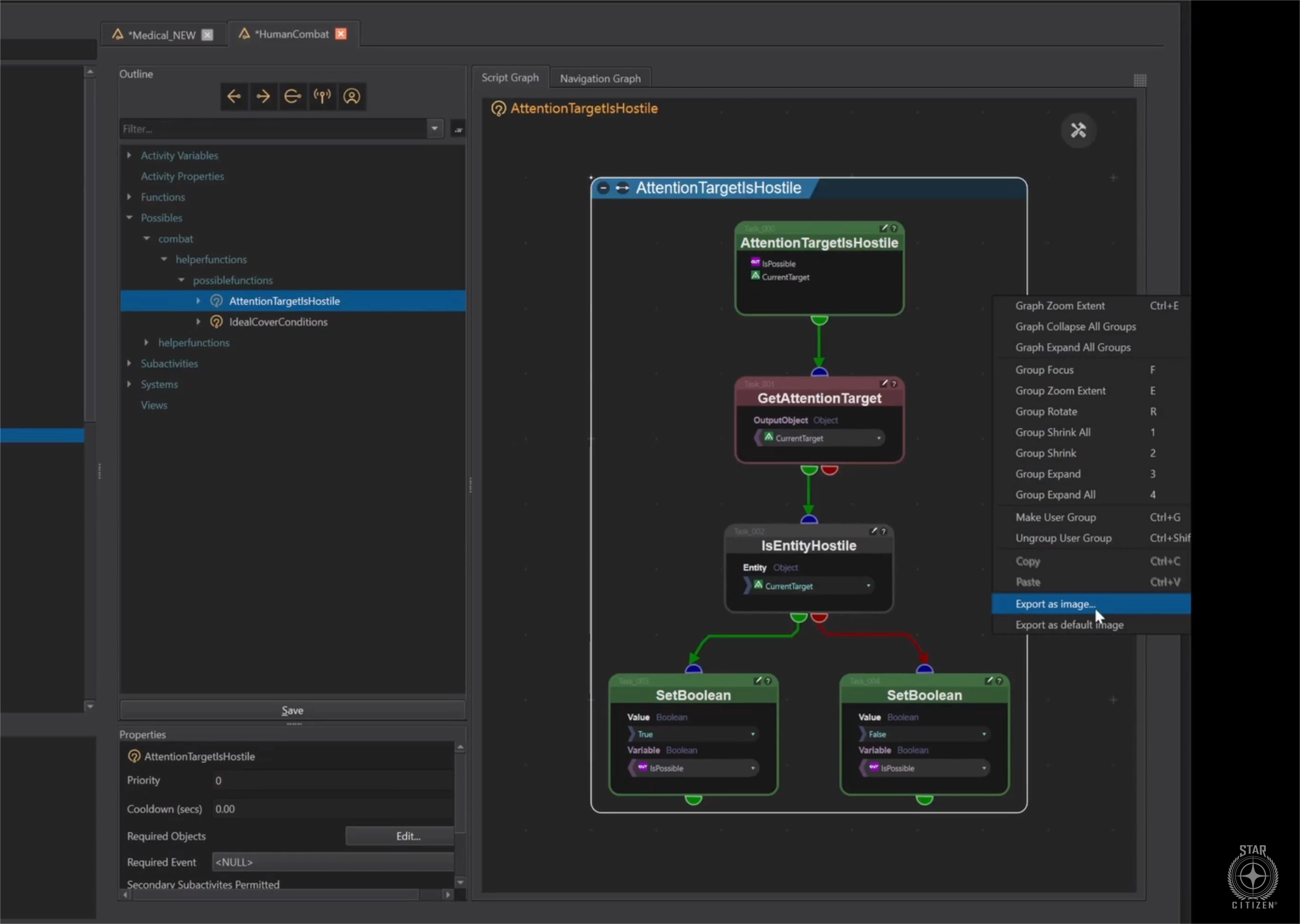
For StarScript, the ‘export as image’ functionality now supports exporting multiple graphs at the same time. Numerous other features progressed that will eventually be used directly in StarScript too.
In other work, the ability for NPCs to react to radar pings was added. Now, they will either consider a ping as a disturbance to investigate or an active event to bring them into combat.
Finally for AI Tech, fixes for NPCs driving vehicles were added, which is a feature the team hope to add to the PU at some point.
Animation
Animation spent the month supporting the irradiated valakkar alongside another new creature for later this year. They also progressed with animations for pre-combat and social-area usables that will promote more stealth gameplay opportunities against NPCs.
Facial Animation supported multiple releases throughout June. They began by finalizing the content required for Alpha 4.2.1, including new lines for Stows, Walton, and the additional NPCs in the defend-location missions. They then worked alongside the Narrative and Mo-cap teams to capture new mission-giver content for Alpha 4.3 and 4.3.1. The team are currently processing the recorded content as the release dates approach.
Art (Ships)
In the UK, the Anvil Paladin continued through greybox, with additional artists being moved onto it as their other tasks were completed to help prepare for its July gate review.
Pre-production began on the Gatac Railen, which will continue between other tasks ahead of the ship officially entering production later this year.
Some of the team moved onto the Drake Ironclad, with some areas receiving layout alterations to improve traversal alongside refinement to the modular Drake kit.
Work progressed on five unannounced vehicles: two completed their whitebox phase and are now well into greybox, with focus on details around the hull. Another is in the final stages of production and is receiving the finishing touches and bug fixes ahead of its release. Another vehicle from a prominent manufacturer entered production and is currently approaching its whitebox review. A new variant also entered pre-production, which the team states “may have the record for the fastest vehicle through the production pipeline.”
In North America, the RSI Apollo Medivac and Triage reached the LOD0 phase, with the devs ensuring the modular medical bays swap out and behave as expected.
Following the release of the Esperia Prowler Utility, the team tackled some bugs, with fixes due to land in Alpha 4.2.1.
The RSI Perseus approached its greybox gate review. As such, a lot of work was done to prepare anything that animates, such as the torpedo launchers, for the downstream teams.
Lastly for Ships, the Drake Kraken entered pre-production, with the team identifying areas from the original concept that need further attention to bring to modern standards. Full production will begin later this year.
Community
June began with a celebration of diversity and culture as the team launched Show Us Your Colors 2025. This was followed by support for Alien Week 2955, which included a Q&A for the Esperia Prowler Utility and the Wikelo’s Nine Tastes Contest, where players embraced Banu culinary traditions through imaginative alien-inspired dishes.
The team also supported the launch of Alpha 4.2, publishing a Patch Watch to spotlight important updates not covered on the Roadmap along with a catch-all post.
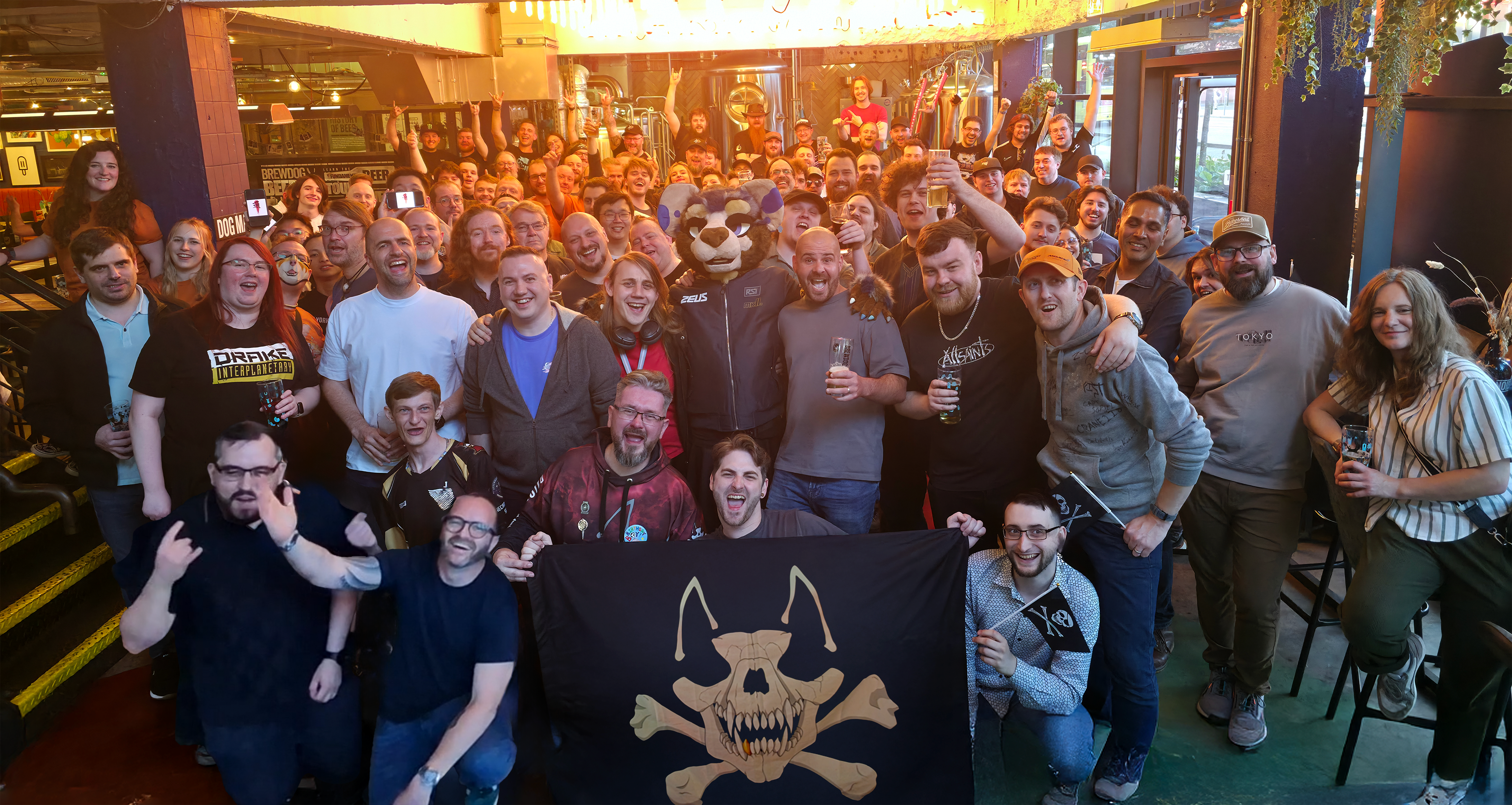
June also marked International Bar Citizen Weekend, where the team celebrated with the community across Frankfurt, Montreal, Austin, and Manchester. Attendees received this year's exclusive Bar Citizen gift, the Holographic Vanduul Skull. This exclusive in-game gift will be available at every Bar Citizen World Tour stop later this year.
“A huge thank you to everyone who joined us! Meeting so many passionate and creative members in person was truly inspiring. Your stories and support continue to drive us forward.” Community Team
Bar Citizen World Tour then made stops in Lyon, Toronto, and Copenhagen, as the team continued to meet and engage with local communities around the globe. The team also collected and reviewed CitizenCon Direct Watch Party submissions from those planning to host a watch party on October 11. More details will be shared soon as the list is finalized.
Evergreen tasks continued, including This Week in Star Citizen, the Roadmap Update and Roundup, the Arena Commander schedule update, and collating several mountains of feedback and ensuring they were delivered to appropriate developers. The team also completed tasks to prepare for the Foundation Festival and Ship Showdown, both set to begin in July, alongside ongoing work for CitizenCon Direct this October. In addition, submissions were collected for the Org Spotlight Comm-Link, which highlights player organizations during Foundation Festival.
Core Gameplay
With the new Storm Breaker content, the Core Gameplay teams added several updates to radiation, hazard areas, and damage-over-time handling. New IFCS logic was also added for storm clouds.
Most of the teams contributed to the apex valakkar encounter, including its appearance and how it interacts with the players. The teams were also involved in the new Argo ATLS IKTI, including enabling freight elevators to support the various power suit variants.
The recently added points of interest uncovered several unexpected issues during internal playtests and the PTU, though the teams worked hard to resolve them for release. One major challenge was managing the new locations’ population and corpse control without causing a significant impact on performance.
Several freight elevator fixes were made across multiple missions, while improvements and bug fixes were made for radiation.
Mission Design
Last month, Mission Design worked to close out the Storm Breaker sandbox activity for release.
For the upcoming Alpha 4.2.1 patch, they expanded the ‘infiltrate and defend’ suite to only use Foxwell as the mission giver and expanded its location pool. They also fixed the ‘recover cargo’ archetype and created an FPS version.
Elsewhere, the team are looking to expand the ‘ship battles’ mission suite with a new escort-based archetype. For this, players will either escort a ship to a hangar or from a hangar to a safe range where it can quantum jump.
Work then continued on content for upcoming patches, including moving generic contracts over to guilds and factions, which is needed for Reputation v2.
Finally for Mission Design, the devs are investigating an issue with mission generation where it appears that there are not enough contracts for everyone, which is likely caused by Server Meshing.
Narrative
Following Alpha 4.2’s release, the Narrative team focused on the next two upcoming patches, which will feature a variety of new missions. This included creating new contracts, mission-provider dialogue, and environmental story detail for a narrative-rich gameplay location.
The team held a performance-capture session to record mission dialogue and numerous audio logs to be discovered by players. Additionally, the team supported the mission designers in adding several new combat contracts along with a refactor of several older missions.
Longer term, Narrative have been solidifying the next major story arc as the mission content comes more into focus - the team are striving to ensure that the stories the players will experience align closely with the gameplay objectives. Part of this new story will introduce a unique hostile faction.
In support of Alien Week, Narrative released a handful of new and expanded Galactapedia articles that focused on the strange fauna and lifeforms found in the PU.
Online Technology
The Online Services team continued to work on the ‘item imprint system’- design aspects are being discussed, technical documentation is being written, and service development began.
The team also began preliminary discussions for the upcoming ‘instancing service’ in collaboration with other teams. They’re currently defining the objectives and high-level technical details to estimate and plan the work properly.
Furthermore, the team discussed Inventory ID Enforcement on the Inventory API. The idea of this project is to ensure that the Inventory API only accepts calls that affect a specific inventory ID. This would set up the foundation for the upcoming Entitygraph Global Database Sharding.
The team also worked on various improvements and bug fixes to provide a better experience for players.
The Live Tools team reworked the filtering and sorting functionality of the moderation tool, significantly enhancing the overall user experience. They also addressed technical debt and introduced quality-of-life improvements, such as quick access to various tools linked directly to game instances.
In parallel, testing began for the new MTL development infrastructure, which offloads computational load from individual developer machines, making day-to-day work smoother and more efficient. Additionally, improvements continued for the crash handler, making it more reliable and less prone to errors.
The Network team focused on bug fixing and stability updates. Steady progress is currently being made toward Dynamic Server Meshing, which is also crucial for the successful implementation of instancing.
R&D
Gas cloud rendering was further refined based on the improvements implemented in March. To get additional detail and improve distance read, support for an extra erosion layer was added. Controls were also added to boost intermediate cloud density during the shaping and erosion process to prevent clouds from thinning out too much. The goal is to preserve the overall shape of the original VDB as much as possible with details added at the cloud interface. The previous density blending step was replaced by a new merging step that combines shaped and original VDB density. This fixes visual artifacts caused by the blending step and helps to preserve details. Lastly, edge albedo control was made aware of the cloud's density environment to limit darkening to shaped regions without the presence of density coming from the original VDB. All improvements were made available to both the PU and Squadron 42.
Elsewhere, the performance of planet cloud rendering for cameras in orbit was increased. Also, night-sky rendering was improved. Previously, it incorrectly included Mie scattering with regards to the fully occluded sun and produced undesired fake halos (especially when looking at the night sky from orbit). This is now fixed.
Furthermore, help was provided to fix the reflection of atmosphere content on water surfaces that was too dark under some conditions.
VFX
The VFX Code and Art teams worked on several things for Alpha 4.2. For example, the irradiated valakkar received bespoke animation and new irradiated VFX, while the weather VFX was refined and increased to make the event even more tense. The Argo ATLS IKTI also received new impact and surface effects.
PU-Monatsbericht
Juni 2025
Der Juni war ein arbeitsreicher Monat bei CIG, in dem die meisten Teams letzte Updates für Alpha 4.2 und kommende Inhalte vornahmen. Lies weiter, um alle Details über die Entwicklung des letzten Monats zu erfahren, einschließlich der Neuigkeiten aus den Teams Schiffe, KI-Technologie und Core Gameplay.
KI-Inhalt
Im Juni trafen sich die KI-Inhalte mit den Direktoren und dem Kampf-KI-Team, um die Entwicklung des aktualisierten Wildline-Skripts für Kämpfer voranzutreiben. Dieses neue Line-Set umfasst sowohl FPS- als auch Dogfighting-NSCs und bietet ein dringend benötigtes Update für die Feinde, gegen die die Spieler/innen seit Jahren kämpfen.
Das Team prüft derzeit, ob es dynamische Konversationen nutzen kann (wobei die Line-Sets übersichtlich genug bleiben), um möglicherweise gruppenspezifische Voicepacks anzubieten. Bevor sie jedoch mit der Aufnahme dieser Inhalte beginnen können, sind Gespräche und Prototypen erforderlich.
Außerhalb des Kampfes aktualisierte das Team das Verhalten von Zivilisten, um zusätzliche, bisher nicht genutzte Sätze zu verwenden und sie in mehr Umgebungen reaktionsfähiger zu machen. Schließlich unterstützte AI Tech die Integration neuer Missionsanbieter in kommende Inhalte.
KI (Features)
Im letzten Monat haben die KI-Features ihre Aufgaben für den bestrahlten Valakkar abgeschlossen, der sein Debüt in der PU gab. Dies war der Höhepunkt monatelanger harter Arbeit von interdisziplinären Teams, darunter AI Features und Tech, Animation, Gameplay-Programmierung, Kunst, VFX, Audio, Design und Waffen.
"Wir freuen uns sehr über das tolle Feedback, das uns die Community beim Kampf gegen diesen Giganten gegeben hat. Das macht uns sehr gespannt auf die kommenden Kreaturen und Begegnungen." KI-Merkmale
In der zweiten Hälfte des Monats haben wir uns auf die Behebung von Fehlern konzentriert. Dazu gehörten Fälle, in denen Valakkar nicht auftauchte, zu früh despawnte oder während seiner Auftauchanimation nicht spuckte.
Außerdem wurden Verbesserungen an den jugendlichen und erwachsenen Valakkar vorgenommen, einschließlich Änderungen an ihrer Positionierung, um Überschneidungen zu vermeiden, und eine bessere Handhabung von unerreichbaren Zielen. Dies beinhaltete auch einen Fix für Kopion, der Ziele jagt, die unerreichbar werden. Das Team hat dann weiter an der Entwicklung neuer Kreaturen gearbeitet, deren Details in den kommenden Monaten bekannt gegeben werden.
Für den menschlichen Kampf wurden kleinere und größere Fehler behoben und zusätzliche Verhaltensänderungen vorgenommen. Dazu gehörten Verbesserungen beim Zielen, die berücksichtigen, welcher Teil des Gegners sichtbar ist. So kannst du zum Beispiel gezielt auf den Kopf zielen, wenn die Brust verdeckt ist. Außerdem wurden NSCs unterstützt, die fortschrittliche Waffentypen verwenden, wie z. B. Strahlenwaffen oder Laser, die überhitzen können.
Die NPCs, die Munition und Waffen suchen und plündern, wurden überarbeitet, der Ablauf der medizinischen Animationen wurde verbessert, um "Knackgeräusche" zu entfernen, und die Designer erhielten mehr Kontrolle über die Parameter für den Beschuss durch eigene Truppen.
Außerdem wurden Verbesserungen an der Wahrnehmung, der Audioübertragung, der Kampferkundung und den Granaten vorgenommen. Bei letzteren wurden die Abklingzeit beim Zielen und die Kollisionsprüfung beim Werfen von Granaten aktualisiert, während sichergestellt wurde, dass fallen gelassene Granaten immer explodieren.
KI (Game Intelligence Development Team)
Das Team für die Entwicklung der Spielintelligenz begann den Monat mit Sitzungen zu StarScript, dem Missionssystem 2.0, dem Kommentatormodell, dem Dichteprofiler, dem Entity-Scripting, Mannequin und dem Animationssystem.
Auch beim Prototyp für Mission System v2 wurden Fortschritte gemacht - mit der Implementierung der Kopfzeile und des Dashboards wurde begonnen. Die Grafik entwickelt sich weiter und passt sich allmählich an die Grenzen der Qt-Programmierung an. In diesem Zusammenhang wurden weitere Icons für die einzelnen Missionskomponenten erstellt.
Außerdem hat das Team weiterhin kleine Fehler behoben und an einigen Funktionen gearbeitet, die von den Spieldesignern gewünscht wurden, um StarScript zu verbessern.
KI (Technik)
Den ganzen Juni über hat das KI-Team Fehler behoben und Support für die Alpha 4.2 geleistet, u. a. durch die Optimierung der Regeneration von Navigationsmaschen für Navigationslinks.
Seit dem letzten Jahr wurde die "Insel"-Berechnung (eine Methode, um zu bestimmen, welche Gebiete aus der Perspektive eines NSCs erreichbar sind) in Teile aufgeteilt, die vom planetarischen Navmesh verwendet werden. Außerdem wurden Fehler behoben, die dazu führten, dass manche NSCs keinen Weg von einer einzelnen Zone zum planetarischen Gelände finden konnten. Außerdem wurde die Suche im Navmesh um einen Punkt herum massiv optimiert.
AI Tech hat die interne Datenstruktur, die auf Ausschlussvolumina oder Kostenmodifikatoren hinweist, in AABBTree umgewandelt, um schnell darauf zugreifen und unnötige Elemente aus den Abfragen ausschließen zu können.
Dann haben sie den Radius vergrößert, den die NSCs zur Erzeugung von Navmesh auf Planeten verwenden, um ein besseres Valakkar-Kampferlebnis zu bieten. Zum Beispiel muss jede Variante der Kreatur in der Lage sein, sich über große Entfernungen auf der Welt zu bewegen, wobei die jüngsten Änderungen eine verbesserte Granularität der Generierung ermöglichen.
Es wurde eine Möglichkeit implementiert, Brushes (Geometrien, die keine Entitäten sind) zu markieren, um sicherzustellen, dass sie für NSCs nicht begehbar sind. Dies war notwendig, um die Verwendung von unnötigen Navigationsausschlüssen zu vermeiden, wenn Künstler/innen verhindern wollen, dass NSCs über bestimmte Objekte laufen.
Es wurde weiter daran gearbeitet, die 3D-Pfadfindung auf den neuen Voxelizer-Ansatz umzustellen. Außerdem hat das Team jetzt volle Unterstützung für den Quantenboosting-Energieverbrauch, um die Geschwindigkeit beim Fliegen im Weltraum effizient zu nutzen.
Bei StarScript unterstützt die Funktion "Als Bild exportieren" jetzt den gleichzeitigen Export mehrerer Diagramme. Zahlreiche andere Funktionen wurden weiterentwickelt, die später auch direkt in StarScript verwendet werden können.
Außerdem wurde die Fähigkeit der NSCs hinzugefügt, auf Radar-Pings zu reagieren. Jetzt betrachten sie einen Ping entweder als eine Störung, die sie untersuchen müssen, oder als ein aktives Ereignis, das sie in den Kampf führt.
Im Bereich der KI-Technik schließlich wurden Korrekturen für NSCs vorgenommen, die Fahrzeuge fahren - eine Funktion, die das Team irgendwann in die PU einbauen möchte.
Animation
Die Animationsabteilung hat den Monat damit verbracht, den verstrahlten Valakkar und eine weitere neue Kreatur zu unterstützen, die später in diesem Jahr erscheinen soll. Außerdem wurde an den Animationen für die Vor-Kampf- und Sozialbereiche gearbeitet, die für mehr Stealth-Möglichkeiten gegen NSCs sorgen werden.
Die Gesichtsanimation unterstützte im Juni mehrere Veröffentlichungen. Sie begannen mit der Fertigstellung der für Alpha 4.2.1 benötigten Inhalte, einschließlich neuer Zeilen für Stows, Walton und die zusätzlichen NSCs in den Verteidigungsmissionen. Anschließend arbeiteten sie mit den Teams für die Erzählung und das Mo-Cap zusammen, um neue Inhalte für die Missionsgeber in Alpha 4.3 und 4.3.1 aufzunehmen. Das Team bearbeitet derzeit die aufgenommenen Inhalte, während die Veröffentlichungstermine näher rücken.
Kunst (Schiffe)
In Großbritannien wurde der Anvil Paladin in der Greybox weiter bearbeitet, wobei zusätzliche Künstler mit der Fertigstellung anderer Aufgaben betraut wurden, um sich auf die Überprüfung im Juli vorzubereiten.
Die Vorproduktion der Gatac Railen hat begonnen und wird zwischen anderen Aufgaben fortgesetzt, bevor das Schiff später in diesem Jahr offiziell in Produktion geht.
Ein Teil des Teams arbeitete an der Drake Ironclad, bei der einige Bereiche geändert wurden, um die Durchfahrt zu verbessern und den modularen Drake-Bausatz zu verfeinern.
Die Arbeit an fünf unangekündigten Fahrzeugen schritt voran: Zwei schlossen ihre Whitebox-Phase ab und befinden sich nun in der Greybox-Phase, wobei der Schwerpunkt auf den Details rund um den Rumpf liegt. Ein weiteres Fahrzeug befindet sich in der Endphase der Produktion und erhält vor seiner Veröffentlichung den letzten Schliff und Fehlerbehebungen. Ein weiteres Fahrzeug eines bekannten Herstellers ist in Produktion gegangen und nähert sich derzeit der Whitebox-Prüfung. Eine neue Variante ist ebenfalls in die Vorproduktion gegangen, die laut dem Team "den Rekord für das schnellste Fahrzeug in der Produktionspipeline halten könnte".
In Nordamerika haben der RSI Apollo Medivac und der Triage die LOD0-Phase erreicht, wobei die Entwickler sicherstellen, dass die modularen medizinischen Buchten austauschbar sind und sich wie erwartet verhalten.
Nach der Veröffentlichung des Esperia Prowler Utility nahm das Team einige Fehler in Angriff, die in der Alpha 4.2.1 behoben werden sollen.
Der RSI Perseus näherte sich der Überprüfung seines Greybox-Gates. Daher wurde viel Arbeit geleistet, um alles, was sich animieren lässt, wie z. B. die Torpedowerfer, für die nachgelagerten Teams vorzubereiten.
Bei den Schiffen schließlich ging die Drake Kraken in die Vorproduktion, wobei das Team Bereiche des ursprünglichen Konzepts identifizierte, die noch weiter bearbeitet werden müssen, um sie an moderne Standards anzupassen. Die vollständige Produktion wird später in diesem Jahr beginnen.
Gemeinschaft
Der Juni begann mit einem Fest der Vielfalt und Kultur, als das Team das Projekt Show Us Your Colors 2025 startete. Darauf folgte die Unterstützung der Alien-Woche 2955, die eine Frage und Antwort für das Esperia Prowler Utility und den Wikelo's Nine Tastes Contest beinhaltete, bei dem die Spieler/innen die kulinarischen Traditionen der Banu durch fantasievolle, von Aliens inspirierte Gerichte kennenlernten.
Das Team unterstützte auch den Start der Alpha 4.2, indem es einen Patch Watch veröffentlichte, in dem es auf wichtige Aktualisierungen hinwies, die nicht in der Roadmap enthalten waren, sowie einen Übersichtspost.
Im Juni fand auch das internationale Bar Citizen Weekend statt, bei dem das Team mit der Community in Frankfurt, Montreal, Austin und Manchester feierte. Die Teilnehmer/innen erhielten das diesjährige exklusive Bar Citizen-Geschenk, den holografischen Vanduul-Schädel. Dieses exklusive Ingame-Geschenk wird im Laufe des Jahres bei jedem Stopp der Bar Citizen World Tour erhältlich sein.
"Ein großes Dankeschön an alle, die dabei waren! So viele leidenschaftliche und kreative Mitglieder persönlich zu treffen, war wirklich inspirierend. Eure Geschichten und eure Unterstützung treiben uns weiter voran." Community Team
Die Bar Citizen World Tour machte dann in Lyon, Toronto und Kopenhagen Halt, wo das Team weiterhin lokale Gemeinschaften auf der ganzen Welt traf und sich mit ihnen austauschte. Das Team sammelte und überprüfte auch die Anmeldungen für die CitizenCon Direct Watch Party von denjenigen, die am 11. Oktober eine Watch Party veranstalten wollen. Weitere Details werden bald bekannt gegeben, sobald die Liste fertiggestellt ist.
Das Team setzte seine Arbeit an den "Evergreens" fort, wie z.B. "Diese Woche in Star Citizen", das Roadmap-Update und das Roundup, die Aktualisierung des Zeitplans für den Arenakommandanten und das Zusammentragen mehrerer Berge von Feedback, um sicherzustellen, dass diese an die zuständigen Entwickler weitergeleitet werden. Das Team erledigte auch Aufgaben zur Vorbereitung des Foundation Festivals und des Ship Showdowns, die beide im Juli beginnen werden, sowie die laufenden Arbeiten für die CitizenCon Direct im Oktober. Außerdem wurden Beiträge für den Org Spotlight Comm-Link gesammelt, mit dem Spielerorganisationen während des Foundation Festivals vorgestellt werden.
Kern-Gameplay
Mit den neuen Storm Breaker-Inhalten fügten die Core Gameplay-Teams mehrere Updates für Strahlung, Gefahrenbereiche und die Handhabung von Schaden über Zeit hinzu. Außerdem wurde eine neue IFCS-Logik für Sturmwolken hinzugefügt.
Die meisten Teams haben an der Begegnung mit dem Apex Valakkar mitgewirkt, einschließlich seines Aussehens und wie er mit den Spielern interagiert. Die Teams waren auch an der neuen Argo ATLS IKTI beteiligt, einschließlich der Aktivierung von Lastenaufzügen zur Unterstützung der verschiedenen Power Suit-Varianten.
Die kürzlich hinzugefügten Points of Interest brachten während der internen Spieltests und der PTU einige unerwartete Probleme ans Tageslicht, an deren Lösung die Teams jedoch bis zur Veröffentlichung hart gearbeitet haben. Eine große Herausforderung war es, die Bevölkerung der neuen Orte und die Leichenkontrolle zu verwalten, ohne die Leistung erheblich zu beeinträchtigen.
Mehrere Lastenaufzüge wurden in mehreren Missionen behoben, während Verbesserungen und Fehlerkorrekturen für die Strahlung vorgenommen wurden.
Missionsdesign
Im letzten Monat arbeitete das Missionsdesign daran, die Sandbox-Aktivität Storm Breaker für die Veröffentlichung abzuschließen.
Für den kommenden Alpha 4.2.1-Patch wurde die "Infiltrieren und Verteidigen"-Suite so erweitert, dass nur noch Foxwell als Missionsgeber verwendet wird und der Standortpool erweitert wurde. Außerdem wurde der Archetyp "Fracht bergen" verbessert und eine FPS-Version erstellt.
Außerdem will das Team das Missionspaket "Schiffsgefechte" um einen neuen Eskorten-Archetyp erweitern. Dabei eskortieren die Spieler/innen entweder ein Schiff zu einem Hangar oder von einem Hangar zu einem sicheren Bereich, wo es einen Quantensprung machen kann.
Die Arbeit an den Inhalten für die kommenden Patches wurde fortgesetzt, einschließlich der Übertragung allgemeiner Verträge auf Gilden und Fraktionen, die für Ruf v2 benötigt werden.
Beim Missionsdesign schließlich untersuchen die Entwickler ein Problem bei der Missionsgenerierung, bei dem es anscheinend nicht genügend Verträge für alle gibt, was wahrscheinlich durch das Server Meshing verursacht wird.
Narrative
Nach der Veröffentlichung von Alpha 4.2 konzentrierte sich das Narrative-Team auf die nächsten beiden Patches, die eine Vielzahl neuer Missionen enthalten werden. Dazu gehörten neue Verträge, Dialoge mit den Missionsanbietern und Details aus der Umgebung für einen erzählerisch reichen Spielort.
Das Team hielt eine Performance-Capture-Session ab, um Missionsdialoge und zahlreiche Audioprotokolle aufzunehmen, die von den Spielern entdeckt werden können. Außerdem unterstützte das Team die Missionsdesigner beim Hinzufügen mehrerer neuer Kampfaufträge und bei der Überarbeitung mehrerer älterer Missionen.
Längerfristig hat Narrative den nächsten großen Storybogen ausgearbeitet, während die Missionsinhalte immer mehr in den Fokus rücken - das Team will sicherstellen, dass die Geschichten, die die Spieler erleben werden, eng mit den Spielzielen übereinstimmen. Ein Teil dieser neuen Geschichte wird eine einzigartige feindliche Fraktion einführen.
Zur Unterstützung der Alien-Woche hat Narrative eine Handvoll neuer und erweiterter Galactapedia-Artikel veröffentlicht, die sich mit der seltsamen Fauna und den Lebensformen in der PU beschäftigen.
Online-Technologie
Das Team der Online-Dienste hat die Arbeit am "Item Imprint System" fortgesetzt - Designaspekte werden diskutiert, die technische Dokumentation wird geschrieben und die Entwicklung der Dienste hat begonnen.
Außerdem hat das Team in Zusammenarbeit mit anderen Teams erste Gespräche über den kommenden "Instanzierungsdienst" geführt. Derzeit werden die Ziele und technischen Details festgelegt, um die Arbeit richtig einschätzen und planen zu können.
Außerdem diskutierte das Team über die Durchsetzung der Inventar-ID in der Inventar-API. Mit diesem Projekt soll sichergestellt werden, dass die Inventory API nur Aufrufe akzeptiert, die eine bestimmte Inventar-ID betreffen. Dies würde die Grundlage für das kommende Entitygraph Global Database Sharding bilden.
Das Team hat außerdem an verschiedenen Verbesserungen und Fehlerbehebungen gearbeitet, um den Spielern ein besseres Erlebnis zu bieten.
Das Team der Live-Tools überarbeitete die Filter- und Sortierfunktionen des Moderationstools und verbesserte damit die Benutzerfreundlichkeit erheblich. Außerdem wurden technische Mängel behoben und Verbesserungen der Lebensqualität eingeführt, wie z. B. der schnelle Zugriff auf verschiedene Tools, die direkt mit Spielinstanzen verknüpft sind.
Parallel dazu begannen die Tests für die neue MTL-Entwicklungsinfrastruktur, die die Rechner der einzelnen Entwickler entlastet und so die tägliche Arbeit reibungsloser und effizienter macht. Außerdem wurde der Crash-Handler weiter verbessert, um ihn zuverlässiger und weniger fehleranfällig zu machen.
Das Netzwerkteam konzentrierte sich auf die Behebung von Fehlern und die Aktualisierung der Stabilität. Stetige Fortschritte werden derzeit beim Dynamic Server Meshing gemacht, das auch für die erfolgreiche Implementierung von Instanzierung entscheidend ist.
F&E
Das Rendering der Gaswolke wurde auf der Grundlage der im März eingeführten Verbesserungen weiter verfeinert. Um zusätzliche Details zu erhalten und die Abstandsanzeige zu verbessern, wurde die Unterstützung für eine zusätzliche Erosionsschicht hinzugefügt. Außerdem wurden Kontrollen hinzugefügt, um die Zwischendichte der Wolken während des Form- und Erosionsprozesses zu erhöhen, damit die Wolken nicht zu sehr ausdünnen. Ziel ist es, die Gesamtform der ursprünglichen VDB so weit wie möglich zu erhalten, wobei die Details an der Wolkenschnittstelle hinzugefügt werden. Der frühere Schritt der Dichtevermischung wurde durch einen neuen Schritt der Zusammenführung ersetzt, der die geformte und die ursprüngliche VDB-Dichte kombiniert. Dadurch werden visuelle Artefakte, die durch den Mischungsschritt verursacht wurden, behoben und die Details bleiben erhalten. Schließlich wurde die Albedo-Kontrolle an den Rändern an die Dichteumgebung der Wolke angepasst, um die Verdunkelung auf die geformten Regionen zu begrenzen, ohne dass die Dichte aus der ursprünglichen VDB vorhanden ist. Alle Verbesserungen wurden sowohl der PU als auch dem Geschwader 42 zur Verfügung gestellt.
An anderer Stelle wurde die Leistung des Renderings der Planetenwolken für Kameras in der Umlaufbahn verbessert. Auch das Rendering des Nachthimmels wurde verbessert. Bisher wurde die Mie-Streuung in Bezug auf die vollständig verdeckte Sonne nicht korrekt berücksichtigt, was zu unerwünschten falschen Halos führte (vor allem bei der Betrachtung des Nachthimmels aus dem Orbit). Das ist jetzt behoben.
Außerdem wurde die Reflexion von Atmosphäreninhalten auf Wasseroberflächen behoben, die unter bestimmten Bedingungen zu dunkel war.
VFX
Die VFX Code- und Art-Teams haben für Alpha 4.2 an mehreren Dingen gearbeitet. Zum Beispiel erhielt der verstrahlte Valakkar maßgeschneiderte Animationen und neue verstrahlte VFX, während die Wetter-VFX verfeinert und erhöht wurde, um das Ereignis noch spannender zu machen. Die Argo ATLS IKTI erhielt außerdem neue Aufprall- und Oberflächeneffekte.
PU Monthly Report
June 2025
June was a busy month at CIG, with most teams making final updates toward Alpha 4.2 and upcoming content. Read on for all the details of last month’s development, including the latest from the Ships, AI Tech, and Core Gameplay teams.
AI Content
June saw AI Content meeting with the directors and Combat AI team to keep pushing the development of the updated combatant wildline script. This new line set covers both FPS and dogfighting NPCs and provides a much-needed update to the enemies players have been fighting for years.
The team is currently looking into leveraging dynamic conversations (while keeping the line sets concise enough) to potentially offer gang-specific voicepacks. However, conversations and prototyping are required before they can begin capturing this content.
Outside of combat, the team updated civilian behaviors to utilize additional lines that haven’t been used yet and to make them feel more reactive in more environments. Finally, AI Tech supported the integration of new mission providers into upcoming content.
AI (Features)
Last month, AI Features completed their tasks for the irradiated valakkar, which made its debut in the PU. This was the culmination of months of hard work by cross-disciplinary teams, including AI Features and Tech, Animation, Gameplay Programming, Art, VFX, Audio, Design, and Weapons.
“We’re really enjoying the lovely feedback that the community has given fighting this giant. It’s making us very excited for future creatures and encounters to come.” AI Features
The latter part of the month was focused on bug fixing, including edge cases where valakkar didn’t emerge, despawned too soon, or failed to spit during its emerge animation.
Improvements were also made to the juvenile and adult valakkar, including changes to their positioning to prevent overlap and the better handling of unreachable targets. This also informed a fix for kopion chasing targets that become unreachable. The team then continued to develop upcoming creatures, the details of which will be shared in the coming months.
Major and minor bugs were fixed for Human combat alongside additional behavior work. This included aiming improvements to consider what part of the enemy is visible. For example, aiming specifically at the head if the chest is obstructed. Support was also added for NPCs using advanced weapon types, such as beam weapons or lasers that can overheat.
Updates were made to NPCs searching and looting ammo and weapons, the medical animation flow was polished to remove ‘pops,’ and more control was given to the designers over friendly-fire parameters.
Fixes were made to perception, audio propagation, combat investigation, and grenades. For the latter, updates were made to the targeting cooldown timer and collision checks when throwing grenades, while a fix was made to ensure that dropped grenades always explode.
AI (Game Intelligence Development Team)
The Game Intelligence Development team started the month with meetings relating to StarScript, Mission System 2.0, the commentator model, the density profiler, entity scripting, Mannequin, and the animation system.
Progress was also made on the prototype for Mission System v2 - implementation of the outline header and dashboard began. The visuals are evolving and adapting gradually to the limitations of Qt programming. As part of this, more icons were created to represent each mission component.
Additionally, the team continued to fix small bugs and work on some of the features requested by the game designers to improve StarScript.
AI (Tech)
Throughout June, the AI tech team provided bug fixes and support for the Alpha 4.2 release, including optimizing how navigation-mesh regeneration accounts for navigation links.
Since last year, the ‘island’ calculation (a way to determine which areas are reachable from the perspective of an NPC) was split into chunks for use by the planetary navmesh. Related bugs were investigated that caused some NPCs to not be able to find a path from an individual zone to planetary terrain. They also massively optimized the searching of navmesh around a point.
AI Tech converted the internal data structure that points at exclusion volumes or cost modifiers into AABBTree to quickly access and exclude unnecessary elements from the queries.
They then increased the radius used by NPCs to generate navmesh on planets to provide a better valakkar fight experience. For example, each variant of the creature needs to be able to move large distances around the world, with the recent amends providing improved generation granularity.
A way to mark up brushes (geometries that aren’t entities) was implemented to ensure they aren’t walkable for NPCs. This was necessary to avoid the use of unnecessary navigation exclusion volumes when artists want to prevent NPCs from walking over specific objects.
Ongoing work continued to update 3D pathfinding to use the new voxelizer approach. Alongside this, the team now has full support for quantum-boosting energy usage to efficiently use speeds when flying in space.
For StarScript, the ‘export as image’ functionality now supports exporting multiple graphs at the same time. Numerous other features progressed that will eventually be used directly in StarScript too.
In other work, the ability for NPCs to react to radar pings was added. Now, they will either consider a ping as a disturbance to investigate or an active event to bring them into combat.
Finally for AI Tech, fixes for NPCs driving vehicles were added, which is a feature the team hope to add to the PU at some point.
Animation
Animation spent the month supporting the irradiated valakkar alongside another new creature for later this year. They also progressed with animations for pre-combat and social-area usables that will promote more stealth gameplay opportunities against NPCs.
Facial Animation supported multiple releases throughout June. They began by finalizing the content required for Alpha 4.2.1, including new lines for Stows, Walton, and the additional NPCs in the defend-location missions. They then worked alongside the Narrative and Mo-cap teams to capture new mission-giver content for Alpha 4.3 and 4.3.1. The team are currently processing the recorded content as the release dates approach.
Art (Ships)
In the UK, the Anvil Paladin continued through greybox, with additional artists being moved onto it as their other tasks were completed to help prepare for its July gate review.
Pre-production began on the Gatac Railen, which will continue between other tasks ahead of the ship officially entering production later this year.
Some of the team moved onto the Drake Ironclad, with some areas receiving layout alterations to improve traversal alongside refinement to the modular Drake kit.
Work progressed on five unannounced vehicles: two completed their whitebox phase and are now well into greybox, with focus on details around the hull. Another is in the final stages of production and is receiving the finishing touches and bug fixes ahead of its release. Another vehicle from a prominent manufacturer entered production and is currently approaching its whitebox review. A new variant also entered pre-production, which the team states “may have the record for the fastest vehicle through the production pipeline.”
In North America, the RSI Apollo Medivac and Triage reached the LOD0 phase, with the devs ensuring the modular medical bays swap out and behave as expected.
Following the release of the Esperia Prowler Utility, the team tackled some bugs, with fixes due to land in Alpha 4.2.1.
The RSI Perseus approached its greybox gate review. As such, a lot of work was done to prepare anything that animates, such as the torpedo launchers, for the downstream teams.
Lastly for Ships, the Drake Kraken entered pre-production, with the team identifying areas from the original concept that need further attention to bring to modern standards. Full production will begin later this year.
Community
June began with a celebration of diversity and culture as the team launched Show Us Your Colors 2025. This was followed by support for Alien Week 2955, which included a Q&A for the Esperia Prowler Utility and the Wikelo’s Nine Tastes Contest, where players embraced Banu culinary traditions through imaginative alien-inspired dishes.
The team also supported the launch of Alpha 4.2, publishing a Patch Watch to spotlight important updates not covered on the Roadmap along with a catch-all post.
June also marked International Bar Citizen Weekend, where the team celebrated with the community across Frankfurt, Montreal, Austin, and Manchester. Attendees received this year's exclusive Bar Citizen gift, the Holographic Vanduul Skull. This exclusive in-game gift will be available at every Bar Citizen World Tour stop later this year.
“A huge thank you to everyone who joined us! Meeting so many passionate and creative members in person was truly inspiring. Your stories and support continue to drive us forward.” Community Team
Bar Citizen World Tour then made stops in Lyon, Toronto, and Copenhagen, as the team continued to meet and engage with local communities around the globe. The team also collected and reviewed CitizenCon Direct Watch Party submissions from those planning to host a watch party on October 11. More details will be shared soon as the list is finalized.
Evergreen tasks continued, including This Week in Star Citizen, the Roadmap Update and Roundup, the Arena Commander schedule update, and collating several mountains of feedback and ensuring they were delivered to appropriate developers. The team also completed tasks to prepare for the Foundation Festival and Ship Showdown, both set to begin in July, alongside ongoing work for CitizenCon Direct this October. In addition, submissions were collected for the Org Spotlight Comm-Link, which highlights player organizations during Foundation Festival.
Core Gameplay
With the new Storm Breaker content, the Core Gameplay teams added several updates to radiation, hazard areas, and damage-over-time handling. New IFCS logic was also added for storm clouds.
Most of the teams contributed to the apex valakkar encounter, including its appearance and how it interacts with the players. The teams were also involved in the new Argo ATLS IKTI, including enabling freight elevators to support the various power suit variants.
The recently added points of interest uncovered several unexpected issues during internal playtests and the PTU, though the teams worked hard to resolve them for release. One major challenge was managing the new locations’ population and corpse control without causing a significant impact on performance.
Several freight elevator fixes were made across multiple missions, while improvements and bug fixes were made for radiation.
Mission Design
Last month, Mission Design worked to close out the Storm Breaker sandbox activity for release.
For the upcoming Alpha 4.2.1 patch, they expanded the ‘infiltrate and defend’ suite to only use Foxwell as the mission giver and expanded its location pool. They also fixed the ‘recover cargo’ archetype and created an FPS version.
Elsewhere, the team are looking to expand the ‘ship battles’ mission suite with a new escort-based archetype. For this, players will either escort a ship to a hangar or from a hangar to a safe range where it can quantum jump.
Work then continued on content for upcoming patches, including moving generic contracts over to guilds and factions, which is needed for Reputation v2.
Finally for Mission Design, the devs are investigating an issue with mission generation where it appears that there are not enough contracts for everyone, which is likely caused by Server Meshing.
Narrative
Following Alpha 4.2’s release, the Narrative team focused on the next two upcoming patches, which will feature a variety of new missions. This included creating new contracts, mission-provider dialogue, and environmental story detail for a narrative-rich gameplay location.
The team held a performance-capture session to record mission dialogue and numerous audio logs to be discovered by players. Additionally, the team supported the mission designers in adding several new combat contracts along with a refactor of several older missions.
Longer term, Narrative have been solidifying the next major story arc as the mission content comes more into focus - the team are striving to ensure that the stories the players will experience align closely with the gameplay objectives. Part of this new story will introduce a unique hostile faction.
In support of Alien Week, Narrative released a handful of new and expanded Galactapedia articles that focused on the strange fauna and lifeforms found in the PU.
Online Technology
The Online Services team continued to work on the ‘item imprint system’- design aspects are being discussed, technical documentation is being written, and service development began.
The team also began preliminary discussions for the upcoming ‘instancing service’ in collaboration with other teams. They’re currently defining the objectives and high-level technical details to estimate and plan the work properly.
Furthermore, the team discussed Inventory ID Enforcement on the Inventory API. The idea of this project is to ensure that the Inventory API only accepts calls that affect a specific inventory ID. This would set up the foundation for the upcoming Entitygraph Global Database Sharding.
The team also worked on various improvements and bug fixes to provide a better experience for players.
The Live Tools team reworked the filtering and sorting functionality of the moderation tool, significantly enhancing the overall user experience. They also addressed technical debt and introduced quality-of-life improvements, such as quick access to various tools linked directly to game instances.
In parallel, testing began for the new MTL development infrastructure, which offloads computational load from individual developer machines, making day-to-day work smoother and more efficient. Additionally, improvements continued for the crash handler, making it more reliable and less prone to errors.
The Network team focused on bug fixing and stability updates. Steady progress is currently being made toward Dynamic Server Meshing, which is also crucial for the successful implementation of instancing.
R&D
Gas cloud rendering was further refined based on the improvements implemented in March. To get additional detail and improve distance read, support for an extra erosion layer was added. Controls were also added to boost intermediate cloud density during the shaping and erosion process to prevent clouds from thinning out too much. The goal is to preserve the overall shape of the original VDB as much as possible with details added at the cloud interface. The previous density blending step was replaced by a new merging step that combines shaped and original VDB density. This fixes visual artifacts caused by the blending step and helps to preserve details. Lastly, edge albedo control was made aware of the cloud's density environment to limit darkening to shaped regions without the presence of density coming from the original VDB. All improvements were made available to both the PU and Squadron 42.
Elsewhere, the performance of planet cloud rendering for cameras in orbit was increased. Also, night-sky rendering was improved. Previously, it incorrectly included Mie scattering with regards to the fully occluded sun and produced undesired fake halos (especially when looking at the night sky from orbit). This is now fixed.
Furthermore, help was provided to fix the reflection of atmosphere content on water surfaces that was too dark under some conditions.
VFX
The VFX Code and Art teams worked on several things for Alpha 4.2. For example, the irradiated valakkar received bespoke animation and new irradiated VFX, while the weather VFX was refined and increased to make the event even more tense. The Argo ATLS IKTI also received new impact and surface effects.
PU Monthly Report
June 2025
June was a busy month at CIG, with most teams making final updates toward Alpha 4.2 and upcoming content. Read on for all the details of last month’s development, including the latest from the Ships, AI Tech, and Core Gameplay teams.
AI Content
June saw AI Content meeting with the directors and Combat AI team to keep pushing the development of the updated combatant wildline script. This new line set covers both FPS and dogfighting NPCs and provides a much-needed update to the enemies players have been fighting for years.
The team is currently looking into leveraging dynamic conversations (while keeping the line sets concise enough) to potentially offer gang-specific voicepacks. However, conversations and prototyping are required before they can begin capturing this content.
Outside of combat, the team updated civilian behaviors to utilize additional lines that haven’t been used yet and to make them feel more reactive in more environments. Finally, AI Tech supported the integration of new mission providers into upcoming content.
AI (Features)
Last month, AI Features completed their tasks for the irradiated valakkar, which made its debut in the PU. This was the culmination of months of hard work by cross-disciplinary teams, including AI Features and Tech, Animation, Gameplay Programming, Art, VFX, Audio, Design, and Weapons.
“We’re really enjoying the lovely feedback that the community has given fighting this giant. It’s making us very excited for future creatures and encounters to come.” AI Features
The latter part of the month was focused on bug fixing, including edge cases where valakkar didn’t emerge, despawned too soon, or failed to spit during its emerge animation.
Improvements were also made to the juvenile and adult valakkar, including changes to their positioning to prevent overlap and the better handling of unreachable targets. This also informed a fix for kopion chasing targets that become unreachable. The team then continued to develop upcoming creatures, the details of which will be shared in the coming months.
Major and minor bugs were fixed for Human combat alongside additional behavior work. This included aiming improvements to consider what part of the enemy is visible. For example, aiming specifically at the head if the chest is obstructed. Support was also added for NPCs using advanced weapon types, such as beam weapons or lasers that can overheat.
Updates were made to NPCs searching and looting ammo and weapons, the medical animation flow was polished to remove ‘pops,’ and more control was given to the designers over friendly-fire parameters.
Fixes were made to perception, audio propagation, combat investigation, and grenades. For the latter, updates were made to the targeting cooldown timer and collision checks when throwing grenades, while a fix was made to ensure that dropped grenades always explode.
AI (Game Intelligence Development Team)
The Game Intelligence Development team started the month with meetings relating to StarScript, Mission System 2.0, the commentator model, the density profiler, entity scripting, Mannequin, and the animation system.
Progress was also made on the prototype for Mission System v2 - implementation of the outline header and dashboard began. The visuals are evolving and adapting gradually to the limitations of Qt programming. As part of this, more icons were created to represent each mission component.
Additionally, the team continued to fix small bugs and work on some of the features requested by the game designers to improve StarScript.
AI (Tech)
Throughout June, the AI tech team provided bug fixes and support for the Alpha 4.2 release, including optimizing how navigation-mesh regeneration accounts for navigation links.
Since last year, the ‘island’ calculation (a way to determine which areas are reachable from the perspective of an NPC) was split into chunks for use by the planetary navmesh. Related bugs were investigated that caused some NPCs to not be able to find a path from an individual zone to planetary terrain. They also massively optimized the searching of navmesh around a point.
AI Tech converted the internal data structure that points at exclusion volumes or cost modifiers into AABBTree to quickly access and exclude unnecessary elements from the queries.
They then increased the radius used by NPCs to generate navmesh on planets to provide a better valakkar fight experience. For example, each variant of the creature needs to be able to move large distances around the world, with the recent amends providing improved generation granularity.
A way to mark up brushes (geometries that aren’t entities) was implemented to ensure they aren’t walkable for NPCs. This was necessary to avoid the use of unnecessary navigation exclusion volumes when artists want to prevent NPCs from walking over specific objects.
Ongoing work continued to update 3D pathfinding to use the new voxelizer approach. Alongside this, the team now has full support for quantum-boosting energy usage to efficiently use speeds when flying in space.
For StarScript, the ‘export as image’ functionality now supports exporting multiple graphs at the same time. Numerous other features progressed that will eventually be used directly in StarScript too.
In other work, the ability for NPCs to react to radar pings was added. Now, they will either consider a ping as a disturbance to investigate or an active event to bring them into combat.
Finally for AI Tech, fixes for NPCs driving vehicles were added, which is a feature the team hope to add to the PU at some point.
Animation
Animation spent the month supporting the irradiated valakkar alongside another new creature for later this year. They also progressed with animations for pre-combat and social-area usables that will promote more stealth gameplay opportunities against NPCs.
Facial Animation supported multiple releases throughout June. They began by finalizing the content required for Alpha 4.2.1, including new lines for Stows, Walton, and the additional NPCs in the defend-location missions. They then worked alongside the Narrative and Mo-cap teams to capture new mission-giver content for Alpha 4.3 and 4.3.1. The team are currently processing the recorded content as the release dates approach.
Art (Ships)
In the UK, the Anvil Paladin continued through greybox, with additional artists being moved onto it as their other tasks were completed to help prepare for its July gate review.
Pre-production began on the Gatac Railen, which will continue between other tasks ahead of the ship officially entering production later this year.
Some of the team moved onto the Drake Ironclad, with some areas receiving layout alterations to improve traversal alongside refinement to the modular Drake kit.
Work progressed on five unannounced vehicles: two completed their whitebox phase and are now well into greybox, with focus on details around the hull. Another is in the final stages of production and is receiving the finishing touches and bug fixes ahead of its release. Another vehicle from a prominent manufacturer entered production and is currently approaching its whitebox review. A new variant also entered pre-production, which the team states “may have the record for the fastest vehicle through the production pipeline.”
In North America, the RSI Apollo Medivac and Triage reached the LOD0 phase, with the devs ensuring the modular medical bays swap out and behave as expected.
Following the release of the Esperia Prowler Utility, the team tackled some bugs, with fixes due to land in Alpha 4.2.1.
The RSI Perseus approached its greybox gate review. As such, a lot of work was done to prepare anything that animates, such as the torpedo launchers, for the downstream teams.
Lastly for Ships, the Drake Kraken entered pre-production, with the team identifying areas from the original concept that need further attention to bring to modern standards. Full production will begin later this year.
Community
June began with a celebration of diversity and culture as the team launched Show Us Your Colors 2025. This was followed by support for Alien Week 2955, which included a Q&A for the Esperia Prowler Utility and the Wikelo’s Nine Tastes Contest, where players embraced Banu culinary traditions through imaginative alien-inspired dishes.
The team also supported the launch of Alpha 4.2, publishing a Patch Watch to spotlight important updates not covered on the Roadmap along with a catch-all post.
June also marked International Bar Citizen Weekend, where the team celebrated with the community across Frankfurt, Montreal, Austin, and Manchester. Attendees received this year's exclusive Bar Citizen gift, the Holographic Vanduul Skull. This exclusive in-game gift will be available at every Bar Citizen World Tour stop later this year.
“A huge thank you to everyone who joined us! Meeting so many passionate and creative members in person was truly inspiring. Your stories and support continue to drive us forward.” Community Team
Bar Citizen World Tour then made stops in Lyon, Toronto, and Copenhagen, as the team continued to meet and engage with local communities around the globe. The team also collected and reviewed CitizenCon Direct Watch Party submissions from those planning to host a watch party on October 11. More details will be shared soon as the list is finalized.
Evergreen tasks continued, including This Week in Star Citizen, the Roadmap Update and Roundup, the Arena Commander schedule update, and collating several mountains of feedback and ensuring they were delivered to appropriate developers. The team also completed tasks to prepare for the Foundation Festival and Ship Showdown, both set to begin in July, alongside ongoing work for CitizenCon Direct this October. In addition, submissions were collected for the Org Spotlight Comm-Link, which highlights player organizations during Foundation Festival.
Core Gameplay
With the new Storm Breaker content, the Core Gameplay teams added several updates to radiation, hazard areas, and damage-over-time handling. New IFCS logic was also added for storm clouds.
Most of the teams contributed to the apex valakkar encounter, including its appearance and how it interacts with the players. The teams were also involved in the new Argo ATLS IKTI, including enabling freight elevators to support the various power suit variants.
The recently added points of interest uncovered several unexpected issues during internal playtests and the PTU, though the teams worked hard to resolve them for release. One major challenge was managing the new locations’ population and corpse control without causing a significant impact on performance.
Several freight elevator fixes were made across multiple missions, while improvements and bug fixes were made for radiation.
Mission Design
Last month, Mission Design worked to close out the Storm Breaker sandbox activity for release.
For the upcoming Alpha 4.2.1 patch, they expanded the ‘infiltrate and defend’ suite to only use Foxwell as the mission giver and expanded its location pool. They also fixed the ‘recover cargo’ archetype and created an FPS version.
Elsewhere, the team are looking to expand the ‘ship battles’ mission suite with a new escort-based archetype. For this, players will either escort a ship to a hangar or from a hangar to a safe range where it can quantum jump.
Work then continued on content for upcoming patches, including moving generic contracts over to guilds and factions, which is needed for Reputation v2.
Finally for Mission Design, the devs are investigating an issue with mission generation where it appears that there are not enough contracts for everyone, which is likely caused by Server Meshing.
Narrative
Following Alpha 4.2’s release, the Narrative team focused on the next two upcoming patches, which will feature a variety of new missions. This included creating new contracts, mission-provider dialogue, and environmental story detail for a narrative-rich gameplay location.
The team held a performance-capture session to record mission dialogue and numerous audio logs to be discovered by players. Additionally, the team supported the mission designers in adding several new combat contracts along with a refactor of several older missions.
Longer term, Narrative have been solidifying the next major story arc as the mission content comes more into focus - the team are striving to ensure that the stories the players will experience align closely with the gameplay objectives. Part of this new story will introduce a unique hostile faction.
In support of Alien Week, Narrative released a handful of new and expanded Galactapedia articles that focused on the strange fauna and lifeforms found in the PU.
Online Technology
The Online Services team continued to work on the ‘item imprint system’- design aspects are being discussed, technical documentation is being written, and service development began.
The team also began preliminary discussions for the upcoming ‘instancing service’ in collaboration with other teams. They’re currently defining the objectives and high-level technical details to estimate and plan the work properly.
Furthermore, the team discussed Inventory ID Enforcement on the Inventory API. The idea of this project is to ensure that the Inventory API only accepts calls that affect a specific inventory ID. This would set up the foundation for the upcoming Entitygraph Global Database Sharding.
The team also worked on various improvements and bug fixes to provide a better experience for players.
The Live Tools team reworked the filtering and sorting functionality of the moderation tool, significantly enhancing the overall user experience. They also addressed technical debt and introduced quality-of-life improvements, such as quick access to various tools linked directly to game instances.
In parallel, testing began for the new MTL development infrastructure, which offloads computational load from individual developer machines, making day-to-day work smoother and more efficient. Additionally, improvements continued for the crash handler, making it more reliable and less prone to errors.
The Network team focused on bug fixing and stability updates. Steady progress is currently being made toward Dynamic Server Meshing, which is also crucial for the successful implementation of instancing.
R&D
Gas cloud rendering was further refined based on the improvements implemented in March. To get additional detail and improve distance read, support for an extra erosion layer was added. Controls were also added to boost intermediate cloud density during the shaping and erosion process to prevent clouds from thinning out too much. The goal is to preserve the overall shape of the original VDB as much as possible with details added at the cloud interface. The previous density blending step was replaced by a new merging step that combines shaped and original VDB density. This fixes visual artifacts caused by the blending step and helps to preserve details. Lastly, edge albedo control was made aware of the cloud's density environment to limit darkening to shaped regions without the presence of density coming from the original VDB. All improvements were made available to both the PU and Squadron 42.
Elsewhere, the performance of planet cloud rendering for cameras in orbit was increased. Also, night-sky rendering was improved. Previously, it incorrectly included Mie scattering with regards to the fully occluded sun and produced undesired fake halos (especially when looking at the night sky from orbit). This is now fixed.
Furthermore, help was provided to fix the reflection of atmosphere content on water surfaces that was too dark under some conditions.
VFX
The VFX Code and Art teams worked on several things for Alpha 4.2. For example, the irradiated valakkar received bespoke animation and new irradiated VFX, while the weather VFX was refined and increased to make the event even more tense. The Argo ATLS IKTI also received new impact and surface effects.
Links
No links available.
Images
5
Metadata
- CIG ID
- 20661
- Channel
- Transmission
- Category
- Undefined
- Series
- None
- Comments
- 0
- Published
- 4 months ago (2026-05-25T10:00:00+00:00)