Galactic Guide: Centauri System
Spectrum Dispatch Undefined Galactic GuideContent
Centauri System
The Centauri System consists of five planets and two known jump points surrounding a large A-type main-sequence star. Centauri was one of the first systems settled during Humanity’s initial period of interstellar expansion. It was discovered in 2365 by a dedicated survey ship that immediately recognized the tremendous colonization potential of the third planet. The flag was quickly planted on Centauri III and land there was immediately offered at a premium to colonial outfitting groups. The result was Saisei, one of the most beautiful and well-constructed Human worlds in the UEE. In the development process, the other worlds in the system went largely ignored. In the ensuing centuries, scattered resources have been discovered on these other worlds and more scattershot development has taken place.
Centauri I & II
Centauri’s innermost world is a tiny protoplanet that orbits very close to the star. Centauri I has no atmosphere and no mineable resources. The close-up view of Centauri’s star from orbit, however, is overwhelming. A well-known photograph (commonly available as a postcard) taken by the initial system survey ship shows the blue-white star with a prominence reaching out to seemingly grab the tiny planet.
Centauri II, called Yar, is a terrestrial rocky world that has been terraformed by the UEE. Its proximity to the sun makes for an arid environment and is largely covered by its most prominent feature: the Red Desert, a sprawling wasteland that’s visible from orbit. Yar is dotted with research stations, commercial layover points and abandoned settlements, many of which are coated in the planet’s fine red sand (and a significant number of which are being reclaimed entirely by the Red Desert).
Why is there development in the first place? Yar underwent an unexpected land grab roughly a century ago after valuable precious minerals were located in a mountain range. These claims petered out quickly and Human civilization on the planet has been in a clear decline since. The world’s largest landing zone is Archibald Station, a scientific outpost that grew into a small town and then shrank back to an outpost as interest in the planet waned. Enough infrastructure remains on the planet to support passing spacecraft, although the small population needs only essentials from traders.
Saisei
Saisei, the third planet, is the reason to visit Centauri. A beautifully terraformed world, Saisei has been planned and cultivated for Human habitation since the initial survey. Saisei is one of the only worlds in explored space where the Governor’s Council has imposed a population cap to limit the number of inhabitants in an effort to preserve the environment.
Centauri was first surveyed in 2365 and bids to terraform Centauri III went on the market almost immediately. The winning group, ADJUST Colonial, consisted largely of Earthen Asiatican expatriates who carried over design foundations and other cultural memes from their homeland to the landfall location at Fujin City. Saisei’s own culture has veered in unique directions since this time, influenced by earthly tradition but having become something completely unique. In addition to natural beauty, organic construction and a limited population, Centauri is also known as the headquarters of MISC, the ship concern responsible for much of the UEE’s heavy vehicle traffic.
Fujin City is the landing point for most visitors to Saisei. It boasts a fully automated high-volume landing platform, Saisei Landing Consortium. Personal hangars here are few and far between, with real estate everywhere on the world going for high UEC values. The city features all the comforts of home, from an Astro-Armada ship dealer to an Advocacy Field office. Downtown Fujin is home to the MISC corporate showroom, where visitors can see the latest Freelancer, Starfarer and bulk transport hulls on display. At the heart of the city is Nessa Park, a beautifully cultivated park designed as an oasis for city workers.
The central MISC factory is located in the city’s outer environs, a carefully crafted automated setup that has been duplicated on many other worlds. The majority of MISC Starfarers are currently constructed in this facility and then shipped off-world (although the fully modular factory can change ship output types as needed). A great deal of other heavy industry takes place on Saisei, but always planned in an environmentally respectful manner. The result is a massive export of ship components, luxury items and other heavy industry that would seem to be completely at odds with Saisei’s well-deserved reputation as one of the cleanest planets in the known galaxy. The message to other Human worlds is clear: planning pays off!
Centauri IV, Centauri Belt Alpha & Centauri V
Centauri IV is a rocky world with one interesting feature: it completely lacks a molten core. As a coreless world, the planet never developed an electromagnetic field and was never able to retain a serious atmosphere (astronomers believe that it had a limited atmosphere for some time, but that solar wind ultimately eliminated it roughly three thousand years ago). Due to its proximity to the system’s asteroid belt, Centauri IV has been heavily impacted by asteroidal strikes. The world is considered a potential candidate for terraforming, albeit a very poor one: the need for special technology and resources to construct a core would be an incredibly expensive and technically difficult proposition.
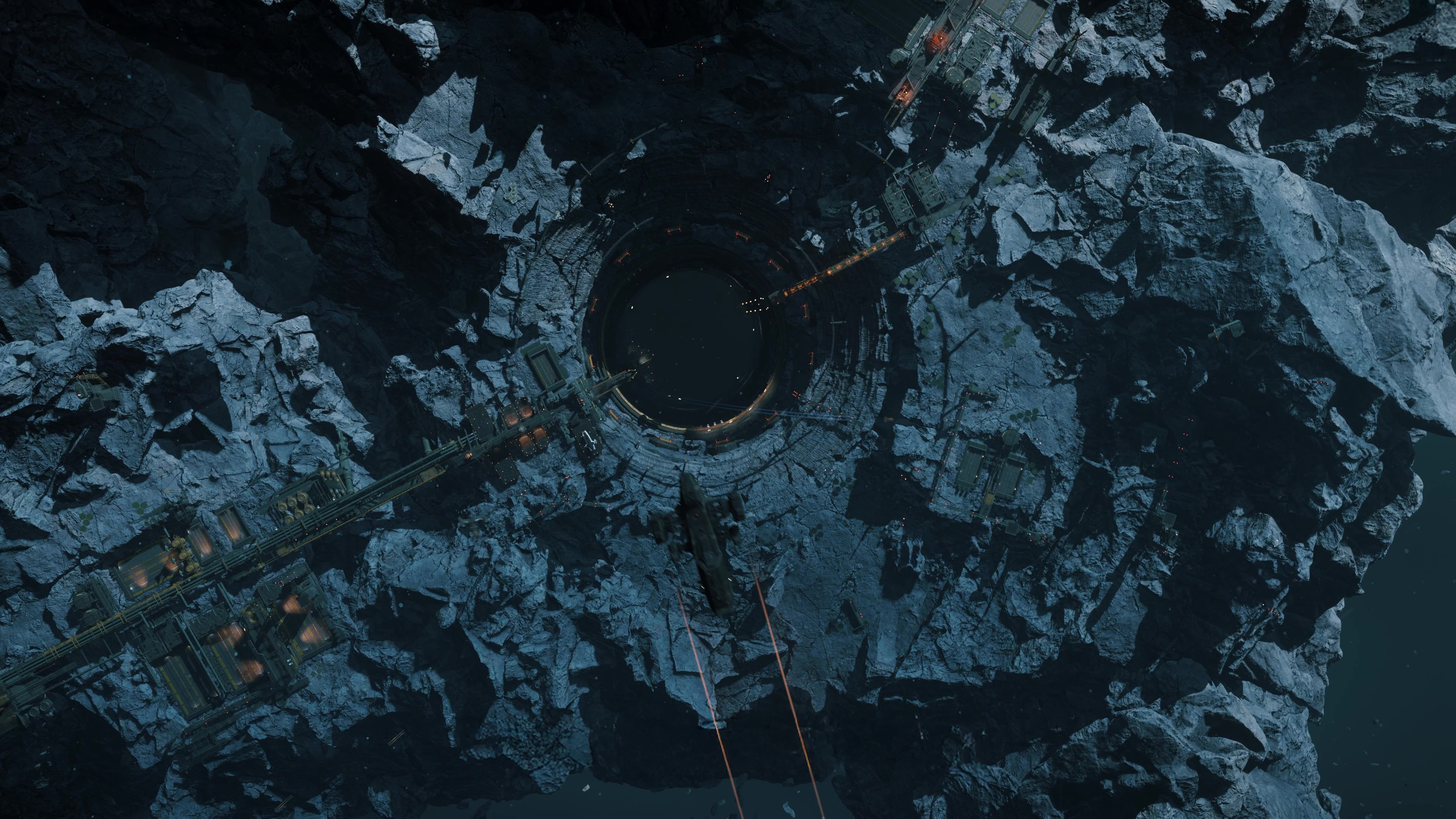
Beyond Centauri IV lies a dense asteroid belt, the only one in the system. Although the Centauri Belt contains enough mass to form a planet, for whatever reason it has never come together. The region is rich in standard heavy metals, and mining bases frequent the area to support Saisei’s heavy industry. The system’s outermost planet, Centauri V, is a massive Super Jupiter, a red and yellow gas giant several times the size of those normally encountered. The world’s atmosphere makes an excellent stop-over for gas collection, but it has not been otherwise developed.
Travel Warning
Visitors to Saisei should be aware that on-planet food and lodging are extremely expensive. Deep pockets are highly recommended.
Centauri System
Das Centauri-System besteht aus fünf Planeten und zwei bekannten Sprungbrettern, die einen großen A-artigen Hauptsequenzstern umgeben. Centauri war eines der ersten Systeme, die während der ersten Periode der interstellaren Expansion der Menschheit angesiedelt wurden. Sie wurde 2365 von einem speziellen Vermessungsschiff entdeckt, das sofort das enorme Kolonisierungspotenzial des dritten Planeten erkannte. Die Flagge wurde schnell auf Centauri III gepflanzt und das Land wurde sofort den Kolonialausrüstungsgruppen angeboten. Das Ergebnis war Saisei, eine der schönsten und am besten konstruierten Menschenwelten in der UEE. Im Entwicklungsprozess wurden die anderen Welten im System weitgehend ignoriert. In den folgenden Jahrhunderten wurden auf diesen anderen Welten verstreute Ressourcen entdeckt und es fand eine weitere Entwicklung statt.
Centauri I & II
Centauris innerste Welt ist ein winziger Protoplanet, der sich ganz nah am Stern befindet. Centauri I hat keine Atmosphäre und keine abbaubaren Ressourcen. Die Nahaufnahme von Centauris Stern aus dem Orbit ist jedoch überwältigend. Ein bekanntes Foto (allgemein als Postkarte erhältlich), das von dem ersten System-Vermessungsschiff aufgenommen wurde, zeigt den blau-weißen Stern mit einem Hervortreten, das den winzigen Planeten scheinbar erfasst.
Centauri II, genannt Yar, ist eine terrestrische felsige Welt, die von der UEE terrestrisch geformt wurde. Die Nähe zur Sonne sorgt für eine trockene Umgebung und wird weitgehend von ihrem wichtigsten Merkmal überdeckt: der Roten Wüste, einer ausgedehnten Ödnis, die vom Orbit aus sichtbar ist. Yar ist übersät mit Forschungsstationen, kommerziellen Aufenthaltsorten und verlassenen Siedlungen, von denen viele mit dem feinen roten Sand des Planeten beschichtet sind (und ein großer Teil davon wird von der Roten Wüste vollständig zurückgewonnen).
Warum gibt es überhaupt eine Entwicklung? Yar erfuhr vor etwa einem Jahrhundert eine unerwartete Landnahme, nachdem wertvolle kostbare Mineralien in einer Bergkette gefunden wurden. Diese Behauptungen liefen schnell aus und die menschliche Zivilisation auf dem Planeten befindet sich seitdem in einem deutlichen Rückgang. Die größte Landezone der Welt ist die Archibald Station, ein wissenschaftlicher Außenposten, der zu einer Kleinstadt wurde und dann mit abnehmendem Interesse an der Erde wieder zu einem Außenposten schrumpfte. Auf dem Planeten gibt es noch genügend Infrastruktur, um vorbeifahrende Raumfahrzeuge zu unterstützen, obwohl die kleine Bevölkerung nur das Wesentliche von Händlern benötigt.
Saisei
Saisei, der dritte Planet, ist der Grund, Centauri zu besuchen. Saisei, eine wunderschön terrassierte Welt, wird seit der ersten Erkundung für die menschliche Lebensweise geplant und kultiviert. Saisei ist eine der wenigen Welten im erforschten Weltraum, in denen der Gouverneursrat eine Bevölkerungsobergrenze festgelegt hat, um die Einwohnerzahl zu begrenzen und damit die Umwelt zu schützen.
Centauri wurde erstmals 2365 vermessen und die Angebote für die Terraform Centauri III kamen fast sofort auf den Markt. Die Gewinnergruppe, ADJUST Colonial, bestand größtenteils aus irdenen asiatischen Expatriates, die Designstiftungen und andere kulturelle Memes von ihrer Heimat in die Landniederlassung in Fujin City überführten. Seit dieser Zeit hat sich die eigene Kultur Saiseis in einzigartige Richtungen entwickelt, beeinflusst von der irdischen Tradition, aber zu etwas ganz Einzigartigem geworden. Neben natürlicher Schönheit, organischer Bauweise und einer begrenzten Bevölkerung ist Centauri auch als Hauptsitz von MISC bekannt, dem Schiffskonzern, der für einen Großteil des Schwerlastverkehrs der UEE verantwortlich ist.
Fujin City ist der Anlegeplatz für die meisten Besucher von Saisei. Sie verfügt über eine vollautomatische, volumenstarke Landeplattform, das Saisei Landing Consortium. Persönliche Hangars gibt es hier nur wenige, mit Immobilien überall auf der Welt, die auf hohe UEC-Werte setzen. Die Stadt bietet alle Annehmlichkeiten eines Hauses, vom Astro-Armada-Schiffhändler bis zum Advocacy Field Office. In der Innenstadt von Fujin befindet sich der MISC Corporate Showroom, in dem die Besucher die neuesten Freelancer-, Starfarer- und Bulk-Transportrümpfe sehen können. Im Herzen der Stadt liegt der Nessa-Park, ein wunderschön gepflegter Park, der als Oase für Stadtarbeiter konzipiert ist.
Die zentrale MISC-Fabrik befindet sich im äußeren Umfeld der Stadt, einem sorgfältig ausgearbeiteten automatisierten Setup, das auf vielen anderen Welten dupliziert wurde. Die Mehrheit der MISC Starfarers wird derzeit in dieser Anlage gebaut und dann außerhalb der Welt verschifft (obwohl die vollmodulare Fabrik bei Bedarf die Schiffsausgangsarten ändern kann). Auf Saisei findet eine Vielzahl anderer Schwerindustrie statt, die aber immer umweltschonend geplant ist. Das Ergebnis ist ein massiver Export von Schiffskomponenten, Luxusgütern und anderer Schwerindustrie, der in völligem Widerspruch zu Saiseis wohlverdientem Ruf als einer der saubersten Planeten der bekannten Galaxie zu stehen scheint. Die Botschaft an andere Menschenwelten ist klar: Planung zahlt sich aus!
Centauri IV, Centauri Gürtel Alpha & Centauri V
Centauri IV ist eine felsige Welt mit einem interessanten Merkmal: Es fehlt völlig ein geschmolzener Kern. Als kernlose Welt hat der Planet nie ein elektromagnetisches Feld entwickelt und konnte nie eine ernsthafte Atmosphäre aufrechterhalten (Astronomen glauben, dass er eine Zeit lang eine begrenzte Atmosphäre hatte, aber dieser Sonnenwind hat ihn schließlich vor etwa dreitausend Jahren eliminiert). Aufgrund seiner Nähe zum Asteroidengürtel des Systems wurde Centauri IV stark von asteroiden Schlägen getroffen. Die Welt gilt als potenzieller Kandidat für das Terraforming, wenn auch ein sehr schlechter: Der Bedarf an spezieller Technologie und Ressourcen zum Bau eines Kerns wäre ein unglaublich teures und technisch schwieriges Unterfangen.
Hinter Centauri IV liegt ein dichter Asteroidengürtel, der einzige im System. Obwohl der Centauri-Gürtel genug Masse enthält, um einen Planeten zu bilden, ist er aus irgendeinem Grund nie zusammen gekommen. Die Region ist reich an Standard-Schwermetallen, und Bergbaubasen kommen häufig vor, um die Saisei-Schwerindustrie zu unterstützen. Der äußerste Planet des Systems, Centauri V, ist ein massiver Superjupiter, ein rot-gelber Gasriese, der ein Mehrfaches der Größe der normalerweise vorkommenden Gase hat. Die Atmosphäre der Welt ist ein ausgezeichneter Zwischenstopp für die Gassammlung, aber sie ist nicht anders entwickelt.
Reisewarnung
Saisei-Besucher sollten sich bewusst sein, dass Essen und Unterkunft auf dem Planeten extrem teuer sind. Tiefe Taschen werden dringend empfohlen.
Centauri System
The Centauri System consists of five planets and two known jump points surrounding a large A-type main-sequence star. Centauri was one of the first systems settled during Humanity’s initial period of interstellar expansion. It was discovered in 2365 by a dedicated survey ship that immediately recognized the tremendous colonization potential of the third planet. The flag was quickly planted on Centauri III and land there was immediately offered at a premium to colonial outfitting groups. The result was Saisei, one of the most beautiful and well-constructed Human worlds in the UEE. In the development process, the other worlds in the system went largely ignored. In the ensuing centuries, scattered resources have been discovered on these other worlds and more scattershot development has taken place.
Centauri I & II
Centauri’s innermost world is a tiny protoplanet that orbits very close to the star. Centauri I has no atmosphere and no mineable resources. The close-up view of Centauri’s star from orbit, however, is overwhelming. A well-known photograph (commonly available as a postcard) taken by the initial system survey ship shows the blue-white star with a prominence reaching out to seemingly grab the tiny planet.
Centauri II, called Yar, is a terrestrial rocky world that has been terraformed by the UEE. Its proximity to the sun makes for an arid environment and is largely covered by its most prominent feature: the Red Desert, a sprawling wasteland that’s visible from orbit. Yar is dotted with research stations, commercial layover points and abandoned settlements, many of which are coated in the planet’s fine red sand (and a significant number of which are being reclaimed entirely by the Red Desert).
Why is there development in the first place? Yar underwent an unexpected land grab roughly a century ago after valuable precious minerals were located in a mountain range. These claims petered out quickly and Human civilization on the planet has been in a clear decline since. The world’s largest landing zone is Archibald Station, a scientific outpost that grew into a small town and then shrank back to an outpost as interest in the planet waned. Enough infrastructure remains on the planet to support passing spacecraft, although the small population needs only essentials from traders.
Saisei
Saisei, the third planet, is the reason to visit Centauri. A beautifully terraformed world, Saisei has been planned and cultivated for Human habitation since the initial survey. Saisei is one of the only worlds in explored space where the Governor’s Council has imposed a population cap to limit the number of inhabitants in an effort to preserve the environment.
Centauri was first surveyed in 2365 and bids to terraform Centauri III went on the market almost immediately. The winning group, ADJUST Colonial, consisted largely of Earthen Asiatican expatriates who carried over design foundations and other cultural memes from their homeland to the landfall location at Fujin City. Saisei’s own culture has veered in unique directions since this time, influenced by earthly tradition but having become something completely unique. In addition to natural beauty, organic construction and a limited population, Centauri is also known as the headquarters of MISC, the ship concern responsible for much of the UEE’s heavy vehicle traffic.
Fujin City is the landing point for most visitors to Saisei. It boasts a fully automated high-volume landing platform, Saisei Landing Consortium. Personal hangars here are few and far between, with real estate everywhere on the world going for high UEC values. The city features all the comforts of home, from an Astro-Armada ship dealer to an Advocacy Field office. Downtown Fujin is home to the MISC corporate showroom, where visitors can see the latest Freelancer, Starfarer and bulk transport hulls on display. At the heart of the city is Nessa Park, a beautifully cultivated park designed as an oasis for city workers.
The central MISC factory is located in the city’s outer environs, a carefully crafted automated setup that has been duplicated on many other worlds. The majority of MISC Starfarers are currently constructed in this facility and then shipped off-world (although the fully modular factory can change ship output types as needed). A great deal of other heavy industry takes place on Saisei, but always planned in an environmentally respectful manner. The result is a massive export of ship components, luxury items and other heavy industry that would seem to be completely at odds with Saisei’s well-deserved reputation as one of the cleanest planets in the known galaxy. The message to other Human worlds is clear: planning pays off!
Centauri IV, Centauri Belt Alpha & Centauri V
Centauri IV is a rocky world with one interesting feature: it completely lacks a molten core. As a coreless world, the planet never developed an electromagnetic field and was never able to retain a serious atmosphere (astronomers believe that it had a limited atmosphere for some time, but that solar wind ultimately eliminated it roughly three thousand years ago). Due to its proximity to the system’s asteroid belt, Centauri IV has been heavily impacted by asteroidal strikes. The world is considered a potential candidate for terraforming, albeit a very poor one: the need for special technology and resources to construct a core would be an incredibly expensive and technically difficult proposition.
Beyond Centauri IV lies a dense asteroid belt, the only one in the system. Although the Centauri Belt contains enough mass to form a planet, for whatever reason it has never come together. The region is rich in standard heavy metals, and mining bases frequent the area to support Saisei’s heavy industry. The system’s outermost planet, Centauri V, is a massive Super Jupiter, a red and yellow gas giant several times the size of those normally encountered. The world’s atmosphere makes an excellent stop-over for gas collection, but it has not been otherwise developed.
Travel Warning
Visitors to Saisei should be aware that on-planet food and lodging are extremely expensive. Deep pockets are highly recommended.
Centauri System
The Centauri System consists of five planets and two known jump points surrounding a large A-type main-sequence star. Centauri was one of the first systems settled during Humanity’s initial period of interstellar expansion. It was discovered in 2365 by a dedicated survey ship that immediately recognized the tremendous colonization potential of the third planet. The flag was quickly planted on Centauri III and land there was immediately offered at a premium to colonial outfitting groups. The result was Saisei, one of the most beautiful and well-constructed Human worlds in the UEE. In the development process, the other worlds in the system went largely ignored. In the ensuing centuries, scattered resources have been discovered on these other worlds and more scattershot development has taken place.
Centauri I & II
Centauri’s innermost world is a tiny protoplanet that orbits very close to the star. Centauri I has no atmosphere and no mineable resources. The close-up view of Centauri’s star from orbit, however, is overwhelming. A well-known photograph (commonly available as a postcard) taken by the initial system survey ship shows the blue-white star with a prominence reaching out to seemingly grab the tiny planet.
Centauri II, called Yar, is a terrestrial rocky world that has been terraformed by the UEE. Its proximity to the sun makes for an arid environment and is largely covered by its most prominent feature: the Red Desert, a sprawling wasteland that’s visible from orbit. Yar is dotted with research stations, commercial layover points and abandoned settlements, many of which are coated in the planet’s fine red sand (and a significant number of which are being reclaimed entirely by the Red Desert).
Why is there development in the first place? Yar underwent an unexpected land grab roughly a century ago after valuable precious minerals were located in a mountain range. These claims petered out quickly and Human civilization on the planet has been in a clear decline since. The world’s largest landing zone is Archibald Station, a scientific outpost that grew into a small town and then shrank back to an outpost as interest in the planet waned. Enough infrastructure remains on the planet to support passing spacecraft, although the small population needs only essentials from traders.
Saisei
Saisei, the third planet, is the reason to visit Centauri. A beautifully terraformed world, Saisei has been planned and cultivated for Human habitation since the initial survey. Saisei is one of the only worlds in explored space where the Governor’s Council has imposed a population cap to limit the number of inhabitants in an effort to preserve the environment.
Centauri was first surveyed in 2365 and bids to terraform Centauri III went on the market almost immediately. The winning group, ADJUST Colonial, consisted largely of Earthen Asiatican expatriates who carried over design foundations and other cultural memes from their homeland to the landfall location at Fujin City. Saisei’s own culture has veered in unique directions since this time, influenced by earthly tradition but having become something completely unique. In addition to natural beauty, organic construction and a limited population, Centauri is also known as the headquarters of MISC, the ship concern responsible for much of the UEE’s heavy vehicle traffic.
Fujin City is the landing point for most visitors to Saisei. It boasts a fully automated high-volume landing platform, Saisei Landing Consortium. Personal hangars here are few and far between, with real estate everywhere on the world going for high UEC values. The city features all the comforts of home, from an Astro-Armada ship dealer to an Advocacy Field office. Downtown Fujin is home to the MISC corporate showroom, where visitors can see the latest Freelancer, Starfarer and bulk transport hulls on display. At the heart of the city is Nessa Park, a beautifully cultivated park designed as an oasis for city workers.
The central MISC factory is located in the city’s outer environs, a carefully crafted automated setup that has been duplicated on many other worlds. The majority of MISC Starfarers are currently constructed in this facility and then shipped off-world (although the fully modular factory can change ship output types as needed). A great deal of other heavy industry takes place on Saisei, but always planned in an environmentally respectful manner. The result is a massive export of ship components, luxury items and other heavy industry that would seem to be completely at odds with Saisei’s well-deserved reputation as one of the cleanest planets in the known galaxy. The message to other Human worlds is clear: planning pays off!
Centauri IV, Centauri Belt Alpha & Centauri V
Centauri IV is a rocky world with one interesting feature: it completely lacks a molten core. As a coreless world, the planet never developed an electromagnetic field and was never able to retain a serious atmosphere (astronomers believe that it had a limited atmosphere for some time, but that solar wind ultimately eliminated it roughly three thousand years ago). Due to its proximity to the system’s asteroid belt, Centauri IV has been heavily impacted by asteroidal strikes. The world is considered a potential candidate for terraforming, albeit a very poor one: the need for special technology and resources to construct a core would be an incredibly expensive and technically difficult proposition.
Beyond Centauri IV lies a dense asteroid belt, the only one in the system. Although the Centauri Belt contains enough mass to form a planet, for whatever reason it has never come together. The region is rich in standard heavy metals, and mining bases frequent the area to support Saisei’s heavy industry. The system’s outermost planet, Centauri V, is a massive Super Jupiter, a red and yellow gas giant several times the size of those normally encountered. The world’s atmosphere makes an excellent stop-over for gas collection, but it has not been otherwise developed.
Travel Warning
Visitors to Saisei should be aware that on-planet food and lodging are extremely expensive. Deep pockets are highly recommended.
Links
No links available.

Metadata
- CIG ID
- 13423
- Channel
- Spectrum Dispatch
- Category
- Undefined
- Series
- Galactic Guide
- Comments
- 146
- Published
- 12 years ago (2013-12-10T00:00:00+00:00)