Galactic Guide: Oso System
Spectrum Dispatch Undefined Galactic GuideContent
Discovered in 2861 by amateur explorer Errol Navis, the system that he named after his daughter featured six distinctive worlds orbiting a white Type-F main sequence star. Oso was quickly set upon by survey teams and corporate groups seeking to lay claim to the latest worlds potentially ripe for terraforming. However within the year, interests changed dramatically. The discovery of higher life forms on Oso II forced the government to issue it protectorate status under the Fair Chance Act. The declaration made the system off limits for economic development, but some of the less-than-scrupulous surveying corporations leaked their planetary assessment findings. They attempted to make a case to the UEE Senate that Oso II could potentially be terraformed for Human habitation without destroying all of the indigenous life. The question of ‘uplifting’ began to circle the Empire. Ultimately, a slim majority in the Senate chose to adhere to the tenets of the Fair Chance Act. They established a permanent garrison near the system’s initial jump point to let the species develop without outside interference. Despite this, travel to the system to engage in black market trade opportunities remains significant.
Oso I
The system’s first planet is a tidally locked world that features one of the most impressive ‘day and night’ differences in the explored galaxy. The side locked towards the sun is an endless sea of lava while the dark side is a stark, black iron-rich landscape too cold to ever sustain Human life (though a landing with proper equipment is possible). Extensive mineral surveys of Oso I’s night side were conducted before the system was placed under the Fair Chance Act, but little of value was ultimately discovered. Today, the planet is best known for its impressive visual display (viewed remotely) rather than for anything worth extraction.
Oso II
A lush biosphere with a variety of distinct regions and climates, Oso II boasts an increased gravity much higher than Earth’s. The planet is mostly known as the home to the most developed primitive species ever encountered by the UEE. Known as Osoians, this multi-limbed race actively communicates with one another using patterned flashes of color generated by head-mounted chameleon cells. Osoian communication studies are ongoing today (within the limitations of the Fair Chance Act).
Beyond the Osoians, the planet is also home to a great deal of lesser species, most of which have evolved to be entirely unlike anything discovered elsewhere to date. Though direct study is a violation of the Fair Chance Act, some scientists are able to receive permission from the UEE to establish off-world research platforms to study the species from a distance. These platforms are carefully supervised and are allowed to operate only for short periods of time.
Middle Planets
The third planet in the Oso system is a gas giant. Oso III began life as a rogue Jupiter that fell into rotation around the system’s star. The planet is distinguished by slight green and white color variations generated by its silicate clouds. From a scientific standpoint, it’s frequently cited as evidence to support the theory that gas giants can act as ‘comet shields’ which allow higher forms of life to evolve. Unmanned scientific monitoring stations are positioned at the planet’s Lagrange points to track and catalog meteor impacts.
Oso IV is an uninhabited coreless planet that boasts a surface rich in gems and mineral resources that were likely exposed due to some sort of planetary catastrophe. These resources have become an issue for the Army who has had ongoing issues with rogue mining operations dating back to the system’s initial discovery. Oso IV has no atmosphere and there is an ongoing (but not especially vehement) argument in the scientific community as to whether or not an atmosphere ever existed.
Station Chimera
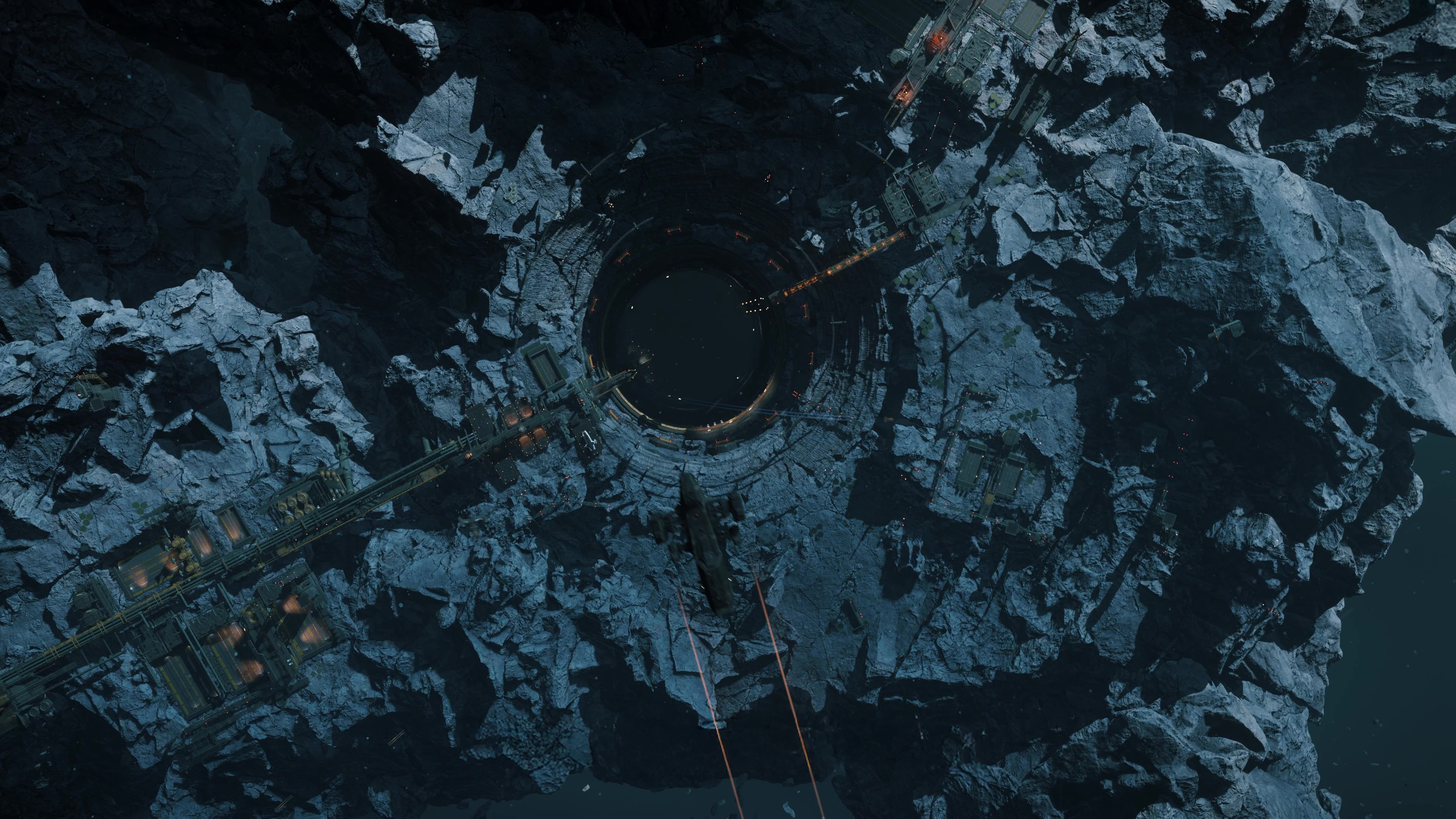
Observation Base Chimera is home to Oso’s rotating military contingent charged with protecting the system from outside interference. While its intention is noble, the base’s effectiveness has been under fire recently as allegations of negligence caused a Senate inquiry into the daily operations of the base. This review revealed consistent average and below average performance reports for nearly all Army personnel assigned to the station, as well as evidence of corruption, bribery and even extortion. Despite a regular crew rotation, Army station reports have corroborated the Senate’s findings and have made public Chimera’s internally well-known reputation of hosting burnouts and failures. While the situation says little for the Army’s reputation, the Senate report painted a myriad of opportunities for any entrepreneur willing to work outside the law. At any time desired, it was possible to pay off the local crews to avoid interception, visit Oso II and escape the system unharmed (and unscanned).
The effects of this inquiry are still being felt today. The Imperator cited the findings in his decree to High Command to immediately restructure Chimera’s operating policy and implement consistent checks from civilian auditors to make sure it was operating ethically.
Note that the edict against travel to Oso is actually only enforced against those approaching the inner planets. A high volume of legitimate transports and other ships transit through the system on unrelated routes, to the point that a Covalex shipping hub was granted a special lease and has been established in the outer reaches.
Outer Planets
Orbiting far away from the warmth of the sun, ice giant Oso V is a churning mass of ammonia vapor while Oso VI is a small rocky dwarf planet. The two isolated worlds see more traffic than many of the inner worlds thanks to their distance from Oso III making construction of various utility stations a much safer prospect.
Heard in the Wind
“To look into the eyes of an Osoian is to look into our own past and see the potential to evolve and grow that lies within us all. For every species we encounter who we shadow with our advancements, you must ask, is there yet still a species out there by whom we ourselves will be overshadowed?”
– Professor JT Collins, A Step Onto the Precipice “An Osoian walks into a bar and orders a drink. The bartender says I’m sorry, but I’m not allowed to serve you because your culture hasn’t discovered alcohol yet. The Osoian thinks for a second and then says, if you leave a bottle on the counter, I’m pretty sure I’ll be able to discover it myself.”
– Jimmy Snart, Laugh Till It Hurts
Das System, das er nach seiner Tochter benannte, wurde 2861 vom Amateurforscher Errol Navis entdeckt und umfasste sechs charakteristische Welten, die einen weißen Typ-F-Hauptreihenstern umkreisen. Oso wurde schnell von Umfrageteams und Unternehmensgruppen eingesetzt, die versuchen, die neuesten Welten, die möglicherweise reif für Terraforming sind, in Anspruch zu nehmen. Doch innerhalb des Jahres änderten sich die Interessen dramatisch. Die Entdeckung höherer Lebensformen auf Oso II zwang die Regierung, ihren Protektoratsstatus nach dem Fair Chance Act zu verleihen. Die Erklärung machte das System für die wirtschaftliche Entwicklung tabu, aber einige der weniger skrupellosen Vermessungsunternehmen ließen ihre Ergebnisse der planetarischen Bewertung durchsickern. Sie versuchten, beim UEE-Senat zu argumentieren, dass Oso II möglicherweise für die menschliche Behausung terrassiert werden könnte, ohne die gesamte einheimische Bevölkerung zu zerstören. Die Frage nach dem "Erheben" begann, das Reich zu umkreisen. Letztendlich entschied sich eine knappe Mehrheit im Senat für die Einhaltung der Grundsätze des Fair Chance Act. Sie errichteten eine permanente Garnison in der Nähe des Anfangssprungpunktes des Systems, um die Spezies ohne äußere Einflüsse entwickeln zu lassen. Dennoch sind die Reisen zum System, um sich auf dem Schwarzmarkt zu engagieren, nach wie vor von Bedeutung.
Oso I
Der erste Planet des Systems ist eine tidally locked world, die einen der beeindruckendsten "Tag und Nacht"-Unterschiede in der erforschten Galaxie aufweist. Die Seite, die der Sonne zugewandt ist, ist ein endloses Lavameer, während die dunkle Seite eine karge, schwarze, eisenreiche Landschaft ist, die zu kalt ist, um jemals menschliches Leben zu erhalten (obwohl eine Landung mit entsprechender Ausrüstung möglich ist). Umfangreiche Mineralienuntersuchungen an der Nachtseite von Oso I wurden durchgeführt, bevor das System unter den Fair Chance Act gestellt wurde, aber letztlich wurde wenig Wert entdeckt. Heute ist der Planet vor allem für seine beeindruckende visuelle Darstellung (aus der Ferne betrachtet) bekannt und nicht für alles, was sich lohnt.
Oso II
Als üppige Biosphäre mit einer Vielzahl von verschiedenen Regionen und Klimazonen weist Oso II eine höhere Schwerkraft auf als die Erde. Der Planet ist vor allem als Heimat der am weitesten entwickelten primitiven Arten bekannt, die jemals von der UEE angetroffen wurden. Diese mehrgliedrige Rasse, die als Osoians bekannt ist, kommuniziert aktiv miteinander durch gemusterte Farbblitze, die von kopfmontierten Chamäleonzellen erzeugt werden. Osoianische Kommunikationsstudien laufen heute (im Rahmen des Fair Chance Act).
Außerhalb der Osoianer beherbergt der Planet auch eine Vielzahl kleinerer Arten, von denen sich die meisten zu etwas ganz anderem entwickelt haben, als das, was bisher anderswo entdeckt wurde. Obwohl eine direkte Studie einen Verstoß gegen den Fair Chance Act darstellt, können einige Wissenschaftler von der UEE die Erlaubnis erhalten, außerirdische Forschungsplattformen einzurichten, um die Arten aus der Ferne zu untersuchen. Diese Plattformen werden sorgfältig überwacht und dürfen nur für kurze Zeit betrieben werden.
Mittlere Planeten
Der dritte Planet im Oso-System ist ein Gasriese. Oso III. begann sein Leben als Schurke Jupiter, der um den Stern des Systems herum in Rotation fiel. Der Planet zeichnet sich durch leichte grüne und weiße Farbschwankungen aus, die durch seine Silikatwolken verursacht werden. Aus wissenschaftlicher Sicht wird es häufig als Beweis für die Theorie angeführt, dass Gasriesen als "Kometenschilde" fungieren können, die es ermöglichen, höhere Lebensformen zu entwickeln. Unbemannte wissenschaftliche Überwachungsstationen sind an den Lagrange-Punkten des Planeten positioniert, um Meteoriteneinschläge zu verfolgen und zu katalogisieren.
Oso IV ist ein unbewohnter, kernloser Planet mit einer Oberfläche, die reich an Edelsteinen und Bodenschätzen ist, die wahrscheinlich durch eine Art Planetenkatastrophe freigelegt wurden. Diese Ressourcen sind zu einem Problem für die Armee geworden, die laufende Probleme mit Mineneinsätzen hatte, die auf die erste Entdeckung des Systems zurückgehen. Oso IV hat keine Atmosphäre und es gibt ein andauerndes (aber nicht besonders heftiges) Argument in der wissenschaftlichen Gemeinschaft, ob eine Atmosphäre jemals existiert hat oder nicht.
Station Chimäre
Die Chimäre der Beobachtungsbasis ist die Heimat von Oso's rotierendem Militärkontingent, das das System vor äußeren Einflüssen schützen soll. Während seine Absicht edel ist, wurde die Wirksamkeit der Basis vor kurzem unter Beschuss genommen, da Vorwürfe der Fahrlässigkeit eine Senatsuntersuchung über den täglichen Betrieb der Basis verursachten. Diese Überprüfung ergab konsistente durchschnittliche und unterdurchschnittliche Leistungsberichte für fast alle der Station zugewiesenen Armeepersonal sowie Beweise für Korruption, Bestechung und sogar Erpressung. Trotz einer regelmäßigen Besatzungsrotation haben die Berichte der Armeestationen die Ergebnisse des Senats bestätigt und den intern bekannten Ruf der Chimäre, Ausbrenner und Ausfälle zu beherbergen, veröffentlicht. Während die Situation wenig für den Ruf der Armee sagt, malte der Senatsbericht eine Vielzahl von Möglichkeiten für jeden Unternehmer, der bereit ist, außerhalb des Gesetzes zu arbeiten. Zu jeder gewünschten Zeit war es möglich, die lokalen Besatzungen abzuzahlen, um ein Abfangen zu vermeiden, Oso II zu besuchen und dem System unbeschadet (und ungescannt) zu entkommen.
Die Auswirkungen dieser Untersuchung sind auch heute noch spürbar. Der Imperator zitierte die Ergebnisse in seinem Erlass an das Oberkommando, die Betriebspolitik von Chimera unverzüglich umzustrukturieren und konsequente Kontrollen durch zivile Auditoren durchzuführen, um sicherzustellen, dass es ethisch einwandfrei funktioniert.
Beachten Sie, dass das Edikt gegen die Reise nach Oso eigentlich nur gegen diejenigen durchgesetzt wird, die sich den inneren Planeten nähern. Ein hohes Volumen an legitimen Transporten und anderen Schiffen, die das System auf nicht miteinander verbundenen Routen durchlaufen, so dass ein Covalex-Schifffahrtsknotenpunkt einen Sondermietvertrag erhalten hat und im Außenbereich eingerichtet wurde.
Äußere Planeten
Der Eisriese Oso V, weit weg von der Wärme der Sonne, ist eine schäumende Masse aus Ammoniakdampf, während Oso VI ein kleiner felsiger Zwergplanet ist. Die beiden isolierten Welten sehen aufgrund ihrer Entfernung von Oso III mehr Verkehr als viele der inneren Welten, was den Bau verschiedener Versorgungsstationen zu einer viel sichereren Perspektive macht.
Im Wind gehört
"In die Augen eines Osoianers zu schauen bedeutet, in unsere eigene Vergangenheit zu schauen und das Potenzial zu sehen, sich zu entwickeln und zu wachsen, das in uns allen liegt. Für jede Spezies, der wir begegnen, die wir mit unseren Fortschritten beschatten, müssen Sie sich fragen: Gibt es noch eine Spezies da draußen, von der wir selbst im Schatten stehen werden?"
- Professor JT Collins, A Step Onto the Precipice "Ein Osoian geht in eine Bar und bestellt einen Drink. Der Barkeeper sagt, dass es mir leid tut, aber ich darf dich nicht bedienen, weil deine Kultur noch keinen Alkohol entdeckt hat. Der Osoianer denkt eine Sekunde nach und sagt dann: Wenn du eine Flasche auf dem Tresen liegen lässt, bin ich mir ziemlich sicher, dass ich sie selbst entdecken kann."
- Jimmy Snart, Lachen bis es wehtut.
Discovered in 2861 by amateur explorer Errol Navis, the system that he named after his daughter featured six distinctive worlds orbiting a white Type-F main sequence star. Oso was quickly set upon by survey teams and corporate groups seeking to lay claim to the latest worlds potentially ripe for terraforming. However within the year, interests changed dramatically. The discovery of higher life forms on Oso II forced the government to issue it protectorate status under the Fair Chance Act. The declaration made the system off limits for economic development, but some of the less-than-scrupulous surveying corporations leaked their planetary assessment findings. They attempted to make a case to the UEE Senate that Oso II could potentially be terraformed for Human habitation without destroying all of the indigenous life. The question of ‘uplifting’ began to circle the Empire. Ultimately, a slim majority in the Senate chose to adhere to the tenets of the Fair Chance Act. They established a permanent garrison near the system’s initial jump point to let the species develop without outside interference. Despite this, travel to the system to engage in black market trade opportunities remains significant.
Oso I
The system’s first planet is a tidally locked world that features one of the most impressive ‘day and night’ differences in the explored galaxy. The side locked towards the sun is an endless sea of lava while the dark side is a stark, black iron-rich landscape too cold to ever sustain Human life (though a landing with proper equipment is possible). Extensive mineral surveys of Oso I’s night side were conducted before the system was placed under the Fair Chance Act, but little of value was ultimately discovered. Today, the planet is best known for its impressive visual display (viewed remotely) rather than for anything worth extraction.
Oso II
A lush biosphere with a variety of distinct regions and climates, Oso II boasts an increased gravity much higher than Earth’s. The planet is mostly known as the home to the most developed primitive species ever encountered by the UEE. Known as Osoians, this multi-limbed race actively communicates with one another using patterned flashes of color generated by head-mounted chameleon cells. Osoian communication studies are ongoing today (within the limitations of the Fair Chance Act).
Beyond the Osoians, the planet is also home to a great deal of lesser species, most of which have evolved to be entirely unlike anything discovered elsewhere to date. Though direct study is a violation of the Fair Chance Act, some scientists are able to receive permission from the UEE to establish off-world research platforms to study the species from a distance. These platforms are carefully supervised and are allowed to operate only for short periods of time.
Middle Planets
The third planet in the Oso system is a gas giant. Oso III began life as a rogue Jupiter that fell into rotation around the system’s star. The planet is distinguished by slight green and white color variations generated by its silicate clouds. From a scientific standpoint, it’s frequently cited as evidence to support the theory that gas giants can act as ‘comet shields’ which allow higher forms of life to evolve. Unmanned scientific monitoring stations are positioned at the planet’s Lagrange points to track and catalog meteor impacts.
Oso IV is an uninhabited coreless planet that boasts a surface rich in gems and mineral resources that were likely exposed due to some sort of planetary catastrophe. These resources have become an issue for the Army who has had ongoing issues with rogue mining operations dating back to the system’s initial discovery. Oso IV has no atmosphere and there is an ongoing (but not especially vehement) argument in the scientific community as to whether or not an atmosphere ever existed.
Station Chimera
Observation Base Chimera is home to Oso’s rotating military contingent charged with protecting the system from outside interference. While its intention is noble, the base’s effectiveness has been under fire recently as allegations of negligence caused a Senate inquiry into the daily operations of the base. This review revealed consistent average and below average performance reports for nearly all Army personnel assigned to the station, as well as evidence of corruption, bribery and even extortion. Despite a regular crew rotation, Army station reports have corroborated the Senate’s findings and have made public Chimera’s internally well-known reputation of hosting burnouts and failures. While the situation says little for the Army’s reputation, the Senate report painted a myriad of opportunities for any entrepreneur willing to work outside the law. At any time desired, it was possible to pay off the local crews to avoid interception, visit Oso II and escape the system unharmed (and unscanned).
The effects of this inquiry are still being felt today. The Imperator cited the findings in his decree to High Command to immediately restructure Chimera’s operating policy and implement consistent checks from civilian auditors to make sure it was operating ethically.
Note that the edict against travel to Oso is actually only enforced against those approaching the inner planets. A high volume of legitimate transports and other ships transit through the system on unrelated routes, to the point that a Covalex shipping hub was granted a special lease and has been established in the outer reaches.
Outer Planets
Orbiting far away from the warmth of the sun, ice giant Oso V is a churning mass of ammonia vapor while Oso VI is a small rocky dwarf planet. The two isolated worlds see more traffic than many of the inner worlds thanks to their distance from Oso III making construction of various utility stations a much safer prospect.
Heard in the Wind
“To look into the eyes of an Osoian is to look into our own past and see the potential to evolve and grow that lies within us all. For every species we encounter who we shadow with our advancements, you must ask, is there yet still a species out there by whom we ourselves will be overshadowed?”
– Professor JT Collins, A Step Onto the Precipice “An Osoian walks into a bar and orders a drink. The bartender says I’m sorry, but I’m not allowed to serve you because your culture hasn’t discovered alcohol yet. The Osoian thinks for a second and then says, if you leave a bottle on the counter, I’m pretty sure I’ll be able to discover it myself.”
– Jimmy Snart, Laugh Till It Hurts
Discovered in 2861 by amateur explorer Errol Navis, the system that he named after his daughter featured six distinctive worlds orbiting a white Type-F main sequence star. Oso was quickly set upon by survey teams and corporate groups seeking to lay claim to the latest worlds potentially ripe for terraforming. However within the year, interests changed dramatically. The discovery of higher life forms on Oso II forced the government to issue it protectorate status under the Fair Chance Act. The declaration made the system off limits for economic development, but some of the less-than-scrupulous surveying corporations leaked their planetary assessment findings. They attempted to make a case to the UEE Senate that Oso II could potentially be terraformed for Human habitation without destroying all of the indigenous life. The question of ‘uplifting’ began to circle the Empire. Ultimately, a slim majority in the Senate chose to adhere to the tenets of the Fair Chance Act. They established a permanent garrison near the system’s initial jump point to let the species develop without outside interference. Despite this, travel to the system to engage in black market trade opportunities remains significant.
Oso I
The system’s first planet is a tidally locked world that features one of the most impressive ‘day and night’ differences in the explored galaxy. The side locked towards the sun is an endless sea of lava while the dark side is a stark, black iron-rich landscape too cold to ever sustain Human life (though a landing with proper equipment is possible). Extensive mineral surveys of Oso I’s night side were conducted before the system was placed under the Fair Chance Act, but little of value was ultimately discovered. Today, the planet is best known for its impressive visual display (viewed remotely) rather than for anything worth extraction.
Oso II
A lush biosphere with a variety of distinct regions and climates, Oso II boasts an increased gravity much higher than Earth’s. The planet is mostly known as the home to the most developed primitive species ever encountered by the UEE. Known as Osoians, this multi-limbed race actively communicates with one another using patterned flashes of color generated by head-mounted chameleon cells. Osoian communication studies are ongoing today (within the limitations of the Fair Chance Act).
Beyond the Osoians, the planet is also home to a great deal of lesser species, most of which have evolved to be entirely unlike anything discovered elsewhere to date. Though direct study is a violation of the Fair Chance Act, some scientists are able to receive permission from the UEE to establish off-world research platforms to study the species from a distance. These platforms are carefully supervised and are allowed to operate only for short periods of time.
Middle Planets
The third planet in the Oso system is a gas giant. Oso III began life as a rogue Jupiter that fell into rotation around the system’s star. The planet is distinguished by slight green and white color variations generated by its silicate clouds. From a scientific standpoint, it’s frequently cited as evidence to support the theory that gas giants can act as ‘comet shields’ which allow higher forms of life to evolve. Unmanned scientific monitoring stations are positioned at the planet’s Lagrange points to track and catalog meteor impacts.
Oso IV is an uninhabited coreless planet that boasts a surface rich in gems and mineral resources that were likely exposed due to some sort of planetary catastrophe. These resources have become an issue for the Army who has had ongoing issues with rogue mining operations dating back to the system’s initial discovery. Oso IV has no atmosphere and there is an ongoing (but not especially vehement) argument in the scientific community as to whether or not an atmosphere ever existed.
Station Chimera
Observation Base Chimera is home to Oso’s rotating military contingent charged with protecting the system from outside interference. While its intention is noble, the base’s effectiveness has been under fire recently as allegations of negligence caused a Senate inquiry into the daily operations of the base. This review revealed consistent average and below average performance reports for nearly all Army personnel assigned to the station, as well as evidence of corruption, bribery and even extortion. Despite a regular crew rotation, Army station reports have corroborated the Senate’s findings and have made public Chimera’s internally well-known reputation of hosting burnouts and failures. While the situation says little for the Army’s reputation, the Senate report painted a myriad of opportunities for any entrepreneur willing to work outside the law. At any time desired, it was possible to pay off the local crews to avoid interception, visit Oso II and escape the system unharmed (and unscanned).
The effects of this inquiry are still being felt today. The Imperator cited the findings in his decree to High Command to immediately restructure Chimera’s operating policy and implement consistent checks from civilian auditors to make sure it was operating ethically.
Note that the edict against travel to Oso is actually only enforced against those approaching the inner planets. A high volume of legitimate transports and other ships transit through the system on unrelated routes, to the point that a Covalex shipping hub was granted a special lease and has been established in the outer reaches.
Outer Planets
Orbiting far away from the warmth of the sun, ice giant Oso V is a churning mass of ammonia vapor while Oso VI is a small rocky dwarf planet. The two isolated worlds see more traffic than many of the inner worlds thanks to their distance from Oso III making construction of various utility stations a much safer prospect.
Heard in the Wind
“To look into the eyes of an Osoian is to look into our own past and see the potential to evolve and grow that lies within us all. For every species we encounter who we shadow with our advancements, you must ask, is there yet still a species out there by whom we ourselves will be overshadowed?”
– Professor JT Collins, A Step Onto the Precipice “An Osoian walks into a bar and orders a drink. The bartender says I’m sorry, but I’m not allowed to serve you because your culture hasn’t discovered alcohol yet. The Osoian thinks for a second and then says, if you leave a bottle on the counter, I’m pretty sure I’ll be able to discover it myself.”
– Jimmy Snart, Laugh Till It Hurts
Links
No links available.

Metadata
- CIG ID
- 14824
- Channel
- Spectrum Dispatch
- Category
- Undefined
- Series
- Galactic Guide
- Comments
- 119
- Published
- 11 years ago (2015-07-08T00:00:00+00:00)