Squadron 42 Monthly Report: March 2019
Transmission Undefined Monthly ReportsContent
This is a cross-post of the report that was recently sent out via the monthly Squadron 42 newsletter. We’re publishing this a second time as a Comm-Link to make it easier for the community to reference back to. Attention Recruits,
What you are about to read is the latest information on the continuing development of Squadron 42 (SCI des: SQ42).
From alien concepts to player control over cutscenes, momentum remains strong. Naturally, there’s a litany of restricted intelligence awaiting review for potential declassification, so keep an eye on these updates for access when release is permitted.
The information contained in this communication is extremely sensitive and it is of paramount importance that it does not fall into the wrong hands. Purge all records after reading.
UEE Naval High Command
AI (Character)
The SQ42 Character AI Team kicks us off this month. They spent the month making general improvements, firstly to combat behaviors enabling the team to assign different tactics to different characters more easily. This work fixed a few bugs with vision perception and cover selection too. Secondly, NPC locomotion saw the integration of the collision avoidance system into smooth locomotion, which now takes into consideration the edge of walkable navigation areas. A handful of dynamic cinematic scenes were also worked on and the first pass of a new solution for blending gameplay animations into cinematic scenes was finished.
AI (Ships)
Ship AI implemented new pilot skill levels to vary the agility of enemy ships and determine how they balance self-preservation and aggression. Improvements were also made to how non-player traffic behaves around landing zones.
AI (Social)
The Social AI Team finished the first pass of ‘scooching’, which made its monthly report debut last month. If you missed it, scooching enables a character to fluidly move from one action to another within a group of useables. Design supported the setup of Master at Arms Duncan Chakma by providing necessary tech pieces where needed. Optimization started on usables too, including the caching of usable entries and TPS query time-slicing.
Animation
March saw the Animation Team focusing on two important features: the finalized system for jumping and completing the first iteration of the female playable character. They also teamed up with AI to start connecting character animations to specific usable dimensions for more realism when picking up and inspecting items. Although currently in development for SQ42, these developments will eventually make their way to the Persistent Universe.
Finally for Animation, they worked on the combat AI system to give enemies several new weapon options to choose from when encountering the player and hostile NPCs.
Art
The Art Team worked on two important locations throughout March: one near a blasted and dying planet and the other close to the Coil. In the coming weeks, more of the team will move onto these locations, with the aim to get them ‘content complete’ for a handful of chapters by the end of the quarter.
Deep space has been getting an art overhaul too, with three key locations (called ‘mini-systems’ internally) now in place and ready for polish. These systems form three separate parts of the overall Squadron 42 map and each has its own unique flavor.
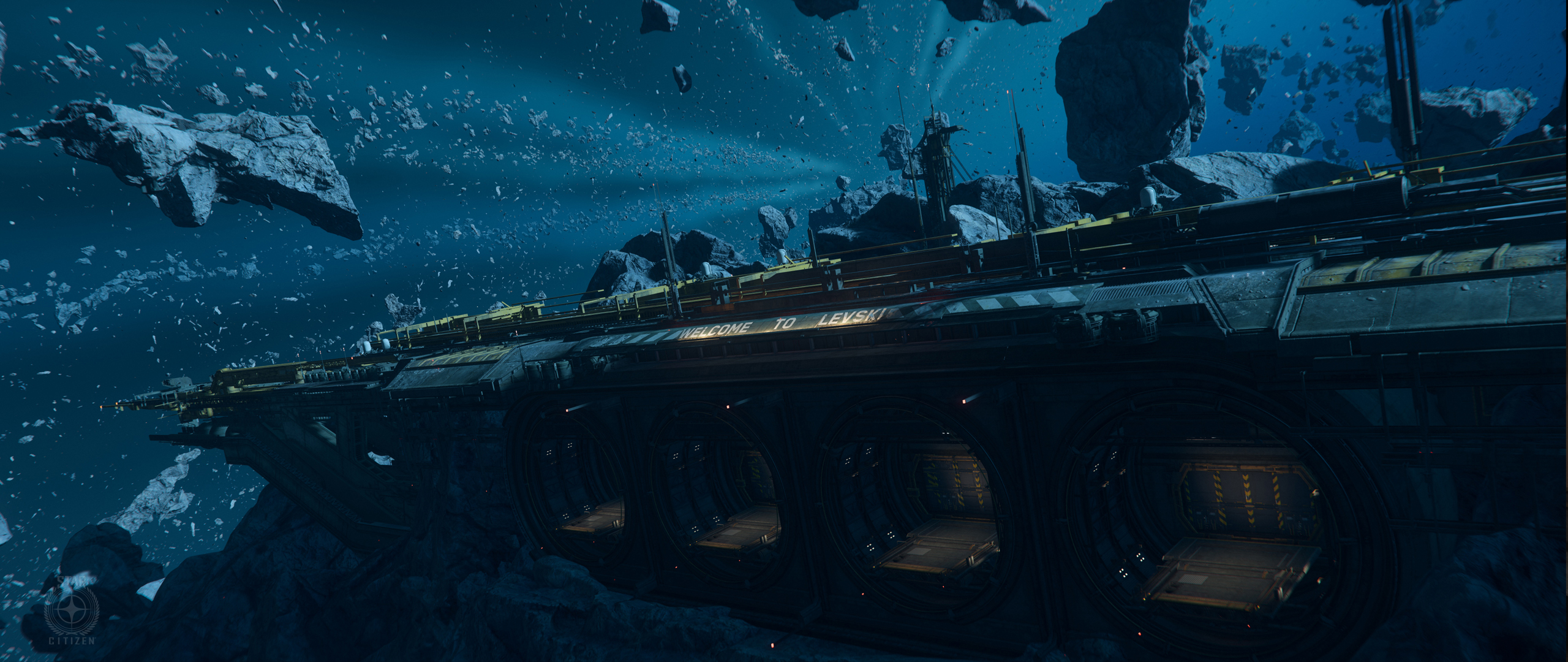
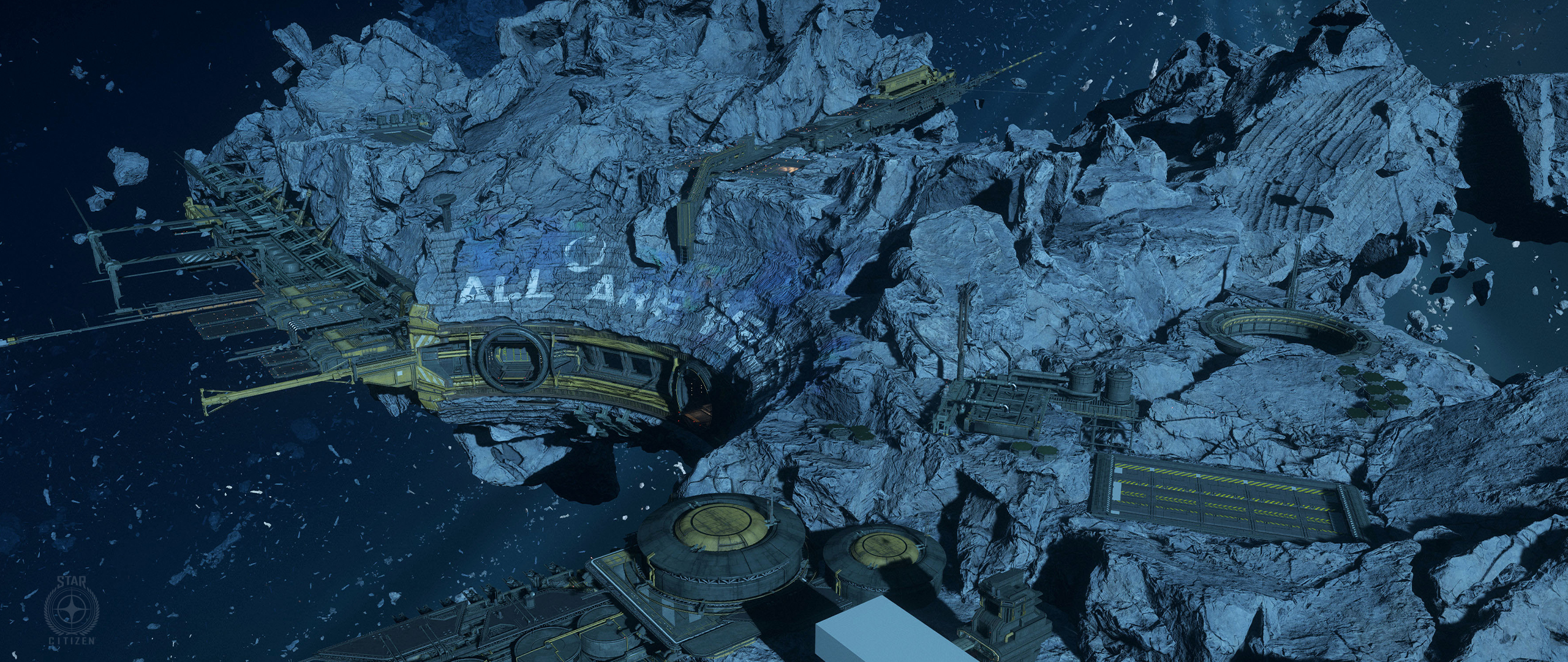
A capital ship is being brought up to scratch by the same team who worked on the Idris. They’re also designing a social hub, a foundry for a major space station, a visual target for an asteroid base, and a number of other tasks that can’t be divulged just yet. All of this is alongside working closely with the design, UI, and cinematic teams to ensure they each have what they need to move forward.
Art (Characters)
Last month, the Character Art Team further developed concepts for SQ42’s alien species, including finalizing textures for the Vanduul. Modeling work continued on several outfits too, such as the Basilisk armor and pilot flight-suit, both of which are awaiting low-poly texturing. Progress continues on the female character model too, which is closely related to the customizer features recently added to the Persistent Universe.
Cinematics
When the team planned cinematics for SQ42, they were torn between using the player perspective for increased immersion and a more ‘filmic’ camera that could focus on the cast and reveal performance details the player could otherwise miss. As the game doesn’t ‘cheat’ the player’s presence in cutscenes (due to the unified first and third person player rig), they realized they could potentially have both. Additional code was added to enable the player entity and camera to be controlled via Trackview, which allows the team (and player) to switch between points of view (POV) with a button press. By default, these new ‘breakfree’ scenes use third person, but players can choose to break free and watch the scene from the player character’s POV when they want. The player can return to the filmic version with a press of the same button. This also allows the team to show more of the customized player face and body. And, when the player looks around in first person (via limited look ranges specifically for that cinematic), their actions are visible when switching back to third person.
Engineering
The Engine Team continued work on Temporal Sample Antialiasing (TSAA) with general quality improvements that translated to less flickering and a sharper picture. They also adjusted the TSAA bicubic filter frame time to prevent the accumulation of ringing artifacts at high framerates. For hair, they added an experimental option for custom tangents, removed the temporary scatter model, moved the hair mask to variation map alpha, improved edge masking, and added card support for the hair physically-based rendering (PBR) shader.
They also completed rendering support for CPU-accessible textures for RTT video comms calls and optimized shaders to avoided unnecessary resource creation (e.g in GPU skinning). The Initial ImGUI integration was completed and will be used to unify and improve the in-game profiling tools. System and module integration were added to avoid an unorganized collection of tools and a text/tag searchable configuration system for registered tools (similar to Visual Code) was implemented. To better improve load times, the team created a new load time profiler to track file access (times accessed, data transfer, etc.), amended the IO scheduler for SSDs and HDDs to give faster load times and response, and vastly improved file access in the shader system to speed up initialization at start-up.
In addition to the compile-time analysis tool developed last month, they finalized an add-in tool to generate optimal uber file sets and, as a result, reshuffled game uber files for even better compile times. Work also began on a physics debugger that will allow the team to record issues, play them back, freeze time, etc. to help understand and speed up fixing complex physics issues.
Engineering/Programming
The Actor Feature Team finished off Vault & Mantling, which included validating the mechanic with the new female player character. They’ve now moved onto the next iteration of jumping, making progress on animations by simplifying the selection count, giving more weight and polish, and utilizing time-warping tech. The first pass of unarmed, non-lethal stealth takedowns has been implemented, which allows the player to punch and knock down enemies.
The team experimented with a new over-the-shoulder camera for cinematics and started looking into how to track the player’s mission performance and what variables need to be exposed to the designers.
The AI Team adjusted the way story scenes are set up and how NPCs enter and exit to make sure they’re positioned correctly. AI ‘push/pull’ behavior has been improved too, so NPCs flying with the player can’t get too far ahead or fall behind.
Gameplay Story
The Gameplay Story Team tackled scenes from chapter four, with the majority now either done or planned for implementation. The remaining scenes will be worked on for the next few months until complete. They also managed to get a couple of scenes properly interacting with the environment and working correctly in operator seats, which was a significant technical achievement. They’re currently working closely with the Social AI Team on usables and are starting to see improvements throughout the system.
Graphics
Regarding vid-comms and general render-to-texture, the teams fixed a few issues that were interfering with brightness along with intermittent cases where lights on holograms were disappearing. They also switched most holographic scenes over to a forward-shaded render pipeline to improve efficiency.
Level Design
The SQ42 Design Team continued the push towards ‘broader’ vertical slice gameplay for the first third of the game. This focus threw up a number of technical challenges that had to be overcome to get all of the game chapters linking correctly and consistently within the mission flow.
Updates to performance capture and in-cockpit scenes are currently being swapped from the narrative placeholders to more polished final representations that support branching conversations, reputation, and player actions.
AI focus was mostly on the social side, with the team building behaviors and schedules for ship crews, which is now possible thanks to the usables pipeline delivering final templates for integration.
Narrative
Narrative continued to sync with the Art Team on the new characters being introduced in Squadron 42. They’re also moving ahead on how mission markers and placement are to be perceived.
QA
QA assisted with mocap recordings for a few scenes where AI characters were missing transitions between their animations. Fixing this makes the animations during certain movements entirely seamless and fluid.
They also worked on creating a cinematics ship zoo test map. Different ship issues will sometimes occur in-game rather than in Trackview, so having them pre-set up makes reproducing (and fixing) bugs much quicker and easier.
They’re currently providing dedicated support to the Cinematics Team, investigating any issues they may encounter that hinder their workflow.
Tech Art
Tech Art continued work on the ‘look-at’ system for redirecting mocap animations, in particular, the head and eyes. Due to recent improvements, eyes are now perfectly aligned and look right into the camera and the player’s eyes in a natural way. Following on, the team began investigating ways to add saccadic eye movements. These rapid and often subtle eye movements happen subconsciously during conversation, with eyes ‘scanning’ the face rather than staying entirely focused on one spot. If these quasi-random movements are missing entirely, the eyes appear to stare at you in an uncanny, almost robotic way. Soft rotation limits were also added to character eyes and the look-at system to improve on the unnatural cutoffs used previously.
The team also worked on multiple prop rigs for cinematic and gameplay-story animations and began work on the first version of a remote exporter for animations. In its final version, this will speed up the team’s workflow, especially for cinematic animation, because the animator can outsource the export to another machine and continue working.
UI
Throughout March, UI supported the SQ42 Environment Team with graphic design needs, such as keypad iconography and background UI displays for Aciedo Station.
VFX
The VFX Team have been working on a custom VDB batch tool for the designers. This allows them to run a simple mesh shape through several custom Houdini presets and have it automatically create a volume the designers can use without them having to open the program themselves. This way, the designers can efficiently iterate on layouts without requiring direct support from the VFX artists.
They also worked on various cinematics using vector fields to make particles move in a more realistic and interesting way around certain ships. For example, particles flowing around a ship’s hull.
Last month, the team continued to block out key destruction sequences whilst working closely with the Art and Design teams. They also began reworking EMP effects, making use of some of the newer GPU particle improvements to make sure it doesn’t look too similar to lightning. The EMP doesn’t deal physical damage, so it’s important to emphasize that from a readability standpoint.
Weapons
The Weapon Art Team started work on the Apocalypse Arms Animus missile launcher, the Klaus & Werner Lumin SMG, and new upgrade levels for various ship weapons.
Covert Intel
To everything (turn, turn, turn) WE’LL SEE YOU NEXT MONTH…
Dies ist ein Querverweis auf den Bericht, der kürzlich über den monatlichen Squadron 42 Newsletter verschickt wurde. Wir veröffentlichen dies ein zweites Mal als Comm-Link, um es der Community zu erleichtern, auf die man zurückgreifen kann.
Achtung Rekruten,
Was Sie hier lesen werden, sind die neuesten Informationen über die Weiterentwicklung der Squadron 42 (SCI des: SQ42).
Von außerirdischen Konzepten bis hin zur Kontrolle der Spieler über Cutscenes bleibt die Dynamik stark. Natürlich gibt es eine Litanei eingeschränkter Intelligenz, die auf eine Überprüfung für eine mögliche Deklassifizierung wartet, also halten Sie ein Auge auf diese Updates für den Zugriff, wenn die Freigabe erlaubt ist.
Die in dieser Mitteilung enthaltenen Informationen sind äußerst sensibel, und es ist von größter Bedeutung, dass sie nicht in die falschen Hände geraten. Alle Datensätze nach dem Lesen löschen.
UEE Naval Oberkommando
AI (Charakter)
Das SQ42 Character AI Team tritt uns diesen Monat an. Sie verbrachten den Monat damit, allgemeine Verbesserungen vorzunehmen, zunächst um das Verhalten zu bekämpfen, so dass das Team verschiedene Taktiken leichter verschiedenen Charakteren zuordnen konnte. Diese Arbeit behebt ein paar Fehler bei der Sehwahrnehmung und der Coverauswahl. Zweitens wurde bei der NSC-Lokomotion das Kollisionsvermeidungssystem in eine reibungslose Lokomotion integriert, die nun den Rand begehbarer Navigationsbereiche berücksichtigt. Eine Handvoll dynamischer Filmszenen wurden ebenfalls bearbeitet und der erste Durchlauf einer neuen Lösung zur Mischung von Gameplay-Animationen in Filmszenen wurde abgeschlossen.
KI (Schiffe)
Die SchiffskI implementierte neue Fertigkeiten für Piloten, um die Agilität feindlicher Schiffe zu variieren und zu bestimmen, wie sie Selbsterhaltung und Aggression ausbalancieren. Außerdem wurde das Verhalten des Nicht-Player-Verkehrs in den Landezonen verbessert.
KI (Sozial)
Das Social AI Team beendete den ersten Durchgang von "scooching", das letzten Monat sein Debüt im Monatsbericht gab. Wenn du es verpasst hast, ermöglicht Scooching einem Charakter, innerhalb einer Gruppe von nützlichen Gegenständen fließend von einer Aktion zur anderen zu wechseln. Design unterstützte den Aufbau von Master at Arms Duncan Chakma, indem es bei Bedarf die notwendigen technischen Teile zur Verfügung stellte. Die Optimierung begann auch bei Usables, einschließlich des Cachings von brauchbaren Einträgen und des TPS-Abfragezeitscheibens.
Animation
Im März konzentrierte sich das Animationsteam auf zwei wichtige Features: das fertige System zum Springen und die erste Iteration der weiblichen spielbaren Figur. Sie haben sich auch mit der KI zusammengetan, um Charakteranimationen mit bestimmten nutzbaren Dimensionen zu verbinden, um bei der Aufnahme und Inspektion von Gegenständen realistischer zu werden. Obwohl sich diese Entwicklungen derzeit in der Entwicklung für SQ42 befinden, werden sie schließlich ihren Weg in das Persistente Universum finden.
Schließlich arbeiteten sie für Animation an dem Kampf-KI-System, um den Gegnern mehrere neue Waffenoptionen zur Auswahl zu geben, wenn sie auf den Spieler und feindliche NSCs treffen.
Kunst
Das Art Team arbeitete den ganzen März über an zwei wichtigen Orten: einem in der Nähe eines gesprengten und sterbenden Planeten und einem in der Nähe der Spule. In den kommenden Wochen werden weitere Mitarbeiter des Teams an diese Standorte ziehen, mit dem Ziel, sie bis zum Ende des Quartals für eine Handvoll Kapitel inhaltlich abzuschließen.
Auch der Weltraum wurde einer Kunstüberholung unterzogen, mit drei wichtigen Standorten (intern Mini-Systeme genannt), die jetzt an Ort und Stelle sind und für den Poliervorgang bereit sind. Diese Systeme bilden drei getrennte Teile der gesamten Staffel 42-Karte und haben jeweils ihren eigenen einzigartigen Geschmack.
Ein großes Schiff wird von dem gleichen Team, das an den Idris gearbeitet hat, auf den Kopf gestellt. Sie entwerfen auch ein soziales Zentrum, eine Gießerei für eine große Raumstation, ein visuelles Ziel für eine Asteroidenbasis und eine Reihe anderer Aufgaben, die noch nicht bekannt sind. All dies geschieht neben der engen Zusammenarbeit mit den Design-, Benutzeroberflächen- und Filmteams, um sicherzustellen, dass jeder von ihnen das hat, was er braucht, um voranzukommen.
Kunst (Charaktere)
Letzten Monat entwickelte das Character Art Team weitere Konzepte für die außerirdischen Arten von SQ42, einschließlich der Fertigstellung von Texturen für die Vanduul. Auch an mehreren Outfits, wie der Basilisk-Rüstung und dem Piloten-Fluganzug, die beide auf eine Low-Poly-Texturierung warten, wurde die Modellarbeit fortgesetzt. Auch beim weiblichen Charaktermodell, das eng mit den kürzlich dem Persistent Universe hinzugefügten Customizer-Funktionen verbunden ist, geht der Fortschritt weiter.
Kinematiken
Als das Team die Filmkunst für das SQ42 plante, waren sie hin und her gerissen zwischen der Verwendung der Spielerperspektive für ein verstärktes Eintauchen und einer eher "filmischen" Kamera, die sich auf den Cast konzentrieren und Leistungsdetails enthüllen konnte, die der Spieler sonst verpassen könnte. Da das Spiel die Präsenz des Spielers in Zwischensequenzen nicht "betrügt" (aufgrund des einheitlichen First- und Third-Person-Spieler-Rigs), erkannten sie, dass sie möglicherweise beides haben könnten. Zusätzlicher Code wurde hinzugefügt, um die Steuerung der Spielereinheit und der Kamera über die Trackview zu ermöglichen, wodurch das Team (und der Spieler) per Knopfdruck zwischen den Blickwinkeln (POV) wechseln können. Standardmäßig verwenden diese neuen "bruchfreien" Szenen eine dritte Person, aber die Spieler können sich entscheiden, sich zu befreien und die Szene aus dem POV des Spielercharakters zu sehen, wann immer sie wollen. Der Spieler kann mit einem Druck auf die gleiche Taste zur filmischen Version zurückkehren. Dies ermöglicht es dem Team auch, mehr von dem individuellen Gesicht und Körper des Spielers zu zeigen. Und wenn sich der Spieler in der ersten Person umsieht (über begrenzte Suchbereiche speziell für diesen Film), sind seine Aktionen sichtbar, wenn er zu einer dritten Person zurückkehrt.
Ingenieurwesen
Das Engine Team setzte die Arbeit an Temporal Sample Antialiasing (TSAA) mit allgemeinen Qualitätsverbesserungen fort, die zu weniger Flackern und einem schärferen Bild führten. Sie passten auch die TSAA-Bikubikfilter-Rahmenzeit an, um die Ansammlung von Ringartefakten bei hohen Frameraten zu verhindern. Für das Haar wurde eine experimentelle Option für benutzerdefinierte Tangenten hinzugefügt, das temporäre Scatter-Modell entfernt, die Haarmaske auf die Variationskarte Alpha verschoben, die Kantenmaskierung verbessert und die Kartenunterstützung für den physisch basierten Rendering (PBR)-Shader hinzugefügt.
Sie vervollständigten auch die Rendering-Unterstützung für CPU-zugängliche Texturen für RTT-Video-Kommandos und optimierte Shader, um unnötige Ressourcenbildung zu vermeiden (z.B. beim GPU-Skinning). Die erste ImGUI-Integration wurde abgeschlossen und wird zur Vereinheitlichung und Verbesserung der In-Game-Profiling-Tools verwendet. Die System- und Modulintegration wurde hinzugefügt, um eine unorganisierte Sammlung von Tools zu vermeiden, und ein Text/Tag-suchbares Konfigurationssystem für registrierte Tools (ähnlich Visual Code) wurde implementiert. Um die Ladezeiten besser zu verbessern, entwickelte das Team einen neuen Ladezeit-Profiler zur Verfolgung des Dateizugriffs (Zugriffszeiten, Datenübertragung usw.), änderte den IO-Scheduler für SSDs und HDDs, um schnellere Ladezeiten und Reaktionen zu ermöglichen, und verbesserte den Dateizugriff im Shader-System, um die Initialisierung beim Start zu beschleunigen.
Zusätzlich zu dem im letzten Monat entwickelten Tool zur Kompilierungszeitanalyse wurde ein Add-In-Tool fertiggestellt, um optimale Über-Dateisets zu generieren und damit die Spielüberdateien für noch bessere Kompilierungszeiten neu zu mischen. Die Arbeit begann auch mit einem Physik-Debugger, der es dem Team ermöglicht, Probleme aufzuzeichnen, abzuspielen, die Zeit einzufrieren usw., um komplexe physikalische Probleme zu verstehen und zu beschleunigen.
Ingenieurwesen/Programmierung
Das Actor Feature Team beendete Vault & Mantling, wozu auch die Validierung des Mechanikers mit dem neuen weiblichen Spielercharakter gehörte. Sie sind nun zur nächsten Iteration des Springens übergegangen und machen Fortschritte bei Animationen, indem sie die Anzahl der Auswahlen vereinfachen, mehr Gewicht und Glanz verleihen und die Zeitverzerrungstechnologie nutzen. Der erste Durchgang von unbewaffneten, nicht tödlichen Tarnaktionen wurde implementiert, der es dem Spieler ermöglicht, Feinde zu schlagen und niederzuschlagen.
Das Team experimentierte mit einer neuen Over-the-Shoulder-Kamera für die Filmkunst und begann zu untersuchen, wie man die Missionsleistung des Spielers verfolgt und welche Variablen den Designern präsentiert werden müssen.
Das KI-Team hat die Art und Weise, wie Geschichtenszenen eingerichtet werden und wie NSCs ein- und ausgehen, angepasst, um sicherzustellen, dass sie richtig positioniert sind. Das Verhalten von KI'Push/Pull' wurde ebenfalls verbessert, so dass NSCs, die mit dem Spieler fliegen, nicht zu weit voraus oder zurückfallen können.
Gameplay-Geschichte
Das Gameplay Story Team beschäftigte sich mit Szenen aus dem vierten Kapitel, wobei die Mehrheit nun entweder fertig ist oder für die Umsetzung geplant ist. Die restlichen Szenen werden für die nächsten Monate bis zur Fertigstellung bearbeitet. Sie schafften es auch, dass einige Szenen richtig mit der Umgebung interagierten und auf den Fahrersitzen korrekt funktionierten, was eine bedeutende technische Errungenschaft war. Sie arbeiten derzeit eng mit dem Social AI Team an Usables zusammen und beginnen, Verbesserungen im gesamten System zu sehen.
Grafiken
In Bezug auf Videokompositionen und allgemeine Render-zu-Textur beheben die Teams einige Probleme, die die Helligkeit störten, sowie intermittierende Fälle, in denen Lichter auf Hologrammen verschwanden. Sie haben auch die meisten holographischen Szenen auf eine vorwärts gerichtete Render-Pipeline umgestellt, um die Effizienz zu verbessern.
Leveldesign
Das SQ42 Design Team setzte die Bemühungen um ein "breiteres" vertikales Slice-Gameplay für das erste Drittel des Spiels fort. Dieser Fokus stellte eine Reihe von technischen Herausforderungen, die es zu meistern galt, um alle Spielkapitel, die korrekt und konsistent innerhalb des Missionsflusses verknüpft waren, zu erhalten.
Aktualisierungen von Performance Capture- und In-Cockpit-Szenen werden derzeit von den narrativen Platzhaltern zu ausgefeilteren Enddarstellungen ausgetauscht, die verzweigte Gespräche, Reputation und Spieleraktionen unterstützen.
Der Schwerpunkt der KI lag hauptsächlich auf der sozialen Seite, mit dem Teambuilding-Verhalten und den Zeitplänen für Schiffsbesatzungen, was nun dank der nutzbaren Pipeline möglich ist, die endgültige Vorlagen für die Integration liefert.
Narrativ
Die Erzählung wurde weiterhin mit dem Art Team über die neuen Charaktere synchronisiert, die in Staffel 42 eingeführt wurden. Sie treiben auch voran, wie Missionsmarker und -platzierungen wahrgenommen werden sollen.
QA
QA unterstützte mit Mocap-Aufnahmen für einige Szenen, in denen KI-Charaktere keine Übergänge zwischen ihren Animationen hatten. Durch die Fixierung werden die Animationen bei bestimmten Bewegungen völlig nahtlos und flüssig.
Sie arbeiteten auch an der Erstellung einer Testkarte für das Filmschiff Zoo. Verschiedene Schiffsprobleme treten manchmal eher im Spiel als in Trackview auf, so dass deren Voreinstellung die Reproduktion (und Behebung) von Fehlern viel schneller und einfacher macht.
Derzeit unterstützen sie das Cinematics-Team bei der Untersuchung von Problemen, die ihren Arbeitsablauf behindern.
Technische Kunst
Tech Art setzte die Arbeit am "look-at"-System fort, um Mocap-Animationen, insbesondere Kopf und Augen, umzuleiten. Durch die jüngsten Verbesserungen sind die Augen nun perfekt ausgerichtet und schauen auf natürliche Weise direkt in die Kamera und die Augen des Spielers. Anschließend begann das Team zu untersuchen, wie man sakkadische Augenbewegungen hinzufügen kann. Diese schnellen und oft subtilen Augenbewegungen geschehen unbewusst während des Gesprächs, wobei die Augen das Gesicht "scannen", anstatt sich ganz auf eine Stelle zu konzentrieren. Fehlen diese quasizufälligen Bewegungen ganz, scheinen die Augen einen auf eine unheimliche, fast robotische Weise anzustarren. Weiche Rotationsbegrenzungen wurden auch den Charakteraugen und dem Look-at-System hinzugefügt, um die bisher verwendeten unnatürlichen Cutoffs zu verbessern.
Das Team arbeitete auch an mehreren Requisiten-Rigs für Film- und Gameplay-Story-Animationen und begann mit der Arbeit an der ersten Version eines Remote-Exporteurs für Animationen. In der endgültigen Version wird dies den Workflow des Teams beschleunigen, insbesondere bei der filmischen Animation, da der Animator den Export an eine andere Maschine auslagern und weiterarbeiten kann.
UI
Während des gesamten Monats März unterstützte die Benutzeroberfläche das SQ42 Environment Team bei grafischen Designanforderungen, wie z.B. Tastatursymbolografie und Hintergrundbedienoberflächen für Aciedo Station.
VFX
Das VFX-Team hat an einem kundenspezifischen VDB-Batch-Tool für die Designer gearbeitet. Dies ermöglicht es ihnen, eine einfache Mesh-Form durch mehrere benutzerdefinierte Houdini-Presets zu führen und automatisch ein Volume zu erstellen, das die Designer verwenden können, ohne dass sie das Programm selbst öffnen müssen. Auf diese Weise können die Designer effizient auf Layouts iterieren, ohne direkte Unterstützung durch die VFX-Künstler zu benötigen.
Sie arbeiteten auch an verschiedenen Kinematiken, die Vektorfelder verwenden, um Partikel realistischer und interessanter um bestimmte Schiffe herum bewegen zu lassen. Zum Beispiel Partikel, die um den Rumpf eines Schiffes herumfließen.
Im vergangenen Monat hat das Team wichtige Zerstörungssequenzen weiter blockiert und dabei eng mit den Teams für Kunst und Design zusammengearbeitet. Sie begannen auch mit der Überarbeitung von EMP-Effekten und nutzten einige der neueren Verbesserungen der GPU-Partikel, um sicherzustellen, dass sie nicht zu ähnlich wie Blitze aussehen. Das EMP verursacht keinen physischen Schaden, daher ist es wichtig, dies aus Sicht der Lesbarkeit zu betonen.
Waffen
Das Weapon Art Team begann mit der Arbeit am Apocalypse Arms Animus Raketenwerfer, der Klaus & Werner Lumin SMG und neuen Upgrade-Levels für verschiedene Schiffswaffen.
Verdeckte Intel
Für alles (drehen, drehen, drehen, drehen) werden wir dich den nächsten Monat sehen......
This is a cross-post of the report that was recently sent out via the monthly Squadron 42 newsletter. We’re publishing this a second time as a Comm-Link to make it easier for the community to reference back to. Attention Recruits,
What you are about to read is the latest information on the continuing development of Squadron 42 (SCI des: SQ42).
From alien concepts to player control over cutscenes, momentum remains strong. Naturally, there’s a litany of restricted intelligence awaiting review for potential declassification, so keep an eye on these updates for access when release is permitted.
The information contained in this communication is extremely sensitive and it is of paramount importance that it does not fall into the wrong hands. Purge all records after reading.
UEE Naval High Command
AI (Character)
The SQ42 Character AI Team kicks us off this month. They spent the month making general improvements, firstly to combat behaviors enabling the team to assign different tactics to different characters more easily. This work fixed a few bugs with vision perception and cover selection too. Secondly, NPC locomotion saw the integration of the collision avoidance system into smooth locomotion, which now takes into consideration the edge of walkable navigation areas. A handful of dynamic cinematic scenes were also worked on and the first pass of a new solution for blending gameplay animations into cinematic scenes was finished.
AI (Ships)
Ship AI implemented new pilot skill levels to vary the agility of enemy ships and determine how they balance self-preservation and aggression. Improvements were also made to how non-player traffic behaves around landing zones.
AI (Social)
The Social AI Team finished the first pass of ‘scooching’, which made its monthly report debut last month. If you missed it, scooching enables a character to fluidly move from one action to another within a group of useables. Design supported the setup of Master at Arms Duncan Chakma by providing necessary tech pieces where needed. Optimization started on usables too, including the caching of usable entries and TPS query time-slicing.
Animation
March saw the Animation Team focusing on two important features: the finalized system for jumping and completing the first iteration of the female playable character. They also teamed up with AI to start connecting character animations to specific usable dimensions for more realism when picking up and inspecting items. Although currently in development for SQ42, these developments will eventually make their way to the Persistent Universe.
Finally for Animation, they worked on the combat AI system to give enemies several new weapon options to choose from when encountering the player and hostile NPCs.
Art
The Art Team worked on two important locations throughout March: one near a blasted and dying planet and the other close to the Coil. In the coming weeks, more of the team will move onto these locations, with the aim to get them ‘content complete’ for a handful of chapters by the end of the quarter.
Deep space has been getting an art overhaul too, with three key locations (called ‘mini-systems’ internally) now in place and ready for polish. These systems form three separate parts of the overall Squadron 42 map and each has its own unique flavor.
A capital ship is being brought up to scratch by the same team who worked on the Idris. They’re also designing a social hub, a foundry for a major space station, a visual target for an asteroid base, and a number of other tasks that can’t be divulged just yet. All of this is alongside working closely with the design, UI, and cinematic teams to ensure they each have what they need to move forward.
Art (Characters)
Last month, the Character Art Team further developed concepts for SQ42’s alien species, including finalizing textures for the Vanduul. Modeling work continued on several outfits too, such as the Basilisk armor and pilot flight-suit, both of which are awaiting low-poly texturing. Progress continues on the female character model too, which is closely related to the customizer features recently added to the Persistent Universe.
Cinematics
When the team planned cinematics for SQ42, they were torn between using the player perspective for increased immersion and a more ‘filmic’ camera that could focus on the cast and reveal performance details the player could otherwise miss. As the game doesn’t ‘cheat’ the player’s presence in cutscenes (due to the unified first and third person player rig), they realized they could potentially have both. Additional code was added to enable the player entity and camera to be controlled via Trackview, which allows the team (and player) to switch between points of view (POV) with a button press. By default, these new ‘breakfree’ scenes use third person, but players can choose to break free and watch the scene from the player character’s POV when they want. The player can return to the filmic version with a press of the same button. This also allows the team to show more of the customized player face and body. And, when the player looks around in first person (via limited look ranges specifically for that cinematic), their actions are visible when switching back to third person.
Engineering
The Engine Team continued work on Temporal Sample Antialiasing (TSAA) with general quality improvements that translated to less flickering and a sharper picture. They also adjusted the TSAA bicubic filter frame time to prevent the accumulation of ringing artifacts at high framerates. For hair, they added an experimental option for custom tangents, removed the temporary scatter model, moved the hair mask to variation map alpha, improved edge masking, and added card support for the hair physically-based rendering (PBR) shader.
They also completed rendering support for CPU-accessible textures for RTT video comms calls and optimized shaders to avoided unnecessary resource creation (e.g in GPU skinning). The Initial ImGUI integration was completed and will be used to unify and improve the in-game profiling tools. System and module integration were added to avoid an unorganized collection of tools and a text/tag searchable configuration system for registered tools (similar to Visual Code) was implemented. To better improve load times, the team created a new load time profiler to track file access (times accessed, data transfer, etc.), amended the IO scheduler for SSDs and HDDs to give faster load times and response, and vastly improved file access in the shader system to speed up initialization at start-up.
In addition to the compile-time analysis tool developed last month, they finalized an add-in tool to generate optimal uber file sets and, as a result, reshuffled game uber files for even better compile times. Work also began on a physics debugger that will allow the team to record issues, play them back, freeze time, etc. to help understand and speed up fixing complex physics issues.
Engineering/Programming
The Actor Feature Team finished off Vault & Mantling, which included validating the mechanic with the new female player character. They’ve now moved onto the next iteration of jumping, making progress on animations by simplifying the selection count, giving more weight and polish, and utilizing time-warping tech. The first pass of unarmed, non-lethal stealth takedowns has been implemented, which allows the player to punch and knock down enemies.
The team experimented with a new over-the-shoulder camera for cinematics and started looking into how to track the player’s mission performance and what variables need to be exposed to the designers.
The AI Team adjusted the way story scenes are set up and how NPCs enter and exit to make sure they’re positioned correctly. AI ‘push/pull’ behavior has been improved too, so NPCs flying with the player can’t get too far ahead or fall behind.
Gameplay Story
The Gameplay Story Team tackled scenes from chapter four, with the majority now either done or planned for implementation. The remaining scenes will be worked on for the next few months until complete. They also managed to get a couple of scenes properly interacting with the environment and working correctly in operator seats, which was a significant technical achievement. They’re currently working closely with the Social AI Team on usables and are starting to see improvements throughout the system.
Graphics
Regarding vid-comms and general render-to-texture, the teams fixed a few issues that were interfering with brightness along with intermittent cases where lights on holograms were disappearing. They also switched most holographic scenes over to a forward-shaded render pipeline to improve efficiency.
Level Design
The SQ42 Design Team continued the push towards ‘broader’ vertical slice gameplay for the first third of the game. This focus threw up a number of technical challenges that had to be overcome to get all of the game chapters linking correctly and consistently within the mission flow.
Updates to performance capture and in-cockpit scenes are currently being swapped from the narrative placeholders to more polished final representations that support branching conversations, reputation, and player actions.
AI focus was mostly on the social side, with the team building behaviors and schedules for ship crews, which is now possible thanks to the usables pipeline delivering final templates for integration.
Narrative
Narrative continued to sync with the Art Team on the new characters being introduced in Squadron 42. They’re also moving ahead on how mission markers and placement are to be perceived.
QA
QA assisted with mocap recordings for a few scenes where AI characters were missing transitions between their animations. Fixing this makes the animations during certain movements entirely seamless and fluid.
They also worked on creating a cinematics ship zoo test map. Different ship issues will sometimes occur in-game rather than in Trackview, so having them pre-set up makes reproducing (and fixing) bugs much quicker and easier.
They’re currently providing dedicated support to the Cinematics Team, investigating any issues they may encounter that hinder their workflow.
Tech Art
Tech Art continued work on the ‘look-at’ system for redirecting mocap animations, in particular, the head and eyes. Due to recent improvements, eyes are now perfectly aligned and look right into the camera and the player’s eyes in a natural way. Following on, the team began investigating ways to add saccadic eye movements. These rapid and often subtle eye movements happen subconsciously during conversation, with eyes ‘scanning’ the face rather than staying entirely focused on one spot. If these quasi-random movements are missing entirely, the eyes appear to stare at you in an uncanny, almost robotic way. Soft rotation limits were also added to character eyes and the look-at system to improve on the unnatural cutoffs used previously.
The team also worked on multiple prop rigs for cinematic and gameplay-story animations and began work on the first version of a remote exporter for animations. In its final version, this will speed up the team’s workflow, especially for cinematic animation, because the animator can outsource the export to another machine and continue working.
UI
Throughout March, UI supported the SQ42 Environment Team with graphic design needs, such as keypad iconography and background UI displays for Aciedo Station.
VFX
The VFX Team have been working on a custom VDB batch tool for the designers. This allows them to run a simple mesh shape through several custom Houdini presets and have it automatically create a volume the designers can use without them having to open the program themselves. This way, the designers can efficiently iterate on layouts without requiring direct support from the VFX artists.
They also worked on various cinematics using vector fields to make particles move in a more realistic and interesting way around certain ships. For example, particles flowing around a ship’s hull.
Last month, the team continued to block out key destruction sequences whilst working closely with the Art and Design teams. They also began reworking EMP effects, making use of some of the newer GPU particle improvements to make sure it doesn’t look too similar to lightning. The EMP doesn’t deal physical damage, so it’s important to emphasize that from a readability standpoint.
Weapons
The Weapon Art Team started work on the Apocalypse Arms Animus missile launcher, the Klaus & Werner Lumin SMG, and new upgrade levels for various ship weapons.
Covert Intel
To everything (turn, turn, turn) WE’LL SEE YOU NEXT MONTH…
This is a cross-post of the report that was recently sent out via the monthly Squadron 42 newsletter. We’re publishing this a second time as a Comm-Link to make it easier for the community to reference back to. Attention Recruits,
What you are about to read is the latest information on the continuing development of Squadron 42 (SCI des: SQ42).
From alien concepts to player control over cutscenes, momentum remains strong. Naturally, there’s a litany of restricted intelligence awaiting review for potential declassification, so keep an eye on these updates for access when release is permitted.
The information contained in this communication is extremely sensitive and it is of paramount importance that it does not fall into the wrong hands. Purge all records after reading.
UEE Naval High Command
AI (Character)
The SQ42 Character AI Team kicks us off this month. They spent the month making general improvements, firstly to combat behaviors enabling the team to assign different tactics to different characters more easily. This work fixed a few bugs with vision perception and cover selection too. Secondly, NPC locomotion saw the integration of the collision avoidance system into smooth locomotion, which now takes into consideration the edge of walkable navigation areas. A handful of dynamic cinematic scenes were also worked on and the first pass of a new solution for blending gameplay animations into cinematic scenes was finished.
AI (Ships)
Ship AI implemented new pilot skill levels to vary the agility of enemy ships and determine how they balance self-preservation and aggression. Improvements were also made to how non-player traffic behaves around landing zones.
AI (Social)
The Social AI Team finished the first pass of ‘scooching’, which made its monthly report debut last month. If you missed it, scooching enables a character to fluidly move from one action to another within a group of useables. Design supported the setup of Master at Arms Duncan Chakma by providing necessary tech pieces where needed. Optimization started on usables too, including the caching of usable entries and TPS query time-slicing.
Animation
March saw the Animation Team focusing on two important features: the finalized system for jumping and completing the first iteration of the female playable character. They also teamed up with AI to start connecting character animations to specific usable dimensions for more realism when picking up and inspecting items. Although currently in development for SQ42, these developments will eventually make their way to the Persistent Universe.
Finally for Animation, they worked on the combat AI system to give enemies several new weapon options to choose from when encountering the player and hostile NPCs.
Art
The Art Team worked on two important locations throughout March: one near a blasted and dying planet and the other close to the Coil. In the coming weeks, more of the team will move onto these locations, with the aim to get them ‘content complete’ for a handful of chapters by the end of the quarter.
Deep space has been getting an art overhaul too, with three key locations (called ‘mini-systems’ internally) now in place and ready for polish. These systems form three separate parts of the overall Squadron 42 map and each has its own unique flavor.
A capital ship is being brought up to scratch by the same team who worked on the Idris. They’re also designing a social hub, a foundry for a major space station, a visual target for an asteroid base, and a number of other tasks that can’t be divulged just yet. All of this is alongside working closely with the design, UI, and cinematic teams to ensure they each have what they need to move forward.
Art (Characters)
Last month, the Character Art Team further developed concepts for SQ42’s alien species, including finalizing textures for the Vanduul. Modeling work continued on several outfits too, such as the Basilisk armor and pilot flight-suit, both of which are awaiting low-poly texturing. Progress continues on the female character model too, which is closely related to the customizer features recently added to the Persistent Universe.
Cinematics
When the team planned cinematics for SQ42, they were torn between using the player perspective for increased immersion and a more ‘filmic’ camera that could focus on the cast and reveal performance details the player could otherwise miss. As the game doesn’t ‘cheat’ the player’s presence in cutscenes (due to the unified first and third person player rig), they realized they could potentially have both. Additional code was added to enable the player entity and camera to be controlled via Trackview, which allows the team (and player) to switch between points of view (POV) with a button press. By default, these new ‘breakfree’ scenes use third person, but players can choose to break free and watch the scene from the player character’s POV when they want. The player can return to the filmic version with a press of the same button. This also allows the team to show more of the customized player face and body. And, when the player looks around in first person (via limited look ranges specifically for that cinematic), their actions are visible when switching back to third person.
Engineering
The Engine Team continued work on Temporal Sample Antialiasing (TSAA) with general quality improvements that translated to less flickering and a sharper picture. They also adjusted the TSAA bicubic filter frame time to prevent the accumulation of ringing artifacts at high framerates. For hair, they added an experimental option for custom tangents, removed the temporary scatter model, moved the hair mask to variation map alpha, improved edge masking, and added card support for the hair physically-based rendering (PBR) shader.
They also completed rendering support for CPU-accessible textures for RTT video comms calls and optimized shaders to avoided unnecessary resource creation (e.g in GPU skinning). The Initial ImGUI integration was completed and will be used to unify and improve the in-game profiling tools. System and module integration were added to avoid an unorganized collection of tools and a text/tag searchable configuration system for registered tools (similar to Visual Code) was implemented. To better improve load times, the team created a new load time profiler to track file access (times accessed, data transfer, etc.), amended the IO scheduler for SSDs and HDDs to give faster load times and response, and vastly improved file access in the shader system to speed up initialization at start-up.
In addition to the compile-time analysis tool developed last month, they finalized an add-in tool to generate optimal uber file sets and, as a result, reshuffled game uber files for even better compile times. Work also began on a physics debugger that will allow the team to record issues, play them back, freeze time, etc. to help understand and speed up fixing complex physics issues.
Engineering/Programming
The Actor Feature Team finished off Vault & Mantling, which included validating the mechanic with the new female player character. They’ve now moved onto the next iteration of jumping, making progress on animations by simplifying the selection count, giving more weight and polish, and utilizing time-warping tech. The first pass of unarmed, non-lethal stealth takedowns has been implemented, which allows the player to punch and knock down enemies.
The team experimented with a new over-the-shoulder camera for cinematics and started looking into how to track the player’s mission performance and what variables need to be exposed to the designers.
The AI Team adjusted the way story scenes are set up and how NPCs enter and exit to make sure they’re positioned correctly. AI ‘push/pull’ behavior has been improved too, so NPCs flying with the player can’t get too far ahead or fall behind.
Gameplay Story
The Gameplay Story Team tackled scenes from chapter four, with the majority now either done or planned for implementation. The remaining scenes will be worked on for the next few months until complete. They also managed to get a couple of scenes properly interacting with the environment and working correctly in operator seats, which was a significant technical achievement. They’re currently working closely with the Social AI Team on usables and are starting to see improvements throughout the system.
Graphics
Regarding vid-comms and general render-to-texture, the teams fixed a few issues that were interfering with brightness along with intermittent cases where lights on holograms were disappearing. They also switched most holographic scenes over to a forward-shaded render pipeline to improve efficiency.
Level Design
The SQ42 Design Team continued the push towards ‘broader’ vertical slice gameplay for the first third of the game. This focus threw up a number of technical challenges that had to be overcome to get all of the game chapters linking correctly and consistently within the mission flow.
Updates to performance capture and in-cockpit scenes are currently being swapped from the narrative placeholders to more polished final representations that support branching conversations, reputation, and player actions.
AI focus was mostly on the social side, with the team building behaviors and schedules for ship crews, which is now possible thanks to the usables pipeline delivering final templates for integration.
Narrative
Narrative continued to sync with the Art Team on the new characters being introduced in Squadron 42. They’re also moving ahead on how mission markers and placement are to be perceived.
QA
QA assisted with mocap recordings for a few scenes where AI characters were missing transitions between their animations. Fixing this makes the animations during certain movements entirely seamless and fluid.
They also worked on creating a cinematics ship zoo test map. Different ship issues will sometimes occur in-game rather than in Trackview, so having them pre-set up makes reproducing (and fixing) bugs much quicker and easier.
They’re currently providing dedicated support to the Cinematics Team, investigating any issues they may encounter that hinder their workflow.
Tech Art
Tech Art continued work on the ‘look-at’ system for redirecting mocap animations, in particular, the head and eyes. Due to recent improvements, eyes are now perfectly aligned and look right into the camera and the player’s eyes in a natural way. Following on, the team began investigating ways to add saccadic eye movements. These rapid and often subtle eye movements happen subconsciously during conversation, with eyes ‘scanning’ the face rather than staying entirely focused on one spot. If these quasi-random movements are missing entirely, the eyes appear to stare at you in an uncanny, almost robotic way. Soft rotation limits were also added to character eyes and the look-at system to improve on the unnatural cutoffs used previously.
The team also worked on multiple prop rigs for cinematic and gameplay-story animations and began work on the first version of a remote exporter for animations. In its final version, this will speed up the team’s workflow, especially for cinematic animation, because the animator can outsource the export to another machine and continue working.
UI
Throughout March, UI supported the SQ42 Environment Team with graphic design needs, such as keypad iconography and background UI displays for Aciedo Station.
VFX
The VFX Team have been working on a custom VDB batch tool for the designers. This allows them to run a simple mesh shape through several custom Houdini presets and have it automatically create a volume the designers can use without them having to open the program themselves. This way, the designers can efficiently iterate on layouts without requiring direct support from the VFX artists.
They also worked on various cinematics using vector fields to make particles move in a more realistic and interesting way around certain ships. For example, particles flowing around a ship’s hull.
Last month, the team continued to block out key destruction sequences whilst working closely with the Art and Design teams. They also began reworking EMP effects, making use of some of the newer GPU particle improvements to make sure it doesn’t look too similar to lightning. The EMP doesn’t deal physical damage, so it’s important to emphasize that from a readability standpoint.
Weapons
The Weapon Art Team started work on the Apocalypse Arms Animus missile launcher, the Klaus & Werner Lumin SMG, and new upgrade levels for various ship weapons.
Covert Intel
To everything (turn, turn, turn) WE’LL SEE YOU NEXT MONTH…
Links
No links available.
Images
21


Vanduul_head_turntable.jpg
Metadata
- CIG ID
- 17065
- Channel
- Transmission
- Category
- Undefined
- Series
- Monthly Reports
- Comments
- 18
- Published
- 7 years ago (2019-05-03T00:00:00+00:00)