Standoff in Hadur
Spectrum Dispatch Undefined News UpdateContent
This portfolio originally appeared in Jump Point 8.11.
In the nascent days of the Human and Xi’an cold war, Imperator Ivar Messer poured billions into developing a new military long-range scanner codenamed the TKL-2900. He boasted that the technology could find and track targets at significantly greater distances than the current generation of Human scanners and that it would surpass those used by the Xi’an. Despite the time and expense of the project, the actual scanner fell short of Messer’s boastful claims when initially tested. Engineer Martha Agrawal, a notorious Messer supporter, was made the new lead in an effort to salvage the project. She quickly asserted that the issues could be remedied with a few modifications. Once the changes were complete, Imperator Messer received Agrawal’s guarantee that it would work before ordering the TKL-2900 to be deployed to Hadur. Other scientists and engineers on the project begged for more field testing before its deployment, but Agrawal dismissed their concerns and made it abundantly clear that anyone opposed to the decision would regret it both professionally and personally.
Imperator Messer pushed for the quick deployment of the TKL-2900 because he believed the scanner would provide the UEE a clear technological advantage in guarding the fledgling Empire against the burgeoning Xi’an threat. Intelligence reports from along the Perry Line, the buffer zone between Human and Xi’an controlled systems established in 2542 by the UPE Tribunal, were scarce at best and that lack of clarity into Xi’an military movements deeply worried Messer. Still fresh from the aftermath of the First Tevarin War, he believed that the Xi’an would not waste time in striking while Humanity was still recovering from one military conflict. Desperate to reestablish military dominance and with Agrawal’s guarantee of superior performance, the scanner was delivered to the Perry Line unproven and untested.
An Unexpected Explosion
On November 7, 2550, the Navy placed a TKL-2900 long-range scanner in Hadur near the jump to Baker. Upon activation, the experimental reactor powering the TKL-2900 suffered a sudden critical failure and triggered a massive explosion that lit up scanners across the system. The first Navy patrol on the scene found several Xi’an ships already scanning the debris. Their arrival drew no fire but also didn’t deter the Xi’an from their scans, as their ships remained singularly focused. When warning measures and bullying flybys yielded no reaction, Lieutenant Commander Polina Balmont fired warning shots to make their intentions abundantly clear. The Xi’an ships immediately disengaged. Balmont instructed her team to establish a perimeter and wait for the other Navy patrols to arrive. Then she made the jump to Baker to comm Admiral Hireche of the UEE Kennelly and leader of the battle group that the TKL-2900 had exploded and Xi’an ships were spotted at the scene.
Hireche relayed the message to Naval Command and then ordered UEE Kennelly to Hadur. Before making the jump, he instructed his entire fleet to converge on the Baker-Hadur jump point and await further instructions. UEE Kennelly arrived at the massive debris field in Hadur to find all the Navy patrols accounted for and policing the perimeter. He dispatched a ship to Baker to retrieve additional forces and lead engineer Martha Agrawal to help diagnose what caused the explosion. He also spoke with Lieutenant Commander Balmont and extracted a moment-by-moment account of her actions. While he deemed the firing of warning shots to be justified and expertly executed, he worried it would prompt a Xi’an response. And, not long after his arrival on scene, scout ships in Hadur began registering heavy activity in Xi’an sectors.
Admiral Hireche knew time was limited and feared any further engagements would only make matters worse. Despite Agrawal’s insistence that Xi’an forces were to blame for the TKL-2900’s failure, Admiral Hireche wanted irrefutable proof before making the claim to Naval Command. He ordered a grid search of the debris field to find any surviving data recorders. Then he requested that every ship in his fleet still stationed in Baker join the action in Hadur.
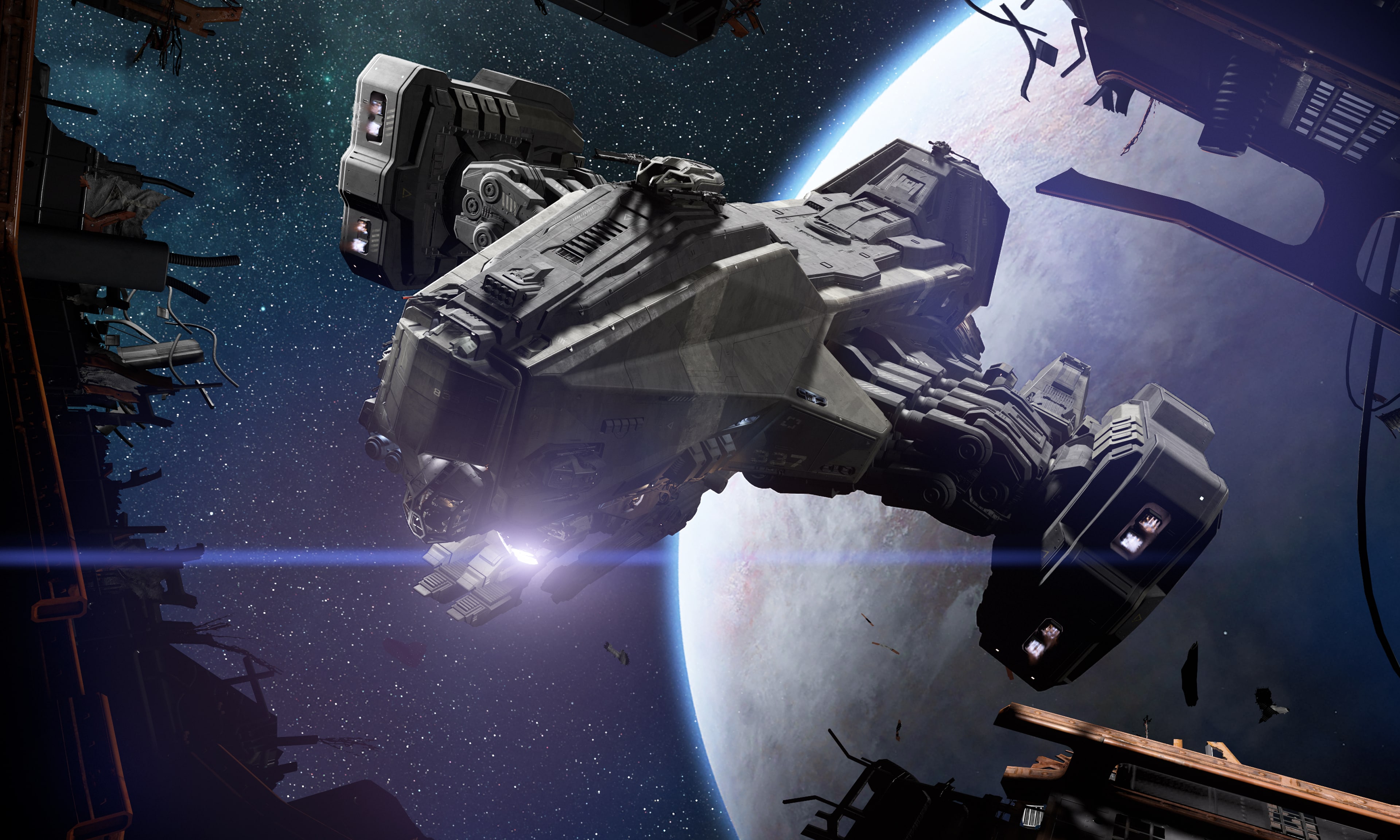
The order gave his crew pause as their fleet included a new Aegis Nautilus-class minelayer ship that had not yet been authorized for field operations in Perry Line systems. The ship had been assigned to Admiral Hireche’s fleet to be put through a series of simulations around a Xi’an incursion into Baker. Naval Command wanted to perfect its use protecting UEE systems before putting it into play on the Perry Line and announcing its arrival to the Xi’an. Seeing scans of a significant Xi’an force assembling across the system, Admiral Hireche knew his fleet would soon be outnumbered before reinforcements could ever arrive, so he disregarded the usage edict and confirmed his order to bring the Nautilus into Hadur. If he couldn’t have the numbers advantage, then he would take the tactical one.
Declassified Defender
With his entire fleet in Hadur, Admiral Hireche ordered the Nautilus to reinforce their perimeter by strategically laying mines to funnel Xi’an ships into a limited number of approach angles. Then he positioned his forces to defend these flight lanes. Admiral Hireche had hoped the Nautilus could lay the mines and return to Baker before the Xi’an arrived, but it was not to be. A massive Xi’an force appeared near the UEE perimeter as the Nautilus crew rushed to complete its objective. Yet, instead of engaging, the Xi’an force halted and held their position. A few of their ships that Admiral Hireche assumed contained their most advanced scanning tech followed from a safe distance, carefully observing the Nautilus. Once the mines were laid, Admiral Hireche ordered the Nautilus back to Baker to restock and potentially repeat the process on the other side of the jump.
Meanwhile, a tense standoff between UEE and Xi’an forces lasted until the grid search of the wreckage was complete and two data recorders were found intact. As Martha Agrawal began to analyze the data, Admiral Hireche organized a swift and safe withdrawal from the debris field and returned his fleet to Baker. No Xi’an ships stalked their retreat, but a subsequent investigation of scans from a nearby UEE station showed a small team of Xi’an ships inspecting the debris field before their forces vacated the area.
Back in Baker, Admiral Hireche commed Naval Command to disclose his use of the Nautilus as a deterrence. Admiral Hireche and engineer Martha Agrawal were ordered back to headquarters to provide a full account of the incident. Initially incensed over the use of the Nautilus, Imperator Messer would eventually praise Admiral Hireche’s swift and decisive actions once analysis of the data recorders revealed the explosion to be a critical system failure and not a secret Xi’an attack. While engineer Agrawal fell out of favor with Imperator Messer for her failure to deliver on her promises for the TKL-2900 and attempts to blame the Xi’an, Admiral Hireche became a trusted confidant, who would eventually be elevated to oversee all forces along the Perry Line. When asked about what he believed was the highlight to his Navy career, Admiral Hireche referenced the Hadur standoff, saying “one of the toughest decisions a commander can make is when to walk away from a fight.”
Dieses Portfolio erschien ursprünglich in Jump Point 8.11.
In den ersten Tagen des kalten Krieges zwischen den Menschen und den Xi'an investierte Imperator Ivar Messer Milliarden in die Entwicklung eines neuen militärischen Langstrecken-Scanners mit dem Codenamen TKL-2900. Er prahlte damit, dass die Technologie Ziele auf wesentlich größere Entfernungen finden und verfolgen könne als die aktuelle Generation der menschlichen Scanner und dass sie die von den Xi'an verwendeten Scanner übertreffen würde. Trotz des hohen Zeit- und Kostenaufwands für das Projekt blieb der tatsächliche Scanner bei den ersten Tests hinter den prahlerischen Behauptungen Messers zurück. Die Ingenieurin Martha Agrawal, eine notorische Messer-Anhängerin, wurde zur neuen Leiterin ernannt, um das Projekt zu retten. Sie behauptete schnell, dass die Probleme mit ein paar Modifikationen behoben werden könnten. Nachdem die Änderungen abgeschlossen waren, erhielt Imperator Messer die Garantie von Agrawal, dass es funktionieren würde, bevor er das TKL-2900 zum Einsatz auf Hadur bestellte. Andere Wissenschaftler und Ingenieure des Projekts baten um weitere Feldtests vor dem Einsatz, aber Agrawal wies ihre Bedenken zurück und machte überdeutlich, dass jeder, der sich der Entscheidung widersetzte, dies sowohl beruflich als auch persönlich bereuen würde.
Imperator Messer drängte auf den schnellen Einsatz des TKL-2900, weil er glaubte, dass der Scanner dem UEE einen klaren technologischen Vorteil beim Schutz des jungen Imperiums gegen die aufkeimende Xi'an-Bedrohung verschaffen würde. Geheimdienstberichte entlang der Perry-Linie, der Pufferzone zwischen den von den Menschen und den von den Xi'an kontrollierten Systemen, die 2542 vom UPE-Tribunal eingerichtet wurde, waren bestenfalls spärlich, und dieser Mangel an Klarheit über die militärischen Bewegungen der Xi'an machte Messer große Sorgen. Noch frisch von den Nachwirkungen des Ersten Tevarin-Krieges, glaubte er, dass die Xi'an keine Zeit damit verschwenden würden, anzugreifen, während sich die Menschheit noch von einem militärischen Konflikt erholte. In dem verzweifelten Bestreben, die militärische Vorherrschaft wiederherzustellen, und mit Agrawals Garantie für überlegene Leistung wurde der Scanner unbewährt und ungetestet an die Perry-Linie geliefert.
Eine unerwartete Explosion
Am 7. November 2550 platzierte die Marine einen TKL-2900 Langstrecken-Scanner in Hadur in der Nähe des Sprungs nach Baker. Bei der Aktivierung erlitt der experimentelle Reaktor, der den TKL-2900 mit Energie versorgte, einen plötzlichen kritischen Ausfall und löste eine massive Explosion aus, die Scanner im ganzen System zum Leuchten brachte. Die erste Navy-Patrouille vor Ort fand bereits mehrere Xi'an-Schiffe, die die Trümmer scannten. Ihr Eintreffen zog keinen Beschuss nach sich, hielt die Xi'an aber auch nicht von ihren Scans ab, da ihre Schiffe weiterhin zielstrebig blieben. Als Warnmaßnahmen und schikanöse Vorbeiflüge keine Reaktion erbrachten, gab Lieutenant Commander Polina Balmont Warnschüsse ab, um ihre Absichten unmissverständlich klar zu machen. Die Xi'an-Schiffe zogen sich sofort zurück. Balmont wies ihr Team an, einen Perimeter einzurichten und auf das Eintreffen der anderen Navy-Patrouillen zu warten. Dann machte sie den Sprung zu Baker, um Admiral Hireche von der UEE Kennelly und Führer der Kampfgruppe zu kommunizieren, dass die TKL-2900 explodiert war und Xi'an-Schiffe am Tatort gesichtet wurden.
Hireche leitete die Nachricht an das Marinekommando weiter und befahl dann der UEE Kennelly nach Hadur. Bevor er den Sprung durchführte, wies er seine gesamte Flotte an, sich am Baker-Hadur-Sprungpunkt zu versammeln und auf weitere Anweisungen zu warten. Als UEE Kennelly am massiven Trümmerfeld in Hadur ankam, fand er alle Navy-Patrouillen vor, die die Umgebung überwachten. Er schickte ein Schiff nach Baker, um zusätzliche Kräfte und die leitende Ingenieurin Martha Agrawal zu holen, die helfen sollten, die Ursache der Explosion zu diagnostizieren. Er sprach auch mit Lieutenant Commander Balmont und extrahierte einen Moment-für-Moment-Bericht über ihre Aktionen. Während er die Abgabe von Warnschüssen für gerechtfertigt und fachmännisch ausgeführt hielt, befürchtete er, dass dies eine Reaktion der Xi'an auslösen würde. Und nicht lange nach seiner Ankunft am Tatort begannen Aufklärungsschiffe in Hadur, starke Aktivitäten in den Sektoren von Xi'an zu registrieren.
Admiral Hireche wusste, dass die Zeit knapp war und befürchtete, dass weitere Angriffe die Situation nur verschlimmern würden. Obwohl Agrawal darauf bestand, dass die Xi'an-Kräfte für den Ausfall der TKL-2900 verantwortlich waren, wollte Admiral Hireche unwiderlegbare Beweise, bevor er diese Behauptung dem Marinekommando vorlegte. Er ordnete eine Rastersuche des Trümmerfeldes an, um überlebende Datenrekorder zu finden. Dann forderte er alle Schiffe seiner Flotte, die noch in Baker stationiert waren, auf, sich der Aktion in Hadur anzuschließen.
Der Befehl ließ seine Crew innehalten, denn zu ihrer Flotte gehörte ein neues Minenlegerschiff der Aegis Nautilus-Klasse, das noch nicht für den Einsatz in den Systemen der Perry-Linie autorisiert worden war. Das Schiff war der Flotte von Admiral Hireche zugeteilt worden, um eine Reihe von Simulationen rund um einen Xi'an-Einfall in Baker zu testen. Das Flottenkommando wollte seinen Einsatz zum Schutz der UEE-Systeme perfektionieren, bevor es auf der Perry-Linie zum Einsatz kam und seine Ankunft bei den Xi'an ankündigte. Als Admiral Hireche die Scans einer bedeutenden Xi'an-Streitmacht sah, die sich im ganzen System versammelte, wusste er, dass seine Flotte bald in der Unterzahl sein würde, bevor überhaupt Verstärkung eintreffen konnte, also missachtete er das Nutzungsedikt und bestätigte seinen Befehl, die Nautilus nach Hadur zu bringen. Wenn er den zahlenmäßigen Vorteil nicht haben konnte, dann würde er den taktischen Vorteil nehmen.
Deklassierter Verteidiger
Mit seiner gesamten Flotte in Hadur befahl Admiral Hireche der Nautilus, ihren Perimeter zu verstärken, indem er strategisch Minen legte, um Xi'an-Schiffe in eine begrenzte Anzahl von Anflugwinkeln zu trichtern. Dann positionierte er seine Streitkräfte, um diese Flugschneisen zu verteidigen. Admiral Hireche hatte gehofft, dass die Nautilus die Minen legen und zu Baker zurückkehren konnte, bevor die Xi'an eintrafen, aber es sollte nicht sein. Eine massive Xi'an-Streitmacht erschien in der Nähe des UEE-Perimeters, als die Nautilus-Besatzung sich beeilte, ihr Ziel zu erreichen. Doch anstatt anzugreifen, hielt die Xi'an-Truppe inne und hielt ihre Position. Ein paar ihrer Schiffe, von denen Admiral Hireche annahm, dass sie über die fortschrittlichste Scantechnologie verfügten, folgten ihnen aus sicherer Entfernung und beobachteten die Nautilus sorgfältig. Sobald die Minen gelegt waren, befahl Admiral Hireche die Nautilus zurück zur Baker, um die Vorräte aufzufüllen und den Vorgang möglicherweise auf der anderen Seite des Sprungs zu wiederholen.
In der Zwischenzeit kam es zu einem angespannten Patt zwischen UEE- und Xi'an-Kräften, bis die Rastersuche des Wracks abgeschlossen war und zwei intakte Datenrekorder gefunden wurden. Während Martha Agrawal begann, die Daten zu analysieren, organisierte Admiral Hireche einen schnellen und sicheren Rückzug aus dem Trümmerfeld und brachte seine Flotte zurück nach Baker. Keine Xi'an-Schiffe verfolgten ihren Rückzug, aber eine spätere Untersuchung von Scans einer nahegelegenen UEE-Station zeigte ein kleines Team von Xi'an-Schiffen, die das Trümmerfeld inspizierten, bevor ihre Streitkräfte das Gebiet verließen.
Zurück in Baker informierte Admiral Hireche das Marinekommando über den Einsatz der Nautilus zur Abschreckung. Admiral Hireche und die Ingenieurin Martha Agrawal wurden zurück ins Hauptquartier beordert, um einen vollständigen Bericht über den Vorfall zu liefern. Zunächst verärgert über den Einsatz der Nautilus, lobte Imperator Messer schließlich Admiral Hireches schnelles und entschlossenes Handeln, nachdem die Analyse der Datenschreiber ergeben hatte, dass es sich bei der Explosion um einen kritischen Systemfehler und nicht um einen geheimen Angriff der Xi'an handelte. Während Ingenieurin Agrawal bei Imperator Messer in Ungnade fiel, weil sie ihre Versprechen für die TKL-2900 nicht einhielt und versuchte, die Schuld auf die Xi'an zu schieben, wurde Admiral Hireche zu einem vertrauenswürdigen Vertrauten, der schließlich zur Aufsicht über alle Streitkräfte entlang der Perry-Linie ernannt wurde. Auf die Frage, was seiner Meinung nach der Höhepunkt seiner Navy-Karriere war, bezog sich Admiral Hireche auf das Hadur-Patt und sagte: "Eine der schwierigsten Entscheidungen, die ein Kommandeur treffen kann, ist, wann er sich von einem Kampf zurückziehen sollte."
This portfolio originally appeared in Jump Point 8.11.
In the nascent days of the Human and Xi’an cold war, Imperator Ivar Messer poured billions into developing a new military long-range scanner codenamed the TKL-2900. He boasted that the technology could find and track targets at significantly greater distances than the current generation of Human scanners and that it would surpass those used by the Xi’an. Despite the time and expense of the project, the actual scanner fell short of Messer’s boastful claims when initially tested. Engineer Martha Agrawal, a notorious Messer supporter, was made the new lead in an effort to salvage the project. She quickly asserted that the issues could be remedied with a few modifications. Once the changes were complete, Imperator Messer received Agrawal’s guarantee that it would work before ordering the TKL-2900 to be deployed to Hadur. Other scientists and engineers on the project begged for more field testing before its deployment, but Agrawal dismissed their concerns and made it abundantly clear that anyone opposed to the decision would regret it both professionally and personally.
Imperator Messer pushed for the quick deployment of the TKL-2900 because he believed the scanner would provide the UEE a clear technological advantage in guarding the fledgling Empire against the burgeoning Xi’an threat. Intelligence reports from along the Perry Line, the buffer zone between Human and Xi’an controlled systems established in 2542 by the UPE Tribunal, were scarce at best and that lack of clarity into Xi’an military movements deeply worried Messer. Still fresh from the aftermath of the First Tevarin War, he believed that the Xi’an would not waste time in striking while Humanity was still recovering from one military conflict. Desperate to reestablish military dominance and with Agrawal’s guarantee of superior performance, the scanner was delivered to the Perry Line unproven and untested.
An Unexpected Explosion
On November 7, 2550, the Navy placed a TKL-2900 long-range scanner in Hadur near the jump to Baker. Upon activation, the experimental reactor powering the TKL-2900 suffered a sudden critical failure and triggered a massive explosion that lit up scanners across the system. The first Navy patrol on the scene found several Xi’an ships already scanning the debris. Their arrival drew no fire but also didn’t deter the Xi’an from their scans, as their ships remained singularly focused. When warning measures and bullying flybys yielded no reaction, Lieutenant Commander Polina Balmont fired warning shots to make their intentions abundantly clear. The Xi’an ships immediately disengaged. Balmont instructed her team to establish a perimeter and wait for the other Navy patrols to arrive. Then she made the jump to Baker to comm Admiral Hireche of the UEE Kennelly and leader of the battle group that the TKL-2900 had exploded and Xi’an ships were spotted at the scene.
Hireche relayed the message to Naval Command and then ordered UEE Kennelly to Hadur. Before making the jump, he instructed his entire fleet to converge on the Baker-Hadur jump point and await further instructions. UEE Kennelly arrived at the massive debris field in Hadur to find all the Navy patrols accounted for and policing the perimeter. He dispatched a ship to Baker to retrieve additional forces and lead engineer Martha Agrawal to help diagnose what caused the explosion. He also spoke with Lieutenant Commander Balmont and extracted a moment-by-moment account of her actions. While he deemed the firing of warning shots to be justified and expertly executed, he worried it would prompt a Xi’an response. And, not long after his arrival on scene, scout ships in Hadur began registering heavy activity in Xi’an sectors.
Admiral Hireche knew time was limited and feared any further engagements would only make matters worse. Despite Agrawal’s insistence that Xi’an forces were to blame for the TKL-2900’s failure, Admiral Hireche wanted irrefutable proof before making the claim to Naval Command. He ordered a grid search of the debris field to find any surviving data recorders. Then he requested that every ship in his fleet still stationed in Baker join the action in Hadur.
The order gave his crew pause as their fleet included a new Aegis Nautilus-class minelayer ship that had not yet been authorized for field operations in Perry Line systems. The ship had been assigned to Admiral Hireche’s fleet to be put through a series of simulations around a Xi’an incursion into Baker. Naval Command wanted to perfect its use protecting UEE systems before putting it into play on the Perry Line and announcing its arrival to the Xi’an. Seeing scans of a significant Xi’an force assembling across the system, Admiral Hireche knew his fleet would soon be outnumbered before reinforcements could ever arrive, so he disregarded the usage edict and confirmed his order to bring the Nautilus into Hadur. If he couldn’t have the numbers advantage, then he would take the tactical one.
Declassified Defender
With his entire fleet in Hadur, Admiral Hireche ordered the Nautilus to reinforce their perimeter by strategically laying mines to funnel Xi’an ships into a limited number of approach angles. Then he positioned his forces to defend these flight lanes. Admiral Hireche had hoped the Nautilus could lay the mines and return to Baker before the Xi’an arrived, but it was not to be. A massive Xi’an force appeared near the UEE perimeter as the Nautilus crew rushed to complete its objective. Yet, instead of engaging, the Xi’an force halted and held their position. A few of their ships that Admiral Hireche assumed contained their most advanced scanning tech followed from a safe distance, carefully observing the Nautilus. Once the mines were laid, Admiral Hireche ordered the Nautilus back to Baker to restock and potentially repeat the process on the other side of the jump.
Meanwhile, a tense standoff between UEE and Xi’an forces lasted until the grid search of the wreckage was complete and two data recorders were found intact. As Martha Agrawal began to analyze the data, Admiral Hireche organized a swift and safe withdrawal from the debris field and returned his fleet to Baker. No Xi’an ships stalked their retreat, but a subsequent investigation of scans from a nearby UEE station showed a small team of Xi’an ships inspecting the debris field before their forces vacated the area.
Back in Baker, Admiral Hireche commed Naval Command to disclose his use of the Nautilus as a deterrence. Admiral Hireche and engineer Martha Agrawal were ordered back to headquarters to provide a full account of the incident. Initially incensed over the use of the Nautilus, Imperator Messer would eventually praise Admiral Hireche’s swift and decisive actions once analysis of the data recorders revealed the explosion to be a critical system failure and not a secret Xi’an attack. While engineer Agrawal fell out of favor with Imperator Messer for her failure to deliver on her promises for the TKL-2900 and attempts to blame the Xi’an, Admiral Hireche became a trusted confidant, who would eventually be elevated to oversee all forces along the Perry Line. When asked about what he believed was the highlight to his Navy career, Admiral Hireche referenced the Hadur standoff, saying “one of the toughest decisions a commander can make is when to walk away from a fight.”
This portfolio originally appeared in Jump Point 8.11.
In the nascent days of the Human and Xi’an cold war, Imperator Ivar Messer poured billions into developing a new military long-range scanner codenamed the TKL-2900. He boasted that the technology could find and track targets at significantly greater distances than the current generation of Human scanners and that it would surpass those used by the Xi’an. Despite the time and expense of the project, the actual scanner fell short of Messer’s boastful claims when initially tested. Engineer Martha Agrawal, a notorious Messer supporter, was made the new lead in an effort to salvage the project. She quickly asserted that the issues could be remedied with a few modifications. Once the changes were complete, Imperator Messer received Agrawal’s guarantee that it would work before ordering the TKL-2900 to be deployed to Hadur. Other scientists and engineers on the project begged for more field testing before its deployment, but Agrawal dismissed their concerns and made it abundantly clear that anyone opposed to the decision would regret it both professionally and personally.
Imperator Messer pushed for the quick deployment of the TKL-2900 because he believed the scanner would provide the UEE a clear technological advantage in guarding the fledgling Empire against the burgeoning Xi’an threat. Intelligence reports from along the Perry Line, the buffer zone between Human and Xi’an controlled systems established in 2542 by the UPE Tribunal, were scarce at best and that lack of clarity into Xi’an military movements deeply worried Messer. Still fresh from the aftermath of the First Tevarin War, he believed that the Xi’an would not waste time in striking while Humanity was still recovering from one military conflict. Desperate to reestablish military dominance and with Agrawal’s guarantee of superior performance, the scanner was delivered to the Perry Line unproven and untested.
An Unexpected Explosion
On November 7, 2550, the Navy placed a TKL-2900 long-range scanner in Hadur near the jump to Baker. Upon activation, the experimental reactor powering the TKL-2900 suffered a sudden critical failure and triggered a massive explosion that lit up scanners across the system. The first Navy patrol on the scene found several Xi’an ships already scanning the debris. Their arrival drew no fire but also didn’t deter the Xi’an from their scans, as their ships remained singularly focused. When warning measures and bullying flybys yielded no reaction, Lieutenant Commander Polina Balmont fired warning shots to make their intentions abundantly clear. The Xi’an ships immediately disengaged. Balmont instructed her team to establish a perimeter and wait for the other Navy patrols to arrive. Then she made the jump to Baker to comm Admiral Hireche of the UEE Kennelly and leader of the battle group that the TKL-2900 had exploded and Xi’an ships were spotted at the scene.
Hireche relayed the message to Naval Command and then ordered UEE Kennelly to Hadur. Before making the jump, he instructed his entire fleet to converge on the Baker-Hadur jump point and await further instructions. UEE Kennelly arrived at the massive debris field in Hadur to find all the Navy patrols accounted for and policing the perimeter. He dispatched a ship to Baker to retrieve additional forces and lead engineer Martha Agrawal to help diagnose what caused the explosion. He also spoke with Lieutenant Commander Balmont and extracted a moment-by-moment account of her actions. While he deemed the firing of warning shots to be justified and expertly executed, he worried it would prompt a Xi’an response. And, not long after his arrival on scene, scout ships in Hadur began registering heavy activity in Xi’an sectors.
Admiral Hireche knew time was limited and feared any further engagements would only make matters worse. Despite Agrawal’s insistence that Xi’an forces were to blame for the TKL-2900’s failure, Admiral Hireche wanted irrefutable proof before making the claim to Naval Command. He ordered a grid search of the debris field to find any surviving data recorders. Then he requested that every ship in his fleet still stationed in Baker join the action in Hadur.
The order gave his crew pause as their fleet included a new Aegis Nautilus-class minelayer ship that had not yet been authorized for field operations in Perry Line systems. The ship had been assigned to Admiral Hireche’s fleet to be put through a series of simulations around a Xi’an incursion into Baker. Naval Command wanted to perfect its use protecting UEE systems before putting it into play on the Perry Line and announcing its arrival to the Xi’an. Seeing scans of a significant Xi’an force assembling across the system, Admiral Hireche knew his fleet would soon be outnumbered before reinforcements could ever arrive, so he disregarded the usage edict and confirmed his order to bring the Nautilus into Hadur. If he couldn’t have the numbers advantage, then he would take the tactical one.
Declassified Defender
With his entire fleet in Hadur, Admiral Hireche ordered the Nautilus to reinforce their perimeter by strategically laying mines to funnel Xi’an ships into a limited number of approach angles. Then he positioned his forces to defend these flight lanes. Admiral Hireche had hoped the Nautilus could lay the mines and return to Baker before the Xi’an arrived, but it was not to be. A massive Xi’an force appeared near the UEE perimeter as the Nautilus crew rushed to complete its objective. Yet, instead of engaging, the Xi’an force halted and held their position. A few of their ships that Admiral Hireche assumed contained their most advanced scanning tech followed from a safe distance, carefully observing the Nautilus. Once the mines were laid, Admiral Hireche ordered the Nautilus back to Baker to restock and potentially repeat the process on the other side of the jump.
Meanwhile, a tense standoff between UEE and Xi’an forces lasted until the grid search of the wreckage was complete and two data recorders were found intact. As Martha Agrawal began to analyze the data, Admiral Hireche organized a swift and safe withdrawal from the debris field and returned his fleet to Baker. No Xi’an ships stalked their retreat, but a subsequent investigation of scans from a nearby UEE station showed a small team of Xi’an ships inspecting the debris field before their forces vacated the area.
Back in Baker, Admiral Hireche commed Naval Command to disclose his use of the Nautilus as a deterrence. Admiral Hireche and engineer Martha Agrawal were ordered back to headquarters to provide a full account of the incident. Initially incensed over the use of the Nautilus, Imperator Messer would eventually praise Admiral Hireche’s swift and decisive actions once analysis of the data recorders revealed the explosion to be a critical system failure and not a secret Xi’an attack. While engineer Agrawal fell out of favor with Imperator Messer for her failure to deliver on her promises for the TKL-2900 and attempts to blame the Xi’an, Admiral Hireche became a trusted confidant, who would eventually be elevated to oversee all forces along the Perry Line. When asked about what he believed was the highlight to his Navy career, Admiral Hireche referenced the Hadur standoff, saying “one of the toughest decisions a commander can make is when to walk away from a fight.”
Links
No links available.


Metadata
- CIG ID
- 18050
- Channel
- Spectrum Dispatch
- Category
- Undefined
- Series
- News Update
- Comments
- 18
- Published
- 5 years ago (2021-03-31T00:00:00+00:00)