Galactic Guide: Cathcart System
Spectrum Dispatch Undefined Galactic GuideContent
Cathcart System
Astronomically speaking, Cathcart is basically void: an A-type dwarf star with no true planets and only a loosely defined chain of asteroids and worldlets orbiting far from the green band. In theory, there is no reason anyone should ever have lived here. What is now known as the galaxy’s junkyard came from humble beginnings. The system was first discovered in 2438 by wanted fugitive Adelaide Lorris, who many believe had been using the system as a hideout and only reported it when she saw explorers scanning near the jump point. She named the system after the Marshal who had been chasing her. While the UNE toyed with potential uses for Cathcart, they never actually claimed it. Ideas ranged from deep-space comm research to plans to construct a transportation hub, but ultimately the system became a dumping ground for the military.
The reasoning was simple: without planets or other major bodies, spacecraft could be easily stored without fear of disturbing a local populace or local ecosystems. A pair of pre-fab processing factories were towed in-system and for decades the system began collecting all varieties of obsolete military spacecraft: fighters “parked” in space, end to end for hundreds of kilometers; abandoned destroyers, cruisers, frigates and carriers; all stripped of various needed or classified systems, berthed together as far as the eye could see.
For two hundred years, the fields of garbage grew in Cathcart, out of sight and out of mind from the military command structure.
That’s where Cathcart’s history becomes fuzzy. The system had quickly become a ‘trash pile’ for the military and private industries to dump crippled hulls, toxic materials and all other varieties of odds and ends, but in 2750, a young Naval pilot tasked with depositing a fractured hull came across something unbelievable in the deep sea of garbage.
Spider
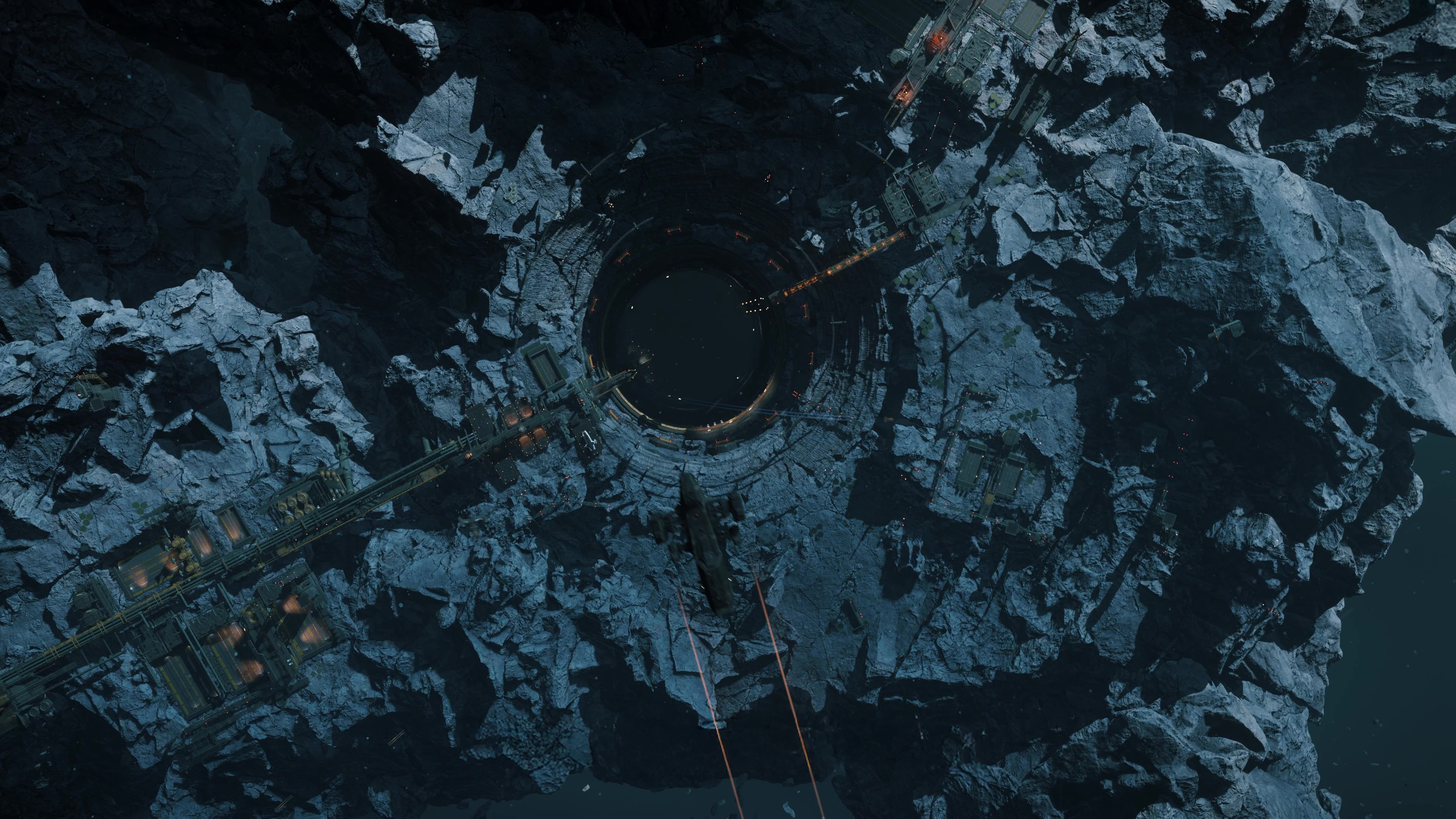
Unbeknownst to anyone, Cathcart had a well ensconced population. Individual outlaws and smaller packs had made the surplus military and civilian hulls their homes, retrofitting them with makeshift atmospheric containment systems and cutting out an unlikely living. But the station that came to be known as Spider was something on a scale not seen before. A sprawling world-sized mass of crippled starships, abandoned colonizers and ancient platforms, all held together with tape, metal and prayer. Spider’s origin story is more the realm of myth than recorded history. Clan legends claim its creation was overseen by tens of thousands of pirates and smugglers working alongside one another, lashing together old habitat modules, destroyers, carriers and colony ships to form a living, breathing city over time. Modern anthropologists consider this story unlikely, but whatever the background, Spider is now one of the most fascinating domains in space: by far the largest place in the galaxy where pirates openly congregate.
Nearing the middle of the 30th century, the outlaw population in Cathcart and the existence of Spider had survived the Messers to become a somewhat normalized element in the universe. With their proximity to Nexus system and several other Unclaimed systems, there were rumors that talks had begun to organize an independent Human government, of which Spider would be the prospective capital.
In 2931, that would all change. Dean Kellar’s infamous Run began as a bar fight on Spider and spilled into five systems and embroiled over three dozen participants. It was this raging battle of lawlessness that made the UEE realize that they needed to exert some control in that area.
Shortly after, they officially reclaimed Nexus system and swept out the inhabitants who had been living there. While many of them relocated to Cathcart and Taranis, a large force stayed, resolute to not give up their home so easily. They struck back at the occupying UEE populace in a terrifying way: the Walzer Massacre of 2935.
The UEE’s retaliation was swift. Convinced that supporters of the attack were congregating in Spider, the Navy launched an intensive bombing campaign to try and destroy the insurgents. The massive trash fields prevented the Navy from effectively targeting Spider, but casualties were still significant.
Protocol
The first thing to remember is that Spider is always changing. The battleship fragment you docked with to purchase narcotics a month ago may be an agro-habitat today … or it may have been blown out into space after a pricing dispute with a no-nonsense buyer. Spider is also constantly expanding: junk located in Cathcart and crippled prize ships are added to the maze on a daily basis. Understandably, taking a wrong turn can be extremely hazardous to your health.
Establishing your credentials can be tricky. Without the right codes — available for the right price in surrounding systems — you won’t survive a minute from arrival in-system. While there is no organized government patrolling Cathcart, plenty of low-caliber pirates hang around the jump point waiting to prey on hapless travellers.
Traversing Spider itself can be a confusing blend of protocols and rituals. The station is primarily run by the three outlaw packs: Dace Clan, Fist & Nail and NKZ. While in their respective territories you will be subject to their rules, so don’t disrespect them.
Culture aboard Spider is deceptively pleasant: everyone knows themselves to be in the company of thieves and any business done is no more or less honest than you would find in a public square on Terra. Don’t anger the locals, of course, but that’s good advice on any world. One important note: every segment of Spider has a different decompression alarm … so watch for flashing lights, beeping sirens or anything that might be trying to get your attention … so don’t be separated from your helmet and pressure suit.
Travel Warning
Travelers to Spider can access different docking ports with different passwords. Note that these expire quickly and that using an incorrect password can flag you as hostile!
Heard in the Wind
“Boomer was walking ahead of me heading up from landing to the Dace level. Talking and joking like he did, then suddenly, BAM, section of the wall blew out and sucked him out into space. Saddest thing I ever saw… he owed me eighty creds.” Reg Wallen, excerpt from Void Walkers: Life in the Underworld
“As an architectural accomplishment, there’s nothing more impressive to me than the development of Spider, especially considering that many of the ‘engineers’ (if you can even call them that) had no real formal training when constructing the labyrinthine web of passageways and habitats.” Kelsey Arthur Draft, interview from Cross & Beam
Cathcart System
Astronomisch gesehen ist Cathcart im Grunde genommen leer: ein Zwergstern vom Typ A ohne echte Planeten und nur eine lose definierte Kette von Asteroiden und Weltkugeln, die weit vom grünen Band entfernt sind. Theoretisch gibt es keinen Grund, warum hier jemals jemand hätte leben sollen. Was heute als Schrottplatz der Galaxie bekannt ist, stammt aus bescheidenen Anfängen. Das System wurde erstmals 2438 von der flüchtigen Adelaide Lorris entdeckt, von der viele glauben, dass sie das System als Versteck benutzt hatte, und berichtete es nur, als sie Entdecker sah, die in der Nähe des Sprungpunktes scannten. Sie benannte das System nach dem Marschall, der sie verfolgt hatte. Während die UNE mit möglichen Einsatzmöglichkeiten für Cathcart spielte, behaupteten sie es nie wirklich. Die Ideen reichten von der Tiefraumforschung bis hin zu Plänen für den Bau einer Verkehrsdrehscheibe, aber schließlich wurde das System zu einer Müllhalde für das Militär.
Die Begründung war einfach: Ohne Planeten oder andere wichtige Körper könnten Raumfahrzeuge leicht gelagert werden, ohne Angst zu haben, eine lokale Bevölkerung oder lokale Ökosysteme zu stören. Ein Paar vorgefertigte Verarbeitungsfabriken wurden im System abgeschleppt, und jahrzehntelang begann das System, alle Arten veralteter militärischer Raumschiffe zu sammeln: Kampfflugzeuge, die im Weltraum "geparkt" wurden, über Hunderte von Kilometern, verlassene Zerstörer, Kreuzer, Fregatten und Träger; alle von verschiedenen benötigten oder klassifizierten Systemen befreit, so weit das Auge reicht zusammengebunden.
Zweihundert Jahre lang wuchsen in Cathcart die Müllfelder, aus den Augen und aus dem Sinn der militärischen Kommandostruktur.
Dort wird die Geschichte von Cathcart unscharf. Das System war schnell zu einem "Müllhaufen" für das Militär und die Privatindustrie geworden, um verkrüppelte Rümpfe, giftige Materialien und alle anderen Arten von Kleinigkeiten zu entsorgen, aber im Jahr 2750 stieß ein junger Marinepilot, der damit beauftragt war, einen gebrochenen Rumpf abzulegen, auf etwas Unglaubliches im tiefen Meer des Mülls.
Spinne
Ohne es zu wissen, hatte Cathcart eine gut besiedelte Bevölkerung. Einzelne Gesetzlose und kleinere Packungen hatten die überschüssigen militärischen und zivilen Rümpfe zu ihren Häusern gemacht, sie mit provisorischen atmosphärischen Eindämmungssystemen nachgerüstet und ein unwahrscheinliches Leben ausgeschlossen. Aber die Station, die als Spider bekannt wurde, war etwas in einem bisher nicht gekannten Ausmaß. Eine riesige weltumspannende Masse von verkrüppelten Raumschiffen, verlassenen Kolonisatoren und alten Plattformen, die alle mit Klebeband, Metall und Gebet zusammengehalten werden. Spiders Ursprungsgeschichte ist mehr das Reich der Mythen als die aufgezeichnete Geschichte. Clanlegenden behaupten, dass ihre Gründung von Zehntausenden von Piraten und Schmugglern überwacht wurde, die nebeneinander arbeiteten und alte Lebensraummodule, Zerstörer, Träger und Kolonieschiffe zu einer lebendigen, atmenden Stadt zusammenschlugen. Moderne Anthropologen halten diese Geschichte für unwahrscheinlich, aber unabhängig vom Hintergrund ist Spider heute eine der faszinierendsten Domänen im All: der mit Abstand größte Ort in der Galaxie, an dem sich Piraten offen versammeln.
Gegen Mitte des 30. Jahrhunderts hatten die Gesetzlosen in Cathcart und die Existenz von Spider die Messers überlebt, um ein etwas normalisiertes Element im Universum zu werden. Mit ihrer Nähe zum Nexus-System und mehreren anderen nicht beanspruchten Systemen gab es Gerüchte, dass Gespräche begonnen hätten, eine unabhängige menschliche Regierung zu organisieren, von der Spider die zukünftige Hauptstadt sein würde.
Im Jahr 2931 würde sich das alles ändern. Dean Kellars berüchtigter Run begann als Kneipenschlägerei auf Spider und wurde in fünf Systeme gespritzt und umfasste über drei Dutzend Teilnehmer. Es war dieser wütende Kampf der Gesetzlosigkeit, der die UEE erkennen ließ, dass sie eine gewisse Kontrolle in diesem Bereich ausüben mussten.
Kurz darauf riefen sie offiziell das Nexus-System zurück und fegten die Bewohner, die dort gelebt hatten, heraus. Während viele von ihnen nach Cathcart und Taranis umzogen, blieb eine große Truppe, entschlossen, ihr Zuhause nicht so leicht aufzugeben. Sie schlugen auf erschreckende Weise gegen die besetzende UEE-Population zurück: das Walzer-Massaker von 2935.
Die Vergeltungsmaßnahmen der UEE erfolgten schnell. Überzeugt, dass sich die Anhänger des Angriffs in Spider versammelten, startete die Marine eine intensive Bombenkampagne, um zu versuchen, die Aufständischen zu vernichten. Die massiven Müllfelder verhinderten, dass die Marine Spider effektiv ins Visier nahm, aber die Verluste waren immer noch beträchtlich.
Protokoll
Das erste, woran man sich erinnern sollte, ist, dass sich Spider ständig verändert. Das Schlachtschifffragment, mit dem Sie vor einem Monat angedockt haben, um Betäubungsmittel zu kaufen, kann heute ein Agro-Lebensraum sein.... oder es wurde nach einem Preisstreit mit einem nüchternen Käufer ins All geblasen. Auch Spider expandiert ständig: Junk in Cathcart und verkrüppelte Preisschiffe werden täglich dem Labyrinth hinzugefügt. Verständlicherweise kann eine falsche Wendung eine große Gefahr für Ihre Gesundheit darstellen.
Die Erstellung Ihrer Anmeldeinformationen kann schwierig sein. Ohne die richtigen Codes - verfügbar zum richtigen Preis in den Umgebungssystemen - überleben Sie keine Minute nach der Ankunft im System. Während es keine organisierte Regierung gibt, die Cathcart patrouilliert, hängen viele niederkalibrige Piraten um den Sprungpunkt herum und warten darauf, unglückliche Reisende auszunehmen.
Die Durchquerung der Spinne selbst kann eine verwirrende Mischung aus Protokollen und Ritualen sein. Die Station wird hauptsächlich von den drei Gesetzlosen betrieben: Dace Clan, Faust & Nagel und NKZ. Während du in ihren jeweiligen Gebieten den Regeln unterworfen bist, solltest du sie also nicht missachten.
Die Kultur an Bord von Spider ist trügerisch angenehm: Jeder weiß, dass er in Gesellschaft von Dieben ist, und jedes Geschäft ist nicht mehr oder weniger ehrlich, als man es auf einem öffentlichen Platz auf Terra finden würde. Verärgere die Einheimischen natürlich nicht, aber das ist ein guter Ratschlag für jede Welt. Eine wichtige Anmerkung: Jedes Segment der Spinne hat einen anderen Dekompressionsalarm.... also achten Sie auf Blinklichter, Piepssirenen oder alles, was versuchen könnte, Ihre Aufmerksamkeit zu erregen.... also lassen Sie sich nicht von Ihrem Helm und Druckanzug trennen.
Reisewarnung
Reisende zu Spider können auf verschiedene Docking-Ports mit unterschiedlichen Passwörtern zugreifen. Beachten Sie, dass diese schnell ablaufen und dass Sie mit einem falschen Passwort als feindlich gekennzeichnet werden können!
Im Wind gehört
"Boomer ging vor mir her und ging von der Landung bis zur Dace-Ebene hinauf. Reden und scherzen wie er, dann plötzlich, BAM, blies ein Teil der Wand aus und saugte ihn ins All. Das Traurigste, was ich je gesehen habe... er schuldete mir achtzig Creds."
Reg Wallen, Auszug aus Void Walkers: Leben in der Unterwelt
"Als architektonische Leistung gibt es für mich nichts Beeindruckenderes als die Entwicklung von Spider, zumal viele der "Ingenieure" (wenn man sie überhaupt so nennen kann) keine wirkliche formale Ausbildung hatten, um das labyrinthische Netz von Gängen und Lebensräumen zu bauen."
Kelsey Arthur Draft, Interview von Cross & Beam
Cathcart System
Astronomically speaking, Cathcart is basically void: an A-type dwarf star with no true planets and only a loosely defined chain of asteroids and worldlets orbiting far from the green band. In theory, there is no reason anyone should ever have lived here. What is now known as the galaxy’s junkyard came from humble beginnings. The system was first discovered in 2438 by wanted fugitive Adelaide Lorris, who many believe had been using the system as a hideout and only reported it when she saw explorers scanning near the jump point. She named the system after the Marshal who had been chasing her. While the UNE toyed with potential uses for Cathcart, they never actually claimed it. Ideas ranged from deep-space comm research to plans to construct a transportation hub, but ultimately the system became a dumping ground for the military.
The reasoning was simple: without planets or other major bodies, spacecraft could be easily stored without fear of disturbing a local populace or local ecosystems. A pair of pre-fab processing factories were towed in-system and for decades the system began collecting all varieties of obsolete military spacecraft: fighters “parked” in space, end to end for hundreds of kilometers; abandoned destroyers, cruisers, frigates and carriers; all stripped of various needed or classified systems, berthed together as far as the eye could see.
For two hundred years, the fields of garbage grew in Cathcart, out of sight and out of mind from the military command structure.
That’s where Cathcart’s history becomes fuzzy. The system had quickly become a ‘trash pile’ for the military and private industries to dump crippled hulls, toxic materials and all other varieties of odds and ends, but in 2750, a young Naval pilot tasked with depositing a fractured hull came across something unbelievable in the deep sea of garbage.
Spider
Unbeknownst to anyone, Cathcart had a well ensconced population. Individual outlaws and smaller packs had made the surplus military and civilian hulls their homes, retrofitting them with makeshift atmospheric containment systems and cutting out an unlikely living. But the station that came to be known as Spider was something on a scale not seen before. A sprawling world-sized mass of crippled starships, abandoned colonizers and ancient platforms, all held together with tape, metal and prayer. Spider’s origin story is more the realm of myth than recorded history. Clan legends claim its creation was overseen by tens of thousands of pirates and smugglers working alongside one another, lashing together old habitat modules, destroyers, carriers and colony ships to form a living, breathing city over time. Modern anthropologists consider this story unlikely, but whatever the background, Spider is now one of the most fascinating domains in space: by far the largest place in the galaxy where pirates openly congregate.
Nearing the middle of the 30th century, the outlaw population in Cathcart and the existence of Spider had survived the Messers to become a somewhat normalized element in the universe. With their proximity to Nexus system and several other Unclaimed systems, there were rumors that talks had begun to organize an independent Human government, of which Spider would be the prospective capital.
In 2931, that would all change. Dean Kellar’s infamous Run began as a bar fight on Spider and spilled into five systems and embroiled over three dozen participants. It was this raging battle of lawlessness that made the UEE realize that they needed to exert some control in that area.
Shortly after, they officially reclaimed Nexus system and swept out the inhabitants who had been living there. While many of them relocated to Cathcart and Taranis, a large force stayed, resolute to not give up their home so easily. They struck back at the occupying UEE populace in a terrifying way: the Walzer Massacre of 2935.
The UEE’s retaliation was swift. Convinced that supporters of the attack were congregating in Spider, the Navy launched an intensive bombing campaign to try and destroy the insurgents. The massive trash fields prevented the Navy from effectively targeting Spider, but casualties were still significant.
Protocol
The first thing to remember is that Spider is always changing. The battleship fragment you docked with to purchase narcotics a month ago may be an agro-habitat today … or it may have been blown out into space after a pricing dispute with a no-nonsense buyer. Spider is also constantly expanding: junk located in Cathcart and crippled prize ships are added to the maze on a daily basis. Understandably, taking a wrong turn can be extremely hazardous to your health.
Establishing your credentials can be tricky. Without the right codes — available for the right price in surrounding systems — you won’t survive a minute from arrival in-system. While there is no organized government patrolling Cathcart, plenty of low-caliber pirates hang around the jump point waiting to prey on hapless travellers.
Traversing Spider itself can be a confusing blend of protocols and rituals. The station is primarily run by the three outlaw packs: Dace Clan, Fist & Nail and NKZ. While in their respective territories you will be subject to their rules, so don’t disrespect them.
Culture aboard Spider is deceptively pleasant: everyone knows themselves to be in the company of thieves and any business done is no more or less honest than you would find in a public square on Terra. Don’t anger the locals, of course, but that’s good advice on any world. One important note: every segment of Spider has a different decompression alarm … so watch for flashing lights, beeping sirens or anything that might be trying to get your attention … so don’t be separated from your helmet and pressure suit.
Travel Warning
Travelers to Spider can access different docking ports with different passwords. Note that these expire quickly and that using an incorrect password can flag you as hostile!
Heard in the Wind
“Boomer was walking ahead of me heading up from landing to the Dace level. Talking and joking like he did, then suddenly, BAM, section of the wall blew out and sucked him out into space. Saddest thing I ever saw… he owed me eighty creds.” Reg Wallen, excerpt from Void Walkers: Life in the Underworld
“As an architectural accomplishment, there’s nothing more impressive to me than the development of Spider, especially considering that many of the ‘engineers’ (if you can even call them that) had no real formal training when constructing the labyrinthine web of passageways and habitats.” Kelsey Arthur Draft, interview from Cross & Beam
Cathcart System
Astronomically speaking, Cathcart is basically void: an A-type dwarf star with no true planets and only a loosely defined chain of asteroids and worldlets orbiting far from the green band. In theory, there is no reason anyone should ever have lived here. What is now known as the galaxy’s junkyard came from humble beginnings. The system was first discovered in 2438 by wanted fugitive Adelaide Lorris, who many believe had been using the system as a hideout and only reported it when she saw explorers scanning near the jump point. She named the system after the Marshal who had been chasing her. While the UNE toyed with potential uses for Cathcart, they never actually claimed it. Ideas ranged from deep-space comm research to plans to construct a transportation hub, but ultimately the system became a dumping ground for the military.
The reasoning was simple: without planets or other major bodies, spacecraft could be easily stored without fear of disturbing a local populace or local ecosystems. A pair of pre-fab processing factories were towed in-system and for decades the system began collecting all varieties of obsolete military spacecraft: fighters “parked” in space, end to end for hundreds of kilometers; abandoned destroyers, cruisers, frigates and carriers; all stripped of various needed or classified systems, berthed together as far as the eye could see.
For two hundred years, the fields of garbage grew in Cathcart, out of sight and out of mind from the military command structure.
That’s where Cathcart’s history becomes fuzzy. The system had quickly become a ‘trash pile’ for the military and private industries to dump crippled hulls, toxic materials and all other varieties of odds and ends, but in 2750, a young Naval pilot tasked with depositing a fractured hull came across something unbelievable in the deep sea of garbage.
Spider
Unbeknownst to anyone, Cathcart had a well ensconced population. Individual outlaws and smaller packs had made the surplus military and civilian hulls their homes, retrofitting them with makeshift atmospheric containment systems and cutting out an unlikely living. But the station that came to be known as Spider was something on a scale not seen before. A sprawling world-sized mass of crippled starships, abandoned colonizers and ancient platforms, all held together with tape, metal and prayer. Spider’s origin story is more the realm of myth than recorded history. Clan legends claim its creation was overseen by tens of thousands of pirates and smugglers working alongside one another, lashing together old habitat modules, destroyers, carriers and colony ships to form a living, breathing city over time. Modern anthropologists consider this story unlikely, but whatever the background, Spider is now one of the most fascinating domains in space: by far the largest place in the galaxy where pirates openly congregate.
Nearing the middle of the 30th century, the outlaw population in Cathcart and the existence of Spider had survived the Messers to become a somewhat normalized element in the universe. With their proximity to Nexus system and several other Unclaimed systems, there were rumors that talks had begun to organize an independent Human government, of which Spider would be the prospective capital.
In 2931, that would all change. Dean Kellar’s infamous Run began as a bar fight on Spider and spilled into five systems and embroiled over three dozen participants. It was this raging battle of lawlessness that made the UEE realize that they needed to exert some control in that area.
Shortly after, they officially reclaimed Nexus system and swept out the inhabitants who had been living there. While many of them relocated to Cathcart and Taranis, a large force stayed, resolute to not give up their home so easily. They struck back at the occupying UEE populace in a terrifying way: the Walzer Massacre of 2935.
The UEE’s retaliation was swift. Convinced that supporters of the attack were congregating in Spider, the Navy launched an intensive bombing campaign to try and destroy the insurgents. The massive trash fields prevented the Navy from effectively targeting Spider, but casualties were still significant.
Protocol
The first thing to remember is that Spider is always changing. The battleship fragment you docked with to purchase narcotics a month ago may be an agro-habitat today … or it may have been blown out into space after a pricing dispute with a no-nonsense buyer. Spider is also constantly expanding: junk located in Cathcart and crippled prize ships are added to the maze on a daily basis. Understandably, taking a wrong turn can be extremely hazardous to your health.
Establishing your credentials can be tricky. Without the right codes — available for the right price in surrounding systems — you won’t survive a minute from arrival in-system. While there is no organized government patrolling Cathcart, plenty of low-caliber pirates hang around the jump point waiting to prey on hapless travellers.
Traversing Spider itself can be a confusing blend of protocols and rituals. The station is primarily run by the three outlaw packs: Dace Clan, Fist & Nail and NKZ. While in their respective territories you will be subject to their rules, so don’t disrespect them.
Culture aboard Spider is deceptively pleasant: everyone knows themselves to be in the company of thieves and any business done is no more or less honest than you would find in a public square on Terra. Don’t anger the locals, of course, but that’s good advice on any world. One important note: every segment of Spider has a different decompression alarm … so watch for flashing lights, beeping sirens or anything that might be trying to get your attention … so don’t be separated from your helmet and pressure suit.
Travel Warning
Travelers to Spider can access different docking ports with different passwords. Note that these expire quickly and that using an incorrect password can flag you as hostile!
Heard in the Wind
“Boomer was walking ahead of me heading up from landing to the Dace level. Talking and joking like he did, then suddenly, BAM, section of the wall blew out and sucked him out into space. Saddest thing I ever saw… he owed me eighty creds.” Reg Wallen, excerpt from Void Walkers: Life in the Underworld
“As an architectural accomplishment, there’s nothing more impressive to me than the development of Spider, especially considering that many of the ‘engineers’ (if you can even call them that) had no real formal training when constructing the labyrinthine web of passageways and habitats.” Kelsey Arthur Draft, interview from Cross & Beam
Links
No links available.
Metadata
- CIG ID
- 12962
- Channel
- Spectrum Dispatch
- Category
- Undefined
- Series
- Galactic Guide
- Comments
- 114
- Published
- 13 years ago (2013-04-16T00:00:00+00:00)