Galactic Guide: Odin System
Spectrum Dispatch Undefined Galactic GuideContent
First discovered in 2532, evidence suggests that the Odin was once home to vibrant ecosystems potentially similar to Earth or Terra. That all changed when Odin’s star entered the red giant phase. The star’s expansion completely enveloped the system’s first planet and quickly boiled off the biospheres of the others, killing all native life, before the star collapsed into a white dwarf. When Humanity’s first explorers jumped to Odin, they found a system of icy rock worlds with uniformly foreboding exteriors.
With no strong terraforming candidates, the system was dedicated to industrial development. Various mining outposts and refineries were established throughout Odin to take advantage of what resources could be found. However, as easily harvestable materials dwindled, Odin’s economy has slowed to a crawl and as is too often the case, when businesses left the system, criminal elements moved in to take their place. Today, the system is seen as an unsavory place on the decline.
Odin most recently received a bit of positive press when it became a cause celebre of the scientific community after a group of noted archaeologists revealed that the government was allowing companies to wipe out an otherwise well-preserved fossil record that could tell the story of the life that came to evolve in the Odin system. While a grassroots “SAVE THE FOSSILS” movement initially gained some traction in popular culture, interest soon faded.
The Coil (Odin I / Odin Cluster Alpha )
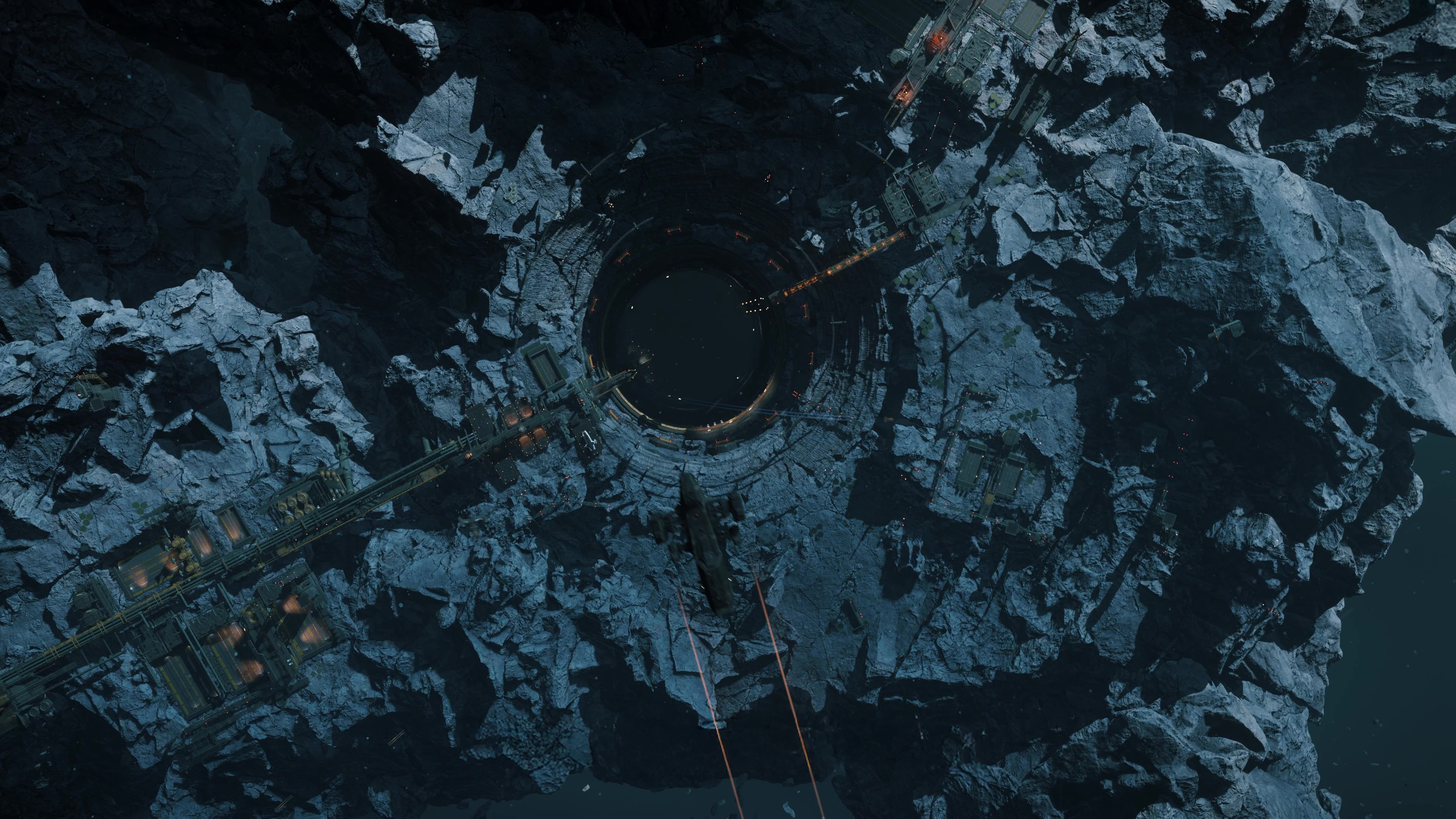
The Odin I Cluster, commonly called the Coil, is possibly the most interesting area of the system. The Coil, thought to be the remnants of the system’s pre-catastrophe first planet, is a seemingly unending cloud of planetary fragments, electromagnetic energy surges and minerals. Odin I’s former moon, known as Gainey, still drifts near the remnants of its former planet and has seen some minor settlement on its lightly atmosphered surface in the form of fraking operations and gas refinement plants. Inside the Coil itself, ore runs the gamut from basic slough to heavy metals, with extremely valuable (and distinctive) caches being discovered more often than one would expect. Despite the cluster being the largest source of untapped resources in the system, it remains relatively untouched thanks to the dangers involved in any attempts to harvest them.
The result of the exposed planetary core’s iron-rich content coming into contact with cast-off stellar remnants, arc charges are deadly to any ship unlucky enough to be caught in their embrace. To avoid these “energy storms,” most mining operations limit themselves to relatively safe pockets that temporarily appear within the shifting cloud. While Shubin Interstellar operates a station in the cluster, most mining operations have remained smaller scale.
Of course, if the arc charges don’t get you, the outlaws may. The labyrinthine tunnels of the Coil have long served as a popular hiding spot for well-armed pirates. Recent reports indicate a new group has moved in and has been involved in dozens of hit-and-run strikes against legitimate operations.
Odin II
Odin II is believed to have been within the star’s former green band and might have been ideal for Human habitation before the star’s collapse. Today, the planet is too cold and has only what little atmosphere it has naturally gathered in the last 50,000 years. Scientists and companies looking for isolated testing facilities have established outposts on the world, but no true population lives here permanently.
The planet’s moon, Villi, is a different matter. Raleigh Station, a snowy base of operations erected by a now defunct weapons testing company, allows civilian contractors to bring in supplies and to ferry out hazardous materials from the facilities on Odin II below. Raleigh Station is not the most welcoming place in the galaxy, but there is enough there to keep a traveler busy.
Odin III & IV
The second planet still intact in the Odin system, Odin III (system residents are notoriously insistent that the Coil still be considered the first planet) is another dead world. A few researchers have taken special note of the planet since it is believed its surface may hold more secrets of Odin’s past inhabitants than the sparse fossils that have been discovered so far.
Odin IV is a gas giant and home to a hydrogen rendering station in geosynchronous orbit. Although there is a minimal crew to handle operations, the facilities for interacting with outsiders are fully automated: a supplier drops off unrefined hydrogen and takes on full tanks without ever encountering any of the occupants. Starship crews are actively discouraged from layovers on Odin IV, although the station has a limited number of poorly maintained rental habs.
Travel Warning
We won’t say not to, but if you go to Odin, stay very alert.
Heard in the Wind
“As of this quarter, due to a recent decline in output and revenue, our Gainey extraction facilities are being permanently shuttered. This marks a continuation in our efforts to focus on the synthesization, and the pairing down of all ongoing Odin operations.”
- Victor Zahid, CEO Chemline Solutions, Shareholders Report, 2919.05.04
“This system was destroyed once already. Let’s not let the history of Odin be destroyed again under the stewardship of Humanity.”
- Dr. Odessa Reynolds, University of Rhetor lecture, Preserving Odin’s Fossil Record, 2943.10.04
Erstmals 2532 entdeckt, deuten Beweise darauf hin, dass der Odin einst die Heimat pulsierender Ökosysteme war, die möglicherweise der Erde oder der Terra ähnlich sind. Das änderte sich alles, als Odins Stern in die Phase des roten Riesen eintrat. Die Ausdehnung des Sterns umhüllte den ersten Planeten des Systems vollständig und verdarb schnell die Biosphären der anderen und tötete alles einheimische Leben, bevor der Stern zu einem Weißen Zwerg zusammenbrach. Als die ersten Entdecker der Menschheit zu Odin sprangen, fanden sie ein System von eisigen Felswelten mit einheitlich ahnungsvollen Außenseiten.
Da es keine starken Terraforming-Kandidaten gab, wurde das System der industriellen Entwicklung gewidmet. In ganz Odin wurden verschiedene Bergbauvorposten und Raffinerien eingerichtet, um die Vorteile der gefundenen Ressourcen zu nutzen. Doch so leicht erntbare Materialien schwanden, hat sich die Wirtschaft von Odin zu einem Schlingern verlangsamt, und wie es allzu oft der Fall ist, als Unternehmen das System verließen, zogen kriminelle Elemente ein, um ihren Platz einzunehmen. Heute wird das System als unappetitlicher Ort des Niedergangs angesehen.
Odin erhielt zuletzt ein wenig positive Presse, als es zu einem wichtigen Ereignis in der wissenschaftlichen Gemeinschaft wurde, nachdem eine Gruppe bekannter Archäologen enthüllte, dass die Regierung es den Unternehmen erlaubte, eine ansonsten gut erhaltene fossile Aufzeichnung auszulöschen, die die Geschichte des Lebens erzählen konnte, das sich im Odin-System entwickeln sollte. Während eine basisdemokratische "SAVE THE FOSSILS"-Bewegung zunächst etwas an Populärkultur gewann, verblasste das Interesse bald.
Die Spule (Odin I / Odin Cluster Alpha)
Der Odin I Cluster, allgemein als Coil bezeichnet, ist möglicherweise der interessanteste Bereich des Systems. Die Spule, von der man annimmt, dass sie die Überreste des ersten Planeten vor der Katastrophe des Systems sind, ist eine scheinbar unendliche Wolke aus planetarischen Fragmenten, elektromagnetischen Energiewellen und Mineralien. Der ehemalige Mond von Odin I., bekannt als Gainey, driftet immer noch in der Nähe der Überreste seines ehemaligen Planeten und hat auf seiner leicht atmosphärischen Oberfläche einige kleinere Siedlungen in Form von Frakturen und Gasveredelungsanlagen gesehen. Im Inneren der Spule selbst erstreckt sich die Bandbreite vom einfachen Slough bis hin zu Schwermetallen, wobei extrem wertvolle (und charakteristische) Caches häufiger entdeckt werden, als man erwarten würde. Obwohl der Cluster die größte Quelle ungenutzter Ressourcen im System ist, bleibt er dank der Gefahren, die mit jedem Versuch, sie zu nutzen, verbunden sind, relativ unberührt.
Als Ergebnis des eisenreichen Gehalts des exponierten Planetenkerns, der mit abgetragenen sternförmigen Überresten in Berührung kommt, sind Lichtbogenladungen für jedes Schiff tödlich, das Pech hat, in seiner Umarmung gefangen zu werden. Um diese "Energiestürme" zu vermeiden, beschränken sich die meisten Minenbetriebe auf relativ sichere Taschen, die vorübergehend in der sich verändernden Wolke erscheinen. Während Shubin Interstellar eine Station im Cluster betreibt, sind die meisten Minenbetriebe kleiner geblieben.
Natürlich, wenn die Bogenladungen dich nicht erwischen, können es die Gesetzlosen tun. Die labyrinthischen Tunnel der Coil dienen seit langem als beliebtes Versteck für gut bewaffnete Piraten. Jüngste Berichte deuten darauf hin, dass eine neue Gruppe eingezogen ist und an Dutzenden von Hit-and-Run-Streiks gegen legitime Operationen beteiligt war.
Odin II
Es wird angenommen, dass Odin II. innerhalb des ehemaligen grünen Bandes des Sterns gelegen hat und ideal für die menschliche Behausung gewesen sein könnte, bevor der Stern zusammenbrach. Heute ist der Planet zu kalt und hat nur noch das wenige Klima, das er in den letzten 50.000 Jahren auf natürliche Weise gesammelt hat. Wissenschaftler und Unternehmen, die auf der Suche nach isolierten Prüfeinrichtungen sind, haben Vorposten auf der ganzen Welt errichtet, aber keine echte Bevölkerung lebt hier dauerhaft.
Der Mond des Planeten, Villi, ist eine andere Sache. Die Raleigh Station, eine verschneite Basis, die von einem inzwischen erloschenen Waffenprüfunternehmen errichtet wurde, ermöglicht es zivilen Auftragnehmern, Vorräte zu beschaffen und gefährliche Stoffe aus den Anlagen auf Odin II unten herauszufahren. Die Raleigh Station ist nicht der einladendste Ort in der Galaxie, aber es gibt genug, um einen Reisenden zu beschäftigen.
Odin III & IV
Der zweite noch intakte Planet im Odin-System, Odin III (die Systembewohner bestehen bekanntlich darauf, dass die Spule immer noch als der erste Planet betrachtet wird), ist eine weitere tote Welt. Einige wenige Forscher haben den Planeten besonders beachtet, da man glaubt, dass seine Oberfläche mehr Geheimnisse der früheren Bewohner von Odin birgt als die bisher entdeckten spärlichen Fossilien.
Odin IV ist ein Gasriese und Heimat einer Wasserstoff-Rendering-Station im geosynchronen Orbit. Obwohl es nur eine minimale Besatzung gibt, die den Betrieb übernimmt, sind die Einrichtungen für die Interaktion mit Außenstehenden vollständig automatisiert: Ein Lieferant lässt unraffinierten Wasserstoff ab und übernimmt volle Tanks, ohne jemals auf einen der Insassen zu treffen. Starship-Crews werden aktiv von Aufenthalten auf Odin IV abgehalten, obwohl die Station über eine begrenzte Anzahl schlecht gepflegter Mietverhältnisse verfügt.
Reisewarnung
Wir werden nicht nein sagen, aber wenn du zu Odin gehst, bleib sehr aufmerksam.
Im Wind gehört
"Ab diesem Quartal werden unsere Gainey-Extraktionseinrichtungen aufgrund eines jüngsten Produktions- und Umsatzrückgangs an die Investmentgesellschaft Thurston, Conroy und Malters verkauft. Dies ist eine Fortsetzung unserer Bemühungen, uns auf die Synthese und die Zusammenführung aller laufenden Odin-Operationen zu konzentrieren."
- Sandra Te, CEO Chemline Solutions, Aktionärsbericht, 2861.05.04
"Dieses System wurde bereits einmal zerstört. Lasst uns nicht zulassen, dass die Geschichte von Odin unter der Führung der Menschheit wieder zerstört wird."
- Dr. Odessa Reynolds, Rhetorikvorlesung der Universität, Erhaltung von Odins Fossil Record, 2943.10.04
First discovered in 2532, evidence suggests that the Odin was once home to vibrant ecosystems potentially similar to Earth or Terra. That all changed when Odin’s star entered the red giant phase. The star’s expansion completely enveloped the system’s first planet and quickly boiled off the biospheres of the others, killing all native life, before the star collapsed into a white dwarf. When Humanity’s first explorers jumped to Odin, they found a system of icy rock worlds with uniformly foreboding exteriors.
With no strong terraforming candidates, the system was dedicated to industrial development. Various mining outposts and refineries were established throughout Odin to take advantage of what resources could be found. However, as easily harvestable materials dwindled, Odin’s economy has slowed to a crawl and as is too often the case, when businesses left the system, criminal elements moved in to take their place. Today, the system is seen as an unsavory place on the decline.
Odin most recently received a bit of positive press when it became a cause celebre of the scientific community after a group of noted archaeologists revealed that the government was allowing companies to wipe out an otherwise well-preserved fossil record that could tell the story of the life that came to evolve in the Odin system. While a grassroots “SAVE THE FOSSILS” movement initially gained some traction in popular culture, interest soon faded.
The Coil (Odin I / Odin Cluster Alpha )
The Odin I Cluster, commonly called the Coil, is possibly the most interesting area of the system. The Coil, thought to be the remnants of the system’s pre-catastrophe first planet, is a seemingly unending cloud of planetary fragments, electromagnetic energy surges and minerals. Odin I’s former moon, known as Gainey, still drifts near the remnants of its former planet and has seen some minor settlement on its lightly atmosphered surface in the form of fraking operations and gas refinement plants. Inside the Coil itself, ore runs the gamut from basic slough to heavy metals, with extremely valuable (and distinctive) caches being discovered more often than one would expect. Despite the cluster being the largest source of untapped resources in the system, it remains relatively untouched thanks to the dangers involved in any attempts to harvest them.
The result of the exposed planetary core’s iron-rich content coming into contact with cast-off stellar remnants, arc charges are deadly to any ship unlucky enough to be caught in their embrace. To avoid these “energy storms,” most mining operations limit themselves to relatively safe pockets that temporarily appear within the shifting cloud. While Shubin Interstellar operates a station in the cluster, most mining operations have remained smaller scale.
Of course, if the arc charges don’t get you, the outlaws may. The labyrinthine tunnels of the Coil have long served as a popular hiding spot for well-armed pirates. Recent reports indicate a new group has moved in and has been involved in dozens of hit-and-run strikes against legitimate operations.
Odin II
Odin II is believed to have been within the star’s former green band and might have been ideal for Human habitation before the star’s collapse. Today, the planet is too cold and has only what little atmosphere it has naturally gathered in the last 50,000 years. Scientists and companies looking for isolated testing facilities have established outposts on the world, but no true population lives here permanently.
The planet’s moon, Villi, is a different matter. Raleigh Station, a snowy base of operations erected by a now defunct weapons testing company, allows civilian contractors to bring in supplies and to ferry out hazardous materials from the facilities on Odin II below. Raleigh Station is not the most welcoming place in the galaxy, but there is enough there to keep a traveler busy.
Odin III & IV
The second planet still intact in the Odin system, Odin III (system residents are notoriously insistent that the Coil still be considered the first planet) is another dead world. A few researchers have taken special note of the planet since it is believed its surface may hold more secrets of Odin’s past inhabitants than the sparse fossils that have been discovered so far.
Odin IV is a gas giant and home to a hydrogen rendering station in geosynchronous orbit. Although there is a minimal crew to handle operations, the facilities for interacting with outsiders are fully automated: a supplier drops off unrefined hydrogen and takes on full tanks without ever encountering any of the occupants. Starship crews are actively discouraged from layovers on Odin IV, although the station has a limited number of poorly maintained rental habs.
Travel Warning
We won’t say not to, but if you go to Odin, stay very alert.
Heard in the Wind
“As of this quarter, due to a recent decline in output and revenue, our Gainey extraction facilities are being permanently shuttered. This marks a continuation in our efforts to focus on the synthesization, and the pairing down of all ongoing Odin operations.”
- Victor Zahid, CEO Chemline Solutions, Shareholders Report, 2919.05.04
“This system was destroyed once already. Let’s not let the history of Odin be destroyed again under the stewardship of Humanity.”
- Dr. Odessa Reynolds, University of Rhetor lecture, Preserving Odin’s Fossil Record, 2943.10.04
First discovered in 2532, evidence suggests that the Odin was once home to vibrant ecosystems potentially similar to Earth or Terra. That all changed when Odin’s star entered the red giant phase. The star’s expansion completely enveloped the system’s first planet and quickly boiled off the biospheres of the others, killing all native life, before the star collapsed into a white dwarf. When Humanity’s first explorers jumped to Odin, they found a system of icy rock worlds with uniformly foreboding exteriors.
With no strong terraforming candidates, the system was dedicated to industrial development. Various mining outposts and refineries were established throughout Odin to take advantage of what resources could be found. However, as easily harvestable materials dwindled, Odin’s economy has slowed to a crawl and as is too often the case, when businesses left the system, criminal elements moved in to take their place. Today, the system is seen as an unsavory place on the decline.
Odin most recently received a bit of positive press when it became a cause celebre of the scientific community after a group of noted archaeologists revealed that the government was allowing companies to wipe out an otherwise well-preserved fossil record that could tell the story of the life that came to evolve in the Odin system. While a grassroots “SAVE THE FOSSILS” movement initially gained some traction in popular culture, interest soon faded.
The Coil (Odin I / Odin Cluster Alpha )
The Odin I Cluster, commonly called the Coil, is possibly the most interesting area of the system. The Coil, thought to be the remnants of the system’s pre-catastrophe first planet, is a seemingly unending cloud of planetary fragments, electromagnetic energy surges and minerals. Odin I’s former moon, known as Gainey, still drifts near the remnants of its former planet and has seen some minor settlement on its lightly atmosphered surface in the form of fraking operations and gas refinement plants. Inside the Coil itself, ore runs the gamut from basic slough to heavy metals, with extremely valuable (and distinctive) caches being discovered more often than one would expect. Despite the cluster being the largest source of untapped resources in the system, it remains relatively untouched thanks to the dangers involved in any attempts to harvest them.
The result of the exposed planetary core’s iron-rich content coming into contact with cast-off stellar remnants, arc charges are deadly to any ship unlucky enough to be caught in their embrace. To avoid these “energy storms,” most mining operations limit themselves to relatively safe pockets that temporarily appear within the shifting cloud. While Shubin Interstellar operates a station in the cluster, most mining operations have remained smaller scale.
Of course, if the arc charges don’t get you, the outlaws may. The labyrinthine tunnels of the Coil have long served as a popular hiding spot for well-armed pirates. Recent reports indicate a new group has moved in and has been involved in dozens of hit-and-run strikes against legitimate operations.
Odin II
Odin II is believed to have been within the star’s former green band and might have been ideal for Human habitation before the star’s collapse. Today, the planet is too cold and has only what little atmosphere it has naturally gathered in the last 50,000 years. Scientists and companies looking for isolated testing facilities have established outposts on the world, but no true population lives here permanently.
The planet’s moon, Villi, is a different matter. Raleigh Station, a snowy base of operations erected by a now defunct weapons testing company, allows civilian contractors to bring in supplies and to ferry out hazardous materials from the facilities on Odin II below. Raleigh Station is not the most welcoming place in the galaxy, but there is enough there to keep a traveler busy.
Odin III & IV
The second planet still intact in the Odin system, Odin III (system residents are notoriously insistent that the Coil still be considered the first planet) is another dead world. A few researchers have taken special note of the planet since it is believed its surface may hold more secrets of Odin’s past inhabitants than the sparse fossils that have been discovered so far.
Odin IV is a gas giant and home to a hydrogen rendering station in geosynchronous orbit. Although there is a minimal crew to handle operations, the facilities for interacting with outsiders are fully automated: a supplier drops off unrefined hydrogen and takes on full tanks without ever encountering any of the occupants. Starship crews are actively discouraged from layovers on Odin IV, although the station has a limited number of poorly maintained rental habs.
Travel Warning
We won’t say not to, but if you go to Odin, stay very alert.
Heard in the Wind
“As of this quarter, due to a recent decline in output and revenue, our Gainey extraction facilities are being permanently shuttered. This marks a continuation in our efforts to focus on the synthesization, and the pairing down of all ongoing Odin operations.”
- Victor Zahid, CEO Chemline Solutions, Shareholders Report, 2919.05.04
“This system was destroyed once already. Let’s not let the history of Odin be destroyed again under the stewardship of Humanity.”
- Dr. Odessa Reynolds, University of Rhetor lecture, Preserving Odin’s Fossil Record, 2943.10.04
Links
No links available.

Metadata
- CIG ID
- 13815
- Channel
- Spectrum Dispatch
- Category
- Undefined
- Series
- Galactic Guide
- Comments
- 146
- Published
- 12 years ago (2014-04-15T00:00:00+00:00)