Galactic Guide: Nexus System
Spectrum Dispatch Undefined Galactic GuideContent
UDS-2445-3-09, Hathor, the “Crossroads of Crime”; the Nexus System has been called many things during its long history. Nexus is just the latest and most obvious moniker of the bunch. Located at a strategically important junction of jump points, Nexus was a colloquial name for the system first used in the 28th century in reference to its role connecting lawless systems.
When the UEE reclaimed the system in 2931, government officials began an initiative to use the system’s older name, Hathor, as an attempt to erase its associations with pirates. However, the name was too embedded in the Empire’s lexicon to be changed, and the effort was almost universally mocked. Eventually the UEE conceded and officially adopted the system’s name as Nexus.
In fact, its name has always been a strong indication of the current condition of the system. Many believe the history of Nexus can be best understood through the various names it bore over the ages.
UDS-2445-3-09
Nexus was discovered on March 9, 2445, by Dominic Thapa, a UNE Navy pilot probing the then military classified Cathcart System for new jump points. It was the military that assigned the system its first name — UDS-2445-3-09. Pathfinders entered the system shortly thereafter to find a bluish-white A-type main-sequence star, five planets and a mineral-rich asteroid belt.
The UNE’s first assessment of the system saw potential, but also a problem. The problem was that Nexus could only be accessed through Cathcart, which was a restricted military system at the time. Rather than risk opening Cathcart to civilian traffic, the military initially tried to make use of the system themselves — terraforming Nexus IV and even experimenting with smog-planet terraforming on Nexus II. Unfortunately, around this time the government started facing a significant budget shortfall, and the expensive development of Nexus was quickly placed on the chopping block. The military still did not want to allow access to Cathcart, so a compromise was settled upon. By allowing limited access to a single corporation, strict control could still be maintained, so the UNE sold Nexus’ mining rights to the Hathor Group for a considerable sum, which was immediately used to help fill the budget gap. Some historians believe the decision helped the ruling Universalist party maintain their majority in the close elections of 2468.
The Hathor Group
The Hathor Group purchased all mining rights to the Nexus System in January of 2468. It was an unprecedented deal that centuries later would be the inspiration for the UEE to do something similar in the Stanton System. The subsequent lack of government and public oversight allowed the Hathor Group to run the system as they saw fit. The company’s control was so ubiquitous that astronomical charts from the 26th century referred to it as the Hathor System.
While Hathor was in charge, few laws were enforced. The military presence in neighboring Cathcart had dwindled as that system was converted into a dumping ground, and as long as minerals were mined, and profits made, the Hathor Group didn’t care what their employees and contractors did outside of work. Nexus became known for gambling, rampant violence and innumerable illicit activities. Crime became the system’s only viable economic engine outside of mining.
Illegal activity only intensified with the subsequent discovery of three additional jump points and increased traffic from neighboring unclaimed systems. Gangs began to stalk the flight paths between the jump points and planets, preying on any ship they found. That, combined with the Hathor Group’s stranglehold on the system, dissuaded most people from visiting and most businesses from setting up operations.
Meanwhile, the Hathor Group continued to rip resources out of Nexus III, Nexus IV and the Elcibre Belt until the profit margin began to dip below their ballooning security budget. The Hathor Group officially abandoned the system in 2672, leaving behind an inhospitable wasteland, scarred by centuries of mining and lacking basic civilian infrastructure. It should come as no surprise what happened next.
The Crossroads of Crime
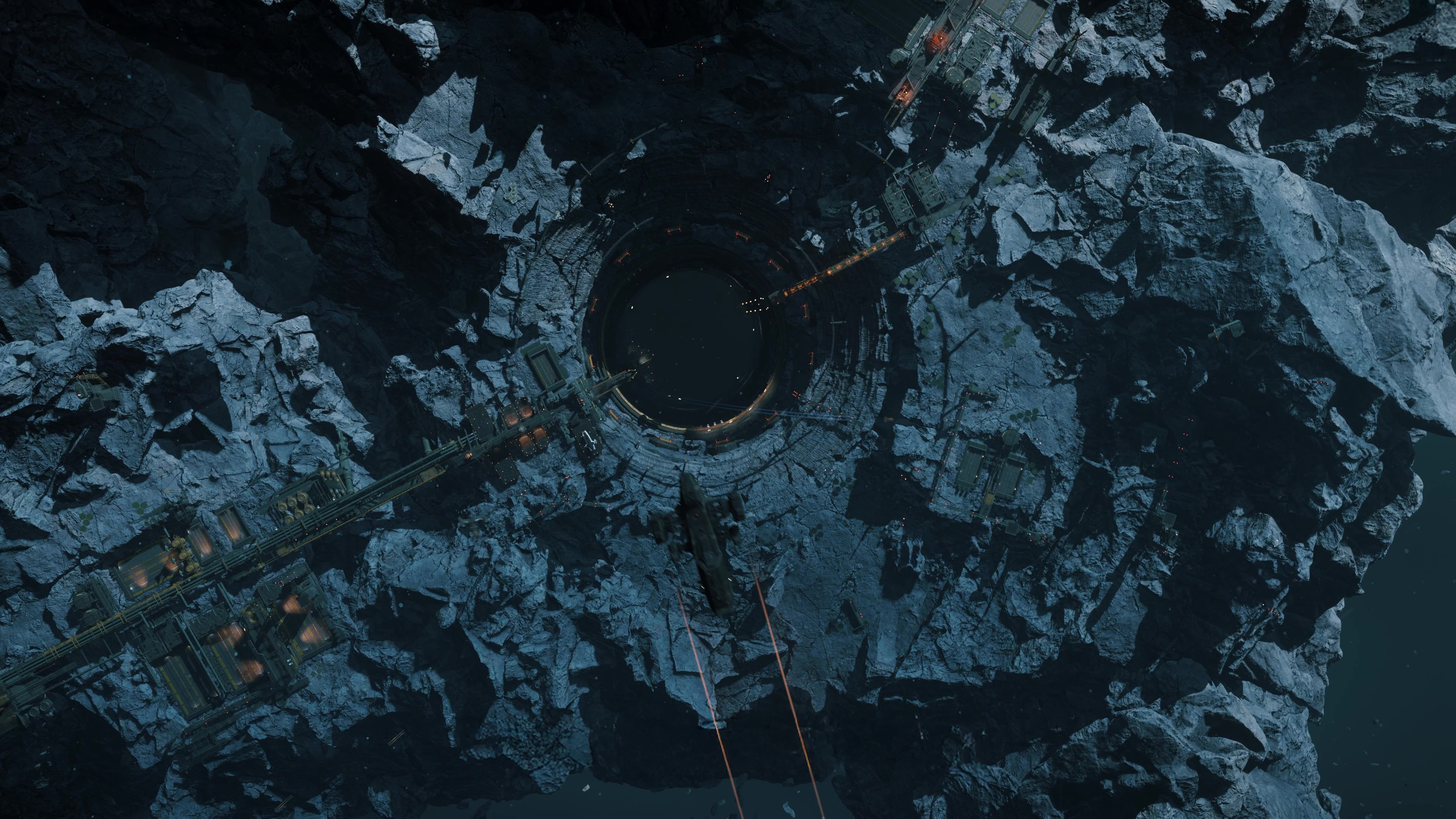
After the Hathor Group left, the strip-mined surface of Lago (in particular) provided perfect cover for criminal packs to move into the system and establish operations. The system’s population swelled and led some to believe it could challenge Spider as the center of the underworld. It was during this era that the name Nexus was first used to describe its role as a criminal system hub, earning it an additional tag: the “Crossroads of Crime.”
For decades, the UEE allocated minimal resources to curb the system’s illegal activity. Then in 2931, when Dean Kellar’s infamous and eponymous run spilled into the Nexus System, UEE authorities attempted to reassert control. They were shocked to realize that not only did the criminal element refuse to back down, but that they didn’t hesitate to open fire at law enforcement. Once Kellar’s Run finally ended, this defiance spurred the UEE to pass a motion to reclaim Nexus and strategically break up the problem-riddled cluster of lawless systems.
The UEE has since instituted a basic infrastructure in Nexus, including establishing a military and Advocacy presence, but conditions in the system are best described as risky. Shipping lanes are mostly secure and even businesses that avoided the system for centuries have started to establish operations. However, entrepreneurial haulers should take note, although the UEE has made progress in the system, the battle for control of Nexus is still ongoing. While the UEE has managed to uproot the entrenched criminal elements on Nexus III, doing so on Nexus IV (Lago) has not been nearly as easy or (as yet) successful.
Nexus I
This protoplanet so closely circles the system’s star that it has been thoroughly charred. Still, that did not stop the Hathor Group from scanning it for resources. Nothing of value was found at the time, to no one’s surprise.
Nexus II
Nexus II features a dense, nitrogen-rich atmosphere. Initially, the UEE used Nexus II to experiment with the terraforming of smog planets, but all attempts at sustaining a breathable atmosphere failed. Many believe that the cost sunk into the unsuccessful terraforming experiments drove the UEE to “sell” the system to the Hathor Group.
Nexus III
This naturally habitable world was once the central hub for the Hathor Group before outlaws made the abandoned facilities their own. When the UEE resolved to retake the system, Nexus III was their first target. After a protracted battle to control the planet, the UEE military moved in and established a permanent presence.
Today, the planet is classified for military personnel only and no one without the proper clearance should attempt to land.
Elcibre Belt
In the 26th and 27th centuries, the Hathor Group heavily mined this sparse asteroid belt. Recent technological advancements have found previously undiscovered pockets of precious minerals.
Nexus IV (Lago)
The planet’s name, Lago, comes from a famous 26th-century Vid about a fictional outlaw haven. By the 2920s, that vision was turning into a reality. The lack of a UEE presence allowed outlaws to accumulate in numbers not seen outside of Spider.
On paper, the UEE has made great strides in reclaiming the planet. An Advocacy Station, local police force and a small Citizen and civilian population have been established. Military families with service members stationed on Nexus III are offered sweetheart land deals in an effort to infuse the planet with respectable residents.
Yet even with all the positive developments, Lago is not without its issues. Settlements are small, cramped and robustly barricaded against attacks from the criminal gangs who wish to reclaim it for their own. Supplies are often in short supply. This and more makes Lago an appealing place for enterprising haulers, but a less than ideal place to live.
Nexus V (Red God)
A gas giant nicknamed the Red God by locals for its swirling colors of reds and dark browns. Sources claim the name originated with the Sang Gestas, a cryptic outlaw pack on Lago who believe the planet possesses mysterious powers.
TRAVEL WARNING
While there have been great strides in restoring law and order to Nexus, anyone entering the system should remember the three S’s of safe travel: Stay in designated lanes, Scan your surroundings, and Shields up!
HEARD IN THE WIND
“Today marks a proud moment in history as we embark on this partnership with the government to further develop our ever-ex-panding territory. I know that by working together, Hathor Group and UNE have many great things in store for this system.”
– Jela Martinez, Hathor Group CEO, Statement to the Press, 2468
“That’s kinda the thing isn’t it? Run ’round Nexus long enough, and there’s no telling who you’ll meet. Pretty much a who’s who of the worst of the worst. As I like to say, all roads lead to Nexus, and you’ll probably get robbed on all of them.”
– Telly “Tubs” Garson, Interviewed on Nexus: Crossroads of Crime, 2925
UDS-2445-3-09, Hathor, der "Scheideweg des Verbrechens"; das Nexus-System wurde in seiner langen Geschichte als vieles bezeichnet. Nexus ist nur der neueste und offensichtlichste Name des Haufenes. An einem strategisch wichtigen Knotenpunkt von Sprungbrettern gelegen, war Nexus ein umgangssprachlicher Name für das System, das erstmals im 28. Jahrhundert in Bezug auf seine Rolle als Bindeglied zwischen rechtsfreien Systemen verwendet wurde.
Als die UEE das System im Jahr 2931 zurückforderte, begannen Regierungsbeamte eine Initiative, den älteren Namen des Systems, Hathor, zu verwenden, als Versuch, seine Verbindungen zu Piraten zu löschen. Der Name war jedoch zu sehr in das Lexikon des Imperiums eingebettet, um geändert zu werden, und der Versuch wurde fast überall verspottet. Schließlich gestand die UEE zu und übernahm offiziell den Namen des Systems als Nexus.
Tatsächlich war sein Name schon immer ein starker Hinweis auf den aktuellen Zustand des Systems. Viele glauben, dass die Geschichte des Nexus am besten durch die verschiedenen Namen verstanden werden kann, die er im Laufe der Zeit trug.
UDS-2445-3-09-3-09
Nexus wurde am 9. März 2445 von Dominic Thapa, einem Piloten der UNE-Marine, entdeckt, der das damals militärisch klassifizierte Cathcart-System auf neue Sprungbretter untersucht. Es war das Militär, das dem System seinen Vornamen gab - UDS-2445-3-09. Pfadfinder traten kurz darauf in das System ein, um einen bläulich-weißen A-Typ Hauptreihenstern, fünf Planeten und einen mineralreichen Asteroidengürtel zu finden.
Die erste Bewertung des Systems durch die UNE sah Potenzial, aber auch ein Problem. Das Problem war, dass der Zugang zum Nexus nur über Cathcart möglich war, das zu diesem Zeitpunkt ein eingeschränktes militärisches System war. Anstatt zu riskieren, Cathcart für den zivilen Verkehr zu öffnen, versuchte das Militär zunächst, das System selbst zu nutzen - Terraforming Nexus IV und sogar mit Smog-Planet Terraforming auf Nexus II zu experimentieren. Leider begann die Regierung zu dieser Zeit mit einem erheblichen Budgetdefizit, und die teure Entwicklung von Nexus wurde schnell auf den Hackblock gelegt. Das Militär wollte immer noch keinen Zugang zu Cathcart gewähren, also wurde ein Kompromiss gefunden. Durch den begrenzten Zugang zu einer einzelnen Gesellschaft konnte eine strenge Kontrolle aufrechterhalten werden, so dass die UNE die Abbaurechte von Nexus an die Hathor-Gruppe für einen beträchtlichen Betrag verkaufte, der sofort zur Schließung der Haushaltslücke verwendet wurde. Einige Historiker glauben, dass die Entscheidung der regierenden universalistischen Partei geholfen hat, ihre Mehrheit bei den knappen Wahlen von 2468 aufrechtzuerhalten.
Die Hathor-Gruppe
Die Hathor-Gruppe erwarb im Januar 2468 alle Bergbaurechte am Nexus-System. Es war ein beispielloses Geschäft, das Jahrhunderte später die Inspiration für die UEE sein würde, etwas Ähnliches im Stanton-System zu tun. Das anschließende Fehlen von Regierung und öffentlicher Aufsicht ermöglichte es der Hathor-Gruppe, das System nach eigenem Ermessen zu betreiben. Die Kontrolle des Unternehmens war so allgegenwärtig, dass astronomische Karten aus dem 26. Jahrhundert es als Hathor-System bezeichneten.
Während die Hathor das Sagen hatte, wurden nur wenige Gesetze durchgesetzt. Die militärische Präsenz im benachbarten Cathcart war geschrumpft, als dieses System in eine Müllhalde umgewandelt wurde, und solange Mineralien abgebaut und Gewinne erzielt wurden, war es der Hathor-Gruppe egal, was ihre Mitarbeiter und Auftragnehmer außerhalb der Arbeit machten. Nexus wurde bekannt für Glücksspiel, grassierende Gewalt und unzählige illegale Aktivitäten. Die Kriminalität wurde zum einzigen tragfähigen Wirtschaftsmotor des Systems außerhalb des Bergbaus.
Illegale Aktivitäten intensivierten sich erst mit der Entdeckung von drei zusätzlichen Sprungbrettpunkten und erhöhtem Traffic aus benachbarten, nicht beanspruchten Systemen. Gangs begannen, die Flugrouten zwischen den Sprungbrettern und Planeten zu verfolgen und plünderten jedes Schiff, das sie fanden. Dies, kombiniert mit dem Würgegriff der Hathor-Gruppe auf das System, hielt die meisten Menschen vom Besuch ab und die meisten Unternehmen von der Betriebsgründung.
Unterdessen riss die Hathor-Gruppe weiterhin Ressourcen aus Nexus III, Nexus IV und dem Elcibre Belt heraus, bis die Gewinnmarge unter das Budget für Ballonsicherheit fiel. Die Hathor-Gruppe gab das System 2672 offiziell auf und hinterließ eine unwirtliche Ödnis, die von jahrhundertelangem Bergbau und fehlender ziviler Basisinfrastruktur geprägt war. Es sollte keine Überraschung sein, was dann geschah.
Der Scheideweg des Verbrechens
Nachdem die Hathor-Gruppe gegangen war, bot insbesondere die bandberührte Oberfläche von Lagos eine perfekte Abdeckung für kriminelle Packungen, die in das System eindringen und den Betrieb aufnehmen konnten. Die Bevölkerung des Systems schwoll an und ließ einige glauben, dass es Spider als das Zentrum der Unterwelt herausfordern könnte. In dieser Zeit wurde der Name Nexus erstmals verwendet, um seine Rolle als Drehscheibe des kriminellen Systems zu beschreiben, was ihm ein zusätzliches Etikett einbrachte: die "Kreuzung der Verbrechen".
Seit Jahrzehnten hat die UEE minimale Ressourcen bereitgestellt, um die illegalen Aktivitäten des Systems einzudämmen. Dann, im Jahr 2931, als Dean Kellars berüchtigter und gleichnamiger Lauf in das Nexus-System eindrang, versuchten die Behörden der UEE, die Kontrolle wiederherzustellen. Sie waren schockiert, als sie feststellten, dass sich das kriminelle Element nicht nur weigerte, zurückzutreten, sondern dass sie auch nicht zögerten, das Feuer auf die Strafverfolgung zu eröffnen. Nachdem Kellars Lauf schließlich beendet war, veranlasste diese Missachtung die UEE, einen Antrag zur Rückforderung des Nexus zu stellen und den problematischen Cluster gesetzloser Systeme strategisch aufzulösen.
Die UEE hat seitdem eine grundlegende Infrastruktur in Nexus eingerichtet, einschließlich der Einrichtung einer Militär- und Advocacy-Präsenz, aber die Bedingungen im System werden am besten als riskant beschrieben. Die Schifffahrtswege sind meist sicher, und selbst Unternehmen, die das System jahrhundertelang vermieden haben, haben begonnen, ihren Betrieb aufzunehmen. Unternehmerische Spediteure sollten jedoch zur Kenntnis nehmen, obwohl die UEE Fortschritte im System gemacht hat, ist der Kampf um die Kontrolle des Nexus noch nicht abgeschlossen. Während es der UEE gelungen ist, die verwurzelten kriminellen Elemente auf Nexus III zu entwurzeln, war dies auf Nexus IV (Lago) nicht annähernd so einfach oder (noch) erfolgreich.
Nexus I
Dieser Protoplanet umkreist den Stern des Systems so eng, dass er vollständig verkohlt ist. Das hinderte die Hathor-Gruppe jedoch nicht daran, sie nach Ressourcen zu durchsuchen. Zu diesem Zeitpunkt wurde zu keiner Überraschung etwas Wertvolles gefunden.
Nexus II
Nexus II zeichnet sich durch eine dichte, stickstoffreiche Atmosphäre aus. Ursprünglich benutzte die UEE Nexus II, um mit der Terraform von Smog-Planeten zu experimentieren, aber alle Versuche, eine atmungsaktive Atmosphäre aufrechtzuerhalten, scheiterten. Viele glauben, dass die Kosten, die in die erfolglosen Terraforming-Experimente flossen, die UEE dazu brachten, das System an die Hathor-Gruppe zu "verkaufen".
Nexus III
Diese natürlich bewohnbare Welt war einst die zentrale Drehscheibe der Hathor-Gruppe, bevor Gesetzlose die verlassenen Anlagen zu ihren eigenen machten. Als die UEE beschloss, das System wieder einzunehmen, war Nexus III ihr erstes Ziel. Nach einem langwierigen Kampf um die Kontrolle des Planeten zog das UEE-Militär ein und etablierte eine permanente Präsenz.
Heute ist der Planet nur für Militärangehörige bestimmt, und niemand ohne die entsprechende Genehmigung sollte versuchen zu landen.
Elcibre Gürtel
Im 26. und 27. Jahrhundert förderte die Hathor-Gruppe diesen spärlichen Asteroidengürtel schwer ab. Die jüngsten technologischen Fortschritte haben bisher unentdeckte Taschen mit wertvollen Mineralien gefunden.
Nexus IV (Lago)
Der Name des Planeten, Lago, stammt von einem berühmten Vid aus dem 26. Jahrhundert über einen fiktiven Geächtetenhafen. In den 2920er Jahren wurde diese Vision Wirklichkeit. Das Fehlen einer UEE-Präsenz erlaubte es den Gesetzlosen, sich in Zahlen zu sammeln, die außerhalb von Spider nicht zu sehen waren.
Auf dem Papier hat die UEE große Fortschritte bei der Rückgewinnung des Planeten gemacht. Es wurden eine Advocacy-Station, eine lokale Polizei sowie ein kleiner Bürger und eine Zivilbevölkerung eingerichtet. Militärischen Familien mit Dienstmitgliedern, die auf Nexus III stationiert sind, werden süße Landabkommen angeboten, um den Planeten mit respektablen Bewohnern zu versorgen.
Doch trotz all der positiven Entwicklungen ist der Lago nicht ohne Probleme. Die Siedlungen sind klein, eng und robust gegen Angriffe der kriminellen Banden verbarrikadiert, die sie selbst zurückfordern wollen. Die Vorräte sind oft knapp. Dies und noch mehr macht Lago zu einem attraktiven Ort für unternehmerisch denkende Spediteure, aber nicht gerade ein idealer Ort zum Leben.
Nexus V (Roter Gott)
Ein Gasriese, der von den Einheimischen wegen seiner wirbelnden Farben von Rot und Dunkelbraun als der Rote Gott bezeichnet wird. Quellen behaupten, der Name stamme von den Sang Gestas, einem kryptischen Gesetzlosen am Lago, der glaubt, dass der Planet mysteriöse Kräfte besitzt.
REISEWARNUNG
Während es große Fortschritte bei der Wiederherstellung von Recht und Ordnung in Nexus gegeben hat, sollte jeder, der das System betritt, sich an die drei S des sicheren Reisens erinnern: Bleiben Sie in den dafür vorgesehenen Bahnen, scannen Sie Ihre Umgebung und Schilde hoch!
IM WIND GEHÖRT
"Heute ist ein stolzer Moment in der Geschichte, in dem wir diese Partnerschaft mit der Regierung eingehen, um unser sich ständig erweiterndes Gebiet weiterzuentwickeln. Ich weiß, dass die Hathor-Gruppe und die UNE durch die Zusammenarbeit viele große Dinge für dieses System vor sich haben."
- Jela Martinez, CEO der Hathor Group, Presseerklärung, 2468
"Das ist irgendwie die Sache, nicht wahr? Laufen Sie lange genug um Nexus herum, und es ist nicht abzusehen, wen Sie treffen werden. So ziemlich ein Wer ist wer von den Schlimmsten der Schlimmsten. Wie ich gerne sage, führen alle Wege zum Nexus, und du wirst wahrscheinlich bei allen ausgeraubt werden."
- Telly "Tubs" Garson, Interview mit Nexus: Kreuzung der Kriminalität, 2925
UDS-2445-3-09, Hathor, the “Crossroads of Crime”; the Nexus System has been called many things during its long history. Nexus is just the latest and most obvious moniker of the bunch. Located at a strategically important junction of jump points, Nexus was a colloquial name for the system first used in the 28th century in reference to its role connecting lawless systems.
When the UEE reclaimed the system in 2931, government officials began an initiative to use the system’s older name, Hathor, as an attempt to erase its associations with pirates. However, the name was too embedded in the Empire’s lexicon to be changed, and the effort was almost universally mocked. Eventually the UEE conceded and officially adopted the system’s name as Nexus.
In fact, its name has always been a strong indication of the current condition of the system. Many believe the history of Nexus can be best understood through the various names it bore over the ages.
UDS-2445-3-09
Nexus was discovered on March 9, 2445, by Dominic Thapa, a UNE Navy pilot probing the then military classified Cathcart System for new jump points. It was the military that assigned the system its first name — UDS-2445-3-09. Pathfinders entered the system shortly thereafter to find a bluish-white A-type main-sequence star, five planets and a mineral-rich asteroid belt.
The UNE’s first assessment of the system saw potential, but also a problem. The problem was that Nexus could only be accessed through Cathcart, which was a restricted military system at the time. Rather than risk opening Cathcart to civilian traffic, the military initially tried to make use of the system themselves — terraforming Nexus IV and even experimenting with smog-planet terraforming on Nexus II. Unfortunately, around this time the government started facing a significant budget shortfall, and the expensive development of Nexus was quickly placed on the chopping block. The military still did not want to allow access to Cathcart, so a compromise was settled upon. By allowing limited access to a single corporation, strict control could still be maintained, so the UNE sold Nexus’ mining rights to the Hathor Group for a considerable sum, which was immediately used to help fill the budget gap. Some historians believe the decision helped the ruling Universalist party maintain their majority in the close elections of 2468.
The Hathor Group
The Hathor Group purchased all mining rights to the Nexus System in January of 2468. It was an unprecedented deal that centuries later would be the inspiration for the UEE to do something similar in the Stanton System. The subsequent lack of government and public oversight allowed the Hathor Group to run the system as they saw fit. The company’s control was so ubiquitous that astronomical charts from the 26th century referred to it as the Hathor System.
While Hathor was in charge, few laws were enforced. The military presence in neighboring Cathcart had dwindled as that system was converted into a dumping ground, and as long as minerals were mined, and profits made, the Hathor Group didn’t care what their employees and contractors did outside of work. Nexus became known for gambling, rampant violence and innumerable illicit activities. Crime became the system’s only viable economic engine outside of mining.
Illegal activity only intensified with the subsequent discovery of three additional jump points and increased traffic from neighboring unclaimed systems. Gangs began to stalk the flight paths between the jump points and planets, preying on any ship they found. That, combined with the Hathor Group’s stranglehold on the system, dissuaded most people from visiting and most businesses from setting up operations.
Meanwhile, the Hathor Group continued to rip resources out of Nexus III, Nexus IV and the Elcibre Belt until the profit margin began to dip below their ballooning security budget. The Hathor Group officially abandoned the system in 2672, leaving behind an inhospitable wasteland, scarred by centuries of mining and lacking basic civilian infrastructure. It should come as no surprise what happened next.
The Crossroads of Crime
After the Hathor Group left, the strip-mined surface of Lago (in particular) provided perfect cover for criminal packs to move into the system and establish operations. The system’s population swelled and led some to believe it could challenge Spider as the center of the underworld. It was during this era that the name Nexus was first used to describe its role as a criminal system hub, earning it an additional tag: the “Crossroads of Crime.”
For decades, the UEE allocated minimal resources to curb the system’s illegal activity. Then in 2931, when Dean Kellar’s infamous and eponymous run spilled into the Nexus System, UEE authorities attempted to reassert control. They were shocked to realize that not only did the criminal element refuse to back down, but that they didn’t hesitate to open fire at law enforcement. Once Kellar’s Run finally ended, this defiance spurred the UEE to pass a motion to reclaim Nexus and strategically break up the problem-riddled cluster of lawless systems.
The UEE has since instituted a basic infrastructure in Nexus, including establishing a military and Advocacy presence, but conditions in the system are best described as risky. Shipping lanes are mostly secure and even businesses that avoided the system for centuries have started to establish operations. However, entrepreneurial haulers should take note, although the UEE has made progress in the system, the battle for control of Nexus is still ongoing. While the UEE has managed to uproot the entrenched criminal elements on Nexus III, doing so on Nexus IV (Lago) has not been nearly as easy or (as yet) successful.
Nexus I
This protoplanet so closely circles the system’s star that it has been thoroughly charred. Still, that did not stop the Hathor Group from scanning it for resources. Nothing of value was found at the time, to no one’s surprise.
Nexus II
Nexus II features a dense, nitrogen-rich atmosphere. Initially, the UEE used Nexus II to experiment with the terraforming of smog planets, but all attempts at sustaining a breathable atmosphere failed. Many believe that the cost sunk into the unsuccessful terraforming experiments drove the UEE to “sell” the system to the Hathor Group.
Nexus III
This naturally habitable world was once the central hub for the Hathor Group before outlaws made the abandoned facilities their own. When the UEE resolved to retake the system, Nexus III was their first target. After a protracted battle to control the planet, the UEE military moved in and established a permanent presence.
Today, the planet is classified for military personnel only and no one without the proper clearance should attempt to land.
Elcibre Belt
In the 26th and 27th centuries, the Hathor Group heavily mined this sparse asteroid belt. Recent technological advancements have found previously undiscovered pockets of precious minerals.
Nexus IV (Lago)
The planet’s name, Lago, comes from a famous 26th-century Vid about a fictional outlaw haven. By the 2920s, that vision was turning into a reality. The lack of a UEE presence allowed outlaws to accumulate in numbers not seen outside of Spider.
On paper, the UEE has made great strides in reclaiming the planet. An Advocacy Station, local police force and a small Citizen and civilian population have been established. Military families with service members stationed on Nexus III are offered sweetheart land deals in an effort to infuse the planet with respectable residents.
Yet even with all the positive developments, Lago is not without its issues. Settlements are small, cramped and robustly barricaded against attacks from the criminal gangs who wish to reclaim it for their own. Supplies are often in short supply. This and more makes Lago an appealing place for enterprising haulers, but a less than ideal place to live.
Nexus V (Red God)
A gas giant nicknamed the Red God by locals for its swirling colors of reds and dark browns. Sources claim the name originated with the Sang Gestas, a cryptic outlaw pack on Lago who believe the planet possesses mysterious powers.
TRAVEL WARNING
While there have been great strides in restoring law and order to Nexus, anyone entering the system should remember the three S’s of safe travel: Stay in designated lanes, Scan your surroundings, and Shields up!
HEARD IN THE WIND
“Today marks a proud moment in history as we embark on this partnership with the government to further develop our ever-ex-panding territory. I know that by working together, Hathor Group and UNE have many great things in store for this system.”
– Jela Martinez, Hathor Group CEO, Statement to the Press, 2468
“That’s kinda the thing isn’t it? Run ’round Nexus long enough, and there’s no telling who you’ll meet. Pretty much a who’s who of the worst of the worst. As I like to say, all roads lead to Nexus, and you’ll probably get robbed on all of them.”
– Telly “Tubs” Garson, Interviewed on Nexus: Crossroads of Crime, 2925
UDS-2445-3-09, Hathor, the “Crossroads of Crime”; the Nexus System has been called many things during its long history. Nexus is just the latest and most obvious moniker of the bunch. Located at a strategically important junction of jump points, Nexus was a colloquial name for the system first used in the 28th century in reference to its role connecting lawless systems.
When the UEE reclaimed the system in 2931, government officials began an initiative to use the system’s older name, Hathor, as an attempt to erase its associations with pirates. However, the name was too embedded in the Empire’s lexicon to be changed, and the effort was almost universally mocked. Eventually the UEE conceded and officially adopted the system’s name as Nexus.
In fact, its name has always been a strong indication of the current condition of the system. Many believe the history of Nexus can be best understood through the various names it bore over the ages.
UDS-2445-3-09
Nexus was discovered on March 9, 2445, by Dominic Thapa, a UNE Navy pilot probing the then military classified Cathcart System for new jump points. It was the military that assigned the system its first name — UDS-2445-3-09. Pathfinders entered the system shortly thereafter to find a bluish-white A-type main-sequence star, five planets and a mineral-rich asteroid belt.
The UNE’s first assessment of the system saw potential, but also a problem. The problem was that Nexus could only be accessed through Cathcart, which was a restricted military system at the time. Rather than risk opening Cathcart to civilian traffic, the military initially tried to make use of the system themselves — terraforming Nexus IV and even experimenting with smog-planet terraforming on Nexus II. Unfortunately, around this time the government started facing a significant budget shortfall, and the expensive development of Nexus was quickly placed on the chopping block. The military still did not want to allow access to Cathcart, so a compromise was settled upon. By allowing limited access to a single corporation, strict control could still be maintained, so the UNE sold Nexus’ mining rights to the Hathor Group for a considerable sum, which was immediately used to help fill the budget gap. Some historians believe the decision helped the ruling Universalist party maintain their majority in the close elections of 2468.
The Hathor Group
The Hathor Group purchased all mining rights to the Nexus System in January of 2468. It was an unprecedented deal that centuries later would be the inspiration for the UEE to do something similar in the Stanton System. The subsequent lack of government and public oversight allowed the Hathor Group to run the system as they saw fit. The company’s control was so ubiquitous that astronomical charts from the 26th century referred to it as the Hathor System.
While Hathor was in charge, few laws were enforced. The military presence in neighboring Cathcart had dwindled as that system was converted into a dumping ground, and as long as minerals were mined, and profits made, the Hathor Group didn’t care what their employees and contractors did outside of work. Nexus became known for gambling, rampant violence and innumerable illicit activities. Crime became the system’s only viable economic engine outside of mining.
Illegal activity only intensified with the subsequent discovery of three additional jump points and increased traffic from neighboring unclaimed systems. Gangs began to stalk the flight paths between the jump points and planets, preying on any ship they found. That, combined with the Hathor Group’s stranglehold on the system, dissuaded most people from visiting and most businesses from setting up operations.
Meanwhile, the Hathor Group continued to rip resources out of Nexus III, Nexus IV and the Elcibre Belt until the profit margin began to dip below their ballooning security budget. The Hathor Group officially abandoned the system in 2672, leaving behind an inhospitable wasteland, scarred by centuries of mining and lacking basic civilian infrastructure. It should come as no surprise what happened next.
The Crossroads of Crime
After the Hathor Group left, the strip-mined surface of Lago (in particular) provided perfect cover for criminal packs to move into the system and establish operations. The system’s population swelled and led some to believe it could challenge Spider as the center of the underworld. It was during this era that the name Nexus was first used to describe its role as a criminal system hub, earning it an additional tag: the “Crossroads of Crime.”
For decades, the UEE allocated minimal resources to curb the system’s illegal activity. Then in 2931, when Dean Kellar’s infamous and eponymous run spilled into the Nexus System, UEE authorities attempted to reassert control. They were shocked to realize that not only did the criminal element refuse to back down, but that they didn’t hesitate to open fire at law enforcement. Once Kellar’s Run finally ended, this defiance spurred the UEE to pass a motion to reclaim Nexus and strategically break up the problem-riddled cluster of lawless systems.
The UEE has since instituted a basic infrastructure in Nexus, including establishing a military and Advocacy presence, but conditions in the system are best described as risky. Shipping lanes are mostly secure and even businesses that avoided the system for centuries have started to establish operations. However, entrepreneurial haulers should take note, although the UEE has made progress in the system, the battle for control of Nexus is still ongoing. While the UEE has managed to uproot the entrenched criminal elements on Nexus III, doing so on Nexus IV (Lago) has not been nearly as easy or (as yet) successful.
Nexus I
This protoplanet so closely circles the system’s star that it has been thoroughly charred. Still, that did not stop the Hathor Group from scanning it for resources. Nothing of value was found at the time, to no one’s surprise.
Nexus II
Nexus II features a dense, nitrogen-rich atmosphere. Initially, the UEE used Nexus II to experiment with the terraforming of smog planets, but all attempts at sustaining a breathable atmosphere failed. Many believe that the cost sunk into the unsuccessful terraforming experiments drove the UEE to “sell” the system to the Hathor Group.
Nexus III
This naturally habitable world was once the central hub for the Hathor Group before outlaws made the abandoned facilities their own. When the UEE resolved to retake the system, Nexus III was their first target. After a protracted battle to control the planet, the UEE military moved in and established a permanent presence.
Today, the planet is classified for military personnel only and no one without the proper clearance should attempt to land.
Elcibre Belt
In the 26th and 27th centuries, the Hathor Group heavily mined this sparse asteroid belt. Recent technological advancements have found previously undiscovered pockets of precious minerals.
Nexus IV (Lago)
The planet’s name, Lago, comes from a famous 26th-century Vid about a fictional outlaw haven. By the 2920s, that vision was turning into a reality. The lack of a UEE presence allowed outlaws to accumulate in numbers not seen outside of Spider.
On paper, the UEE has made great strides in reclaiming the planet. An Advocacy Station, local police force and a small Citizen and civilian population have been established. Military families with service members stationed on Nexus III are offered sweetheart land deals in an effort to infuse the planet with respectable residents.
Yet even with all the positive developments, Lago is not without its issues. Settlements are small, cramped and robustly barricaded against attacks from the criminal gangs who wish to reclaim it for their own. Supplies are often in short supply. This and more makes Lago an appealing place for enterprising haulers, but a less than ideal place to live.
Nexus V (Red God)
A gas giant nicknamed the Red God by locals for its swirling colors of reds and dark browns. Sources claim the name originated with the Sang Gestas, a cryptic outlaw pack on Lago who believe the planet possesses mysterious powers.
TRAVEL WARNING
While there have been great strides in restoring law and order to Nexus, anyone entering the system should remember the three S’s of safe travel: Stay in designated lanes, Scan your surroundings, and Shields up!
HEARD IN THE WIND
“Today marks a proud moment in history as we embark on this partnership with the government to further develop our ever-ex-panding territory. I know that by working together, Hathor Group and UNE have many great things in store for this system.”
– Jela Martinez, Hathor Group CEO, Statement to the Press, 2468
“That’s kinda the thing isn’t it? Run ’round Nexus long enough, and there’s no telling who you’ll meet. Pretty much a who’s who of the worst of the worst. As I like to say, all roads lead to Nexus, and you’ll probably get robbed on all of them.”
– Telly “Tubs” Garson, Interviewed on Nexus: Crossroads of Crime, 2925
Links
No links available.


Metadata
- CIG ID
- 15131
- Channel
- Spectrum Dispatch
- Category
- Undefined
- Series
- Galactic Guide
- Comments
- 70
- Published
- 10 years ago (2015-12-22T00:00:00+00:00)