The Shipyard: SCU and Cargo Capacity
Engineering Undefined Concept Ship Q&AContent
SCU and Cargo Capacity A Guide to the New Ship Matrix
Greetings Citizens!
One of the exciting new features coming online with Star Citizen ALpha 3.0 and beyond is the ability for ships to ferry cargo. This presents a world of opportunity for players to pilot ships beyond combat as we hope to provide interesting alternatives and very real ways for players to earn an honest (or perhaps dishonest…) day’s pay. Buying and selling commodities from stations and transporting them across civilized space to the people who need it most (or willing to pay the most for it) we hope will encourage many players to take up a career as a Transporter.
The Transporter playstyle comes with an entirely new way for players to consider which ships they want to fly. Cargo capacity becomes one of the most important considerations when judging which ship to use. Highest SCU capacities may seem like no-brainers when looking to pick the best cargo ship, but many of the larger vessels eschew defensive capabilities like thicker armor, more weapon mounts, or faster engines for that greater cargo space and can be left exposed as a result. Your decisions at this stage may ultimately lead to the great rewards, or even greater catastrophes.
Cargo ships come in all shapes and sizes, but consider which trade routes are available to you before deciding. A Hull-C can carry an impressive amount of freight but its defensive options are extremely limited. Hull pilots will need to employ fighter escorts or travel in convoy in hopes to deter would-be pirates from accosting them. Ships like the Caterpillar and Starfarer offer more defense and maneuverability at the cost of cargo space. If your trade route takes you to frontier worlds where fringers play fast and loose with the law, you’re going to be thankful you have something up your sleeves to make a ship-jacker think twice. Smaller ships like the Cutlass have a decent amount of SCU capacity for short runs but more importantly, the combat acumen to go toe-to-toe with aggressors and protect its precious cargo.
Knowing not only the amount of cargo that needs to be taken but the route that cargo will take should help a discerning pilot make the right choice about which transporter is right for them. Of course, the more “entrepreneurial” trader may also want to consider whether they need to avoid any… imperial entanglements.
As more and more legitimate trade routes expand across the systems, so too will the number of pirates looking take what isn’t theirs. Similarly, as new colonies start to become established and will need deliveries of restricted weapons to defend themselves against marauders, so too will back-alley dealers need a steady supply of illegal stims and narcotics. Whatever the story, willing Transporters are going to needed for smuggling cargo under the nose of law enforcement from time to time. We want to make sure that gameplay is involving, fun, and more than a little bit nerve-wracking. Smugglers have a range of techniques available to them to sneak their cargo by authorities, from simply not declaring it, through making specific goods appear to be something else, and right up to masking them completely so they won’t appear on scans at all. Judging a ship for its smuggling capabilities is another consideration when it comes to picking the right ship for the right job which we’ll cover below.
Commodities and Units and SCU, Oh My!
When the player buys a commodity, they do so in amounts of ‘Units’. “Give me thirty units of beans” one might say. Likewise, when buying weapons, equipment and other things, they all have a numerical size attribute that governs how many ‘units’ they take up. These values are essential in figuring out how players store and transport their goods, which brings us to the Unit’s big brother: SCU.
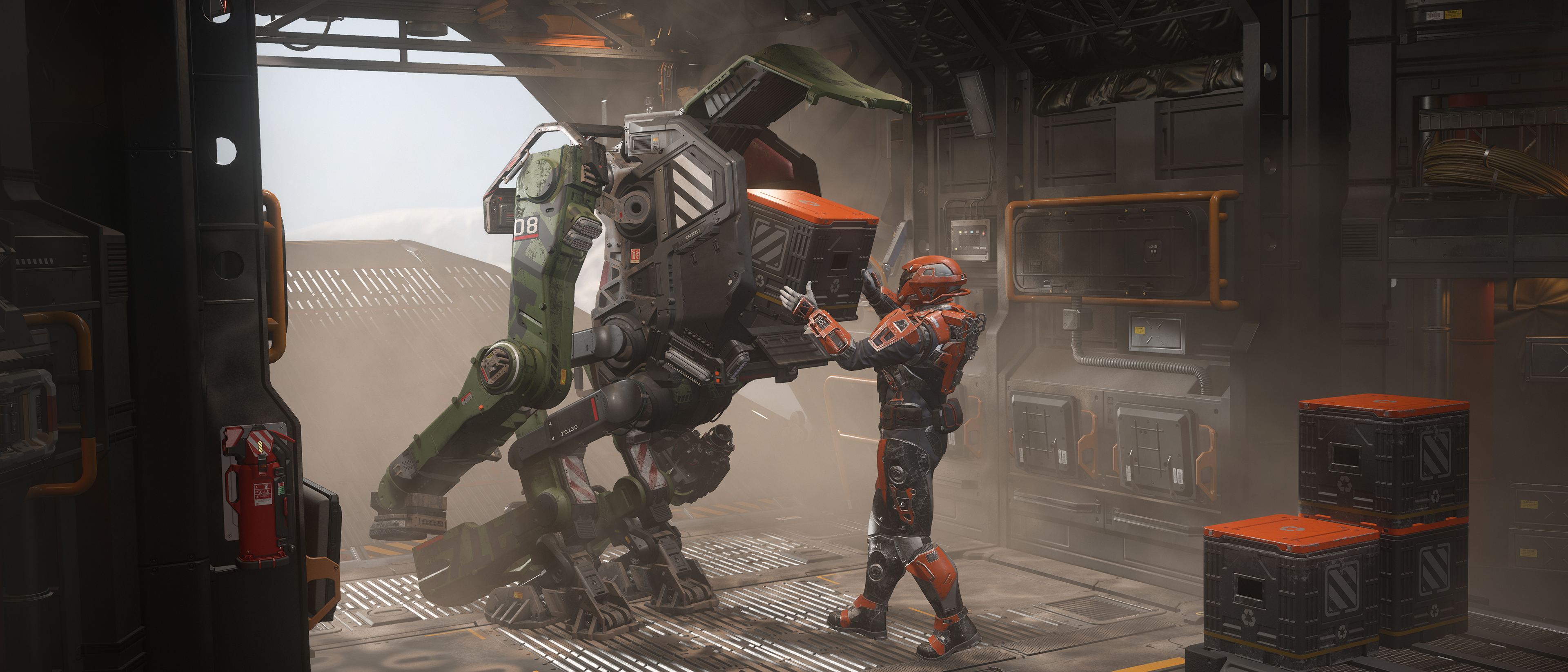
A Standard Cargo Unit, or SCU, is the universal measure for cargo storage and transport measurements. 1 SCU will be our standard box, the size of which all other boxes are measured. We wanted a universal unit so that when we say a ship has space for 100 SCU, you’ll come to know just how many containers you’ll be able to fit. More than just using 1m3, we want to make sure we can group the commodity with the container. In terms of metrics, 1 SCU comes in at (1.25m)3 which is 1m3 of cargo space with 125mm protection on each side, base and lid. When we have our refrigerated containers, biohazard containers, potentially livestock containers in later releases, it allows us to use that 125mm edge for extra protection or bespoke construction without losing the internal cargo space. So, as the name suggests, our cargo is universally sized, regardless of what kind of container you come across.
1 SCU can hold 100 units before it’s full. Since 1 SCU is the smallest sized storage container, this mean buying 1 unit of beans or 100 units of beans, the same 1 SCU of Beans will be delivered into the cargo hold. As you can probably imagine, the 101st unit of Beans that is purchased means that beans are now occupying 2 SCU in the cargo hold. The more efficient traders will want to round off their cargo to the nearest 100 if they can. It’s also worth noting that players cannot mix commodities in the same SCU Crate, so half filling 1 SCU with Beans doesn’t mean they can fill the other half with Pork and save on space, Pork will be stored in its own SCU crate. Any additional units of Pork or Beans that are bought will be added into the existing SCUs, though. This will allow players to work at fixing their inefficient cargo holds and getting the most from their space.
Since weapons and equipment have a unit size attributed to them too, it allows players to buy SCU-sized Storage Crates allowing them to secure their equipment and weapons safely on the grid, rather than just leave them loosely around the ship.
The Numbers Game or: My Ship’s Place in All This
When it comes to deciding on a ship’s cargo capacity, we have to think about what role we see that ship occupying within the Star Citizen universe.
We have entry level ships that have been given a limited amount of cargo space. The idea here is that players will be able to buy these ships cheap and once they’re making regular cargo runs with a full hold, should be able to afford going bigger. The Auroras and Reliants in these cases are designed to give players a taste of the Transporter career without breaking the bank to get involved, and should they like it they can go bigger.
Other ships have cargo capacity without them being considered a ‘cargo ship’-per se. These are vessels we simply think players would expect to be able to transport a bit of cargo through. These ships are usually not taking full advantage of the space but have an area put aside for storage, like the Hornet or Mustang.
Then we have the dedicated cargo ships whose cargo holds are as squared off as we can get them to be able to utilize as much space as possible while still maintaining structural integrity. We’re talking Freelancers, Starfarers, Caterpillars, and the Hull Series to name only a few. These ships have their cargo space determined a balance of cost and performance.
When it comes to determining where a cargo ship sits in relation to another, we look at its speed and combat proficiency, and make a judgement about what kind of capacity fits with that kind of ship. A classic pairing would be the Freelancer opposed to the Cutlass. The Freelancer has sacrificed some combat and maneuvering ability to be able to haul more goods. Looking at the new Cutlass it can hold its own in a fight and even go on the offensive if needed, but at a cost of cargo space. We want players to make a judgement what kind of cargo ship is right for the specific job. Where will they be taking goods? How fast do they need to get there? How much is needed to fulfill the order? We’re endeavoring to make certain no two cargo ships are providing the exact same role. Even in the specialized field of cargo transportation, there can be even more specialization depending on the routes, danger and even commodities themselves that the player wishes to transport.
We’re doing what we can to ensure that cargo space is also logistically sensible. Cargo squeezed into every nook and cranny of the ship might seem like a win for the player on a numerical side, but the act of loading and unloading will become a pain or even impossible with high ceilings and small doorways. The advantage of the Caterpillar with its huge doors will not always be structurally sound for other cargo ships. There may be instances where some ships have potentially ‘useable’ space left over.
Packing for the Job You Have, and for the Job You Want
Overloading a ship with more cargo is certainly something a lot of pilots have asked for, and it’s something we’re going to support. Because cargo will be able to be lifted and placed by hand, the player won’t need a cargo grid underneath them in order to place it, meaning they can release those commodities anywhere. We encourage players to want to store their cargo securely though, otherwise a myriad of additional challenges may await you.
The more you carry, the more mass you’re trying to move around, the more adverse your ship’s efficiency is going to be. If you’re exceeding mass recommendations with loose cargo just placed wherever you’re going to throw out a ship’s interior balance and place more strain on thrusters of one side than the other. The flight system will do its best to compensate, but expect to burn through fuel a lot faster and risk additional component wear-and-tear than at an optimized weight.
Additionally, as we develop our physics for internal behavior we are looking at room temperature, atmospherics and other forces to act upon the player and when cargo isn’t secure, these systems will act upon that, as well. Future updates will see inertial forces act upon a ship so that every bump or a bang from combat, re-entry, quantum jumps etc. will knock around anything unsecureed in the cargo hold, potentially causing it to suffer damage. While the extent of damage remains to be seen, expect some loss of integrity of the goods you’re shipping if not being stored appropriately. Also: keep an eye on any loose cargo if someone opens an airlock, too. With nothing keeping it in place, your goods will find themselves at the mercy of any decompression suffered.
The True Purpose of Keeping Cargo Off Grids
Smuggling is one of the next big features we will be adding to the Cargo System and is something we’re excited for players to take advantage of. Goods that will be secured in place on the cargo grid will also be considered ‘declared’ on the ship’s cargo manifest. What this means is that when players go through customs checkpoints in the future, or are encountered by law enforcement out in the space lanes, their manifest will be broadcast like a trucker handing over a clipboard, declaring what’s inside their hold that everything is above board.
This will allow a player to be able to make a conscious effort not to declare an item as well, by deliberately leaving it off the grid. As highlighted beforehand, a box left in a passageway risks unbalancing a ship, over-weighing it and rattling around in the back, but once the smuggling system comes online, players have a plus side in that it’s not broadcast to others as part of the manifest. A player who wants to slip a crate full of contraband through customs will be able to do so simply by leaving it off the grid and avoiding transmitting its details to a passing police officer.
Of course, the police wouldn’t be doing their job properly if they just believed what every trucker told them, so they will be scanning ships on occasion to confirm what the transporter is ferrying, whether it is on the grid or not. To combat this, we’ll be allowing smugglers to add additional technology to their SCU crates such as ‘scramblers’ that will make it harder to detect, or something we’re calling ‘spoofers’ to make a container appear as something else altogether.
It’s unlikely any smuggler trickery will be able to stand up to sustained scanning forever though, so if the player finds themselves under continued scrutiny from the law, or maybe even a pirate looking to relieve them of their precious cargo, unless they have the best gear on the black market to respond with, it may be worth thinking about finding a new line of work. This won’t be a life for the meek.
Frequently Asked Questions or: Questions We Figured You Might Have
The Reclaimer originally sold with 2,500 SCU and now it’s listed as 360. Where did the cargo space go?
A: As part of our update to the listings, we now refer to a ship’s ‘Cargo Capacity’ as its ‘usable’ cargo space for storing and transporting commodities and other items. For the Reclaimer, the majority of its internal space is dedicated exclusively to storing the salvage it has gathered. Since we don’t want to misrepresent the ship to potential buyers, we list the Reclaimer as having ‘only’ 360 SCU of Cargo Capacity. Our hope is that players looking for their next cargo ship have a much clearer understanding of the actual ‘usable’ cargo space.
Players should expect the same for listings on mining ships like the Orion and Prospector too. These ships dedicate most of their previously listed SCU space to storing and processing the metals, crystals, and minerals they gather through mining operations, so players will see their ‘Cargo Capacity’ number go down compared to what it may have previously been listed at.
Rest assured, the space has gone nowhere, it’s just better labelled now so players know exactly what they’re getting.
Further Reading
Ship Mass Careers and Roles Thrusters Ship Technical Information Ordnance Hardpoints Weapon Hardpoints Other Hardpoints Turrets Variants & Modules scu and Cargo
SCU und Laderaum Ein Leitfaden für die neue Schiffsmatrix
Grüße Bürger!
Eine der aufregenden neuen Funktionen, die mit Star Citizen ALpha 3.0 und darüber hinaus online gehen, ist die Möglichkeit für Schiffe, Fracht zu transportieren. Dies bietet Spielern die Möglichkeit, Schiffe über den Kampf hinaus zu steuern, da wir hoffen, interessante Alternativen und sehr reale Möglichkeiten für die Spieler zu bieten, einen ehrlichen (oder vielleicht unehrlichen....) Tageslohn zu verdienen. Wir hoffen, dass der Kauf und Verkauf von Gütern von Bahnhöfen und deren Transport durch zivilisierte Gebiete zu den Menschen, die sie am meisten brauchen (oder bereit sind, dafür die meisten zu bezahlen), viele Spieler ermutigen wird, eine Karriere als Transporter einzuschlagen.
Der Transporter Spielstil bietet den Spielern eine völlig neue Möglichkeit, sich zu überlegen, welche Schiffe sie fliegen wollen. Die Ladekapazität wird zu einem der wichtigsten Faktoren bei der Beurteilung des einzusetzenden Schiffes. Höchste SCU-Kapazitäten mögen wie No-Brainers erscheinen, wenn es darum geht, das beste Frachtschiff auszuwählen, aber viele der größeren Schiffe meiden defensive Fähigkeiten wie dickere Rüstungen, mehr Waffenhalterungen oder schnellere Motoren für diesen größeren Laderaum und können dadurch exponiert bleiben. Deine Entscheidungen in dieser Phase können letztendlich zu großen Belohnungen oder noch größeren Katastrophen führen.
Frachtschiffe gibt es in allen Formen und Größen, aber überlegen Sie sich vor der Entscheidung, welche Handelsrouten Ihnen zur Verfügung stehen. Ein Hull-C kann eine beeindruckende Menge an Fracht transportieren, aber seine Verteidigungsmöglichkeiten sind extrem begrenzt. Rumpfpiloten müssen Kampfflugzeuge einsetzen oder im Konvoi reisen, um potenzielle Piraten davon abzuhalten, sie anzusprechen. Schiffe wie die Caterpillar und Starfarer bieten mehr Verteidigung und Manövrierfähigkeit auf Kosten des Laderaums. Wenn Ihre Handelsroute Sie in Grenzwelten führt, in denen Fransen schnell und locker mit dem Gesetz spielen, werden Sie dankbar sein, dass Sie etwas im Ärmel haben, das einen Schiffsjacker dazu bringt, es sich zweimal zu überlegen. Kleinere Schiffe wie die Cutlass verfügen über eine ordentliche SCU-Kapazität für kurze Läufe, aber noch wichtiger ist der Kampfgeist, mit Angreifern auf Augenhöhe zu gehen und ihre wertvolle Fracht zu schützen.
Nicht nur die Menge der zu befördernden Ladung zu kennen, sondern auch die Route, die die Ladung nehmen wird, sollte einem anspruchsvollen Piloten helfen, die richtige Wahl zu treffen, welcher Transporter für ihn der richtige ist. Natürlich kann der "unternehmerischere" Händler auch darüber nachdenken, ob er irgendwelche.... imperialen Verstrickungen vermeiden muss.
Da sich immer mehr legitime Handelsrouten über die Systeme ausdehnen, wird auch die Zahl der Piraten, die sich umsehen, das nehmen, was ihnen nicht gehört. In ähnlicher Weise, wenn sich neue Kolonien zu etablieren beginnen und Lieferungen von beschränkten Waffen benötigen, um sich gegen Plünderer zu verteidigen, brauchen auch Hinterhofhändler eine kontinuierliche Versorgung mit illegalen Stims und Drogen. Was auch immer die Geschichte ist, willige Transporter werden von Zeit zu Zeit für den Schmuggel von Fracht unter der Nase der Strafverfolgung benötigt. Wir wollen sicherstellen, dass das Gameplay mit viel Spaß und mehr als nur ein wenig nervenaufreibend ist. Schmuggler verfügen über eine Reihe von Techniken, um ihre Ladung von Behörden schleusen zu lassen, von der einfachen Nicht-Erklärung, über die Darstellung bestimmter Waren als etwas anderes bis hin zur vollständigen Maskierung, damit sie überhaupt nicht auf Scans erscheinen. Die Beurteilung eines Schiffes nach seinen Schmugglerfähigkeiten ist eine weitere Überlegung, wenn es darum geht, das richtige Schiff für den richtigen Job auszuwählen, den wir im Folgenden behandeln werden.
Rohstoffe und Einheiten und SCU, Oh My!
Wenn der Spieler eine Ware kauft, tut er dies in Mengen von "Einheiten". "Gib mir dreißig Einheiten Bohnen", könnte man sagen. Ebenso haben sie beim Kauf von Waffen, Ausrüstung und anderen Dingen alle ein numerisches Größenattribut, das bestimmt, wie viele "Einheiten" sie aufnehmen. Diese Werte sind entscheidend, um herauszufinden, wie die Spieler ihre Waren lagern und transportieren, was uns zum großen Bruder der Einheit führt: SCU.
Eine Standard Cargo Unit, kurz SCU, ist das universelle Maß für Ladungslagerungs- und Transportmessungen. 1 SCU ist unsere Standardbox, deren Größe alle anderen Boxen gemessen werden. Wir wollten eine universelle Einheit, so dass, wenn wir sagen, dass ein Schiff Platz für 100 SCU hat, Sie erfahren, wie viele Container Sie aufnehmen können. Wir wollen nicht nur 1m3 verwenden, sondern sicherstellen, dass wir die Ware mit dem Container gruppieren können. In Bezug auf die Kennzahlen kommt 1 SCU auf (1,25m)3, was 1m3 Laderaum mit 125mm Schutz auf jeder Seite, Boden und Deckel entspricht. Wenn wir unsere Kühlcontainer, Biohazard-Container, potenziell Viehcontainer in späteren Versionen haben, können wir diese 125 mm Kante für zusätzlichen Schutz oder maßgeschneiderte Konstruktionen verwenden, ohne den inneren Laderaum zu verlieren. Wie der Name schon sagt, ist unsere Ladung also universell groß, unabhängig davon, auf welche Art von Container Sie stoßen.
1 SCU kann 100 Einheiten aufnehmen, bevor sie voll ist. Da 1 SCU der kleinste Lagercontainer ist, bedeutet dies, dass 1 Einheit Bohnen oder 100 Einheiten Bohnen gekauft werden, die gleiche 1 SCU Bohnen wird in den Frachtraum geliefert. Wie Sie sich wahrscheinlich vorstellen können, bedeutet die 101. Einheit der gekauften Bohnen, dass die Bohnen nun 2 SCU im Frachtraum belegen. Die effizienteren Händler werden ihre Ladung auf die nächsten 100 runden wollen, wenn sie können. Es ist auch erwähnenswert, dass Spieler keine Waren in derselben SCU-Kiste mischen können, so dass die Hälfte der Befüllung einer SCU mit Bohnen nicht bedeutet, dass sie die andere Hälfte mit Schweinefleisch befüllen können und Platz sparen, Schweinefleisch wird in seiner eigenen SCU-Kiste gelagert. Alle zusätzlichen Einheiten von Schweinefleisch oder Bohnen, die gekauft werden, werden jedoch in die bestehenden SCUs aufgenommen. Dies wird es den Spielern ermöglichen, daran zu arbeiten, ihre ineffizienten Laderäume zu reparieren und das Beste aus ihrem Raum herauszuholen.
Da Waffen und Ausrüstung auch eine Einheitsgröße haben, können Spieler Lagerkästen in SCU-Größe kaufen, die es ihnen ermöglichen, ihre Ausrüstung und Waffen sicher am Gitter zu sichern, anstatt sie einfach lose auf dem Schiff zurückzulassen.
Das Zahlenspiel oder: Der Platz meines Schiffes in all dem hier
Wenn es darum geht, die Ladekapazität eines Schiffes zu bestimmen, müssen wir darüber nachdenken, welche Rolle dieses Schiff innerhalb des Star Citizen-Universums einnimmt.
Wir haben Einsteigerschiffe, die eine begrenzte Ladefläche erhalten haben. Die Idee hier ist, dass die Spieler in der Lage sein werden, diese Schiffe billig zu kaufen, und sobald sie regelmäßige Ladeläufe mit einem vollen Laderaum durchführen, sollten sie es sich leisten können, größer zu werden. Die Auroras und Relianten in diesen Fällen sind so konzipiert, dass sie den Spielern einen Eindruck von der Transporter-Karriere vermitteln, ohne die Bank zu brechen, um sich zu engagieren, und wenn sie es mögen, können sie größer werden.
Andere Schiffe haben Ladekapazität, ohne dass sie als "Frachtschiff" an sich betrachtet werden. Das sind Schiffe, von denen wir einfach glauben, dass die Spieler erwarten würden, dass sie ein wenig Fracht transportieren können. Diese Schiffe nutzen den Raum in der Regel nicht voll aus, haben aber einen Bereich zur Aufbewahrung, wie die Hornet oder Mustang.
Dann haben wir die speziellen Frachtschiffe, deren Laderäume so abgekröpft sind, dass sie so viel Platz wie möglich nutzen und gleichzeitig die strukturelle Integrität erhalten können. Wir sprechen von Freelancern, Starfarers, Caterpillars und der Hull Series, um nur einige zu nennen. Diese Schiffe haben ihren Laderaum, der ein Gleichgewicht von Kosten und Leistung bestimmt.
Wenn es darum geht, festzustellen, wo ein Frachtschiff im Verhältnis zu einem anderen steht, betrachten wir seine Geschwindigkeit und sein Kampfvermögen und treffen ein Urteil darüber, welche Art von Kapazität zu dieser Art von Schiff passt. Eine klassische Paarung wäre der Freelancer im Gegensatz zum Entermesser. Der Freelancer hat einige Kampf- und Manövrierfähigkeiten geopfert, um mehr Güter transportieren zu können. Mit Blick auf das neue Entermesser kann es sich im Kampf behaupten und bei Bedarf sogar in die Offensive gehen, allerdings auf Kosten des Laderaums. Wir möchten, dass die Spieler ein Urteil darüber fällen, welche Art von Frachtschiff für die jeweilige Aufgabe geeignet ist. Wo werden sie Waren hinbringen? Wie schnell müssen sie dort sein? Wie viel wird benötigt, um die Bestellung auszuführen? Wir sind bestrebt, sicherzustellen, dass nicht zwei Frachtschiffe genau die gleiche Rolle spielen. Selbst im spezialisierten Bereich des Güterverkehrs kann es je nach Route, Gefahr und sogar den Gütern selbst, die der Spieler transportieren möchte, zu einer noch stärkeren Spezialisierung kommen.
Wir tun alles, was wir können, um sicherzustellen, dass der Laderaum auch logistisch sinnvoll ist. Die Ladung, die in jeden Winkel und jede Ritze des Schiffes gepresst wird, mag für den Spieler auf einer numerischen Seite wie ein Gewinn erscheinen, aber der Akt des Be- und Entladens wird mit hohen Decken und kleinen Türen zu einem Schmerz oder sogar unmöglich. Der Vorteil der Caterpillar mit ihren riesigen Türen wird für andere Frachtschiffe nicht immer strukturell sinnvoll sein. Es kann Fälle geben, in denen einige Schiffe möglicherweise noch über "nutzbaren" Raum verfügen.
Verpacken für den Job, den Sie haben, und für den Job, den Sie wollen.
Die Überladung eines Schiffes mit mehr Ladung ist sicherlich etwas, worum viele Piloten gebeten haben, und das ist etwas, das wir unterstützen werden. Da die Ladung von Hand angehoben und platziert werden kann, benötigt der Spieler kein Ladungsgitter unter ihnen, um sie zu platzieren, d.h. er kann diese Waren überall abgeben. Wir ermutigen die Spieler jedoch, ihre Ladung sicher zu lagern, da Sie sonst eine Vielzahl zusätzlicher Herausforderungen erwarten können.
Je mehr Sie tragen, desto mehr Masse versuchen Sie sich zu bewegen, desto ungünstiger wird die Effizienz Ihres Schiffes sein. Wenn Sie die Massenempfehlungen mit loser Ladung übertreffen, die einfach überall dort platziert wird, wo Sie das innere Gleichgewicht eines Schiffes zerstören und die Triebwerke von einer Seite zur anderen stärker belasten. Das Flugsystem wird sein Bestes tun, um dies auszugleichen, erwartet aber, dass es den Kraftstoff viel schneller verbrennt und zusätzlichen Komponentenverschleiß riskiert als bei einem optimierten Gewicht.
Zusätzlich, wenn wir unsere Physik für das interne Verhalten entwickeln, betrachten wir Raumtemperatur, Atmosphären und andere Kräfte, um auf den Spieler einzuwirken, und wenn die Ladung nicht sicher ist, werden diese Systeme auch darauf reagieren. Zukünftige Updates werden Trägheitskräfte auf ein Schiff einwirken lassen, so dass jeder Stoß oder ein Knall aus Kampf, Wiedereintritt, Quantensprüngen usw. um alles Unsichere im Frachtraum herum klopft und möglicherweise Schäden verursacht. Während das Ausmaß der Beschädigung noch zu sehen ist, erwarten Sie einen gewissen Verlust der Integrität der Ware, die Sie versenden, wenn sie nicht ordnungsgemäß gelagert wird. Außerdem: Achte auf lose Ladung, wenn jemand auch eine Luftschleuse öffnet. Ohne es an Ort und Stelle zu halten, sind Ihre Waren jeder Dekompression ausgeliefert.
Der wahre Zweck der Absperrung von Frachtnetzen
Schmuggel ist eines der nächsten großen Features, die wir dem Cargo-System hinzufügen werden, und es ist etwas, das wir für die Spieler sehr interessant finden. Waren, die auf dem Ladungsraster gesichert werden, gelten auch als im Ladungsverzeichnis des Schiffes "deklariert". Das bedeutet, dass, wenn Spieler in Zukunft durch Zollkontrollstellen gehen oder von der Strafverfolgung auf den Weltraumspuren angetroffen werden, ihr Manifest wie ein Trucker übertragen wird, der eine Zwischenablage übergibt und erklärt, was sich in ihrem Besitz befindet, dass alles über Bord ist.
Dies wird es einem Spieler ermöglichen, sich bewusst zu bemühen, einen Gegenstand nicht ebenfalls zu deklarieren, indem er ihn bewusst aus dem Spiel lässt. Wie bereits erwähnt, riskiert eine Box in einem Durchgang, ein Schiff aus dem Gleichgewicht zu bringen, es zu wiegen und im Hintergrund zu rasseln, aber sobald das Schmuggelsystem online ist, haben die Spieler eine positive Seite, da es nicht an andere als Teil des Manifests übertragen wird. Ein Spieler, der eine Kiste voller Schmuggelware durch den Zoll schieben will, kann dies einfach tun, indem er sie vom Netz nimmt und es vermeidet, seine Daten an einen vorbeikommenden Polizisten zu übermitteln.
Natürlich würde die Polizei ihre Arbeit nicht richtig machen, wenn sie nur glauben würde, was jeder Trucker ihnen gesagt hat, also werden sie gelegentlich Schiffe scannen, um zu bestätigen, was der Transporter transportiert, ob er nun im Netz ist oder nicht. Um dies zu bekämpfen, werden wir Schmugglern erlauben, zusätzliche Technologien zu ihren SCU-Kisten hinzuzufügen, wie z.B. "Scrambler", die es schwieriger machen, sie zu erkennen, oder etwas, das wir "Spoofer" nennen, um einen Container als etwas anderes erscheinen zu lassen.
Es ist unwahrscheinlich, dass ein Schmuggler-Trickery in der Lage sein wird, dem nachhaltigen Scannen für immer standzuhalten, wenn sich der Spieler also unter ständiger Beobachtung des Gesetzes befindet, oder vielleicht sogar ein Pirat, der sie von ihrer wertvollen Fracht befreien will, es sei denn, er hat die beste Ausrüstung auf dem Schwarzmarkt, um damit zu reagieren, kann es sich lohnen, darüber nachzudenken, eine neue Art von Arbeit zu finden. Das wird kein Leben für die Sanftmütigen sein.
Häufig gestellte Fragen oder: Fragen, von denen wir dachten, dass du sie vielleicht hast.
Der Reclaimer wurde ursprünglich mit 2.500 SCU verkauft und ist nun mit 360 aufgelistet. Wo ist der Laderaum hin?
A: Als Teil unserer Aktualisierung der Listen bezeichnen wir nun die "Frachtkapazität" eines Schiffes als seinen "nutzbaren" Laderaum für die Lagerung und den Transport von Waren und anderen Gegenständen. Für den Reclaimer ist der größte Teil seines Innenraums ausschließlich der Lagerung der gesammelten Altgeräte gewidmet. Da wir das Schiff gegenüber potenziellen Käufern nicht falsch darstellen wollen, listen wir den Reclaimer mit "nur" 360 SCU Laderaum auf. Wir hoffen, dass die Spieler, die nach ihrem nächsten Frachtschiff suchen, ein viel klareres Verständnis für den tatsächlich "nutzbaren" Laderaum haben.
Das Gleiche sollten die Spieler auch für Listings auf Minenschiffen wie der Orion und dem Prospector erwarten. Diese Schiffe widmen den größten Teil ihres zuvor gelisteten SCU-Raums der Lagerung und Verarbeitung der Metalle, Kristalle und Mineralien, die sie durch Bergbaubetriebe gewinnen, so dass die Spieler sehen werden, wie ihre "Cargo Capacity"-Nummer im Vergleich zu dem, was zuvor gelistet worden sein könnte, sinkt.
Seien Sie versichert, der Platz ist nirgendwo hingegangen, er ist jetzt nur noch besser beschriftet, damit die Spieler genau wissen, was sie bekommen.
Weiterführende Literatur
Schiffsmassenkarrieren und Rollen Triebwerke Schiff Technische Informationen Ordnungs-Haltepunkte Waffen-Haltepunkte Andere Haltepunkte Geschütztürme Varianten & Module scu und Ladung
SCU and Cargo Capacity A Guide to the New Ship Matrix
Greetings Citizens!
One of the exciting new features coming online with Star Citizen ALpha 3.0 and beyond is the ability for ships to ferry cargo. This presents a world of opportunity for players to pilot ships beyond combat as we hope to provide interesting alternatives and very real ways for players to earn an honest (or perhaps dishonest…) day’s pay. Buying and selling commodities from stations and transporting them across civilized space to the people who need it most (or willing to pay the most for it) we hope will encourage many players to take up a career as a Transporter.
The Transporter playstyle comes with an entirely new way for players to consider which ships they want to fly. Cargo capacity becomes one of the most important considerations when judging which ship to use. Highest SCU capacities may seem like no-brainers when looking to pick the best cargo ship, but many of the larger vessels eschew defensive capabilities like thicker armor, more weapon mounts, or faster engines for that greater cargo space and can be left exposed as a result. Your decisions at this stage may ultimately lead to the great rewards, or even greater catastrophes.
Cargo ships come in all shapes and sizes, but consider which trade routes are available to you before deciding. A Hull-C can carry an impressive amount of freight but its defensive options are extremely limited. Hull pilots will need to employ fighter escorts or travel in convoy in hopes to deter would-be pirates from accosting them. Ships like the Caterpillar and Starfarer offer more defense and maneuverability at the cost of cargo space. If your trade route takes you to frontier worlds where fringers play fast and loose with the law, you’re going to be thankful you have something up your sleeves to make a ship-jacker think twice. Smaller ships like the Cutlass have a decent amount of SCU capacity for short runs but more importantly, the combat acumen to go toe-to-toe with aggressors and protect its precious cargo.
Knowing not only the amount of cargo that needs to be taken but the route that cargo will take should help a discerning pilot make the right choice about which transporter is right for them. Of course, the more “entrepreneurial” trader may also want to consider whether they need to avoid any… imperial entanglements.
As more and more legitimate trade routes expand across the systems, so too will the number of pirates looking take what isn’t theirs. Similarly, as new colonies start to become established and will need deliveries of restricted weapons to defend themselves against marauders, so too will back-alley dealers need a steady supply of illegal stims and narcotics. Whatever the story, willing Transporters are going to needed for smuggling cargo under the nose of law enforcement from time to time. We want to make sure that gameplay is involving, fun, and more than a little bit nerve-wracking. Smugglers have a range of techniques available to them to sneak their cargo by authorities, from simply not declaring it, through making specific goods appear to be something else, and right up to masking them completely so they won’t appear on scans at all. Judging a ship for its smuggling capabilities is another consideration when it comes to picking the right ship for the right job which we’ll cover below.
Commodities and Units and SCU, Oh My!
When the player buys a commodity, they do so in amounts of ‘Units’. “Give me thirty units of beans” one might say. Likewise, when buying weapons, equipment and other things, they all have a numerical size attribute that governs how many ‘units’ they take up. These values are essential in figuring out how players store and transport their goods, which brings us to the Unit’s big brother: SCU.
A Standard Cargo Unit, or SCU, is the universal measure for cargo storage and transport measurements. 1 SCU will be our standard box, the size of which all other boxes are measured. We wanted a universal unit so that when we say a ship has space for 100 SCU, you’ll come to know just how many containers you’ll be able to fit. More than just using 1m3, we want to make sure we can group the commodity with the container. In terms of metrics, 1 SCU comes in at (1.25m)3 which is 1m3 of cargo space with 125mm protection on each side, base and lid. When we have our refrigerated containers, biohazard containers, potentially livestock containers in later releases, it allows us to use that 125mm edge for extra protection or bespoke construction without losing the internal cargo space. So, as the name suggests, our cargo is universally sized, regardless of what kind of container you come across.
1 SCU can hold 100 units before it’s full. Since 1 SCU is the smallest sized storage container, this mean buying 1 unit of beans or 100 units of beans, the same 1 SCU of Beans will be delivered into the cargo hold. As you can probably imagine, the 101st unit of Beans that is purchased means that beans are now occupying 2 SCU in the cargo hold. The more efficient traders will want to round off their cargo to the nearest 100 if they can. It’s also worth noting that players cannot mix commodities in the same SCU Crate, so half filling 1 SCU with Beans doesn’t mean they can fill the other half with Pork and save on space, Pork will be stored in its own SCU crate. Any additional units of Pork or Beans that are bought will be added into the existing SCUs, though. This will allow players to work at fixing their inefficient cargo holds and getting the most from their space.
Since weapons and equipment have a unit size attributed to them too, it allows players to buy SCU-sized Storage Crates allowing them to secure their equipment and weapons safely on the grid, rather than just leave them loosely around the ship.
The Numbers Game or: My Ship’s Place in All This
When it comes to deciding on a ship’s cargo capacity, we have to think about what role we see that ship occupying within the Star Citizen universe.
We have entry level ships that have been given a limited amount of cargo space. The idea here is that players will be able to buy these ships cheap and once they’re making regular cargo runs with a full hold, should be able to afford going bigger. The Auroras and Reliants in these cases are designed to give players a taste of the Transporter career without breaking the bank to get involved, and should they like it they can go bigger.
Other ships have cargo capacity without them being considered a ‘cargo ship’-per se. These are vessels we simply think players would expect to be able to transport a bit of cargo through. These ships are usually not taking full advantage of the space but have an area put aside for storage, like the Hornet or Mustang.
Then we have the dedicated cargo ships whose cargo holds are as squared off as we can get them to be able to utilize as much space as possible while still maintaining structural integrity. We’re talking Freelancers, Starfarers, Caterpillars, and the Hull Series to name only a few. These ships have their cargo space determined a balance of cost and performance.
When it comes to determining where a cargo ship sits in relation to another, we look at its speed and combat proficiency, and make a judgement about what kind of capacity fits with that kind of ship. A classic pairing would be the Freelancer opposed to the Cutlass. The Freelancer has sacrificed some combat and maneuvering ability to be able to haul more goods. Looking at the new Cutlass it can hold its own in a fight and even go on the offensive if needed, but at a cost of cargo space. We want players to make a judgement what kind of cargo ship is right for the specific job. Where will they be taking goods? How fast do they need to get there? How much is needed to fulfill the order? We’re endeavoring to make certain no two cargo ships are providing the exact same role. Even in the specialized field of cargo transportation, there can be even more specialization depending on the routes, danger and even commodities themselves that the player wishes to transport.
We’re doing what we can to ensure that cargo space is also logistically sensible. Cargo squeezed into every nook and cranny of the ship might seem like a win for the player on a numerical side, but the act of loading and unloading will become a pain or even impossible with high ceilings and small doorways. The advantage of the Caterpillar with its huge doors will not always be structurally sound for other cargo ships. There may be instances where some ships have potentially ‘useable’ space left over.
Packing for the Job You Have, and for the Job You Want
Overloading a ship with more cargo is certainly something a lot of pilots have asked for, and it’s something we’re going to support. Because cargo will be able to be lifted and placed by hand, the player won’t need a cargo grid underneath them in order to place it, meaning they can release those commodities anywhere. We encourage players to want to store their cargo securely though, otherwise a myriad of additional challenges may await you.
The more you carry, the more mass you’re trying to move around, the more adverse your ship’s efficiency is going to be. If you’re exceeding mass recommendations with loose cargo just placed wherever you’re going to throw out a ship’s interior balance and place more strain on thrusters of one side than the other. The flight system will do its best to compensate, but expect to burn through fuel a lot faster and risk additional component wear-and-tear than at an optimized weight.
Additionally, as we develop our physics for internal behavior we are looking at room temperature, atmospherics and other forces to act upon the player and when cargo isn’t secure, these systems will act upon that, as well. Future updates will see inertial forces act upon a ship so that every bump or a bang from combat, re-entry, quantum jumps etc. will knock around anything unsecureed in the cargo hold, potentially causing it to suffer damage. While the extent of damage remains to be seen, expect some loss of integrity of the goods you’re shipping if not being stored appropriately. Also: keep an eye on any loose cargo if someone opens an airlock, too. With nothing keeping it in place, your goods will find themselves at the mercy of any decompression suffered.
The True Purpose of Keeping Cargo Off Grids
Smuggling is one of the next big features we will be adding to the Cargo System and is something we’re excited for players to take advantage of. Goods that will be secured in place on the cargo grid will also be considered ‘declared’ on the ship’s cargo manifest. What this means is that when players go through customs checkpoints in the future, or are encountered by law enforcement out in the space lanes, their manifest will be broadcast like a trucker handing over a clipboard, declaring what’s inside their hold that everything is above board.
This will allow a player to be able to make a conscious effort not to declare an item as well, by deliberately leaving it off the grid. As highlighted beforehand, a box left in a passageway risks unbalancing a ship, over-weighing it and rattling around in the back, but once the smuggling system comes online, players have a plus side in that it’s not broadcast to others as part of the manifest. A player who wants to slip a crate full of contraband through customs will be able to do so simply by leaving it off the grid and avoiding transmitting its details to a passing police officer.
Of course, the police wouldn’t be doing their job properly if they just believed what every trucker told them, so they will be scanning ships on occasion to confirm what the transporter is ferrying, whether it is on the grid or not. To combat this, we’ll be allowing smugglers to add additional technology to their SCU crates such as ‘scramblers’ that will make it harder to detect, or something we’re calling ‘spoofers’ to make a container appear as something else altogether.
It’s unlikely any smuggler trickery will be able to stand up to sustained scanning forever though, so if the player finds themselves under continued scrutiny from the law, or maybe even a pirate looking to relieve them of their precious cargo, unless they have the best gear on the black market to respond with, it may be worth thinking about finding a new line of work. This won’t be a life for the meek.
Frequently Asked Questions or: Questions We Figured You Might Have
The Reclaimer originally sold with 2,500 SCU and now it’s listed as 360. Where did the cargo space go?
A: As part of our update to the listings, we now refer to a ship’s ‘Cargo Capacity’ as its ‘usable’ cargo space for storing and transporting commodities and other items. For the Reclaimer, the majority of its internal space is dedicated exclusively to storing the salvage it has gathered. Since we don’t want to misrepresent the ship to potential buyers, we list the Reclaimer as having ‘only’ 360 SCU of Cargo Capacity. Our hope is that players looking for their next cargo ship have a much clearer understanding of the actual ‘usable’ cargo space.
Players should expect the same for listings on mining ships like the Orion and Prospector too. These ships dedicate most of their previously listed SCU space to storing and processing the metals, crystals, and minerals they gather through mining operations, so players will see their ‘Cargo Capacity’ number go down compared to what it may have previously been listed at.
Rest assured, the space has gone nowhere, it’s just better labelled now so players know exactly what they’re getting.
Further Reading
Ship Mass Careers and Roles Thrusters Ship Technical Information Ordnance Hardpoints Weapon Hardpoints Other Hardpoints Turrets Variants & Modules scu and Cargo
SCU and Cargo Capacity A Guide to the New Ship Matrix
Greetings Citizens!
One of the exciting new features coming online with Star Citizen ALpha 3.0 and beyond is the ability for ships to ferry cargo. This presents a world of opportunity for players to pilot ships beyond combat as we hope to provide interesting alternatives and very real ways for players to earn an honest (or perhaps dishonest…) day’s pay. Buying and selling commodities from stations and transporting them across civilized space to the people who need it most (or willing to pay the most for it) we hope will encourage many players to take up a career as a Transporter.
The Transporter playstyle comes with an entirely new way for players to consider which ships they want to fly. Cargo capacity becomes one of the most important considerations when judging which ship to use. Highest SCU capacities may seem like no-brainers when looking to pick the best cargo ship, but many of the larger vessels eschew defensive capabilities like thicker armor, more weapon mounts, or faster engines for that greater cargo space and can be left exposed as a result. Your decisions at this stage may ultimately lead to the great rewards, or even greater catastrophes.
Cargo ships come in all shapes and sizes, but consider which trade routes are available to you before deciding. A Hull-C can carry an impressive amount of freight but its defensive options are extremely limited. Hull pilots will need to employ fighter escorts or travel in convoy in hopes to deter would-be pirates from accosting them. Ships like the Caterpillar and Starfarer offer more defense and maneuverability at the cost of cargo space. If your trade route takes you to frontier worlds where fringers play fast and loose with the law, you’re going to be thankful you have something up your sleeves to make a ship-jacker think twice. Smaller ships like the Cutlass have a decent amount of SCU capacity for short runs but more importantly, the combat acumen to go toe-to-toe with aggressors and protect its precious cargo.
Knowing not only the amount of cargo that needs to be taken but the route that cargo will take should help a discerning pilot make the right choice about which transporter is right for them. Of course, the more “entrepreneurial” trader may also want to consider whether they need to avoid any… imperial entanglements.
As more and more legitimate trade routes expand across the systems, so too will the number of pirates looking take what isn’t theirs. Similarly, as new colonies start to become established and will need deliveries of restricted weapons to defend themselves against marauders, so too will back-alley dealers need a steady supply of illegal stims and narcotics. Whatever the story, willing Transporters are going to needed for smuggling cargo under the nose of law enforcement from time to time. We want to make sure that gameplay is involving, fun, and more than a little bit nerve-wracking. Smugglers have a range of techniques available to them to sneak their cargo by authorities, from simply not declaring it, through making specific goods appear to be something else, and right up to masking them completely so they won’t appear on scans at all. Judging a ship for its smuggling capabilities is another consideration when it comes to picking the right ship for the right job which we’ll cover below.
Commodities and Units and SCU, Oh My!
When the player buys a commodity, they do so in amounts of ‘Units’. “Give me thirty units of beans” one might say. Likewise, when buying weapons, equipment and other things, they all have a numerical size attribute that governs how many ‘units’ they take up. These values are essential in figuring out how players store and transport their goods, which brings us to the Unit’s big brother: SCU.
A Standard Cargo Unit, or SCU, is the universal measure for cargo storage and transport measurements. 1 SCU will be our standard box, the size of which all other boxes are measured. We wanted a universal unit so that when we say a ship has space for 100 SCU, you’ll come to know just how many containers you’ll be able to fit. More than just using 1m3, we want to make sure we can group the commodity with the container. In terms of metrics, 1 SCU comes in at (1.25m)3 which is 1m3 of cargo space with 125mm protection on each side, base and lid. When we have our refrigerated containers, biohazard containers, potentially livestock containers in later releases, it allows us to use that 125mm edge for extra protection or bespoke construction without losing the internal cargo space. So, as the name suggests, our cargo is universally sized, regardless of what kind of container you come across.
1 SCU can hold 100 units before it’s full. Since 1 SCU is the smallest sized storage container, this mean buying 1 unit of beans or 100 units of beans, the same 1 SCU of Beans will be delivered into the cargo hold. As you can probably imagine, the 101st unit of Beans that is purchased means that beans are now occupying 2 SCU in the cargo hold. The more efficient traders will want to round off their cargo to the nearest 100 if they can. It’s also worth noting that players cannot mix commodities in the same SCU Crate, so half filling 1 SCU with Beans doesn’t mean they can fill the other half with Pork and save on space, Pork will be stored in its own SCU crate. Any additional units of Pork or Beans that are bought will be added into the existing SCUs, though. This will allow players to work at fixing their inefficient cargo holds and getting the most from their space.
Since weapons and equipment have a unit size attributed to them too, it allows players to buy SCU-sized Storage Crates allowing them to secure their equipment and weapons safely on the grid, rather than just leave them loosely around the ship.
The Numbers Game or: My Ship’s Place in All This
When it comes to deciding on a ship’s cargo capacity, we have to think about what role we see that ship occupying within the Star Citizen universe.
We have entry level ships that have been given a limited amount of cargo space. The idea here is that players will be able to buy these ships cheap and once they’re making regular cargo runs with a full hold, should be able to afford going bigger. The Auroras and Reliants in these cases are designed to give players a taste of the Transporter career without breaking the bank to get involved, and should they like it they can go bigger.
Other ships have cargo capacity without them being considered a ‘cargo ship’-per se. These are vessels we simply think players would expect to be able to transport a bit of cargo through. These ships are usually not taking full advantage of the space but have an area put aside for storage, like the Hornet or Mustang.
Then we have the dedicated cargo ships whose cargo holds are as squared off as we can get them to be able to utilize as much space as possible while still maintaining structural integrity. We’re talking Freelancers, Starfarers, Caterpillars, and the Hull Series to name only a few. These ships have their cargo space determined a balance of cost and performance.
When it comes to determining where a cargo ship sits in relation to another, we look at its speed and combat proficiency, and make a judgement about what kind of capacity fits with that kind of ship. A classic pairing would be the Freelancer opposed to the Cutlass. The Freelancer has sacrificed some combat and maneuvering ability to be able to haul more goods. Looking at the new Cutlass it can hold its own in a fight and even go on the offensive if needed, but at a cost of cargo space. We want players to make a judgement what kind of cargo ship is right for the specific job. Where will they be taking goods? How fast do they need to get there? How much is needed to fulfill the order? We’re endeavoring to make certain no two cargo ships are providing the exact same role. Even in the specialized field of cargo transportation, there can be even more specialization depending on the routes, danger and even commodities themselves that the player wishes to transport.
We’re doing what we can to ensure that cargo space is also logistically sensible. Cargo squeezed into every nook and cranny of the ship might seem like a win for the player on a numerical side, but the act of loading and unloading will become a pain or even impossible with high ceilings and small doorways. The advantage of the Caterpillar with its huge doors will not always be structurally sound for other cargo ships. There may be instances where some ships have potentially ‘useable’ space left over.
Packing for the Job You Have, and for the Job You Want
Overloading a ship with more cargo is certainly something a lot of pilots have asked for, and it’s something we’re going to support. Because cargo will be able to be lifted and placed by hand, the player won’t need a cargo grid underneath them in order to place it, meaning they can release those commodities anywhere. We encourage players to want to store their cargo securely though, otherwise a myriad of additional challenges may await you.
The more you carry, the more mass you’re trying to move around, the more adverse your ship’s efficiency is going to be. If you’re exceeding mass recommendations with loose cargo just placed wherever you’re going to throw out a ship’s interior balance and place more strain on thrusters of one side than the other. The flight system will do its best to compensate, but expect to burn through fuel a lot faster and risk additional component wear-and-tear than at an optimized weight.
Additionally, as we develop our physics for internal behavior we are looking at room temperature, atmospherics and other forces to act upon the player and when cargo isn’t secure, these systems will act upon that, as well. Future updates will see inertial forces act upon a ship so that every bump or a bang from combat, re-entry, quantum jumps etc. will knock around anything unsecureed in the cargo hold, potentially causing it to suffer damage. While the extent of damage remains to be seen, expect some loss of integrity of the goods you’re shipping if not being stored appropriately. Also: keep an eye on any loose cargo if someone opens an airlock, too. With nothing keeping it in place, your goods will find themselves at the mercy of any decompression suffered.
The True Purpose of Keeping Cargo Off Grids
Smuggling is one of the next big features we will be adding to the Cargo System and is something we’re excited for players to take advantage of. Goods that will be secured in place on the cargo grid will also be considered ‘declared’ on the ship’s cargo manifest. What this means is that when players go through customs checkpoints in the future, or are encountered by law enforcement out in the space lanes, their manifest will be broadcast like a trucker handing over a clipboard, declaring what’s inside their hold that everything is above board.
This will allow a player to be able to make a conscious effort not to declare an item as well, by deliberately leaving it off the grid. As highlighted beforehand, a box left in a passageway risks unbalancing a ship, over-weighing it and rattling around in the back, but once the smuggling system comes online, players have a plus side in that it’s not broadcast to others as part of the manifest. A player who wants to slip a crate full of contraband through customs will be able to do so simply by leaving it off the grid and avoiding transmitting its details to a passing police officer.
Of course, the police wouldn’t be doing their job properly if they just believed what every trucker told them, so they will be scanning ships on occasion to confirm what the transporter is ferrying, whether it is on the grid or not. To combat this, we’ll be allowing smugglers to add additional technology to their SCU crates such as ‘scramblers’ that will make it harder to detect, or something we’re calling ‘spoofers’ to make a container appear as something else altogether.
It’s unlikely any smuggler trickery will be able to stand up to sustained scanning forever though, so if the player finds themselves under continued scrutiny from the law, or maybe even a pirate looking to relieve them of their precious cargo, unless they have the best gear on the black market to respond with, it may be worth thinking about finding a new line of work. This won’t be a life for the meek.
Frequently Asked Questions or: Questions We Figured You Might Have
The Reclaimer originally sold with 2,500 SCU and now it’s listed as 360. Where did the cargo space go?
A: As part of our update to the listings, we now refer to a ship’s ‘Cargo Capacity’ as its ‘usable’ cargo space for storing and transporting commodities and other items. For the Reclaimer, the majority of its internal space is dedicated exclusively to storing the salvage it has gathered. Since we don’t want to misrepresent the ship to potential buyers, we list the Reclaimer as having ‘only’ 360 SCU of Cargo Capacity. Our hope is that players looking for their next cargo ship have a much clearer understanding of the actual ‘usable’ cargo space.
Players should expect the same for listings on mining ships like the Orion and Prospector too. These ships dedicate most of their previously listed SCU space to storing and processing the metals, crystals, and minerals they gather through mining operations, so players will see their ‘Cargo Capacity’ number go down compared to what it may have previously been listed at.
Rest assured, the space has gone nowhere, it’s just better labelled now so players know exactly what they’re getting.
Further Reading
Ship Mass Careers and Roles Thrusters Ship Technical Information Ordnance Hardpoints Weapon Hardpoints Other Hardpoints Turrets Variants & Modules scu and Cargo
Links
Images
11


Metadata
- CIG ID
- 16204
- Channel
- Engineering
- Category
- Undefined
- Series
- Concept Ship Q&A
- Comments
- 171
- Published
- 8 years ago (2017-10-25T00:00:00+00:00)