Untold Tales: Ghost Ship From Beyond Saturn
Spectrum Dispatch Undefined News UpdateContent
We live in an era where scientific understanding and innovations have led to us reversing death itself, yet despite these amazing advances, there is still much in this universe we do not understand. Every day, new stories of unexplained phenomena confound the senses and make us question the very fabric of reality itself. These are the universe’s Untold Tales.
Deep beneath the icy surface on the dark side of Sol VI’s moon, Iapetus, lies an unexpected monument to Humanity’s quest for understanding… and an all-too-Human tragedy that has come to light after centuries of total darkness.
In 2944, the scanning vessel Tintern Abbey logged an unusual sensor reading during a routine outer-planets survey assignment in the Sol system. Deep sensor scans of the dark side of Iapetus revealed an unidentified object several meters below the moon’s surface. While Iapetus’ dark side is uninhabited, the region had been used in previous decades for heavy weapons testing and the immediate belief was that the anomaly represented a large, unexploded munition. A UEEN survey and cleanup crew was assigned to examine the site. Equipped with excavators and more detailed surface scanners, the team was shocked by what they discovered buried beneath the layers of rocky ice: a largely intact spacecraft.
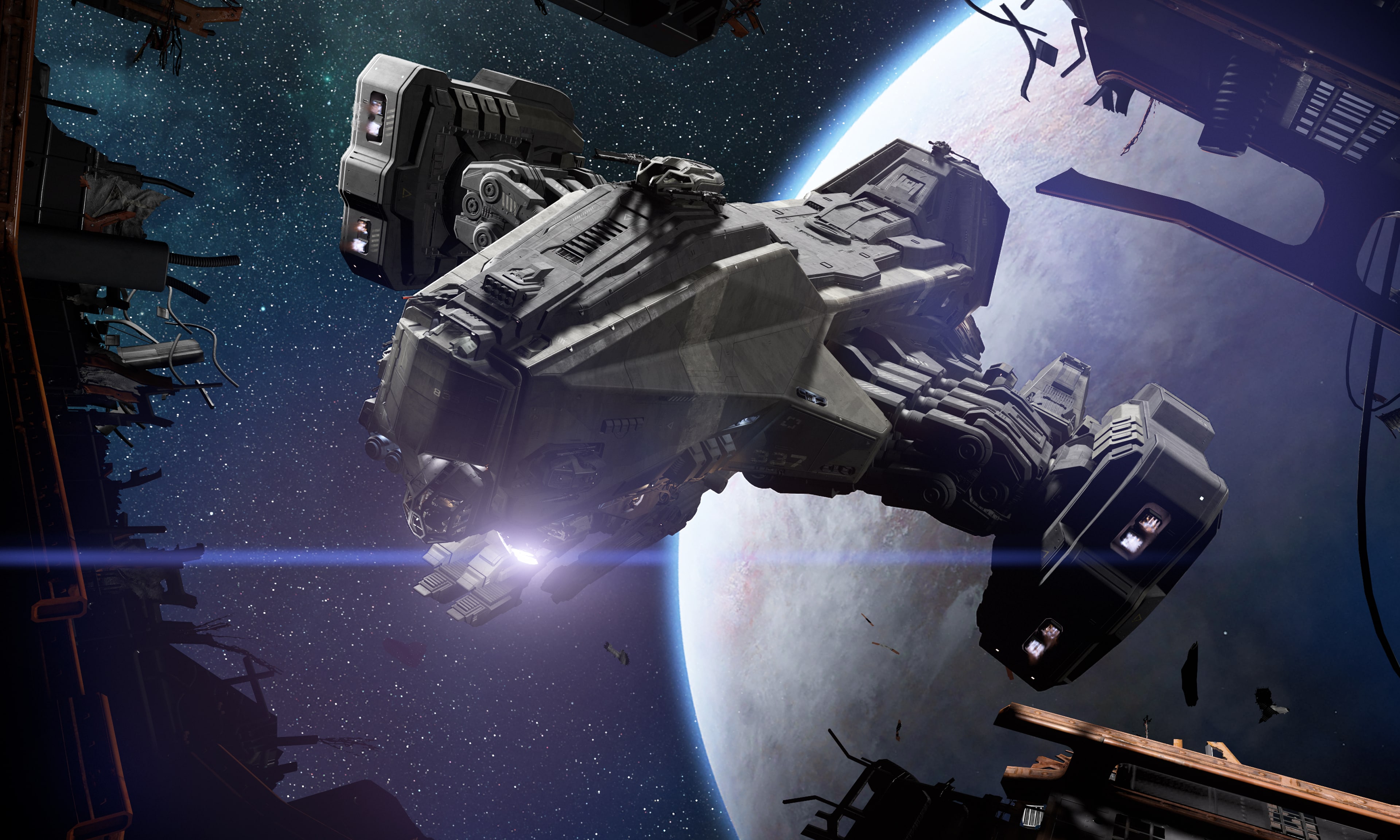
As the excavation continued, it quickly became apparent that the ship trapped on the moon was a preserved treasure plucked from the annals of history itself in the form of a Roberts Space Industries Zeus. Unveiled over eight hundred years ago as the first civilian-owned spacecraft ever mass produced, the Zeus helped popularize private space travel. Today, the Zeus is seen by historians as the singular ancestor of the modern personal spacecraft, the great grandfather of RSI’s ubiquitous Aurora and Constellation ships.
Once the historical importance of their find was learned, the Navy quickly dispatched an archaeological team to the wreckage. It was soon discovered that the tail designation ‘C-6’ was visible through the ice, which allowed for a fast identification. Historical records provided by RSI say that C-6 disappeared on August 10, 2255, during the test flight of a new type of deep-space communications system capable of transmitting in known dead regions of space. The craft was last tracked by an automated station on Iapetus’ light side before disappearing as planned behind the moon. These final scans indicated that the ship was in the correct elliptical orbit, which would have kept it far from the surface. At 12:00 SET when the first test communication was supposed to activate, the awaiting teams back on the light side of the moon were instead greeted by silence. The C-6 and her crew would never be heard from again.
Rescue crews of the time attempted to conduct a seemingly thorough search of the area but were stymied by recent severe avalanches and were unable to find any indication of wreckage. A week passed before the C-6’s crew of three were pronounced dead: Mission Commander Brooke Cloverly, Engineer K. Scott Bashara, and Test Pilot Eve Price Murray. Cloverly was the youngest commander in the program at the time and contemporary press reports note that her loss was a particular blow to Roberts Space Industries’ test program. Bashara had almost forty years of experience as an engineer for the company. Less information survives on Murray, who had joined the company just weeks before the disappearance. Even after seven centuries, a Roberts Space Industries’ spokesperson confirmed that all three crew names are still memorialized on the company’s ‘wall of honor’ located at its headquarters on Earth.
After the layers of ice were carefully removed, the ship was found to be in remarkably good condition for a seven-hundred-year-old wreckage. One of the Zeus’ engines was clearly damaged on impact, dislodged from its casings and covered in intense scorching, and the bow armor was crumpled from where the ship hit the surface. Otherwise, most of the superstructure remained in excellent condition and the interior of the ship had remained sealed. Investigators theorized that the C-6 had most likely soft-landed but became trapped when an ice avalanche buried it below the surface. However, it was what was inside the ill-fated ship (or rather was not inside) that would prove a more troublesome mystery.
When historians accessed the ship’s interior, they were shocked to find that there were no Human remains to be found. The Zeus’ blackbox had been removed, as had all three space suits, one survival tent, and seemingly any limited supplies (estimated to be food, water, and carbon filters capable of sustaining three people for five days). Investigators discussed the idea that grave robbers might have discovered the site in the ensuing centuries but generally rejected the possibility as the ship itself remained full of valuable components and there was no evidence anyone had searched the cabin. The further discovery of used bandages and several empty ration packages in the ship’s trash further suggested the crew had been conscious after the impact and that one or more may have been injured.
Two weeks later, a comprehensive archaeological survey of the crash site had failed to turn up any additional information on what had happened to the crew of C-6. It was at this point that a decision was made to transport the wrecked Zeus from its crash site to Roberts Space Industries’ Earth laboratory for detailed analysis. New and more confounding details emerged as the smallest details of the ship were studied. The cutting-edge communication module the ship had been equipped with was in perfect working order. Later test flights after the C-6’s disappearance would prove that the system worked so, in theory, the crew should have been able to use it to summon a rescue and it remains unknown why they did not. Additionally, while the removal of the blackbox means that the details of C-6’s last flight remain unknown, records salvaged from the ship’s aging computer systems show that, shortly upon entering the dark side of the moon, ship authority was transferred from Commander Cloverly to Pilot Murray. Perhaps one of the biggest remaining mysteries is that with all the supplies that were taken from the ship, why did the crew decide to leave behind the ship’s only emergency flare gun?
After three years had passed since the discovery of C-6, another piece of the puzzle surfaced that only raised more questions. A survey crew operating deep in the dark side to help establish a water mining system was digging exploratory boreholes when they unearthed an empty RSI space suit bearing a C-6 patch. Its location? Almost three hundred miles from the C-6 crash site… three hundred miles in the wrong direction from civilization. One must wonder, how did this brave explorer find themself so far off course? Or perhaps, was there something they were trying to escape from? Tracing a path from the suit to the crash suit only revealed one more piece of evidence, ten unopened ration packets buried within the ice.
In the end, we can only speculate as to what caused the loss of RSI Zeus C-6 and what the true story of her crew’s final hours may have been. The missing blackbox has not been recovered, though historians are hopeful that should it ever be found more details of the event may yet be revealed. For now, this is one Untold Tale that will continue to haunt all those who seek to know the truth behind the Zeus’ tragic end.
Wir leben in einer Zeit, in der wissenschaftliche Erkenntnisse und Innovationen dazu geführt haben, dass wir den Tod selbst rückgängig machen können. Doch trotz dieser erstaunlichen Fortschritte gibt es immer noch vieles in diesem Universum, das wir nicht verstehen. Jeden Tag gibt es neue Geschichten über unerklärliche Phänomene, die unsere Sinne verwirren und uns die Struktur der Realität selbst in Frage stellen lassen. Dies sind die "Untold Tales" des Universums.
Tief unter der eisigen Oberfläche auf der dunklen Seite des Mondes von Sol VI, Iapetus, liegt ein unerwartetes Monument für das Streben der Menschheit nach Verständnis... und eine allzu menschliche Tragödie, die nach Jahrhunderten der totalen Dunkelheit ans Licht gekommen ist.
Im Jahr 2944 registrierte das Scanning-Schiff Tintern Abbey während einer Routineuntersuchung der äußeren Planeten im Sol-System einen ungewöhnlichen Sensorwert. Tiefe Sensorscans der dunklen Seite von Iapetus zeigten ein nicht identifiziertes Objekt mehrere Meter unter der Oberfläche des Mondes. Die dunkle Seite von Iapetus ist zwar unbewohnt, aber die Region war in den vergangenen Jahrzehnten für schwere Waffentests genutzt worden. Ein UEEN-Vermessungs- und Säuberungsteam wurde mit der Untersuchung des Fundortes beauftragt. Ausgestattet mit Baggern und detaillierten Oberflächenscannern war das Team schockiert über das, was es unter den Schichten des felsigen Eises entdeckte: ein weitgehend intaktes Raumschiff.
Als die Ausgrabung fortgesetzt wurde, stellte sich schnell heraus, dass es sich bei dem auf dem Mond gefangenen Schiff um einen konservierten Schatz handelte, der in Form einer Roberts Space Industries Zeus aus den Annalen der Geschichte selbst gepflückt wurde. Die Zeus wurde vor mehr als achthundert Jahren als das erste Raumschiff in zivilem Besitz vorgestellt, das jemals in Serie produziert wurde, und trug zur Popularisierung der privaten Raumfahrt bei. Heute wird die Zeus von Historikern als einzigartiger Vorfahre des modernen persönlichen Raumschiffs angesehen, als Urgroßvater der allgegenwärtigen Aurora- und Constellation-Schiffe von RSI.
Als die Navy von der historischen Bedeutung des Fundes erfuhr, schickte sie schnell ein archäologisches Team zu dem Wrack. Es wurde bald entdeckt, dass die Heckbezeichnung 'C-6' durch das Eis hindurch sichtbar war, was eine schnelle Identifizierung ermöglichte. Historische Aufzeichnungen, die von RSI zur Verfügung gestellt wurden, besagen, dass C-6 am 10. August 2255 verschwand, während des Testflugs eines neuartigen Deep-Space-Kommunikationssystems, das in bekannten toten Regionen des Weltraums senden kann. Das Schiff wurde zuletzt von einer automatischen Station auf der hellen Seite von Iapetus geortet, bevor es wie geplant hinter dem Mond verschwand. Diese letzten Scans zeigten, dass sich das Schiff in der richtigen elliptischen Umlaufbahn befand, die es weit von der Oberfläche entfernt gehalten hätte. Um 12:00 SET, als die erste Testkommunikation aktiviert werden sollte, wurden die wartenden Teams auf der hellen Seite des Mondes stattdessen von Stille begrüßt. Von der C-6 und ihrer Besatzung würde man nie wieder etwas hören.
Die Rettungsmannschaften versuchten damals, das Gebiet gründlich abzusuchen, wurden aber durch die jüngsten schweren Lawinenabgänge behindert und konnten keine Hinweise auf Wrackteile finden. Eine Woche verging, bevor die drei Besatzungsmitglieder der C-6 für tot erklärt wurden: Mission Commander Brooke Cloverly, Ingenieur K. Scott Bashara und Testpilotin Eve Price Murray. Cloverly war zu diesem Zeitpunkt die jüngste Kommandantin des Programms und zeitgenössischen Presseberichten zufolge war ihr Verlust ein besonderer Schlag für das Testprogramm von Roberts Space Industries. Bashara hatte fast vierzig Jahre Erfahrung als Ingenieur für das Unternehmen. Über Murray, der erst wenige Wochen vor seinem Verschwinden in das Unternehmen eingetreten war, liegen weniger Informationen vor. Selbst nach sieben Jahrhunderten bestätigte ein Sprecher von Roberts Space Industries, dass die Namen aller drei Besatzungsmitglieder immer noch auf der "Ehrenwand" des Unternehmens in seinem Hauptsitz auf der Erde verewigt sind.
Nachdem die Eisschichten sorgfältig entfernt worden waren, befand sich das Schiff in einem bemerkenswert guten Zustand für ein siebenhundert Jahre altes Wrack. Eines der Triebwerke der Zeus wurde beim Aufprall eindeutig beschädigt, es hatte sich aus seinem Gehäuse gelöst und war stark verbrannt. Die Bugpanzerung war an der Stelle, an der das Schiff auf die Oberfläche aufschlug, zerknittert. Ansonsten waren die meisten Aufbauten in ausgezeichnetem Zustand und das Innere des Schiffes war versiegelt geblieben. Die Ermittler vermuteten, dass die C-6 höchstwahrscheinlich weich gelandet war und von einer Eislawine unter der Oberfläche begraben wurde. Was sich jedoch im Inneren des unglückseligen Schiffes befand (oder besser gesagt, nicht befand), sollte sich als ein noch schwierigeres Rätsel erweisen.
Als sich Historiker Zugang zum Inneren des Schiffes verschafften, waren sie schockiert, dass keine menschlichen Überreste zu finden waren. Die Blackbox der Zeus war entfernt worden, ebenso wie alle drei Raumanzüge, ein Überlebenszelt und scheinbar alle begrenzten Vorräte (schätzungsweise Nahrung, Wasser und Kohlefilter, die drei Personen fünf Tage lang versorgen können). Die Ermittler diskutierten die Idee, dass Grabräuber den Fundort in den folgenden Jahrhunderten entdeckt haben könnten, verwarfen diese Möglichkeit jedoch im Allgemeinen, da das Schiff selbst voller wertvoller Komponenten war und es keine Hinweise darauf gab, dass jemand die Kabine durchsucht hatte. Die Entdeckung von gebrauchten Verbänden und mehreren leeren Rationspaketen im Abfall des Schiffes deutete darauf hin, dass die Besatzung nach dem Aufprall bei Bewusstsein gewesen war und dass einer oder mehrere verletzt worden sein könnten.
Zwei Wochen später hatte eine umfassende archäologische Untersuchung der Absturzstelle keine weiteren Informationen darüber erbracht, was mit der Besatzung von C-6 geschehen war. Zu diesem Zeitpunkt wurde beschlossen, das Wrack der Zeus von der Absturzstelle zum Labor von Roberts Space Industries auf der Erde zu transportieren, um es dort eingehend zu analysieren. Bei der Untersuchung der kleinsten Details des Schiffes kamen neue und noch verwirrendere Einzelheiten ans Licht. Das hochmoderne Kommunikationsmodul, mit dem das Schiff ausgestattet gewesen war, funktionierte einwandfrei. Spätere Testflüge nach dem Verschwinden der C-6 bewiesen, dass das System funktionierte, so dass die Besatzung theoretisch in der Lage hätte sein müssen, es zu benutzen, um eine Rettung herbeizurufen, und es bleibt unbekannt, warum sie es nicht getan hat. Außerdem bedeutet die Entfernung der Blackbox, dass die Details des letzten Fluges von C-6 unbekannt bleiben. Die Aufzeichnungen, die aus den alternden Computersystemen des Schiffes geborgen wurden, zeigen, dass kurz nach dem Eintritt in die dunkle Seite des Mondes die Befehlsgewalt über das Schiff von Commander Cloverly auf Pilot Murray übertragen wurde. Eines der größten Rätsel ist vielleicht, warum die Besatzung bei all den Vorräten, die aus dem Schiff mitgenommen wurden, die einzige Notfallkanone des Schiffes zurückgelassen hat.
Nachdem drei Jahre seit der Entdeckung von C-6 vergangen waren, tauchte ein weiteres Teil des Puzzles auf, das nur noch mehr Fragen aufwarf. Ein Vermessungsteam, das tief auf der dunklen Seite tätig war, um ein Wasserabbausystem zu errichten, grub gerade Erkundungsbohrungen, als es einen leeren RSI-Raumanzug mit einem C-6-Aufnäher entdeckte. Sein Standort? Fast dreihundert Meilen von der Absturzstelle der C-6 entfernt... dreihundert Meilen in die falsche Richtung von der Zivilisation. Man muss sich fragen, wie dieser tapfere Forscher so weit vom Kurs abgekommen ist. Oder gab es vielleicht etwas, dem sie zu entkommen versuchten? Die Verfolgung des Weges vom Anzug zum Absturzanzug ergab nur ein weiteres Beweisstück: zehn ungeöffnete Rationspakete, die im Eis vergraben waren.
Letztendlich können wir nur spekulieren, was die Ursache für den Verlust der RSI Zeus C-6 war und was die wahre Geschichte der letzten Stunden ihrer Besatzung gewesen sein könnte. Die vermisste Blackbox wurde nicht gefunden, obwohl Historiker hoffen, dass, sollte sie jemals gefunden werden, weitere Details des Ereignisses enthüllt werden könnten. Bis auf Weiteres wird diese unsagbare Geschichte all diejenigen verfolgen, die die Wahrheit über das tragische Ende der Zeus erfahren wollen.
We live in an era where scientific understanding and innovations have led to us reversing death itself, yet despite these amazing advances, there is still much in this universe we do not understand. Every day, new stories of unexplained phenomena confound the senses and make us question the very fabric of reality itself. These are the universe’s Untold Tales.
Deep beneath the icy surface on the dark side of Sol VI’s moon, Iapetus, lies an unexpected monument to Humanity’s quest for understanding… and an all-too-Human tragedy that has come to light after centuries of total darkness.
In 2944, the scanning vessel Tintern Abbey logged an unusual sensor reading during a routine outer-planets survey assignment in the Sol system. Deep sensor scans of the dark side of Iapetus revealed an unidentified object several meters below the moon’s surface. While Iapetus’ dark side is uninhabited, the region had been used in previous decades for heavy weapons testing and the immediate belief was that the anomaly represented a large, unexploded munition. A UEEN survey and cleanup crew was assigned to examine the site. Equipped with excavators and more detailed surface scanners, the team was shocked by what they discovered buried beneath the layers of rocky ice: a largely intact spacecraft.
As the excavation continued, it quickly became apparent that the ship trapped on the moon was a preserved treasure plucked from the annals of history itself in the form of a Roberts Space Industries Zeus. Unveiled over eight hundred years ago as the first civilian-owned spacecraft ever mass produced, the Zeus helped popularize private space travel. Today, the Zeus is seen by historians as the singular ancestor of the modern personal spacecraft, the great grandfather of RSI’s ubiquitous Aurora and Constellation ships.
Once the historical importance of their find was learned, the Navy quickly dispatched an archaeological team to the wreckage. It was soon discovered that the tail designation ‘C-6’ was visible through the ice, which allowed for a fast identification. Historical records provided by RSI say that C-6 disappeared on August 10, 2255, during the test flight of a new type of deep-space communications system capable of transmitting in known dead regions of space. The craft was last tracked by an automated station on Iapetus’ light side before disappearing as planned behind the moon. These final scans indicated that the ship was in the correct elliptical orbit, which would have kept it far from the surface. At 12:00 SET when the first test communication was supposed to activate, the awaiting teams back on the light side of the moon were instead greeted by silence. The C-6 and her crew would never be heard from again.
Rescue crews of the time attempted to conduct a seemingly thorough search of the area but were stymied by recent severe avalanches and were unable to find any indication of wreckage. A week passed before the C-6’s crew of three were pronounced dead: Mission Commander Brooke Cloverly, Engineer K. Scott Bashara, and Test Pilot Eve Price Murray. Cloverly was the youngest commander in the program at the time and contemporary press reports note that her loss was a particular blow to Roberts Space Industries’ test program. Bashara had almost forty years of experience as an engineer for the company. Less information survives on Murray, who had joined the company just weeks before the disappearance. Even after seven centuries, a Roberts Space Industries’ spokesperson confirmed that all three crew names are still memorialized on the company’s ‘wall of honor’ located at its headquarters on Earth.
After the layers of ice were carefully removed, the ship was found to be in remarkably good condition for a seven-hundred-year-old wreckage. One of the Zeus’ engines was clearly damaged on impact, dislodged from its casings and covered in intense scorching, and the bow armor was crumpled from where the ship hit the surface. Otherwise, most of the superstructure remained in excellent condition and the interior of the ship had remained sealed. Investigators theorized that the C-6 had most likely soft-landed but became trapped when an ice avalanche buried it below the surface. However, it was what was inside the ill-fated ship (or rather was not inside) that would prove a more troublesome mystery.
When historians accessed the ship’s interior, they were shocked to find that there were no Human remains to be found. The Zeus’ blackbox had been removed, as had all three space suits, one survival tent, and seemingly any limited supplies (estimated to be food, water, and carbon filters capable of sustaining three people for five days). Investigators discussed the idea that grave robbers might have discovered the site in the ensuing centuries but generally rejected the possibility as the ship itself remained full of valuable components and there was no evidence anyone had searched the cabin. The further discovery of used bandages and several empty ration packages in the ship’s trash further suggested the crew had been conscious after the impact and that one or more may have been injured.
Two weeks later, a comprehensive archaeological survey of the crash site had failed to turn up any additional information on what had happened to the crew of C-6. It was at this point that a decision was made to transport the wrecked Zeus from its crash site to Roberts Space Industries’ Earth laboratory for detailed analysis. New and more confounding details emerged as the smallest details of the ship were studied. The cutting-edge communication module the ship had been equipped with was in perfect working order. Later test flights after the C-6’s disappearance would prove that the system worked so, in theory, the crew should have been able to use it to summon a rescue and it remains unknown why they did not. Additionally, while the removal of the blackbox means that the details of C-6’s last flight remain unknown, records salvaged from the ship’s aging computer systems show that, shortly upon entering the dark side of the moon, ship authority was transferred from Commander Cloverly to Pilot Murray. Perhaps one of the biggest remaining mysteries is that with all the supplies that were taken from the ship, why did the crew decide to leave behind the ship’s only emergency flare gun?
After three years had passed since the discovery of C-6, another piece of the puzzle surfaced that only raised more questions. A survey crew operating deep in the dark side to help establish a water mining system was digging exploratory boreholes when they unearthed an empty RSI space suit bearing a C-6 patch. Its location? Almost three hundred miles from the C-6 crash site… three hundred miles in the wrong direction from civilization. One must wonder, how did this brave explorer find themself so far off course? Or perhaps, was there something they were trying to escape from? Tracing a path from the suit to the crash suit only revealed one more piece of evidence, ten unopened ration packets buried within the ice.
In the end, we can only speculate as to what caused the loss of RSI Zeus C-6 and what the true story of her crew’s final hours may have been. The missing blackbox has not been recovered, though historians are hopeful that should it ever be found more details of the event may yet be revealed. For now, this is one Untold Tale that will continue to haunt all those who seek to know the truth behind the Zeus’ tragic end.
We live in an era where scientific understanding and innovations have led to us reversing death itself, yet despite these amazing advances, there is still much in this universe we do not understand. Every day, new stories of unexplained phenomena confound the senses and make us question the very fabric of reality itself. These are the universe’s Untold Tales.
Deep beneath the icy surface on the dark side of Sol VI’s moon, Iapetus, lies an unexpected monument to Humanity’s quest for understanding… and an all-too-Human tragedy that has come to light after centuries of total darkness.
In 2944, the scanning vessel Tintern Abbey logged an unusual sensor reading during a routine outer-planets survey assignment in the Sol system. Deep sensor scans of the dark side of Iapetus revealed an unidentified object several meters below the moon’s surface. While Iapetus’ dark side is uninhabited, the region had been used in previous decades for heavy weapons testing and the immediate belief was that the anomaly represented a large, unexploded munition. A UEEN survey and cleanup crew was assigned to examine the site. Equipped with excavators and more detailed surface scanners, the team was shocked by what they discovered buried beneath the layers of rocky ice: a largely intact spacecraft.
As the excavation continued, it quickly became apparent that the ship trapped on the moon was a preserved treasure plucked from the annals of history itself in the form of a Roberts Space Industries Zeus. Unveiled over eight hundred years ago as the first civilian-owned spacecraft ever mass produced, the Zeus helped popularize private space travel. Today, the Zeus is seen by historians as the singular ancestor of the modern personal spacecraft, the great grandfather of RSI’s ubiquitous Aurora and Constellation ships.
Once the historical importance of their find was learned, the Navy quickly dispatched an archaeological team to the wreckage. It was soon discovered that the tail designation ‘C-6’ was visible through the ice, which allowed for a fast identification. Historical records provided by RSI say that C-6 disappeared on August 10, 2255, during the test flight of a new type of deep-space communications system capable of transmitting in known dead regions of space. The craft was last tracked by an automated station on Iapetus’ light side before disappearing as planned behind the moon. These final scans indicated that the ship was in the correct elliptical orbit, which would have kept it far from the surface. At 12:00 SET when the first test communication was supposed to activate, the awaiting teams back on the light side of the moon were instead greeted by silence. The C-6 and her crew would never be heard from again.
Rescue crews of the time attempted to conduct a seemingly thorough search of the area but were stymied by recent severe avalanches and were unable to find any indication of wreckage. A week passed before the C-6’s crew of three were pronounced dead: Mission Commander Brooke Cloverly, Engineer K. Scott Bashara, and Test Pilot Eve Price Murray. Cloverly was the youngest commander in the program at the time and contemporary press reports note that her loss was a particular blow to Roberts Space Industries’ test program. Bashara had almost forty years of experience as an engineer for the company. Less information survives on Murray, who had joined the company just weeks before the disappearance. Even after seven centuries, a Roberts Space Industries’ spokesperson confirmed that all three crew names are still memorialized on the company’s ‘wall of honor’ located at its headquarters on Earth.
After the layers of ice were carefully removed, the ship was found to be in remarkably good condition for a seven-hundred-year-old wreckage. One of the Zeus’ engines was clearly damaged on impact, dislodged from its casings and covered in intense scorching, and the bow armor was crumpled from where the ship hit the surface. Otherwise, most of the superstructure remained in excellent condition and the interior of the ship had remained sealed. Investigators theorized that the C-6 had most likely soft-landed but became trapped when an ice avalanche buried it below the surface. However, it was what was inside the ill-fated ship (or rather was not inside) that would prove a more troublesome mystery.
When historians accessed the ship’s interior, they were shocked to find that there were no Human remains to be found. The Zeus’ blackbox had been removed, as had all three space suits, one survival tent, and seemingly any limited supplies (estimated to be food, water, and carbon filters capable of sustaining three people for five days). Investigators discussed the idea that grave robbers might have discovered the site in the ensuing centuries but generally rejected the possibility as the ship itself remained full of valuable components and there was no evidence anyone had searched the cabin. The further discovery of used bandages and several empty ration packages in the ship’s trash further suggested the crew had been conscious after the impact and that one or more may have been injured.
Two weeks later, a comprehensive archaeological survey of the crash site had failed to turn up any additional information on what had happened to the crew of C-6. It was at this point that a decision was made to transport the wrecked Zeus from its crash site to Roberts Space Industries’ Earth laboratory for detailed analysis. New and more confounding details emerged as the smallest details of the ship were studied. The cutting-edge communication module the ship had been equipped with was in perfect working order. Later test flights after the C-6’s disappearance would prove that the system worked so, in theory, the crew should have been able to use it to summon a rescue and it remains unknown why they did not. Additionally, while the removal of the blackbox means that the details of C-6’s last flight remain unknown, records salvaged from the ship’s aging computer systems show that, shortly upon entering the dark side of the moon, ship authority was transferred from Commander Cloverly to Pilot Murray. Perhaps one of the biggest remaining mysteries is that with all the supplies that were taken from the ship, why did the crew decide to leave behind the ship’s only emergency flare gun?
After three years had passed since the discovery of C-6, another piece of the puzzle surfaced that only raised more questions. A survey crew operating deep in the dark side to help establish a water mining system was digging exploratory boreholes when they unearthed an empty RSI space suit bearing a C-6 patch. Its location? Almost three hundred miles from the C-6 crash site… three hundred miles in the wrong direction from civilization. One must wonder, how did this brave explorer find themself so far off course? Or perhaps, was there something they were trying to escape from? Tracing a path from the suit to the crash suit only revealed one more piece of evidence, ten unopened ration packets buried within the ice.
In the end, we can only speculate as to what caused the loss of RSI Zeus C-6 and what the true story of her crew’s final hours may have been. The missing blackbox has not been recovered, though historians are hopeful that should it ever be found more details of the event may yet be revealed. For now, this is one Untold Tale that will continue to haunt all those who seek to know the truth behind the Zeus’ tragic end.
Links
No links available.


Metadata
- CIG ID
- 18793
- Channel
- Spectrum Dispatch
- Category
- Undefined
- Series
- News Update
- Comments
- 45
- Published
- 4 years ago (2022-07-20T00:00:00+00:00)