Star Citizen - Salvage and Repair Guide
Transmission Undefined NoneContent
SALVAGE GAMEPLAY GUIDE
Star Citizen's Persistent Universe features an ever-evolving salvage system that turns destruction into opportunity. From precision hull scraping to full-scale material and component recovery, salvaging offers one of the most profitable and versatile careers in the 'verse. Whether flying solo or as part of a crew, each wreck presents a chance to explore, recover, and profit from the remains of the stars.
Join us as we explore the systems and tools that define this profession, and ensure you're fully prepared to seize every derelict and debris field across Alpha 4.4 and beyond. And if you're looking for guidance as you begin your journey into the world of salvage, visit the Guide System to connect with an experienced player ready to help you master the art of reclamation.
NOTE: This post was released to coincide with Alpha 4.4, and will be updated when adjustments and changes are made to Salvage gameplay.
TYPES OF SALVAGE
Components & Cargo
Before tearing down a wreck, it's always worth checking its interior and systems for anything still intact or valuable. Many derelicts still hold functional components, weapons, or cargo that can be retrieved before the hull is stripped away.
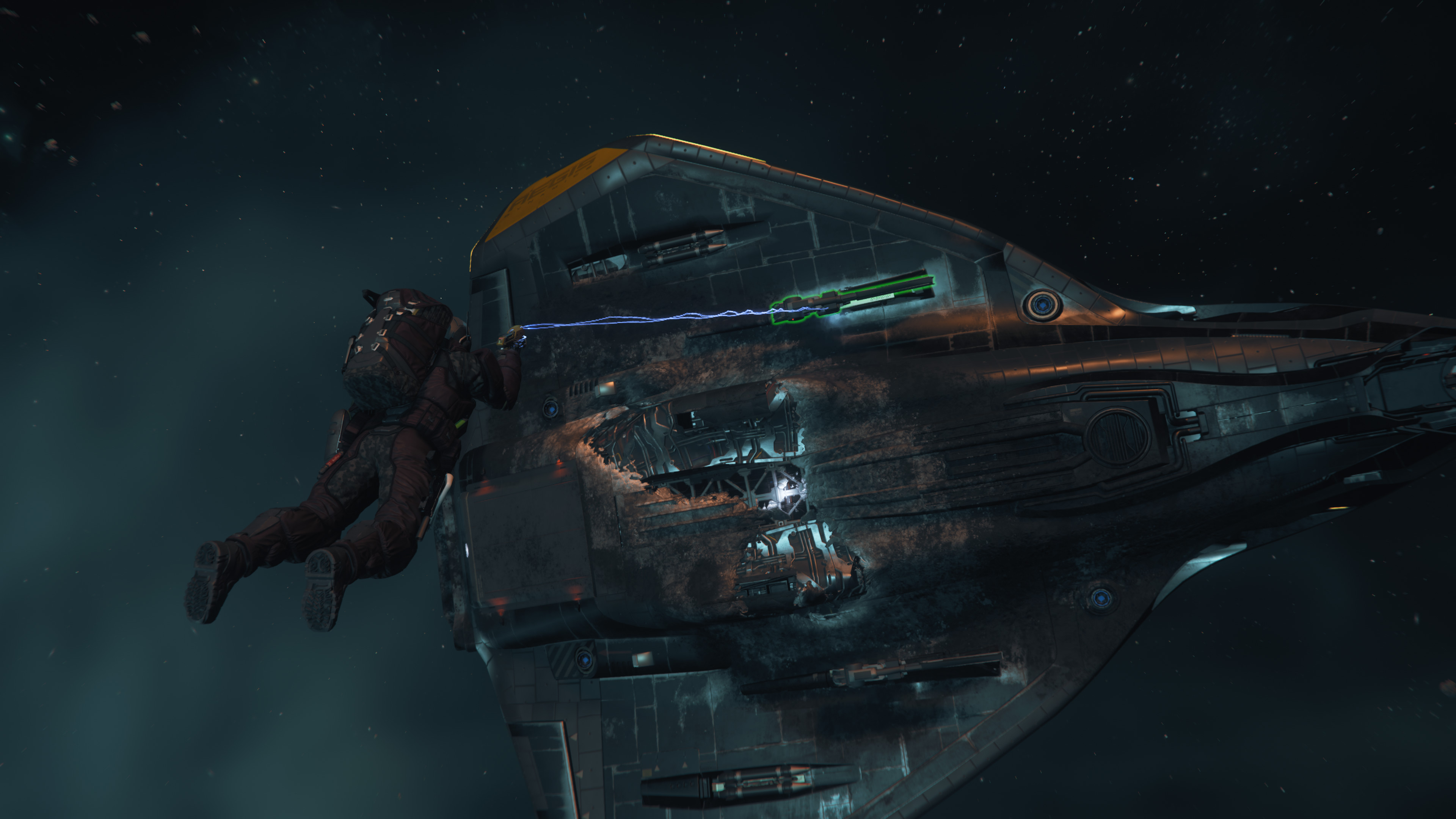
Component salvage focuses on recovering intact ship systems and high-value parts before the wreck is broken down. Using precision tractor beams, salvagers can remove weapons, shields generators, quantum drives, and other functional modules.
Currently, with the right tools, all weapons and all components up to size 2 can be removed from vehicles as long as you have access to them through a component bay on the interior or exterior of the wreck. Once detached, these items can be stored aboard your ship if you have available space, allowing you to transport multiple components for future use. You can later attach them to your own vehicles, sell them at shops that accept components, or trade them with other players.
Hull Scraping
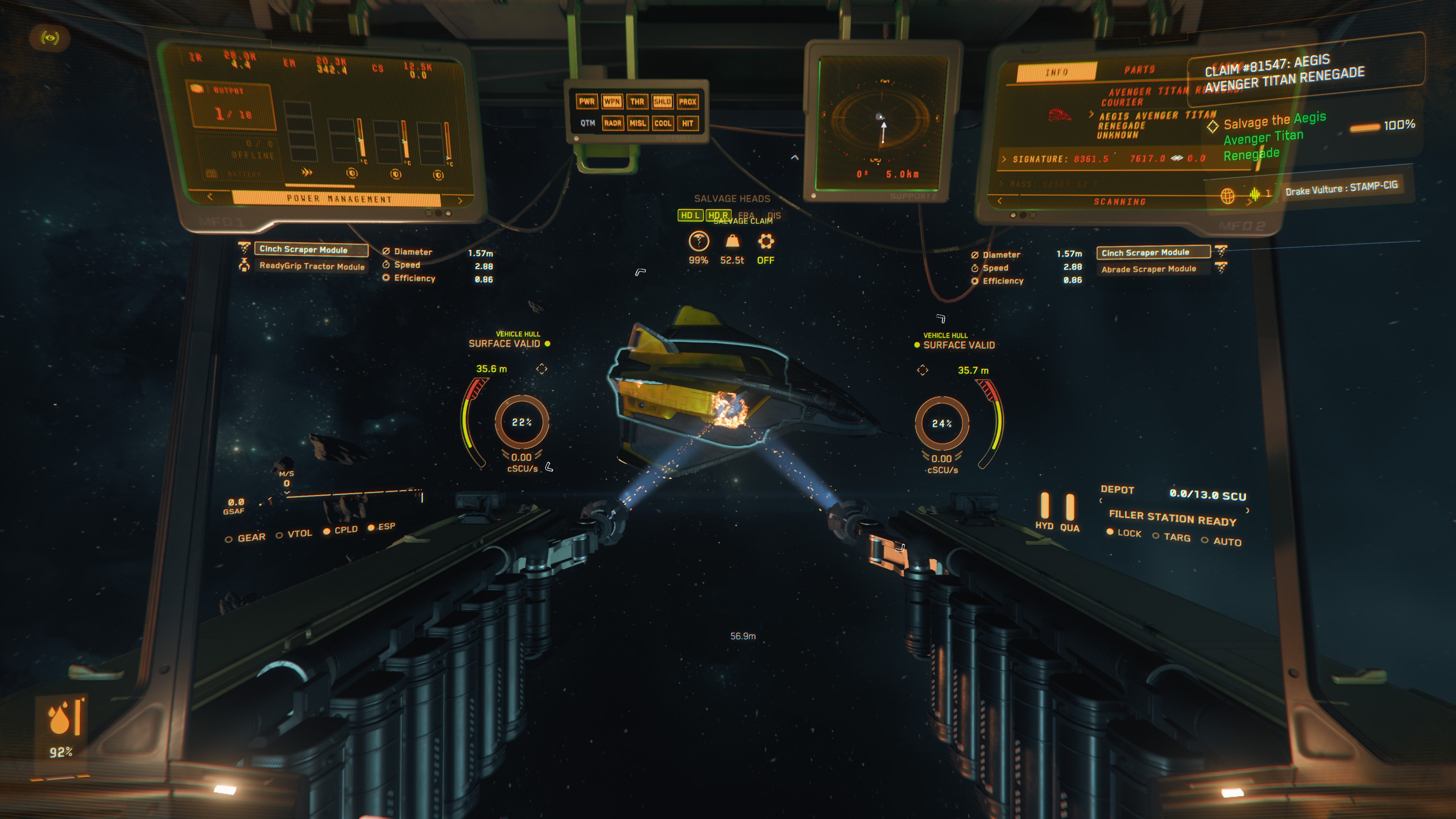
Hull scraping is the foundation of modern salvage operations, allowing pilots to reclaim valuable Recycled Material Composite (RMC) from the outer plating of derelict ships and debris. Using specialized salvage beams or hand tools, operators carefully strip away layers of hull material, converting wreckage into usable resources for trade, repair, or resale. Whether performed by a lone RSI Salvation pilot or a full Aegis Reclaimer crew, hull scraping represents an easy step in transforming destruction into profit.
RMC
Recycled Material Composite (RMC) is the commodity gathered while hull scraping. The onboard processing unit (filler station) on salvage ships will produce SCU containers with the collected RMC. These RMC containers can then be sold for profit.
On most salvage vessels, RMC can also be converted into RMC canisters (for example, the Cambio-Lite SRT Canister) used by salvage and repair hand tools. Empty canisters that can be bought at dedicated shops can also be filled at commodity kiosks with RMC.
Structural Salvage
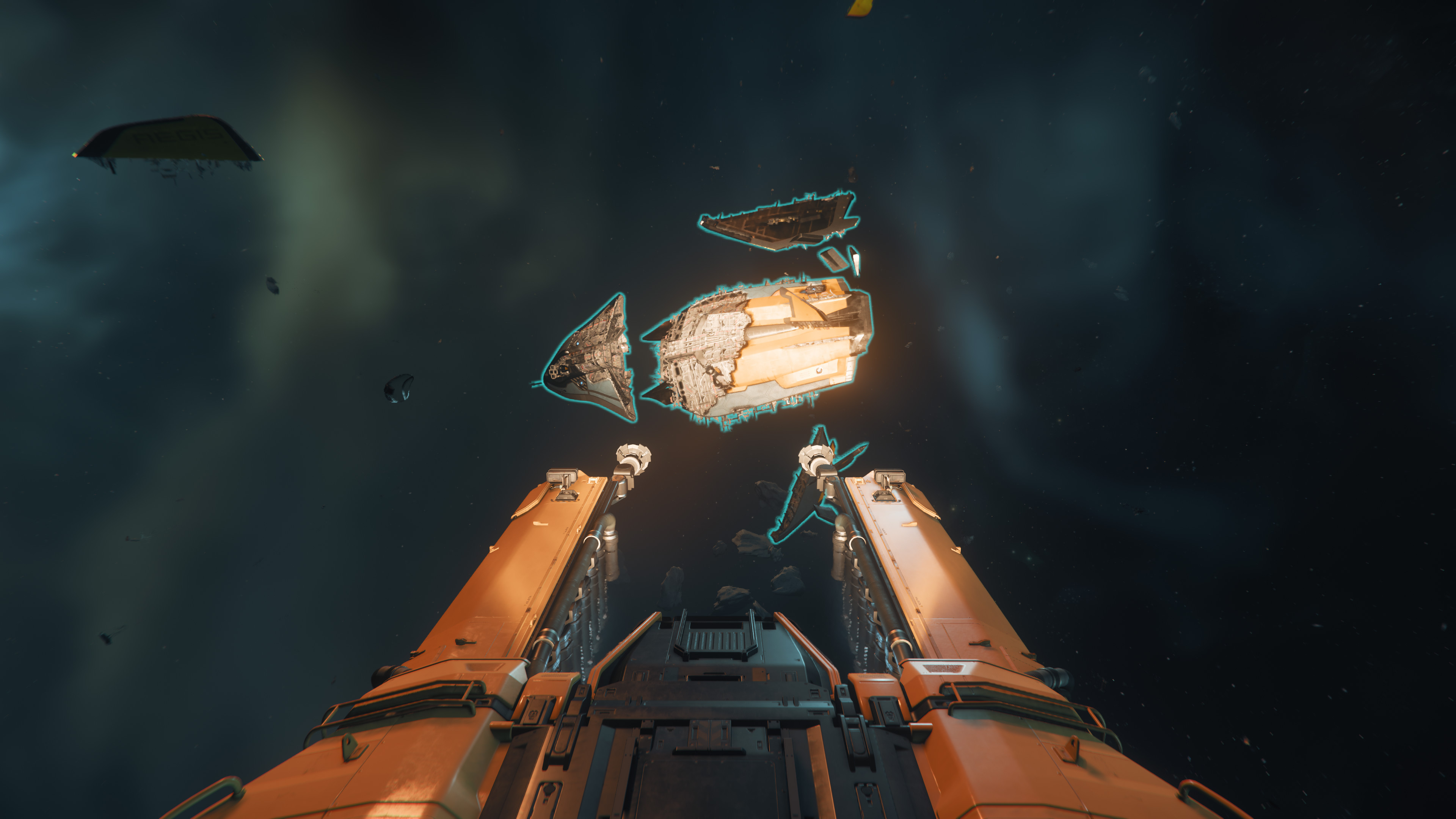
Structural salvage takes recovery operations beyond the surface, breaking down derelicts into their raw framework to harvest useful commodities. The process begins with "Fracture," which cracks the derelict hulls into smaller parts. This is followed by "Disintegrate," which further breaks down the pieces into smaller fragments, yielding Construction Materials with output varying by the type of salvage ship used, ranging from "Rubble" to "Pieces" to "Salvage". These raw materials require refinery processing before future use. This deeper level of reclamation demands power, precision, and coordination, but rewards operators with the highest yields, turning once-lost starships into the building blocks of tomorrow's fleet.
CONSTRUCTION MATERIALS
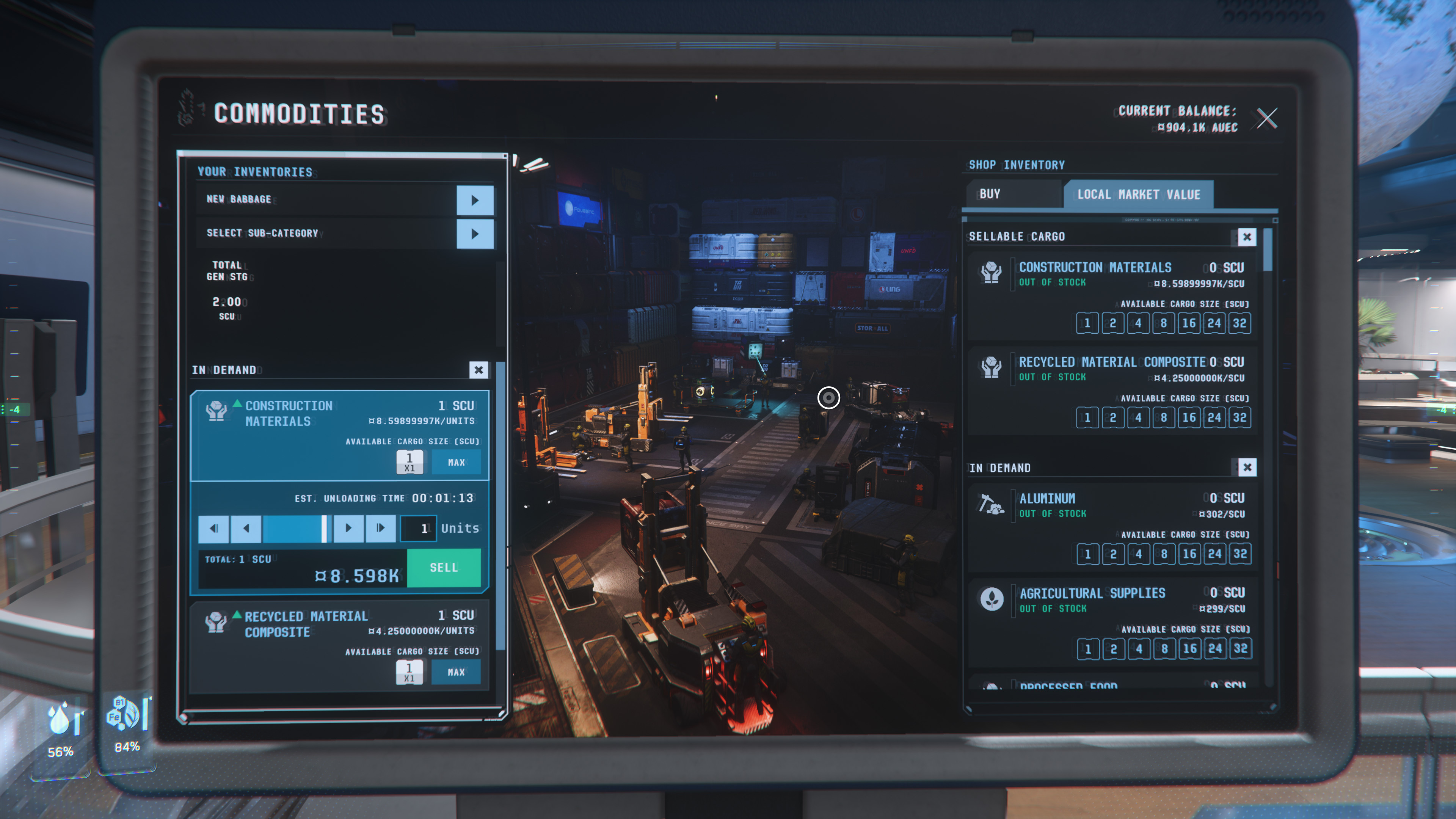
Construction Materials are the commodity generated by disintegrating the hulls of vehicles using structural salvage. After undergoing refinery processing, they can be sold at Trade and Development Division locations at major landing zones, as well as scrapyards and Grim HEX.
If you have previously done hull scraping on your ship, remember to eject the RMC before beginning the structural salvaging process as Construction Materials are stored in the same filler station buffer as the RMC.
SCU CONTAINERS
From Debris to Depot
Standard Cargo Units (SCU) containers are generated as part of the salvage process. When performing hull scraping or structural salvage, materials are converted into SCU containers, either directly in your ship's cargo hold or into onboard canisters that can be transferred to storage.
Starter ships like the RSI Salvation feature onboard processing that automatically compacts recovered materials into SCU containers, streamlining the entire salvage loop. Larger vessels, such as the Aegis Reclaimer, use a more manual process that requires coordination between crew members to transfer and manage cargo.
Ships will display storage capacity through the HUD or MFDs, alerting you when the processing buffer or cargo grid is full. Once full, you'll need to eject or offload SCU containers before continuing operations to avoid halting production. These containers can then be transported, stored, or sold at Trade and Development Division (TDD) terminals, scrapyards, or Grim HEX.
REFINE, RECOUP & REPAIR
Refine
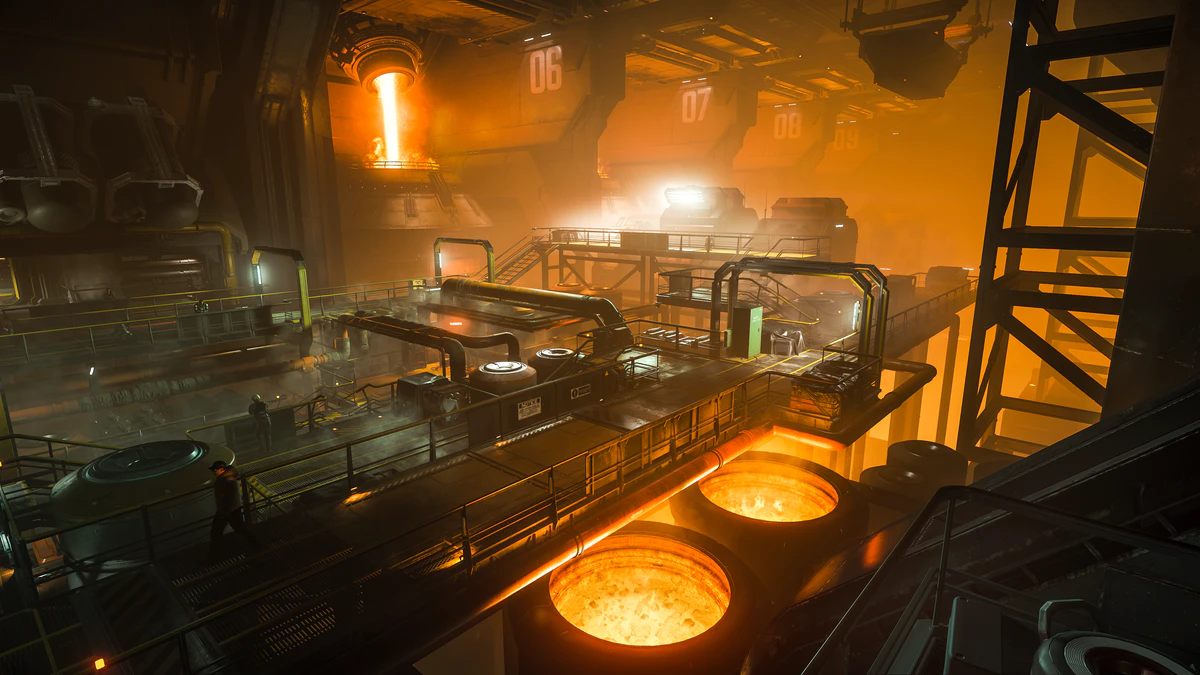
Construction Materials recovered in structural salvage will need to be refined before selling, with results varying by salvage ship type: Rubble from Light Salvage ships offers the fastest processing but lowest yield, Pieces from Medium Salvage ships provide balanced results, and Salvage from Heavy Salvage ships delivers the highest refined return at the cost of longer processing times.
Refineries are located on all L1 stations and specific stations like Checkmate, Orbituary, Ruin Station, and Levski, which also have extra-large hangars.
To use a refinery, you must first unload your salvaged materials via a freight elevator into the station's inventory before starting the refinement job. You can choose between different processing methods that affect the yield, cost, and time of the refinement.
Sell Your Spoils
Once you've got SCU containers full of RMC or Construction Materials, head to a commodity kiosk, which can be found at most landing zones and space stations (for example, at a TDD locale) to sell them.
However, not all kiosks will purchase these recycled materials, and don't forget to keep an eye on the price to make sure you're not getting a raw deal!
Fix it Features
If you created RMC canisters at your onboard filler station and you've got your SRT Multi-Tool attachment handy, you can use the RMC to repair your or a friend's hull damage and ship components. With your Multi-Tool attachment and filled RMC canister equipped, press right click on the area you wish to repair.
You can significantly repair your hull and components but not fully. To fully restore your ship, you'll need to take it to a landing pad or hangar that offers repair services. RMC plays an important role in Engineering gameplay for maintaining ships during operations.
MISSIONS
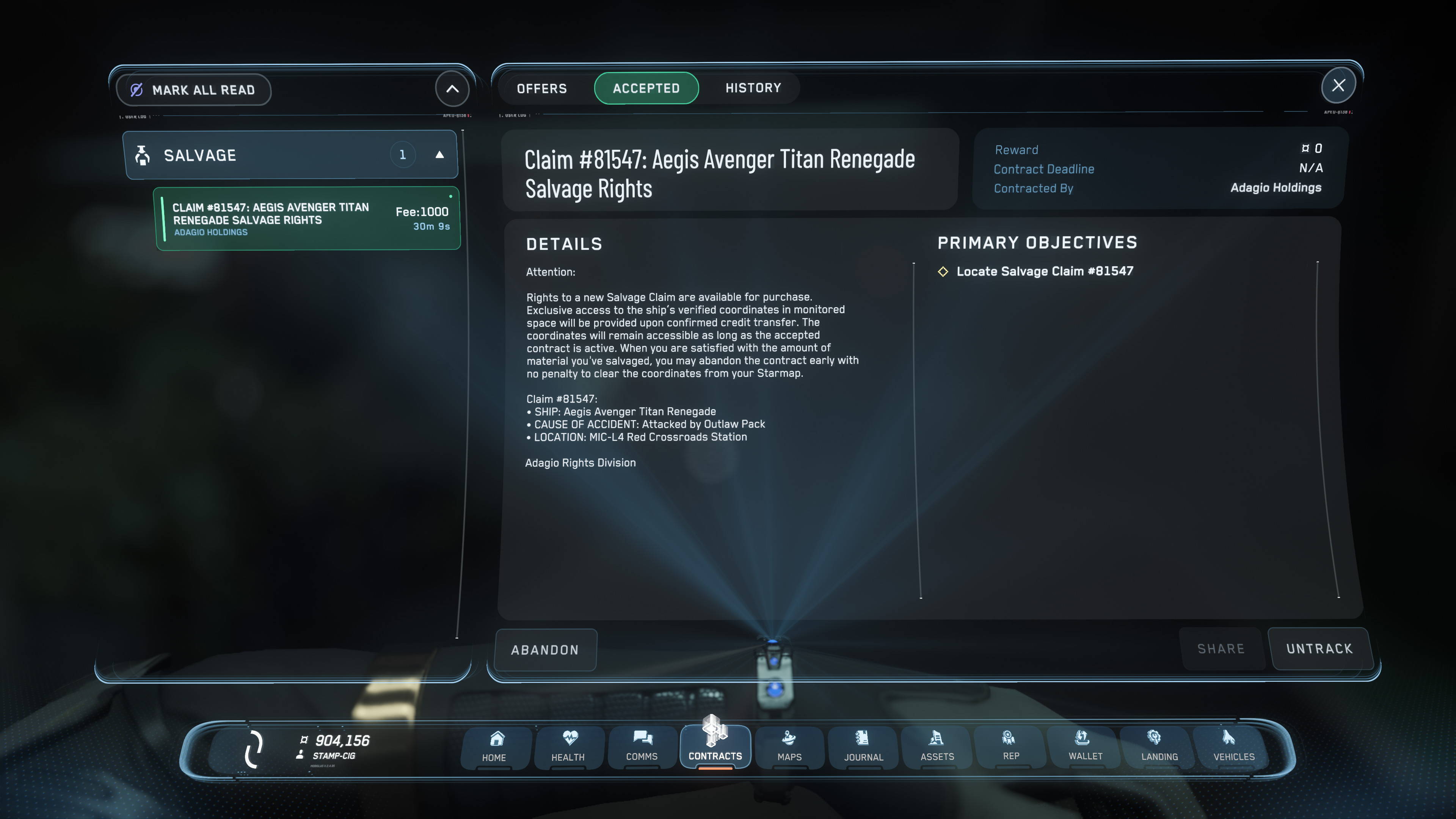
Salvage missions offer structured opportunities to recover valuable commodities from wrecks throughout the Persistent Universe. You can access these contracts through the Contracts Manager on your mobiGlas, where each listing outlines the target site, required equipment, and potential payout. Rewards may include aUEC, rare components, or resources such as RMC and Construction Materials, depending on the mission’s scale and risk.
You'll start with simpler contracts designed to introduce you to the basics of the profession. These initial missions ease you into core salvage operations, and completing them builds your reputation and unlocks access to higher-paying, more complex opportunities. As your standing improves, you'll gain access to larger wrecks, riskier jobs, and greater rewards — with even more salvage missions scheduled to come online in 2026, further expanding the multitude of opportunities ahead.
Some missions are ideal for solo salvagers flying smaller ships like the RSI Salvation, while others are best handled by a full crew aboard an Aegis Reclaimer, coordinating to process and transport recovered materials efficiently. Each completed contract not only boosts your income but also sharpens your knowledge of wreck types, tools, and best practices for reclamation.
TOOLS OF THE TRADE
Multi-Tool with Salvage Repair Attachment The Cambio-Lite SRT Attachment is a specialized module for the Greycat Pyro RYT Multi-Tool, enabling players to perform handheld hull stripping and field repairs.
The Multi-Tool & attachment can be purchased at various in-game shops, including Dumper’s Depot at Area18, Tammany & Sons in Lorville, and select Platinum Bay outlets across the 'verse.
A Aurora LX transport emerged from the jump-point and lumbered toward the Launch deck We offer this Entity to the Timeline as a place to study and a place to meet Multi-Tool with Tractor Beam Attachment The Tractor Beam Attachment for the Greycat Pyro RYT Multi-Tool allows players to move and position objects with precision, making it invaluable during salvage, repair, and cargo operations.
The Multi-Tool & attachment can be purchased at various in-game shops, including Dumper's Depot at Area18, Tammany & Sons in Lorville, and select Platinum Bay outlets across the 'verse.
Nicknamed Abyss due to its proximity to the Nebula, Yulin II looks like it's overseeCustoms agent the Pulsar Salvage Repair Standalone Tool The Cambio SRT is designed exclusively for the task of hull scraping and repairs, and utilizes a higher capacity canister compared with the smaller attachment version.
The tool can be purchased at various in-game shops, including Dumper's Depot at Area18, Tammany & Sons in Lorville, and select Platinum Bay outlets across the 'verse.
Claimed entirely for military purposes, Hadrian II is home to the UPE and has the distinction of housUEE Colonial Command the largest population of Inforunners in the Empire Johnny waited a few moments before approachProcedural the Lift that Kray disappeared into Tractor Beam Standalone Tool The MaxLift Tractor Beam, manufactured by Greycat Industrial. It's a full-fledged gadget that allows the user to manipulate heavier objects than the Multi-Tool version.
The tool can be purchased from most major equipment vendors, including Dumper’s Depot at Area18, Tammany & Sons in Lorville, CenterMass, and select Platinum Bay outlets across the 'verse.
The Captain casually glanced at it So Messer, ever since Quarterdeck's announcement, you've been quite critical of the entire concept SHIPS OF THE TRADE
Star Citizen Salvage Ships
Tempor Incididunt Sed Do Eiusmod Sed ut perspiciatis unde omnis iste natus error sit voluptatem accusantium doloremque laudantium, totam rem aperiam, eaque ipsa quae ab illo inventore veritatis et quasi architecto beatae vitae dicta sunt explicabo.
Lorem ipsum dolor sit amet, consectetur adipiscing elit, sed do eiusmod tempor incididunt ut labore et dolore magna aliqua. Ut enim ad minim veniam, quis nostrud exercitation ullamco laboris nisi ut aliquip ex ea commodo consequat.
Tempor IncididuntTempor IncididuntSed Do EiusmodSed ut perspiciatis unde omnis iste natus error sit voluptatem accusantium doloremque laudantium, totam rem aperiam, eaque ipsa quae ab illo inventore veritatis et quasi architecto beatae vitae dicta sunt explicabo.Lorem ipsum dolor sit amet, consectetur adipiscing elit, sed do eiusmod tempor incididunt ut labore et dolore magna aliqua. Ut enim ad minim veniam, quis nostrud exercitation ullamco laboris nisi ut aliquip ex ea commodo consequat. RSI Salvation The RSI Salvation is a Light Salvage ship built for newcomers, with onboard processing that turns wreckage into SCU crates without ever leaving the seat.
Best suited for hull scraping, providing an introduction to structural salvage.
RSI SalvationThe RSI Salvation is a Light Salvage ship built for newcomers, with onboard processing that turns wreckage into SCU crates without ever leaving the seat.Best suited for hull scraping, providing an introduction to structural salvage. MISC Fortune The MISC Fortune is a Light Salvage ship designed for ease of use, with an automated external container dispenser that allows solo pilots to load up to 12x 1-SCU cargo boxes with minimal effort.
Balanced salvage ship, favouring hull scraping over structural salvage.
MISC FortuneThe MISC Fortune is a Light Salvage ship designed for ease of use, with an automated external container dispenser that allows solo pilots to load up to 12x 1-SCU cargo boxes with minimal effort.Balanced salvage ship, favouring hull scraping over structural salvage. Drake Vulture The Drake Vulture is a Light Salvage ship. A fully integrated onboard scrap processor breaks down salvaged material as quickly as the tractor system pulls it in, instantly converting raw scrap into saleable output.
Balanced salvage ship, favouring structural salvage over hull scraping.
Drake VultureThe Drake Vulture is a Light Salvage ship. A fully integrated onboard scrap processor breaks down salvaged material as quickly as the tractor system pulls it in, instantly converting raw scrap into saleable output.Balanced salvage ship, favouring structural salvage over hull scraping. Argo MOTH The Argo MOTH is a Medium Salvage ship purpose-built to bridge the gap between light salvage and full industrial undertakings, with the tools to earn its keep, the storage for a long job, and the capability to elevate your team's performance.
Balanced medium salvager, designed for multi-crew operations between light and industrial scale.
Argo MOTHThe Argo MOTH is a Medium Salvage ship purpose-built to bridge the gap between light salvage and full industrial undertakings, with the tools to earn its keep, the storage for a long job, and the capability to elevate your team's performance.Balanced medium salvager, designed for multi-crew operations between light and industrial scale. Aegis Reclaimer The Aegis Reclaimer is a Heavy Salvage ship built for industrial recovery, featuring a reinforced cargo bay, tractor beams, floodlights, scanner options, and docking ports to complete its robust toolset.
Fast structural salvage processing, designed for large-scale operations.
Aegis ReclaimerThe Aegis Reclaimer is a Heavy Salvage ship built for industrial recovery, featuring a reinforced cargo bay, tractor beams, floodlights, scanner options, and docking ports to complete its robust toolset.Fast structural salvage processing, designed for large-scale operations. Quick Tips Don't Be the Wreck "Today's salvager is tomorrow's salvage if you're not paying attention. Wrecks often attract pirates or other salvagers. Stay alert."
- Scrawled in grease pencil on a Vulture cockpit panel
Know Where to Cash In "You've done the hard work, now make it count. Check terminals at big landing zones for the best payout. Your wallet will thank you."
- Shared during a late-night comms call, near Pyro Jump Point
Bring Your Friends "Your Multi-Tool is your best friend. Unless you forgot your tractor beam attachment. Then it's just a fancy paperweight and you won't be able to move your SCU containers."
- Found in a salvage crew handbook, Hurston
The Buffer Bonus "Even when your cargo hold's stacked to the brim with SCU boxes, don't overlook the buffer. Fill it before you leave the wreck; it's the last pocket of profit a seasoned salvager never leaves behind."
- Printed on a cargo crate, TDD, New Babbage
Scan-dalous Side Hustle "Running off-mission? Don't ignore salvage panels, they pay out big. Use your scanner smart: look for signatures in multiples of 2000s. That's your ticket to scraper's paradise."
- Veteran salvager, Stanton system
The Slice is Right "Your salvage beam does the work, but only if you do yours. Nail the angle, stay within optimal range and strip clean or you'll lose good material. Precision pays."
- Passed down in an salvage ops briefing, Lorville
Risk It for the Biscuit "Feeling brave, are we? Well, illegal salvage missions can be thrilling, but slip up, and you'll be rocking a shiny new crimestat."
- Heard over drinks at a dive bar, Grim HEX
Salvage Head Savvy "There's a scraper module (and tractor beam) for every job. Abrade, Cinch, Trawler, they each pull their weight if you use 'em right. Abrade's a decent pick if you want good speed without sacrificing bite."
- Advice from a fixer at Dumper's Depot, Area18
Don't forget to share your thoughts and experiences with Salvage in the Feedback section of Spectrum!
We'll be adding to this guide in the future as additional aspects of Salvage come online! See you all in the 'verse!
Bergung & Reparatur
Alpha 3.18
Star Citizen Alpha 3.18 führt einen völlig neuen Karrierepfad ein: Bergung & Reparatur.
In diesem Zusammenhang wurden alle Schiffe aktualisiert, um den "weichen Tod" zu unterstützen. Das bedeutet, dass die Schiffe der Spieler beim Tod nicht immer vollständig zerstört werden, sondern dass der Rumpf geborgen werden kann. Das gesammelte Material kann dann gewinnbringend verkauft oder zur Reparatur beschädigter Fahrzeuge verwendet werden.
Im Folgenden findest du eine Kurzanleitung für die Bergungs- und Reparaturkarriere ab Alpha 3.18. Wir werden diese Seite ergänzen, sobald weitere Aspekte der Karriere online gehen.
RMC
Recycled Material Composite (RMC) ist ein Rohstoff, der beim Verschrotten von Schiffsrümpfen gewonnen wird. RMC wird in Rohstoffcontainern gelagert und kann an Rohstoffkiosken mit Gewinn verkauft werden. Auf allen Bergungsschiffen wie der Vulture kann RMC auch in Kanister umgewandelt werden, die von Bergungs- und Reparaturwerkzeugen verwendet werden. Leere Kanister für das Multi-Tool, die in speziellen Läden gekauft werden können, können auch an Rohstoffkiosken mit RMC gefüllt werden.
Werkzeuge des Handwerks
Multi-Tool-Aufsatz
Erpel-Geier
Aegis Reclaimer
Multi-Tool-Aufsatz
Willst du deine Karriere als Bergungsarbeiter beginnen? Geh zu Dumper's Depot oder Platinum Bay und hol dir ein Multi-Tool und den Cambio-Lite SRT-Aufsatz für das Greycat Multi-Tool.
Mit diesem Aufsatz kannst du sowohl RMC-Kanister (Recycled Material Composite) füllen, indem du Schiffsrümpfe abkratzt, als auch RMC ausgeben, um Schäden am Schiffsrumpf zu reparieren.
Erpel-Geier
Gehorche niemandem, schalte den Mittelsmann aus und verdiene viel Geld, indem du Wracks wie ein Profi auseinander nimmst.
Dieses einsitzige Schiff ist der perfekte Einstieg in die Bergungsarbeit, wenn du bereit bist, das Multi-Tool zu verlassen.
Aegis Reclaimer
Dank eines verstärkten Laderaums und eines Langstrecken-Sprungantriebs ist der Reclaimer ideal für das Zerlegen von Wracks im Weltraum.
Du hast eine Crew, die größere Schiffe bergen will? Der Aegis Reclaimer hilft deinem Team, große Gewinne zu erzielen.
Hüllenschrottung und Reparatur
Das erste Bergungsfeature, das im Verse Einzug hält, ist das Schaben und Reparieren des Schiffsrumpfes. Diese beiden Funktionen gehen Hand in Hand, denn das Material, das du von ausgedienten Schiffsrümpfen abkratzt, kannst du dann für die Reparatur deiner eigenen Schiffe verwenden.
Bergungsmodus
RMC betreiben
Verkaufe deine Ausbeute
Fix It Funktionen
Bergungsmodus
Bist du an Bord eines Geiers oder Reclaimers? Aktiviere den Bergungsmodus (Standardtaste "M") oder springe in einen Bergungsturm und du siehst das HUD. Auf der linken und/oder rechten Seite werden Informationen zu den Bergungsmodulen angezeigt, die du ausgerüstet hast. Dort werden wichtige Parameter wie der Durchmesser des Strahls und seine aktuelle Geschwindigkeit und Effizienz angezeigt. Standardmäßig kannst du mit der rechten Maustaste durch die ausgerüsteten Module wechseln. Zusätzliche Module sind bei Dumper's Depot, Platinum Bay und anderen Shops erhältlich. Wir halten sogar noch mehr Optionen bereit, die du in den Einstellungen der Tastenbelegung anpassen kannst.
RMC starten
Wenn du ein Objekt zum Schaben gefunden hast, aktiviere deinen Balken mit der Standardeinstellung "Maus 1". Am unteren Rand des HUD siehst du, wie viel Material unter deinem Kratzerbalken verfügbar ist. Oben im HUD werden deine aktuelle Abbaurate und der Fortschritt beim Füllen eines SCU-Containers mit RMC und zusätzlich das verbleibende Material des anvisierten Abschnitts angezeigt. Diese Container werden automatisch gefüllt, während du schürfst und in den Frachtraum wirfst.
Während du diese Container füllst, erhältst du möglicherweise eine Warnung auf deinem HUD, die dich auf ein blockiertes Förderband hinweist. Jetzt musst du den Warencontainer mit einem Traktorstrahl vom Förderband des Frachtraums wegschieben (oder dir von einem Freund helfen lassen). Du kannst auch die Füllstation in deinem Laderaum benutzen, um RMC-Kanister herzustellen, die du mit deinem Multi-Tool mit dem Cambio-Lite SRT-Aufsatz für Reparaturen verwenden kannst.
Verkaufe deine Ausbeute
Sobald du SCU-Container voll mit RMC hast, kannst du sie an einem Warenkiosk verkaufen. Diese findest du in den meisten Landezonen und Raumstationen. Allerdings kaufen nicht alle Kioske RMC an. Achte also auf den Preis, um sicherzugehen, dass du keinen schlechten Deal bekommst!
Fix It Features
Wenn du RMC-Kanister erstellt hast, anstatt deine SCU-Container zu füllen, und du dein SRT-Multi-Tool-Aufsatz griffbereit hast, kannst du RMC verwenden, um deinen Hüllenschaden oder den eines Freundes zu reparieren. Wenn du mit deinem Multi-Tool, dem Aufsatz und dem gefüllten RMC-Kanister ausgerüstet bist, drückst du die B-Taste, um vom Bergungsmodus in den Reparaturmodus zu wechseln.
Du kannst deinen Rumpf erheblich reparieren, aber nicht vollständig. Um den Rumpf deines Schiffes vollständig zu reparieren, musst du es zu einem Landeplatz oder Hangar bringen, der Reparaturen anbietet.
SALVAGE GAMEPLAY GUIDE
Star Citizen's Persistent Universe features an ever-evolving salvage system that turns destruction into opportunity. From precision hull scraping to full-scale material and component recovery, salvaging offers one of the most profitable and versatile careers in the 'verse. Whether flying solo or as part of a crew, each wreck presents a chance to explore, recover, and profit from the remains of the stars.
Join us as we explore the systems and tools that define this profession, and ensure you're fully prepared to seize every derelict and debris field across Alpha 4.4 and beyond. And if you're looking for guidance as you begin your journey into the world of salvage, visit the Guide System to connect with an experienced player ready to help you master the art of reclamation.
NOTE: This post was released to coincide with Alpha 4.4, and will be updated when adjustments and changes are made to Salvage gameplay.
TYPES OF SALVAGE
Components & Cargo
Before tearing down a wreck, it's always worth checking its interior and systems for anything still intact or valuable. Many derelicts still hold functional components, weapons, or cargo that can be retrieved before the hull is stripped away.
Component salvage focuses on recovering intact ship systems and high-value parts before the wreck is broken down. Using precision tractor beams, salvagers can remove weapons, shields generators, quantum drives, and other functional modules.
Currently, with the right tools, all weapons and all components up to size 2 can be removed from vehicles as long as you have access to them through a component bay on the interior or exterior of the wreck. Once detached, these items can be stored aboard your ship if you have available space, allowing you to transport multiple components for future use. You can later attach them to your own vehicles, sell them at shops that accept components, or trade them with other players.
Hull Scraping
Hull scraping is the foundation of modern salvage operations, allowing pilots to reclaim valuable Recycled Material Composite (RMC) from the outer plating of derelict ships and debris. Using specialized salvage beams or hand tools, operators carefully strip away layers of hull material, converting wreckage into usable resources for trade, repair, or resale. Whether performed by a lone RSI Salvation pilot or a full Aegis Reclaimer crew, hull scraping represents an easy step in transforming destruction into profit.
RMC
Recycled Material Composite (RMC) is the commodity gathered while hull scraping. The onboard processing unit (filler station) on salvage ships will produce SCU containers with the collected RMC. These RMC containers can then be sold for profit.
On most salvage vessels, RMC can also be converted into RMC canisters (for example, the Cambio-Lite SRT Canister) used by salvage and repair hand tools. Empty canisters that can be bought at dedicated shops can also be filled at commodity kiosks with RMC.
Structural Salvage
Structural salvage takes recovery operations beyond the surface, breaking down derelicts into their raw framework to harvest useful commodities. The process begins with "Fracture," which cracks the derelict hulls into smaller parts. This is followed by "Disintegrate," which further breaks down the pieces into smaller fragments, yielding Construction Materials with output varying by the type of salvage ship used, ranging from "Rubble" to "Pieces" to "Salvage". These raw materials require refinery processing before future use. This deeper level of reclamation demands power, precision, and coordination, but rewards operators with the highest yields, turning once-lost starships into the building blocks of tomorrow's fleet.
CONSTRUCTION MATERIALS
Construction Materials are the commodity generated by disintegrating the hulls of vehicles using structural salvage. After undergoing refinery processing, they can be sold at Trade and Development Division locations at major landing zones, as well as scrapyards and Grim HEX.
If you have previously done hull scraping on your ship, remember to eject the RMC before beginning the structural salvaging process as Construction Materials are stored in the same filler station buffer as the RMC.
SCU CONTAINERS
From Debris to Depot
Standard Cargo Units (SCU) containers are generated as part of the salvage process. When performing hull scraping or structural salvage, materials are converted into SCU containers, either directly in your ship's cargo hold or into onboard canisters that can be transferred to storage.
Starter ships like the RSI Salvation feature onboard processing that automatically compacts recovered materials into SCU containers, streamlining the entire salvage loop. Larger vessels, such as the Aegis Reclaimer, use a more manual process that requires coordination between crew members to transfer and manage cargo.
Ships will display storage capacity through the HUD or MFDs, alerting you when the processing buffer or cargo grid is full. Once full, you'll need to eject or offload SCU containers before continuing operations to avoid halting production. These containers can then be transported, stored, or sold at Trade and Development Division (TDD) terminals, scrapyards, or Grim HEX.
REFINE, RECOUP & REPAIR
Refine
Construction Materials recovered in structural salvage will need to be refined before selling, with results varying by salvage ship type: Rubble from Light Salvage ships offers the fastest processing but lowest yield, Pieces from Medium Salvage ships provide balanced results, and Salvage from Heavy Salvage ships delivers the highest refined return at the cost of longer processing times.
Refineries are located on all L1 stations and specific stations like Checkmate, Orbituary, Ruin Station, and Levski, which also have extra-large hangars.
To use a refinery, you must first unload your salvaged materials via a freight elevator into the station's inventory before starting the refinement job. You can choose between different processing methods that affect the yield, cost, and time of the refinement.
Sell Your Spoils
Once you've got SCU containers full of RMC or Construction Materials, head to a commodity kiosk, which can be found at most landing zones and space stations (for example, at a TDD locale) to sell them.
However, not all kiosks will purchase these recycled materials, and don't forget to keep an eye on the price to make sure you're not getting a raw deal!
Fix it Features
If you created RMC canisters at your onboard filler station and you've got your SRT Multi-Tool attachment handy, you can use the RMC to repair your or a friend's hull damage and ship components. With your Multi-Tool attachment and filled RMC canister equipped, press right click on the area you wish to repair.
You can significantly repair your hull and components but not fully. To fully restore your ship, you'll need to take it to a landing pad or hangar that offers repair services. RMC plays an important role in Engineering gameplay for maintaining ships during operations.
MISSIONS
Salvage missions offer structured opportunities to recover valuable commodities from wrecks throughout the Persistent Universe. You can access these contracts through the Contracts Manager on your mobiGlas, where each listing outlines the target site, required equipment, and potential payout. Rewards may include aUEC, rare components, or resources such as RMC and Construction Materials, depending on the mission’s scale and risk.
You'll start with simpler contracts designed to introduce you to the basics of the profession. These initial missions ease you into core salvage operations, and completing them builds your reputation and unlocks access to higher-paying, more complex opportunities. As your standing improves, you'll gain access to larger wrecks, riskier jobs, and greater rewards — with even more salvage missions scheduled to come online in 2026, further expanding the multitude of opportunities ahead.
Some missions are ideal for solo salvagers flying smaller ships like the RSI Salvation, while others are best handled by a full crew aboard an Aegis Reclaimer, coordinating to process and transport recovered materials efficiently. Each completed contract not only boosts your income but also sharpens your knowledge of wreck types, tools, and best practices for reclamation.
TOOLS OF THE TRADE
Multi-Tool with Salvage Repair Attachment The Cambio-Lite SRT Attachment is a specialized module for the Greycat Pyro RYT Multi-Tool, enabling players to perform handheld hull stripping and field repairs.
The Multi-Tool & attachment can be purchased at various in-game shops, including Dumper’s Depot at Area18, Tammany & Sons in Lorville, and select Platinum Bay outlets across the 'verse.
A Aurora LX transport emerged from the jump-point and lumbered toward the Launch deck We offer this Entity to the Timeline as a place to study and a place to meet Multi-Tool with Tractor Beam Attachment The Tractor Beam Attachment for the Greycat Pyro RYT Multi-Tool allows players to move and position objects with precision, making it invaluable during salvage, repair, and cargo operations.
The Multi-Tool & attachment can be purchased at various in-game shops, including Dumper's Depot at Area18, Tammany & Sons in Lorville, and select Platinum Bay outlets across the 'verse.
Nicknamed Abyss due to its proximity to the Nebula, Yulin II looks like it's overseeCustoms agent the Pulsar Salvage Repair Standalone Tool The Cambio SRT is designed exclusively for the task of hull scraping and repairs, and utilizes a higher capacity canister compared with the smaller attachment version.
The tool can be purchased at various in-game shops, including Dumper's Depot at Area18, Tammany & Sons in Lorville, and select Platinum Bay outlets across the 'verse.
Claimed entirely for military purposes, Hadrian II is home to the UPE and has the distinction of housUEE Colonial Command the largest population of Inforunners in the Empire Johnny waited a few moments before approachProcedural the Lift that Kray disappeared into Tractor Beam Standalone Tool The MaxLift Tractor Beam, manufactured by Greycat Industrial. It's a full-fledged gadget that allows the user to manipulate heavier objects than the Multi-Tool version.
The tool can be purchased from most major equipment vendors, including Dumper’s Depot at Area18, Tammany & Sons in Lorville, CenterMass, and select Platinum Bay outlets across the 'verse.
The Captain casually glanced at it So Messer, ever since Quarterdeck's announcement, you've been quite critical of the entire concept SHIPS OF THE TRADE
Star Citizen Salvage Ships
Tempor Incididunt Sed Do Eiusmod Sed ut perspiciatis unde omnis iste natus error sit voluptatem accusantium doloremque laudantium, totam rem aperiam, eaque ipsa quae ab illo inventore veritatis et quasi architecto beatae vitae dicta sunt explicabo.
Lorem ipsum dolor sit amet, consectetur adipiscing elit, sed do eiusmod tempor incididunt ut labore et dolore magna aliqua. Ut enim ad minim veniam, quis nostrud exercitation ullamco laboris nisi ut aliquip ex ea commodo consequat.
Tempor IncididuntTempor IncididuntSed Do EiusmodSed ut perspiciatis unde omnis iste natus error sit voluptatem accusantium doloremque laudantium, totam rem aperiam, eaque ipsa quae ab illo inventore veritatis et quasi architecto beatae vitae dicta sunt explicabo.Lorem ipsum dolor sit amet, consectetur adipiscing elit, sed do eiusmod tempor incididunt ut labore et dolore magna aliqua. Ut enim ad minim veniam, quis nostrud exercitation ullamco laboris nisi ut aliquip ex ea commodo consequat. RSI Salvation The RSI Salvation is a Light Salvage ship built for newcomers, with onboard processing that turns wreckage into SCU crates without ever leaving the seat.
Best suited for hull scraping, providing an introduction to structural salvage.
RSI SalvationThe RSI Salvation is a Light Salvage ship built for newcomers, with onboard processing that turns wreckage into SCU crates without ever leaving the seat.Best suited for hull scraping, providing an introduction to structural salvage. MISC Fortune The MISC Fortune is a Light Salvage ship designed for ease of use, with an automated external container dispenser that allows solo pilots to load up to 12x 1-SCU cargo boxes with minimal effort.
Balanced salvage ship, favouring hull scraping over structural salvage.
MISC FortuneThe MISC Fortune is a Light Salvage ship designed for ease of use, with an automated external container dispenser that allows solo pilots to load up to 12x 1-SCU cargo boxes with minimal effort.Balanced salvage ship, favouring hull scraping over structural salvage. Drake Vulture The Drake Vulture is a Light Salvage ship. A fully integrated onboard scrap processor breaks down salvaged material as quickly as the tractor system pulls it in, instantly converting raw scrap into saleable output.
Balanced salvage ship, favouring structural salvage over hull scraping.
Drake VultureThe Drake Vulture is a Light Salvage ship. A fully integrated onboard scrap processor breaks down salvaged material as quickly as the tractor system pulls it in, instantly converting raw scrap into saleable output.Balanced salvage ship, favouring structural salvage over hull scraping. Argo MOTH The Argo MOTH is a Medium Salvage ship purpose-built to bridge the gap between light salvage and full industrial undertakings, with the tools to earn its keep, the storage for a long job, and the capability to elevate your team's performance.
Balanced medium salvager, designed for multi-crew operations between light and industrial scale.
Argo MOTHThe Argo MOTH is a Medium Salvage ship purpose-built to bridge the gap between light salvage and full industrial undertakings, with the tools to earn its keep, the storage for a long job, and the capability to elevate your team's performance.Balanced medium salvager, designed for multi-crew operations between light and industrial scale. Aegis Reclaimer The Aegis Reclaimer is a Heavy Salvage ship built for industrial recovery, featuring a reinforced cargo bay, tractor beams, floodlights, scanner options, and docking ports to complete its robust toolset.
Fast structural salvage processing, designed for large-scale operations.
Aegis ReclaimerThe Aegis Reclaimer is a Heavy Salvage ship built for industrial recovery, featuring a reinforced cargo bay, tractor beams, floodlights, scanner options, and docking ports to complete its robust toolset.Fast structural salvage processing, designed for large-scale operations. Quick Tips Don't Be the Wreck "Today's salvager is tomorrow's salvage if you're not paying attention. Wrecks often attract pirates or other salvagers. Stay alert."
- Scrawled in grease pencil on a Vulture cockpit panel
Know Where to Cash In "You've done the hard work, now make it count. Check terminals at big landing zones for the best payout. Your wallet will thank you."
- Shared during a late-night comms call, near Pyro Jump Point
Bring Your Friends "Your Multi-Tool is your best friend. Unless you forgot your tractor beam attachment. Then it's just a fancy paperweight and you won't be able to move your SCU containers."
- Found in a salvage crew handbook, Hurston
The Buffer Bonus "Even when your cargo hold's stacked to the brim with SCU boxes, don't overlook the buffer. Fill it before you leave the wreck; it's the last pocket of profit a seasoned salvager never leaves behind."
- Printed on a cargo crate, TDD, New Babbage
Scan-dalous Side Hustle "Running off-mission? Don't ignore salvage panels, they pay out big. Use your scanner smart: look for signatures in multiples of 2000s. That's your ticket to scraper's paradise."
- Veteran salvager, Stanton system
The Slice is Right "Your salvage beam does the work, but only if you do yours. Nail the angle, stay within optimal range and strip clean or you'll lose good material. Precision pays."
- Passed down in an salvage ops briefing, Lorville
Risk It for the Biscuit "Feeling brave, are we? Well, illegal salvage missions can be thrilling, but slip up, and you'll be rocking a shiny new crimestat."
- Heard over drinks at a dive bar, Grim HEX
Salvage Head Savvy "There's a scraper module (and tractor beam) for every job. Abrade, Cinch, Trawler, they each pull their weight if you use 'em right. Abrade's a decent pick if you want good speed without sacrificing bite."
- Advice from a fixer at Dumper's Depot, Area18
Don't forget to share your thoughts and experiences with Salvage in the Feedback section of Spectrum!
We'll be adding to this guide in the future as additional aspects of Salvage come online! See you all in the 'verse!
SALVAGE GAMEPLAY GUIDE
Star Citizen's Persistent Universe features an ever-evolving salvage system that turns destruction into opportunity. From precision hull scraping to full-scale material and component recovery, salvaging offers one of the most profitable and versatile careers in the 'verse. Whether flying solo or as part of a crew, each wreck presents a chance to explore, recover, and profit from the remains of the stars.
Join us as we explore the systems and tools that define this profession, and ensure you're fully prepared to seize every derelict and debris field across Alpha 4.4 and beyond. And if you're looking for guidance as you begin your journey into the world of salvage, visit the Guide System to connect with an experienced player ready to help you master the art of reclamation.
NOTE: This post was released to coincide with Alpha 4.4, and will be updated when adjustments and changes are made to Salvage gameplay.
TYPES OF SALVAGE
Components & Cargo
Before tearing down a wreck, it's always worth checking its interior and systems for anything still intact or valuable. Many derelicts still hold functional components, weapons, or cargo that can be retrieved before the hull is stripped away.
Component salvage focuses on recovering intact ship systems and high-value parts before the wreck is broken down. Using precision tractor beams, salvagers can remove weapons, shields generators, quantum drives, and other functional modules.
Currently, with the right tools, all weapons and all components up to size 2 can be removed from vehicles as long as you have access to them through a component bay on the interior or exterior of the wreck. Once detached, these items can be stored aboard your ship if you have available space, allowing you to transport multiple components for future use. You can later attach them to your own vehicles, sell them at shops that accept components, or trade them with other players.
Hull Scraping
Hull scraping is the foundation of modern salvage operations, allowing pilots to reclaim valuable Recycled Material Composite (RMC) from the outer plating of derelict ships and debris. Using specialized salvage beams or hand tools, operators carefully strip away layers of hull material, converting wreckage into usable resources for trade, repair, or resale. Whether performed by a lone RSI Salvation pilot or a full Aegis Reclaimer crew, hull scraping represents an easy step in transforming destruction into profit.
RMC
Recycled Material Composite (RMC) is the commodity gathered while hull scraping. The onboard processing unit (filler station) on salvage ships will produce SCU containers with the collected RMC. These RMC containers can then be sold for profit.
On most salvage vessels, RMC can also be converted into RMC canisters (for example, the Cambio-Lite SRT Canister) used by salvage and repair hand tools. Empty canisters that can be bought at dedicated shops can also be filled at commodity kiosks with RMC.
Structural Salvage
Structural salvage takes recovery operations beyond the surface, breaking down derelicts into their raw framework to harvest useful commodities. The process begins with "Fracture," which cracks the derelict hulls into smaller parts. This is followed by "Disintegrate," which further breaks down the pieces into smaller fragments, yielding Construction Materials with output varying by the type of salvage ship used, ranging from "Rubble" to "Pieces" to "Salvage". These raw materials require refinery processing before future use. This deeper level of reclamation demands power, precision, and coordination, but rewards operators with the highest yields, turning once-lost starships into the building blocks of tomorrow's fleet.
CONSTRUCTION MATERIALS
Construction Materials are the commodity generated by disintegrating the hulls of vehicles using structural salvage. After undergoing refinery processing, they can be sold at Trade and Development Division locations at major landing zones, as well as scrapyards and Grim HEX.
If you have previously done hull scraping on your ship, remember to eject the RMC before beginning the structural salvaging process as Construction Materials are stored in the same filler station buffer as the RMC.
SCU CONTAINERS
From Debris to Depot
Standard Cargo Units (SCU) containers are generated as part of the salvage process. When performing hull scraping or structural salvage, materials are converted into SCU containers, either directly in your ship's cargo hold or into onboard canisters that can be transferred to storage.
Starter ships like the RSI Salvation feature onboard processing that automatically compacts recovered materials into SCU containers, streamlining the entire salvage loop. Larger vessels, such as the Aegis Reclaimer, use a more manual process that requires coordination between crew members to transfer and manage cargo.
Ships will display storage capacity through the HUD or MFDs, alerting you when the processing buffer or cargo grid is full. Once full, you'll need to eject or offload SCU containers before continuing operations to avoid halting production. These containers can then be transported, stored, or sold at Trade and Development Division (TDD) terminals, scrapyards, or Grim HEX.
REFINE, RECOUP & REPAIR
Refine
Construction Materials recovered in structural salvage will need to be refined before selling, with results varying by salvage ship type: Rubble from Light Salvage ships offers the fastest processing but lowest yield, Pieces from Medium Salvage ships provide balanced results, and Salvage from Heavy Salvage ships delivers the highest refined return at the cost of longer processing times.
Refineries are located on all L1 stations and specific stations like Checkmate, Orbituary, Ruin Station, and Levski, which also have extra-large hangars.
To use a refinery, you must first unload your salvaged materials via a freight elevator into the station's inventory before starting the refinement job. You can choose between different processing methods that affect the yield, cost, and time of the refinement.
Sell Your Spoils
Once you've got SCU containers full of RMC or Construction Materials, head to a commodity kiosk, which can be found at most landing zones and space stations (for example, at a TDD locale) to sell them.
However, not all kiosks will purchase these recycled materials, and don't forget to keep an eye on the price to make sure you're not getting a raw deal!
Fix it Features
If you created RMC canisters at your onboard filler station and you've got your SRT Multi-Tool attachment handy, you can use the RMC to repair your or a friend's hull damage and ship components. With your Multi-Tool attachment and filled RMC canister equipped, press right click on the area you wish to repair.
You can significantly repair your hull and components but not fully. To fully restore your ship, you'll need to take it to a landing pad or hangar that offers repair services. RMC plays an important role in Engineering gameplay for maintaining ships during operations.
MISSIONS
Salvage missions offer structured opportunities to recover valuable commodities from wrecks throughout the Persistent Universe. You can access these contracts through the Contracts Manager on your mobiGlas, where each listing outlines the target site, required equipment, and potential payout. Rewards may include aUEC, rare components, or resources such as RMC and Construction Materials, depending on the mission’s scale and risk.
You'll start with simpler contracts designed to introduce you to the basics of the profession. These initial missions ease you into core salvage operations, and completing them builds your reputation and unlocks access to higher-paying, more complex opportunities. As your standing improves, you'll gain access to larger wrecks, riskier jobs, and greater rewards — with even more salvage missions scheduled to come online in 2026, further expanding the multitude of opportunities ahead.
Some missions are ideal for solo salvagers flying smaller ships like the RSI Salvation, while others are best handled by a full crew aboard an Aegis Reclaimer, coordinating to process and transport recovered materials efficiently. Each completed contract not only boosts your income but also sharpens your knowledge of wreck types, tools, and best practices for reclamation.
TOOLS OF THE TRADE
Multi-Tool with Salvage Repair Attachment The Cambio-Lite SRT Attachment is a specialized module for the Greycat Pyro RYT Multi-Tool, enabling players to perform handheld hull stripping and field repairs.
The Multi-Tool & attachment can be purchased at various in-game shops, including Dumper’s Depot at Area18, Tammany & Sons in Lorville, and select Platinum Bay outlets across the 'verse.
A Aurora LX transport emerged from the jump-point and lumbered toward the Launch deck We offer this Entity to the Timeline as a place to study and a place to meet Multi-Tool with Tractor Beam Attachment The Tractor Beam Attachment for the Greycat Pyro RYT Multi-Tool allows players to move and position objects with precision, making it invaluable during salvage, repair, and cargo operations.
The Multi-Tool & attachment can be purchased at various in-game shops, including Dumper's Depot at Area18, Tammany & Sons in Lorville, and select Platinum Bay outlets across the 'verse.
Nicknamed Abyss due to its proximity to the Nebula, Yulin II looks like it's overseeCustoms agent the Pulsar Salvage Repair Standalone Tool The Cambio SRT is designed exclusively for the task of hull scraping and repairs, and utilizes a higher capacity canister compared with the smaller attachment version.
The tool can be purchased at various in-game shops, including Dumper's Depot at Area18, Tammany & Sons in Lorville, and select Platinum Bay outlets across the 'verse.
Claimed entirely for military purposes, Hadrian II is home to the UPE and has the distinction of housUEE Colonial Command the largest population of Inforunners in the Empire Johnny waited a few moments before approachProcedural the Lift that Kray disappeared into Tractor Beam Standalone Tool The MaxLift Tractor Beam, manufactured by Greycat Industrial. It's a full-fledged gadget that allows the user to manipulate heavier objects than the Multi-Tool version.
The tool can be purchased from most major equipment vendors, including Dumper’s Depot at Area18, Tammany & Sons in Lorville, CenterMass, and select Platinum Bay outlets across the 'verse.
The Captain casually glanced at it So Messer, ever since Quarterdeck's announcement, you've been quite critical of the entire concept SHIPS OF THE TRADE
Star Citizen Salvage Ships
Tempor Incididunt Sed Do Eiusmod Sed ut perspiciatis unde omnis iste natus error sit voluptatem accusantium doloremque laudantium, totam rem aperiam, eaque ipsa quae ab illo inventore veritatis et quasi architecto beatae vitae dicta sunt explicabo.
Lorem ipsum dolor sit amet, consectetur adipiscing elit, sed do eiusmod tempor incididunt ut labore et dolore magna aliqua. Ut enim ad minim veniam, quis nostrud exercitation ullamco laboris nisi ut aliquip ex ea commodo consequat.
Tempor IncididuntTempor IncididuntSed Do EiusmodSed ut perspiciatis unde omnis iste natus error sit voluptatem accusantium doloremque laudantium, totam rem aperiam, eaque ipsa quae ab illo inventore veritatis et quasi architecto beatae vitae dicta sunt explicabo.Lorem ipsum dolor sit amet, consectetur adipiscing elit, sed do eiusmod tempor incididunt ut labore et dolore magna aliqua. Ut enim ad minim veniam, quis nostrud exercitation ullamco laboris nisi ut aliquip ex ea commodo consequat. RSI Salvation The RSI Salvation is a Light Salvage ship built for newcomers, with onboard processing that turns wreckage into SCU crates without ever leaving the seat.
Best suited for hull scraping, providing an introduction to structural salvage.
RSI SalvationThe RSI Salvation is a Light Salvage ship built for newcomers, with onboard processing that turns wreckage into SCU crates without ever leaving the seat.Best suited for hull scraping, providing an introduction to structural salvage. MISC Fortune The MISC Fortune is a Light Salvage ship designed for ease of use, with an automated external container dispenser that allows solo pilots to load up to 12x 1-SCU cargo boxes with minimal effort.
Balanced salvage ship, favouring hull scraping over structural salvage.
MISC FortuneThe MISC Fortune is a Light Salvage ship designed for ease of use, with an automated external container dispenser that allows solo pilots to load up to 12x 1-SCU cargo boxes with minimal effort.Balanced salvage ship, favouring hull scraping over structural salvage. Drake Vulture The Drake Vulture is a Light Salvage ship. A fully integrated onboard scrap processor breaks down salvaged material as quickly as the tractor system pulls it in, instantly converting raw scrap into saleable output.
Balanced salvage ship, favouring structural salvage over hull scraping.
Drake VultureThe Drake Vulture is a Light Salvage ship. A fully integrated onboard scrap processor breaks down salvaged material as quickly as the tractor system pulls it in, instantly converting raw scrap into saleable output.Balanced salvage ship, favouring structural salvage over hull scraping. Argo MOTH The Argo MOTH is a Medium Salvage ship purpose-built to bridge the gap between light salvage and full industrial undertakings, with the tools to earn its keep, the storage for a long job, and the capability to elevate your team's performance.
Balanced medium salvager, designed for multi-crew operations between light and industrial scale.
Argo MOTHThe Argo MOTH is a Medium Salvage ship purpose-built to bridge the gap between light salvage and full industrial undertakings, with the tools to earn its keep, the storage for a long job, and the capability to elevate your team's performance.Balanced medium salvager, designed for multi-crew operations between light and industrial scale. Aegis Reclaimer The Aegis Reclaimer is a Heavy Salvage ship built for industrial recovery, featuring a reinforced cargo bay, tractor beams, floodlights, scanner options, and docking ports to complete its robust toolset.
Fast structural salvage processing, designed for large-scale operations.
Aegis ReclaimerThe Aegis Reclaimer is a Heavy Salvage ship built for industrial recovery, featuring a reinforced cargo bay, tractor beams, floodlights, scanner options, and docking ports to complete its robust toolset.Fast structural salvage processing, designed for large-scale operations. Quick Tips Don't Be the Wreck "Today's salvager is tomorrow's salvage if you're not paying attention. Wrecks often attract pirates or other salvagers. Stay alert."
- Scrawled in grease pencil on a Vulture cockpit panel
Know Where to Cash In "You've done the hard work, now make it count. Check terminals at big landing zones for the best payout. Your wallet will thank you."
- Shared during a late-night comms call, near Pyro Jump Point
Bring Your Friends "Your Multi-Tool is your best friend. Unless you forgot your tractor beam attachment. Then it's just a fancy paperweight and you won't be able to move your SCU containers."
- Found in a salvage crew handbook, Hurston
The Buffer Bonus "Even when your cargo hold's stacked to the brim with SCU boxes, don't overlook the buffer. Fill it before you leave the wreck; it's the last pocket of profit a seasoned salvager never leaves behind."
- Printed on a cargo crate, TDD, New Babbage
Scan-dalous Side Hustle "Running off-mission? Don't ignore salvage panels, they pay out big. Use your scanner smart: look for signatures in multiples of 2000s. That's your ticket to scraper's paradise."
- Veteran salvager, Stanton system
The Slice is Right "Your salvage beam does the work, but only if you do yours. Nail the angle, stay within optimal range and strip clean or you'll lose good material. Precision pays."
- Passed down in an salvage ops briefing, Lorville
Risk It for the Biscuit "Feeling brave, are we? Well, illegal salvage missions can be thrilling, but slip up, and you'll be rocking a shiny new crimestat."
- Heard over drinks at a dive bar, Grim HEX
Salvage Head Savvy "There's a scraper module (and tractor beam) for every job. Abrade, Cinch, Trawler, they each pull their weight if you use 'em right. Abrade's a decent pick if you want good speed without sacrificing bite."
- Advice from a fixer at Dumper's Depot, Area18
Don't forget to share your thoughts and experiences with Salvage in the Feedback section of Spectrum!
We'll be adding to this guide in the future as additional aspects of Salvage come online! See you all in the 'verse!
Links
No links available.
Images
72

)/85/multi-tool-with-salvage-repair-attachment.webp)
)/multi-tool-with-salvage-repair-attachment.webp)
)/85/salvage-repair-standalone-tool.webp)
)/85/tractor-beam-standalone-tool.webp)

star-citizen-misc-fortune-fea-01-munching-4k.jpg
star-citizen-misc-fortune-fea-01-munching-4k.webp
VultureSalvageCommLink.png
star-citizen-rsi-salvation-mining-cockpit-sales.webp
Weapon-Salvage.jpg
weapon-salvage.jpg
weapon-salvage.webp
weapon-salvage.jpg
Structural-Salvage.jpg
structural-salvage.jpg
structural-salvage.webp
structural-salvage.jpg
multi-tool-with-salvage-repair-attachment.jpg
multi-tool-with-salvage-repair-attachment.webp
multi-tool-with-salvage-repair-attachment.jpg
multi-tool-with-salvage-repair-attachment.webp
salvage-repair-standalone-tool.jpg
salvage-repair-standalone-tool.webp
tractor-beam-standalone-tool.jpg
tractor-beam-standalone-tool.webp
star-citizen-rsi-salvation-mining-external-night.jpg
star-citizen-rsi-salvation-mining-external-night.webp
star-citizen-drake-vulture-2022-kf02-21-9.jpg
star-citizen-drake-vulture-2022-kf02-21-9.webp
argomoth-featureframe1.jpg
argomoth-featureframe1.webp
aegis-reclaimer-4k-flip-30-07-2020.jpg
Metadata
- CIG ID
- 19070
- Channel
- Transmission
- Category
- Undefined
- Series
- None
- Comments
- 0
- Published
- 4 months ago (2026-05-25T12:00:00+00:00)