Whitley's Guide - Terrapin
Spectrum Dispatch Undefined News UpdateContent
This article originally appeared in Jump Point 6.02.
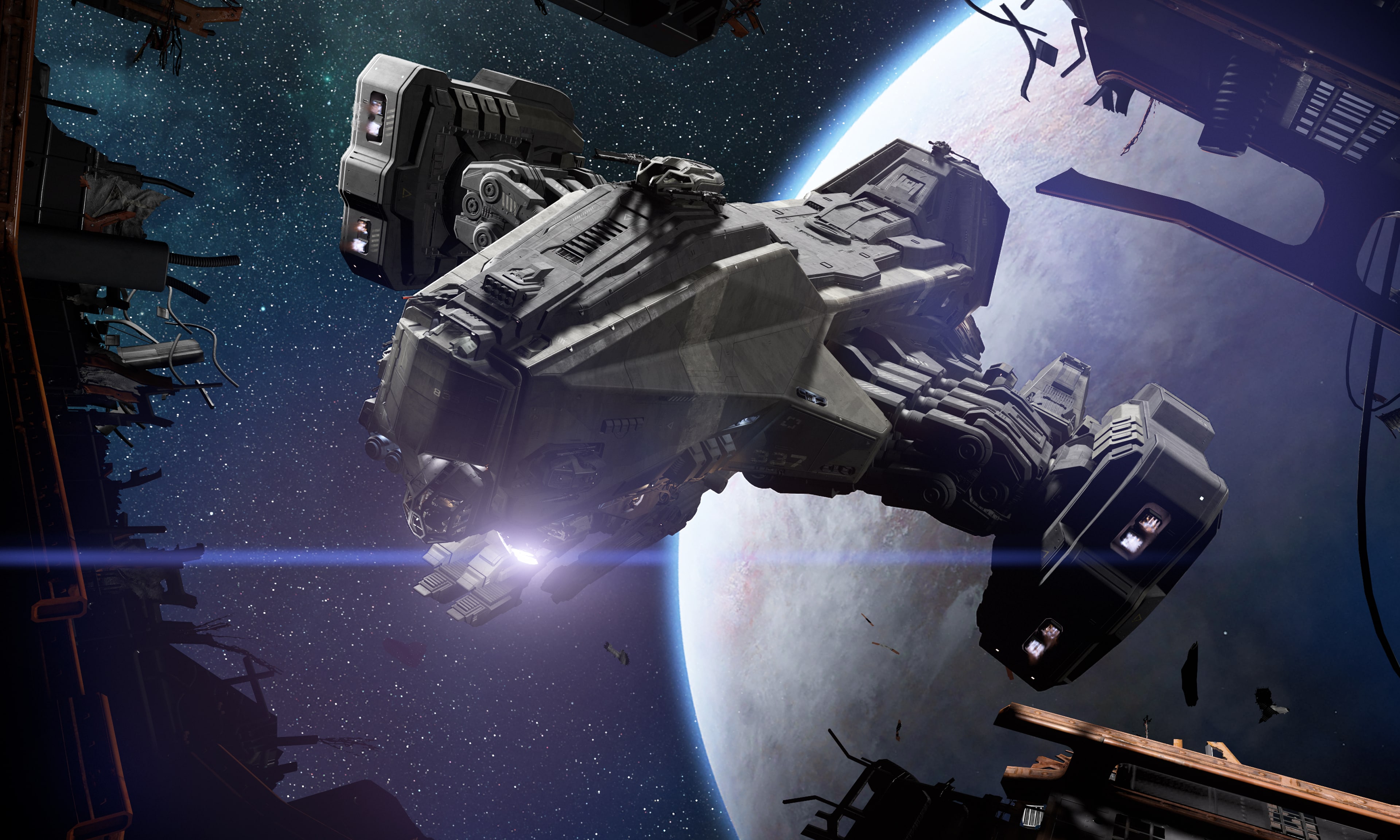
Anvil Aerospace Terrapin-class Pathfinder
INITIAL ORDER
Initial deliveries of production model U4A-3 Block I Terrapin-class ships began on September 19, 2796, with the first units forming the core of the newly-established 198th Utility and Support Wing (motto: “we’ve got u covered”) in a formal handover at MacArthur. As part of the United Empire of Earth’s intended phased military reorganization, elements of the 198th Wing were detached to active fleets as they became available, ensuring that the newly minted Terrapins saw action quickly. Indeed, the design’s first blooding occurred only two months after its introduction, when a single Terrapin downed a mercenary fighter as part of a combined forces narcotics interdiction operation off Castra. The Terrapin very easily settled into its fleet operations role, proving itself an effective support craft, armored personnel carrier and, when called, fighting platform. Military planners were extremely pleased with the ease of adoption and frequently cited the Terrapin as proof of the success behind the ‘new model Navy’ initiative of the immediate post-Messer era.
MARINE ADOPTION
The original Naval order for Terrapins was quickly followed by a second, similarly-sized request from the UEE Marines. Although the Terrapin lacks the heavy guns used by dedicated dropships, its protective armor and enhanced scanning capabilities mean that it is ideal as an armored personnel carrier. Terrapin APCs quickly became a frequent sight on convoy duty and in smaller-scale interdiction missions; it was a UEEM Terrapin which located and then boarded the liner Astoria during the 2820 hijacking disaster. (The boarding Terrapin itself was destroyed during the ensuing explosion, but its crew survived, along with the crew and passengers they helped lead to safety.) Marines are said to prefer travel aboard the smaller Terrapins when possible, their more advanced systems offering a far smoother (if more cramped) ride than traditional troopships. Terrapins have also become popular for ‘safe’ landing operations: generally, any landing where it will face no more than small arms fire. A rumor persists that the UEEM operates an advanced technology ‘improved stealth’ Terrapin for covert boarding operations; there has been no proper sighting of this spacecraft and its existence has been roundly denied by both Anvil and the military.
SUBSEQUENT VERSIONS
Reconnaissance and scouting units began transitioning to the Terrapin five years after its introduction as an armored utility ship, though this adoption was rockier than the initial launch. Recon pilots, used to incredibly fast, light spacecraft that rely on speed over armor to escape trouble, were turned off by the Terrapin’s opposite nature. This changed in a single incident: the ship was said to have “paid for itself” in 2814 when a reconnaissance ship flown by Commander Bruce Dunbar successfully tracked a Vanduul raiding party across four systems without being identified. The tactical information gathered from the mission helped form important elements of the modern strategic understanding of the Vanduul; the ensuing interdiction and destruction of the raiding party by elements of the Ninth Fleet was also a major public relations victory for the UEE. In the three years following the incident, every single front line reconnaissance unit received at least one Terrapin (and crew assignment).
The largest downside to the early Terrapin was the difficulty of power management, which required that a pilot become particularly familiar with the design in order to use it most effectively. With multiple flight configurations, some of which significantly alter the design’s on-orbit geometry, the difficulty in ‘mastering’ the Terrapin became apparent. Later models would ease this, adapting from the tricks developed by the early pilots for managing such an unusual set of abilities. Anvil Aerospace began rolling out the modified U4A-3 Block II version in July 2845, with battlefield upgrade kits converting extant Block I models to parity over the course of the following 24 months. The U4A-3 Block II transition was the result of a massive review of pilot experiences from the previous half-century; thousands of current and former Terrapin-drivers were interviewed and countless hours of combat and flight footage were reviewed as part of the improvement process. The biggest takeaway from the process was that the ship’s durability would make it ideal for exploratory roles it had not yet filled. As a result, Block I models dropped a largely unused remote chin turret and were given extended batteries, improved shielding and a sensor suite capable of gathering and storing more data than would ordinarily be required for a fire support spacecraft. Though the changes were not the result of a formal request for proposal, the Navy quickly saw the value and began purchasing Terrapins specifically for exploratory services assignments.
VERSATILITY IN ACTION
Although the Terrapin’s active service includes lengthy periods of peacetime, it is a design that is considered in-demand under any circumstances; Admiral Vos Kant famously claimed that the Terrapin’s multirole capabilities meant that there was no single spacecraft he would rather have in ready five position. Indeed, Terrapin pilots quickly adapted to keeping track of more than a ‘kill score’: auxiliary and support squadrons typically treat with equal importance the number of missions flown, the number of rescues performed, or the number of boarding operations conducted. Exploratory squadrons compete in terms of raw data uploaded. In all these areas, the Terrapin has become a recordsetter; a Terrapin currently holds the record for ‘live rescues’; pickups of humans who have been exposed to pure vacuum.
Terrapin were among the first spacecraft dispatched as part of the Synthworld project. The massive construction project was such a drain on Navy resources that by the early 30th century it was estimated that three in five Terrapin had been assigned to the effort at some point in their service. In addition to APC and S&R duties, multiple attempts were made to modify them for small-scale ore transport and mineral analysis. These modification efforts were not notably successful, although a well known Synthworld project patch displays an anthropomorphic Terrapin toting a shovel and bucket. Construction-oriented Terrapins received a distinct yellow-and-black paint scheme during this era, which is still commonly associated with the effort.
In 2910, the Terrapin became an unexpected household name following a “starring” role in a popular vid. To the Stars, partially financed by the Empire’s office of civilian outreach, featured a ragtag band of Humans aboard a garishly painted purple-and-orange Terrapin affectionately named Maxwell. The Terrapin was ‘played’ by an active duty U4A-3 Block II model on loan from the Navy, nominally assigned to the UEEN Declan Smith. Referred to early on as an “ugly lump,” the spacecraft ultimately saves the day and becomes a home for its crew of explorers. The ubiquity of the film and the popularity of the personified spacecraft led to a brief craze, with a number of companies producing Terrapin-themed merchandise for an eager civilian population. Maxwell itself returned to active duty after filming, but was ultimately donated to the Garber Aerospace Museum where it was restored to its on-camera appearance and is now on permanent display.
U4A-3 BLOCK III & CURRENT DEPLOYMENT
The “modern” U4A-3 Block III model premiered in 2899, featuring (among other things) upgrades to weapons hardpoints and a number of control surfaces. The Block III model also formalizes a longtime ‘trick’ used by Terrapin pilots, the ability to release energy by toggling flight modes. While no battlefield upgrade option was created, Block III spaceframes have now fully replaced the Block II model. Recent years have seen the Terrapin fill out its combat history, as battles with the Vanduul have become larger and more commonplace. In a noteworthy 2944 engagement, a flight of six Scythe fighters happened into a quartet of Terrapins operating with systems low in stealth mode as part of a training observation. With their emissions low, the Terrapin crews spent a terrifying eight minutes avoiding detection before ultimately being in a position to turn the table and get the jump on the Vanduul. The UEEN flight suffered damage but lost no spacecraft, while five of the six Scythes were destroyed. Gun camera footage was not able to determine the fate of the sixth, but it is considered to be a probable kill.
It was also around the turn of the century that civilians began more widespread operation of Terrapins; the Navy surplused thousands of Block IIs as part of the transition and then began rotating out Block IIIs on a fifteen year cycle. The civilian refurbishment program, operated by Anvil out of a dedicated decommissioning facility at Nova Kyiv, makes veteran Terrapins available to corporations and individual users. ArkJen was the first large corporation to adopt Terrapins en masse, adapting the ships’ reconnaissance capabilities for their traditional survey work. Noteworthy civilian operators today include Meridian Transport, where Terrapins are used for higher security planetary hops, and GRUT, where they have become instrumental in search and rescue missions.
Individual Terrapin owners have also become extremely common in recent years, with thousands of the ships on the official registry. Owner/operators consider them to be a sound investment, even used: a solid spacecraft capable of meeting many essential, common roles while still being rough-and-tumble enough to adapt to a constantly changing galaxy.
This extract is from the 2947 Whitley’s Guide to Spacecraft’s U4A Terrapin Service History. Reprinted with permission. Whitley’s Guide is the property of Gallivan Publishing, 2860-2948, all rights reserved.
Dieser Artikel erschien ursprünglich in Jump Point 6.02.
Anvil Aerospace Terrapin-Klasse Pathfinder
ERSTE BESTELLUNG
Die ersten Lieferungen von Schiffen der Terrapin-Klasse des Produktionsmodells U4A-3 Block I begannen am 19. September 2796. Die ersten Einheiten bildeten den Kern des neu gegründeten 198th Utility and Support Wing (Motto: "we've got u covered") und wurden bei einer formellen Übergabe in MacArthur übergeben. Im Rahmen der vom Vereinigten Imperium der Erde geplanten schrittweisen Umstrukturierung des Militärs wurden Elemente des 198. Geschwaders zu aktiven Flotten abkommandiert, sobald sie verfügbar waren, um sicherzustellen, dass die neu geprägten Terrapins schnell zum Einsatz kamen. In der Tat kam das Design nur zwei Monate nach seiner Einführung zum ersten Mal zum Einsatz, als ein einziger Terrapin einen Söldnerjäger im Rahmen einer Drogenbekämpfungsoperation vor Castra abschießt. Der Terrapin lebte sich sehr schnell in seine Rolle bei Flottenoperationen ein und erwies sich als effektives Unterstützungsfahrzeug, gepanzerter Mannschaftstransporter und, wenn nötig, als Kampfplattform. Die militärischen Planer waren äußerst zufrieden mit der problemlosen Einführung und führten die Terrapin häufig als Beweis für den Erfolg der Initiative 'New Model Navy' der unmittelbaren Nach-Messer-Ära an.
ÜBERNAHME DURCH DIE MARINE
Auf die ursprüngliche Bestellung der Marine für Terrapins folgte schnell eine zweite, ähnlich große Anfrage der UEE Marines. Obwohl der Terrapin nicht über die schweren Geschütze verfügt, die von speziellen Transportschiffen verwendet werden, eignet er sich dank seiner Schutzpanzerung und seiner verbesserten Scanning-Fähigkeiten ideal als gepanzerter Mannschaftstransporter. Terrapin APCs wurden schnell zu einem häufigen Anblick im Konvoi und bei kleineren Abwehreinsätzen; es war ein UEEM Terrapin, der den Liner Astoria während der Entführungskatastrophe von 2820 aufspürte und dann an Bord ging. (Der an Bord gehende Terrapin selbst wurde bei der anschließenden Explosion zerstört, aber seine Besatzung überlebte zusammen mit der Crew und den Passagieren, die sie in Sicherheit brachten). Es heißt, dass Marines, wenn möglich, lieber an Bord der kleineren Terrapins reisen, da ihre fortschrittlicheren Systeme eine weitaus angenehmere (wenn auch beengtere) Fahrt bieten als herkömmliche Truppentransporter. Terrapins sind auch für 'sichere' Landungen beliebt geworden: im Allgemeinen jede Landung, bei der sie nur mit Handfeuerwaffen beschossen werden. Es hält sich hartnäckig das Gerücht, dass die UEEM einen hochmodernen 'verbesserten Tarnkappen'-Terrapin für verdeckte Enteroperationen einsetzt. Dieses Raumschiff wurde nie richtig gesichtet und seine Existenz wurde sowohl von Anvil als auch vom Militär rundweg dementiert.
NACHFOLGEVERSIONEN
Fünf Jahre nach der Einführung des Terrapin als gepanzertes Versorgungsschiff begannen Aufklärungs- und Späheinheiten mit der Umstellung auf den Terrapin, auch wenn die Akzeptanz schwieriger war als bei der ersten Einführung. Aufklärungspiloten, die an unglaublich schnelle, leichte Raumschiffe gewöhnt waren, bei denen Geschwindigkeit wichtiger ist als Panzerung, waren von der entgegengesetzten Natur der Terrapin abgeschreckt. Das änderte sich mit einem einzigen Vorfall: Das Schiff soll sich 2814 "bezahlt gemacht" haben, als ein Aufklärungsschiff unter Commander Bruce Dunbar einen Vanduul-Angriffstrupp erfolgreich durch vier Systeme verfolgte, ohne identifiziert zu werden. Die taktischen Informationen, die bei dieser Mission gesammelt wurden, trugen dazu bei, wichtige Elemente des modernen strategischen Verständnisses der Vanduul zu formen. Die anschließende Unterbindung und Zerstörung des Überfallkommandos durch Elemente der Neunten Flotte war auch ein großer Sieg für die Öffentlichkeitsarbeit der UEE. In den drei Jahren nach dem Vorfall erhielt jede einzelne Aufklärungseinheit an der Front mindestens einen Terrapin (und eine entsprechende Besatzung).
Der größte Nachteil der frühen Terrapin war die schwierige Energieverwaltung, die es einem Piloten abverlangte, sich besonders gut mit der Konstruktion vertraut zu machen, um sie möglichst effektiv nutzen zu können. Da es mehrere Flugkonfigurationen gab, von denen einige die Geometrie der Konstruktion im Orbit erheblich veränderten, wurde die Schwierigkeit, die Terrapin zu "beherrschen", deutlich. Spätere Modelle sollten dies erleichtern, indem sie die von den frühen Piloten entwickelten Tricks zur Beherrschung dieser ungewöhnlichen Fähigkeiten adaptierten. Anvil Aerospace begann im Juli 2845 mit der Markteinführung der modifizierten U4A-3 Block II-Version. Im Laufe der folgenden 24 Monate wurden die vorhandenen Block I-Modelle mit Aufrüstungskits für den Einsatz auf dem Schlachtfeld auf den gleichen Stand gebracht. Die Umstellung auf den U4A-3 Block II war das Ergebnis einer umfassenden Auswertung der Erfahrungen von Piloten aus dem letzten halben Jahrhundert. Tausende von aktuellen und ehemaligen Terrapin-Piloten wurden befragt und unzählige Stunden an Kampf- und Flugmaterial wurden im Rahmen des Verbesserungsprozesses ausgewertet. Die wichtigste Erkenntnis aus diesem Prozess war, dass das Schiff aufgrund seiner Langlebigkeit ideal für Erkundungsaufgaben geeignet war, die es bisher noch nicht erfüllt hatte. Infolgedessen entfiel bei den Block I-Modellen ein weitgehend ungenutzter ferngesteuerter Kinnturm und sie erhielten erweiterte Batterien, eine verbesserte Abschirmung und eine Sensorensuite, die mehr Daten erfassen und speichern konnte, als für ein feuerunterstützendes Raumschiff normalerweise erforderlich wäre. Obwohl die Änderungen nicht das Ergebnis einer formellen Ausschreibung waren, erkannte die Marine schnell den Wert und begann, Terrapins speziell für Erkundungseinsätze zu kaufen.
VIELSEITIGKEIT IM EINSATZ
Obwohl der Terrapin auch in Friedenszeiten eingesetzt wird, ist er ein Design, das unter allen Umständen gefragt ist. Admiral Vos Kant behauptete bekanntermaßen, dass es aufgrund der Mehrzweckfähigkeiten des Terrapin kein einziges Raumschiff gibt, das er lieber in Bereitschaftsstellung hätte. In der Tat gewöhnten sich die Terrapin-Piloten schnell daran, mehr als nur eine 'Abschussquote' im Auge zu behalten: Hilfs- und Unterstützungsgeschwader behandeln die Anzahl der geflogenen Missionen, die Anzahl der durchgeführten Rettungsaktionen oder die Anzahl der durchgeführten Entermanöver in der Regel mit gleicher Wichtigkeit. Erkundungsgeschwader wetteifern in Bezug auf die hochgeladenen Rohdaten. In all diesen Bereichen hat sich der Terrapin zu einem Rekordhalter entwickelt. Ein Terrapin hält derzeit den Rekord für 'Live-Rescues', also das Aufnehmen von Menschen, die einem reinen Vakuum ausgesetzt waren.
Die Terrapin gehörten zu den ersten Raumschiffen, die im Rahmen des Synthworld-Projekts entsandt wurden. Das gewaltige Bauprojekt beanspruchte die Ressourcen der Navy so sehr, dass zu Beginn des 30. Jahrhunderts schätzungsweise drei von fünf Terrapin zu irgendeinem Zeitpunkt ihrer Dienstzeit für das Projekt eingesetzt wurden. Zusätzlich zu den APC- und S&R-Aufgaben wurden mehrere Versuche unternommen, sie für den Transport kleinerer Mengen von Erzen und die Analyse von Mineralien zu modifizieren. Diese Modifizierungsversuche waren nicht sonderlich erfolgreich, obwohl ein bekannter Synthworld-Projektaufnäher einen anthropomorphen Terrapin zeigt, der eine Schaufel und einen Eimer trägt. Konstruktionsorientierte Terrapins erhielten in dieser Ära ein ausgeprägtes gelb-schwarzes Farbschema, das immer noch häufig mit diesen Bemühungen in Verbindung gebracht wird.
Im Jahr 2910 wurde der Terrapin unerwartet bekannt, nachdem er die Hauptrolle in einem beliebten Videofilm gespielt hatte. In dem Film To the Stars, der teilweise vom Imperium finanziert wurde, war eine bunt zusammengewürfelte Gruppe von Menschen an Bord eines schrill lackierten lila-orangefarbenen Terrapins zu sehen, der liebevoll Maxwell genannt wurde. Der Terrapin wurde von einem U4A-3 Block II Modell im aktiven Dienst gespielt, das von der Navy ausgeliehen und nominell der UEEN Declan Smith zugeteilt war. Das Raumschiff, das schon früh als "hässlicher Klotz" bezeichnet wird, rettet schließlich den Tag und wird zur Heimat für seine Crew von Forschern. Die Allgegenwärtigkeit des Films und die Beliebtheit des personifizierten Raumschiffs führten zu einem kurzen Hype, bei dem eine Reihe von Unternehmen Terrapin-Artikel für die begeisterte Zivilbevölkerung herstellten. Maxwell selbst kehrte nach den Dreharbeiten in den aktiven Dienst zurück, wurde aber schließlich dem Garber Aerospace Museum gespendet, wo es so restauriert wurde, wie es im Film aussah, und nun dauerhaft ausgestellt ist.
U4A-3 BLOCK III & AKTUELLER EINSATZ
Das "moderne" Modell U4A-3 Block III wurde erstmals 2899 vorgestellt und bietet (unter anderem) Verbesserungen an den Waffenstützpunkten und einer Reihe von Steuerflächen. Das Block III Modell formalisiert auch einen langjährigen "Trick" der Terrapin-Piloten, nämlich die Fähigkeit, Energie durch Umschalten des Flugmodus freizusetzen. Es wurde zwar keine Upgrade-Option für das Schlachtfeld geschaffen, aber die Block III-Raumschiffe haben das Block II-Modell nun vollständig ersetzt. In den letzten Jahren hat der Terrapin seine Kampfgeschichte vervollständigt, da die Schlachten mit den Vanduul größer und alltäglicher wurden. In einem bemerkenswerten Gefecht im Jahr 2944 traf ein Flug von sechs Scythe-Jägern im Rahmen einer Trainingsbeobachtung auf ein Quartett von Terrapins, die mit niedrigen Systemen im Tarnmodus operierten. Mit niedrigen Emissionen verbrachten die Terrapin-Besatzungen erschreckende acht Minuten damit, der Entdeckung zu entgehen, bevor sie schließlich in der Lage waren, den Spieß umzudrehen und die Vanduul zu besiegen. Der UEEN-Flug erlitt Schäden, verlor aber kein Raumschiff, während fünf der sechs Scythes zerstört wurden. Die Aufnahmen der Waffenkamera konnten das Schicksal der sechsten Scythes nicht klären, aber es gilt als wahrscheinlich, dass sie getötet wurde.
Um die Jahrhundertwende begann auch die zivile Nutzung der Terrapins. Die Marine gab im Rahmen der Umstellung Tausende von Block IIs ab und begann dann, die Block IIIs in einem fünfzehnjährigen Zyklus auszutauschen. Das zivile Überholungsprogramm, das von Anvil in einer speziellen Ausmusterungsanlage in Nova Kiev betrieben wird, macht alte Terrapins für Unternehmen und Einzelpersonen verfügbar. ArkJen war das erste große Unternehmen, das Terrapins in großem Umfang einsetzte und die Aufklärungsfähigkeiten der Schiffe für seine traditionellen Vermessungsaufgaben nutzte. Zu den bemerkenswerten zivilen Betreibern gehören heute Meridian Transport, wo Terrapins für Planetenhüpfer mit höherer Sicherheit eingesetzt werden, und GRUT, wo sie bei Such- und Rettungsmissionen zum Einsatz kommen.
Einzelne Terrapin-Besitzer sind in den letzten Jahren ebenfalls sehr häufig geworden, und Tausende von Schiffen sind offiziell registriert. Die Besitzer/Betreiber halten sie für eine solide Investition, selbst wenn sie gebraucht werden: ein solides Raumschiff, das viele wichtige, alltägliche Aufgaben erfüllen kann und dennoch robust genug ist, um sich an eine sich ständig verändernde Galaxie anzupassen.
Dieser Auszug stammt aus dem 2947 Whitley's Guide to Spacecraft's U4A Terrapin Service History. Nachdruck mit Genehmigung. Whitley's Guide ist das Eigentum von Gallivan Publishing, 2860-2948, alle Rechte vorbehalten.
This article originally appeared in Jump Point 6.02.
Anvil Aerospace Terrapin-class Pathfinder
INITIAL ORDER
Initial deliveries of production model U4A-3 Block I Terrapin-class ships began on September 19, 2796, with the first units forming the core of the newly-established 198th Utility and Support Wing (motto: “we’ve got u covered”) in a formal handover at MacArthur. As part of the United Empire of Earth’s intended phased military reorganization, elements of the 198th Wing were detached to active fleets as they became available, ensuring that the newly minted Terrapins saw action quickly. Indeed, the design’s first blooding occurred only two months after its introduction, when a single Terrapin downed a mercenary fighter as part of a combined forces narcotics interdiction operation off Castra. The Terrapin very easily settled into its fleet operations role, proving itself an effective support craft, armored personnel carrier and, when called, fighting platform. Military planners were extremely pleased with the ease of adoption and frequently cited the Terrapin as proof of the success behind the ‘new model Navy’ initiative of the immediate post-Messer era.
MARINE ADOPTION
The original Naval order for Terrapins was quickly followed by a second, similarly-sized request from the UEE Marines. Although the Terrapin lacks the heavy guns used by dedicated dropships, its protective armor and enhanced scanning capabilities mean that it is ideal as an armored personnel carrier. Terrapin APCs quickly became a frequent sight on convoy duty and in smaller-scale interdiction missions; it was a UEEM Terrapin which located and then boarded the liner Astoria during the 2820 hijacking disaster. (The boarding Terrapin itself was destroyed during the ensuing explosion, but its crew survived, along with the crew and passengers they helped lead to safety.) Marines are said to prefer travel aboard the smaller Terrapins when possible, their more advanced systems offering a far smoother (if more cramped) ride than traditional troopships. Terrapins have also become popular for ‘safe’ landing operations: generally, any landing where it will face no more than small arms fire. A rumor persists that the UEEM operates an advanced technology ‘improved stealth’ Terrapin for covert boarding operations; there has been no proper sighting of this spacecraft and its existence has been roundly denied by both Anvil and the military.
SUBSEQUENT VERSIONS
Reconnaissance and scouting units began transitioning to the Terrapin five years after its introduction as an armored utility ship, though this adoption was rockier than the initial launch. Recon pilots, used to incredibly fast, light spacecraft that rely on speed over armor to escape trouble, were turned off by the Terrapin’s opposite nature. This changed in a single incident: the ship was said to have “paid for itself” in 2814 when a reconnaissance ship flown by Commander Bruce Dunbar successfully tracked a Vanduul raiding party across four systems without being identified. The tactical information gathered from the mission helped form important elements of the modern strategic understanding of the Vanduul; the ensuing interdiction and destruction of the raiding party by elements of the Ninth Fleet was also a major public relations victory for the UEE. In the three years following the incident, every single front line reconnaissance unit received at least one Terrapin (and crew assignment).
The largest downside to the early Terrapin was the difficulty of power management, which required that a pilot become particularly familiar with the design in order to use it most effectively. With multiple flight configurations, some of which significantly alter the design’s on-orbit geometry, the difficulty in ‘mastering’ the Terrapin became apparent. Later models would ease this, adapting from the tricks developed by the early pilots for managing such an unusual set of abilities. Anvil Aerospace began rolling out the modified U4A-3 Block II version in July 2845, with battlefield upgrade kits converting extant Block I models to parity over the course of the following 24 months. The U4A-3 Block II transition was the result of a massive review of pilot experiences from the previous half-century; thousands of current and former Terrapin-drivers were interviewed and countless hours of combat and flight footage were reviewed as part of the improvement process. The biggest takeaway from the process was that the ship’s durability would make it ideal for exploratory roles it had not yet filled. As a result, Block I models dropped a largely unused remote chin turret and were given extended batteries, improved shielding and a sensor suite capable of gathering and storing more data than would ordinarily be required for a fire support spacecraft. Though the changes were not the result of a formal request for proposal, the Navy quickly saw the value and began purchasing Terrapins specifically for exploratory services assignments.
VERSATILITY IN ACTION
Although the Terrapin’s active service includes lengthy periods of peacetime, it is a design that is considered in-demand under any circumstances; Admiral Vos Kant famously claimed that the Terrapin’s multirole capabilities meant that there was no single spacecraft he would rather have in ready five position. Indeed, Terrapin pilots quickly adapted to keeping track of more than a ‘kill score’: auxiliary and support squadrons typically treat with equal importance the number of missions flown, the number of rescues performed, or the number of boarding operations conducted. Exploratory squadrons compete in terms of raw data uploaded. In all these areas, the Terrapin has become a recordsetter; a Terrapin currently holds the record for ‘live rescues’; pickups of humans who have been exposed to pure vacuum.
Terrapin were among the first spacecraft dispatched as part of the Synthworld project. The massive construction project was such a drain on Navy resources that by the early 30th century it was estimated that three in five Terrapin had been assigned to the effort at some point in their service. In addition to APC and S&R duties, multiple attempts were made to modify them for small-scale ore transport and mineral analysis. These modification efforts were not notably successful, although a well known Synthworld project patch displays an anthropomorphic Terrapin toting a shovel and bucket. Construction-oriented Terrapins received a distinct yellow-and-black paint scheme during this era, which is still commonly associated with the effort.
In 2910, the Terrapin became an unexpected household name following a “starring” role in a popular vid. To the Stars, partially financed by the Empire’s office of civilian outreach, featured a ragtag band of Humans aboard a garishly painted purple-and-orange Terrapin affectionately named Maxwell. The Terrapin was ‘played’ by an active duty U4A-3 Block II model on loan from the Navy, nominally assigned to the UEEN Declan Smith. Referred to early on as an “ugly lump,” the spacecraft ultimately saves the day and becomes a home for its crew of explorers. The ubiquity of the film and the popularity of the personified spacecraft led to a brief craze, with a number of companies producing Terrapin-themed merchandise for an eager civilian population. Maxwell itself returned to active duty after filming, but was ultimately donated to the Garber Aerospace Museum where it was restored to its on-camera appearance and is now on permanent display.
U4A-3 BLOCK III & CURRENT DEPLOYMENT
The “modern” U4A-3 Block III model premiered in 2899, featuring (among other things) upgrades to weapons hardpoints and a number of control surfaces. The Block III model also formalizes a longtime ‘trick’ used by Terrapin pilots, the ability to release energy by toggling flight modes. While no battlefield upgrade option was created, Block III spaceframes have now fully replaced the Block II model. Recent years have seen the Terrapin fill out its combat history, as battles with the Vanduul have become larger and more commonplace. In a noteworthy 2944 engagement, a flight of six Scythe fighters happened into a quartet of Terrapins operating with systems low in stealth mode as part of a training observation. With their emissions low, the Terrapin crews spent a terrifying eight minutes avoiding detection before ultimately being in a position to turn the table and get the jump on the Vanduul. The UEEN flight suffered damage but lost no spacecraft, while five of the six Scythes were destroyed. Gun camera footage was not able to determine the fate of the sixth, but it is considered to be a probable kill.
It was also around the turn of the century that civilians began more widespread operation of Terrapins; the Navy surplused thousands of Block IIs as part of the transition and then began rotating out Block IIIs on a fifteen year cycle. The civilian refurbishment program, operated by Anvil out of a dedicated decommissioning facility at Nova Kyiv, makes veteran Terrapins available to corporations and individual users. ArkJen was the first large corporation to adopt Terrapins en masse, adapting the ships’ reconnaissance capabilities for their traditional survey work. Noteworthy civilian operators today include Meridian Transport, where Terrapins are used for higher security planetary hops, and GRUT, where they have become instrumental in search and rescue missions.
Individual Terrapin owners have also become extremely common in recent years, with thousands of the ships on the official registry. Owner/operators consider them to be a sound investment, even used: a solid spacecraft capable of meeting many essential, common roles while still being rough-and-tumble enough to adapt to a constantly changing galaxy.
This extract is from the 2947 Whitley’s Guide to Spacecraft’s U4A Terrapin Service History. Reprinted with permission. Whitley’s Guide is the property of Gallivan Publishing, 2860-2948, all rights reserved.
This article originally appeared in Jump Point 6.02.
Anvil Aerospace Terrapin-class Pathfinder
INITIAL ORDER
Initial deliveries of production model U4A-3 Block I Terrapin-class ships began on September 19, 2796, with the first units forming the core of the newly-established 198th Utility and Support Wing (motto: “we’ve got u covered”) in a formal handover at MacArthur. As part of the United Empire of Earth’s intended phased military reorganization, elements of the 198th Wing were detached to active fleets as they became available, ensuring that the newly minted Terrapins saw action quickly. Indeed, the design’s first blooding occurred only two months after its introduction, when a single Terrapin downed a mercenary fighter as part of a combined forces narcotics interdiction operation off Castra. The Terrapin very easily settled into its fleet operations role, proving itself an effective support craft, armored personnel carrier and, when called, fighting platform. Military planners were extremely pleased with the ease of adoption and frequently cited the Terrapin as proof of the success behind the ‘new model Navy’ initiative of the immediate post-Messer era.
MARINE ADOPTION
The original Naval order for Terrapins was quickly followed by a second, similarly-sized request from the UEE Marines. Although the Terrapin lacks the heavy guns used by dedicated dropships, its protective armor and enhanced scanning capabilities mean that it is ideal as an armored personnel carrier. Terrapin APCs quickly became a frequent sight on convoy duty and in smaller-scale interdiction missions; it was a UEEM Terrapin which located and then boarded the liner Astoria during the 2820 hijacking disaster. (The boarding Terrapin itself was destroyed during the ensuing explosion, but its crew survived, along with the crew and passengers they helped lead to safety.) Marines are said to prefer travel aboard the smaller Terrapins when possible, their more advanced systems offering a far smoother (if more cramped) ride than traditional troopships. Terrapins have also become popular for ‘safe’ landing operations: generally, any landing where it will face no more than small arms fire. A rumor persists that the UEEM operates an advanced technology ‘improved stealth’ Terrapin for covert boarding operations; there has been no proper sighting of this spacecraft and its existence has been roundly denied by both Anvil and the military.
SUBSEQUENT VERSIONS
Reconnaissance and scouting units began transitioning to the Terrapin five years after its introduction as an armored utility ship, though this adoption was rockier than the initial launch. Recon pilots, used to incredibly fast, light spacecraft that rely on speed over armor to escape trouble, were turned off by the Terrapin’s opposite nature. This changed in a single incident: the ship was said to have “paid for itself” in 2814 when a reconnaissance ship flown by Commander Bruce Dunbar successfully tracked a Vanduul raiding party across four systems without being identified. The tactical information gathered from the mission helped form important elements of the modern strategic understanding of the Vanduul; the ensuing interdiction and destruction of the raiding party by elements of the Ninth Fleet was also a major public relations victory for the UEE. In the three years following the incident, every single front line reconnaissance unit received at least one Terrapin (and crew assignment).
The largest downside to the early Terrapin was the difficulty of power management, which required that a pilot become particularly familiar with the design in order to use it most effectively. With multiple flight configurations, some of which significantly alter the design’s on-orbit geometry, the difficulty in ‘mastering’ the Terrapin became apparent. Later models would ease this, adapting from the tricks developed by the early pilots for managing such an unusual set of abilities. Anvil Aerospace began rolling out the modified U4A-3 Block II version in July 2845, with battlefield upgrade kits converting extant Block I models to parity over the course of the following 24 months. The U4A-3 Block II transition was the result of a massive review of pilot experiences from the previous half-century; thousands of current and former Terrapin-drivers were interviewed and countless hours of combat and flight footage were reviewed as part of the improvement process. The biggest takeaway from the process was that the ship’s durability would make it ideal for exploratory roles it had not yet filled. As a result, Block I models dropped a largely unused remote chin turret and were given extended batteries, improved shielding and a sensor suite capable of gathering and storing more data than would ordinarily be required for a fire support spacecraft. Though the changes were not the result of a formal request for proposal, the Navy quickly saw the value and began purchasing Terrapins specifically for exploratory services assignments.
VERSATILITY IN ACTION
Although the Terrapin’s active service includes lengthy periods of peacetime, it is a design that is considered in-demand under any circumstances; Admiral Vos Kant famously claimed that the Terrapin’s multirole capabilities meant that there was no single spacecraft he would rather have in ready five position. Indeed, Terrapin pilots quickly adapted to keeping track of more than a ‘kill score’: auxiliary and support squadrons typically treat with equal importance the number of missions flown, the number of rescues performed, or the number of boarding operations conducted. Exploratory squadrons compete in terms of raw data uploaded. In all these areas, the Terrapin has become a recordsetter; a Terrapin currently holds the record for ‘live rescues’; pickups of humans who have been exposed to pure vacuum.
Terrapin were among the first spacecraft dispatched as part of the Synthworld project. The massive construction project was such a drain on Navy resources that by the early 30th century it was estimated that three in five Terrapin had been assigned to the effort at some point in their service. In addition to APC and S&R duties, multiple attempts were made to modify them for small-scale ore transport and mineral analysis. These modification efforts were not notably successful, although a well known Synthworld project patch displays an anthropomorphic Terrapin toting a shovel and bucket. Construction-oriented Terrapins received a distinct yellow-and-black paint scheme during this era, which is still commonly associated with the effort.
In 2910, the Terrapin became an unexpected household name following a “starring” role in a popular vid. To the Stars, partially financed by the Empire’s office of civilian outreach, featured a ragtag band of Humans aboard a garishly painted purple-and-orange Terrapin affectionately named Maxwell. The Terrapin was ‘played’ by an active duty U4A-3 Block II model on loan from the Navy, nominally assigned to the UEEN Declan Smith. Referred to early on as an “ugly lump,” the spacecraft ultimately saves the day and becomes a home for its crew of explorers. The ubiquity of the film and the popularity of the personified spacecraft led to a brief craze, with a number of companies producing Terrapin-themed merchandise for an eager civilian population. Maxwell itself returned to active duty after filming, but was ultimately donated to the Garber Aerospace Museum where it was restored to its on-camera appearance and is now on permanent display.
U4A-3 BLOCK III & CURRENT DEPLOYMENT
The “modern” U4A-3 Block III model premiered in 2899, featuring (among other things) upgrades to weapons hardpoints and a number of control surfaces. The Block III model also formalizes a longtime ‘trick’ used by Terrapin pilots, the ability to release energy by toggling flight modes. While no battlefield upgrade option was created, Block III spaceframes have now fully replaced the Block II model. Recent years have seen the Terrapin fill out its combat history, as battles with the Vanduul have become larger and more commonplace. In a noteworthy 2944 engagement, a flight of six Scythe fighters happened into a quartet of Terrapins operating with systems low in stealth mode as part of a training observation. With their emissions low, the Terrapin crews spent a terrifying eight minutes avoiding detection before ultimately being in a position to turn the table and get the jump on the Vanduul. The UEEN flight suffered damage but lost no spacecraft, while five of the six Scythes were destroyed. Gun camera footage was not able to determine the fate of the sixth, but it is considered to be a probable kill.
It was also around the turn of the century that civilians began more widespread operation of Terrapins; the Navy surplused thousands of Block IIs as part of the transition and then began rotating out Block IIIs on a fifteen year cycle. The civilian refurbishment program, operated by Anvil out of a dedicated decommissioning facility at Nova Kyiv, makes veteran Terrapins available to corporations and individual users. ArkJen was the first large corporation to adopt Terrapins en masse, adapting the ships’ reconnaissance capabilities for their traditional survey work. Noteworthy civilian operators today include Meridian Transport, where Terrapins are used for higher security planetary hops, and GRUT, where they have become instrumental in search and rescue missions.
Individual Terrapin owners have also become extremely common in recent years, with thousands of the ships on the official registry. Owner/operators consider them to be a sound investment, even used: a solid spacecraft capable of meeting many essential, common roles while still being rough-and-tumble enough to adapt to a constantly changing galaxy.
This extract is from the 2947 Whitley’s Guide to Spacecraft’s U4A Terrapin Service History. Reprinted with permission. Whitley’s Guide is the property of Gallivan Publishing, 2860-2948, all rights reserved.
Links
No links available.
Images
3

Metadata
- CIG ID
- 19081
- Channel
- Spectrum Dispatch
- Category
- Undefined
- Series
- News Update
- Comments
- 78
- Published
- 3 years ago (2023-01-10T00:00:00+00:00)