Medical Guide
Transmission Undefined NoneContent
This is an archived page of previous medical gameplay design.
Please visit this page for more up-to-date information.
Medical Guide
Star Citizen's persistent universe bolsters a comprehensive medical system, complete with hospitals, tiered injuries, and a plethora of medical drugs and tools. Join us as we dive deep into each of these new features in hope you'll be properly equipped to face this update, which significantly ups the stakes of surviving in the 'verse.
And if you're looking for additional help to get started in medicine, check out the Guide System to get paired with an experienced player who can help show you the ropes.
Tools of the TradeA good medic keeps an array of tools on hand. From single-use items to trusty healing tools, there's plenty gear and goodies to keep you and your team upright. Before we jump into the details of how and where to heal, here are looks at the three tools currently available to a budding medical professional, all able to be purchased at any hospital or clinic:Medical Pens
Simple and effective, pens deliver the specific medicine you need quickly and easily
Medical pens are an easy, straight-forward way to treat either yourself or another person in the field, and conveniently, all medical drugs can be purchased in pen form (more on those later). To use a pen, hold the 4 key to open a radial menu and select the pen you'd like to use. From here, either press B to use it on yourself, or use Mouse 2 to apply it to someone else. These controls apply to all medical tools.
Multi-Tool
Using the dedicated attachment, your Multi-Tool can be used to deliver Hemozal in a pinch, both to yourself and others from a distance
The Multi-Tool can be equipped with the LifeGuard medical attachment in order to be used as a life-saving device. More precise and effective than a MedPen, with the added benefit of healing from a short distance, this attachment is limited to administering Hemozal.
Curelife Medical Tool
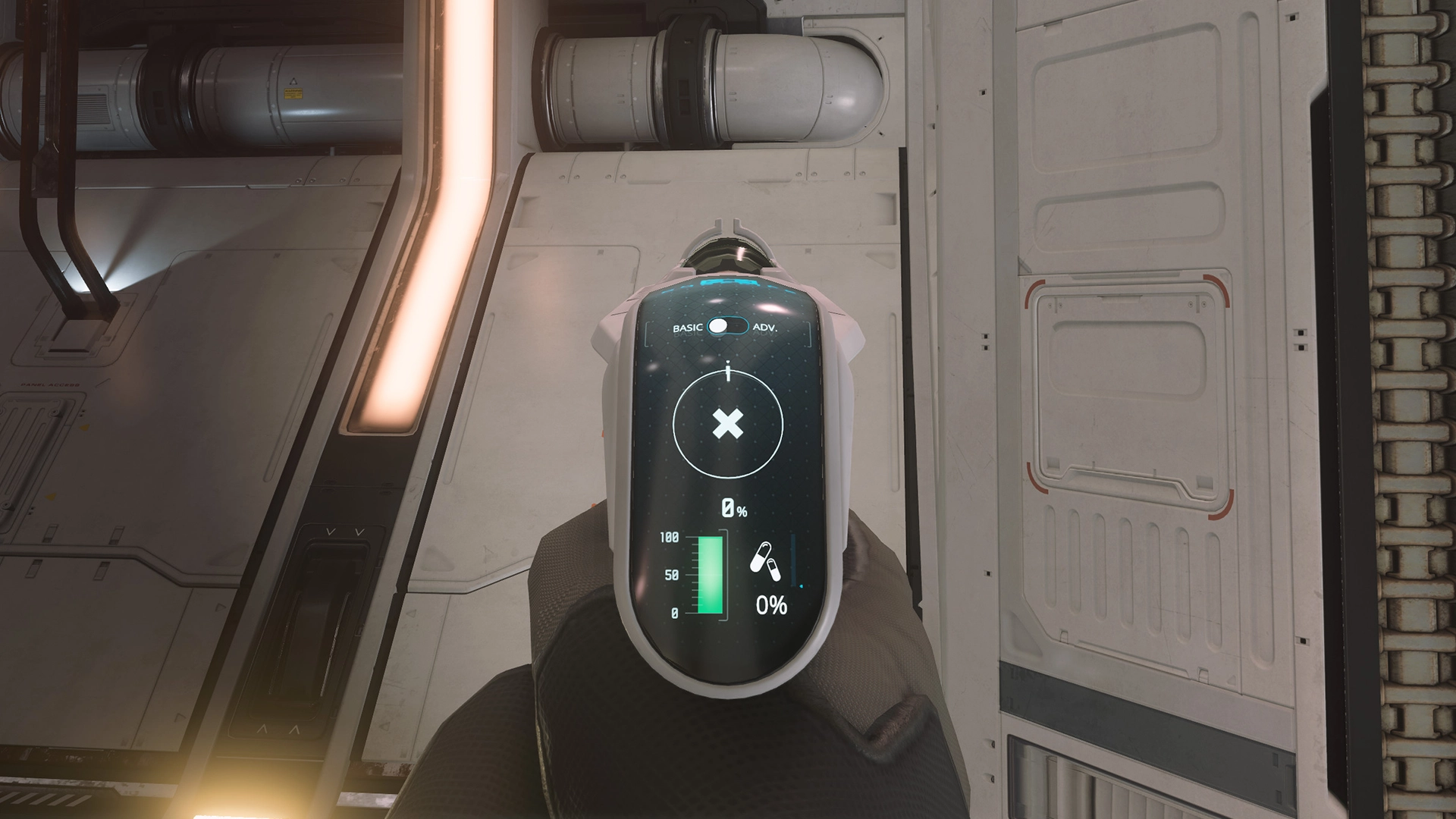
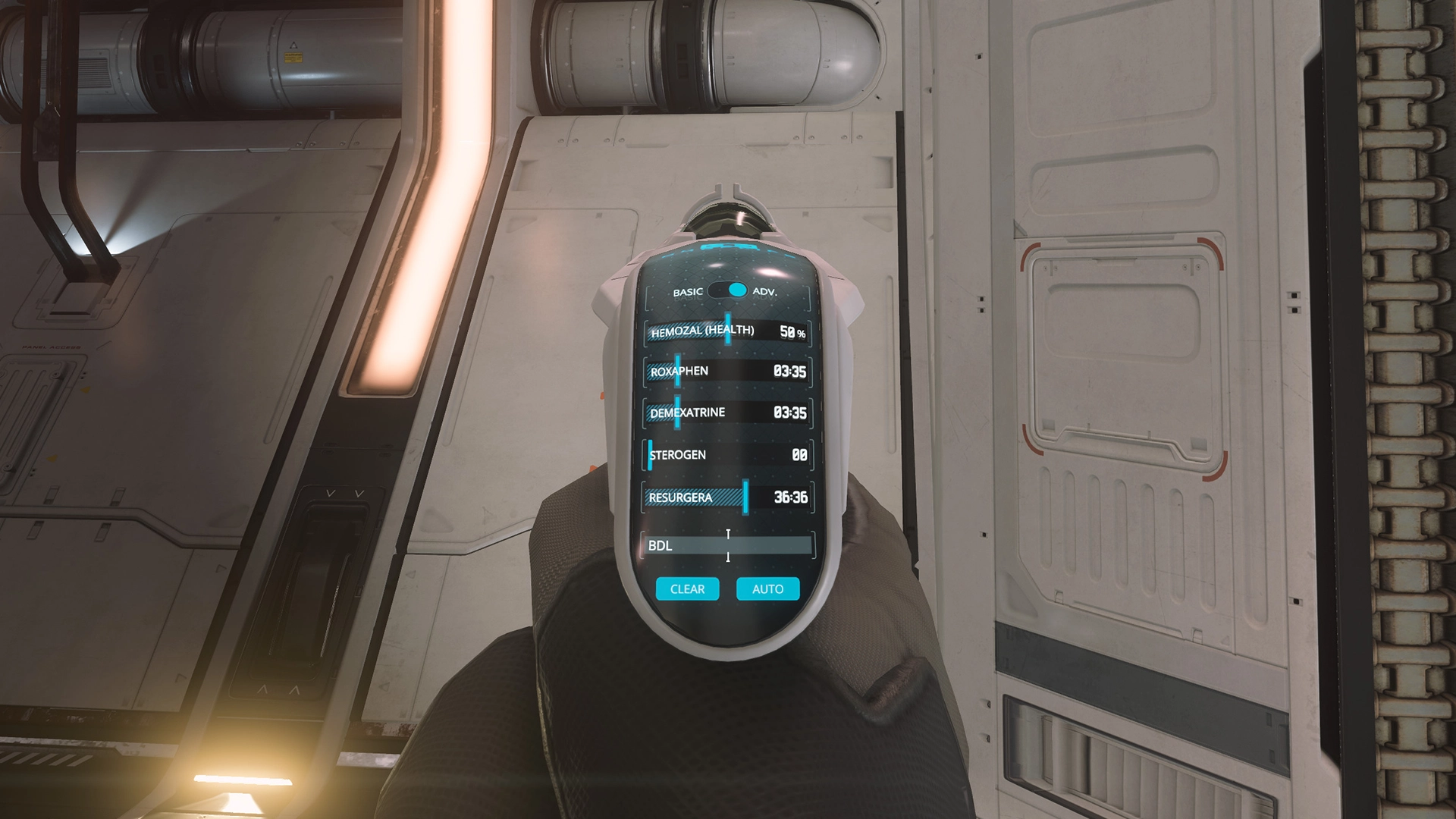
A must-have for any medical professional, this tool can administer any medical drug in precise amounts, as well as provide detailed medical scans
A must-have for any medical professional, this tool can administer any of the five medical drugs in precise amounts, or simply apply Hemozal as needed. What's more, it can also provide detailed medical scans of another person, highlighting specific injuries and recommending treatments.
Drugs and BDLHemozal is but one of several pharmaceuticals available to a medic's arsenal. These drugs all have unique attributes and effects, however all of them increase your Blood Drug Level (BDL). Your BDL is tracked next to your health status on your helmet HUD. Once this level reaches 50% of maximum, your character will enter an Overdosed state. This will affect your traversal speed, blur your vision, add a weapon sway effect, and cause your character to pilot vehicle erratically. Additionally, your character will begin to take damage slowly unless the effects are countered.Below are the types of drugs available, both separately in single-use pens as well as collectively included in Curelife's Medical Tool:Hemozal
Stops bleeding, restores health percentage to current maximum, and can bring a person back from incapacitation.
Hemozal is the primary drug used by medics, and can be found in both a pen (MedPen) as well as used by both the Curelife Medical Gun and the LifeGuard Medical Attachment for the multi-tool. This drug can stop bleeding and restore health up to the current maximum, in addition to bringing a person back from incapacitation. Bleeding is stopped with any amount of the drug used.
Demexatrine
Relieves muscle fatigue and concussion symptoms
Demexatrine is a form of synthetic adrenaline that can be used to relieve muscle fatigue and symptoms related to being concussed. This can help with weapon sway and slowed movement effects caused by injuries. Demexatrine can be administered via either a pen (AdrenaPen) or the Curelife Medical Tool's advanced mode.
Roxaphen
Alleviates symptoms that hinder movement, such as severe injury to legs or arms
Roxaphen is a painkiller that can assist with relieving the symptoms that limit your movement drastically, such as a severe injury to your legs or arms preventing you from standing or holding objects, respectively. Roxaphen can be administered via either a pen (OpioPen) or the Curelife Medical Tool's advanced mode.
Sterogen
Relieves symptoms caused by muscle weakness or respiratory damage, such as a chest injury
Sterogen is a corticosteroid that can help relieve symptoms associated with muscle weakness or respiratory damage, such as a chest injury's effects of reduced melee damage or a head injury causing your vision to be blurred. Sterogen can be administered via either a pen (CorticoPen) or the Curelife Medical Tool's advanced mode.
Resurgera
Used to reduce BDL over time as well as alleviate symptoms caused by an overdose
Resurgera is a rapid detoxicant that, when taken, begins to slowly reduce a raised Blood Drug Level, and can also reduce the symptoms caused by an Overdose. Resurgera can be administered via either a pen (DetoxPen) or the Curelife Medical Tool's advanced mode.
InjuriesInjuries are inflicted when a player received sustained, repeated damage. Injuries can be received on any limb, your chest, or your head. Injuries are shown to you either via your helmet HUD in the bottom left corner, or via scan using the Curelife Medical Tool.Below are the different types of injuries, how they affect you, and how and where they can be healed.Tier 3Minor InjuryMinor injuries can be healed by any Tier 3 medical bed, such as the ones in the Cutlass Red. This first level of injury decreases your maximum health pool as well as introduces a few gameplay effects, depending on where you were injured. If your arms are injured, your weapons will be harder to aim and the damage done by melee attacks is reduced. If it's your legs, your move speed is reduced. Chest, your stamina is reduced and your character will begin to wheeze. And finally, if it's your head, your vision will begin to blur, the audio you hear will be muffled, and it will take longer to recover from a stun. No minor injury requires stabilization.Tier 2Moderate InjuryA moderate injury requires a Tier 2 medical bed to heal, such as the medical bays of larger ships like the Carrack or 890 Jump. Moderate injuries greatly pronounces the effects seen in minor injuries, with a few additions. Moderate injuries will cause your character to start limping and audibly grunt in pain. If the moderate injury is sustained to the head or chest, stabilization is required in a medical bed of any tier.Tier 1Severe InjuryA severe injury requires a Tier 1 medical bed to heal, such as ones found in a hospital or clinic. Severe injuries escalate the effects of moderate injuries even further, with even more detriments added. A severe injury to your legs will force your character into a prone state, with no ability to stand or crouch. If it's to your arms, your character will not be able to hold objects. Severe injuries to the head or torso will also require stabilization in any medical bed.Tier 3
Minor Injury
Minor injuries can be healed by any Tier 3 medical bed, such as the ones in the Cutlass Red. This first level of injury decreases your maximum health pool as well as introduces a few gameplay effects, depending on where you were injured. If your arms are injured, your weapons will be harder to aim and the damage done by melee attacks is reduced. If it's your legs, your move speed is reduced. Chest, your stamina is reduced and your character will begin to wheeze. And finally, if it's your head, your vision will begin to blur, the audio you hear will be muffled, and it will take longer to recover from a stun. No minor injury requires stabilization.
Tier 2
Moderate Injury
A moderate injury requires a Tier 2 medical bed to heal, such as the medical bays of larger ships like the Carrack or 890 Jump. Moderate injuries greatly pronounces the effects seen in minor injuries, with a few additions. Moderate injuries will cause your character to start limping and audibly grunt in pain. If the moderate injury is sustained to the head or chest, stabilization is required in a medical bed of any tier.
Tier 1
Severe Injury
A severe injury requires a Tier 1 medical bed to heal, such as ones found in a hospital or clinic. Severe injuries escalate the effects of moderate injuries even further, with even more detriments added. A severe injury to your legs will force your character into a prone state, with no ability to stand or crouch. If it's to your arms, your character will not be able to hold objects. Severe injuries to the head or torso will also require stabilization in any medical bed.
Medical Facilities
Now that we're familiar with injuries, we need places to heal them. Medical facilities can be found all over the 'verse, from massive cities to small space stations. There are even a select few ships that offer medical care within them.
If it's a public facility and not a ship, feel free to admit yourself using the Patient Check-In console, which functions similarly to an ASOP terminal. Below are the three types of medical facility, as well as what services they provide.
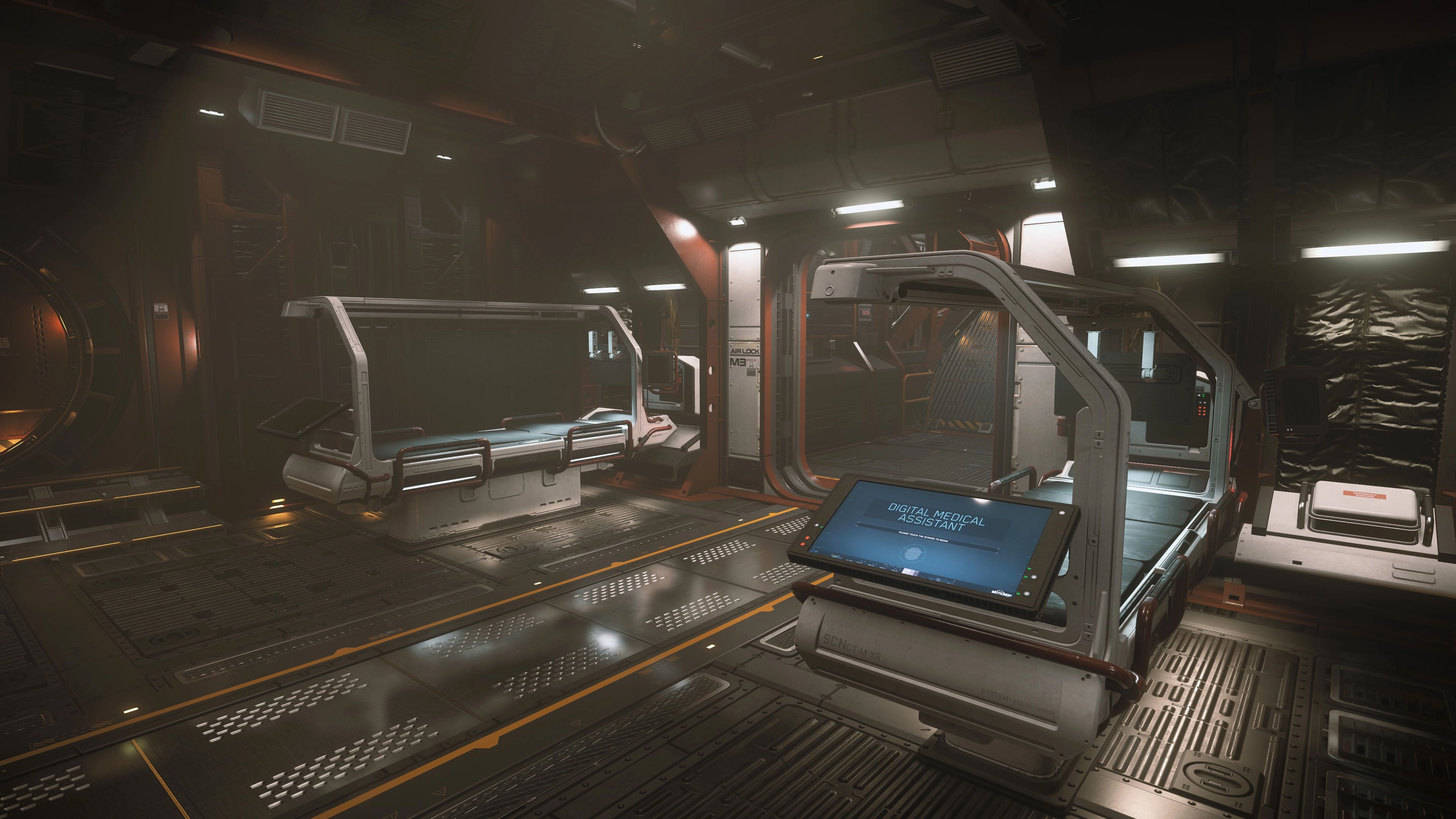
Medical Beds and TreatmentNow that we're familiar with injuries and the facilities that can heal them, let's go to one and find a medical bed. These can be found in any number of locations, from a ship to a space station to a city's hospital. If it's a public facility and not a ship, feel free to admit yourself using the Patient Check-In console, which functions similarly to an ASOP terminal. However, if you have sustained a severe injury and it is difficult for you to walk, an expedited option is available in any public hangar bay, shown below. A medic can bring a patient to these emergency drop off locations (use a gurney to speed things up!) and then send this elevator directly to the medical facility. In either case, get over to a medical bed as soon as possible!Get Your DiagnosisOnce you're on the medical bed, you're presented with a menu with up to three options (the third appearing for ship owners, giving them the option to clear out players that registered to their ship's ICU). The first option will give you an overview of your character, shown below. Here you can see the injuries you've sustained in detail, along with recommended treatment options. All's Well that Heals WellTo apply a treatment, click the tab "Treatment" and select the injuries you wish to heal. After a few seconds, your injury will be removed and your health restored to full. Simple as that! Keep in mind, these options are presented to you only if you are conscious. If unconscious and delivered to a hospital or clinic, the facility will take care of your injuries for you and you will wake up fully healed.Get Your Diagnosis
Once you're on the medical bed, you're presented with a menu with up to three options (the third appearing for ship owners, giving them the option to clear out players that registered to their ship's ICU). The first option will give you an overview of your character, shown below. Here you can see the injuries you've sustained in detail, along with recommended treatment options.
All's Well that Heals Well
To apply a treatment, click the tab "Treatment" and select the injuries you wish to heal. After a few seconds, your injury will be removed and your health restored to full. Simple as that! Keep in mind, these options are presented to you only if you are conscious. If unconscious and delivered to a hospital or clinic, the facility will take care of your injuries for you and you will wake up fully healed.
IncapacitationYou've sustained significant damage, your health has hit 0%, and you fall to the ground. Congratulations, you've been incapacitated!Your character is now immobile, and the clock has started. You must receive a dose of Hemozal before the timer runs out, otherwise...you're dead! Keep in mind, the items on your person are left behind on your corpse if you die.The good news is that all hope is not lost, even if you're alone! If there's no one to aid you in the immediate vicinity, you can create a beacon by holding the M key. This creates a Beacon mission for nearby players, automatically set for a fifteen thousand aUEC reward and paid out upon delivery to a medical facility. Players accepting this mission can bring you to the Emergency Medical drop-off area, located in all hangars attached to a medical facility. More info on these locations is above in the Medical Beds and Treatment section.The good news is that all hope is not lost, even if you're alone! If there's no one to aid you in the immediate vicinity, you can create a beacon by holding the M key. This creates a Beacon mission for nearby players, automatically set for a fifteen thousand aUEC reward and paid out upon delivery to a medical facility.
Players accepting this mission can bring you to the Emergency Medical drop-off area, located in all hangars attached to a medical facility. More info on these locations is above in the Medical Beds and Treatment section.
The medics and pilots taking on this career are the unsung heroes of the 'verse, and we hope this gives those interested in joining their ranks a solid foundation to begin their journey as a healer. Medical gameplay will continue to expand in the future with additional ailments, cybernetics, and far greater consequences for dying, making your role even more significant in the persistent universe.
Be sure to check out the Guide System to get paired with a fellow medic, and head over to Spectrum to provide any and all feedback on medical gameplay in Star Citizen.
Medizinischer Leitfaden
Alpha 3.23
Das persistente Universum von Star Citizen verfügt über ein umfassendes medizinisches System mit Krankenhäusern, abgestuften Verletzungen und einer Fülle von Medikamenten und Werkzeugen. Begleite uns, wenn wir die neuen Funktionen genauer unter die Lupe nehmen. Wir hoffen, dass du mit diesem Update gut gerüstet bist, denn das Überleben im Universum wird dadurch deutlich schwieriger.
Und wenn du zusätzliche Hilfe für deinen Einstieg in die Medizin suchst, kannst du dich im Guide-System mit einem erfahrenen Spieler zusammentun, der dir zeigt, wo es langgeht.
Medizinische Einrichtungen
Jetzt, wo wir mit Verletzungen vertraut sind, brauchen wir Orte, um sie zu heilen. Medizinische Einrichtungen gibt es überall im Verse, von großen Städten bis hin zu kleinen Raumstationen. Es gibt sogar einige wenige Schiffe, die medizinische Versorgung anbieten.
Wenn es sich um eine öffentliche Einrichtung und nicht um ein Schiff handelt, kannst du dich über die Patienten-Check-In-Konsole einweisen lassen, die ähnlich wie ein ASOP-Terminal funktioniert. Im Folgenden findest du die drei Arten von medizinischen Einrichtungen und die von ihnen angebotenen Leistungen.
Die Mediziner und Piloten, die diesen Beruf ergreifen, sind die unbesungenen Helden des Universums, und wir hoffen, dass diese Informationen denjenigen, die sich für eine Karriere in ihren Reihen interessieren, eine solide Grundlage für ihre Reise als Heiler bieten. Das medizinische Gameplay wird in Zukunft mit zusätzlichen Krankheiten, Kybernetik und weitaus größeren Konsequenzen für das Sterben erweitert werden, was deine Rolle im persistenten Universum noch bedeutender macht.
Schau dir das Guide-System an, um dich mit einem anderen Sanitäter zusammenzutun, und melde dich auf Spectrum, um uns dein Feedback zum medizinischen Spiel in Star Citizen zu geben.
Handwerkszeug
Ein guter Sanitäter hat immer eine Reihe von Werkzeugen zur Hand. Von Einweggegenständen bis hin zu zuverlässigen Heilmitteln gibt es viele Ausrüstungsgegenstände, die dich und dein Team auf Trab halten. Bevor wir ins Detail gehen, wie und wo du heilen kannst, werfen wir einen Blick auf die drei Werkzeuge, die einem angehenden Mediziner zur Verfügung stehen und die du in jedem Krankenhaus oder jeder Klinik kaufen kannst:
Medikamente und BDL
Hemozal ist nur eines von mehreren Medikamenten, die einem Mediziner zur Verfügung stehen. Diese Medikamente haben alle einzigartige Eigenschaften und Wirkungen, aber alle erhöhen deinen Blutdrogenspiegel (BDL).
Dein BDL wird neben deinem Gesundheitsstatus auf dem HUD deines Helms angezeigt. Sobald dieser Wert 50 % des Maximalwerts erreicht, gerät deine Spielfigur in einen überdosierten Zustand. Dies beeinträchtigt deine Bewegungsgeschwindigkeit, trübt deine Sicht, lässt deine Waffen schwanken und führt dazu, dass dein Charakter sein Fahrzeug unberechenbar steuert. Außerdem erleidet deine Spielfigur langsam Schaden, wenn die Auswirkungen nicht abgefangen werden.
Im Folgenden findest du die Arten von Medikamenten, die sowohl einzeln in Einweg-Pens als auch gemeinsam im medizinischen Tool von Curelife enthalten sind:
Verwundungen
Verletzungen entstehen, wenn ein Spieler anhaltenden, wiederholten Schaden erleidet. Verletzungen können an allen Gliedmaßen, an der Brust oder am Kopf auftreten. Verletzungen werden dir entweder über dein Helm-HUD in der linken unteren Ecke oder durch Scannen mit dem Curelife Medical Tool angezeigt.
Im Folgenden findest du die verschiedenen Arten von Verletzungen, wie sie sich auf dich auswirken und wie und wo sie geheilt werden können.
Stufe 3
Leichte Verletzung
Stufe 2
Mäßige Verletzung
Stufe 1
Schwere Verletzung
Stufe 3
Geringfügige Verwundung
Geringfügige Verletzungen können von jedem medizinischen Bett der Stufe 3 geheilt werden, wie z. B. dem im Cutlass Red. Diese erste Stufe der Verletzung verringert deinen maximalen Lebenspunktepool und hat einige Auswirkungen auf das Spiel, je nachdem, wo du verletzt wurdest. Wenn deine Arme verletzt sind, kannst du mit deinen Waffen schlechter zielen und der Schaden von Nahkampfangriffen ist geringer. Wenn es deine Beine sind, ist deine Bewegungsgeschwindigkeit reduziert. Wenn es die Brust ist, verringert sich deine Ausdauer und dein Charakter fängt an zu keuchen. Und wenn es deinen Kopf trifft, verschwimmt deine Sicht, dein Gehör wird gedämpft und es dauert länger, bis du dich von einer Betäubung erholst. Keine leichte Verletzung erfordert eine Stabilisierung.
Stufe 2
Mäßige Verletzung
Eine mittelschwere Verletzung erfordert zur Heilung ein medizinisches Bett der Stufe 2, z. B. in einer Klinik oder in den medizinischen Buchten von größeren Schiffen wie der Carrack oder 890 Jump. Eine mittelschwere Verletzung hat die gleichen Auswirkungen wie eine leichte Verletzung, allerdings mit einigen Zusätzen. Bei mittelschweren Verletzungen beginnt dein Charakter zu hinken und stöhnt hörbar vor Schmerzen. Wenn die mittelschwere Verletzung den Kopf oder den Brustkorb betrifft, ist eine Stabilisierung in einem Krankenbett jeder Stufe erforderlich.
Stufe 1
Schwere Verwundung
Eine schwere Verletzung erfordert zur Heilung ein medizinisches Bett der Stufe 1, wie man es in einem Krankenhaus findet. Schwere Verletzungen verschärfen die Auswirkungen von mittelschweren Verletzungen noch weiter und bringen noch mehr Nachteile mit sich. Eine schwere Verletzung an den Beinen zwingt deine Spielfigur in die Bauchlage, so dass sie weder stehen noch hocken kann. Wenn du an den Armen verletzt bist, kannst du keine Gegenstände mehr halten. Schwere Verletzungen des Kopfes oder des Rumpfes erfordern außerdem eine Stabilisierung in einem Krankenbett.
Krankenbetten und Behandlung
Da wir nun mit den Verletzungen und den Einrichtungen, die sie heilen können, vertraut sind, suchen wir ein medizinisches Bett auf. Diese gibt es an vielen Orten, von einem Schiff über eine Raumstation bis hin zum Krankenhaus einer Stadt. Wenn es sich nicht um ein Schiff, sondern um eine öffentliche Einrichtung handelt, kannst du dich an der Patienten-Check-In-Konsole anmelden, die ähnlich wie ein ASOP-Terminal funktioniert.
Wenn du jedoch eine schwere Verletzung erlitten hast und nur schwer laufen kannst, gibt es in jedem öffentlichen Hangar eine Schnelloption, die unten abgebildet ist. Ein Sanitäter kann einen Patienten zu diesen Notabwurfstellen bringen (benutze eine Trage, um die Dinge zu beschleunigen!) und diesen Aufzug dann direkt zur medizinischen Einrichtung schicken. In jedem Fall solltest du dich so schnell wie möglich zu einem Krankenbett begeben!
Erhalte deine Diagnose
Gut, was gut heilt
Erhalte deine Diagnose
Sobald du auf dem Krankenbett liegst, wird dir ein Menü mit bis zu drei Optionen angezeigt (die dritte Option erscheint für Schiffseigner und gibt ihnen die Möglichkeit, Spieler zu löschen, die sich auf der Intensivstation ihres Schiffs angemeldet haben). Die erste Option gibt dir einen Überblick über deinen Charakter (siehe unten). Hier siehst du die Verletzungen, die du erlitten hast, im Detail und die empfohlenen Behandlungsmöglichkeiten.
Gut ist, was gut heilt
Um eine Behandlung anzuwenden, klicke auf den Reiter "Behandlung" und wähle die Verletzungen aus, die du heilen möchtest. Nach ein paar Sekunden ist deine Verletzung beseitigt und deine Gesundheit wieder vollständig hergestellt. So einfach ist das! Denke daran, dass dir diese Optionen nur angeboten werden, wenn du bei Bewusstsein bist. Wenn du bewusstlos bist und in ein Krankenhaus oder eine Klinik gebracht wirst, kümmert sich die Einrichtung um deine Verletzungen und du wachst vollständig geheilt auf.
Entmündigung
Du hast erheblichen Schaden erlitten, deine Gesundheit ist auf 0% gesunken und du fällst zu Boden. Herzlichen Glückwunsch, du bist außer Gefecht gesetzt!
Dein Charakter ist jetzt bewegungsunfähig und die Zeit läuft. Du musst eine Dosis Hemozal erhalten, bevor der Timer abläuft, sonst... bist du tot! Vergiss nicht, dass die Gegenstände, die du bei dir trägst, auf deiner Leiche zurückbleiben, wenn du stirbst.
Die gute Nachricht ist, dass nicht alle Hoffnung verloren ist, selbst wenn du allein bist! Wenn es in deiner unmittelbaren Umgebung niemanden gibt, der dir helfen kann, kannst du ein Leuchtfeuer erzeugen, indem du die Taste M gedrückt hältst. Dadurch wird eine Leuchtfeuer-Mission für Spieler/innen in der Nähe erstellt, die automatisch auf eine Belohnung von fünfzehntausend AUEC eingestellt ist und bei Lieferung an eine medizinische Einrichtung ausgezahlt wird.
Spieler, die diese Mission annehmen, können dich in den Bereich für medizinische Notfälle bringen, der sich in allen Hangars befindet, die an eine medizinische Einrichtung angeschlossen sind. Weitere Informationen zu diesen Orten findest du oben im Abschnitt Medizinische Betten und Behandlung.
This is an archived page of previous medical gameplay design.
Please visit this page for more up-to-date information.
Medical Guide
Star Citizen's persistent universe bolsters a comprehensive medical system, complete with hospitals, tiered injuries, and a plethora of medical drugs and tools. Join us as we dive deep into each of these new features in hope you'll be properly equipped to face this update, which significantly ups the stakes of surviving in the 'verse.
And if you're looking for additional help to get started in medicine, check out the Guide System to get paired with an experienced player who can help show you the ropes.
Tools of the TradeA good medic keeps an array of tools on hand. From single-use items to trusty healing tools, there's plenty gear and goodies to keep you and your team upright. Before we jump into the details of how and where to heal, here are looks at the three tools currently available to a budding medical professional, all able to be purchased at any hospital or clinic:Medical Pens
Simple and effective, pens deliver the specific medicine you need quickly and easily
Medical pens are an easy, straight-forward way to treat either yourself or another person in the field, and conveniently, all medical drugs can be purchased in pen form (more on those later). To use a pen, hold the 4 key to open a radial menu and select the pen you'd like to use. From here, either press B to use it on yourself, or use Mouse 2 to apply it to someone else. These controls apply to all medical tools.
Multi-Tool
Using the dedicated attachment, your Multi-Tool can be used to deliver Hemozal in a pinch, both to yourself and others from a distance
The Multi-Tool can be equipped with the LifeGuard medical attachment in order to be used as a life-saving device. More precise and effective than a MedPen, with the added benefit of healing from a short distance, this attachment is limited to administering Hemozal.
Curelife Medical Tool
A must-have for any medical professional, this tool can administer any medical drug in precise amounts, as well as provide detailed medical scans
A must-have for any medical professional, this tool can administer any of the five medical drugs in precise amounts, or simply apply Hemozal as needed. What's more, it can also provide detailed medical scans of another person, highlighting specific injuries and recommending treatments.
Drugs and BDLHemozal is but one of several pharmaceuticals available to a medic's arsenal. These drugs all have unique attributes and effects, however all of them increase your Blood Drug Level (BDL). Your BDL is tracked next to your health status on your helmet HUD. Once this level reaches 50% of maximum, your character will enter an Overdosed state. This will affect your traversal speed, blur your vision, add a weapon sway effect, and cause your character to pilot vehicle erratically. Additionally, your character will begin to take damage slowly unless the effects are countered.Below are the types of drugs available, both separately in single-use pens as well as collectively included in Curelife's Medical Tool:Hemozal
Stops bleeding, restores health percentage to current maximum, and can bring a person back from incapacitation.
Hemozal is the primary drug used by medics, and can be found in both a pen (MedPen) as well as used by both the Curelife Medical Gun and the LifeGuard Medical Attachment for the multi-tool. This drug can stop bleeding and restore health up to the current maximum, in addition to bringing a person back from incapacitation. Bleeding is stopped with any amount of the drug used.
Demexatrine
Relieves muscle fatigue and concussion symptoms
Demexatrine is a form of synthetic adrenaline that can be used to relieve muscle fatigue and symptoms related to being concussed. This can help with weapon sway and slowed movement effects caused by injuries. Demexatrine can be administered via either a pen (AdrenaPen) or the Curelife Medical Tool's advanced mode.
Roxaphen
Alleviates symptoms that hinder movement, such as severe injury to legs or arms
Roxaphen is a painkiller that can assist with relieving the symptoms that limit your movement drastically, such as a severe injury to your legs or arms preventing you from standing or holding objects, respectively. Roxaphen can be administered via either a pen (OpioPen) or the Curelife Medical Tool's advanced mode.
Sterogen
Relieves symptoms caused by muscle weakness or respiratory damage, such as a chest injury
Sterogen is a corticosteroid that can help relieve symptoms associated with muscle weakness or respiratory damage, such as a chest injury's effects of reduced melee damage or a head injury causing your vision to be blurred. Sterogen can be administered via either a pen (CorticoPen) or the Curelife Medical Tool's advanced mode.
Resurgera
Used to reduce BDL over time as well as alleviate symptoms caused by an overdose
Resurgera is a rapid detoxicant that, when taken, begins to slowly reduce a raised Blood Drug Level, and can also reduce the symptoms caused by an Overdose. Resurgera can be administered via either a pen (DetoxPen) or the Curelife Medical Tool's advanced mode.
InjuriesInjuries are inflicted when a player received sustained, repeated damage. Injuries can be received on any limb, your chest, or your head. Injuries are shown to you either via your helmet HUD in the bottom left corner, or via scan using the Curelife Medical Tool.Below are the different types of injuries, how they affect you, and how and where they can be healed.Tier 3Minor InjuryMinor injuries can be healed by any Tier 3 medical bed, such as the ones in the Cutlass Red. This first level of injury decreases your maximum health pool as well as introduces a few gameplay effects, depending on where you were injured. If your arms are injured, your weapons will be harder to aim and the damage done by melee attacks is reduced. If it's your legs, your move speed is reduced. Chest, your stamina is reduced and your character will begin to wheeze. And finally, if it's your head, your vision will begin to blur, the audio you hear will be muffled, and it will take longer to recover from a stun. No minor injury requires stabilization.Tier 2Moderate InjuryA moderate injury requires a Tier 2 medical bed to heal, such as the medical bays of larger ships like the Carrack or 890 Jump. Moderate injuries greatly pronounces the effects seen in minor injuries, with a few additions. Moderate injuries will cause your character to start limping and audibly grunt in pain. If the moderate injury is sustained to the head or chest, stabilization is required in a medical bed of any tier.Tier 1Severe InjuryA severe injury requires a Tier 1 medical bed to heal, such as ones found in a hospital or clinic. Severe injuries escalate the effects of moderate injuries even further, with even more detriments added. A severe injury to your legs will force your character into a prone state, with no ability to stand or crouch. If it's to your arms, your character will not be able to hold objects. Severe injuries to the head or torso will also require stabilization in any medical bed.Tier 3
Minor Injury
Minor injuries can be healed by any Tier 3 medical bed, such as the ones in the Cutlass Red. This first level of injury decreases your maximum health pool as well as introduces a few gameplay effects, depending on where you were injured. If your arms are injured, your weapons will be harder to aim and the damage done by melee attacks is reduced. If it's your legs, your move speed is reduced. Chest, your stamina is reduced and your character will begin to wheeze. And finally, if it's your head, your vision will begin to blur, the audio you hear will be muffled, and it will take longer to recover from a stun. No minor injury requires stabilization.
Tier 2
Moderate Injury
A moderate injury requires a Tier 2 medical bed to heal, such as the medical bays of larger ships like the Carrack or 890 Jump. Moderate injuries greatly pronounces the effects seen in minor injuries, with a few additions. Moderate injuries will cause your character to start limping and audibly grunt in pain. If the moderate injury is sustained to the head or chest, stabilization is required in a medical bed of any tier.
Tier 1
Severe Injury
A severe injury requires a Tier 1 medical bed to heal, such as ones found in a hospital or clinic. Severe injuries escalate the effects of moderate injuries even further, with even more detriments added. A severe injury to your legs will force your character into a prone state, with no ability to stand or crouch. If it's to your arms, your character will not be able to hold objects. Severe injuries to the head or torso will also require stabilization in any medical bed.
Medical Facilities
Now that we're familiar with injuries, we need places to heal them. Medical facilities can be found all over the 'verse, from massive cities to small space stations. There are even a select few ships that offer medical care within them.
If it's a public facility and not a ship, feel free to admit yourself using the Patient Check-In console, which functions similarly to an ASOP terminal. Below are the three types of medical facility, as well as what services they provide.
Medical Beds and TreatmentNow that we're familiar with injuries and the facilities that can heal them, let's go to one and find a medical bed. These can be found in any number of locations, from a ship to a space station to a city's hospital. If it's a public facility and not a ship, feel free to admit yourself using the Patient Check-In console, which functions similarly to an ASOP terminal. However, if you have sustained a severe injury and it is difficult for you to walk, an expedited option is available in any public hangar bay, shown below. A medic can bring a patient to these emergency drop off locations (use a gurney to speed things up!) and then send this elevator directly to the medical facility. In either case, get over to a medical bed as soon as possible!Get Your DiagnosisOnce you're on the medical bed, you're presented with a menu with up to three options (the third appearing for ship owners, giving them the option to clear out players that registered to their ship's ICU). The first option will give you an overview of your character, shown below. Here you can see the injuries you've sustained in detail, along with recommended treatment options. All's Well that Heals WellTo apply a treatment, click the tab "Treatment" and select the injuries you wish to heal. After a few seconds, your injury will be removed and your health restored to full. Simple as that! Keep in mind, these options are presented to you only if you are conscious. If unconscious and delivered to a hospital or clinic, the facility will take care of your injuries for you and you will wake up fully healed.Get Your Diagnosis
Once you're on the medical bed, you're presented with a menu with up to three options (the third appearing for ship owners, giving them the option to clear out players that registered to their ship's ICU). The first option will give you an overview of your character, shown below. Here you can see the injuries you've sustained in detail, along with recommended treatment options.
All's Well that Heals Well
To apply a treatment, click the tab "Treatment" and select the injuries you wish to heal. After a few seconds, your injury will be removed and your health restored to full. Simple as that! Keep in mind, these options are presented to you only if you are conscious. If unconscious and delivered to a hospital or clinic, the facility will take care of your injuries for you and you will wake up fully healed.
IncapacitationYou've sustained significant damage, your health has hit 0%, and you fall to the ground. Congratulations, you've been incapacitated!Your character is now immobile, and the clock has started. You must receive a dose of Hemozal before the timer runs out, otherwise...you're dead! Keep in mind, the items on your person are left behind on your corpse if you die.The good news is that all hope is not lost, even if you're alone! If there's no one to aid you in the immediate vicinity, you can create a beacon by holding the M key. This creates a Beacon mission for nearby players, automatically set for a fifteen thousand aUEC reward and paid out upon delivery to a medical facility. Players accepting this mission can bring you to the Emergency Medical drop-off area, located in all hangars attached to a medical facility. More info on these locations is above in the Medical Beds and Treatment section.The good news is that all hope is not lost, even if you're alone! If there's no one to aid you in the immediate vicinity, you can create a beacon by holding the M key. This creates a Beacon mission for nearby players, automatically set for a fifteen thousand aUEC reward and paid out upon delivery to a medical facility.
Players accepting this mission can bring you to the Emergency Medical drop-off area, located in all hangars attached to a medical facility. More info on these locations is above in the Medical Beds and Treatment section.
The medics and pilots taking on this career are the unsung heroes of the 'verse, and we hope this gives those interested in joining their ranks a solid foundation to begin their journey as a healer. Medical gameplay will continue to expand in the future with additional ailments, cybernetics, and far greater consequences for dying, making your role even more significant in the persistent universe.
Be sure to check out the Guide System to get paired with a fellow medic, and head over to Spectrum to provide any and all feedback on medical gameplay in Star Citizen.
This is an archived page of previous medical gameplay design.
Please visit this page for more up-to-date information.
Medical Guide
Star Citizen's persistent universe bolsters a comprehensive medical system, complete with hospitals, tiered injuries, and a plethora of medical drugs and tools. Join us as we dive deep into each of these new features in hope you'll be properly equipped to face this update, which significantly ups the stakes of surviving in the 'verse.
And if you're looking for additional help to get started in medicine, check out the Guide System to get paired with an experienced player who can help show you the ropes.
Tools of the TradeA good medic keeps an array of tools on hand. From single-use items to trusty healing tools, there's plenty gear and goodies to keep you and your team upright. Before we jump into the details of how and where to heal, here are looks at the three tools currently available to a budding medical professional, all able to be purchased at any hospital or clinic:Medical Pens
Simple and effective, pens deliver the specific medicine you need quickly and easily
Medical pens are an easy, straight-forward way to treat either yourself or another person in the field, and conveniently, all medical drugs can be purchased in pen form (more on those later). To use a pen, hold the 4 key to open a radial menu and select the pen you'd like to use. From here, either press B to use it on yourself, or use Mouse 2 to apply it to someone else. These controls apply to all medical tools.
Multi-Tool
Using the dedicated attachment, your Multi-Tool can be used to deliver Hemozal in a pinch, both to yourself and others from a distance
The Multi-Tool can be equipped with the LifeGuard medical attachment in order to be used as a life-saving device. More precise and effective than a MedPen, with the added benefit of healing from a short distance, this attachment is limited to administering Hemozal.
Curelife Medical Tool
A must-have for any medical professional, this tool can administer any medical drug in precise amounts, as well as provide detailed medical scans
A must-have for any medical professional, this tool can administer any of the five medical drugs in precise amounts, or simply apply Hemozal as needed. What's more, it can also provide detailed medical scans of another person, highlighting specific injuries and recommending treatments.
Drugs and BDLHemozal is but one of several pharmaceuticals available to a medic's arsenal. These drugs all have unique attributes and effects, however all of them increase your Blood Drug Level (BDL). Your BDL is tracked next to your health status on your helmet HUD. Once this level reaches 50% of maximum, your character will enter an Overdosed state. This will affect your traversal speed, blur your vision, add a weapon sway effect, and cause your character to pilot vehicle erratically. Additionally, your character will begin to take damage slowly unless the effects are countered.Below are the types of drugs available, both separately in single-use pens as well as collectively included in Curelife's Medical Tool:Hemozal
Stops bleeding, restores health percentage to current maximum, and can bring a person back from incapacitation.
Hemozal is the primary drug used by medics, and can be found in both a pen (MedPen) as well as used by both the Curelife Medical Gun and the LifeGuard Medical Attachment for the multi-tool. This drug can stop bleeding and restore health up to the current maximum, in addition to bringing a person back from incapacitation. Bleeding is stopped with any amount of the drug used.
Demexatrine
Relieves muscle fatigue and concussion symptoms
Demexatrine is a form of synthetic adrenaline that can be used to relieve muscle fatigue and symptoms related to being concussed. This can help with weapon sway and slowed movement effects caused by injuries. Demexatrine can be administered via either a pen (AdrenaPen) or the Curelife Medical Tool's advanced mode.
Roxaphen
Alleviates symptoms that hinder movement, such as severe injury to legs or arms
Roxaphen is a painkiller that can assist with relieving the symptoms that limit your movement drastically, such as a severe injury to your legs or arms preventing you from standing or holding objects, respectively. Roxaphen can be administered via either a pen (OpioPen) or the Curelife Medical Tool's advanced mode.
Sterogen
Relieves symptoms caused by muscle weakness or respiratory damage, such as a chest injury
Sterogen is a corticosteroid that can help relieve symptoms associated with muscle weakness or respiratory damage, such as a chest injury's effects of reduced melee damage or a head injury causing your vision to be blurred. Sterogen can be administered via either a pen (CorticoPen) or the Curelife Medical Tool's advanced mode.
Resurgera
Used to reduce BDL over time as well as alleviate symptoms caused by an overdose
Resurgera is a rapid detoxicant that, when taken, begins to slowly reduce a raised Blood Drug Level, and can also reduce the symptoms caused by an Overdose. Resurgera can be administered via either a pen (DetoxPen) or the Curelife Medical Tool's advanced mode.
InjuriesInjuries are inflicted when a player received sustained, repeated damage. Injuries can be received on any limb, your chest, or your head. Injuries are shown to you either via your helmet HUD in the bottom left corner, or via scan using the Curelife Medical Tool.Below are the different types of injuries, how they affect you, and how and where they can be healed.Tier 3Minor InjuryMinor injuries can be healed by any Tier 3 medical bed, such as the ones in the Cutlass Red. This first level of injury decreases your maximum health pool as well as introduces a few gameplay effects, depending on where you were injured. If your arms are injured, your weapons will be harder to aim and the damage done by melee attacks is reduced. If it's your legs, your move speed is reduced. Chest, your stamina is reduced and your character will begin to wheeze. And finally, if it's your head, your vision will begin to blur, the audio you hear will be muffled, and it will take longer to recover from a stun. No minor injury requires stabilization.Tier 2Moderate InjuryA moderate injury requires a Tier 2 medical bed to heal, such as the medical bays of larger ships like the Carrack or 890 Jump. Moderate injuries greatly pronounces the effects seen in minor injuries, with a few additions. Moderate injuries will cause your character to start limping and audibly grunt in pain. If the moderate injury is sustained to the head or chest, stabilization is required in a medical bed of any tier.Tier 1Severe InjuryA severe injury requires a Tier 1 medical bed to heal, such as ones found in a hospital or clinic. Severe injuries escalate the effects of moderate injuries even further, with even more detriments added. A severe injury to your legs will force your character into a prone state, with no ability to stand or crouch. If it's to your arms, your character will not be able to hold objects. Severe injuries to the head or torso will also require stabilization in any medical bed.Tier 3
Minor Injury
Minor injuries can be healed by any Tier 3 medical bed, such as the ones in the Cutlass Red. This first level of injury decreases your maximum health pool as well as introduces a few gameplay effects, depending on where you were injured. If your arms are injured, your weapons will be harder to aim and the damage done by melee attacks is reduced. If it's your legs, your move speed is reduced. Chest, your stamina is reduced and your character will begin to wheeze. And finally, if it's your head, your vision will begin to blur, the audio you hear will be muffled, and it will take longer to recover from a stun. No minor injury requires stabilization.
Tier 2
Moderate Injury
A moderate injury requires a Tier 2 medical bed to heal, such as the medical bays of larger ships like the Carrack or 890 Jump. Moderate injuries greatly pronounces the effects seen in minor injuries, with a few additions. Moderate injuries will cause your character to start limping and audibly grunt in pain. If the moderate injury is sustained to the head or chest, stabilization is required in a medical bed of any tier.
Tier 1
Severe Injury
A severe injury requires a Tier 1 medical bed to heal, such as ones found in a hospital or clinic. Severe injuries escalate the effects of moderate injuries even further, with even more detriments added. A severe injury to your legs will force your character into a prone state, with no ability to stand or crouch. If it's to your arms, your character will not be able to hold objects. Severe injuries to the head or torso will also require stabilization in any medical bed.
Medical Facilities
Now that we're familiar with injuries, we need places to heal them. Medical facilities can be found all over the 'verse, from massive cities to small space stations. There are even a select few ships that offer medical care within them.
If it's a public facility and not a ship, feel free to admit yourself using the Patient Check-In console, which functions similarly to an ASOP terminal. Below are the three types of medical facility, as well as what services they provide.
Medical Beds and TreatmentNow that we're familiar with injuries and the facilities that can heal them, let's go to one and find a medical bed. These can be found in any number of locations, from a ship to a space station to a city's hospital. If it's a public facility and not a ship, feel free to admit yourself using the Patient Check-In console, which functions similarly to an ASOP terminal. However, if you have sustained a severe injury and it is difficult for you to walk, an expedited option is available in any public hangar bay, shown below. A medic can bring a patient to these emergency drop off locations (use a gurney to speed things up!) and then send this elevator directly to the medical facility. In either case, get over to a medical bed as soon as possible!Get Your DiagnosisOnce you're on the medical bed, you're presented with a menu with up to three options (the third appearing for ship owners, giving them the option to clear out players that registered to their ship's ICU). The first option will give you an overview of your character, shown below. Here you can see the injuries you've sustained in detail, along with recommended treatment options. All's Well that Heals WellTo apply a treatment, click the tab "Treatment" and select the injuries you wish to heal. After a few seconds, your injury will be removed and your health restored to full. Simple as that! Keep in mind, these options are presented to you only if you are conscious. If unconscious and delivered to a hospital or clinic, the facility will take care of your injuries for you and you will wake up fully healed.Get Your Diagnosis
Once you're on the medical bed, you're presented with a menu with up to three options (the third appearing for ship owners, giving them the option to clear out players that registered to their ship's ICU). The first option will give you an overview of your character, shown below. Here you can see the injuries you've sustained in detail, along with recommended treatment options.
All's Well that Heals Well
To apply a treatment, click the tab "Treatment" and select the injuries you wish to heal. After a few seconds, your injury will be removed and your health restored to full. Simple as that! Keep in mind, these options are presented to you only if you are conscious. If unconscious and delivered to a hospital or clinic, the facility will take care of your injuries for you and you will wake up fully healed.
IncapacitationYou've sustained significant damage, your health has hit 0%, and you fall to the ground. Congratulations, you've been incapacitated!Your character is now immobile, and the clock has started. You must receive a dose of Hemozal before the timer runs out, otherwise...you're dead! Keep in mind, the items on your person are left behind on your corpse if you die.The good news is that all hope is not lost, even if you're alone! If there's no one to aid you in the immediate vicinity, you can create a beacon by holding the M key. This creates a Beacon mission for nearby players, automatically set for a fifteen thousand aUEC reward and paid out upon delivery to a medical facility. Players accepting this mission can bring you to the Emergency Medical drop-off area, located in all hangars attached to a medical facility. More info on these locations is above in the Medical Beds and Treatment section.The good news is that all hope is not lost, even if you're alone! If there's no one to aid you in the immediate vicinity, you can create a beacon by holding the M key. This creates a Beacon mission for nearby players, automatically set for a fifteen thousand aUEC reward and paid out upon delivery to a medical facility.
Players accepting this mission can bring you to the Emergency Medical drop-off area, located in all hangars attached to a medical facility. More info on these locations is above in the Medical Beds and Treatment section.
The medics and pilots taking on this career are the unsung heroes of the 'verse, and we hope this gives those interested in joining their ranks a solid foundation to begin their journey as a healer. Medical gameplay will continue to expand in the future with additional ailments, cybernetics, and far greater consequences for dying, making your role even more significant in the persistent universe.
Be sure to check out the Guide System to get paired with a fellow medic, and head over to Spectrum to provide any and all feedback on medical gameplay in Star Citizen.
Links
Images
8)/75/medpen.webp)
)/75/medical-multitool.webp)
)/75/medical-gun.webp)
)/75/adrenapen.webp)
)/75/detoxpen.webp)
Metadata
- CIG ID
- 20047
- Channel
- Transmission
- Category
- Undefined
- Series
- None
- Comments
- 0
- Published
- 4 months ago (2026-05-25T11:00:00+00:00)