Whitley's Guide - Prowler
Spectrum Dispatch Undefined News UpdateContent
This article originally appeared in Jump Point 8.4.
Esperia Prowler
TEVARIN SERVICE
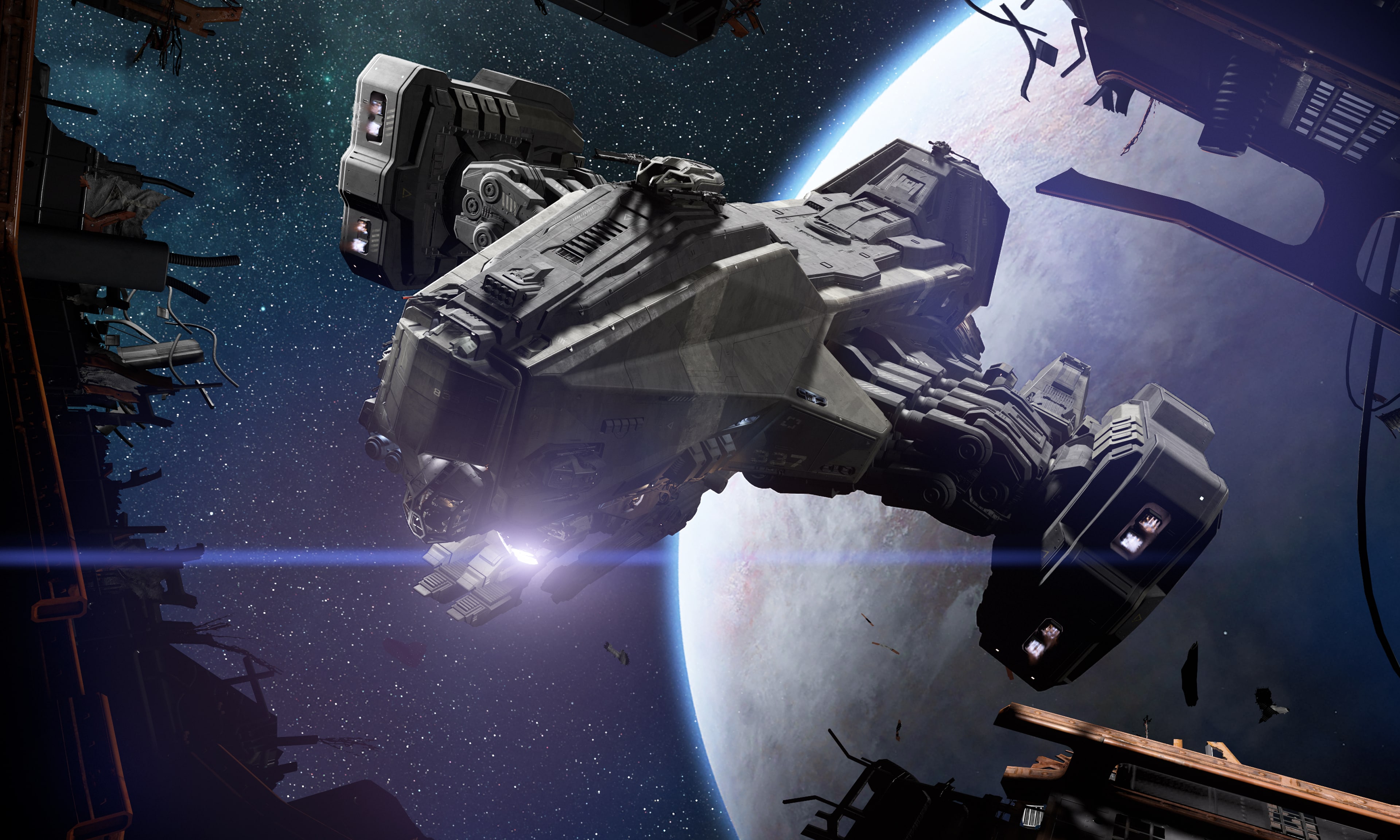
The Prowler dropship has the unusual distinction of having two nearly separate histories: the first being its original manufacture and service by Tevarin forces several centuries ago, and the second being the now familiar replica constructed by Esperia. There is little agreed-upon history of the original Tevarin development process or its military service beyond its extensive use during both Tevarin Wars. What is certain is that the Prowler is a powerful landing craft whose unique silhouette, silent flight, and exceptional fighting capabilities made it emblematic of the Tevarin military cause and garnered both the ire and the respect of the Human soldiers who faced it in combat. The Prowler was first encountered by Human forces during the annexation of Idris IV in 2541 at the outset of the conflict. Prowler units were instrumental in pacifying the remaining Human defenders and transporting the first wave of elite Tevarin shock troops who secured the former military installations on the planet. A news photograph captured from the battlefield showing a sky full of distinct Prowler silhouettes became intimately associated with the early days of the conflict and the alien nature of the threat posed to the UPE by the Sovereignty.
Two distinct versions of the Prowler were encountered during the wars. The first, dubbed the Prowler-A, lacked the top-mounted remote turret. This initial configuration gave rise to a responsive tactic in which UPE interceptors would site a Prowler and then initiate a kick stop to blast this blind spot with full weapons as quickly as possible. As the war dragged into its second year, Prowler-Bs mounting what opponents called the ‘stinger’ (then a maser-based energy weapon turret) began to appear, costing the lives of dozens of Human pilots before new tactics could be disseminated. Technically speaking, the Esperia-manufactured replicas and updates were not the first Prowlers to be operated by Humans. During the first conflict, Human forces captured mostly-operational Prowlers on a number of occasions and equipped them for special forces missions, including behind-enemy-lines drone deployment and, in one case, a carefully orchestrated POW rescue operation. These Prowlers were not significantly modified for Human use and were often operated by UPE-loyal Tevarin.
The Human government of the era had very little interest in recovering or studying Tevarin technology and, as a result, most captured Prowlers (and other Tevarin-built spacecraft) were either scrapped or utilized as target vehicles in the final days of the war. The rapid destruction of Tevarin technology was fueled by the immediate value of their sometimes-rare composite metals to speculators and an overall societal interest in moving beyond the war. A number of Prowlers escaped the scrapyards to find themselves in private hands where they typically served as mercenary ships. These Prowlers were common until the early 28th century, where their existence faded due to wear and tear and the lack of available replacement parts. A single example, a stinger-armed late model Prowler, was retained by what would become the Imperial Archives and Records Administration. Stored in pieces, the vehicle’s wings were ultimately destroyed in a building collapse while the fuselage remained untouched for almost two centuries. The remaining portion of the ship has since been restored and appears in the Tevarin War Gallery at the Dayton Aerospace Museum. This spacecraft, still bearing UPE logos hastily painted on its side, was studied by Esperia as a control case alongside the newly recovered examples upon which the Human models were based.
DEVELOPING THE MODERN PROWLER
The Prowler’s impressive second act began in 2941 when Imperial pathfinders entered the newly discovered Kabal System and located a series of abandoned Tevarin settlements on Kabal III. Xenoarchaeologists and Tevarin historians would eventually date the preserved settlements to the middle of the 25th century, sometime before the start of the Human-Tevarin conflicts. The nature of the system and its separation (or potential deletion) from the rest of the Tevarin Sovereignty remains hotly contested. Whatever the history, the discovery was a major windfall for Esperia, a company then best known for constructing limited runs of replica Vanduul spacecraft for military use and occasional civilian sale. The UEEN, particularly happy with the recent purchase of four squadrons of replica Blade fighters for aggressor training, insisted that Esperia be included in the group of analysts brought to Kabal to study potentially lost Tevarin technologies at two aerospace bases identified by the initial surveyors.
Much of what was discovered in the Kabal System remains classified today and Esperia’s overall involvement with the project is no exception. What is known is that the researchers discovered what amounted to nine fully equipped squadrons of A-model Prowlers safely stored in antinuclear bunkers. The investigation revealed that none of the Prowlers had flown for almost five centuries and that they had been properly mothballed rather than left in situ. Another dozen examples were not properly prepared and had significantly decayed left to the elements on flight lines. Esperia requested that these also be provided for the study of individual parts, but instead they were remitted to another group for the study of long-term spacecraft storage.
Esperia’s initial survey team reviewed the available spacecraft, performed a series of atomic scans, and were allowed to disassemble two examples to produce an initial report on individual technologies and components involved in their construction. A UEEN test pilot was attached to the group and in the culmination of the initial study, a single vintage Prowler was fueled and tested in a 45-minute atmospheric flight that seemed to confirm that the spacecraft were as fully functional as could be determined with the equipment available in the Kabal System. The remote stage of the project took 18 months and at its conclusion, the government opted to ferry six of the Prowlers back to Esperia’s clean lab at Kutaram rather than retain the Esperia team on Kabal.
As the team from Esperia completed their work disassembling and documenting the ancient spacecraft, management began to develop an extension – a blue-sky project to go beyond study and move to recreating the ship with Human control surfaces and updated modern components. A tiger team developed a formal pitch to the UEE to allow the company both access and legal rights to recreate the ship, ostensibly to sell to hobbyists and others interested in a historical spacecraft. There was also a deeper plan. Esperia was keenly aware of teething issues then-delaying the intended deployment of the Aegis Dynamics Redeemer, intended to be the UEEN’s next-generation gunship. Seeing the briefest opportunity to market the Prowler once again back to the military, the company put an amount of resources into the project that greatly eclipsed those of their prior builds. Much to the surprise of all involved, the government approved the idea almost immediately and formally declassified the recovered Prowlers for Esperia’s benefit.
One of the first issues facing the recreation team was that the models found on Kabal predated the wars and thus lacked the dorsal maser turret. Knowing that newly created Prowlers would want to correct the blind spot, the team carefully studied the example stored at Dayton to structurally adapt the new fuselage for a standard turret mount (older maser turrets having long gone out of production in favor of efficient and modular present-day systems). Astroengineers also had trouble recreating the ‘plate cockpit’, requiring several months to perfect the once-commonplace Tevarin technologies that gave the ship its distinct forward structure. Working alongside historians and collectors, the company was able to trace every subsystem and component of the original spacecraft and either resynthesize it using present-day technology or substitute it for an existing modular system. Computer systems in particular were completely reworked, with the original Tevarin software either completely lost to data rot or deemed incompatible with present-day systems.
The ‘new’ Prowler debuted in 2946 in a stunning show at the annual IAE event, in which the distinctive winged ship cut a dashing and unexpected figure just as it had once in the skies of Idris IV. The intent to sell the design to the military largely fell through, with the UEEN ultimately purchasing only a limited run of the craft for study and potential special operations assignments. However, the design did immediately attract the attention of the civilian sector. Preorders for Prowlers were taken not from historians and preservation groups but instead from mercenary forces and wildcatters seeing a durable, high-tech ship for rough-and-tumble operations. Generations removed from the stigma of the war, the Prowler had found an unlikely second life serving the descendants of the Humans it had once fought so fiercely against.
Dieser Artikel erschien ursprünglich in Jump Point 8.4.
Esperia Prowler
TEVARIN-DIENST
Das Prowler-Abwurfschiff hat die ungewöhnliche Eigenschaft, dass es zwei fast getrennte Geschichten hat: die erste ist seine ursprüngliche Herstellung und sein Einsatz durch die Tevarin-Streitkräfte vor mehreren Jahrhunderten und die zweite ist der heute bekannte Nachbau, der von Esperia gebaut wurde. Über den ursprünglichen Entwicklungsprozess der Tevarin oder ihren militärischen Einsatz gibt es nur wenige gesicherte Erkenntnisse, abgesehen von ihrem umfangreichen Einsatz während der beiden Tevarin-Kriege. Sicher ist, dass der Prowler ein mächtiges Landungsboot ist, dessen einzigartige Silhouette, sein lautloser Flug und seine außergewöhnlichen Kampffähigkeiten ihn zu einem Symbol für die militärische Sache der Tevarin machten und ihm sowohl den Zorn als auch den Respekt der menschlichen Soldaten einbrachten, die ihm im Kampf gegenüberstanden. Der Prowler begegnete den menschlichen Streitkräften zum ersten Mal bei der Annexion von Idris IV im Jahr 2541, zu Beginn des Konflikts. Prowler-Einheiten waren maßgeblich daran beteiligt, die verbliebenen menschlichen Verteidiger zu befrieden und die erste Welle der tevarinischen Elitetruppen zu transportieren, die die ehemaligen Militäreinrichtungen auf dem Planeten sicherten. Ein Nachrichtenfoto vom Schlachtfeld, das einen Himmel voller Prowler-Silhouetten zeigt, wurde eng mit den ersten Tagen des Konflikts und der fremden Bedrohung der UPE durch die Sovereignty verbunden.
Zwei verschiedene Versionen des Prowlers wurden während der Kriege angetroffen. Der ersten, Prowler-A genannt, fehlte der oben angebrachte Fernsteuerungsturm. Diese anfängliche Konfiguration führte zu einer reaktionsschnellen Taktik, bei der UPE-Abfangjäger einen Prowler aufspürten und dann einen Kickstop einleiteten, um diesen toten Winkel so schnell wie möglich mit voller Bewaffnung zu beschießen. Als sich der Krieg in sein zweites Jahr hineinzog, tauchten immer mehr Prowler-Bs auf, die mit dem von den Gegnern als "Stinger" bezeichneten Energiewaffenturm ausgestattet waren, der Dutzende von menschlichen Piloten das Leben kostete, bevor die neue Taktik verbreitet werden konnte. Technisch gesehen waren die von Esperia hergestellten Nachbauten und Updates nicht die ersten Prowler, die von Menschen gesteuert wurden. Während des ersten Konflikts erbeuteten die menschlichen Streitkräfte bei mehreren Gelegenheiten größtenteils einsatzbereite Prowler und rüsteten sie für Spezialeinsätze aus, darunter Drohneneinsätze hinter feindlichen Linien und in einem Fall eine sorgfältig inszenierte Rettungsaktion für Kriegsgefangene. Diese Prowler wurden nicht wesentlich für den Einsatz bei den Menschen modifiziert und wurden oft von UPE-treuen Tevarin gesteuert.
Die menschliche Regierung hatte damals nur wenig Interesse daran, die Technologie der Tevarin zu bergen oder zu erforschen. Daher wurden die meisten erbeuteten Prowler (und andere von den Tevarin gebaute Raumschiffe) entweder verschrottet oder in den letzten Kriegstagen als Zielfahrzeuge eingesetzt. Die rasche Zerstörung der Tevarin-Technologie wurde durch den unmittelbaren Wert ihrer manchmal seltenen Verbundmetalle für Spekulanten und ein allgemeines gesellschaftliches Interesse an der Überwindung des Krieges angeheizt. Eine Reihe von Prowlern entkam den Schrottplätzen und gelangte in private Hände, wo sie in der Regel als Söldnerschiffe dienten. Diese Prowler waren bis zum Beginn des 28. Jahrhunderts weit verbreitet, als ihre Existenz aufgrund von Verschleiß und fehlenden Ersatzteilen schwand. Ein einziges Exemplar, ein mit Stinger bewaffnetes Spätmodell des Prowlers, wurde von der späteren Imperial Archives and Records Administration aufbewahrt. Die in Einzelteilen gelagerten Flügel des Fahrzeugs wurden schließlich bei einem Gebäudeeinsturz zerstört, während der Rumpf fast zwei Jahrhunderte lang unangetastet blieb. Der verbliebene Teil des Schiffes wurde inzwischen restauriert und befindet sich in der Tevarin War Gallery im Dayton Aerospace Museum. Dieses Raumschiff, das noch immer eilig auf die Seite gemalte UPE-Logos trägt, wurde von Esperia als Kontrollfall neben den neu geborgenen Exemplaren untersucht, auf denen die menschlichen Modelle basieren.
DIE ENTWICKLUNG DES MODERNEN PROWLERS
Der beeindruckende zweite Akt des Prowlers begann im Jahr 2941, als imperiale Pfadfinder in das neu entdeckte Kabal-System eindrangen und eine Reihe verlassener Tevarin-Siedlungen auf Kabal III entdeckten. Xenoarchäologen und Tevarin-Historiker datierten die erhaltenen Siedlungen schließlich auf die Mitte des 25. Jahrhunderts, also auf die Zeit vor dem Beginn der Mensch-Tevarin-Konflikte. Die Art des Systems und seine Abtrennung (oder mögliche Auslöschung) vom Rest der Tevarin-Souveränität ist nach wie vor sehr umstritten. Unabhängig von der Geschichte war die Entdeckung ein großer Gewinn für Esperia, ein Unternehmen, das damals vor allem für den Bau von Nachbauten vanduulischer Raumschiffe für militärische Zwecke und den gelegentlichen Verkauf an Zivilisten bekannt war. Die UEEN, die sich besonders über den kürzlichen Kauf von vier Schwadronen nachgebauter Blade-Jäger für die Ausbildung von Aggressoren freuten, bestanden darauf, dass Esperia in die Gruppe von Analysten aufgenommen wurde, die nach Kabal gebracht wurde, um potenziell verloren gegangene Tevarin-Technologien in zwei Raumfahrtbasen zu untersuchen, die von den ersten Untersuchern identifiziert worden waren.
Vieles von dem, was im Kabal-System entdeckt wurde, ist bis heute geheim und auch Esperias Beteiligung an dem Projekt ist keine Ausnahme. Bekannt ist nur, dass die Forscher neun voll ausgerüstete Geschwader von Prowlern des Typs A entdeckten, die sicher in antinuklearen Bunkern gelagert waren. Die Untersuchung ergab, dass keiner der Prowler seit fast fünf Jahrhunderten geflogen war und dass sie ordnungsgemäß eingemottet worden waren, anstatt sie an Ort und Stelle zu lassen. Ein weiteres Dutzend Exemplare war nicht ordnungsgemäß präpariert und den Elementen auf den Fluglinien überlassen worden und stark verfallen. Esperia bat darum, dass auch diese für die Untersuchung einzelner Teile zur Verfügung gestellt werden, aber stattdessen wurden sie an eine andere Gruppe zur Untersuchung der langfristigen Lagerung von Raumfahrzeugen weitergeleitet.
Das Esperia-Erstuntersuchungsteam untersuchte die verfügbaren Raumfahrzeuge, führte eine Reihe von Atomscans durch und durfte zwei Exemplare zerlegen, um einen ersten Bericht über die einzelnen Technologien und Komponenten zu erstellen, die an deren Bau beteiligt waren. Ein UEEN-Testpilot wurde der Gruppe zugeteilt und als Höhepunkt der ersten Studie wurde ein einzelner alter Prowler betankt und in einem 45-minütigen Atmosphärenflug getestet, der zu bestätigen schien, dass die Raumfahrzeuge so voll funktionsfähig waren, wie es mit der im Kabal-System verfügbaren Ausrüstung möglich war. Die Remote-Phase des Projekts dauerte 18 Monate, und am Ende entschied sich die Regierung, sechs der Prowler zurück in das Esperia-Labor nach Kutaram zu bringen, anstatt das Esperia-Team auf Kabal zu behalten.
Als das Team von Esperia seine Arbeit mit dem Zerlegen und Dokumentieren des alten Raumschiffs abschloss, begann das Management, eine Erweiterung zu entwickeln - ein Zukunftsprojekt, das über das Studium hinausgehen und das Schiff mit menschlichen Steuerflächen und modernen Komponenten nachbauen sollte. Ein Tiger-Team entwickelte ein offizielles Angebot an die UEE, dem Unternehmen sowohl den Zugang als auch die Rechte für den Nachbau des Schiffes zu gewähren, angeblich, um es an Bastler und andere, die an einem historischen Raumschiff interessiert sind, zu verkaufen. Es gab aber auch einen tieferen Plan. Esperia war sich der Kinderkrankheiten bewusst, die den geplanten Einsatz der Aegis Dynamics Redeemer verzögerten, die das Kanonenboot der nächsten Generation der UEEN werden sollte. Das Unternehmen sah eine günstige Gelegenheit, den Prowler wieder an das Militär zu vermarkten, und investierte so viele Ressourcen in das Projekt, dass es die vorherigen Konstruktionen bei weitem übertraf. Zur großen Überraschung aller Beteiligten stimmte die Regierung der Idee fast sofort zu und gab die geborgenen Prowler offiziell für Esperia frei.
Eines der ersten Probleme, mit denen sich das Wiederherstellungsteam konfrontiert sah, war, dass die auf Kabal gefundenen Modelle aus der Zeit vor den Kriegen stammten und daher nicht über den rückwärtigen Maser-Turm verfügten. Da das Team wusste, dass die neu gebauten Prowler diesen blinden Fleck ausbessern würden, untersuchte es die in Dayton gelagerten Exemplare sorgfältig, um den neuen Rumpf strukturell für die Montage eines Standardturms anzupassen (ältere Maser-Türme werden schon lange nicht mehr produziert, sondern sind durch effiziente und modulare Systeme ersetzt worden). Die Astro-Ingenieure hatten auch Schwierigkeiten, das "Plattencockpit" nachzubauen. Sie brauchten mehrere Monate, um die einst üblichen Tevarin-Technologien zu perfektionieren, die dem Schiff seine charakteristische Vorderstruktur verliehen. In Zusammenarbeit mit Historikern und Sammlern war das Unternehmen in der Lage, jedes Subsystem und jede Komponente des ursprünglichen Raumschiffs aufzuspüren und sie entweder mit heutiger Technologie neu zu synthetisieren oder durch ein bestehendes modulares System zu ersetzen. Vor allem die Computersysteme wurden komplett überarbeitet, da die ursprüngliche Tevarin-Software entweder durch Datenfäulnis vollständig verloren gegangen war oder als nicht kompatibel mit den heutigen Systemen galt.
Der "neue" Prowler wurde 2946 auf der jährlichen IAE-Veranstaltung in einer atemberaubenden Show vorgestellt, bei der das unverwechselbare geflügelte Schiff eine ebenso verwegene und unerwartete Figur machte wie einst am Himmel von Idris IV. Die Absicht, das Design an das Militär zu verkaufen, scheiterte weitgehend. Die UEEN kaufte schließlich nur eine begrenzte Anzahl von Schiffen zu Studienzwecken und für mögliche Sondereinsätze. Das Design zog jedoch sofort die Aufmerksamkeit des zivilen Sektors auf sich. Vorbestellungen für Prowler kamen nicht von Historikern und Denkmalschützern, sondern von Söldnern und Wildbeutern, die ein robustes Hightech-Schiff für raue Einsätze suchten. Generationen nach dem Krieg hatte der Prowler ein unwahrscheinliches zweites Leben im Dienste der Nachkommen der Menschen gefunden, gegen die er einst so erbittert gekämpft hatte.
This article originally appeared in Jump Point 8.4.
Esperia Prowler
TEVARIN SERVICE
The Prowler dropship has the unusual distinction of having two nearly separate histories: the first being its original manufacture and service by Tevarin forces several centuries ago, and the second being the now familiar replica constructed by Esperia. There is little agreed-upon history of the original Tevarin development process or its military service beyond its extensive use during both Tevarin Wars. What is certain is that the Prowler is a powerful landing craft whose unique silhouette, silent flight, and exceptional fighting capabilities made it emblematic of the Tevarin military cause and garnered both the ire and the respect of the Human soldiers who faced it in combat. The Prowler was first encountered by Human forces during the annexation of Idris IV in 2541 at the outset of the conflict. Prowler units were instrumental in pacifying the remaining Human defenders and transporting the first wave of elite Tevarin shock troops who secured the former military installations on the planet. A news photograph captured from the battlefield showing a sky full of distinct Prowler silhouettes became intimately associated with the early days of the conflict and the alien nature of the threat posed to the UPE by the Sovereignty.
Two distinct versions of the Prowler were encountered during the wars. The first, dubbed the Prowler-A, lacked the top-mounted remote turret. This initial configuration gave rise to a responsive tactic in which UPE interceptors would site a Prowler and then initiate a kick stop to blast this blind spot with full weapons as quickly as possible. As the war dragged into its second year, Prowler-Bs mounting what opponents called the ‘stinger’ (then a maser-based energy weapon turret) began to appear, costing the lives of dozens of Human pilots before new tactics could be disseminated. Technically speaking, the Esperia-manufactured replicas and updates were not the first Prowlers to be operated by Humans. During the first conflict, Human forces captured mostly-operational Prowlers on a number of occasions and equipped them for special forces missions, including behind-enemy-lines drone deployment and, in one case, a carefully orchestrated POW rescue operation. These Prowlers were not significantly modified for Human use and were often operated by UPE-loyal Tevarin.
The Human government of the era had very little interest in recovering or studying Tevarin technology and, as a result, most captured Prowlers (and other Tevarin-built spacecraft) were either scrapped or utilized as target vehicles in the final days of the war. The rapid destruction of Tevarin technology was fueled by the immediate value of their sometimes-rare composite metals to speculators and an overall societal interest in moving beyond the war. A number of Prowlers escaped the scrapyards to find themselves in private hands where they typically served as mercenary ships. These Prowlers were common until the early 28th century, where their existence faded due to wear and tear and the lack of available replacement parts. A single example, a stinger-armed late model Prowler, was retained by what would become the Imperial Archives and Records Administration. Stored in pieces, the vehicle’s wings were ultimately destroyed in a building collapse while the fuselage remained untouched for almost two centuries. The remaining portion of the ship has since been restored and appears in the Tevarin War Gallery at the Dayton Aerospace Museum. This spacecraft, still bearing UPE logos hastily painted on its side, was studied by Esperia as a control case alongside the newly recovered examples upon which the Human models were based.
DEVELOPING THE MODERN PROWLER
The Prowler’s impressive second act began in 2941 when Imperial pathfinders entered the newly discovered Kabal System and located a series of abandoned Tevarin settlements on Kabal III. Xenoarchaeologists and Tevarin historians would eventually date the preserved settlements to the middle of the 25th century, sometime before the start of the Human-Tevarin conflicts. The nature of the system and its separation (or potential deletion) from the rest of the Tevarin Sovereignty remains hotly contested. Whatever the history, the discovery was a major windfall for Esperia, a company then best known for constructing limited runs of replica Vanduul spacecraft for military use and occasional civilian sale. The UEEN, particularly happy with the recent purchase of four squadrons of replica Blade fighters for aggressor training, insisted that Esperia be included in the group of analysts brought to Kabal to study potentially lost Tevarin technologies at two aerospace bases identified by the initial surveyors.
Much of what was discovered in the Kabal System remains classified today and Esperia’s overall involvement with the project is no exception. What is known is that the researchers discovered what amounted to nine fully equipped squadrons of A-model Prowlers safely stored in antinuclear bunkers. The investigation revealed that none of the Prowlers had flown for almost five centuries and that they had been properly mothballed rather than left in situ. Another dozen examples were not properly prepared and had significantly decayed left to the elements on flight lines. Esperia requested that these also be provided for the study of individual parts, but instead they were remitted to another group for the study of long-term spacecraft storage.
Esperia’s initial survey team reviewed the available spacecraft, performed a series of atomic scans, and were allowed to disassemble two examples to produce an initial report on individual technologies and components involved in their construction. A UEEN test pilot was attached to the group and in the culmination of the initial study, a single vintage Prowler was fueled and tested in a 45-minute atmospheric flight that seemed to confirm that the spacecraft were as fully functional as could be determined with the equipment available in the Kabal System. The remote stage of the project took 18 months and at its conclusion, the government opted to ferry six of the Prowlers back to Esperia’s clean lab at Kutaram rather than retain the Esperia team on Kabal.
As the team from Esperia completed their work disassembling and documenting the ancient spacecraft, management began to develop an extension – a blue-sky project to go beyond study and move to recreating the ship with Human control surfaces and updated modern components. A tiger team developed a formal pitch to the UEE to allow the company both access and legal rights to recreate the ship, ostensibly to sell to hobbyists and others interested in a historical spacecraft. There was also a deeper plan. Esperia was keenly aware of teething issues then-delaying the intended deployment of the Aegis Dynamics Redeemer, intended to be the UEEN’s next-generation gunship. Seeing the briefest opportunity to market the Prowler once again back to the military, the company put an amount of resources into the project that greatly eclipsed those of their prior builds. Much to the surprise of all involved, the government approved the idea almost immediately and formally declassified the recovered Prowlers for Esperia’s benefit.
One of the first issues facing the recreation team was that the models found on Kabal predated the wars and thus lacked the dorsal maser turret. Knowing that newly created Prowlers would want to correct the blind spot, the team carefully studied the example stored at Dayton to structurally adapt the new fuselage for a standard turret mount (older maser turrets having long gone out of production in favor of efficient and modular present-day systems). Astroengineers also had trouble recreating the ‘plate cockpit’, requiring several months to perfect the once-commonplace Tevarin technologies that gave the ship its distinct forward structure. Working alongside historians and collectors, the company was able to trace every subsystem and component of the original spacecraft and either resynthesize it using present-day technology or substitute it for an existing modular system. Computer systems in particular were completely reworked, with the original Tevarin software either completely lost to data rot or deemed incompatible with present-day systems.
The ‘new’ Prowler debuted in 2946 in a stunning show at the annual IAE event, in which the distinctive winged ship cut a dashing and unexpected figure just as it had once in the skies of Idris IV. The intent to sell the design to the military largely fell through, with the UEEN ultimately purchasing only a limited run of the craft for study and potential special operations assignments. However, the design did immediately attract the attention of the civilian sector. Preorders for Prowlers were taken not from historians and preservation groups but instead from mercenary forces and wildcatters seeing a durable, high-tech ship for rough-and-tumble operations. Generations removed from the stigma of the war, the Prowler had found an unlikely second life serving the descendants of the Humans it had once fought so fiercely against.
This article originally appeared in Jump Point 8.4.
Esperia Prowler
TEVARIN SERVICE
The Prowler dropship has the unusual distinction of having two nearly separate histories: the first being its original manufacture and service by Tevarin forces several centuries ago, and the second being the now familiar replica constructed by Esperia. There is little agreed-upon history of the original Tevarin development process or its military service beyond its extensive use during both Tevarin Wars. What is certain is that the Prowler is a powerful landing craft whose unique silhouette, silent flight, and exceptional fighting capabilities made it emblematic of the Tevarin military cause and garnered both the ire and the respect of the Human soldiers who faced it in combat. The Prowler was first encountered by Human forces during the annexation of Idris IV in 2541 at the outset of the conflict. Prowler units were instrumental in pacifying the remaining Human defenders and transporting the first wave of elite Tevarin shock troops who secured the former military installations on the planet. A news photograph captured from the battlefield showing a sky full of distinct Prowler silhouettes became intimately associated with the early days of the conflict and the alien nature of the threat posed to the UPE by the Sovereignty.
Two distinct versions of the Prowler were encountered during the wars. The first, dubbed the Prowler-A, lacked the top-mounted remote turret. This initial configuration gave rise to a responsive tactic in which UPE interceptors would site a Prowler and then initiate a kick stop to blast this blind spot with full weapons as quickly as possible. As the war dragged into its second year, Prowler-Bs mounting what opponents called the ‘stinger’ (then a maser-based energy weapon turret) began to appear, costing the lives of dozens of Human pilots before new tactics could be disseminated. Technically speaking, the Esperia-manufactured replicas and updates were not the first Prowlers to be operated by Humans. During the first conflict, Human forces captured mostly-operational Prowlers on a number of occasions and equipped them for special forces missions, including behind-enemy-lines drone deployment and, in one case, a carefully orchestrated POW rescue operation. These Prowlers were not significantly modified for Human use and were often operated by UPE-loyal Tevarin.
The Human government of the era had very little interest in recovering or studying Tevarin technology and, as a result, most captured Prowlers (and other Tevarin-built spacecraft) were either scrapped or utilized as target vehicles in the final days of the war. The rapid destruction of Tevarin technology was fueled by the immediate value of their sometimes-rare composite metals to speculators and an overall societal interest in moving beyond the war. A number of Prowlers escaped the scrapyards to find themselves in private hands where they typically served as mercenary ships. These Prowlers were common until the early 28th century, where their existence faded due to wear and tear and the lack of available replacement parts. A single example, a stinger-armed late model Prowler, was retained by what would become the Imperial Archives and Records Administration. Stored in pieces, the vehicle’s wings were ultimately destroyed in a building collapse while the fuselage remained untouched for almost two centuries. The remaining portion of the ship has since been restored and appears in the Tevarin War Gallery at the Dayton Aerospace Museum. This spacecraft, still bearing UPE logos hastily painted on its side, was studied by Esperia as a control case alongside the newly recovered examples upon which the Human models were based.
DEVELOPING THE MODERN PROWLER
The Prowler’s impressive second act began in 2941 when Imperial pathfinders entered the newly discovered Kabal System and located a series of abandoned Tevarin settlements on Kabal III. Xenoarchaeologists and Tevarin historians would eventually date the preserved settlements to the middle of the 25th century, sometime before the start of the Human-Tevarin conflicts. The nature of the system and its separation (or potential deletion) from the rest of the Tevarin Sovereignty remains hotly contested. Whatever the history, the discovery was a major windfall for Esperia, a company then best known for constructing limited runs of replica Vanduul spacecraft for military use and occasional civilian sale. The UEEN, particularly happy with the recent purchase of four squadrons of replica Blade fighters for aggressor training, insisted that Esperia be included in the group of analysts brought to Kabal to study potentially lost Tevarin technologies at two aerospace bases identified by the initial surveyors.
Much of what was discovered in the Kabal System remains classified today and Esperia’s overall involvement with the project is no exception. What is known is that the researchers discovered what amounted to nine fully equipped squadrons of A-model Prowlers safely stored in antinuclear bunkers. The investigation revealed that none of the Prowlers had flown for almost five centuries and that they had been properly mothballed rather than left in situ. Another dozen examples were not properly prepared and had significantly decayed left to the elements on flight lines. Esperia requested that these also be provided for the study of individual parts, but instead they were remitted to another group for the study of long-term spacecraft storage.
Esperia’s initial survey team reviewed the available spacecraft, performed a series of atomic scans, and were allowed to disassemble two examples to produce an initial report on individual technologies and components involved in their construction. A UEEN test pilot was attached to the group and in the culmination of the initial study, a single vintage Prowler was fueled and tested in a 45-minute atmospheric flight that seemed to confirm that the spacecraft were as fully functional as could be determined with the equipment available in the Kabal System. The remote stage of the project took 18 months and at its conclusion, the government opted to ferry six of the Prowlers back to Esperia’s clean lab at Kutaram rather than retain the Esperia team on Kabal.
As the team from Esperia completed their work disassembling and documenting the ancient spacecraft, management began to develop an extension – a blue-sky project to go beyond study and move to recreating the ship with Human control surfaces and updated modern components. A tiger team developed a formal pitch to the UEE to allow the company both access and legal rights to recreate the ship, ostensibly to sell to hobbyists and others interested in a historical spacecraft. There was also a deeper plan. Esperia was keenly aware of teething issues then-delaying the intended deployment of the Aegis Dynamics Redeemer, intended to be the UEEN’s next-generation gunship. Seeing the briefest opportunity to market the Prowler once again back to the military, the company put an amount of resources into the project that greatly eclipsed those of their prior builds. Much to the surprise of all involved, the government approved the idea almost immediately and formally declassified the recovered Prowlers for Esperia’s benefit.
One of the first issues facing the recreation team was that the models found on Kabal predated the wars and thus lacked the dorsal maser turret. Knowing that newly created Prowlers would want to correct the blind spot, the team carefully studied the example stored at Dayton to structurally adapt the new fuselage for a standard turret mount (older maser turrets having long gone out of production in favor of efficient and modular present-day systems). Astroengineers also had trouble recreating the ‘plate cockpit’, requiring several months to perfect the once-commonplace Tevarin technologies that gave the ship its distinct forward structure. Working alongside historians and collectors, the company was able to trace every subsystem and component of the original spacecraft and either resynthesize it using present-day technology or substitute it for an existing modular system. Computer systems in particular were completely reworked, with the original Tevarin software either completely lost to data rot or deemed incompatible with present-day systems.
The ‘new’ Prowler debuted in 2946 in a stunning show at the annual IAE event, in which the distinctive winged ship cut a dashing and unexpected figure just as it had once in the skies of Idris IV. The intent to sell the design to the military largely fell through, with the UEEN ultimately purchasing only a limited run of the craft for study and potential special operations assignments. However, the design did immediately attract the attention of the civilian sector. Preorders for Prowlers were taken not from historians and preservation groups but instead from mercenary forces and wildcatters seeing a durable, high-tech ship for rough-and-tumble operations. Generations removed from the stigma of the war, the Prowler had found an unlikely second life serving the descendants of the Humans it had once fought so fiercely against.
Links
No links available.


Metadata
- CIG ID
- 20156
- Channel
- Spectrum Dispatch
- Category
- Undefined
- Series
- News Update
- Comments
- 12
- Published
- 2 years ago (2024-09-10T00:00:00+00:00)