Galactic Guide: Pyro System
Spectrum Dispatch Undefined Galactic GuideContent
If Spider is the face of piracy in the galaxy, Pyro is unquestionably the beating heart. A system ravaged by a flare star, Pyro is most notably the home of the shared pirate outpost of Ruin Station. Like Spider, Pyro is a case of pirates filling (and expanding upon) a void left when the system was abandoned by civilized developers; unlike Spider, Pyro’s station has not settled into an orderly system of black market commerce. Instead, opposing packs constantly struggle for control.
Background & Discovery
The Pyro System consists of six worlds that orbit a variable type-K main sequence star with unpredictable solar flares. This flare star has created strange environments on each of these planets and, in some cases, stranger life. Curious astrobiologists have examined the plants and animals that survive on the planets in Pyro’s fluctuating green band and have found that they possess high resistance to radiation and astonishing tolerance to temperature vacillations.
The system was first visited in 2493, twenty-four years after the first person suspected something was there. In 2469, the watch officer of the Roustabout, an Earth-flagged tanker ship moving through the Cano System, noted an anomaly thirty thousand kilometers off the transport’s port bow. A detailed report was sent to the ship’s corporate owners and eventual namesake, Pyrotechnic Amalgamated, but no action was taken. Twenty-four years later, when Pyrotechnic was seeking new mining territories, they began reviewing old scan records when it noted the original report from the Roustabout. They dispatched an exploration ship to the region that was able to formally discover Pyro. When the crew charted its environs, their survey noted the overall disarray of the planetary system, the effects of the unusual solar activity from the star on their equipment, and the unlikelihood that the company could afford to successfully terraform anything there. The board fiercely debated what to do with their discovery, but ultimately decided to deliver Pyro’s coordinates to the United Nations of Earth.
Once the system was in their hands, the UNE conducted a much more thorough analysis. While some of the findings seemed promising, such as the presence of potentially profitable mineral deposits on Pyro II, others indicated danger, especially concerning the possible consequences of living under a flare star. The UNE determined that it would sponsor a pilot program measuring the effects of solar flares on Humans before officially claiming the system, and opened Pyro up to commercial use in the meantime. If the results of the study proved positive, Pyro would be given the green light for colonization.
Over the next few decades, however, all plans for Pyro’s development would continually be stymied and the system would never be formally claimed. In 2499, the Magnus system was discovered, and the UNE suspended the Pyro program in favor of funding the terraformation of Magnus II and constructing a vast new shipyard there for the Navy. In 2516, when more funding from the UNE might have resurrected the pilot program, the discovery of the Terra system effectively derailed any possibility of government support. Pyrotechnic Amalgamated remained in the Pyro system after the UNE left, but their equipment faced continual damage from frequent solar flares. The company abandoned the system completely in 2563 when the cost of replacement and repair finally outstripped their profits. The space stations and planetary infrastructure they’d previously constructed to support their strip-mining operations remain scattered across the system to this day. Other corporations and research interests soon followed in Pyrotechnic Amalgamated’s footsteps. Left unguarded, Pyro became a haven for marauding gangs like the infamous Headhunters, 73R Vipers, and Fire Rats. By the early 27th century, the system had become a nexus of outlaw activity, and doing anything commercial with it seemed more trouble than it was worth.
In addition to its development as a center of organized piracy, Pyro is also a household name in the UEE today because it served as inspiration for one of Original Systems’ Arena Commander levels. While the “dying star” moniker given to the level is technically not accurate, the system’s dramatic solar flares are a memorable and ideal location for Arena Commander’s designers to show off how interesting 3D space combat can be!
Pyro I
Pyro I is a stormy planet that orbits very close to Pyro’s volatile star. Its high pressure atmosphere creates treacherous conditions that make landing difficult, to say nothing of its frequent lightning strikes. The space around Pyro I can be difficult to navigate without advanced shielding. Although it’s a dangerous place in more ways than one, some industrious outlaws have attempted to eke out a living on this harsh world.
Monox (Pyro II)
During the system’s initial discovery, the coreless Monox, nicknamed for the toxic carbon monoxide in its part-oxygen atmosphere, was a major focus. The world’s seemingly significant mineral deposits led to a minor “metal rush” that saw Human trade ships quickly try to harvest what they could. The planet today bears the scars of these quick and dirty mining operations, with a sparse transient population who drift through hoping to find a vein that might have been overlooked during the initial boom.
Bloom (Pyro III)
This terrestrial world has a breathable atmosphere of nitrogen and oxygen, but was never settled beyond staging sites, processing centers, and mining encampments that have since been claimed by outlaws and various squatters who have retrofitted the outposts into makeshift settlements. Icy landscapes give way to liquid bodies of saltwater in the temperate zones.
Pyro IV
Pyro IV is a planet with a warped landscape that is dotted with water-and-ammonia lakes. Astronomers theorize that before Humans discovered the Pyro system, Pyro IV suffered a collision with a planet-sized mass that knocked it into the orbit of the gas giant Pyro V. Over time, this unstable orbit will decay, and Pyro IV will be completely subsumed by Pyro V.
Pyro V
A massive gas giant with six (arguably seven, if you count Pyro IV) moons, Pyro V is the largest planet in the Pyro system, and one of the most visually striking. Shades of green and yellow swirl together in its upper atmosphere, giving Pyro V the appearance of a mossy boulder surrounded by a glittering black sea.
Terminus (Pyro VI) & Ruin Station
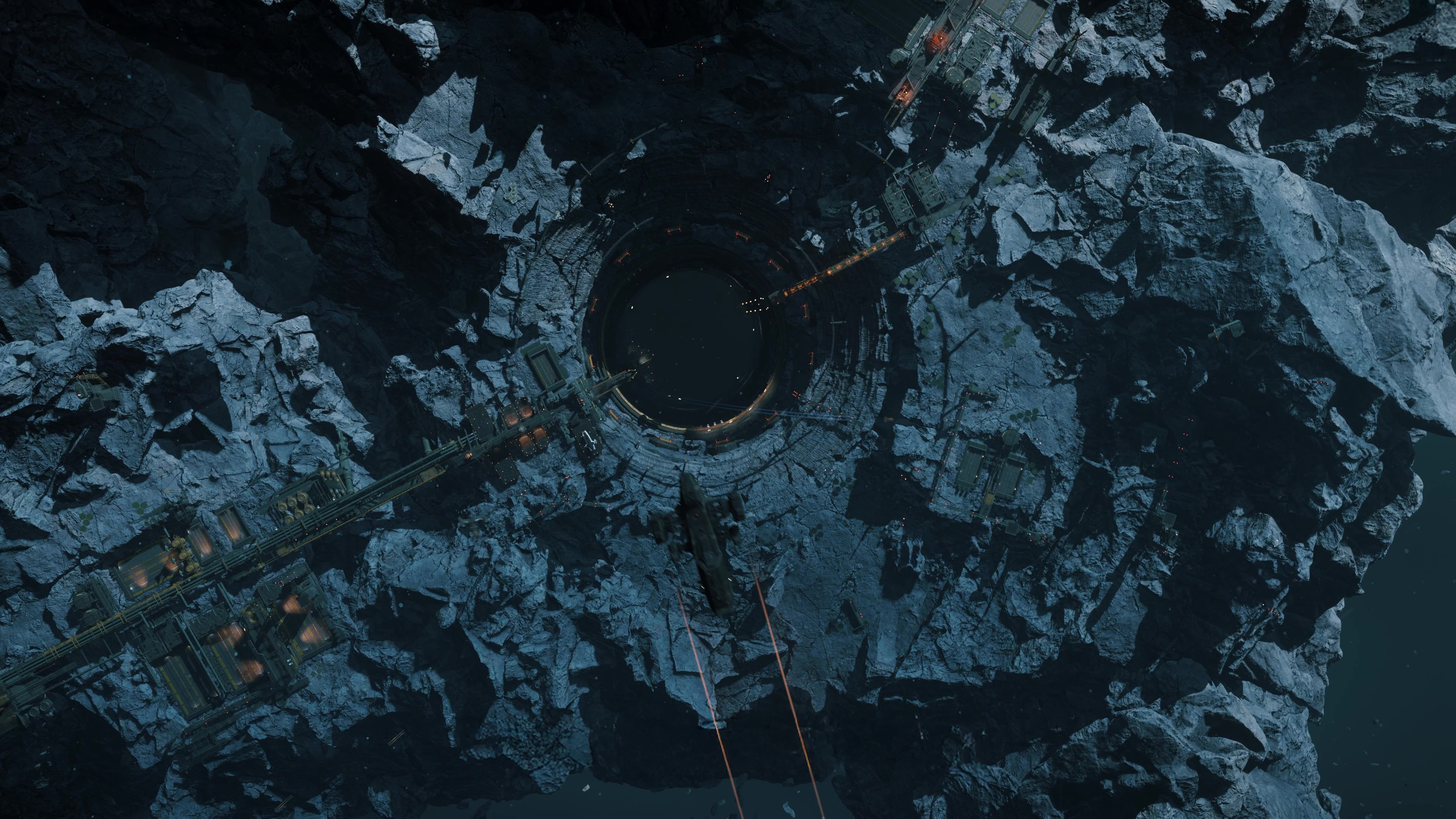
The outermost world in the Pyro system, this very cold, barely-habitable planet is notable mainly for the fact that it is the home of Ruin Station. Originally commissioned by Pyrotechnic Amalgamated to serve as a hub for their operations in the system, it was only in use by the company for a short time before it was abandoned along with any hopes of earning a profit from the desolate system.
Once the system was generally vacated by corporate, research and mining interests, the dilapidated station fell into use as a meeting place for squatters, runaways, and black market deal-making. It was around this time that it earned the moniker Ruin Station, as many who traversed its crumbling halls did so with the risk of the station collapsing around them. Yet, despite the dangers, the hideaway’s popularity grew. It was only a matter of time until it followed the same path as Spider, with outlaws gradually adding to the station’s infrastructure and developing a unique subculture. However, where Spider’s culture centers around honor among thieves, Pyro is based more around whoever has the most guns wins.
Make no mistake: Ruin Station is not suitable for tourism, regular trade or even experienced bounty hunters seeking the thrill of combat. The outlaws that do crew the station are notorious for their use of violence. Recently released Advocacy reports list extremist group XenoThreat as the current pack in control of the station, but this may change at a moment’s notice.
A highlight of Pyro’s dimly lit halls is Corner Four, a sequence of former research labs converted into drug factories and no-questions-asked medical treatment facilities. Neutrality, the station’s requisite dive bar, is the only arguably safe place on the station.
Travel Warning:
Spacecraft traversing the system should be mindful of Pyro’s solar flares as they are particularly hazardous and have the potential to disrupt travel.
Heard in the Wind:
“If there are any doubts to Humanity’s ability to survive in adverse conditions, one only needs to look at the inhabitants of Pyro to understand that our species adaptability is something quite remarkable.”
- Conrad Hesler, Struggling to Survive: The Human Story, 2812.05.11
“Pyro’s potential has long been wasted on those who haven’t done anything to deserve it. It’s high time we retake it – not for ourselves, but for everyone who has ever dared to dream of a better, safer future.”
- Madge Hartford, minutes of a Citizens for Pyro meeting, 2952.03.13
“You hear ‘bout this group, whadda they call themselves… People for Pyro? Seem to think they’re gonna swipe the system out from under the people who’ve been squatting there for centuries. You scumbags listening right now better promise to send up a comm when they finally show, ‘cause I’m dying to watch ‘em try.”
- unauthorized signal, captured in the Nyx system on 2953.09.17 at 03:44:19 Earth Standard Time
Wenn Spider das Gesicht der Piraterie in der Galaxie ist, ist Pyro zweifellos das schlagende Herz. Pyro, ein ansonsten trostloses, lebloses Sternensystem, das von einem Flare-Star verkrüppelt wird, ist vor allem die Heimat des gemeinsamen Piratenaußenpostens der Ruin Station. Wie Spider ist Pyro ein Fall von Piraten, die eine Lücke füllen (und erweitern), die hinterlassen wurde, als das System von zivilisierten Entwicklern verlassen wurde; im Gegensatz zu Spider hat sich Pyros Station nicht in einem geordneten System des Schwarzmarkthandels niedergelassen. Stattdessen kämpfen gegnerische Packs ständig um die Kontrolle.
Hintergrund & Entdeckung
Das Pyro-System besteht aus sechs Welten, die von einem variablen Hauptreihenstern vom Typ M mit unvorhersehbaren Sonneneruptionen als Geiseln gehalten werden. Dieser Aufflackerstern hat jede Chance auf Leben im System gestoppt. Neugierige Astrobiologen untersuchten sogar die Planeten im schwankenden grünen Band von Pyro und fanden bisher keine Hinweise auf einheimische Lebensformen. Es scheint, dass die ersten Anzeichen von Leben, die jemals im System vorhanden waren, durch seine Sprungbretter dorthin gebracht wurden.
Das System wurde erstmals 2493 besucht, vierundzwanzig Jahre nachdem die erste Person den Verdacht hatte, dass etwas da war. Im Jahr 2469 bemerkte der Wachoffizier der Roustabout, einem mit Erdflaggen versehenen Tankschiff, das durch das Kanusystem fährt, eine gravitäre Anomalie dreißigtausend Kilometer vor dem Hafenbogen des Transports. Ein detaillierter Bericht wurde an die Firmeninhaber des Schiffes und den späteren Namensgeber Pyrotechnic Amalgamated geschickt, aber es wurden keine Maßnahmen ergriffen. Vierundzwanzig Jahre später, als Pyrotechniker nach neuen Bergbaugebieten suchte, begannen sie, alte Scan-Aufzeichnungen zu überprüfen, als sie den ursprünglichen Bericht vom Roustabout notierten. Sie schickten einen Entdecker in die Region, nur um Pyro offiziell zu entdecken und seine Umgebung zu kartieren. Diese Umfrage ergab lediglich die allgemeine Unordnung des Planetensystems, die Schwierigkeit, transportable Ressourcen zu finden, und die Unwahrscheinlichkeit, dort erfolgreich etwas zu terraformen.
Neben der Entwicklung zu einem Zentrum der organisierten Piraterie ist Pyro heute auch in der UEE ein Begriff, da es als Inspiration für einen der Arena Commander Level von Original Systems diente. Während der Name "Sterbender Stern", der dem Level gegeben wird, technisch nicht korrekt ist, sind die dramatischen Sonneneruptionen des Systems ein denkwürdiger und idealer Ort für die Designer des Arena Commander, um zu zeigen, wie interessant 3D-Weltraumkämpfe sein können!
Pyro I
Pyro I ist ein verkohlter schwarzer Stein, der sich mit jeder weiteren Sonneneruption langsam in Pyros Stern verwandelt. Der Raum um Pyro I ist schwer zu navigieren mit nichts anderem als den hochwertigsten Schilden, obwohl einige fleißige Gesetzlose versucht haben, die gefährlichen Leuchtfeuer als provisorische Reaktoren für kompliziertere Raffinationsprozesse zu nutzen.
Pyro II
Bei der ersten Entdeckung des Systems stand das kernlose Pyro II im Vordergrund. Der Planet besaß scheinbar bedeutende Lagerstätten, und ein kleiner "Metallrausch" ließ menschliche Handelsschiffe schnell versuchen, zu ernten, was sie konnten. Der Planet trägt heute die Narben dieser schnellen und schmutzigen Minenoperationen, mit einer spärlichen, vorübergehenden Bevölkerung, die durch die Hoffnung driftet, eine Ader zu finden, die während des ersten Booms übersehen worden sein könnte.
Pyro III
Die Oberfläche dieser irdischen Welt wurde durch die Fackeln des Sterns des Systems auf Magma reduziert. Einige Wissenschaftler glauben, dass der große Himmelskörper, der Pyro IV aus seiner Umlaufbahn schlug, auch Pyro III näher an den Stern gestoßen haben könnte.
Pyro IV & V
Die Kombination aus Pyro IV, einem felsigen, Merkur-ähnlichen Protoplaneten, und Pyro V, einem massiven Gelb- und Grüngasriesen, ist eine der markanteren Sternenlandschaften, die bisher im bekannten Raum entdeckt wurden. Pyro IV und V sind das Ergebnis eines massiven Meteoritenangriffs, der die Umlaufbahn der ersteren in die letztere veränderte. Pyro V scheint nun Pyro IV in Zeitlupe aufzunehmen, ein visuelles Erscheinungsbild, das nur schwer irgendwo sonst in der Galaxie zu übertreffen ist.
Pyro VI & Ruinenstation
Dieser Protoplanet, der äußerste Planet im Pyro-System, zeichnet sich vor allem dadurch aus, dass er die Heimat der Ruin Station ist, die von den einzigen ständigen Bewohnern Pyros bewohnt wird. Ursprünglich von Pyrotechnic Amalgamated gebaut, um als Drehscheibe für ihren Betrieb im System zu dienen, wurde es von dem Unternehmen nur für kurze Zeit genutzt, bevor es aufgegeben wurde, zusammen mit der Hoffnung, einen Gewinn aus dem desolaten System zu erzielen.
Nachdem das System im Allgemeinen von Unternehmens-, Forschungs- und Bergbauinteressen verlassen wurde, wurde die verfallene Station schnell als Treffpunkt für Hausbesetzer, Ausreißer und Schwarzmarktgeschäfte genutzt. Es war um diese Zeit, dass es ihm den Namen Ruin Station einbrachte, da viele, die seine bröckelnden Hallen durchquerten, dies taten, mit der Gefahr, dass die Station um sie herum zusammenbrach. Doch trotz der Gefahren wuchs die Popularität des Versteckes nur noch. Es war nur eine Frage der Zeit, bis sie den gleichen Weg wie Spider einschlug, wobei die Gesetzlosen die Infrastruktur der Station allmählich erweiterten und eine einzigartige Subkultur entwickelten. Wo sich Spiders Kultur jedoch um die Ehre unter Dieben dreht, basiert Pyro mehr auf demjenigen, der die meisten Waffen hat, gewinnt.
Machen Sie keinen Fehler: Ruin Station ist nicht geeignet für Tourismus, regulären Handel oder sogar erfahrene Kopfgeldjäger, die den Nervenkitzel des Kampfes suchen. Die Gesetzlosen, die die Station besetzen, sind berüchtigt für ihren Einsatz von Gewalt. Kürzlich veröffentlichte Advocacy-Berichte liste Xeno Threat als das aktuelle Paket in der Kontrolle der Station, aber das kann sich jederzeit ändern.
Ein Highlight in Pyros schwach beleuchteten Sälen ist die Vierte Ecke, eine Abfolge ehemaliger Forschungslabore, die in Arzneimittelfabriken und fraglose medizinische Behandlungseinrichtungen umgewandelt wurden. Neutralität, die notwendige Dive Bar der Station, ist der einzige wohl sichere Ort auf der Station: Gepanzerte Harte, die Cousins genannt werden, halten hier den Frieden, zumindest soweit sie zum Schutz des Personals und der Einrichtungen der Bar erforderlich sind.
Reisewarnung:
Jedes unsachgemäß abgeschirmte Raumschiff erleidet Restschaden, wenn Pyros Stern während des Transports durch das System aufflammt.
Er wurde im Wind gehört:
"Yo ho ho ho, es gibt einen Ort, den ich kenne.
Der Knall ist ganz sauber und die Frauen leuchten,
Yo ho ho ho, a-Ruin, ich gehe,
Markiere meinen Sprung zu Pyro."
- Traditionelle Weltraumshanty
"Wenn es irgendwelche Zweifel an der Fähigkeit der Menschheit gibt, unter widrigen Bedingungen zu überleben, braucht man sich nur die Bewohner von Pyro anzusehen, um zu verstehen, dass die Anpassungsfähigkeit unserer Spezies etwas ganz Besonderes ist.
- Conrad Hesler, Kampf ums Überleben: Die menschliche Geschichte, 2812.05.11
If Spider is the face of piracy in the galaxy, Pyro is unquestionably the beating heart. A system ravaged by a flare star, Pyro is most notably the home of the shared pirate outpost of Ruin Station. Like Spider, Pyro is a case of pirates filling (and expanding upon) a void left when the system was abandoned by civilized developers; unlike Spider, Pyro’s station has not settled into an orderly system of black market commerce. Instead, opposing packs constantly struggle for control.
Background & Discovery
The Pyro System consists of six worlds that orbit a variable type-K main sequence star with unpredictable solar flares. This flare star has created strange environments on each of these planets and, in some cases, stranger life. Curious astrobiologists have examined the plants and animals that survive on the planets in Pyro’s fluctuating green band and have found that they possess high resistance to radiation and astonishing tolerance to temperature vacillations.
The system was first visited in 2493, twenty-four years after the first person suspected something was there. In 2469, the watch officer of the Roustabout, an Earth-flagged tanker ship moving through the Cano System, noted an anomaly thirty thousand kilometers off the transport’s port bow. A detailed report was sent to the ship’s corporate owners and eventual namesake, Pyrotechnic Amalgamated, but no action was taken. Twenty-four years later, when Pyrotechnic was seeking new mining territories, they began reviewing old scan records when it noted the original report from the Roustabout. They dispatched an exploration ship to the region that was able to formally discover Pyro. When the crew charted its environs, their survey noted the overall disarray of the planetary system, the effects of the unusual solar activity from the star on their equipment, and the unlikelihood that the company could afford to successfully terraform anything there. The board fiercely debated what to do with their discovery, but ultimately decided to deliver Pyro’s coordinates to the United Nations of Earth.
Once the system was in their hands, the UNE conducted a much more thorough analysis. While some of the findings seemed promising, such as the presence of potentially profitable mineral deposits on Pyro II, others indicated danger, especially concerning the possible consequences of living under a flare star. The UNE determined that it would sponsor a pilot program measuring the effects of solar flares on Humans before officially claiming the system, and opened Pyro up to commercial use in the meantime. If the results of the study proved positive, Pyro would be given the green light for colonization.
Over the next few decades, however, all plans for Pyro’s development would continually be stymied and the system would never be formally claimed. In 2499, the Magnus system was discovered, and the UNE suspended the Pyro program in favor of funding the terraformation of Magnus II and constructing a vast new shipyard there for the Navy. In 2516, when more funding from the UNE might have resurrected the pilot program, the discovery of the Terra system effectively derailed any possibility of government support. Pyrotechnic Amalgamated remained in the Pyro system after the UNE left, but their equipment faced continual damage from frequent solar flares. The company abandoned the system completely in 2563 when the cost of replacement and repair finally outstripped their profits. The space stations and planetary infrastructure they’d previously constructed to support their strip-mining operations remain scattered across the system to this day. Other corporations and research interests soon followed in Pyrotechnic Amalgamated’s footsteps. Left unguarded, Pyro became a haven for marauding gangs like the infamous Headhunters, 73R Vipers, and Fire Rats. By the early 27th century, the system had become a nexus of outlaw activity, and doing anything commercial with it seemed more trouble than it was worth.
In addition to its development as a center of organized piracy, Pyro is also a household name in the UEE today because it served as inspiration for one of Original Systems’ Arena Commander levels. While the “dying star” moniker given to the level is technically not accurate, the system’s dramatic solar flares are a memorable and ideal location for Arena Commander’s designers to show off how interesting 3D space combat can be!
Pyro I
Pyro I is a stormy planet that orbits very close to Pyro’s volatile star. Its high pressure atmosphere creates treacherous conditions that make landing difficult, to say nothing of its frequent lightning strikes. The space around Pyro I can be difficult to navigate without advanced shielding. Although it’s a dangerous place in more ways than one, some industrious outlaws have attempted to eke out a living on this harsh world.
Monox (Pyro II)
During the system’s initial discovery, the coreless Monox, nicknamed for the toxic carbon monoxide in its part-oxygen atmosphere, was a major focus. The world’s seemingly significant mineral deposits led to a minor “metal rush” that saw Human trade ships quickly try to harvest what they could. The planet today bears the scars of these quick and dirty mining operations, with a sparse transient population who drift through hoping to find a vein that might have been overlooked during the initial boom.
Bloom (Pyro III)
This terrestrial world has a breathable atmosphere of nitrogen and oxygen, but was never settled beyond staging sites, processing centers, and mining encampments that have since been claimed by outlaws and various squatters who have retrofitted the outposts into makeshift settlements. Icy landscapes give way to liquid bodies of saltwater in the temperate zones.
Pyro IV
Pyro IV is a planet with a warped landscape that is dotted with water-and-ammonia lakes. Astronomers theorize that before Humans discovered the Pyro system, Pyro IV suffered a collision with a planet-sized mass that knocked it into the orbit of the gas giant Pyro V. Over time, this unstable orbit will decay, and Pyro IV will be completely subsumed by Pyro V.
Pyro V
A massive gas giant with six (arguably seven, if you count Pyro IV) moons, Pyro V is the largest planet in the Pyro system, and one of the most visually striking. Shades of green and yellow swirl together in its upper atmosphere, giving Pyro V the appearance of a mossy boulder surrounded by a glittering black sea.
Terminus (Pyro VI) & Ruin Station
The outermost world in the Pyro system, this very cold, barely-habitable planet is notable mainly for the fact that it is the home of Ruin Station. Originally commissioned by Pyrotechnic Amalgamated to serve as a hub for their operations in the system, it was only in use by the company for a short time before it was abandoned along with any hopes of earning a profit from the desolate system.
Once the system was generally vacated by corporate, research and mining interests, the dilapidated station fell into use as a meeting place for squatters, runaways, and black market deal-making. It was around this time that it earned the moniker Ruin Station, as many who traversed its crumbling halls did so with the risk of the station collapsing around them. Yet, despite the dangers, the hideaway’s popularity grew. It was only a matter of time until it followed the same path as Spider, with outlaws gradually adding to the station’s infrastructure and developing a unique subculture. However, where Spider’s culture centers around honor among thieves, Pyro is based more around whoever has the most guns wins.
Make no mistake: Ruin Station is not suitable for tourism, regular trade or even experienced bounty hunters seeking the thrill of combat. The outlaws that do crew the station are notorious for their use of violence. Recently released Advocacy reports list extremist group XenoThreat as the current pack in control of the station, but this may change at a moment’s notice.
A highlight of Pyro’s dimly lit halls is Corner Four, a sequence of former research labs converted into drug factories and no-questions-asked medical treatment facilities. Neutrality, the station’s requisite dive bar, is the only arguably safe place on the station.
Travel Warning:
Spacecraft traversing the system should be mindful of Pyro’s solar flares as they are particularly hazardous and have the potential to disrupt travel.
Heard in the Wind:
“If there are any doubts to Humanity’s ability to survive in adverse conditions, one only needs to look at the inhabitants of Pyro to understand that our species adaptability is something quite remarkable.”
- Conrad Hesler, Struggling to Survive: The Human Story, 2812.05.11
“Pyro’s potential has long been wasted on those who haven’t done anything to deserve it. It’s high time we retake it – not for ourselves, but for everyone who has ever dared to dream of a better, safer future.”
- Madge Hartford, minutes of a Citizens for Pyro meeting, 2952.03.13
“You hear ‘bout this group, whadda they call themselves… People for Pyro? Seem to think they’re gonna swipe the system out from under the people who’ve been squatting there for centuries. You scumbags listening right now better promise to send up a comm when they finally show, ‘cause I’m dying to watch ‘em try.”
- unauthorized signal, captured in the Nyx system on 2953.09.17 at 03:44:19 Earth Standard Time
If Spider is the face of piracy in the galaxy, Pyro is unquestionably the beating heart. A system ravaged by a flare star, Pyro is most notably the home of the shared pirate outpost of Ruin Station. Like Spider, Pyro is a case of pirates filling (and expanding upon) a void left when the system was abandoned by civilized developers; unlike Spider, Pyro’s station has not settled into an orderly system of black market commerce. Instead, opposing packs constantly struggle for control.
Background & Discovery
The Pyro System consists of six worlds that orbit a variable type-K main sequence star with unpredictable solar flares. This flare star has created strange environments on each of these planets and, in some cases, stranger life. Curious astrobiologists have examined the plants and animals that survive on the planets in Pyro’s fluctuating green band and have found that they possess high resistance to radiation and astonishing tolerance to temperature vacillations.
The system was first visited in 2493, twenty-four years after the first person suspected something was there. In 2469, the watch officer of the Roustabout, an Earth-flagged tanker ship moving through the Cano System, noted an anomaly thirty thousand kilometers off the transport’s port bow. A detailed report was sent to the ship’s corporate owners and eventual namesake, Pyrotechnic Amalgamated, but no action was taken. Twenty-four years later, when Pyrotechnic was seeking new mining territories, they began reviewing old scan records when it noted the original report from the Roustabout. They dispatched an exploration ship to the region that was able to formally discover Pyro. When the crew charted its environs, their survey noted the overall disarray of the planetary system, the effects of the unusual solar activity from the star on their equipment, and the unlikelihood that the company could afford to successfully terraform anything there. The board fiercely debated what to do with their discovery, but ultimately decided to deliver Pyro’s coordinates to the United Nations of Earth.
Once the system was in their hands, the UNE conducted a much more thorough analysis. While some of the findings seemed promising, such as the presence of potentially profitable mineral deposits on Pyro II, others indicated danger, especially concerning the possible consequences of living under a flare star. The UNE determined that it would sponsor a pilot program measuring the effects of solar flares on Humans before officially claiming the system, and opened Pyro up to commercial use in the meantime. If the results of the study proved positive, Pyro would be given the green light for colonization.
Over the next few decades, however, all plans for Pyro’s development would continually be stymied and the system would never be formally claimed. In 2499, the Magnus system was discovered, and the UNE suspended the Pyro program in favor of funding the terraformation of Magnus II and constructing a vast new shipyard there for the Navy. In 2516, when more funding from the UNE might have resurrected the pilot program, the discovery of the Terra system effectively derailed any possibility of government support. Pyrotechnic Amalgamated remained in the Pyro system after the UNE left, but their equipment faced continual damage from frequent solar flares. The company abandoned the system completely in 2563 when the cost of replacement and repair finally outstripped their profits. The space stations and planetary infrastructure they’d previously constructed to support their strip-mining operations remain scattered across the system to this day. Other corporations and research interests soon followed in Pyrotechnic Amalgamated’s footsteps. Left unguarded, Pyro became a haven for marauding gangs like the infamous Headhunters, 73R Vipers, and Fire Rats. By the early 27th century, the system had become a nexus of outlaw activity, and doing anything commercial with it seemed more trouble than it was worth.
In addition to its development as a center of organized piracy, Pyro is also a household name in the UEE today because it served as inspiration for one of Original Systems’ Arena Commander levels. While the “dying star” moniker given to the level is technically not accurate, the system’s dramatic solar flares are a memorable and ideal location for Arena Commander’s designers to show off how interesting 3D space combat can be!
Pyro I
Pyro I is a stormy planet that orbits very close to Pyro’s volatile star. Its high pressure atmosphere creates treacherous conditions that make landing difficult, to say nothing of its frequent lightning strikes. The space around Pyro I can be difficult to navigate without advanced shielding. Although it’s a dangerous place in more ways than one, some industrious outlaws have attempted to eke out a living on this harsh world.
Monox (Pyro II)
During the system’s initial discovery, the coreless Monox, nicknamed for the toxic carbon monoxide in its part-oxygen atmosphere, was a major focus. The world’s seemingly significant mineral deposits led to a minor “metal rush” that saw Human trade ships quickly try to harvest what they could. The planet today bears the scars of these quick and dirty mining operations, with a sparse transient population who drift through hoping to find a vein that might have been overlooked during the initial boom.
Bloom (Pyro III)
This terrestrial world has a breathable atmosphere of nitrogen and oxygen, but was never settled beyond staging sites, processing centers, and mining encampments that have since been claimed by outlaws and various squatters who have retrofitted the outposts into makeshift settlements. Icy landscapes give way to liquid bodies of saltwater in the temperate zones.
Pyro IV
Pyro IV is a planet with a warped landscape that is dotted with water-and-ammonia lakes. Astronomers theorize that before Humans discovered the Pyro system, Pyro IV suffered a collision with a planet-sized mass that knocked it into the orbit of the gas giant Pyro V. Over time, this unstable orbit will decay, and Pyro IV will be completely subsumed by Pyro V.
Pyro V
A massive gas giant with six (arguably seven, if you count Pyro IV) moons, Pyro V is the largest planet in the Pyro system, and one of the most visually striking. Shades of green and yellow swirl together in its upper atmosphere, giving Pyro V the appearance of a mossy boulder surrounded by a glittering black sea.
Terminus (Pyro VI) & Ruin Station
The outermost world in the Pyro system, this very cold, barely-habitable planet is notable mainly for the fact that it is the home of Ruin Station. Originally commissioned by Pyrotechnic Amalgamated to serve as a hub for their operations in the system, it was only in use by the company for a short time before it was abandoned along with any hopes of earning a profit from the desolate system.
Once the system was generally vacated by corporate, research and mining interests, the dilapidated station fell into use as a meeting place for squatters, runaways, and black market deal-making. It was around this time that it earned the moniker Ruin Station, as many who traversed its crumbling halls did so with the risk of the station collapsing around them. Yet, despite the dangers, the hideaway’s popularity grew. It was only a matter of time until it followed the same path as Spider, with outlaws gradually adding to the station’s infrastructure and developing a unique subculture. However, where Spider’s culture centers around honor among thieves, Pyro is based more around whoever has the most guns wins.
Make no mistake: Ruin Station is not suitable for tourism, regular trade or even experienced bounty hunters seeking the thrill of combat. The outlaws that do crew the station are notorious for their use of violence. Recently released Advocacy reports list extremist group XenoThreat as the current pack in control of the station, but this may change at a moment’s notice.
A highlight of Pyro’s dimly lit halls is Corner Four, a sequence of former research labs converted into drug factories and no-questions-asked medical treatment facilities. Neutrality, the station’s requisite dive bar, is the only arguably safe place on the station.
Travel Warning:
Spacecraft traversing the system should be mindful of Pyro’s solar flares as they are particularly hazardous and have the potential to disrupt travel.
Heard in the Wind:
“If there are any doubts to Humanity’s ability to survive in adverse conditions, one only needs to look at the inhabitants of Pyro to understand that our species adaptability is something quite remarkable.”
- Conrad Hesler, Struggling to Survive: The Human Story, 2812.05.11
“Pyro’s potential has long been wasted on those who haven’t done anything to deserve it. It’s high time we retake it – not for ourselves, but for everyone who has ever dared to dream of a better, safer future.”
- Madge Hartford, minutes of a Citizens for Pyro meeting, 2952.03.13
“You hear ‘bout this group, whadda they call themselves… People for Pyro? Seem to think they’re gonna swipe the system out from under the people who’ve been squatting there for centuries. You scumbags listening right now better promise to send up a comm when they finally show, ‘cause I’m dying to watch ‘em try.”
- unauthorized signal, captured in the Nyx system on 2953.09.17 at 03:44:19 Earth Standard Time
Links
No links available.


Metadata
- CIG ID
- 13852
- Channel
- Spectrum Dispatch
- Category
- Undefined
- Series
- Galactic Guide
- Comments
- 187
- Published
- 12 years ago (2014-05-06T00:00:00+00:00)