Galactic Guide: Osiris System
Spectrum Dispatch Undefined Galactic GuideContent
Discovery & Debate
Osiris is an orange-yellow K-type main sequence star orbited by a pair of planets and a dense asteroid belt. When discovered in the late 2700s, a true survey of the system ended up taking a lot longer than anticipated, as the UEE suddenly found itself in the middle of a revolution.
While science teams were en route to the Osiris System to start their detailed scanning and mapping process, footage of the Massacre of Garron II leaked to the populace and ignited public outcry and demonstrations. The Messer regime, already stretched thin, now found that every riot they squashed emboldened and inspired others to take their place.
By the time the dust settled and the government finally got back to studying this system, the survey results of the inner planet yielded fascinating data. Beneath the cloud layer of Osiris I was an extremely active biosphere capable of supporting Human life, playing host to an amazing diversity of species unlike those found anywhere else in the known galaxy.
Following a science team’s discovery of higher primate-equivalents on Osiris I (by now known as Etos), the system became the flashpoint for a new debate over the morality of expansion and something of a cause célèbre for environmentalists and expansionists alike as Osiris System became the first system declared to be a developing system under the Fair Chance Act. Though the thought of terraforming inhabited worlds for Human settlement is considered immoral by proponents of the Fair Chance Act, critics continue to argue that we should try to enrich the lives of species we discover instead of idly watching them potentially suffer from afar.
Osiris I (Etos)
Ask the average Citizen to describe Osiris I’s fabled biosphere and you will likely hear descriptions of impossibly dense rain forests teeming with every form of life imaginable. The reality is nowhere close. Etos is on the extreme solar side of Osiris’ green belt, and life there has adapted very differently than on Earth. The first thing to understand is that life on Etos does not thrive in the open; there are no teeming forests reaching for the sky or wild, untamed polar steppes. While the atmosphere can support Human life, the proximity to the star means that most evolution has occurred underground.
Etos has an extensive, miles-deep cave system that worms its way into the planet’s mantle. There, a variety of life forms have taken hold, ranging from spiny crustaceans to a divergent set of species that might best be described as a gelatinous disc or as noted in one researcher’s journal, a ’flopping pancake.’ One of the deciding factors behind Etos’ formal protection is Phare’s Ape, a vaguely Human-like primate that biologists believe has the potential to develop higher thinking. With what can only be described as a natural ‘sad face’ and a seemingly gentle nature, Phare’s Ape became the iconic image of the Etosian preservation movement.
The planet is monitored from a safe distance by Observation Station Kobold which is charged with protecting Osiris I under the guidelines of the Fair Chance Act. While it houses a mixture of scientist and military personnel, the most unusual inhabitants are the small collection of Phare’s Apes who make their home aboard the station. Recovered from a smuggler’s hold, the clutch was deemed too injured to be returned to the planet below, and were nursed back to health on Kobold where they live and continue to be studied.
Osiris Belt Alpha
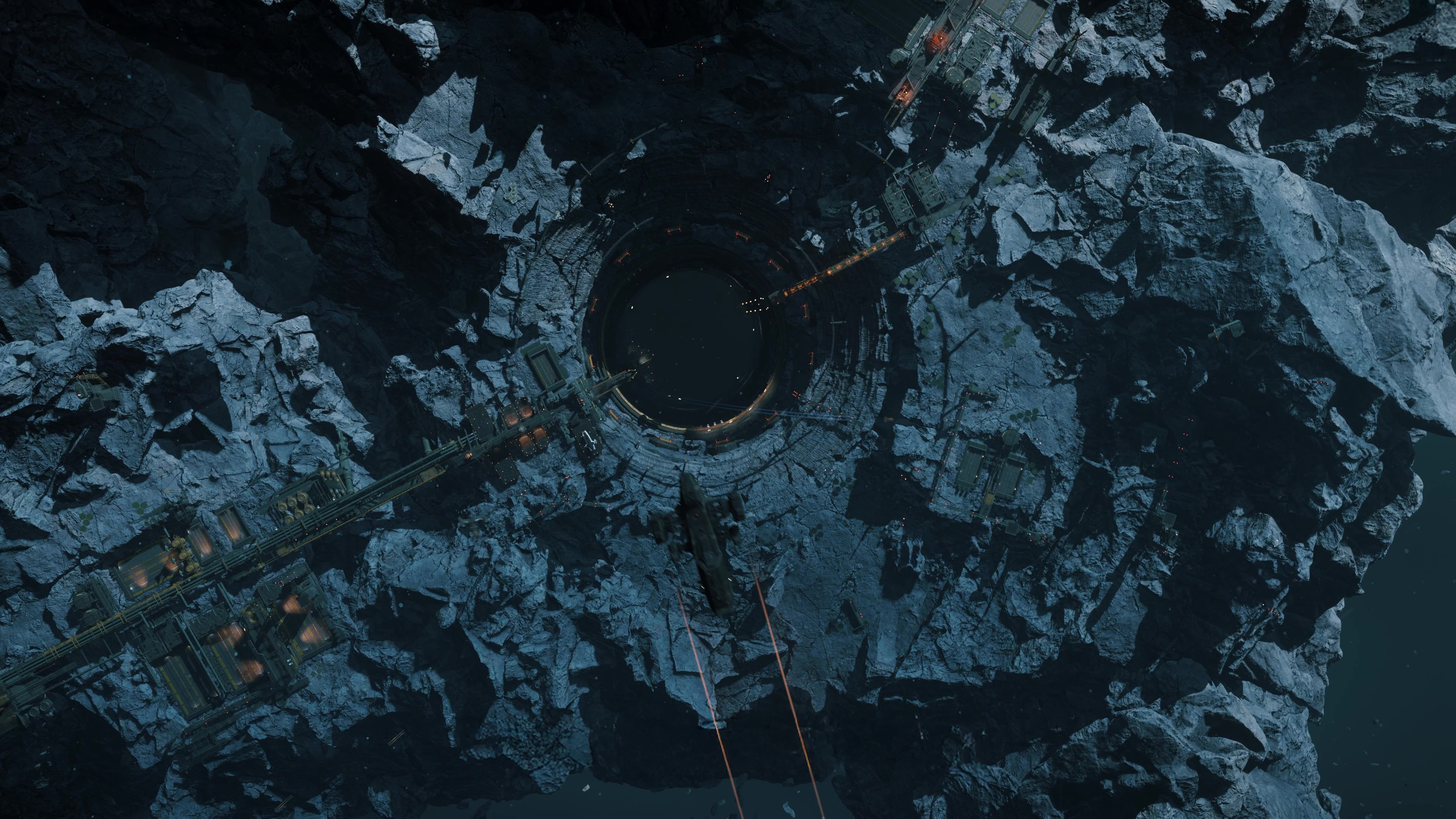
The Osiris belt is one of the densest yet discovered, with frequent asteroid collisions making traversal and mining extremely hazardous. The debris sent hurtling from the belt is a constant concern for those studying Etos, as a massive enough collision could be catastrophic for the life there. Patrols are frequently sent to destroy and divert rogue asteroids before they become an issue.
Osiris II
The gas giant, Osiris II, was what initially drew prospectors to the system: a large Jovian world with naturally pure hydrogen. While technically in a system protected by the Fair Chance Act, Osiris II was made available under license to various companies and refinery concerns to help offset the initial costs of the program. Outposts here have gained the animosity of the military due to their frequent use in various smuggling and poaching schemes.
Travel Warning
Just because you can, doesn’t mean you should. Looks can be deceiving! While it may appear there’s little UEE oversight, Etos itself is well-guarded. A record number pilots with questionable intentions were caught attempting to access the planet in 2945.
Heard in the Wind
“Osiris offered us a unique opportunity. With all the vicious arguments about settlement and cohabitation, all the pieces were there for us to falter in our resolve, but we didn’t. Humanity chose what was right.”
- Imperator Erin Toi, Excerpt from her memoir On the Path
“The creature caught my eye as the light of the flashlight caused a prismatic burst of colors to ripple across its gelatinous disc shaped body. As I moved in closer to get a better look, it peeled itself from the rock surface and fell to the ground in a manner that can only be described as reminiscent of a flopping pancake.”
- Esther Punari, Etos Field Notes, 2823
Entdeckung & Diskussion
Osiris ist ein orange-gelber K-Hauptreihenstern, der von einem Planetenpaar und einem dichten Asteroidengürtel umkreist wird. Als sie in den späten 2700er Jahren entdeckt wurden, dauerte ein wahrer Überblick über das System viel länger als erwartet, da sich die UEE plötzlich mitten in einer Revolution befand.
Während die Wissenschaftsteams auf dem Weg zum Osiris-System waren, um ihren detaillierten Scan- und Kartierungsprozess zu starten, liefen die Aufnahmen vom Massaker an Garron II an die Bevölkerung durch und lösten öffentliche Aufschreie und Demonstrationen aus. Das bereits dünn besetzte Messer-Regime fand nun heraus, dass jeder Aufstand, den sie zerschlugen, ermutigend war und andere dazu inspirierte, ihren Platz einzunehmen.
Als sich der Staub gelegt hatte und die Regierung endlich wieder dieses System studierte, lieferten die Umfrageergebnisse des inneren Planeten faszinierende Daten. Unter der Wolkenschicht von Osiris war ich eine äußerst aktive Biosphäre, die in der Lage war, das menschliche Leben zu unterstützen und eine erstaunliche Artenvielfalt zu bieten, wie sie sonst nirgendwo in der bekannten Galaxie zu finden ist.
Nach der Entdeckung höherer Primatenäquivalente durch ein Wissenschaftsteam bei Osiris I (inzwischen bekannt als Etos) wurde das System zum Brennpunkt für eine neue Debatte über die Moral der Expansion und zu einer Art Cause Célèbre für Umweltschützer und Expansionisten gleichermaßen, da das Osiris-System das erste System wurde, das nach dem Fair Chance Act zu einem Entwicklungssystem erklärt wurde. Obwohl der Gedanke, bewohnte Welten für die menschliche Besiedlung zu terrassieren, von den Befürwortern des Fair Chance Act als unmoralisch angesehen wird, argumentieren Kritiker weiterhin, dass wir versuchen sollten, das Leben der Arten zu bereichern, die wir entdecken, anstatt untätig zuzusehen, wie sie möglicherweise aus der Ferne leiden.
Osiris I (Etos)
Bitten Sie den Durchschnittsbürger, die sagenumwobene Biosphäre von Osiris I. zu beschreiben, und Sie werden wahrscheinlich Beschreibungen von unmöglich dichten Regenwäldern hören, die von jeder erdenklichen Lebensform wimmeln. Die Realität ist nicht annähernd so nah. Etos liegt auf der extremen Sonnenseite des Grüngürtels von Osiris, und das Leben dort hat sich ganz anders angepasst als auf der Erde. Das erste, was man verstehen muss, ist, dass das Leben auf Etos nicht in der Natur gedeiht; es gibt keine wimmelnden Wälder, die nach dem Himmel greifen, oder wilde, ungezähmte Polarsteppen. Während die Atmosphäre das menschliche Leben unterstützen kann, bedeutet die Nähe zum Stern, dass die meiste Evolution unter der Erde stattgefunden hat.
Etos hat ein ausgedehntes, kilometerweites Höhlensystem, das sich in den Planetenmantel einschleicht. Dort haben sich verschiedene Lebensformen durchgesetzt, von stacheligen Krustentieren bis hin zu verschiedenen Arten, die man am besten als gelartige Bandscheibe oder wie in einem Forscherjournal, einem "fallenden Pfannkuchen", beschreiben könnte. Einer der entscheidenden Faktoren für Etos' formalen Schutz ist Phare's Ape, ein vage menschenähnlicher Primat, von dem Biologen glauben, dass er das Potenzial hat, höheres Denken zu entwickeln. Mit einem, wie man nur sagen kann, natürlichen, traurigen Gesicht und einer scheinbar sanften Natur, wurde PHARE's Affe zum ikonischen Bild der etosianischen Erhaltungsbewegung.
Der Planet wird aus sicherer Entfernung von der Beobachtungsstation Kobold überwacht, die mit dem Schutz von Osiris I nach den Richtlinien des Fair Chance Act beauftragt ist. Obwohl es eine Mischung aus Wissenschaftlern und Militärangehörigen beherbergt, sind die ungewöhnlichsten Bewohner die kleine Sammlung von PHARE-Affen, die an Bord der Station ihr Zuhause finden. Die Kupplung, die aus dem Besitz eines Schmugglers geborgen wurde, galt als zu verletzt, um auf den Planeten unten gebracht zu werden, und wurde auf Kobold wieder gesund gepflegt, wo sie leben und weiter untersucht werden.
Osiris Gürtel Alpha
Der Osiris-Gürtel ist einer der dichtesten, die je entdeckt wurden, mit häufigen Asteroidenkollisionen, die das Durchqueren und den Abbau extrem gefährlich machen. Die Trümmer, die aus dem Gürtel springen, sind ein ständiges Problem für diejenigen, die Etos studieren, da eine massive Kollision für das Leben dort katastrophal sein könnte. Patrouillen werden häufig geschickt, um Schurken-Asteroiden zu zerstören und abzulenken, bevor sie zum Problem werden.
Osiris II
Der Gasriese Osiris II. war es, der zunächst die Goldsucher an das System heranführte: eine große jowianische Welt mit natürlich reinem Wasserstoff. Obwohl technisch in einem durch den Fair Chance Act geschützten System, wurde Osiris II unter Lizenz verschiedenen Unternehmen und Raffineriebetreibern zur Verfügung gestellt, um die Anfangskosten des Programms auszugleichen. Die Außenposten hier haben die Feindseligkeit des Militärs gewonnen, da sie häufig bei verschiedenen Schmuggel und Wildereivorhaben eingesetzt werden.
Reisewarnung
Nur weil du es kannst, heißt das nicht, dass du es solltest. Der Schein kann trügen! Obwohl es den Anschein hat, dass es wenig UEE-Aufsicht gibt, ist Etos selbst gut bewacht. Eine Rekordzahl von Piloten mit fragwürdigen Absichten wurde 2945 bei dem Versuch erwischt, den Planeten zu erreichen.
Im Wind gehört
"Osiris bot uns eine einzigartige Gelegenheit. Bei all den bösartigen Auseinandersetzungen über Siedlung und Zusammenleben waren alle Teile da, damit wir in unserer Entschlossenheit ins Stocken geraten konnten, aber das taten wir nicht. Die Menschheit wählte, was richtig war."
- Imperatorin Erin Toi, Auszug aus ihren Memoiren Auf dem Weg
"Die Kreatur fiel mir auf, als das Licht der Taschenlampe einen prismatischen Farbausbruch verursachte, der sich über ihren gelatineartigen scheibenförmigen Körper ausbreitete. Als ich näher kam, um einen besseren Blick zu erhalten, schälte sie sich von der Felsoberfläche und fiel zu Boden, auf eine Art und Weise, die man nur als an einen herunterfallenden Pfannkuchen erinnern kann."
- Esther Punari, Etos Field Notes, 2823
Discovery & Debate
Osiris is an orange-yellow K-type main sequence star orbited by a pair of planets and a dense asteroid belt. When discovered in the late 2700s, a true survey of the system ended up taking a lot longer than anticipated, as the UEE suddenly found itself in the middle of a revolution.
While science teams were en route to the Osiris System to start their detailed scanning and mapping process, footage of the Massacre of Garron II leaked to the populace and ignited public outcry and demonstrations. The Messer regime, already stretched thin, now found that every riot they squashed emboldened and inspired others to take their place.
By the time the dust settled and the government finally got back to studying this system, the survey results of the inner planet yielded fascinating data. Beneath the cloud layer of Osiris I was an extremely active biosphere capable of supporting Human life, playing host to an amazing diversity of species unlike those found anywhere else in the known galaxy.
Following a science team’s discovery of higher primate-equivalents on Osiris I (by now known as Etos), the system became the flashpoint for a new debate over the morality of expansion and something of a cause célèbre for environmentalists and expansionists alike as Osiris System became the first system declared to be a developing system under the Fair Chance Act. Though the thought of terraforming inhabited worlds for Human settlement is considered immoral by proponents of the Fair Chance Act, critics continue to argue that we should try to enrich the lives of species we discover instead of idly watching them potentially suffer from afar.
Osiris I (Etos)
Ask the average Citizen to describe Osiris I’s fabled biosphere and you will likely hear descriptions of impossibly dense rain forests teeming with every form of life imaginable. The reality is nowhere close. Etos is on the extreme solar side of Osiris’ green belt, and life there has adapted very differently than on Earth. The first thing to understand is that life on Etos does not thrive in the open; there are no teeming forests reaching for the sky or wild, untamed polar steppes. While the atmosphere can support Human life, the proximity to the star means that most evolution has occurred underground.
Etos has an extensive, miles-deep cave system that worms its way into the planet’s mantle. There, a variety of life forms have taken hold, ranging from spiny crustaceans to a divergent set of species that might best be described as a gelatinous disc or as noted in one researcher’s journal, a ’flopping pancake.’ One of the deciding factors behind Etos’ formal protection is Phare’s Ape, a vaguely Human-like primate that biologists believe has the potential to develop higher thinking. With what can only be described as a natural ‘sad face’ and a seemingly gentle nature, Phare’s Ape became the iconic image of the Etosian preservation movement.
The planet is monitored from a safe distance by Observation Station Kobold which is charged with protecting Osiris I under the guidelines of the Fair Chance Act. While it houses a mixture of scientist and military personnel, the most unusual inhabitants are the small collection of Phare’s Apes who make their home aboard the station. Recovered from a smuggler’s hold, the clutch was deemed too injured to be returned to the planet below, and were nursed back to health on Kobold where they live and continue to be studied.
Osiris Belt Alpha
The Osiris belt is one of the densest yet discovered, with frequent asteroid collisions making traversal and mining extremely hazardous. The debris sent hurtling from the belt is a constant concern for those studying Etos, as a massive enough collision could be catastrophic for the life there. Patrols are frequently sent to destroy and divert rogue asteroids before they become an issue.
Osiris II
The gas giant, Osiris II, was what initially drew prospectors to the system: a large Jovian world with naturally pure hydrogen. While technically in a system protected by the Fair Chance Act, Osiris II was made available under license to various companies and refinery concerns to help offset the initial costs of the program. Outposts here have gained the animosity of the military due to their frequent use in various smuggling and poaching schemes.
Travel Warning
Just because you can, doesn’t mean you should. Looks can be deceiving! While it may appear there’s little UEE oversight, Etos itself is well-guarded. A record number pilots with questionable intentions were caught attempting to access the planet in 2945.
Heard in the Wind
“Osiris offered us a unique opportunity. With all the vicious arguments about settlement and cohabitation, all the pieces were there for us to falter in our resolve, but we didn’t. Humanity chose what was right.”
- Imperator Erin Toi, Excerpt from her memoir On the Path
“The creature caught my eye as the light of the flashlight caused a prismatic burst of colors to ripple across its gelatinous disc shaped body. As I moved in closer to get a better look, it peeled itself from the rock surface and fell to the ground in a manner that can only be described as reminiscent of a flopping pancake.”
- Esther Punari, Etos Field Notes, 2823
Discovery & Debate
Osiris is an orange-yellow K-type main sequence star orbited by a pair of planets and a dense asteroid belt. When discovered in the late 2700s, a true survey of the system ended up taking a lot longer than anticipated, as the UEE suddenly found itself in the middle of a revolution.
While science teams were en route to the Osiris System to start their detailed scanning and mapping process, footage of the Massacre of Garron II leaked to the populace and ignited public outcry and demonstrations. The Messer regime, already stretched thin, now found that every riot they squashed emboldened and inspired others to take their place.
By the time the dust settled and the government finally got back to studying this system, the survey results of the inner planet yielded fascinating data. Beneath the cloud layer of Osiris I was an extremely active biosphere capable of supporting Human life, playing host to an amazing diversity of species unlike those found anywhere else in the known galaxy.
Following a science team’s discovery of higher primate-equivalents on Osiris I (by now known as Etos), the system became the flashpoint for a new debate over the morality of expansion and something of a cause célèbre for environmentalists and expansionists alike as Osiris System became the first system declared to be a developing system under the Fair Chance Act. Though the thought of terraforming inhabited worlds for Human settlement is considered immoral by proponents of the Fair Chance Act, critics continue to argue that we should try to enrich the lives of species we discover instead of idly watching them potentially suffer from afar.
Osiris I (Etos)
Ask the average Citizen to describe Osiris I’s fabled biosphere and you will likely hear descriptions of impossibly dense rain forests teeming with every form of life imaginable. The reality is nowhere close. Etos is on the extreme solar side of Osiris’ green belt, and life there has adapted very differently than on Earth. The first thing to understand is that life on Etos does not thrive in the open; there are no teeming forests reaching for the sky or wild, untamed polar steppes. While the atmosphere can support Human life, the proximity to the star means that most evolution has occurred underground.
Etos has an extensive, miles-deep cave system that worms its way into the planet’s mantle. There, a variety of life forms have taken hold, ranging from spiny crustaceans to a divergent set of species that might best be described as a gelatinous disc or as noted in one researcher’s journal, a ’flopping pancake.’ One of the deciding factors behind Etos’ formal protection is Phare’s Ape, a vaguely Human-like primate that biologists believe has the potential to develop higher thinking. With what can only be described as a natural ‘sad face’ and a seemingly gentle nature, Phare’s Ape became the iconic image of the Etosian preservation movement.
The planet is monitored from a safe distance by Observation Station Kobold which is charged with protecting Osiris I under the guidelines of the Fair Chance Act. While it houses a mixture of scientist and military personnel, the most unusual inhabitants are the small collection of Phare’s Apes who make their home aboard the station. Recovered from a smuggler’s hold, the clutch was deemed too injured to be returned to the planet below, and were nursed back to health on Kobold where they live and continue to be studied.
Osiris Belt Alpha
The Osiris belt is one of the densest yet discovered, with frequent asteroid collisions making traversal and mining extremely hazardous. The debris sent hurtling from the belt is a constant concern for those studying Etos, as a massive enough collision could be catastrophic for the life there. Patrols are frequently sent to destroy and divert rogue asteroids before they become an issue.
Osiris II
The gas giant, Osiris II, was what initially drew prospectors to the system: a large Jovian world with naturally pure hydrogen. While technically in a system protected by the Fair Chance Act, Osiris II was made available under license to various companies and refinery concerns to help offset the initial costs of the program. Outposts here have gained the animosity of the military due to their frequent use in various smuggling and poaching schemes.
Travel Warning
Just because you can, doesn’t mean you should. Looks can be deceiving! While it may appear there’s little UEE oversight, Etos itself is well-guarded. A record number pilots with questionable intentions were caught attempting to access the planet in 2945.
Heard in the Wind
“Osiris offered us a unique opportunity. With all the vicious arguments about settlement and cohabitation, all the pieces were there for us to falter in our resolve, but we didn’t. Humanity chose what was right.”
- Imperator Erin Toi, Excerpt from her memoir On the Path
“The creature caught my eye as the light of the flashlight caused a prismatic burst of colors to ripple across its gelatinous disc shaped body. As I moved in closer to get a better look, it peeled itself from the rock surface and fell to the ground in a manner that can only be described as reminiscent of a flopping pancake.”
- Esther Punari, Etos Field Notes, 2823
Links
No links available.

Metadata
- CIG ID
- 14876
- Channel
- Spectrum Dispatch
- Category
- Undefined
- Series
- Galactic Guide
- Comments
- 42
- Published
- 11 years ago (2015-08-07T00:00:00+00:00)