Galactic Guide: Tayac System
Spectrum Dispatch Undefined Galactic GuideContent
A simple system with a complicated past, Tayac has showcased the best and worst of Humanity over the four centuries in which we have occupied it. Discovered as part of Project Far Star, the G-Class Main Sequence star system was first visited in 2524 by a UPE pilot further exploring the Terra jump point to Magnus. Home to three planets and an asteroid belt, the system, then known as 368A, was classified by surveyors for commercial development, with the innermost planet noted as a potential terraforming candidate.
Due to the bevy of other systems discovered during that decade of expansion, a backlog of planets waiting to be terraformed grew as funding and the necessary resources were claimed as quickly as they were budgeted. It was not until 2539 that the initial steps for terraforming of 368A.01M (Tayac I) were finally taken, and construction on an orbital rig begun. However, before the process could be completed, Humanity’s first official inter-species war erupted in 2541. As the battle against the Tevarin stepped into high gear, all non-essential projects were canceled in order to focus on expanding the war effort and strengthening the Naval fleet; the terraformation of Tayac was one of the projects included in the cutbacks.
The system remained relatively untouched until the conclusion of the war and rise of Ivar Messer to the role of Imperator. With Messer’s expansion of the Empire’s control, Tayac was made a military system, declared off-limits to civilian traffic, and all known jumps into the system were shut off by Naval blockades. Completely removed from the public eye, the truth of what happened there during the Messer regime wasn’t fully known till their reign came to an end centuries later.
Tayac I
After experiencing the high cost of the Tevarin war, particularly his own experiences on the front line, Ivar Messer was eager to develop weapons that would enable the Empire to end future conflicts swiftly and with minimal loss of military personnel. Under his rule, dozens of highly classified blacklist initiatives, proposals and research projects dedicated to mass destruction were quietly established and generously funded. One such project, code named Vespa, was the brainchild of Dr. Thessaly Tayac, who believed that terraforming technology could be adapted for weaponization. The half-finished terraforming of 368A.01M was selected as the perfect test environment and in 2546, the small rocky planet was assigned to Dr. Tayac for experimentation. For the next several decades, the planet was systematically terraformed and then de-terraformed, eventually transforming a planet with great potential into a desolate rock with zero atmosphere. Though Dr. Tayac was able to successfully reverse the terraforming process, his team was never able to weaponize the technology.
The problem was two-fold: size and time. The orbital platform needed to destabilize the planet’s biosphere was of considerable size. It was impossible to imagine a scenario where the Navy would be able to safely maneuver such a platform into place over a hostile world under battle-like conditions. And if they ever did manage to move the platform into a suitable position, the destabilization process was not a quick one. By the time Dr. Tayac passed away, considerable strides had been made, but not enough to make the project feasible for actual use. After the doctor’s death, the reins of Project Vespa were passed on and the work continued in the system that was by then commonly referred to among Navy personnel as Tayac. Despite generation after generation of Messers eager to see Vespa come to fruition, the hurdles were just too insurmountable. By 2750, Tayac I had become increasingly unstable from the experimentation and could no longer be terraformed, while interest for the project had dried up along with funding. Vespa was officially shut down and Tayac System all but shuttered.
It wasn’t long afterwards that the political winds of the Empire shifted and toppled the Messers from power. In the upheaval that followed, the experiments of Dr. Tayac became public knowledge. Not only was it a shocking revelation of what the Messers had been truly capable of, but it put a significant strain on the still fragile peace treaty that had only just been negotiated with the Xi’An. As a sign of trust and as an assurance that the Empire of old was a thing of the past, Imperator Toi shared all of the Project Vespa research with the Xi’An government, swearing that the technology would never be pursued again.
The Ark
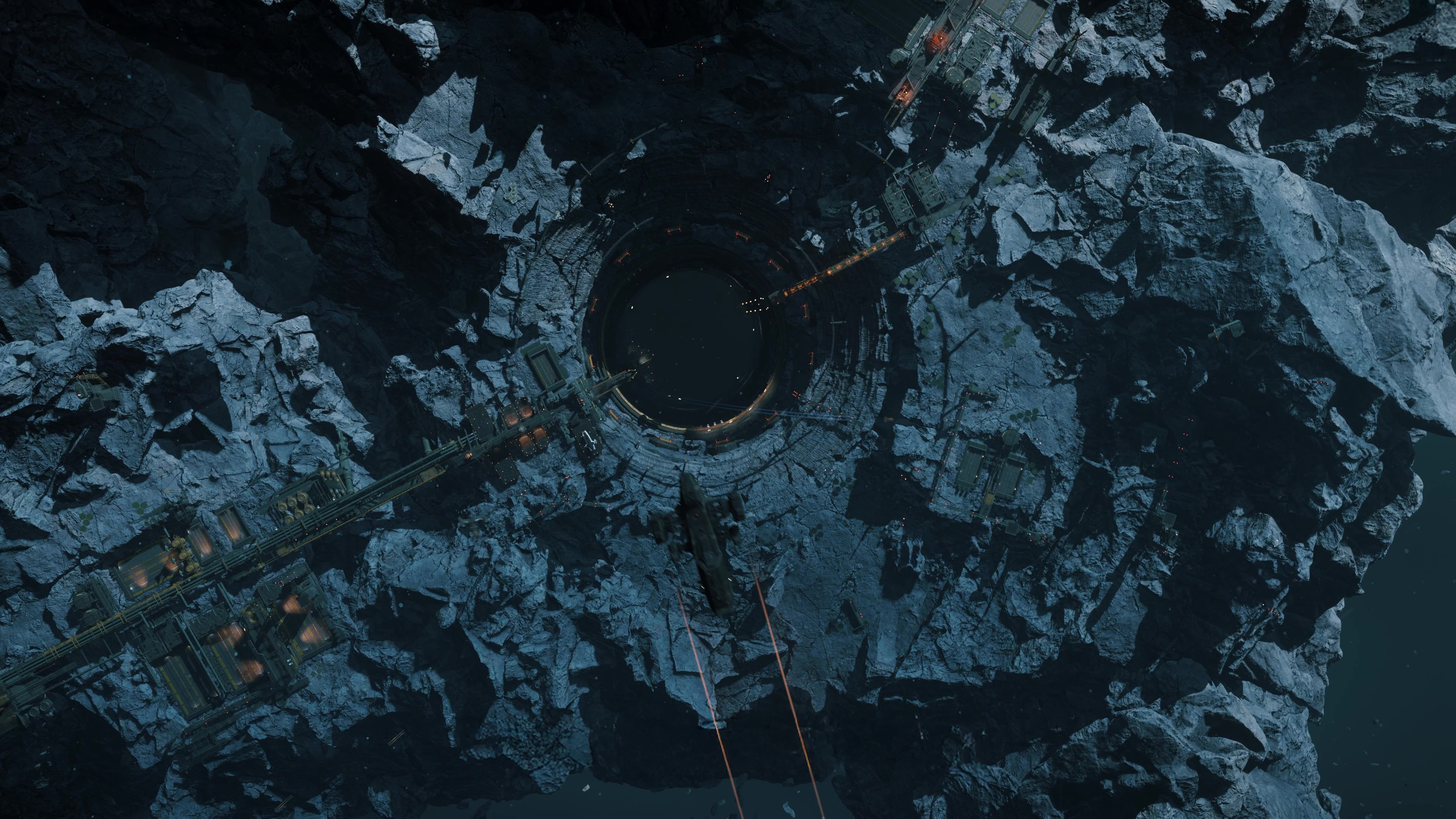
As the new government continued to distance itself from the previous regime, Imperator Marshall Leon proposed that, after centuries of distrust and war, a beacon of peace was needed to unite the species of the universe together. His idea grew into what would become known as the Ark, a repository for universal knowledge and a safe place for diplomatic discussions between species. Many sites were proposed to house the Ark, but in the end, Tayac I was chosen to symbolize how great works can shed hope and light onto the shadows of our past.
Initial construction was finished in 2800, and from its earliest days the Ark has contained one of the largest public libraries and archival collections in the known universe. With no habitable planets in the system, the Ark has become the main hub of activity in Tayac, with knowledge seekers — along with services to cater to them — congregating around the library.
Though the Ark has yet to travel, it is rumored that as the bicentennial of its completion nears, the Ark may for the first time begin its journey through the stars as Imperator Leon originally proposed all those years ago. Those wanting to visit the Ark are urged to do so now, to take advantage of the convenience of it currently having a semi-permanent residence.
Tayac II
A massive gas giant, Tayac II is known for its awe-inspiring planetary rings, which are some of the most dense in the UEE. The dark lines make for a visually pleasing contrast against the bright hued atmosphere of the planet they encircle.
Tayac Belt Alpha
A sparse belt with minimal resources, the most noteworthy thing about Tayac’s asteroid belt is that it is home to an orbiting art installation that was commissioned in celebration of the Ark’s centennial. Completed in 2900, the piece, known as the Silent Song, was the joint effort between Human artist Yosef Colt, Xi’An artist Aor, and a Banu fabrication team who all lived and worked together for an entire decade. Some say that the cohabitation was a more impressive achievement than the installation itself.
Tayac III (Shepherd)
Orbiting extremely close to the asteroid belt, this dwarf planet earned its nickname for appearing to be keeping a watchful eye over a flock of asteroids. It is speculated that the planet was originally a part of the belt before it coalesced and separated itself from the herd.
TRAVEL WARNING
A reminder that the Ark and its immediate surroundings are considered neutral space as accorded by the Ark Treaty, and the UEE does not have jurisdiction there.
Heard in the Wind
“We shaved a full 6 hours off the process. An impressive achievement despite how much further we have to go before our endeavor proves itself useful. A very worthwhile endeavor I may add, as all our effort here is nothing compared to its potential to save our starmen’s lives.”
– Dr. Tayac, Project Vespa Progress Report, 06.03.2572
“Let this Ark stands as a testament and proud record of the lives that we and those before us have all lived.”
– Imperator Marshall Leon, Ark Dedicatory Celebration Gala, 2800
Als einfaches System mit einer komplizierten Vergangenheit hat Tayac das Beste und Schlechteste der Menschheit in den vier Jahrhunderten, in denen wir sie besetzt haben, gezeigt. Das im Rahmen des Project Far Star entdeckte Sternsystem der G-Klasse Main Sequence wurde erstmals 2524 von einem UPE-Piloten besucht, der den Terra-Sprungpunkt zu Magnus erkundet. Das System, das damals als 368A bekannt war, wurde von Vermessungsingenieuren für die kommerzielle Entwicklung eingestuft, wobei der innerste Planet als potenzieller Terraforming-Kandidat bekannt war.
Aufgrund der Vielzahl anderer Systeme, die in diesem Jahrzehnt der Expansion entdeckt wurden, wuchs ein Nachholbedarf an Planeten, die darauf warteten, terraformiert zu werden, da die Finanzierung und die notwendigen Ressourcen so schnell beansprucht wurden, wie sie geplant waren. Erst im Jahr 2539 wurden die ersten Schritte für das Terraforming von 368A.01M (Tayac I) unternommen und der Bau einer Orbitalplattform begonnen. Bevor der Prozess jedoch abgeschlossen werden konnte, brach 2541 der erste offizielle Krieg zwischen den Spezies der Menschheit aus. Als der Kampf gegen die Tevarin in vollem Gange war, wurden alle nicht wesentlichen Projekte gestrichen, um sich auf den Ausbau der Kriegsanstrengungen und die Stärkung der Marineflotte zu konzentrieren; die Terraformation von Tayac war eines der Projekte, die in den Kürzungen enthalten waren.
Das System blieb bis zum Ende des Krieges und dem Aufstieg von Ivar Messer in die Rolle des Imperators relativ unberührt. Mit der Erweiterung der Kontrolle des Imperiums durch Messer wurde Tayac zu einem militärischen System, erklärte die Grenze für den zivilen Verkehr, und alle bekannten Sprünge in das System wurden durch Marineblockaden abgeschaltet. Völlig aus der Öffentlichkeit verschwunden, war die Wahrheit dessen, was dort während des Messer-Regimes geschah, nicht vollständig bekannt, bis ihre Herrschaft Jahrhunderte später zu Ende ging.
Tayac I
Nachdem er die hohen Kosten des Tevarin-Krieges, insbesondere seine eigenen Erfahrungen an der Front, erlebt hatte, war Ivar Messer bestrebt, Waffen zu entwickeln, die es dem Imperium ermöglichen würden, zukünftige Konflikte schnell und mit minimalem Verlust von Militärpersonal zu beenden. Unter seiner Herrschaft wurden Dutzende von hochklassifizierten Initiativen, Vorschlägen und Forschungsprojekten zur Massenvernichtung eingerichtet und großzügig finanziert. Ein solches Projekt, der Code Vespa, war die Idee von Dr. Thessaly Tayac, der glaubte, dass die Terraforming-Technologie für die Waffenbestückung angepasst werden könnte. Das halbfertige Terraforming von 368A.01M wurde als perfekte Testumgebung ausgewählt und 2546 wurde der kleine felsige Planet Dr. Tayac zum Experimentieren zugewiesen. In den nächsten Jahrzehnten wurde der Planet systematisch terraformiert und dann deformiert, um schließlich einen Planeten mit großem Potenzial in ein trostloses Gestein mit null Atmosphäre zu verwandeln. Obwohl Dr. Tayac in der Lage war, den Terraforming-Prozess erfolgreich umzukehren, war sein Team nie in der Lage, die Technologie zu bewaffnen.
Das Problem war zweifach: Größe und Zeit. Die Orbitalplattform, die zur Destabilisierung der Biosphäre des Planeten benötigt wurde, war von beträchtlicher Größe. Es war unmöglich, sich ein Szenario vorzustellen, in dem die Marine in der Lage sein würde, eine solche Plattform sicher über eine feindliche Welt unter kampfähnlichen Bedingungen zu manövrieren. Und wenn es ihnen jemals gelang, die Plattform in eine geeignete Position zu bringen, war der Destabilisierungsprozess nicht schnell. Als Dr. Tayac starb, waren erhebliche Fortschritte gemacht worden, aber nicht genug, um das Projekt für den tatsächlichen Einsatz nutzbar zu machen. Nach dem Tod des Arztes wurden die Zügel des Projekts Vespa weitergegeben und die Arbeit an dem System fortgesetzt, das inzwischen von den Marinekräften allgemein als Tayac bezeichnet wurde. Trotz Generation um Generation von Messern, die darauf bedacht waren, die Vespa zum Erfolg zu führen, waren die Hürden einfach zu unüberwindbar. Um 2750 war Tayac I durch das Experimentieren zunehmend instabil geworden und konnte nicht mehr terraformiert werden, während das Interesse an dem Projekt mit der Finanzierung gesunken war. Die Vespa wurde offiziell stillgelegt und das Tayac-System fast geschlossen.
Es dauerte nicht lange, bis sich die politischen Winde des Imperiums verschoben und die Messers von der Macht stürzten. In der anschließenden Umwälzung wurden die Experimente von Dr. Tayac öffentlich bekannt. Es war nicht nur eine schockierende Enthüllung dessen, wozu die Messers wirklich in der Lage waren, sondern es belastete auch den noch immer fragilen Friedensvertrag, der gerade erst mit dem Xi'An verhandelt worden war, erheblich. Als Zeichen des Vertrauens und als Bestätigung, dass das alte Reich der Vergangenheit angehörte, teilte Imperator Toi die gesamte Vespa-Forschung des Projekts mit der Regierung von Xi'An und schwor, dass die Technologie nie wieder eingesetzt werden würde.
Die Arche
Als sich die neue Regierung weiterhin von dem früheren Regime distanzierte, schlug Imperator Marshall Leon vor, dass nach Jahrhunderten des Misstrauens und Krieges ein Leuchtfeuer des Friedens benötigt werde, um die Arten des Universums zusammenzubringen. Seine Idee entwickelte sich zu dem, was als Arche bekannt wurde, einem Speicher für universelles Wissen und einem sicheren Ort für diplomatische Gespräche zwischen den Arten. Viele Orte wurden vorgeschlagen, um die Arche unterzubringen, aber am Ende wurde Tayac I ausgewählt, um zu symbolisieren, wie große Werke Hoffnung und Licht in die Schatten unserer Vergangenheit werfen können.
Der erste Bau wurde im Jahr 2800 abgeschlossen, und von Anfang an enthielt die Arche eine der größten öffentlichen Bibliotheken und Archivbestände des bekannten Universums. Da es keine bewohnbaren Planeten im System gibt, ist die Arche zum wichtigsten Zentrum der Aktivität in Tayac geworden, wo sich Wissenssuchende - zusammen mit Dienstleistungen für sie - in der Bibliothek versammeln.
Obwohl die Arche noch nicht gereist ist, wird gemunkelt, dass die Arche, wenn sich das zweihundertjährige Jubiläum ihrer Fertigstellung nähert, zum ersten Mal ihre Reise durch die Sterne beginnen kann, wie Imperator Leon es ursprünglich vor all diesen Jahren vorgeschlagen hatte. Diejenigen, die die Arche besuchen wollen, werden dringend gebeten, dies jetzt zu tun, um den Vorteil zu nutzen, dass sie derzeit eine semi-permanente Residenz hat.
Tayac II
Als massiver Gasriese ist Tayac II bekannt für seine atemberaubenden Planetenringe, die zu den dichtesten in der UEE gehören. Die dunklen Linien bilden einen optisch ansprechenden Kontrast zur hell gefärbten Atmosphäre des Planeten, den sie umkreisen.
Tayac Gürtel Alpha
Ein spärlicher Gürtel mit minimalen Ressourcen, das Bemerkenswerteste an Tayacs Asteroidengürtel ist, dass er die Heimat einer umlaufenden Kunstinstallation ist, die anlässlich des hundertjährigen Bestehens der Arche in Auftrag gegeben wurde. Das im Jahr 2900 fertiggestellte Stück, das als Stummlied bekannt ist, war die gemeinsame Arbeit des menschlichen Künstlers Yosef Colt, des Xi'An-Künstlers Aor und eines Banu-Fertigungsteams, die alle ein ganzes Jahrzehnt lang zusammenlebten und arbeiteten. Einige sagen, dass das Zusammenleben eine beeindruckendere Leistung war als die Installation selbst.
Tayac III (Hirte)
Dieser Zwergplanet, der extrem nahe am Asteroidengürtel kreist, erhielt seinen Spitznamen, weil er scheinbar ein wachsames Auge auf eine Schar von Asteroiden geworfen hat. Es wird spekuliert, dass der Planet ursprünglich ein Teil des Gürtels war, bevor er sich zusammenschloss und sich von der Herde trennte.
REISEWARNUNG
Eine Erinnerung daran, dass die Arche und ihre unmittelbare Umgebung als neutraler Raum angesehen werden, wie es der Archenvertrag vorsieht, und die UEE dort keine Zuständigkeit hat.
Im Wind gehört
"Wir haben ganze 6 Stunden von dem Prozess abgeschnitten. Eine beeindruckende Leistung, trotz der Tatsache, wie weit wir noch gehen müssen, bevor sich unser Vorhaben als nützlich erweist. Ein sehr lohnenswertes Unterfangen, denn all unsere Bemühungen hier sind nichts im Vergleich zu seinem Potenzial, das Leben unserer Stars zu retten."
- Dr. Tayac, Projekt Vespa Fortschrittsbericht, 06.03.2572
"Lasst diese Arche als Testament und stolze Aufzeichnung des Lebens stehen, das wir und die vor uns alle gelebt haben."
- Imperator Marschall Leon, Ark Dedicatory Celebration Gala, 2800
A simple system with a complicated past, Tayac has showcased the best and worst of Humanity over the four centuries in which we have occupied it. Discovered as part of Project Far Star, the G-Class Main Sequence star system was first visited in 2524 by a UPE pilot further exploring the Terra jump point to Magnus. Home to three planets and an asteroid belt, the system, then known as 368A, was classified by surveyors for commercial development, with the innermost planet noted as a potential terraforming candidate.
Due to the bevy of other systems discovered during that decade of expansion, a backlog of planets waiting to be terraformed grew as funding and the necessary resources were claimed as quickly as they were budgeted. It was not until 2539 that the initial steps for terraforming of 368A.01M (Tayac I) were finally taken, and construction on an orbital rig begun. However, before the process could be completed, Humanity’s first official inter-species war erupted in 2541. As the battle against the Tevarin stepped into high gear, all non-essential projects were canceled in order to focus on expanding the war effort and strengthening the Naval fleet; the terraformation of Tayac was one of the projects included in the cutbacks.
The system remained relatively untouched until the conclusion of the war and rise of Ivar Messer to the role of Imperator. With Messer’s expansion of the Empire’s control, Tayac was made a military system, declared off-limits to civilian traffic, and all known jumps into the system were shut off by Naval blockades. Completely removed from the public eye, the truth of what happened there during the Messer regime wasn’t fully known till their reign came to an end centuries later.
Tayac I
After experiencing the high cost of the Tevarin war, particularly his own experiences on the front line, Ivar Messer was eager to develop weapons that would enable the Empire to end future conflicts swiftly and with minimal loss of military personnel. Under his rule, dozens of highly classified blacklist initiatives, proposals and research projects dedicated to mass destruction were quietly established and generously funded. One such project, code named Vespa, was the brainchild of Dr. Thessaly Tayac, who believed that terraforming technology could be adapted for weaponization. The half-finished terraforming of 368A.01M was selected as the perfect test environment and in 2546, the small rocky planet was assigned to Dr. Tayac for experimentation. For the next several decades, the planet was systematically terraformed and then de-terraformed, eventually transforming a planet with great potential into a desolate rock with zero atmosphere. Though Dr. Tayac was able to successfully reverse the terraforming process, his team was never able to weaponize the technology.
The problem was two-fold: size and time. The orbital platform needed to destabilize the planet’s biosphere was of considerable size. It was impossible to imagine a scenario where the Navy would be able to safely maneuver such a platform into place over a hostile world under battle-like conditions. And if they ever did manage to move the platform into a suitable position, the destabilization process was not a quick one. By the time Dr. Tayac passed away, considerable strides had been made, but not enough to make the project feasible for actual use. After the doctor’s death, the reins of Project Vespa were passed on and the work continued in the system that was by then commonly referred to among Navy personnel as Tayac. Despite generation after generation of Messers eager to see Vespa come to fruition, the hurdles were just too insurmountable. By 2750, Tayac I had become increasingly unstable from the experimentation and could no longer be terraformed, while interest for the project had dried up along with funding. Vespa was officially shut down and Tayac System all but shuttered.
It wasn’t long afterwards that the political winds of the Empire shifted and toppled the Messers from power. In the upheaval that followed, the experiments of Dr. Tayac became public knowledge. Not only was it a shocking revelation of what the Messers had been truly capable of, but it put a significant strain on the still fragile peace treaty that had only just been negotiated with the Xi’An. As a sign of trust and as an assurance that the Empire of old was a thing of the past, Imperator Toi shared all of the Project Vespa research with the Xi’An government, swearing that the technology would never be pursued again.
The Ark
As the new government continued to distance itself from the previous regime, Imperator Marshall Leon proposed that, after centuries of distrust and war, a beacon of peace was needed to unite the species of the universe together. His idea grew into what would become known as the Ark, a repository for universal knowledge and a safe place for diplomatic discussions between species. Many sites were proposed to house the Ark, but in the end, Tayac I was chosen to symbolize how great works can shed hope and light onto the shadows of our past.
Initial construction was finished in 2800, and from its earliest days the Ark has contained one of the largest public libraries and archival collections in the known universe. With no habitable planets in the system, the Ark has become the main hub of activity in Tayac, with knowledge seekers — along with services to cater to them — congregating around the library.
Though the Ark has yet to travel, it is rumored that as the bicentennial of its completion nears, the Ark may for the first time begin its journey through the stars as Imperator Leon originally proposed all those years ago. Those wanting to visit the Ark are urged to do so now, to take advantage of the convenience of it currently having a semi-permanent residence.
Tayac II
A massive gas giant, Tayac II is known for its awe-inspiring planetary rings, which are some of the most dense in the UEE. The dark lines make for a visually pleasing contrast against the bright hued atmosphere of the planet they encircle.
Tayac Belt Alpha
A sparse belt with minimal resources, the most noteworthy thing about Tayac’s asteroid belt is that it is home to an orbiting art installation that was commissioned in celebration of the Ark’s centennial. Completed in 2900, the piece, known as the Silent Song, was the joint effort between Human artist Yosef Colt, Xi’An artist Aor, and a Banu fabrication team who all lived and worked together for an entire decade. Some say that the cohabitation was a more impressive achievement than the installation itself.
Tayac III (Shepherd)
Orbiting extremely close to the asteroid belt, this dwarf planet earned its nickname for appearing to be keeping a watchful eye over a flock of asteroids. It is speculated that the planet was originally a part of the belt before it coalesced and separated itself from the herd.
TRAVEL WARNING
A reminder that the Ark and its immediate surroundings are considered neutral space as accorded by the Ark Treaty, and the UEE does not have jurisdiction there.
Heard in the Wind
“We shaved a full 6 hours off the process. An impressive achievement despite how much further we have to go before our endeavor proves itself useful. A very worthwhile endeavor I may add, as all our effort here is nothing compared to its potential to save our starmen’s lives.”
– Dr. Tayac, Project Vespa Progress Report, 06.03.2572
“Let this Ark stands as a testament and proud record of the lives that we and those before us have all lived.”
– Imperator Marshall Leon, Ark Dedicatory Celebration Gala, 2800
A simple system with a complicated past, Tayac has showcased the best and worst of Humanity over the four centuries in which we have occupied it. Discovered as part of Project Far Star, the G-Class Main Sequence star system was first visited in 2524 by a UPE pilot further exploring the Terra jump point to Magnus. Home to three planets and an asteroid belt, the system, then known as 368A, was classified by surveyors for commercial development, with the innermost planet noted as a potential terraforming candidate.
Due to the bevy of other systems discovered during that decade of expansion, a backlog of planets waiting to be terraformed grew as funding and the necessary resources were claimed as quickly as they were budgeted. It was not until 2539 that the initial steps for terraforming of 368A.01M (Tayac I) were finally taken, and construction on an orbital rig begun. However, before the process could be completed, Humanity’s first official inter-species war erupted in 2541. As the battle against the Tevarin stepped into high gear, all non-essential projects were canceled in order to focus on expanding the war effort and strengthening the Naval fleet; the terraformation of Tayac was one of the projects included in the cutbacks.
The system remained relatively untouched until the conclusion of the war and rise of Ivar Messer to the role of Imperator. With Messer’s expansion of the Empire’s control, Tayac was made a military system, declared off-limits to civilian traffic, and all known jumps into the system were shut off by Naval blockades. Completely removed from the public eye, the truth of what happened there during the Messer regime wasn’t fully known till their reign came to an end centuries later.
Tayac I
After experiencing the high cost of the Tevarin war, particularly his own experiences on the front line, Ivar Messer was eager to develop weapons that would enable the Empire to end future conflicts swiftly and with minimal loss of military personnel. Under his rule, dozens of highly classified blacklist initiatives, proposals and research projects dedicated to mass destruction were quietly established and generously funded. One such project, code named Vespa, was the brainchild of Dr. Thessaly Tayac, who believed that terraforming technology could be adapted for weaponization. The half-finished terraforming of 368A.01M was selected as the perfect test environment and in 2546, the small rocky planet was assigned to Dr. Tayac for experimentation. For the next several decades, the planet was systematically terraformed and then de-terraformed, eventually transforming a planet with great potential into a desolate rock with zero atmosphere. Though Dr. Tayac was able to successfully reverse the terraforming process, his team was never able to weaponize the technology.
The problem was two-fold: size and time. The orbital platform needed to destabilize the planet’s biosphere was of considerable size. It was impossible to imagine a scenario where the Navy would be able to safely maneuver such a platform into place over a hostile world under battle-like conditions. And if they ever did manage to move the platform into a suitable position, the destabilization process was not a quick one. By the time Dr. Tayac passed away, considerable strides had been made, but not enough to make the project feasible for actual use. After the doctor’s death, the reins of Project Vespa were passed on and the work continued in the system that was by then commonly referred to among Navy personnel as Tayac. Despite generation after generation of Messers eager to see Vespa come to fruition, the hurdles were just too insurmountable. By 2750, Tayac I had become increasingly unstable from the experimentation and could no longer be terraformed, while interest for the project had dried up along with funding. Vespa was officially shut down and Tayac System all but shuttered.
It wasn’t long afterwards that the political winds of the Empire shifted and toppled the Messers from power. In the upheaval that followed, the experiments of Dr. Tayac became public knowledge. Not only was it a shocking revelation of what the Messers had been truly capable of, but it put a significant strain on the still fragile peace treaty that had only just been negotiated with the Xi’An. As a sign of trust and as an assurance that the Empire of old was a thing of the past, Imperator Toi shared all of the Project Vespa research with the Xi’An government, swearing that the technology would never be pursued again.
The Ark
As the new government continued to distance itself from the previous regime, Imperator Marshall Leon proposed that, after centuries of distrust and war, a beacon of peace was needed to unite the species of the universe together. His idea grew into what would become known as the Ark, a repository for universal knowledge and a safe place for diplomatic discussions between species. Many sites were proposed to house the Ark, but in the end, Tayac I was chosen to symbolize how great works can shed hope and light onto the shadows of our past.
Initial construction was finished in 2800, and from its earliest days the Ark has contained one of the largest public libraries and archival collections in the known universe. With no habitable planets in the system, the Ark has become the main hub of activity in Tayac, with knowledge seekers — along with services to cater to them — congregating around the library.
Though the Ark has yet to travel, it is rumored that as the bicentennial of its completion nears, the Ark may for the first time begin its journey through the stars as Imperator Leon originally proposed all those years ago. Those wanting to visit the Ark are urged to do so now, to take advantage of the convenience of it currently having a semi-permanent residence.
Tayac II
A massive gas giant, Tayac II is known for its awe-inspiring planetary rings, which are some of the most dense in the UEE. The dark lines make for a visually pleasing contrast against the bright hued atmosphere of the planet they encircle.
Tayac Belt Alpha
A sparse belt with minimal resources, the most noteworthy thing about Tayac’s asteroid belt is that it is home to an orbiting art installation that was commissioned in celebration of the Ark’s centennial. Completed in 2900, the piece, known as the Silent Song, was the joint effort between Human artist Yosef Colt, Xi’An artist Aor, and a Banu fabrication team who all lived and worked together for an entire decade. Some say that the cohabitation was a more impressive achievement than the installation itself.
Tayac III (Shepherd)
Orbiting extremely close to the asteroid belt, this dwarf planet earned its nickname for appearing to be keeping a watchful eye over a flock of asteroids. It is speculated that the planet was originally a part of the belt before it coalesced and separated itself from the herd.
TRAVEL WARNING
A reminder that the Ark and its immediate surroundings are considered neutral space as accorded by the Ark Treaty, and the UEE does not have jurisdiction there.
Heard in the Wind
“We shaved a full 6 hours off the process. An impressive achievement despite how much further we have to go before our endeavor proves itself useful. A very worthwhile endeavor I may add, as all our effort here is nothing compared to its potential to save our starmen’s lives.”
– Dr. Tayac, Project Vespa Progress Report, 06.03.2572
“Let this Ark stands as a testament and proud record of the lives that we and those before us have all lived.”
– Imperator Marshall Leon, Ark Dedicatory Celebration Gala, 2800
Links
No links available.

Metadata
- CIG ID
- 15185
- Channel
- Spectrum Dispatch
- Category
- Undefined
- Series
- Galactic Guide
- Comments
- 70
- Published
- 10 years ago (2016-02-03T00:00:00+00:00)