Squadron 42 Monthly Report: April 2021
Transmission Undefined Monthly ReportsContent
This is a cross-post of the report that was recently sent out via the monthly Squadron 42 newsletter. We’re publishing this a second time as a Comm-Link to make it easier for the community to reference back to. Attention Recruits,
What you are about to read is the latest information on the continuing development of Squadron 42 (SCI des: SQ42).
Thanks to the work of dedicated field agents and operatives, we’ve uncovered information on Vanduul combat, Screaming Galsons, and gas clouds.
The information contained in this communication is extremely sensitive and it is of paramount importance that it does not fall into the wrong hands. Purge all records after reading.
UEE Naval High Command
AI (Content)
Throughout April, AI Content focused on completing the first pass of the security, tourist, and tour guide behaviors, polishing animations from recent mocap sessions and adjusting the related behaviors. They also implemented the first version of the landing officer, one of the deck crew that will be used in hangars, landing zones, and capital ships. The landing officer gives players clear directions on how to position their ships in relation to the pad for perfect decents.
Work also continued on the hygiene behavior, with the team completing setups for the toilet and shower cubicles and their relative blockout animations. For sleep behaviors, new animations for beds were set up to support physicalized sheets, and the process of standardizing the proper usage of bed shutters began.
They also progressed with the ongoing goal of propagating vendor behaviors to as many shops as possible. They’re currently designing and blocking out the different elements that will make up the various locations (coffee shops, differing food stalls, etc.) and are enabling the available kiosks to use the hawker behavior too.
AI (Features)
April saw AI Features improve the Subsumption tasks used to queue requests in the communication system to link directly to Dataforge entries. This allows the designers to select communication configurations and channel names from a dropdown instead of having to manually type the string names. Patrol path tech was further developed, while the usable system code was reworked to refresh the usable archetype and use channel archetype flags of an entity post-initialize. The movement blocks that install an NPC to a usable were refactored to rely on the usable component for their internal logic, as the usable component should abstract the AI knowledge of how to interact with the world and not delegate to all other possible components of the game.
Work also progressed on combat behaviors for untrained characters, such as civilians. This involved making sure they react appropriately to combat scenarios and try to preserve their lives as best they can, which is affected by what weapons, if any, they have available to them. The team also improved the reaction distance definition that was causing NPCs to react incorrectly to the player’s presence when fighting in some situations.
Spaceship behaviors related to subcomponent targeting were worked on, with the ability to find the root targetable entities from any targetable object added. The data gathered can be used in flight tasks to perform specific maneuvers, such as allowing a ship to sphere-strafe to attack a subcomponent on a specific sector of a target ship. They also updated the ‘AISeatWeaponControllerComponent’ to handle missiles.
Support began for spawn closets, including implementing handling for the ‘OnDespawnRequest’ event and the initial pass of the despawn activity. Currently, the entity will look for a usable in the spawn closet action area and use it. If that fails, it will move to a random position in the area.
AI (Tech)
One of the Tech Team’s focuses throughout April was navigation links for the navigation mesh. Work involved restructuring the code to allow navigation link entities to specify extenders, which act as code bridges between game code functionality and the navigation link. This provides navigation-system-specific data in a format that can be correctly used during pathfinding. For example, they can now create an extender that uses an explicit offset to connect two navmesh locations or an animation. The animation can also motion-warp markers in a similar way to how mantle is currently used by players. It’s currently being used in SQ42 to allow the Vanduul to jump on and off objects of varying heights, but it can scale to anything needed for environment traversal by any character type. For EVA, they completed tasks to allow NPCs to systemically transition from zero-g into a usable (and vice versa). For example, AI characters can leave the cockpit of a ship smoothly and then process a 3D movement in zero gravity. They can filter the appropriate enter/exit animation so that the 3D path correctly starts or ends at the appropriate location too.
April also saw the team convert the Subsumption component to use the ECUS ‘InRangeChanged’ event. This uses the more efficient Entity Component Update System API and improves the assignment handling to ensure that assignment requests are propagated correctly from the queue when changing the in-range state. They also fixed how the mastergraph event queues when propagated into the newly selected activity when handling assignments, which is used to select the appropriate subactivity when the transition is delayed.
Finally for AI, the team continued to improve the flowgraph functionality for requesting a custom function assignment. This was achieved by adding support for dynamic input and output variables defined in the selected global function. Ultimately, this will ensure the team can correctly create feature test levels to validate and test behavior content and their related features in a scalable way.
Animation
Throughout April, the Animation Team continued to develop animations for Vanduul combat, the landing officer, zero-g traversal, crouched ‘hurt’ locomotion, male and female mess hall sets, positional blending locomotion tests, MedPen assets, and the firing range. Mocap was solved for perception reaction data for civilians (surprise, cower, flee) and spec ops (surrender, fake surrender), and useables were worked out for enemies in combat zones. The Facial Team worked on animations for the effort set and security pilots too.
Art (Characters)
Character Art began R&D and modeling for the Screaming Galsons. A wide variety of characters are needed for this faction, so the team are looking into new modular systems to support efficient ways of mixing armor parts in interesting and performant ways. Following on from previous reports, Trejo’s hair and uniform progressed well, while the team prepared to start development on the Aciedo comm-relay characters.
Art (Weapons)
The Weapons Team continued to move the standalone Greycat tools through the pipeline, with the tractor beam going into final art and the salvage tool going through whitebox. They also iterated on medical tools alongside the UI Design teams, who progressed with wider feature work.
Audio
The Audio Team focused on chapter 4a, creating music content to help drive the narrative. This includes identifying key areas for new cinematic cues and defining and tuning music logic to support the gameplay.
Engine
In April, the Physics Team continued to improve vehicle support, including the steering limit of a neutrally turning tank and the gravity of a free-falling tank. The wheeled vehicle code was further cleaned up too. For Alpha 3.13, a solution was found to enabling floating-point exceptions on Linux servers, which will help the team get to the root of issues quicker, meaning a faster turnaround on bugs. For numerical robustness, several improvements were made when converting double-precision floats to either single-precision floats or 32-bit integers.
Throughout April, Engineering continued to work on the G12 renderer, enabling parts of the new Gen12 render path by default and starting the full transition to the new architecture. They also continued to port render passes alongside the Graphics Team. For example, the Scaleform (UI) render path received an initial commit to port it to Gen12. The shader parser received several new improvements and optimizations too.
Work continued on the volumetric cloud system, with April seeing a pass on efficient empty space skipping in the raymarcher. The SDF generation was further optimized, and a required refinement pass was also implemented. Research continued into ways to generate and apply SDFs and, with the initial SDFs generated, work commenced on integrating them into the raymarch process. For cloud modeling, the artists can now specify a custom set of volume textures per planet to shape clouds, as not every planet has clouds resembling those on earth.
On the core engine side, the job manager received further improvements, with the team introducing an explicit per-thread and fiber info block to reduce contention in some of the threading backends. In the near future, they’ll improve out-lock implementations to make fewer unnecessary thread wakeups and fewer kernel calls when simultaneously waking up more than one thread. Additionally, they removed contention in one of the threading backends by switching the scheduling algorithm from a lock-protected priority queue to a lockless approach of fixed size producer/consumer queues with aging. For post-mortem profiling, they saw the first results in visualizing collected data in a newly written tool that’s more user-friendly and flexible.
Time in April was also dedicated to server meshing. The existing StarHash logic, which is used for server object container streaming, was moved to the network module in preparation for a later move to a server meshing service. The assert pipeline was revamped and streamlined for more effective issue tracking too. This also involved introducing data assets (in case malign data causes code to run in unexpected conditions), allowing issues to be directly assigned to the relevant content team.
Lastly, code was implemented to mark unused texture slots in materials to guide automated asset dependency tracking, which will keep game data bloat in check.
Features (Gameplay)
The majority of the team’s work last month was providing support for the internal quarterly milestone. They also implemented the ability to have RTT video comms calls between two NPC characters, which was required for several cinematic sequences, as previously only the player was able to receive them. They also completed the initial implementation of player formation flying, using a hologram to show the desired position and use automated flying to assist if requested.
Gameplay Story
April saw the team implement all the female player story facial and audio recorded so far, with nearly 140 lines set up, synchronized, incorporated, exported, and tested. They then supported Design with chapter 5. “It has been great to see all the animations we have already prepared for chapter 5 suddenly being used and working nicely in-game.” -The Gameplay Story Team
Extra variations and polishing animations were then created to further improve the player experience. They were also able to use the new eating and drinking animations to improve gameplay story scenes in the mess hall. Alongside this, they used new motion capture to create bespoke transitions between scenes in the med bay, allowing characters to move naturally and maintain the believability of the area.
Further tasks were completed for chapter 14, including polishing a scene on the bridge and creating prototypes for additional post-combat vignettes.
Graphics & VFX Programming
After a period of bug fixing, the Graphics Team returned to focusing on the Gen12 renderer. Most post effects are now running the Gen12 version by default and, once the final few are enabled, they’ll begin enabling geometry passes. This will start with shadows, followed by opaque geometry, and finally transparent geometry. The geometry passes are already partially complete, though there are still problems to solve before they see the expected performance gains. Progress was made on the Vulkan backend to achieve parity with DirectX 11, which requires a pass over all shaders to remove a handful of legacy DirectX 9 features that are no longer supported.
The VFX Programmers continued the Gen12 conversion of their code, which is almost complete. Great progress was made on the fire hazard too, while a major overhaul of particle lighting was completed. Finally, the particle lighting is now more physically based, energy-conserving (doesn’t reflect more light than it receives), and gives higher quality results that are more consistent over different lighting scenarios.
Level Design
The Space/Dogfight Team worked on flight AI for the recent internal milestone, including further work on the traits system mentioned in previous reports. Alongside traits, they progressed many base mechanics such as the formation system and QT linking. Level Design continued to populate the various gravity-based levels and solidified areas of gameplay with support from the art teams, while Social Design worked through some of the many narrative-driven scenes across the campaign.
Narrative
Narrative supported several other teams by scripting dialogue for various uses, including gameplay hints, environmental storytelling, and filling in long stretches of travel with character exchanges. As in March, they supported the Audio and Gameplay teams with placeholder recordings for scenes throughout the campaign. In another production initiative, some of the team worked with the Design and Character teams to help organize and sanity-check the Master Character List by providing context and descriptions for all characters in the game. “As you might expect, it is not a short list!” -The Narrative Team
They also met with the Art Team to talk over initial ideas for adding additional depth and character to some of the locations. Following the meeting, they began building documents to outline potential audio cues, set dressing, and overarching tone ideas to share with the artists.
QA
Cinematics continued to rely on QA for recordings of each level, with further testing done following subsequent changes and updates. QA also tested behavior implementations for the AI Team, running daily checklists and assisting in reproducing issues.
Tech Animation
Tech Animation began working on a new area of the facial pipeline that will convert photographs into full head geometry models. The process itself has been used for years, but this initiative sees the team automating as much as possible to enable the artists to focus on the art rather than time-consuming technical processes. This involves utilizing several applications and streamlining all required data through them without user interaction. The weapons authoring pipeline also received attention to assist its users and automate as much as possible. This will see Maya more intelligently handle engine files and enable a portion of the authoring and validation to be done directly in its environment.
UI
The UI artists spent part of the month upgrading the visuals of background screens in one of the campaign’s key areas, overhauling the design and colors to a level you would see in a sci-fi movie. On the code side, the team supported various areas, such as the UI visuals for scanning gameplay and expanding the visual tools used to make interactive screens. They also added the ability for developers to add tooltips to give players more info when they hover over an item on certain screens.
VFX
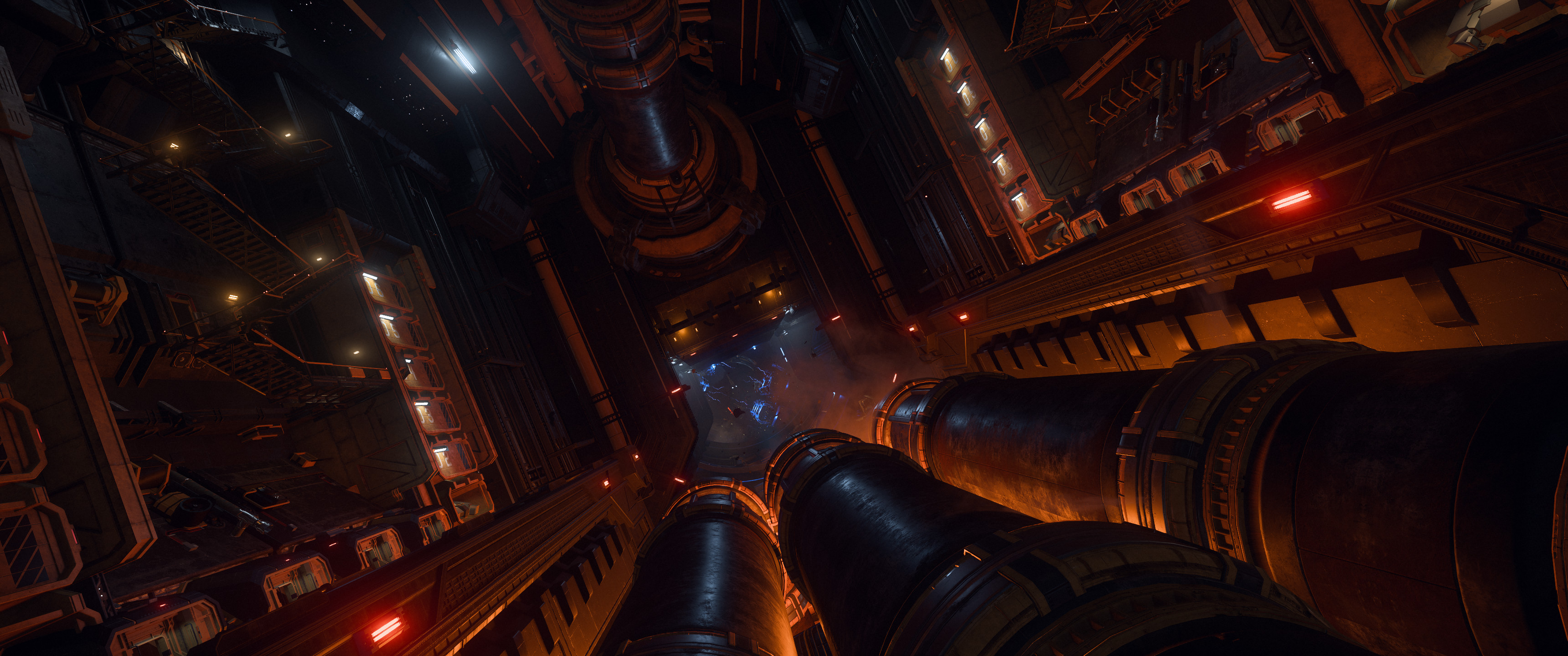
Throughout April, the team supported the VFX requirements of gas clouds and put plans in place to take a more active role in the creation of VDBs alongside Art and Design. They also worked on one of the larger ships in the game. “Further improvements were made to the Bengal’s thruster effects, including its absolutely huge main rear thrusters that dwarf smaller ships like the Gladius!” -The VFX Team WE’LL SEE YOU NEXT MONTH…
Dies ist ein Cross-Post des Berichts, der kürzlich über den monatlichen Squadron 42 Newsletter verschickt wurde. Wir veröffentlichen ihn ein zweites Mal als Comm-Link, damit die Community leichter darauf zurückgreifen kann.
Achtung Rekruten,
Was ihr gleich lesen werdet, sind die neuesten Informationen über die weitere Entwicklung von Squadron 42 (SCI des: SQ42).
Dank der Arbeit von engagierten Feldagenten und Agenten haben wir Informationen über Vanduul-Kämpfe, Schreiende Galsons und Gaswolken aufgedeckt.
Die in dieser Mitteilung enthaltenen Informationen sind äußerst sensibel und es ist von größter Wichtigkeit, dass sie nicht in die falschen Hände geraten. Lösche alle Aufzeichnungen nach dem Lesen.
UEE Marine Oberkommando
KI (Inhalt)
Im April konzentrierte sich der KI-Content auf die Fertigstellung des ersten Durchlaufs der Sicherheits-, Touristen- und Reiseleiter-Verhaltensweisen, das Polieren der Animationen aus den letzten Mocap-Sessions und die Anpassung der entsprechenden Verhaltensweisen. Außerdem wurde die erste Version des Landeoffiziers implementiert, einer der Deckscrews, die in Hangars, Landezonen und großen Schiffen zum Einsatz kommen werden. Der Landeoffizier gibt den Spielern klare Anweisungen, wie sie ihre Schiffe in Bezug auf die Landefläche positionieren müssen, damit sie perfekt landen können.
Die Arbeit am Hygiene-Verhalten wurde ebenfalls fortgesetzt, wobei das Team die Setups für die Toiletten- und Duschkabinen und ihre relativen Blockout-Animationen fertiggestellt hat. Für das Schlafverhalten wurden neue Animationen für die Betten erstellt, um physische Laken zu unterstützen, und der Prozess der Standardisierung der korrekten Verwendung von Bettläden begann.
Außerdem wurde das Ziel verfolgt, das Verhalten von Händlern in so vielen Läden wie möglich zu verbreiten. Sie entwerfen und blockieren derzeit die verschiedenen Elemente, die die verschiedenen Standorte ausmachen werden (Cafés, verschiedene Essensstände, etc.) und ermöglichen es den verfügbaren Kiosken, ebenfalls das Hawker-Verhalten zu nutzen.
KI (Eigenschaften)
Im April wurden durch AI Features die Subsumption Tasks verbessert, die verwendet werden, um Anfragen im Kommunikationssystem in eine Warteschlange zu stellen und direkt mit Dataforge Einträgen zu verknüpfen. Dies erlaubt es den Designern, Kommunikationskonfigurationen und Kanalnamen aus einem Dropdown auszuwählen, anstatt die Stringnamen manuell eingeben zu müssen. Die Patrouillenpfad-Technologie wurde weiterentwickelt, während der Code des nutzbaren Systems überarbeitet wurde, um den nutzbaren Archetyp zu aktualisieren und Kanal-Archetyp-Flags einer Entität nach der Initialisierung zu verwenden. Die Bewegungsblöcke, die einen NSC in einem Usable installieren, wurden refaktorisiert, um sich für ihre interne Logik auf die Usable-Komponente zu verlassen, da die Usable-Komponente das KI-Wissen, wie man mit der Welt interagiert, abstrahieren und nicht an alle anderen möglichen Komponenten des Spiels delegieren sollte.
Die Arbeit am Kampfverhalten für untrainierte Charaktere, wie z.B. Zivilisten, ging ebenfalls voran. Dabei ging es darum, sicherzustellen, dass sie angemessen auf Kampfszenarien reagieren und versuchen, ihr Leben so gut wie möglich zu erhalten, was davon beeinflusst wird, welche Waffen, wenn überhaupt, ihnen zur Verfügung stehen. Das Team verbesserte auch die Definition der Reaktionsdistanz, die dazu führte, dass NSCs in manchen Situationen falsch auf die Anwesenheit des Spielers im Kampf reagierten.
Das Verhalten von Raumschiffen in Bezug auf das Anvisieren von Unterkomponenten wurde überarbeitet, wobei die Fähigkeit hinzugefügt wurde, von jedem anvisierbaren Objekt aus die Wurzel der anvisierbaren Einheiten zu finden. Die gesammelten Daten können in Flugaufgaben verwendet werden, um bestimmte Manöver durchzuführen, wie z.B. einem Schiff zu erlauben, eine Sphärenstrafe auszuführen, um eine Unterkomponente in einem bestimmten Sektor eines Zielschiffes anzugreifen. Sie haben auch die 'AISeatWeaponControllerComponent' aktualisiert, um Raketen zu handhaben.
Es wurde mit der Unterstützung von Spawn-Closets begonnen, einschließlich der Implementierung der Behandlung des 'OnDespawnRequest'-Ereignisses und des ersten Durchlaufs der Despawn-Aktivität. Momentan sucht die Entität nach einem brauchbaren im Spawn Closet Aktionsbereich und benutzt ihn. Wenn das fehlschlägt, wird es sich an eine zufällige Position im Bereich bewegen.
KI (Tech)
Einer der Schwerpunkte des Tech-Teams im April waren die Navigationslinks für das Navigationsnetz. Die Arbeit umfasste die Umstrukturierung des Codes, um es Navigationslink-Entitäten zu ermöglichen, Extender zu spezifizieren, die als Code-Brücken zwischen der Spielcode-Funktionalität und dem Navigationslink fungieren. Dadurch werden navigationsystemspezifische Daten in einem Format bereitgestellt, das bei der Pfadfindung korrekt verwendet werden kann. Zum Beispiel können sie nun einen Extender erstellen, der einen expliziten Offset verwendet, um zwei Navmesh-Positionen oder eine Animation zu verbinden. Die Animation kann auch Motion-Warp-Marker in einer ähnlichen Art und Weise, wie Mantel derzeit von Spielern verwendet wird. Es wird derzeit in SQ42 verwendet, um den Vanduul zu ermöglichen, auf und von Objekten unterschiedlicher Höhe zu springen, aber es kann auf alles skaliert werden, was für das Durchqueren der Umgebung durch jeden Charaktertyp benötigt wird. Für EVA haben sie Aufgaben erledigt, die es NSCs erlauben, systematisch aus der Schwerelosigkeit in eine nutzbare zu wechseln (und umgekehrt). Zum Beispiel können KI-Charaktere das Cockpit eines Schiffes reibungslos verlassen und dann eine 3D-Bewegung in der Schwerelosigkeit ausführen. Sie können die entsprechende Enter/Exit-Animation filtern, damit der 3D-Pfad auch an der entsprechenden Stelle korrekt beginnt oder endet.
Im April hat das Team auch die Subsumption Komponente konvertiert, um das ECUS 'InRangeChanged' Event zu nutzen. Dies nutzt die effizientere Entity Component Update System API und verbessert die Handhabung der Zuweisung, um sicherzustellen, dass Zuweisungsanfragen korrekt aus der Warteschlange propagiert werden, wenn der In-Range-Status geändert wird. Außerdem wurde behoben, wie die Ereigniswarteschlange des Mastergraphen bei der Handhabung von Zuweisungen in die neu gewählte Aktivität propagiert wird, die zur Auswahl der entsprechenden Unteraktivität verwendet wird, wenn der Übergang verzögert wird.
Schließlich hat das Team für AI die Flowgraph-Funktionalität für das Anfordern einer benutzerdefinierten Funktionszuweisung weiter verbessert. Dies wurde durch das Hinzufügen von Unterstützung für dynamische Eingangs- und Ausgangsvariablen erreicht, die in der ausgewählten globalen Funktion definiert sind. Letztendlich wird dies sicherstellen, dass das Team korrekt Funktionstestebenen erstellen kann, um Verhaltensinhalte und die damit verbundenen Funktionen auf eine skalierbare Weise zu validieren und zu testen.
Animation
Während des gesamten Aprils entwickelte das Animationsteam weiterhin Animationen für den Vanduul-Kampf, den Landeoffizier, Zero-G-Traversal, geduckte 'verletzte' Fortbewegung, männliche und weibliche Messehallen-Sets, Positional Blending Fortbewegungs-Tests, MedPen-Assets und den Schießstand. Mocap wurde für Wahrnehmungsreaktionsdaten für Zivilisten (überraschen, kauern, fliehen) und Spec Ops (kapitulieren, falsche Kapitulation) gelöst und Useables wurden für Feinde in Kampfzonen ausgearbeitet. Das Facial Team arbeitete auch an Animationen für das Effort Set und die Sicherheitspiloten.
Kunst (Charaktere)
Character Art begann mit der Entwicklung und Modellierung für die Screaming Galsons. Für diese Fraktion wird eine Vielzahl von Charakteren benötigt, weshalb das Team nach neuen modularen Systemen sucht, um effiziente Wege zu finden, Rüstungsteile auf interessante und performante Weise zu mischen. Anknüpfend an frühere Berichte machten Trejos Haare und Uniform gute Fortschritte, während sich das Team darauf vorbereitete, mit der Entwicklung der Aciedo-Comm-Relay-Charaktere zu beginnen.
Kunst (Waffen)
Das Waffenteam arbeitete weiter an den Standalone-Greycat-Werkzeugen, wobei der Traktorstrahl in die finale Art ging und das Bergungswerkzeug die Whitebox durchlief. Außerdem wurde an den medizinischen Werkzeugen iteriert, zusammen mit dem UI Design Team, das die Arbeit an weiteren Features vorantrieb.
Audio
Das Audio Team konzentrierte sich auf Kapitel 4a und erstellte Musikinhalte, um die Erzählung voranzutreiben. Dies beinhaltet die Identifizierung von Schlüsselbereichen für neue Cinematic Cues und die Definition und Abstimmung der Musiklogik, um das Gameplay zu unterstützen.
Engine
Im April hat das Physics Team die Fahrzeugunterstützung weiter verbessert, einschließlich der Lenkgrenze eines neutral drehenden Panzers und der Schwerkraft eines frei fallenden Panzers. Auch der Code für Fahrzeuge auf Rädern wurde weiter aufgeräumt. Für Alpha 3.13 wurde eine Lösung gefunden, um Fließkomma-Ausnahmen auf Linux-Servern zu aktivieren, was dem Team helfen wird, Probleme schneller an der Wurzel zu packen, was eine schnellere Behebung von Bugs bedeutet. Für die numerische Robustheit wurden einige Verbesserungen bei der Konvertierung von Double-Precision Floats in Single-Precision Floats oder 32-Bit Integer vorgenommen.
Während des gesamten Aprils hat das Engineering weiter am G12 Renderer gearbeitet und Teile des neuen Gen12 Renderpfades standardmäßig aktiviert und den vollständigen Übergang zur neuen Architektur begonnen. Außerdem wurde die Portierung von Renderpässen zusammen mit dem Grafikteam fortgesetzt. Zum Beispiel erhielt der Scaleform (UI) Renderpfad einen ersten Commit, um ihn auf Gen12 zu portieren. Der Shader-Parser erhielt ebenfalls einige neue Verbesserungen und Optimierungen.
Die Arbeit am volumetrischen Wolkensystem wurde fortgesetzt, wobei im April ein Pass für effizientes Leerspace-Skipping im Raymarcher erfolgte. Die SDF-Generierung wurde weiter optimiert und ein erforderlicher Verfeinerungspass wurde ebenfalls implementiert. Es wurde weiter an der Generierung und Anwendung von SDFs geforscht und mit den ersten generierten SDFs wurde begonnen, diese in den raymarcher Prozess zu integrieren. Für die Wolkenmodellierung können die Künstler nun ein benutzerdefiniertes Set von Volumentexturen pro Planet festlegen, um Wolken zu formen, da nicht jeder Planet Wolken hat, die denen auf der Erde ähneln.
Auf der Seite der Core-Engine wurde der Job-Manager weiter verbessert, indem das Team einen expliziten Pro-Thread- und Faser-Infoblock eingeführt hat, um Konflikte in einigen der Threading-Backends zu reduzieren. In naher Zukunft werden sie die Out-Lock-Implementierungen verbessern, um weniger unnötige Thread-Wakeups und weniger Kernel-Aufrufe beim gleichzeitigen Aufwecken von mehr als einem Thread zu machen. Zusätzlich haben sie in einem der Threading-Backends Contention beseitigt, indem sie den Scheduling-Algorithmus von einer Lock-geschützten Prioritäts-Warteschlange auf einen Lockless-Ansatz mit Producer/Consumer-Warteschlangen fester Größe mit Aging umgestellt haben. Für das Post-Mortem-Profiling haben sie erste Ergebnisse bei der Visualisierung der gesammelten Daten in einem neu geschriebenen Tool gesehen, das benutzerfreundlicher und flexibler ist.
Die Zeit im April wurde auch dem Server Meshing gewidmet. Die bestehende StarHash Logik, die für das Streaming von Server-Objekt-Containern verwendet wird, wurde in das Netzwerkmodul verschoben, um einen späteren Umzug zu einem Server-Meshing-Service vorzubereiten. Die Assert-Pipeline wurde ebenfalls überarbeitet und für eine effektivere Fehlerverfolgung gestrafft. Dies beinhaltete auch die Einführung von Daten-Assets (für den Fall, dass bösartige Daten dazu führen, dass Code unter unerwarteten Bedingungen ausgeführt wird), wodurch Probleme direkt dem entsprechenden Content-Team zugeordnet werden können.
Zu guter Letzt wurde Code implementiert, um ungenutzte Textur-Slots in Materialien zu markieren, um die automatische Nachverfolgung von Asset-Abhängigkeiten zu steuern, was die Datenflut im Spiel in Schach halten wird.
Features (Gameplay)
Der größte Teil der Arbeit des Teams im letzten Monat war die Unterstützung des internen vierteljährlichen Meilensteins. Außerdem wurde die Fähigkeit implementiert, RTT-Videogespräche zwischen zwei NPC-Charakteren zu führen, was für mehrere filmische Sequenzen erforderlich war, da bisher nur der Spieler diese empfangen konnte. Außerdem haben sie die erste Implementierung des Formationsfluges der Spieler abgeschlossen, bei dem ein Hologramm die gewünschte Position anzeigt und automatisiertes Fliegen zur Unterstützung eingesetzt wird, falls gewünscht.
Gameplay Story
Im April implementierte das Team alle bisher aufgenommenen Gesichts- und Audioaufnahmen der Spielerin für die Story, wobei fast 140 Zeilen erstellt, synchronisiert, eingearbeitet, exportiert und getestet wurden. Anschließend unterstützten sie das Design mit Kapitel 5. "Es war großartig zu sehen, wie all die Animationen, die wir bereits für Kapitel 5 vorbereitet haben, plötzlich verwendet werden und im Spiel gut funktionieren." -Das Gameplay Story Team
Es wurden zusätzliche Variationen und Polieranimationen erstellt, um das Spielerlebnis weiter zu verbessern. Sie konnten auch die neuen Ess- und Trinkanimationen nutzen, um die Gameplay-Story-Szenen in der Kantine zu verbessern. Außerdem wurden neue Motion-Capture-Animationen verwendet, um maßgeschneiderte Übergänge zwischen den Szenen in der Krankenstation zu erstellen, die es den Charakteren ermöglichen, sich natürlich zu bewegen und die Glaubwürdigkeit des Bereichs zu erhalten.
Weitere Aufgaben wurden für Kapitel 14 abgeschlossen, darunter das Polieren einer Szene auf der Brücke und die Erstellung von Prototypen für zusätzliche Post-Combat-Vignetten.
Grafiken & VFX Programmierung
Nach einer Phase der Fehlerbehebung konzentrierte sich das Grafikteam wieder auf den Gen12 Renderer. Die meisten Post-Effekte laufen nun standardmäßig mit der Gen12-Version und sobald die letzten paar aktiviert sind, werden sie beginnen, Geometrie-Pässe zu aktivieren. Dies wird mit Schatten beginnen, gefolgt von opaker Geometrie und schließlich transparenter Geometrie. Die Geometrie-Passes sind bereits teilweise fertiggestellt, obwohl es noch Probleme zu lösen gibt, bevor sie die erwarteten Leistungssteigerungen sehen. Es wurden Fortschritte im Vulkan-Backend gemacht, um Parität mit DirectX 11 zu erreichen, was einen Durchlauf über alle Shader erfordert, um eine Handvoll veralteter DirectX 9 Features zu entfernen, die nicht mehr unterstützt werden.
Die VFX-Programmierer setzten die Gen12-Konvertierung ihres Codes fort, die fast abgeschlossen ist. Große Fortschritte wurden auch bei der Feuergefahr gemacht, während eine große Überarbeitung der Partikelbeleuchtung abgeschlossen wurde. Die Partikel-Beleuchtung ist nun physikalisch basierter, energiesparender (reflektiert nicht mehr Licht als es empfängt) und liefert qualitativ hochwertigere Ergebnisse, die in verschiedenen Beleuchtungsszenarien konsistenter sind.
Level Design
Das Space/Dogfight Team hat für den letzten internen Meilenstein an der Flug-KI gearbeitet, einschließlich weiterer Arbeiten am Traits-System, das in früheren Berichten erwähnt wurde. Neben den Eigenschaften wurden auch viele Basismechaniken wie das Formationssystem und die QT-Verbindung weiterentwickelt. Das Level Design hat weiterhin die verschiedenen gravitationsbasierten Levels bevölkert und Bereiche des Gameplays mit Unterstützung des Art-Teams gefestigt, während das Social Design an einigen der vielen erzählerischen Szenen der Kampagne gearbeitet hat.
Erzählung
Das Narrative Team unterstützte mehrere andere Teams, indem es Dialoge für verschiedene Zwecke schrieb, darunter Gameplay-Hinweise, Umgebungserzählungen und das Auffüllen langer Reiseabschnitte mit dem Austausch von Charakteren. Wie schon im März unterstützten sie die Audio- und Gameplay-Teams mit Platzhalter-Aufnahmen für Szenen während der gesamten Kampagne. In einer weiteren Produktionsinitiative arbeitete ein Teil des Teams mit den Design- und Charakterteams zusammen, um die Master-Charakterliste zu organisieren und auf ihre Richtigkeit zu überprüfen, indem sie Kontext und Beschreibungen für alle Charaktere im Spiel lieferten. "Wie zu erwarten, ist es keine kurze Liste!" -Das Narrative Team
Sie trafen sich auch mit dem Art Team, um erste Ideen zu besprechen, wie man einigen der Orte zusätzliche Tiefe und Charakter verleihen kann. Im Anschluss an das Treffen begannen sie mit der Erstellung von Dokumenten, um potenzielle Audio-Cues, Set-Dressing und übergreifende Ideen für den Ton zu skizzieren und mit den Künstlern zu teilen.
QA
Die Cinematics verließen sich weiterhin auf die QA für die Aufnahmen jedes Levels, wobei weitere Tests nach nachfolgenden Änderungen und Updates durchgeführt wurden. Die QA testete auch Verhaltensimplementierungen für das KI-Team, indem sie tägliche Checklisten durchführte und bei der Reproduktion von Problemen half.
Tech Animation
Tech Animation begann mit der Arbeit an einem neuen Bereich der Gesichts-Pipeline, der Fotos in vollständige Kopfgeometriemodelle umwandelt. Der Prozess selbst wird schon seit Jahren verwendet, aber diese Initiative sieht vor, dass das Team so viel wie möglich automatisiert, damit sich die Künstler auf die Kunst konzentrieren können, anstatt auf zeitraubende technische Prozesse. Dies beinhaltet die Nutzung mehrerer Anwendungen und das Streamlining aller benötigten Daten durch diese ohne Benutzerinteraktion. Die Waffen-Authoring-Pipeline wurde ebenfalls überarbeitet, um die Benutzer zu unterstützen und so viel wie möglich zu automatisieren. So wird Maya die Engine-Dateien intelligenter handhaben und einen Teil des Authorings und der Validierung direkt in seiner Umgebung durchführen können.
UI
Die UI-Künstler haben einen Teil des Monats damit verbracht, die Optik der Hintergrundbildschirme in einem der Schlüsselbereiche der Kampagne zu überarbeiten und das Design und die Farben auf ein Niveau zu bringen, das man in einem Sci-Fi-Film sehen würde. Auf der Codeseite unterstützte das Team verschiedene Bereiche, wie z.B. die UI-Visuals für das Scannen des Gameplays und die Erweiterung der visuellen Werkzeuge, die zur Erstellung interaktiver Bildschirme verwendet werden. Sie fügten auch die Möglichkeit für Entwickler hinzu, Tooltips hinzuzufügen, um den Spielern mehr Informationen zu geben, wenn sie mit dem Mauszeiger über einen Gegenstand auf bestimmten Bildschirmen fahren.
VFX
Den ganzen April über unterstützte das Team die VFX-Anforderungen von Gaswolken und stellte Pläne auf, um neben Art und Design eine aktivere Rolle bei der Erstellung von VDBs zu übernehmen. Sie arbeiteten auch an einem der größeren Schiffe im Spiel. "Es wurden weitere Verbesserungen an den Triebwerkseffekten der Bengal vorgenommen, einschließlich ihrer absolut riesigen hinteren Haupttriebwerke, die kleinere Schiffe wie die Gladius in den Schatten stellen!" -Das VFX Team
WIR SEHEN UNS NÄCHSTEN MONAT...
This is a cross-post of the report that was recently sent out via the monthly Squadron 42 newsletter. We’re publishing this a second time as a Comm-Link to make it easier for the community to reference back to. Attention Recruits,
What you are about to read is the latest information on the continuing development of Squadron 42 (SCI des: SQ42).
Thanks to the work of dedicated field agents and operatives, we’ve uncovered information on Vanduul combat, Screaming Galsons, and gas clouds.
The information contained in this communication is extremely sensitive and it is of paramount importance that it does not fall into the wrong hands. Purge all records after reading.
UEE Naval High Command
AI (Content)
Throughout April, AI Content focused on completing the first pass of the security, tourist, and tour guide behaviors, polishing animations from recent mocap sessions and adjusting the related behaviors. They also implemented the first version of the landing officer, one of the deck crew that will be used in hangars, landing zones, and capital ships. The landing officer gives players clear directions on how to position their ships in relation to the pad for perfect decents.
Work also continued on the hygiene behavior, with the team completing setups for the toilet and shower cubicles and their relative blockout animations. For sleep behaviors, new animations for beds were set up to support physicalized sheets, and the process of standardizing the proper usage of bed shutters began.
They also progressed with the ongoing goal of propagating vendor behaviors to as many shops as possible. They’re currently designing and blocking out the different elements that will make up the various locations (coffee shops, differing food stalls, etc.) and are enabling the available kiosks to use the hawker behavior too.
AI (Features)
April saw AI Features improve the Subsumption tasks used to queue requests in the communication system to link directly to Dataforge entries. This allows the designers to select communication configurations and channel names from a dropdown instead of having to manually type the string names. Patrol path tech was further developed, while the usable system code was reworked to refresh the usable archetype and use channel archetype flags of an entity post-initialize. The movement blocks that install an NPC to a usable were refactored to rely on the usable component for their internal logic, as the usable component should abstract the AI knowledge of how to interact with the world and not delegate to all other possible components of the game.
Work also progressed on combat behaviors for untrained characters, such as civilians. This involved making sure they react appropriately to combat scenarios and try to preserve their lives as best they can, which is affected by what weapons, if any, they have available to them. The team also improved the reaction distance definition that was causing NPCs to react incorrectly to the player’s presence when fighting in some situations.
Spaceship behaviors related to subcomponent targeting were worked on, with the ability to find the root targetable entities from any targetable object added. The data gathered can be used in flight tasks to perform specific maneuvers, such as allowing a ship to sphere-strafe to attack a subcomponent on a specific sector of a target ship. They also updated the ‘AISeatWeaponControllerComponent’ to handle missiles.
Support began for spawn closets, including implementing handling for the ‘OnDespawnRequest’ event and the initial pass of the despawn activity. Currently, the entity will look for a usable in the spawn closet action area and use it. If that fails, it will move to a random position in the area.
AI (Tech)
One of the Tech Team’s focuses throughout April was navigation links for the navigation mesh. Work involved restructuring the code to allow navigation link entities to specify extenders, which act as code bridges between game code functionality and the navigation link. This provides navigation-system-specific data in a format that can be correctly used during pathfinding. For example, they can now create an extender that uses an explicit offset to connect two navmesh locations or an animation. The animation can also motion-warp markers in a similar way to how mantle is currently used by players. It’s currently being used in SQ42 to allow the Vanduul to jump on and off objects of varying heights, but it can scale to anything needed for environment traversal by any character type. For EVA, they completed tasks to allow NPCs to systemically transition from zero-g into a usable (and vice versa). For example, AI characters can leave the cockpit of a ship smoothly and then process a 3D movement in zero gravity. They can filter the appropriate enter/exit animation so that the 3D path correctly starts or ends at the appropriate location too.
April also saw the team convert the Subsumption component to use the ECUS ‘InRangeChanged’ event. This uses the more efficient Entity Component Update System API and improves the assignment handling to ensure that assignment requests are propagated correctly from the queue when changing the in-range state. They also fixed how the mastergraph event queues when propagated into the newly selected activity when handling assignments, which is used to select the appropriate subactivity when the transition is delayed.
Finally for AI, the team continued to improve the flowgraph functionality for requesting a custom function assignment. This was achieved by adding support for dynamic input and output variables defined in the selected global function. Ultimately, this will ensure the team can correctly create feature test levels to validate and test behavior content and their related features in a scalable way.
Animation
Throughout April, the Animation Team continued to develop animations for Vanduul combat, the landing officer, zero-g traversal, crouched ‘hurt’ locomotion, male and female mess hall sets, positional blending locomotion tests, MedPen assets, and the firing range. Mocap was solved for perception reaction data for civilians (surprise, cower, flee) and spec ops (surrender, fake surrender), and useables were worked out for enemies in combat zones. The Facial Team worked on animations for the effort set and security pilots too.
Art (Characters)
Character Art began R&D and modeling for the Screaming Galsons. A wide variety of characters are needed for this faction, so the team are looking into new modular systems to support efficient ways of mixing armor parts in interesting and performant ways. Following on from previous reports, Trejo’s hair and uniform progressed well, while the team prepared to start development on the Aciedo comm-relay characters.
Art (Weapons)
The Weapons Team continued to move the standalone Greycat tools through the pipeline, with the tractor beam going into final art and the salvage tool going through whitebox. They also iterated on medical tools alongside the UI Design teams, who progressed with wider feature work.
Audio
The Audio Team focused on chapter 4a, creating music content to help drive the narrative. This includes identifying key areas for new cinematic cues and defining and tuning music logic to support the gameplay.
Engine
In April, the Physics Team continued to improve vehicle support, including the steering limit of a neutrally turning tank and the gravity of a free-falling tank. The wheeled vehicle code was further cleaned up too. For Alpha 3.13, a solution was found to enabling floating-point exceptions on Linux servers, which will help the team get to the root of issues quicker, meaning a faster turnaround on bugs. For numerical robustness, several improvements were made when converting double-precision floats to either single-precision floats or 32-bit integers.
Throughout April, Engineering continued to work on the G12 renderer, enabling parts of the new Gen12 render path by default and starting the full transition to the new architecture. They also continued to port render passes alongside the Graphics Team. For example, the Scaleform (UI) render path received an initial commit to port it to Gen12. The shader parser received several new improvements and optimizations too.
Work continued on the volumetric cloud system, with April seeing a pass on efficient empty space skipping in the raymarcher. The SDF generation was further optimized, and a required refinement pass was also implemented. Research continued into ways to generate and apply SDFs and, with the initial SDFs generated, work commenced on integrating them into the raymarch process. For cloud modeling, the artists can now specify a custom set of volume textures per planet to shape clouds, as not every planet has clouds resembling those on earth.
On the core engine side, the job manager received further improvements, with the team introducing an explicit per-thread and fiber info block to reduce contention in some of the threading backends. In the near future, they’ll improve out-lock implementations to make fewer unnecessary thread wakeups and fewer kernel calls when simultaneously waking up more than one thread. Additionally, they removed contention in one of the threading backends by switching the scheduling algorithm from a lock-protected priority queue to a lockless approach of fixed size producer/consumer queues with aging. For post-mortem profiling, they saw the first results in visualizing collected data in a newly written tool that’s more user-friendly and flexible.
Time in April was also dedicated to server meshing. The existing StarHash logic, which is used for server object container streaming, was moved to the network module in preparation for a later move to a server meshing service. The assert pipeline was revamped and streamlined for more effective issue tracking too. This also involved introducing data assets (in case malign data causes code to run in unexpected conditions), allowing issues to be directly assigned to the relevant content team.
Lastly, code was implemented to mark unused texture slots in materials to guide automated asset dependency tracking, which will keep game data bloat in check.
Features (Gameplay)
The majority of the team’s work last month was providing support for the internal quarterly milestone. They also implemented the ability to have RTT video comms calls between two NPC characters, which was required for several cinematic sequences, as previously only the player was able to receive them. They also completed the initial implementation of player formation flying, using a hologram to show the desired position and use automated flying to assist if requested.
Gameplay Story
April saw the team implement all the female player story facial and audio recorded so far, with nearly 140 lines set up, synchronized, incorporated, exported, and tested. They then supported Design with chapter 5. “It has been great to see all the animations we have already prepared for chapter 5 suddenly being used and working nicely in-game.” -The Gameplay Story Team
Extra variations and polishing animations were then created to further improve the player experience. They were also able to use the new eating and drinking animations to improve gameplay story scenes in the mess hall. Alongside this, they used new motion capture to create bespoke transitions between scenes in the med bay, allowing characters to move naturally and maintain the believability of the area.
Further tasks were completed for chapter 14, including polishing a scene on the bridge and creating prototypes for additional post-combat vignettes.
Graphics & VFX Programming
After a period of bug fixing, the Graphics Team returned to focusing on the Gen12 renderer. Most post effects are now running the Gen12 version by default and, once the final few are enabled, they’ll begin enabling geometry passes. This will start with shadows, followed by opaque geometry, and finally transparent geometry. The geometry passes are already partially complete, though there are still problems to solve before they see the expected performance gains. Progress was made on the Vulkan backend to achieve parity with DirectX 11, which requires a pass over all shaders to remove a handful of legacy DirectX 9 features that are no longer supported.
The VFX Programmers continued the Gen12 conversion of their code, which is almost complete. Great progress was made on the fire hazard too, while a major overhaul of particle lighting was completed. Finally, the particle lighting is now more physically based, energy-conserving (doesn’t reflect more light than it receives), and gives higher quality results that are more consistent over different lighting scenarios.
Level Design
The Space/Dogfight Team worked on flight AI for the recent internal milestone, including further work on the traits system mentioned in previous reports. Alongside traits, they progressed many base mechanics such as the formation system and QT linking. Level Design continued to populate the various gravity-based levels and solidified areas of gameplay with support from the art teams, while Social Design worked through some of the many narrative-driven scenes across the campaign.
Narrative
Narrative supported several other teams by scripting dialogue for various uses, including gameplay hints, environmental storytelling, and filling in long stretches of travel with character exchanges. As in March, they supported the Audio and Gameplay teams with placeholder recordings for scenes throughout the campaign. In another production initiative, some of the team worked with the Design and Character teams to help organize and sanity-check the Master Character List by providing context and descriptions for all characters in the game. “As you might expect, it is not a short list!” -The Narrative Team
They also met with the Art Team to talk over initial ideas for adding additional depth and character to some of the locations. Following the meeting, they began building documents to outline potential audio cues, set dressing, and overarching tone ideas to share with the artists.
QA
Cinematics continued to rely on QA for recordings of each level, with further testing done following subsequent changes and updates. QA also tested behavior implementations for the AI Team, running daily checklists and assisting in reproducing issues.
Tech Animation
Tech Animation began working on a new area of the facial pipeline that will convert photographs into full head geometry models. The process itself has been used for years, but this initiative sees the team automating as much as possible to enable the artists to focus on the art rather than time-consuming technical processes. This involves utilizing several applications and streamlining all required data through them without user interaction. The weapons authoring pipeline also received attention to assist its users and automate as much as possible. This will see Maya more intelligently handle engine files and enable a portion of the authoring and validation to be done directly in its environment.
UI
The UI artists spent part of the month upgrading the visuals of background screens in one of the campaign’s key areas, overhauling the design and colors to a level you would see in a sci-fi movie. On the code side, the team supported various areas, such as the UI visuals for scanning gameplay and expanding the visual tools used to make interactive screens. They also added the ability for developers to add tooltips to give players more info when they hover over an item on certain screens.
VFX
Throughout April, the team supported the VFX requirements of gas clouds and put plans in place to take a more active role in the creation of VDBs alongside Art and Design. They also worked on one of the larger ships in the game. “Further improvements were made to the Bengal’s thruster effects, including its absolutely huge main rear thrusters that dwarf smaller ships like the Gladius!” -The VFX Team WE’LL SEE YOU NEXT MONTH…
This is a cross-post of the report that was recently sent out via the monthly Squadron 42 newsletter. We’re publishing this a second time as a Comm-Link to make it easier for the community to reference back to. Attention Recruits,
What you are about to read is the latest information on the continuing development of Squadron 42 (SCI des: SQ42).
Thanks to the work of dedicated field agents and operatives, we’ve uncovered information on Vanduul combat, Screaming Galsons, and gas clouds.
The information contained in this communication is extremely sensitive and it is of paramount importance that it does not fall into the wrong hands. Purge all records after reading.
UEE Naval High Command
AI (Content)
Throughout April, AI Content focused on completing the first pass of the security, tourist, and tour guide behaviors, polishing animations from recent mocap sessions and adjusting the related behaviors. They also implemented the first version of the landing officer, one of the deck crew that will be used in hangars, landing zones, and capital ships. The landing officer gives players clear directions on how to position their ships in relation to the pad for perfect decents.
Work also continued on the hygiene behavior, with the team completing setups for the toilet and shower cubicles and their relative blockout animations. For sleep behaviors, new animations for beds were set up to support physicalized sheets, and the process of standardizing the proper usage of bed shutters began.
They also progressed with the ongoing goal of propagating vendor behaviors to as many shops as possible. They’re currently designing and blocking out the different elements that will make up the various locations (coffee shops, differing food stalls, etc.) and are enabling the available kiosks to use the hawker behavior too.
AI (Features)
April saw AI Features improve the Subsumption tasks used to queue requests in the communication system to link directly to Dataforge entries. This allows the designers to select communication configurations and channel names from a dropdown instead of having to manually type the string names. Patrol path tech was further developed, while the usable system code was reworked to refresh the usable archetype and use channel archetype flags of an entity post-initialize. The movement blocks that install an NPC to a usable were refactored to rely on the usable component for their internal logic, as the usable component should abstract the AI knowledge of how to interact with the world and not delegate to all other possible components of the game.
Work also progressed on combat behaviors for untrained characters, such as civilians. This involved making sure they react appropriately to combat scenarios and try to preserve their lives as best they can, which is affected by what weapons, if any, they have available to them. The team also improved the reaction distance definition that was causing NPCs to react incorrectly to the player’s presence when fighting in some situations.
Spaceship behaviors related to subcomponent targeting were worked on, with the ability to find the root targetable entities from any targetable object added. The data gathered can be used in flight tasks to perform specific maneuvers, such as allowing a ship to sphere-strafe to attack a subcomponent on a specific sector of a target ship. They also updated the ‘AISeatWeaponControllerComponent’ to handle missiles.
Support began for spawn closets, including implementing handling for the ‘OnDespawnRequest’ event and the initial pass of the despawn activity. Currently, the entity will look for a usable in the spawn closet action area and use it. If that fails, it will move to a random position in the area.
AI (Tech)
One of the Tech Team’s focuses throughout April was navigation links for the navigation mesh. Work involved restructuring the code to allow navigation link entities to specify extenders, which act as code bridges between game code functionality and the navigation link. This provides navigation-system-specific data in a format that can be correctly used during pathfinding. For example, they can now create an extender that uses an explicit offset to connect two navmesh locations or an animation. The animation can also motion-warp markers in a similar way to how mantle is currently used by players. It’s currently being used in SQ42 to allow the Vanduul to jump on and off objects of varying heights, but it can scale to anything needed for environment traversal by any character type. For EVA, they completed tasks to allow NPCs to systemically transition from zero-g into a usable (and vice versa). For example, AI characters can leave the cockpit of a ship smoothly and then process a 3D movement in zero gravity. They can filter the appropriate enter/exit animation so that the 3D path correctly starts or ends at the appropriate location too.
April also saw the team convert the Subsumption component to use the ECUS ‘InRangeChanged’ event. This uses the more efficient Entity Component Update System API and improves the assignment handling to ensure that assignment requests are propagated correctly from the queue when changing the in-range state. They also fixed how the mastergraph event queues when propagated into the newly selected activity when handling assignments, which is used to select the appropriate subactivity when the transition is delayed.
Finally for AI, the team continued to improve the flowgraph functionality for requesting a custom function assignment. This was achieved by adding support for dynamic input and output variables defined in the selected global function. Ultimately, this will ensure the team can correctly create feature test levels to validate and test behavior content and their related features in a scalable way.
Animation
Throughout April, the Animation Team continued to develop animations for Vanduul combat, the landing officer, zero-g traversal, crouched ‘hurt’ locomotion, male and female mess hall sets, positional blending locomotion tests, MedPen assets, and the firing range. Mocap was solved for perception reaction data for civilians (surprise, cower, flee) and spec ops (surrender, fake surrender), and useables were worked out for enemies in combat zones. The Facial Team worked on animations for the effort set and security pilots too.
Art (Characters)
Character Art began R&D and modeling for the Screaming Galsons. A wide variety of characters are needed for this faction, so the team are looking into new modular systems to support efficient ways of mixing armor parts in interesting and performant ways. Following on from previous reports, Trejo’s hair and uniform progressed well, while the team prepared to start development on the Aciedo comm-relay characters.
Art (Weapons)
The Weapons Team continued to move the standalone Greycat tools through the pipeline, with the tractor beam going into final art and the salvage tool going through whitebox. They also iterated on medical tools alongside the UI Design teams, who progressed with wider feature work.
Audio
The Audio Team focused on chapter 4a, creating music content to help drive the narrative. This includes identifying key areas for new cinematic cues and defining and tuning music logic to support the gameplay.
Engine
In April, the Physics Team continued to improve vehicle support, including the steering limit of a neutrally turning tank and the gravity of a free-falling tank. The wheeled vehicle code was further cleaned up too. For Alpha 3.13, a solution was found to enabling floating-point exceptions on Linux servers, which will help the team get to the root of issues quicker, meaning a faster turnaround on bugs. For numerical robustness, several improvements were made when converting double-precision floats to either single-precision floats or 32-bit integers.
Throughout April, Engineering continued to work on the G12 renderer, enabling parts of the new Gen12 render path by default and starting the full transition to the new architecture. They also continued to port render passes alongside the Graphics Team. For example, the Scaleform (UI) render path received an initial commit to port it to Gen12. The shader parser received several new improvements and optimizations too.
Work continued on the volumetric cloud system, with April seeing a pass on efficient empty space skipping in the raymarcher. The SDF generation was further optimized, and a required refinement pass was also implemented. Research continued into ways to generate and apply SDFs and, with the initial SDFs generated, work commenced on integrating them into the raymarch process. For cloud modeling, the artists can now specify a custom set of volume textures per planet to shape clouds, as not every planet has clouds resembling those on earth.
On the core engine side, the job manager received further improvements, with the team introducing an explicit per-thread and fiber info block to reduce contention in some of the threading backends. In the near future, they’ll improve out-lock implementations to make fewer unnecessary thread wakeups and fewer kernel calls when simultaneously waking up more than one thread. Additionally, they removed contention in one of the threading backends by switching the scheduling algorithm from a lock-protected priority queue to a lockless approach of fixed size producer/consumer queues with aging. For post-mortem profiling, they saw the first results in visualizing collected data in a newly written tool that’s more user-friendly and flexible.
Time in April was also dedicated to server meshing. The existing StarHash logic, which is used for server object container streaming, was moved to the network module in preparation for a later move to a server meshing service. The assert pipeline was revamped and streamlined for more effective issue tracking too. This also involved introducing data assets (in case malign data causes code to run in unexpected conditions), allowing issues to be directly assigned to the relevant content team.
Lastly, code was implemented to mark unused texture slots in materials to guide automated asset dependency tracking, which will keep game data bloat in check.
Features (Gameplay)
The majority of the team’s work last month was providing support for the internal quarterly milestone. They also implemented the ability to have RTT video comms calls between two NPC characters, which was required for several cinematic sequences, as previously only the player was able to receive them. They also completed the initial implementation of player formation flying, using a hologram to show the desired position and use automated flying to assist if requested.
Gameplay Story
April saw the team implement all the female player story facial and audio recorded so far, with nearly 140 lines set up, synchronized, incorporated, exported, and tested. They then supported Design with chapter 5. “It has been great to see all the animations we have already prepared for chapter 5 suddenly being used and working nicely in-game.” -The Gameplay Story Team
Extra variations and polishing animations were then created to further improve the player experience. They were also able to use the new eating and drinking animations to improve gameplay story scenes in the mess hall. Alongside this, they used new motion capture to create bespoke transitions between scenes in the med bay, allowing characters to move naturally and maintain the believability of the area.
Further tasks were completed for chapter 14, including polishing a scene on the bridge and creating prototypes for additional post-combat vignettes.
Graphics & VFX Programming
After a period of bug fixing, the Graphics Team returned to focusing on the Gen12 renderer. Most post effects are now running the Gen12 version by default and, once the final few are enabled, they’ll begin enabling geometry passes. This will start with shadows, followed by opaque geometry, and finally transparent geometry. The geometry passes are already partially complete, though there are still problems to solve before they see the expected performance gains. Progress was made on the Vulkan backend to achieve parity with DirectX 11, which requires a pass over all shaders to remove a handful of legacy DirectX 9 features that are no longer supported.
The VFX Programmers continued the Gen12 conversion of their code, which is almost complete. Great progress was made on the fire hazard too, while a major overhaul of particle lighting was completed. Finally, the particle lighting is now more physically based, energy-conserving (doesn’t reflect more light than it receives), and gives higher quality results that are more consistent over different lighting scenarios.
Level Design
The Space/Dogfight Team worked on flight AI for the recent internal milestone, including further work on the traits system mentioned in previous reports. Alongside traits, they progressed many base mechanics such as the formation system and QT linking. Level Design continued to populate the various gravity-based levels and solidified areas of gameplay with support from the art teams, while Social Design worked through some of the many narrative-driven scenes across the campaign.
Narrative
Narrative supported several other teams by scripting dialogue for various uses, including gameplay hints, environmental storytelling, and filling in long stretches of travel with character exchanges. As in March, they supported the Audio and Gameplay teams with placeholder recordings for scenes throughout the campaign. In another production initiative, some of the team worked with the Design and Character teams to help organize and sanity-check the Master Character List by providing context and descriptions for all characters in the game. “As you might expect, it is not a short list!” -The Narrative Team
They also met with the Art Team to talk over initial ideas for adding additional depth and character to some of the locations. Following the meeting, they began building documents to outline potential audio cues, set dressing, and overarching tone ideas to share with the artists.
QA
Cinematics continued to rely on QA for recordings of each level, with further testing done following subsequent changes and updates. QA also tested behavior implementations for the AI Team, running daily checklists and assisting in reproducing issues.
Tech Animation
Tech Animation began working on a new area of the facial pipeline that will convert photographs into full head geometry models. The process itself has been used for years, but this initiative sees the team automating as much as possible to enable the artists to focus on the art rather than time-consuming technical processes. This involves utilizing several applications and streamlining all required data through them without user interaction. The weapons authoring pipeline also received attention to assist its users and automate as much as possible. This will see Maya more intelligently handle engine files and enable a portion of the authoring and validation to be done directly in its environment.
UI
The UI artists spent part of the month upgrading the visuals of background screens in one of the campaign’s key areas, overhauling the design and colors to a level you would see in a sci-fi movie. On the code side, the team supported various areas, such as the UI visuals for scanning gameplay and expanding the visual tools used to make interactive screens. They also added the ability for developers to add tooltips to give players more info when they hover over an item on certain screens.
VFX
Throughout April, the team supported the VFX requirements of gas clouds and put plans in place to take a more active role in the creation of VDBs alongside Art and Design. They also worked on one of the larger ships in the game. “Further improvements were made to the Bengal’s thruster effects, including its absolutely huge main rear thrusters that dwarf smaller ships like the Gladius!” -The VFX Team WE’LL SEE YOU NEXT MONTH…
Links
No links available.
Images
16


Metadata
- CIG ID
- 18122
- Channel
- Transmission
- Category
- Undefined
- Series
- Monthly Reports
- Comments
- 14
- Published
- 5 years ago (2021-05-12T00:00:00+00:00)