Components, Power, Signatures
Transmission Undefined NoneContent
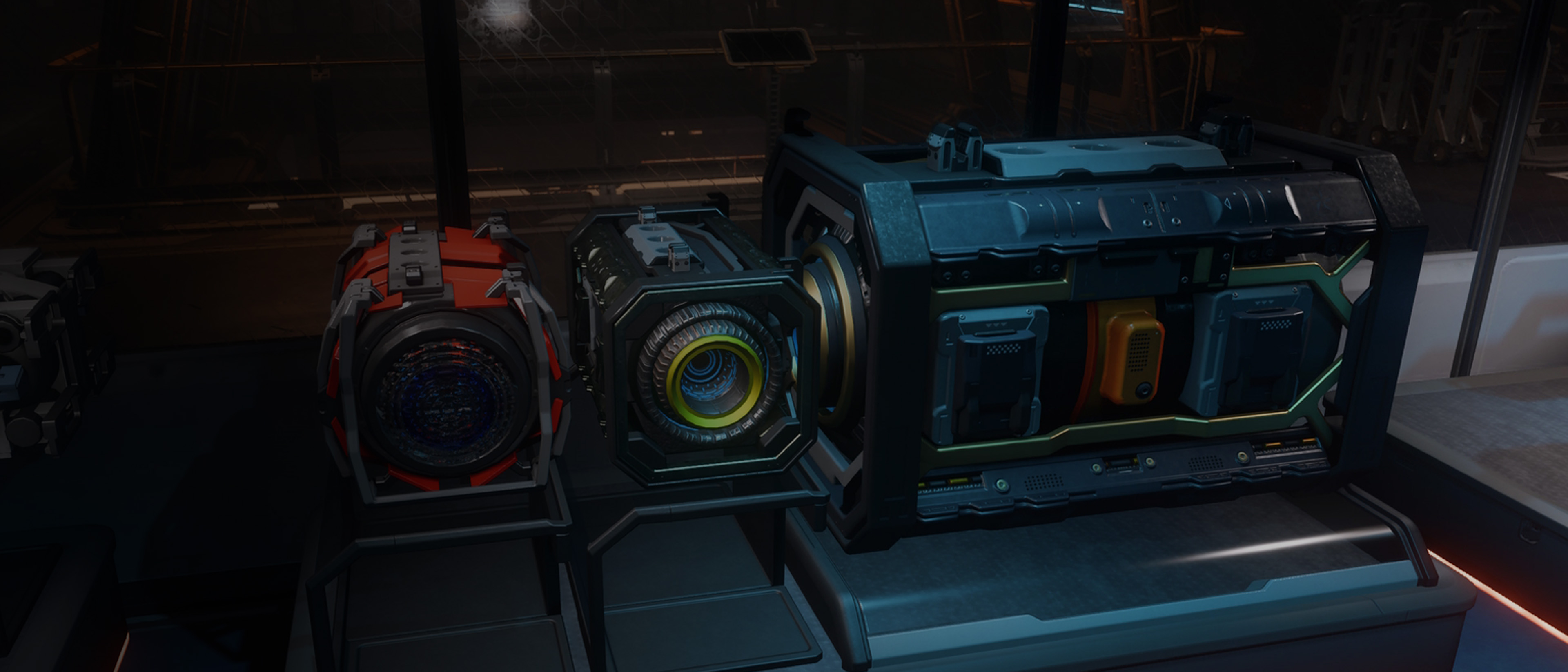
Components, Power, Signatures Your Ship Owner Guide Ever wondered how your decisions impact your ship’s performance, what makes one component better than another, and how different manufacturers set themselves apart?
Welcome to your Ship Owner’s Guide, your go-to resource for understanding the mechanics of power, heat, and signature. With this knowledge, you'll gain full control over your ship’s efficiency and performance, making every flight smoother and every battle more strategic.
Since the introduction and continuous development of the Resource Network, Star Citizen allows engineers to control power distribution to individual ship components from their vehicle's energy pools. This feature will be refined and fine-tuned in future updates and will play an increasingly significant role.
Let’s take a detailed look at the properties of components as well as the mechanics of power, heat, and signature.
Component Properties Component properties are determined by a variety of ratings tied to key
parameters: type, class, grade, and size. These parameters not only
define a component’s role within a vehicle but also influence critical factors,
such as its health, durability, weight, and power consumption.
The manufacturer also has a small influence on the performance of a
component through its unique style. The style subtly affects the final
properties of the component, making your choice of manufacturer relevant
not only for cosmetic and lore reasons but also for stats.
Each parameter plays a vital role in shaping the performance and efficiency
of your ship. Let’s break them down in detail to better understand their impact
on your gameplay.
Type The type of a component defines its primary function by describing its actions and the resources it consumes, produces, or stores. This is the foundation of the component's role within your ship's systems.
Most components are further categorized by their class, manufacturer, grade, and size, with exceptions such as fuel tanks, quantum tanks, and thrusters/engines, which may not always include all these attributes.
To help you visualize this, think of type as the high-level category of an FPS gear item. It determines whether something functions as a piece of armor, a weapon, or a backpack. In the same way, type establishes a component's overall purpose in your ship.
TypeThe type of a component defines its primary function by describing its actions and the resources it consumes, produces, or stores. This is the foundation of the component's role within your ship's systems.Most components are further categorized by their class, manufacturer, grade, and size, with exceptions such as fuel tanks, quantum tanks, and thrusters/engines, which may not always include all these attributes.To help you visualize this, think of type as the high-level category of an FPS gear item. It determines whether something functions as a piece of armor, a weapon, or a backpack. In the same way, type establishes a component's overall purpose in your ship. Battery Planned for a future release.
Cooler A cooler is a critical ship component that manages heat generated by other systems. It produces coolant, which is distributed to powered components to prevent overheating and ensure smooth operation. Each unit of power assigned to a component directly translates to a unit of coolant required to cool it down. Each cooler has a specific maximum coolant output, determining its ability to support different loadouts. Proper cooler selection ensures efficient heat management based on your ship’s power consumption.
Hydrogen Fuel Tank A hydrogen fuel tank holds your ship's hydrogen fuel, which is the default fuel type for most spacecraft. Hydrogen fuel, a colorless and odorless substance, powers conventional engines during non-quantum flight. It is essential for standard propulsion and maneuvering, making the fuel tank a fundamental component of any spacecraft's operation. Proper fuel management ensures your ship remains operational during atmospheric or non-quantum travel, emphasizing its critical role in both short and long-distance missions.
Gravity Generator Planned for a future release.
Gravity generators produce gravity, a resource consumed by rooms to create and maintain a gravity field within their boundaries. This ensures that areas of the ship have functional gravity for crew movement and operations. Proper maintenance and management of gravity generators is essential for maintaining consistent gravity fields across the ship’s interior, supporting both comfort and safety for your crew members during missions.
Jump Drive A quantum drive can be upgraded with a jump module, transforming it into a jump drive that enables interstellar travel through interspace. This feature allows ships to traverse jump tunnels, naturally occurring wormholes in spacetime that facilitate superluminal travel across vast distances. Jump drives are essential for accessing these tunnels, opening opportunities for exploration, trade, and missions in distant systems.
Life Support Generator Planned for a future release.
A life-support generator is a critical ship component that produces life support, a resource consumed by rooms to maintain a habitable environment. It replenishes the atmosphere, regulates pressure, and normalizes temperature within the ship’s interior. The capacity of a life-support generator scales multiplicatively with the internal volume of vehicles of similar size, ensuring consistent functionality across different ship designs. Proper life-support management is essential for sustaining crew health and comfort, especially on long missions or in extreme conditions.
Power Plant A powerplant is essential for a vehicle’s operation, generating power to run all systems. Protecting your powerplant is crucial, as its destruction could cause catastrophic damage to your ship.
Vehicles operate at a power deficit, requiring careful allocation of power to prioritized systems. Strategic power distribution creates meaningful tradeoffs, ensuring shields, weapons, or engines are optimized based on the situation, enhancing adaptability and performance.
Quantum Drive A quantum drive is a specialized engine that generates a Chan-Eisen field, enabling spacecraft to travel at extremely high speeds across vast distances. Quantum drives can also be upgraded with a jump module to become a jump drive, allowing travel through interspace. When active, a quantum drive is either fully on or off and its operation affects the ship’s electromagnetic (EM) signature, adding another layer of strategic consideration.
Quantum Fuel Tank A quantum fuel tank stores your ship's quantum fuel, enabling travel across vast distances in space. Generally, quantum-fuel capacity is consistent among ships of the same size category, ensuring balance and predictability. However, certain ships, such as exploration or special-purpose ships, feature larger quantum tanks to support their unique roles, offering extended range or specialized functionality. This makes the quantum tank a key consideration when evaluating a ship's capabilities and its suitability for long-range or mission-specific operations.
Radar Radars play a crucial role in detecting and tracking objects by analyzing various signatures, such as infrared or electromagnetic outputs. Different radar variants come with unique sensitivities to these signatures, allowing for specialized functionality depending on the context.
Additionally, using a radar’s ping function amplifies its effective sensitivity, increasing detection range and capability but potentially revealing your position to others. Strategic radar use is vital for maintaining awareness and avoiding detection.
Shield Emitter Shield Generator A shield generator provides vital protection by creating shields around your ship. Shield Health represents the total defensive capacity, distributed across all faces. Generators larger than Size 2 (S2) generate shields with four sides.
The Shield Regeneration rate determines how quickly shields recover per second. While regeneration also scales with generator size, it increases more slowly than health, meaning larger shields take longer to fully recharge.
Choosing the right shield generator is crucial for balancing defense and recovery, ensuring your ship remains protected in various scenarios.
Thrusters / Engines Thrusters and engines are key systems for ship propulsion and maneuverability in space and atmosphere. They enable acceleration, deceleration, rotation, and precise directional control.
Engines provide sustained thrust for forward movement, while thrusters handle fine adjustments and stability. Both systems consume hydrogen fuel, with efficiency depending on their type and size. Larger ships often rely on more powerful engines and multiple thrusters to remain responsive.
Efficient use of thrusters and engines is essential for effective navigation, combat readiness, and fuel conservation, particularly during prolonged missions or high-demand scenarios.
Size The size of a component determines its input and output capacity, defining its role within a ship or vehicle. Item-port sizes range from S0 to S4, with additional steps for larger capital ships to maintain balance. For example, while both a Reclaimer and a Bengal use S4 components, their unique requirements call for further distinctions.
Most properties, such as health, signatures, and output, scale with size, though some, like power and coolant, cap at S4. The size system ensures components are properly scaled, balancing functionality, efficiency, and versatility across all ship classes.
This categorization helps align components with the unique demands of different ship types, ensuring a balanced and engaging gameplay experience.
Below is an overview of ship sizes and their typical component sizes (exceptions may apply for special-purpose ships):
SizeThe size of a component determines its input and output capacity, defining its role within a ship or vehicle. Item-port sizes range from S0 to S4, with additional steps for larger capital ships to maintain balance. For example, while both a Reclaimer and a Bengal use S4 components, their unique requirements call for further distinctions.Most properties, such as health, signatures, and output, scale with size, though some, like power and coolant, cap at S4. The size system ensures components are properly scaled, balancing functionality, efficiency, and versatility across all ship classes.This categorization helps align components with the unique demands of different ship types, ensuring a balanced and engaging gameplay experience.Below is an overview of ship sizes and their typical component sizes (exceptions may apply for special-purpose ships): Size 0 Most ground vehicles, such as the Mirai Pulse.
Size 1 Single-seaters / light fighters, such as the Aegis Gladius.
Size 2 Small multi-crew ships / heavy fighters, such as the RSI Zeus Mk II.
Size 3 Large multi-crew ships, such as the Crusader Hercules C2.
Size 4 Even bigger capital ships, such as the RSI Polaris, Aegis Idris, Aegis Javelin, and RSI Bengal. (Some capital-sized vehicles use bespoke, non-swappable components.)
Class The class of a component defines its specialization and the type of gameplay it's best suited to. Classes help differentiate components based on their intended roles, offering a variety of options for different strategies and playstyles.
You can equip your vehicle with components from any class, allowing you to experiment and find the configurations that best suit your needs and objectives.
Each class comes with its own strengths, making it particularly suited to specific situations or playstyles. At the same time, every has balanced weaknesses that offset these advantages.
The strengths and weaknesses are carefully distributed across all classes, ensuring that no class is overall better or worse than another.
ClassThe class of a component defines its specialization and the type of gameplay it's best suited to. Classes help differentiate components based on their intended roles, offering a variety of options for different strategies and playstyles.You can equip your vehicle with components from any class, allowing you to experiment and find the configurations that best suit your needs and objectives. Each class comes with its own strengths, making it particularly suited to specific situations or playstyles. At the same time, every has balanced weaknesses that offset these advantages.The strengths and weaknesses are carefully distributed across all classes, ensuring that no class is overall better or worse than another. Civilian Average overall performance, with the benefit of low maintenance overheads.
Competition High performance and low weight, but with a trade-off of low durability, fewer options for power management, and the 'loudest' signatures across all classes.
Industrial Although heavy and power-hungry, this class excels in durability and heat management and also has lower maintenance costs.
Military Extremely durable and highly configurable, with the highest output of any class at the cost of significant signature emittance and power consumption.
Stealth Stealth components are the most fragile and their output is in the middle of the pack. However, they consume very little power, have lower minimum power consumption, and produce extremely low signature emissions. This reduced minimum consumption makes them more flexible for power management, allowing you to easily adjust their settings without overburdening your power pool.
Grade The final modifier is the Grade (D, C, B, A), which acts as an item’s quality indicator. Depending on the Grade, it may enhance, maintain, or reduce a component's default values.
GradeThe final modifier is the Grade (D, C, B, A), which acts as an item’s quality indicator. Depending on the Grade, it may enhance, maintain, or reduce a component's default values. Grade D Common (budget-friendly option)
Grade C Uncommon (standard loadout on most ships)
Grade B Rare (typically found on highly specialized ships)
Grade A Ultra-rare (the highest possible performance. Not expected to be obtained through regular means)
Power, Heat, and Signature Component Consumption and Emissions Choosing the right components is one thing, but an experienced ship owner
alsoknows how to get the most out of their vessel and what dangers to watch out
for. Understanding the intricate systems of your ship is what separates a
good pilot from a great one.
Let’s take a closer look at power, heat, and signature, three key factors that
not only define your ship’s performance but also determine your ability to
adapt and thrive in the vast and unpredictable expanse of the 'verse.
Power Power is the lifeblood of your vehicle, supplied by powerplants that produce a maximum output scaled to their size, up to S4 for standard components. Powerplants provide energy to all onboard systems, forming a shared network with limited capacity. Future updates will introduce fuel consumption for powerplants, adding a layer of complexity to resource management.
Power Throttles Each power-consuming component has properties for minimum and maximum power units, along with low, mid, and high ranges that determine its performance. Some components have a minimum power consumption that displays as combined power segments. These components are harder to reassign power to or from because they require a significant amount of power just to activate. This is referred to as controllability, where a smaller or larger minimum power requirement affects how easily a component can be adjusted in real time.
Components reaching mid/high ranges at lower power settings provide stronger functionality sooner but wear down faster, generate more signature, and are more prone to malfunctions.
In contrast, components with extended low ranges offer better stealth and durability, letting you operate them efficiently without sacrificing reliability. This flexibility allows you to fine-tune power settings to optimize performance based on your current objectives and situation.
Power Distribution You can manage your vehicle's power distribution through the engineering screen (available on select ships) or via multi-function displays (MFDs). Power is allocated in segments to components, which consume these universal units based on their demands. Components are divided into:
Main Systems: Weapons, thrusters/engines, shield generators, quantum drives, and coolers. These are critical systems that require the most power and careful prioritization.
Sub Systems: Radars, life support, and gravity generators. These secondary systems consume less power, ensuring you have flexibility in managing resources.
While most components are managed through dedicated power throttles, weapons share a single power pool across the entire ship. Each weapon draws a proportion of this pool, with energy weapons consuming significantly more than ballistics. If you run out of available power, you can trade off by equipping more ballistic weapons to reduce the overall demand on your ship’s systems.
Larger ships often operate at a power deficit, making strategic allocation essential. Batteries help fill gaps by providing temporary power, which depletes over time and requires active management.
Coolant & Heat Each unit of power assigned to a component requires a matching unit of coolant to manage the heat it generates. Coolant demand is directly tied to the power consumed, meaning coolers play a critical role in ensuring a loadout operates efficiently. Choosing the right cooler involves comparing its coolant production to the power requirements of your loadout rather than tracking coolant as a separate resource.
Default loadouts and power settings are designed to avoid overheating under normal conditions. However, certain scenarios can still push systems beyond their limits. Overheating may occur when too many components are running at high power levels, coolers are underpowered, or components become degraded or malfunction. Components operating in high ranges are especially demanding on coolant, and powerplants, as the largest power generators, require the most attention.
For vehicles equipped with multiple powerplants, it’s important to note that additional powerplants do not double your power output but instead add only a small boost while generating significantly more heat. This means it’s worth considering whether activating an additional powerplant is worth the extra coolant usage.
Heat management is also influenced by how long components take to reach their maximum heat threshold. This provides flexibility to temporarily reassign power from coolers to other systems in critical situations like combat or emergencies. Additionally, overheating components can be cycled on and off to balance their performance without compromising the overall system.
By understanding the relationship between power and coolant, you can optimize your loadout for efficiency and reliability. Strategic decisions about when to push your systems and how to manage heat effectively can give you the edge in challenging situations. Whether you’re balancing powerplants, selecting the right cooler, or managing component wear and tear, staying mindful of these mechanics ensures your ship operates at its best, even under demanding conditions.
Signatures Since the implementation of the Resource Network, we transitioned to a system where electromagnetic (EM) and infrared (IR) signatures are generated by individual components rather than the entire vehicle. This change makes stealth and scanning more dynamic, requiring careful selection and operation of components. Each signature is influenced by component properties, making your choices critical for staying undetected or detecting others. Radar sensitivity to signatures will also vary in the future, adding complexity.
Signatures are measured as effective detection ranges in meters. Ground vehicles benefit from a sensitivity modifier, reducing their detectability, especially against spaceships, making them more stealthy during ground-based operations.
Electromagnetic (EM) EM signatures are generated by consumed power or produced by your ship’s components. For example, assigning power to items increases EM output, while activating a quantum drive generates a significant EM burst, making your ship easier to detect while fleeing.
EM signatures provide valuable information:
Low EM indicates idling or minimal activity
Moderate EM suggests active systems or combat
High EM, especially with doubling, reveals quantum-drive activity.
Stealth-class components reduce EM output by consuming less power, helping you remain less detectable.
Infrared (IR) IR signatures are produced by the heat expelled from your ship’s components. Overheating drastically increases IR output, while stealth loadouts with minimal coolant usage result in lower IR signatures.
Coolers play a key role in IR management by expelling heat but also increase IR signatures the more they are utilized. Running IR dark, which involves disabling coolers to reduce signature emissions, causes heat to gradually build up, making IR levels creep higher over time. When coolers are reactivated to prevent overheating, they create a significant IR spike as they work to stabilize temperatures. Balancing these effects is critical for effective heat and signature management.
Cross Section (CS) CS signatures are determined by the physical size, shape, and overall dimensions of your ship, specifically its width (X axis), height (Y axis), and length (Z axis). Larger vehicles naturally have higher CS signatures, making them easier to detect on radar, regardless of their EM or IR output. Additionally, some chassis have modifiers to simulate radar absorbent coatings, particularly on stealth ships.
DISCLAIMER The statements accurately reflect development's intentions at the time of writing, but the company and development team reserve the right to adapt, improve, or change feature and ship designs in response to feedback, playtesting, design revisions, or other considerations to improve balance or the quality of the game overall.
DISCLAIMERThe statements accurately reflect development's intentions at the time of writing, but the company and development team reserve the right to adapt, improve, or change feature and ship designs in response to feedback, playtesting, design revisions, or other considerations to improve balance or the quality of the game overall.
Hast du dich schon mal gefragt, wie sich deine Entscheidungen auf die Leistung deines Schiffes auswirken, was eine Komponente besser macht als eine andere und wie sich verschiedene Hersteller voneinander unterscheiden?
Willkommen in deinem Ship Owner's Guide, deinem Handbuch für Schiffseigner, in dem du die Mechanik von Kraft, Wärme und Signatur verstehst. Mit diesem Wissen hast du die volle Kontrolle über die Effizienz und Leistung deines Schiffes und machst jeden Flug reibungsloser und jede Schlacht strategischer.
Seit der Einführung und kontinuierlichen Weiterentwicklung des Ressourcennetzwerks ermöglicht es Star Citizen den Ingenieuren, die Energieverteilung an einzelne Schiffskomponenten aus den Energiepools ihres Fahrzeugs zu steuern. Diese Funktion wird in zukünftigen Updates weiter verfeinert und verfeinert und wird eine immer wichtigere Rolle spielen.
Werfen wir einen detaillierten Blick auf die Eigenschaften der Komponenten sowie auf die Mechanik von Strom, Wärme und Signatur.
Komponenten, Energie, Signaturen
Dein Schiffseigner-Handbuch
Eigenschaften von Bauteilen
Die Eigenschaften von Bauteilen werden durch eine Reihe von Werten bestimmt, die an
Parameter: Typ, Klasse, Güteklasse und Größe. Diese Parameter bestimmen nicht nur
bestimmen nicht nur die Rolle eines Bauteils im Fahrzeug, sondern beeinflussen auch kritische Faktoren,
wie Gesundheit, Haltbarkeit, Gewicht und Stromverbrauch.
Auch der Hersteller hat einen kleinen Einfluss auf die Leistung eines
Bauteils durch seinen einzigartigen Stil. Der Stil wirkt sich subtil auf die endgültigen
Eigenschaften des Bauteils und macht die Wahl des Herstellers nicht nur
nicht nur aus kosmetischen Gründen, sondern auch für die Statistik.
Jeder Parameter spielt eine wichtige Rolle bei der Gestaltung der Leistung und Effizienz
deines Schiffes. Wir werden sie im Detail aufschlüsseln, um ihre Auswirkungen
auf dein Gameplay zu verstehen.
Leistung, Wärme und Signatur
Komponentenverbrauch und Emissionen
Die Wahl der richtigen Komponenten ist eine Sache, aber ein erfahrener Schiffseigner
weiß auch, wie er das Beste aus seinem Schiff herausholen kann und auf welche Gefahren er achten
aufpassen muss. Das Verständnis für die komplizierten Systeme deines Schiffes ist das, was einen
einen guten Lotsen von einem großartigen Lotsen.
Lass uns einen genaueren Blick auf Energie, Wärme und Signatur werfen, drei Schlüsselfaktoren, die
die nicht nur die Leistung deines Schiffes bestimmen, sondern auch deine Fähigkeit, dich
in den unermesslichen und unvorhersehbaren Weiten des Universums anzupassen.
TypDer Typ einer Komponente definiert ihre Hauptfunktion, indem er ihre Aktionen und die Ressourcen beschreibt, die sie verbraucht, produziert oder speichert. Dies ist die Grundlage für die Rolle der Komponente in den Systemen deines Schiffes.
Die meisten Komponenten werden außerdem nach Klasse, Hersteller, Qualität und Größe kategorisiert, mit Ausnahmen wie Treibstofftanks, Quantentanks und Triebwerken, die nicht immer alle diese Attribute aufweisen.
Um dir das zu verdeutlichen, kannst du dir den Typ als die übergeordnete Kategorie eines FPS-Ausrüstungsgegenstands vorstellen. Er bestimmt, ob etwas als Rüstung, Waffe oder Rucksack funktioniert. Genauso legt der Typ den allgemeinen Zweck einer Komponente in deinem Schiff fest.
GrößeDie Größe einer Komponente bestimmt ihre Eingangs- und Ausgangskapazität und damit ihre Rolle in einem Schiff oder Fahrzeug. Die Größen der Item Ports reichen von S0 bis S4, wobei es für größere Schiffe zusätzliche Stufen gibt, um das Gleichgewicht zu wahren. Zum Beispiel verwenden sowohl ein Reclaimer als auch ein Bengal S4-Komponenten, aber ihre besonderen Anforderungen erfordern weitere Unterscheidungen.
Die meisten Eigenschaften wie Gesundheit, Signaturen und Leistung skalieren mit der Größe, aber einige, wie Energie und Kühlmittel, sind bei S4 begrenzt. Das Größensystem stellt sicher, dass die Komponenten richtig skaliert sind, um Funktionalität, Effizienz und Vielseitigkeit in allen Schiffsklassen auszugleichen.
Diese Kategorisierung hilft dabei, die Komponenten an die besonderen Anforderungen der verschiedenen Schiffstypen anzupassen, um ein ausgewogenes und spannendes Spielerlebnis zu gewährleisten.
Nachfolgend findest du eine Übersicht über die Schiffsgrößen und ihre typischen Komponentengrößen (Ausnahmen können für Spezialschiffe gelten):
KlasseDie Klasse einer Komponente definiert ihre Spezialisierung und die Art des Spiels, für die sie am besten geeignet ist. Die Klassen helfen dabei, die Komponenten anhand ihrer beabsichtigten Rolle zu unterscheiden und bieten eine Vielzahl von Optionen für verschiedene Strategien und Spielstile.
Du kannst dein Fahrzeug mit Komponenten aus jeder Klasse ausstatten und so experimentieren und die Konfigurationen finden, die deinen Bedürfnissen und Zielen am besten entsprechen.
Jede Klasse hat ihre eigenen Stärken, die sie für bestimmte Situationen oder Spielstile besonders geeignet machen. Gleichzeitig hat jede Klasse aber auch ausgewogene Schwächen, die diese Vorteile ausgleichen.
Die Stärken und Schwächen sind sorgfältig auf alle Klassen verteilt, so dass keine Klasse insgesamt besser oder schlechter ist als eine andere.
GradDer letzte Modifikator ist der Grad (D, C, B, A), der als Qualitätsindikator für einen Gegenstand dient. Je nach Grad kann er die Standardwerte einer Komponente verbessern, beibehalten oder verringern.
HAFTUNGSAUSSCHLUSSDie Aussagen spiegeln die Absichten der Entwickler zum Zeitpunkt der Erstellung dieses Dokuments wider. Das Unternehmen und das Entwicklungsteam behalten sich jedoch das Recht vor, Features und Schiffsdesigns als Reaktion auf Feedback, Spieltests, Designüberarbeitungen oder andere Überlegungen zur Verbesserung der Balance oder der Qualität des Spiels insgesamt anzupassen, zu verbessern oder zu ändern.
Components, Power, Signatures Your Ship Owner Guide Ever wondered how your decisions impact your ship’s performance, what makes one component better than another, and how different manufacturers set themselves apart?
Welcome to your Ship Owner’s Guide, your go-to resource for understanding the mechanics of power, heat, and signature. With this knowledge, you'll gain full control over your ship’s efficiency and performance, making every flight smoother and every battle more strategic.
Since the introduction and continuous development of the Resource Network, Star Citizen allows engineers to control power distribution to individual ship components from their vehicle's energy pools. This feature will be refined and fine-tuned in future updates and will play an increasingly significant role.
Let’s take a detailed look at the properties of components as well as the mechanics of power, heat, and signature.
Component Properties Component properties are determined by a variety of ratings tied to key
parameters: type, class, grade, and size. These parameters not only
define a component’s role within a vehicle but also influence critical factors,
such as its health, durability, weight, and power consumption.
The manufacturer also has a small influence on the performance of a
component through its unique style. The style subtly affects the final
properties of the component, making your choice of manufacturer relevant
not only for cosmetic and lore reasons but also for stats.
Each parameter plays a vital role in shaping the performance and efficiency
of your ship. Let’s break them down in detail to better understand their impact
on your gameplay.
Type The type of a component defines its primary function by describing its actions and the resources it consumes, produces, or stores. This is the foundation of the component's role within your ship's systems.
Most components are further categorized by their class, manufacturer, grade, and size, with exceptions such as fuel tanks, quantum tanks, and thrusters/engines, which may not always include all these attributes.
To help you visualize this, think of type as the high-level category of an FPS gear item. It determines whether something functions as a piece of armor, a weapon, or a backpack. In the same way, type establishes a component's overall purpose in your ship.
TypeThe type of a component defines its primary function by describing its actions and the resources it consumes, produces, or stores. This is the foundation of the component's role within your ship's systems.Most components are further categorized by their class, manufacturer, grade, and size, with exceptions such as fuel tanks, quantum tanks, and thrusters/engines, which may not always include all these attributes.To help you visualize this, think of type as the high-level category of an FPS gear item. It determines whether something functions as a piece of armor, a weapon, or a backpack. In the same way, type establishes a component's overall purpose in your ship. Battery Planned for a future release.
Cooler A cooler is a critical ship component that manages heat generated by other systems. It produces coolant, which is distributed to powered components to prevent overheating and ensure smooth operation. Each unit of power assigned to a component directly translates to a unit of coolant required to cool it down. Each cooler has a specific maximum coolant output, determining its ability to support different loadouts. Proper cooler selection ensures efficient heat management based on your ship’s power consumption.
Hydrogen Fuel Tank A hydrogen fuel tank holds your ship's hydrogen fuel, which is the default fuel type for most spacecraft. Hydrogen fuel, a colorless and odorless substance, powers conventional engines during non-quantum flight. It is essential for standard propulsion and maneuvering, making the fuel tank a fundamental component of any spacecraft's operation. Proper fuel management ensures your ship remains operational during atmospheric or non-quantum travel, emphasizing its critical role in both short and long-distance missions.
Gravity Generator Planned for a future release.
Gravity generators produce gravity, a resource consumed by rooms to create and maintain a gravity field within their boundaries. This ensures that areas of the ship have functional gravity for crew movement and operations. Proper maintenance and management of gravity generators is essential for maintaining consistent gravity fields across the ship’s interior, supporting both comfort and safety for your crew members during missions.
Jump Drive A quantum drive can be upgraded with a jump module, transforming it into a jump drive that enables interstellar travel through interspace. This feature allows ships to traverse jump tunnels, naturally occurring wormholes in spacetime that facilitate superluminal travel across vast distances. Jump drives are essential for accessing these tunnels, opening opportunities for exploration, trade, and missions in distant systems.
Life Support Generator Planned for a future release.
A life-support generator is a critical ship component that produces life support, a resource consumed by rooms to maintain a habitable environment. It replenishes the atmosphere, regulates pressure, and normalizes temperature within the ship’s interior. The capacity of a life-support generator scales multiplicatively with the internal volume of vehicles of similar size, ensuring consistent functionality across different ship designs. Proper life-support management is essential for sustaining crew health and comfort, especially on long missions or in extreme conditions.
Power Plant A powerplant is essential for a vehicle’s operation, generating power to run all systems. Protecting your powerplant is crucial, as its destruction could cause catastrophic damage to your ship.
Vehicles operate at a power deficit, requiring careful allocation of power to prioritized systems. Strategic power distribution creates meaningful tradeoffs, ensuring shields, weapons, or engines are optimized based on the situation, enhancing adaptability and performance.
Quantum Drive A quantum drive is a specialized engine that generates a Chan-Eisen field, enabling spacecraft to travel at extremely high speeds across vast distances. Quantum drives can also be upgraded with a jump module to become a jump drive, allowing travel through interspace. When active, a quantum drive is either fully on or off and its operation affects the ship’s electromagnetic (EM) signature, adding another layer of strategic consideration.
Quantum Fuel Tank A quantum fuel tank stores your ship's quantum fuel, enabling travel across vast distances in space. Generally, quantum-fuel capacity is consistent among ships of the same size category, ensuring balance and predictability. However, certain ships, such as exploration or special-purpose ships, feature larger quantum tanks to support their unique roles, offering extended range or specialized functionality. This makes the quantum tank a key consideration when evaluating a ship's capabilities and its suitability for long-range or mission-specific operations.
Radar Radars play a crucial role in detecting and tracking objects by analyzing various signatures, such as infrared or electromagnetic outputs. Different radar variants come with unique sensitivities to these signatures, allowing for specialized functionality depending on the context.
Additionally, using a radar’s ping function amplifies its effective sensitivity, increasing detection range and capability but potentially revealing your position to others. Strategic radar use is vital for maintaining awareness and avoiding detection.
Shield Emitter Shield Generator A shield generator provides vital protection by creating shields around your ship. Shield Health represents the total defensive capacity, distributed across all faces. Generators larger than Size 2 (S2) generate shields with four sides.
The Shield Regeneration rate determines how quickly shields recover per second. While regeneration also scales with generator size, it increases more slowly than health, meaning larger shields take longer to fully recharge.
Choosing the right shield generator is crucial for balancing defense and recovery, ensuring your ship remains protected in various scenarios.
Thrusters / Engines Thrusters and engines are key systems for ship propulsion and maneuverability in space and atmosphere. They enable acceleration, deceleration, rotation, and precise directional control.
Engines provide sustained thrust for forward movement, while thrusters handle fine adjustments and stability. Both systems consume hydrogen fuel, with efficiency depending on their type and size. Larger ships often rely on more powerful engines and multiple thrusters to remain responsive.
Efficient use of thrusters and engines is essential for effective navigation, combat readiness, and fuel conservation, particularly during prolonged missions or high-demand scenarios.
Size The size of a component determines its input and output capacity, defining its role within a ship or vehicle. Item-port sizes range from S0 to S4, with additional steps for larger capital ships to maintain balance. For example, while both a Reclaimer and a Bengal use S4 components, their unique requirements call for further distinctions.
Most properties, such as health, signatures, and output, scale with size, though some, like power and coolant, cap at S4. The size system ensures components are properly scaled, balancing functionality, efficiency, and versatility across all ship classes.
This categorization helps align components with the unique demands of different ship types, ensuring a balanced and engaging gameplay experience.
Below is an overview of ship sizes and their typical component sizes (exceptions may apply for special-purpose ships):
SizeThe size of a component determines its input and output capacity, defining its role within a ship or vehicle. Item-port sizes range from S0 to S4, with additional steps for larger capital ships to maintain balance. For example, while both a Reclaimer and a Bengal use S4 components, their unique requirements call for further distinctions.Most properties, such as health, signatures, and output, scale with size, though some, like power and coolant, cap at S4. The size system ensures components are properly scaled, balancing functionality, efficiency, and versatility across all ship classes.This categorization helps align components with the unique demands of different ship types, ensuring a balanced and engaging gameplay experience.Below is an overview of ship sizes and their typical component sizes (exceptions may apply for special-purpose ships): Size 0 Most ground vehicles, such as the Mirai Pulse.
Size 1 Single-seaters / light fighters, such as the Aegis Gladius.
Size 2 Small multi-crew ships / heavy fighters, such as the RSI Zeus Mk II.
Size 3 Large multi-crew ships, such as the Crusader Hercules C2.
Size 4 Even bigger capital ships, such as the RSI Polaris, Aegis Idris, Aegis Javelin, and RSI Bengal. (Some capital-sized vehicles use bespoke, non-swappable components.)
Class The class of a component defines its specialization and the type of gameplay it's best suited to. Classes help differentiate components based on their intended roles, offering a variety of options for different strategies and playstyles.
You can equip your vehicle with components from any class, allowing you to experiment and find the configurations that best suit your needs and objectives.
Each class comes with its own strengths, making it particularly suited to specific situations or playstyles. At the same time, every has balanced weaknesses that offset these advantages.
The strengths and weaknesses are carefully distributed across all classes, ensuring that no class is overall better or worse than another.
ClassThe class of a component defines its specialization and the type of gameplay it's best suited to. Classes help differentiate components based on their intended roles, offering a variety of options for different strategies and playstyles.You can equip your vehicle with components from any class, allowing you to experiment and find the configurations that best suit your needs and objectives. Each class comes with its own strengths, making it particularly suited to specific situations or playstyles. At the same time, every has balanced weaknesses that offset these advantages.The strengths and weaknesses are carefully distributed across all classes, ensuring that no class is overall better or worse than another. Civilian Average overall performance, with the benefit of low maintenance overheads.
Competition High performance and low weight, but with a trade-off of low durability, fewer options for power management, and the 'loudest' signatures across all classes.
Industrial Although heavy and power-hungry, this class excels in durability and heat management and also has lower maintenance costs.
Military Extremely durable and highly configurable, with the highest output of any class at the cost of significant signature emittance and power consumption.
Stealth Stealth components are the most fragile and their output is in the middle of the pack. However, they consume very little power, have lower minimum power consumption, and produce extremely low signature emissions. This reduced minimum consumption makes them more flexible for power management, allowing you to easily adjust their settings without overburdening your power pool.
Grade The final modifier is the Grade (D, C, B, A), which acts as an item’s quality indicator. Depending on the Grade, it may enhance, maintain, or reduce a component's default values.
GradeThe final modifier is the Grade (D, C, B, A), which acts as an item’s quality indicator. Depending on the Grade, it may enhance, maintain, or reduce a component's default values. Grade D Common (budget-friendly option)
Grade C Uncommon (standard loadout on most ships)
Grade B Rare (typically found on highly specialized ships)
Grade A Ultra-rare (the highest possible performance. Not expected to be obtained through regular means)
Power, Heat, and Signature Component Consumption and Emissions Choosing the right components is one thing, but an experienced ship owner
alsoknows how to get the most out of their vessel and what dangers to watch out
for. Understanding the intricate systems of your ship is what separates a
good pilot from a great one.
Let’s take a closer look at power, heat, and signature, three key factors that
not only define your ship’s performance but also determine your ability to
adapt and thrive in the vast and unpredictable expanse of the 'verse.
Power Power is the lifeblood of your vehicle, supplied by powerplants that produce a maximum output scaled to their size, up to S4 for standard components. Powerplants provide energy to all onboard systems, forming a shared network with limited capacity. Future updates will introduce fuel consumption for powerplants, adding a layer of complexity to resource management.
Power Throttles Each power-consuming component has properties for minimum and maximum power units, along with low, mid, and high ranges that determine its performance. Some components have a minimum power consumption that displays as combined power segments. These components are harder to reassign power to or from because they require a significant amount of power just to activate. This is referred to as controllability, where a smaller or larger minimum power requirement affects how easily a component can be adjusted in real time.
Components reaching mid/high ranges at lower power settings provide stronger functionality sooner but wear down faster, generate more signature, and are more prone to malfunctions.
In contrast, components with extended low ranges offer better stealth and durability, letting you operate them efficiently without sacrificing reliability. This flexibility allows you to fine-tune power settings to optimize performance based on your current objectives and situation.
Power Distribution You can manage your vehicle's power distribution through the engineering screen (available on select ships) or via multi-function displays (MFDs). Power is allocated in segments to components, which consume these universal units based on their demands. Components are divided into:
Main Systems: Weapons, thrusters/engines, shield generators, quantum drives, and coolers. These are critical systems that require the most power and careful prioritization.
Sub Systems: Radars, life support, and gravity generators. These secondary systems consume less power, ensuring you have flexibility in managing resources.
While most components are managed through dedicated power throttles, weapons share a single power pool across the entire ship. Each weapon draws a proportion of this pool, with energy weapons consuming significantly more than ballistics. If you run out of available power, you can trade off by equipping more ballistic weapons to reduce the overall demand on your ship’s systems.
Larger ships often operate at a power deficit, making strategic allocation essential. Batteries help fill gaps by providing temporary power, which depletes over time and requires active management.
Coolant & Heat Each unit of power assigned to a component requires a matching unit of coolant to manage the heat it generates. Coolant demand is directly tied to the power consumed, meaning coolers play a critical role in ensuring a loadout operates efficiently. Choosing the right cooler involves comparing its coolant production to the power requirements of your loadout rather than tracking coolant as a separate resource.
Default loadouts and power settings are designed to avoid overheating under normal conditions. However, certain scenarios can still push systems beyond their limits. Overheating may occur when too many components are running at high power levels, coolers are underpowered, or components become degraded or malfunction. Components operating in high ranges are especially demanding on coolant, and powerplants, as the largest power generators, require the most attention.
For vehicles equipped with multiple powerplants, it’s important to note that additional powerplants do not double your power output but instead add only a small boost while generating significantly more heat. This means it’s worth considering whether activating an additional powerplant is worth the extra coolant usage.
Heat management is also influenced by how long components take to reach their maximum heat threshold. This provides flexibility to temporarily reassign power from coolers to other systems in critical situations like combat or emergencies. Additionally, overheating components can be cycled on and off to balance their performance without compromising the overall system.
By understanding the relationship between power and coolant, you can optimize your loadout for efficiency and reliability. Strategic decisions about when to push your systems and how to manage heat effectively can give you the edge in challenging situations. Whether you’re balancing powerplants, selecting the right cooler, or managing component wear and tear, staying mindful of these mechanics ensures your ship operates at its best, even under demanding conditions.
Signatures Since the implementation of the Resource Network, we transitioned to a system where electromagnetic (EM) and infrared (IR) signatures are generated by individual components rather than the entire vehicle. This change makes stealth and scanning more dynamic, requiring careful selection and operation of components. Each signature is influenced by component properties, making your choices critical for staying undetected or detecting others. Radar sensitivity to signatures will also vary in the future, adding complexity.
Signatures are measured as effective detection ranges in meters. Ground vehicles benefit from a sensitivity modifier, reducing their detectability, especially against spaceships, making them more stealthy during ground-based operations.
Electromagnetic (EM) EM signatures are generated by consumed power or produced by your ship’s components. For example, assigning power to items increases EM output, while activating a quantum drive generates a significant EM burst, making your ship easier to detect while fleeing.
EM signatures provide valuable information:
Low EM indicates idling or minimal activity
Moderate EM suggests active systems or combat
High EM, especially with doubling, reveals quantum-drive activity.
Stealth-class components reduce EM output by consuming less power, helping you remain less detectable.
Infrared (IR) IR signatures are produced by the heat expelled from your ship’s components. Overheating drastically increases IR output, while stealth loadouts with minimal coolant usage result in lower IR signatures.
Coolers play a key role in IR management by expelling heat but also increase IR signatures the more they are utilized. Running IR dark, which involves disabling coolers to reduce signature emissions, causes heat to gradually build up, making IR levels creep higher over time. When coolers are reactivated to prevent overheating, they create a significant IR spike as they work to stabilize temperatures. Balancing these effects is critical for effective heat and signature management.
Cross Section (CS) CS signatures are determined by the physical size, shape, and overall dimensions of your ship, specifically its width (X axis), height (Y axis), and length (Z axis). Larger vehicles naturally have higher CS signatures, making them easier to detect on radar, regardless of their EM or IR output. Additionally, some chassis have modifiers to simulate radar absorbent coatings, particularly on stealth ships.
DISCLAIMER The statements accurately reflect development's intentions at the time of writing, but the company and development team reserve the right to adapt, improve, or change feature and ship designs in response to feedback, playtesting, design revisions, or other considerations to improve balance or the quality of the game overall.
DISCLAIMERThe statements accurately reflect development's intentions at the time of writing, but the company and development team reserve the right to adapt, improve, or change feature and ship designs in response to feedback, playtesting, design revisions, or other considerations to improve balance or the quality of the game overall.
Components, Power, Signatures Your Ship Owner Guide Ever wondered how your decisions impact your ship’s performance, what makes one component better than another, and how different manufacturers set themselves apart?
Welcome to your Ship Owner’s Guide, your go-to resource for understanding the mechanics of power, heat, and signature. With this knowledge, you'll gain full control over your ship’s efficiency and performance, making every flight smoother and every battle more strategic.
Since the introduction and continuous development of the Resource Network, Star Citizen allows engineers to control power distribution to individual ship components from their vehicle's energy pools. This feature will be refined and fine-tuned in future updates and will play an increasingly significant role.
Let’s take a detailed look at the properties of components as well as the mechanics of power, heat, and signature.
Component Properties Component properties are determined by a variety of ratings tied to key
parameters: type, class, grade, and size. These parameters not only
define a component’s role within a vehicle but also influence critical factors,
such as its health, durability, weight, and power consumption.
The manufacturer also has a small influence on the performance of a
component through its unique style. The style subtly affects the final
properties of the component, making your choice of manufacturer relevant
not only for cosmetic and lore reasons but also for stats.
Each parameter plays a vital role in shaping the performance and efficiency
of your ship. Let’s break them down in detail to better understand their impact
on your gameplay.
Type The type of a component defines its primary function by describing its actions and the resources it consumes, produces, or stores. This is the foundation of the component's role within your ship's systems.
Most components are further categorized by their class, manufacturer, grade, and size, with exceptions such as fuel tanks, quantum tanks, and thrusters/engines, which may not always include all these attributes.
To help you visualize this, think of type as the high-level category of an FPS gear item. It determines whether something functions as a piece of armor, a weapon, or a backpack. In the same way, type establishes a component's overall purpose in your ship.
TypeThe type of a component defines its primary function by describing its actions and the resources it consumes, produces, or stores. This is the foundation of the component's role within your ship's systems.Most components are further categorized by their class, manufacturer, grade, and size, with exceptions such as fuel tanks, quantum tanks, and thrusters/engines, which may not always include all these attributes.To help you visualize this, think of type as the high-level category of an FPS gear item. It determines whether something functions as a piece of armor, a weapon, or a backpack. In the same way, type establishes a component's overall purpose in your ship. Battery Planned for a future release.
Cooler A cooler is a critical ship component that manages heat generated by other systems. It produces coolant, which is distributed to powered components to prevent overheating and ensure smooth operation. Each unit of power assigned to a component directly translates to a unit of coolant required to cool it down. Each cooler has a specific maximum coolant output, determining its ability to support different loadouts. Proper cooler selection ensures efficient heat management based on your ship’s power consumption.
Hydrogen Fuel Tank A hydrogen fuel tank holds your ship's hydrogen fuel, which is the default fuel type for most spacecraft. Hydrogen fuel, a colorless and odorless substance, powers conventional engines during non-quantum flight. It is essential for standard propulsion and maneuvering, making the fuel tank a fundamental component of any spacecraft's operation. Proper fuel management ensures your ship remains operational during atmospheric or non-quantum travel, emphasizing its critical role in both short and long-distance missions.
Gravity Generator Planned for a future release.
Gravity generators produce gravity, a resource consumed by rooms to create and maintain a gravity field within their boundaries. This ensures that areas of the ship have functional gravity for crew movement and operations. Proper maintenance and management of gravity generators is essential for maintaining consistent gravity fields across the ship’s interior, supporting both comfort and safety for your crew members during missions.
Jump Drive A quantum drive can be upgraded with a jump module, transforming it into a jump drive that enables interstellar travel through interspace. This feature allows ships to traverse jump tunnels, naturally occurring wormholes in spacetime that facilitate superluminal travel across vast distances. Jump drives are essential for accessing these tunnels, opening opportunities for exploration, trade, and missions in distant systems.
Life Support Generator Planned for a future release.
A life-support generator is a critical ship component that produces life support, a resource consumed by rooms to maintain a habitable environment. It replenishes the atmosphere, regulates pressure, and normalizes temperature within the ship’s interior. The capacity of a life-support generator scales multiplicatively with the internal volume of vehicles of similar size, ensuring consistent functionality across different ship designs. Proper life-support management is essential for sustaining crew health and comfort, especially on long missions or in extreme conditions.
Power Plant A powerplant is essential for a vehicle’s operation, generating power to run all systems. Protecting your powerplant is crucial, as its destruction could cause catastrophic damage to your ship.
Vehicles operate at a power deficit, requiring careful allocation of power to prioritized systems. Strategic power distribution creates meaningful tradeoffs, ensuring shields, weapons, or engines are optimized based on the situation, enhancing adaptability and performance.
Quantum Drive A quantum drive is a specialized engine that generates a Chan-Eisen field, enabling spacecraft to travel at extremely high speeds across vast distances. Quantum drives can also be upgraded with a jump module to become a jump drive, allowing travel through interspace. When active, a quantum drive is either fully on or off and its operation affects the ship’s electromagnetic (EM) signature, adding another layer of strategic consideration.
Quantum Fuel Tank A quantum fuel tank stores your ship's quantum fuel, enabling travel across vast distances in space. Generally, quantum-fuel capacity is consistent among ships of the same size category, ensuring balance and predictability. However, certain ships, such as exploration or special-purpose ships, feature larger quantum tanks to support their unique roles, offering extended range or specialized functionality. This makes the quantum tank a key consideration when evaluating a ship's capabilities and its suitability for long-range or mission-specific operations.
Radar Radars play a crucial role in detecting and tracking objects by analyzing various signatures, such as infrared or electromagnetic outputs. Different radar variants come with unique sensitivities to these signatures, allowing for specialized functionality depending on the context.
Additionally, using a radar’s ping function amplifies its effective sensitivity, increasing detection range and capability but potentially revealing your position to others. Strategic radar use is vital for maintaining awareness and avoiding detection.
Shield Emitter Shield Generator A shield generator provides vital protection by creating shields around your ship. Shield Health represents the total defensive capacity, distributed across all faces. Generators larger than Size 2 (S2) generate shields with four sides.
The Shield Regeneration rate determines how quickly shields recover per second. While regeneration also scales with generator size, it increases more slowly than health, meaning larger shields take longer to fully recharge.
Choosing the right shield generator is crucial for balancing defense and recovery, ensuring your ship remains protected in various scenarios.
Thrusters / Engines Thrusters and engines are key systems for ship propulsion and maneuverability in space and atmosphere. They enable acceleration, deceleration, rotation, and precise directional control.
Engines provide sustained thrust for forward movement, while thrusters handle fine adjustments and stability. Both systems consume hydrogen fuel, with efficiency depending on their type and size. Larger ships often rely on more powerful engines and multiple thrusters to remain responsive.
Efficient use of thrusters and engines is essential for effective navigation, combat readiness, and fuel conservation, particularly during prolonged missions or high-demand scenarios.
Size The size of a component determines its input and output capacity, defining its role within a ship or vehicle. Item-port sizes range from S0 to S4, with additional steps for larger capital ships to maintain balance. For example, while both a Reclaimer and a Bengal use S4 components, their unique requirements call for further distinctions.
Most properties, such as health, signatures, and output, scale with size, though some, like power and coolant, cap at S4. The size system ensures components are properly scaled, balancing functionality, efficiency, and versatility across all ship classes.
This categorization helps align components with the unique demands of different ship types, ensuring a balanced and engaging gameplay experience.
Below is an overview of ship sizes and their typical component sizes (exceptions may apply for special-purpose ships):
SizeThe size of a component determines its input and output capacity, defining its role within a ship or vehicle. Item-port sizes range from S0 to S4, with additional steps for larger capital ships to maintain balance. For example, while both a Reclaimer and a Bengal use S4 components, their unique requirements call for further distinctions.Most properties, such as health, signatures, and output, scale with size, though some, like power and coolant, cap at S4. The size system ensures components are properly scaled, balancing functionality, efficiency, and versatility across all ship classes.This categorization helps align components with the unique demands of different ship types, ensuring a balanced and engaging gameplay experience.Below is an overview of ship sizes and their typical component sizes (exceptions may apply for special-purpose ships): Size 0 Most ground vehicles, such as the Mirai Pulse.
Size 1 Single-seaters / light fighters, such as the Aegis Gladius.
Size 2 Small multi-crew ships / heavy fighters, such as the RSI Zeus Mk II.
Size 3 Large multi-crew ships, such as the Crusader Hercules C2.
Size 4 Even bigger capital ships, such as the RSI Polaris, Aegis Idris, Aegis Javelin, and RSI Bengal. (Some capital-sized vehicles use bespoke, non-swappable components.)
Class The class of a component defines its specialization and the type of gameplay it's best suited to. Classes help differentiate components based on their intended roles, offering a variety of options for different strategies and playstyles.
You can equip your vehicle with components from any class, allowing you to experiment and find the configurations that best suit your needs and objectives.
Each class comes with its own strengths, making it particularly suited to specific situations or playstyles. At the same time, every has balanced weaknesses that offset these advantages.
The strengths and weaknesses are carefully distributed across all classes, ensuring that no class is overall better or worse than another.
ClassThe class of a component defines its specialization and the type of gameplay it's best suited to. Classes help differentiate components based on their intended roles, offering a variety of options for different strategies and playstyles.You can equip your vehicle with components from any class, allowing you to experiment and find the configurations that best suit your needs and objectives. Each class comes with its own strengths, making it particularly suited to specific situations or playstyles. At the same time, every has balanced weaknesses that offset these advantages.The strengths and weaknesses are carefully distributed across all classes, ensuring that no class is overall better or worse than another. Civilian Average overall performance, with the benefit of low maintenance overheads.
Competition High performance and low weight, but with a trade-off of low durability, fewer options for power management, and the 'loudest' signatures across all classes.
Industrial Although heavy and power-hungry, this class excels in durability and heat management and also has lower maintenance costs.
Military Extremely durable and highly configurable, with the highest output of any class at the cost of significant signature emittance and power consumption.
Stealth Stealth components are the most fragile and their output is in the middle of the pack. However, they consume very little power, have lower minimum power consumption, and produce extremely low signature emissions. This reduced minimum consumption makes them more flexible for power management, allowing you to easily adjust their settings without overburdening your power pool.
Grade The final modifier is the Grade (D, C, B, A), which acts as an item’s quality indicator. Depending on the Grade, it may enhance, maintain, or reduce a component's default values.
GradeThe final modifier is the Grade (D, C, B, A), which acts as an item’s quality indicator. Depending on the Grade, it may enhance, maintain, or reduce a component's default values. Grade D Common (budget-friendly option)
Grade C Uncommon (standard loadout on most ships)
Grade B Rare (typically found on highly specialized ships)
Grade A Ultra-rare (the highest possible performance. Not expected to be obtained through regular means)
Power, Heat, and Signature Component Consumption and Emissions Choosing the right components is one thing, but an experienced ship owner
alsoknows how to get the most out of their vessel and what dangers to watch out
for. Understanding the intricate systems of your ship is what separates a
good pilot from a great one.
Let’s take a closer look at power, heat, and signature, three key factors that
not only define your ship’s performance but also determine your ability to
adapt and thrive in the vast and unpredictable expanse of the 'verse.
Power Power is the lifeblood of your vehicle, supplied by powerplants that produce a maximum output scaled to their size, up to S4 for standard components. Powerplants provide energy to all onboard systems, forming a shared network with limited capacity. Future updates will introduce fuel consumption for powerplants, adding a layer of complexity to resource management.
Power Throttles Each power-consuming component has properties for minimum and maximum power units, along with low, mid, and high ranges that determine its performance. Some components have a minimum power consumption that displays as combined power segments. These components are harder to reassign power to or from because they require a significant amount of power just to activate. This is referred to as controllability, where a smaller or larger minimum power requirement affects how easily a component can be adjusted in real time.
Components reaching mid/high ranges at lower power settings provide stronger functionality sooner but wear down faster, generate more signature, and are more prone to malfunctions.
In contrast, components with extended low ranges offer better stealth and durability, letting you operate them efficiently without sacrificing reliability. This flexibility allows you to fine-tune power settings to optimize performance based on your current objectives and situation.
Power Distribution You can manage your vehicle's power distribution through the engineering screen (available on select ships) or via multi-function displays (MFDs). Power is allocated in segments to components, which consume these universal units based on their demands. Components are divided into:
Main Systems: Weapons, thrusters/engines, shield generators, quantum drives, and coolers. These are critical systems that require the most power and careful prioritization.
Sub Systems: Radars, life support, and gravity generators. These secondary systems consume less power, ensuring you have flexibility in managing resources.
While most components are managed through dedicated power throttles, weapons share a single power pool across the entire ship. Each weapon draws a proportion of this pool, with energy weapons consuming significantly more than ballistics. If you run out of available power, you can trade off by equipping more ballistic weapons to reduce the overall demand on your ship’s systems.
Larger ships often operate at a power deficit, making strategic allocation essential. Batteries help fill gaps by providing temporary power, which depletes over time and requires active management.
Coolant & Heat Each unit of power assigned to a component requires a matching unit of coolant to manage the heat it generates. Coolant demand is directly tied to the power consumed, meaning coolers play a critical role in ensuring a loadout operates efficiently. Choosing the right cooler involves comparing its coolant production to the power requirements of your loadout rather than tracking coolant as a separate resource.
Default loadouts and power settings are designed to avoid overheating under normal conditions. However, certain scenarios can still push systems beyond their limits. Overheating may occur when too many components are running at high power levels, coolers are underpowered, or components become degraded or malfunction. Components operating in high ranges are especially demanding on coolant, and powerplants, as the largest power generators, require the most attention.
For vehicles equipped with multiple powerplants, it’s important to note that additional powerplants do not double your power output but instead add only a small boost while generating significantly more heat. This means it’s worth considering whether activating an additional powerplant is worth the extra coolant usage.
Heat management is also influenced by how long components take to reach their maximum heat threshold. This provides flexibility to temporarily reassign power from coolers to other systems in critical situations like combat or emergencies. Additionally, overheating components can be cycled on and off to balance their performance without compromising the overall system.
By understanding the relationship between power and coolant, you can optimize your loadout for efficiency and reliability. Strategic decisions about when to push your systems and how to manage heat effectively can give you the edge in challenging situations. Whether you’re balancing powerplants, selecting the right cooler, or managing component wear and tear, staying mindful of these mechanics ensures your ship operates at its best, even under demanding conditions.
Signatures Since the implementation of the Resource Network, we transitioned to a system where electromagnetic (EM) and infrared (IR) signatures are generated by individual components rather than the entire vehicle. This change makes stealth and scanning more dynamic, requiring careful selection and operation of components. Each signature is influenced by component properties, making your choices critical for staying undetected or detecting others. Radar sensitivity to signatures will also vary in the future, adding complexity.
Signatures are measured as effective detection ranges in meters. Ground vehicles benefit from a sensitivity modifier, reducing their detectability, especially against spaceships, making them more stealthy during ground-based operations.
Electromagnetic (EM) EM signatures are generated by consumed power or produced by your ship’s components. For example, assigning power to items increases EM output, while activating a quantum drive generates a significant EM burst, making your ship easier to detect while fleeing.
EM signatures provide valuable information:
Low EM indicates idling or minimal activity
Moderate EM suggests active systems or combat
High EM, especially with doubling, reveals quantum-drive activity.
Stealth-class components reduce EM output by consuming less power, helping you remain less detectable.
Infrared (IR) IR signatures are produced by the heat expelled from your ship’s components. Overheating drastically increases IR output, while stealth loadouts with minimal coolant usage result in lower IR signatures.
Coolers play a key role in IR management by expelling heat but also increase IR signatures the more they are utilized. Running IR dark, which involves disabling coolers to reduce signature emissions, causes heat to gradually build up, making IR levels creep higher over time. When coolers are reactivated to prevent overheating, they create a significant IR spike as they work to stabilize temperatures. Balancing these effects is critical for effective heat and signature management.
Cross Section (CS) CS signatures are determined by the physical size, shape, and overall dimensions of your ship, specifically its width (X axis), height (Y axis), and length (Z axis). Larger vehicles naturally have higher CS signatures, making them easier to detect on radar, regardless of their EM or IR output. Additionally, some chassis have modifiers to simulate radar absorbent coatings, particularly on stealth ships.
DISCLAIMER The statements accurately reflect development's intentions at the time of writing, but the company and development team reserve the right to adapt, improve, or change feature and ship designs in response to feedback, playtesting, design revisions, or other considerations to improve balance or the quality of the game overall.
DISCLAIMERThe statements accurately reflect development's intentions at the time of writing, but the company and development team reserve the right to adapt, improve, or change feature and ship designs in response to feedback, playtesting, design revisions, or other considerations to improve balance or the quality of the game overall.
Links
No links available.
Images
72

starcitizen-crusader-intrepid-sales-2.webp
cousin-crows.webp
star-citizen-spacer-top-banner.webp
lifesupport1.webp
shieldemitter1.jpg
shieldemitter1.webp
screenshot-2025-02-05-130752.png
screenshot-2025-02-05-130752.webp
star-citizen-mirai-pulse-lx-garage-gal-02-4k.jpg
star-citizen-mirai-pulse-lx-garage-gal-02-4k.webp
gladius-store-beauty.jpg
gladius-store-beauty.webp
star-citizen-rsi-zeus-kf-02-4k.jpg
star-citizen-rsi-zeus-kf-02-4k.webp
c2-gallery-042021-min.jpg
c2-gallery-042021-min.webp
star-citizen-aegs-peregrine-gal-01-4k-16-9.jpg
star-citizen-aegs-peregrine-gal-01-4k-16-9.webp
star-citizen-argo-mpuv-1t-gal-03.jpg
star-citizen-argo-mpuv-1t-gal-03.webp
starcitizen-f7a-sales-banner.jpg
starcitizen-f7a-sales-banner.webp
starcitizen-anvl-ghost-kf-01.jpg
starcitizen-anvl-ghost-kf-01.webp
star-citizen-32-9-banner.webp
starcitizen-components-01.jpg
starcitizen-components-01.webp
star-citizen-rsi-polaris-interior-brain-fix.jpg
star-citizen-rsi-polaris-interior-brain-fix.webp
inside-starcitizen-thumbnail-playingwithfire-only.jpg
inside-starcitizen-thumbnail-playingwithfire-only.webp
starcitizen-anvl-tracker-kf-02.jpg
starcitizen-anvl-tracker-kf-02.webp
Metadata
- CIG ID
- 20263
- Channel
- Transmission
- Category
- Undefined
- Series
- None
- Comments
- 0
- Published
- 4 months ago (2026-05-25T11:00:00+00:00)